Korean shirt labels such as 95, 100, 105, free size, and XXL do not map reliably to one US or EU size. Compare the exact product’s shoulder width, flat chest width, total length, and sleeve length with the same measurements on a shirt that already fits.
Last checked: August 1, 2026. Size charts, product labels, stock, and return rules can change; re-check the exact product page or store label before buying.
The label is not a US or EU conversion
Numbers such as 95, 100, and 105 are Korean size designations, not a universal translation to S, M, or L. Even two shirts carrying the same number can differ by cut, fabric, and product measurements. Use the label only to find a candidate, then compare the exact product chart with your own shirt.
How to read 95, 100, and 105 safely
Men’s tops sold in Korea may use numbers such as 95, 100, 105, 110, or 115. Those labels locate an option in that seller’s range; they do not establish a US or EU letter size across brands. First check whether the chart describes body measurements or finished garment measurements, then compare like with like.
| Label format | What it helps you find | What it cannot prove |
|---|---|---|
| 95, 100, 105, 110, 115+ | A numbered option in that product or seller’s range. | A guaranteed S, M, L, XL, or XXL match across brands. |
| S, M, L, XL, XXL | A lettered option in that product’s range. | The same fit as that label in another country or brand. |
| Free size | The single size offered for that item. | That the item fits every body. |
The official KS K 0050 record states that the standard covers adult men’s clothing sizes, including dress shirts. It provides Korean sizing context, but this guide does not use it as a universal US/EU conversion table.
Free size is not one size fits all
“Free size” is one of the easiest Korean shopping terms to misunderstand. It usually means the item is sold in one size, not that it fits every body. A free-size T-shirt may be roomy. A free-size blouse with no stretch may be narrow at the bust or shoulder. A free-size cardigan may depend almost entirely on sleeve length and how you want it to drape.
If the store gives model information, read it carefully. Model height, weight, and the way the shirt is styled can help, but it is still not enough. The actual flat measurements are more useful than a model photo.
A measurement-first way to reduce fit mistakes
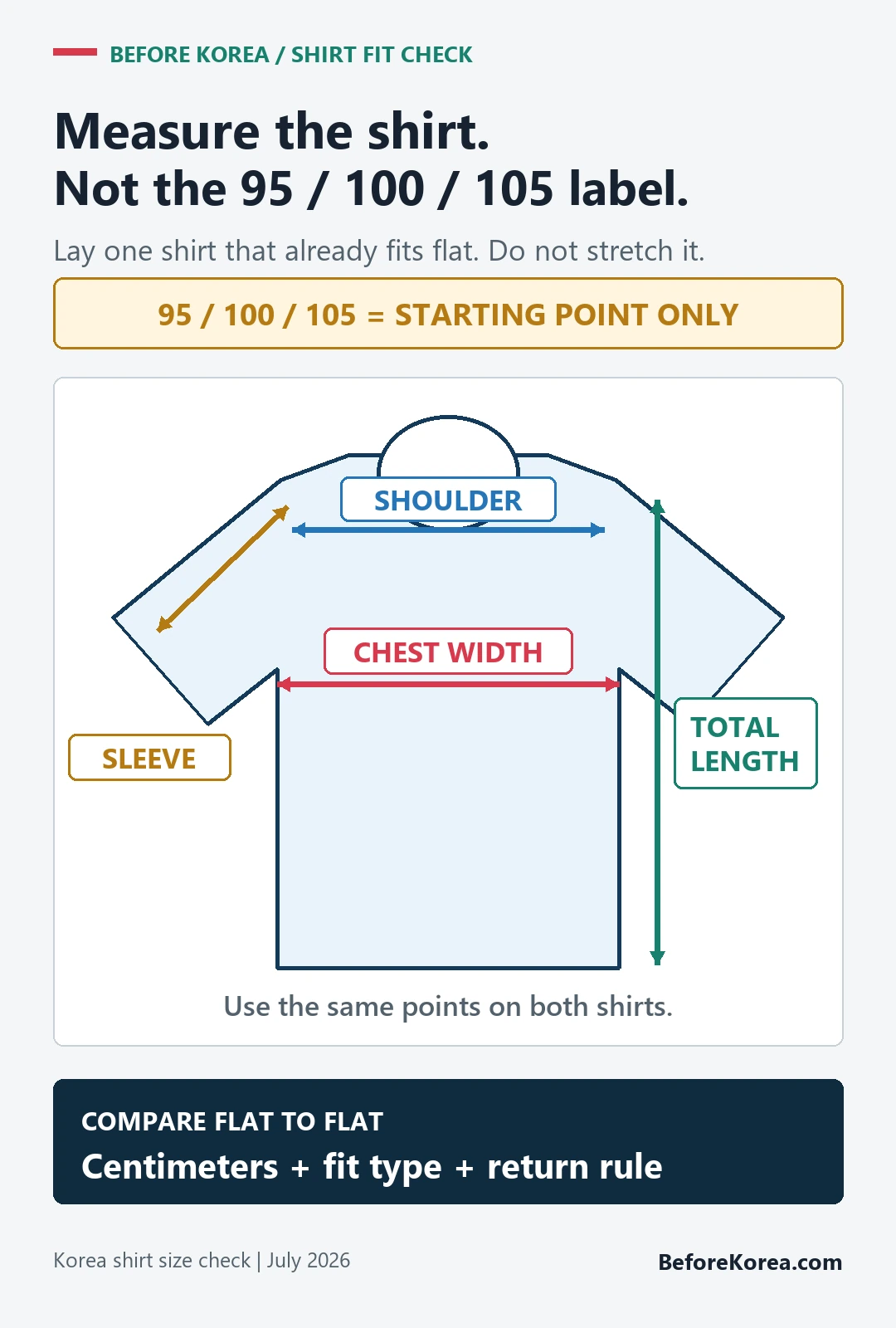
Before you shop, measure one shirt you already like. Lay it flat without stretching it, then compare the same fields shown in the exact product chart.
| Measurement | Korean word often used | Why it matters |
|---|---|---|
| Shoulder width | 어깨 | This decides whether the shirt feels tight even if the chest looks fine. |
| Chest or bust | 가슴 | The chart must state whether this is a flat garment width or a body circumference; compare like with like. |
| Total length | 총장 | Check where the hem falls compared with a shirt that fits, especially if you prefer a longer cut. |
| Sleeve length | 소매 | Long-sleeve shirts and jackets can fail here even when the body fits. |
| Hem width | 밑단 | Important for cropped tops, boxy shirts, and layered outfits. |
Product charts may list either finished-garment measurements or body measurements. If the chart explicitly defines chest as a flat garment width, compare it flat-to-flat with your own shirt. Do not infer the measurement basis from the number alone.
How to use a Korean size chart without guessing
Use this simple order when a product page has a size chart:
- Find the exact size chart for that product, not a general brand chart.
- Check whether the measurements are flat garment measurements.
- Compare shoulder width first if you often have fit problems there.
- Compare chest or bust width next.
- Check total length and sleeve length if you are tall, broad, or between sizes.
- Read the fabric information. Stretchy knit, woven cotton, and structured jacket fabric fit differently.
- Check the return rule before paying, especially for sale items, markets, boutiques, and overseas shipping.
XL, XXL, tall, and plus-size labels need the same check
If you usually buy XL, XXL, tall, big, or plus sizes, do not assume a similarly named option has the same measurements. An oversized silhouette describes styling; it does not establish sleeve length, total length, shoulder width, or plus-size grading. Compare each field in the exact product chart.
Check the exact measurements and return or exchange terms before buying. If a shop omits the chart, does not allow trying on, and offers no practical return option, the fit is harder to verify.
In-store shopping: what to check before paying
When you shop in Seoul, Busan, or another Korean city, the fastest safe move is to ask whether trying on tops is allowed. Some stores allow fitting for shirts, some limit fitting for delicate items, and some market shops may have stricter return policies. Do not assume you can return a shirt just because it does not fit.
- Check the label inside the shirt, not only the hanger tag.
- Ask about exchange or refund before payment if fit is uncertain.
- Keep the receipt and tag attached until you are sure.
- For white, delicate, or sale items, confirm the rule before trying or buying.
- If the store is crowded, take a photo of the size label and decide outside the line.
Online shopping: what can go wrong
Online shopping adds fit risk because trying on and returns may be difficult. A photo may show a loose fit because of the selected sample size, styling, or model measurements. A product described as oversized can still have a shoulder, sleeve, or total length that does not suit you. Translation tools may also render size-chart terms inconsistently, so confirm the chart labels and numbers.
| Risk | What it looks like | Better move |
|---|---|---|
| Model-photo trap | The shirt looks loose in photos, but the model is much smaller than you. | Use measurements, not the photo mood. |
| Free-size trap | Only one size is sold and no flat measurements are shown. | Avoid expensive blind purchases unless returns are clear. |
| Oversized trap | Wide chest, but short sleeves or short total length. | Check length and sleeve, not only width. |
| Return trap | Sale, personal-import, tag-removed, or hygiene-related limits. | Read return conditions before ordering. |
A simple buying rule
If the shirt is cheap, easy to try on, and not important, a rough label may be enough. If the shirt is expensive, hard to return, bought online, or meant to fit precisely, do not buy from the Korean label alone. Use centimeter measurements and a return plan.
Download the shirt measurement atlas
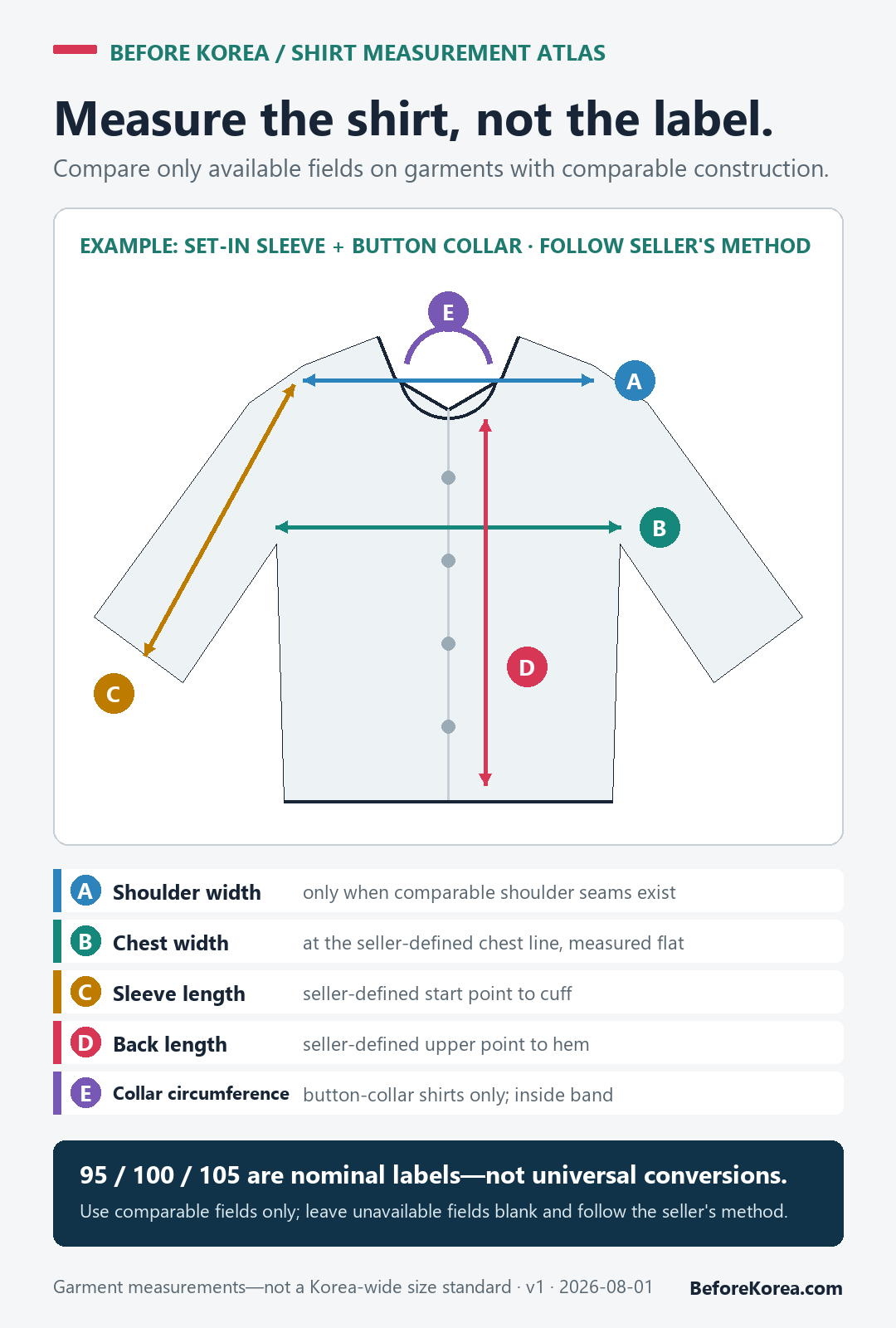
Use this original Before Korea atlas as a downloadable working companion: measure a comparable shirt you already own, then compare only the same available fields in the seller’s exact product chart. Follow the seller’s stated reference points, and leave a field blank when a collar, shoulder seam, or other reference point does not apply. It is a garment-measurement workflow, not a body-sizing chart or a Korea-wide conversion.
| Code | Field | Measure on the garment | When to use it |
|---|---|---|---|
| A | Shoulder width | Across the back from one shoulder seam to the other. | Only when both garments have comparable shoulder seams; otherwise leave blank. |
| B | Chest width | Measure the garment flat at the seller-defined chest line. | Only when both measurements use the same chest-line definition; otherwise leave blank. |
| C | Sleeve length | From the seller-defined sleeve start point to the cuff. | Only when sleeve construction and the start point are comparable; otherwise leave blank. |
| D | Back length | From the seller-defined upper reference point to the hem. | Only when the start and end points are comparable; otherwise leave blank. |
| E | Collar circumference | Inside the button-collar band, from the button to the buttonhole. | Button-collar shirts only; for collarless or non-comparable collars, leave blank. |
Downloads: PNG atlas · ZIP resource bundle. The ZIP contains the English SVG, blank 23-column worksheet, multilingual A-E field dictionary, README, license, and integrity manifest.
License and limitations: © 2026 Before Korea. The graphic, field dictionary, and blank worksheet are original Before Korea materials. You may download them for your own comparison; contact Before Korea before republishing or adapting the files, and cite this page rather than an attachment page. The files contain no brand measurements, personal data, external raw dataset rows, universal Korean-to-US/EU conversion values, or fit guarantee.
FAQ
What is Korean shirt size 100 in US size?
There is no reliable one-to-one answer. Check whether the product chart uses body measurements or finished garment measurements, then compare shoulder, flat chest, length, and sleeve with a shirt that fits.
Is Korean XXL smaller than US XXL?
The label alone cannot answer this. Compare the exact product’s measurements with an XXL garment that fits you; cut, length, shoulder width, and grading can differ by product and brand.
What does free size mean in Korean clothing?
It means the item is sold in one size. It does not mean it fits every body. Always check flat measurements, fabric stretch, and model information.
Do Korean shirts run small?
A Korean label alone cannot tell you whether an item runs small. Fit varies by product measurements, cut, intended silhouette, and fabric, even within one brand.
What Korean words should I know on a shirt size chart?
Look for 어깨 (shoulder), 가슴 (chest or bust), 총장 (total length), 소매 (sleeve), and 밑단 (hem). Compare these with a shirt you own.
Related Before Korea guides
- Korean clothing size to US guide
- Before you shop in Korea
- What to buy in Korea
- Korea tax refund for tourists
- What not to buy in Korea
Official measurement references and limits
The official KS K 0050 record covers adult men’s clothing sizes, including dress shirts. The Korean Agency for Technology and Standards clothing-label example shows size information in centimeters, and Size Korea provides Korean anthropometric context. ISO 8559-1:2017 defines body-measurement concepts, while ISO 8559-2:2025 identifies primary and secondary dimensions.
These references support measurement terminology; they do not create a universal 95/100/105-to-US/EU conversion. This guide covers shirts and tops, not bottoms or footwear. Use the exact product chart and a comparable garment to make the final decision.