If a bag or box travels to South Korea separately from you, identify the shipping route before doing anything else. A delayed airline bag, air-cargo shipment, courier parcel, and household move do not use one common “unaccompanied luggage” procedure. Get the tracking or transport document, classify the goods, and ask the responsible carrier which Korean customs route applies.
| What happened | Who owns the next step | What to obtain |
|---|---|---|
| Your checked bag missed your passenger flight | Airline baggage service | Baggage report or reference number and delivery or pickup instructions |
| You shipped personal belongings by air cargo or sea freight | Carrier, freight forwarder, or customs broker | Air waybill or bill of lading, packing list, arrival location, and clearance instructions |
| A mover sent household effects | Mover or broker plus Korea Customs | Moving-goods document list and proof of residence or entry status |
| You mailed a box or used an express courier | Postal or express-cargo channel | Tracking, recipient data request, item descriptions, value evidence, and any customs notice |
Do not use this page as proof that the goods are duty-free, admissible, released, or deliverable. Those decisions depend on the shipment, contents, value, purpose, residence status, and documents actually reviewed by the carrier and authorities.
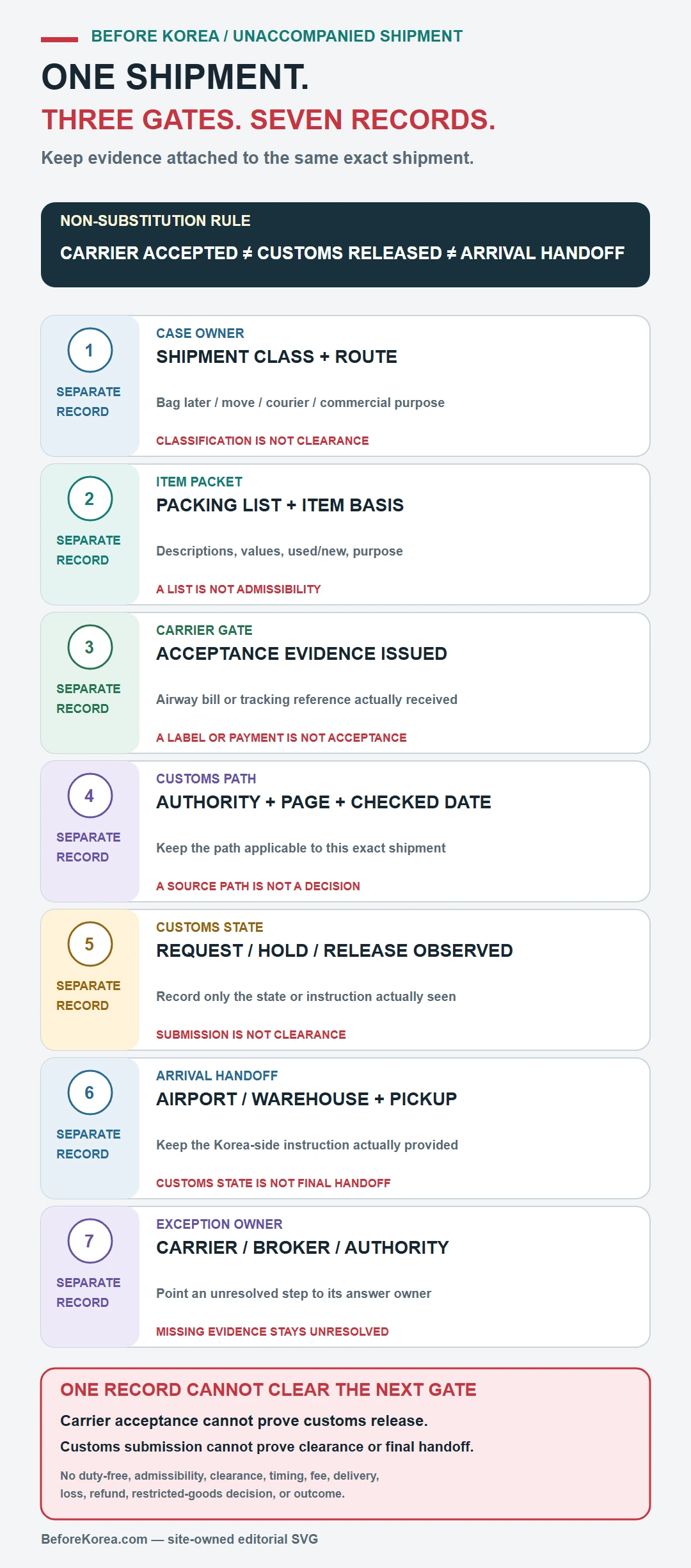
Start with the transport document, not the word luggage
Ask for the document that identifies the movement: airline baggage reference, air waybill, bill of lading, postal tracking number, or courier tracking number. Record the carrier, Korean arrival airport, port or warehouse, consignee name, shipment count, and the contact that will issue the next instruction. A hotel address by itself is not a clearance plan.
- Confirm the exact shipment type and responsible carrier.
- Get the tracking or transport-document number in writing.
- Make a line-by-line packing list with honest descriptions, quantity, condition, and value evidence.
- Separate used personal effects from new purchases, gifts, samples, goods for repair, or business inventory.
- Ask where and how customs clearance will occur and who will contact you.
- Do not ship until the carrier confirms it accepts every item and explains the destination requirements.
Use the correct Korea Customs path
The Korea Customs passenger-belongings guide covers traveler belongings and goods that must be declared. The separate moving-household-effects guidance for foreigners addresses people relocating to Korea and lists its own residence, timing, and document requirements. Postal items and express cargo have their own channels.
| Route | Do not assume | Question to ask |
|---|---|---|
| Delayed checked baggage | That you must clear it as a self-shipped parcel | Has the airline located it, and will it deliver or require airport pickup? |
| Personal cargo | That “used” automatically means duty-free | Which declaration and evidence will the Korean handler request? |
| Household move | That every box qualifies as moving household effects | Does my residence and arrival status meet the current KCS definition? |
| Courier or post | That traveler baggage allowances control the parcel | Which recipient identification, value, and item data must be submitted? |
If this is a household move
On the current Korea Customs page, the household-effects route is tied to the person’s move to Korea, residence period, arrival date, and the arrival of the goods. It lists documents such as a moving-goods declaration, item descriptions, packing list, bill of lading, and evidence of immigration or residence status. The page currently states a six-month arrival period for qualifying unaccompanied household effects, with specific rules and exceptions.
That summary is not a classification decision. Before the shipment leaves, send the official page to the mover or broker and ask them to confirm in writing which version applies to your status, what originals or translations are required, where the declaration will be filed, and which goods are excluded or taxable.
Build a customs-ready packing list
“Clothes and personal stuff” is too vague for a useful shipment record. Use separate lines such as “12 used cotton shirts,” “one used laptop, brand and model,” or “three sealed skincare products, purchase receipts attached.” Keep serial numbers for electronics and photographs of high-value items. Do not understate a value or label a commercial item as a personal effect.
- Item description and quantity
- Used or new condition
- Purchase price or reasonable value evidence
- Brand, model, and serial number where relevant
- Personal, household, repair, gift, sample, or business purpose
- Any food, medicine, plant, animal product, battery, liquid, aerosol, blade, or regulated component
The official passenger guide lists categories that require declaration or additional controls, including commercial goods, certain medicines, animals and plants and their products, weapons and weapon-like items, and goods exceeding applicable allowances. Carrier acceptance and customs admissibility are different checks; verify both before shipping.
Keep these items with you
- Passport, visa or residence documents, and irreplaceable originals
- Medication needed before the shipment can clear, subject to its own entry rules
- Phone, charger, payment cards, and access credentials
- One change of clothes and essential toiletries
- Copies of the packing list, transport document, receipts, and insurance record
- Anything the carrier prohibits or that must remain under personal control
When the shipment is held or the notice is unclear
- Verify that the message came from the actual airline, carrier, broker, postal service, or customs authority.
- Ask for the shipment number, current location, reason for the hold, requested document, deadline, and official payment route.
- Do not send passport scans, customs codes, or payment through an unverified chat link.
- Respond through the carrier account, known support channel, or the official authority page.
- Keep a dated log of documents submitted and the status actually confirmed.
FAQ
Is unaccompanied luggage the same as checked baggage?
No. Checked baggage is accepted under a passenger journey. A bag sent separately may enter an airline tracing, cargo, moving-goods, postal, or express-cargo process. The transport document tells you which problem you have.
Can my Seoul hotel receive it?
Only the hotel can confirm its receiving policy. Ask about recipient name, arrival date, storage fee, size limit, and what happens if the parcel arrives before check-in. Hotel acceptance does not replace customs clearance or carrier paperwork.
Do used personal items enter duty-free?
Do not assume so. The result depends on the applicable customs route, your status, the goods, their purpose and value, and the documents. Obtain a shipment-specific answer from the carrier or broker and use the current Korea Customs guidance.
For bags moving only between a Korean airport, station, and hotel after clearance, use the separate Korea luggage delivery guide. For goods arriving with you, use the Korea customs declaration guide.
Korea Customs pages rechecked August 24, 2026. Rules, forms, contacts, and carrier procedures can change; confirm the live instructions for your exact shipment.
Current source review, August 24, 2026: KCS continues to distinguish passenger belongings from the moving-household-effects route. A transport document, honest packing list, carrier clearance instructions, and the traveler’s actual residence status remain necessary; a hotel delivery promise is not customs release.