If you have a food allergy in Korea, prepare a reviewed Korean allergy card before the trip, show it before anyone starts cooking, and ask about the exact dish rather than the menu name alone. Check broth, sauces, seasoning, shared oil, grills, and utensils. If staff cannot confirm the ingredients or cross-contact risk, choose another dish or another restaurant. Keep prescribed medicine and your emergency plan with you; a translation card does not make a kitchen allergen-free.
Last checked: July 22, 2026.
Prepare before the first meal
Do the medical planning before travel, not at the restaurant table. The CDC Yellow Book guidance for severely allergic travelers recommends a pre-travel review of allergens, medication, and the traveler’s action plan. It also recommends carrying a chef card in the destination language and keeping prescribed emergency medication accessible.
- Ask your clinician how your existing allergy plan applies during the trip.
- Carry enough prescribed medicine in its labeled packaging and keep it with you.
- Save the allergy card on your phone and carry a printed copy if the risk is serious.
- Identify nearby medical care and save Korea’s medical-emergency number, 119.
This page is a travel decision guide, not medical advice. Use the treatment and emergency instructions given by your own clinician.
Show the card before anyone starts cooking
Hand the card to staff before you order. Keep it short enough to read during a busy service and name the exact allergen in both English and Korean. A long paragraph is easier to skim past and harder for the kitchen to check.
| What you need to communicate | Useful Korean |
|---|---|
| Food allergy | 음식 알레르기가 있습니다. |
| Exact allergen | 알레르기 식품: ______ |
| Check sauce, broth, and seasoning | 소스, 육수, 양념에 들어가는지 확인해 주세요. |
| Check shared oil and utensils | 같은 기름이나 조리도구를 사용하는지 확인해 주세요. |
| Please say if you are unsure | 확실하지 않으면 말씀해 주세요. |
Have the finished card reviewed by a fluent Korean speaker and, when the allergy is severe, by the clinician or allergy organization helping with your travel plan. For a printable structure and wording choices, use the separate Korean food allergy card guide.
Ask about the parts you cannot see
The visible meat, vegetable, or noodle is only part of the meal. Korean dishes can rely on prepared stock, paste, sauce, batter, garnish, and shared equipment. Ask staff to check the kitchen’s actual recipe and handling rather than answering from the dish name.
| Where the allergen may be | What to ask |
|---|---|
| Soup, stew, or noodles | What is in the broth or stock? |
| BBQ or marinated meat | What is in the marinade, dipping sauce, and seasoning? |
| Fried food | Is the same oil or fryer used for other foods? |
| Grills and utensils | Are the same grill, tongs, knife, or cutting surface used? |
| Side dishes and garnish | Do any banchan, powders, seeds, or toppings contain the allergen? |
Sesame, soy, wheat, egg, shellfish, fish stock, nuts, dairy, and meat-based seasoning can appear outside the main ingredient. This is not a complete list. Your own diagnosed allergen and cross-contact threshold should control the questions you ask.
Packaged food labels follow a different check
Korea’s Ministry of Food and Drug Safety food-labeling page explains that covered allergens used as ingredients are listed near the raw-material information in a separate allergen line. The page also describes a warning when allergen mixing may occur because the same manufacturing process is used.
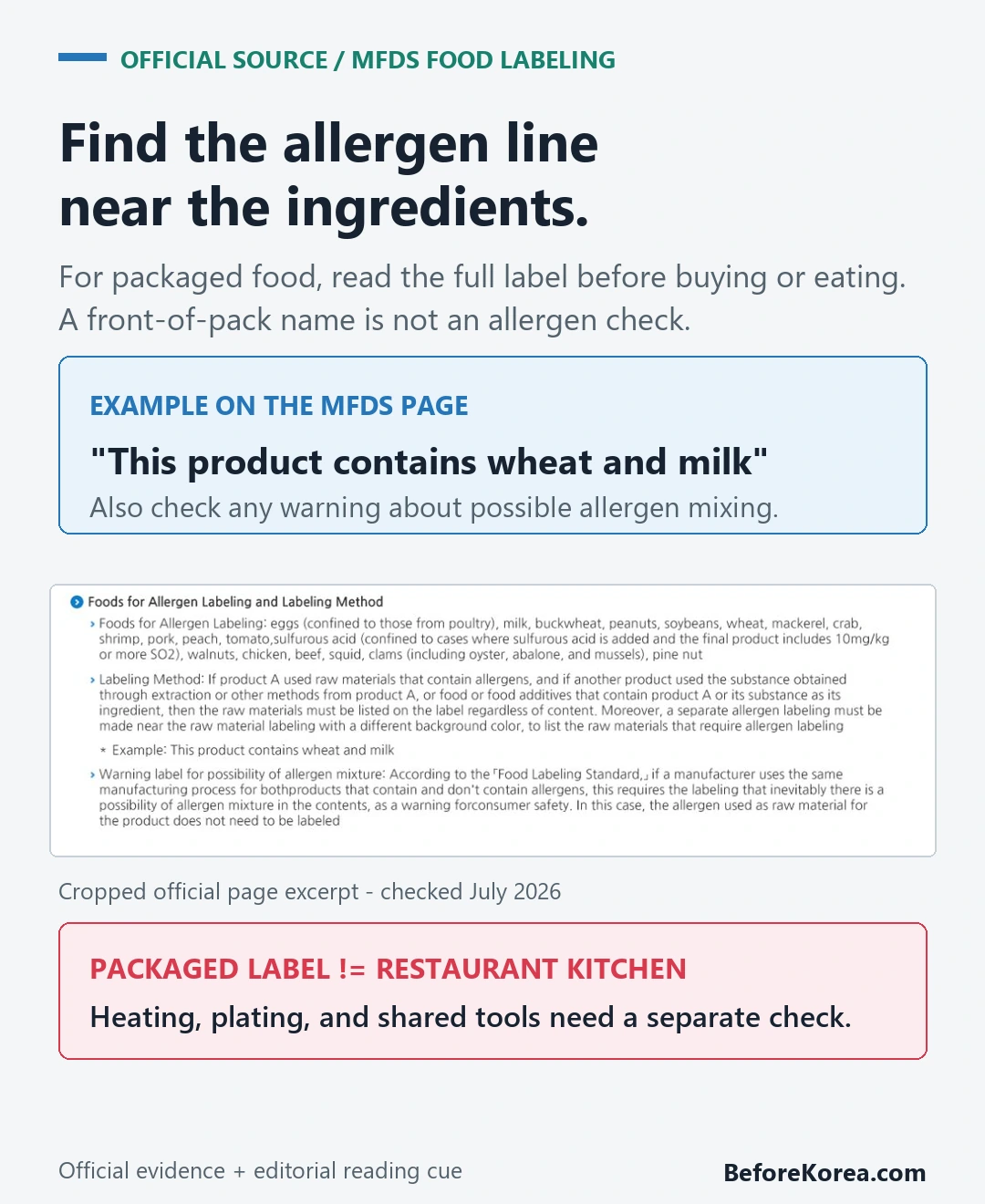
- Read the full ingredient list, not only the product name or front label.
- Find the separate allergen statement near the ingredients.
- Look for a warning about possible mixing or shared manufacturing.
- Do not assume every personal allergen appears in the mandatory list. For example, sesame does not appear in the list shown on the current English MFDS page, so the ingredient list still matters.
A sealed packaged-food label and a restaurant kitchen are different evidence. The label describes that product and its manufacturing warning; it does not prove that food heated, plated, or mixed in a store avoided cross-contact. The Korean convenience-store label guide covers that workflow in more detail.
Know when the answer is not enough
A clear card starts the conversation, but the decision depends on whether someone can check the actual ingredients and shared equipment. A quick nod, a guess based on the visible ingredient, or an automated translation of the menu is not the same as a kitchen check.
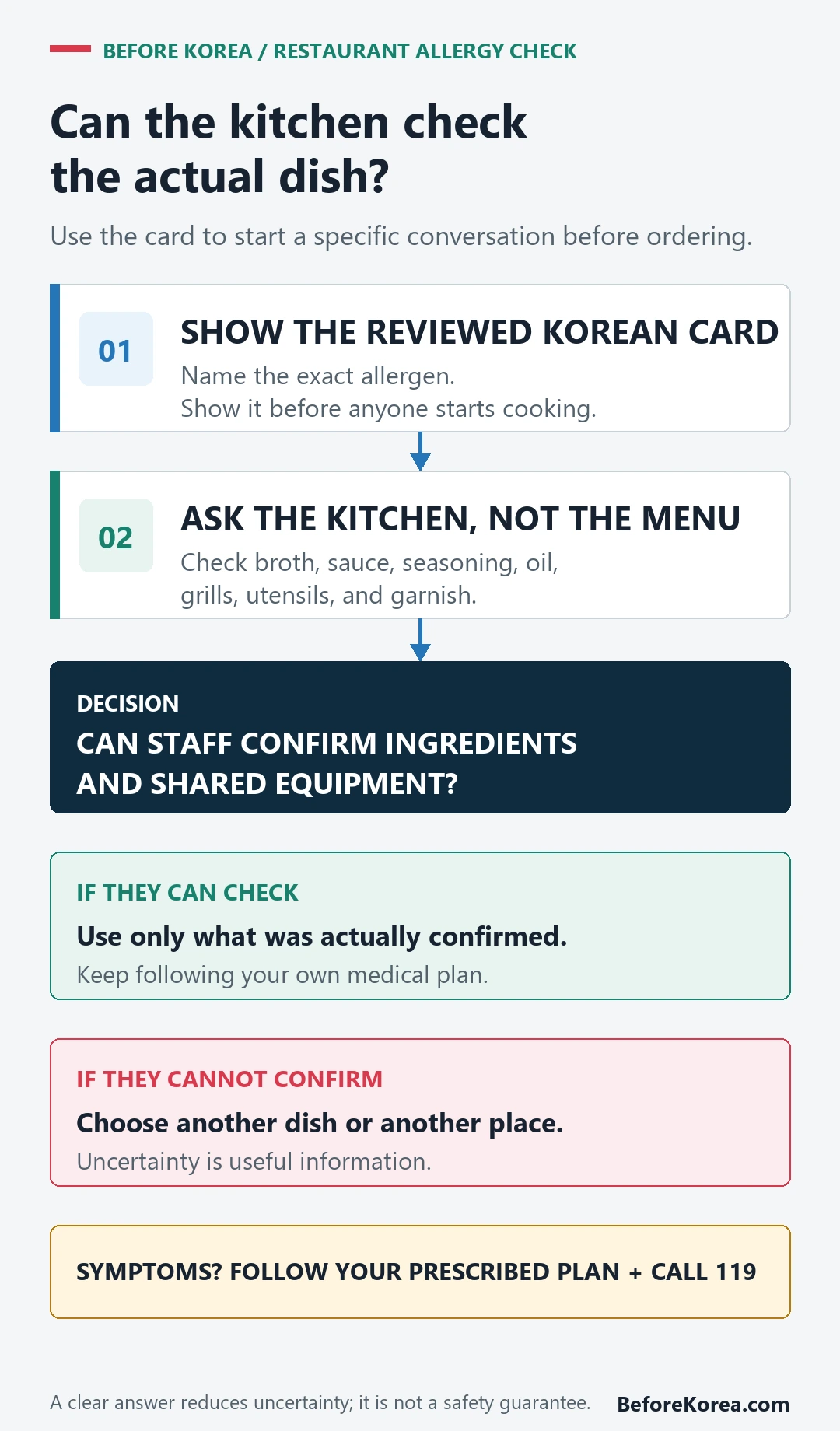
- Continue the conversation: staff take the card, understand the allergen, and can check the dish with the kitchen.
- Change the order: one ingredient or shared process cannot be avoided, but a simpler alternative can be checked.
- Leave: staff are unsure, the recipe cannot be checked, or service is too rushed for a reliable answer.
Even a careful answer is not a guarantee of an allergen-free kitchen. Make the final decision using your medical plan and the severity of your allergy, not social pressure to stay.
Keep the emergency plan on you
If symptoms begin, follow your prescribed action plan and get emergency help. VISITKOREA lists 119 for medical emergencies in Korea. Keep the hotel address, an emergency contact, and your medical information available offline so another person can help make the call.
The 1330 Korea Travel Helpline provides tourism information and interpretation support. It is not a replacement for 119 or for the emergency instructions from your clinician. Check the service’s current availability before relying on it.
Use the detailed guide that matches the next step
- Write a Korean food allergy card when you need the actual message and layout.
- Check Korean restaurant kiosks when ordering is screen-only.
- Plan allergy questions for Korean BBQ when marinades and shared grills are the main concern.
Questions travelers still ask
Can I trust a yes from restaurant staff?
Ask what was checked. A useful answer refers to the actual recipe, broth, sauce, seasoning, and shared equipment. A yes based only on the menu name leaves important uncertainty.
Are Korean packaged-food labels enough?
They are useful for the sealed product, but you still need the ingredient list, the allergen statement, and any mixing warning. Heating or preparing the product in a store can add a separate handling question.
Is delivery a good choice for a serious allergy?
Delivery removes the face-to-face kitchen check and app notes can be missed. When the consequence could be severe, choose a situation where staff can read the card and confirm the actual dish, or use a verified packaged option that fits your medical plan.
Sources checked August 24, 2026: MFDS food-labeling system, CDC Yellow Book guidance for severely allergic travelers, and VISITKOREA emergency and 1330 pages. Recheck official pages and your own medical plan before travel because services and labeling rules can change.
The current Korean labeling list is not a list of every possible allergy
MFDS currently lists the foods covered by required allergen labeling: poultry eggs, milk, buckwheat, peanuts, soybeans, wheat, mackerel, crab, shrimp, pork, peach, tomato, sulfites at the stated threshold, walnuts, chicken, beef, squid, shellfish including oyster, abalone and mussel, and pine nut. A traveler’s allergen can fall outside that list, and restaurant cross-contact remains a separate question.