Korean cafe etiquette is a branch workflow, not a national rulebook: identify the order channel, confirm whether a seat is available or restricted, keep the receipt or pickup number, and follow the return and waste signs at that exact cafe. Do not turn one chain’s policy into a rule for every independent cafe.
Reviewed August 24, 2026 against current Korea Tourism Organization information. Seating, minimum orders, waiting lists, laptop zones, outside food, reusable cups, toilets, pickup and tray returns can change by branch and time.
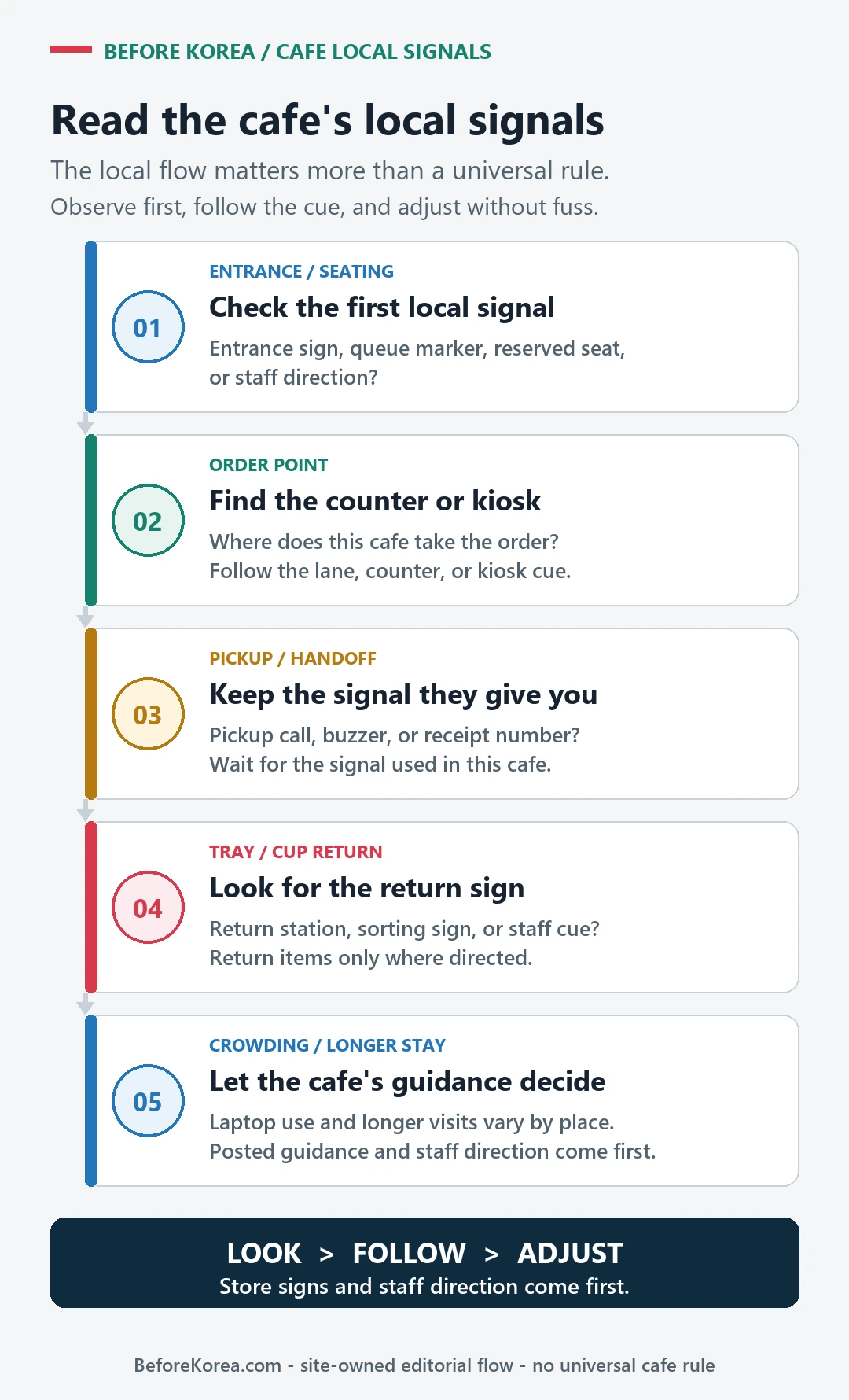
Read the cafe before claiming a seat
| Visible signal | What to confirm | Do not assume |
|---|---|---|
| Queue at counter | Order first or wait for a table | The queue reserves a seat |
| Kiosk or QR | Where payment and pickup happen | Staff will call an English name |
| Reserved or time-limit sign | Which seats and hours it covers | Every table has the same rule |
| One-drink notice | Whether it applies per person or per seat | Food purchase automatically replaces it |
| Return station | Tray, cup, liquid and waste bins | Dishes stay on the table |
Separate branch rules from social habits
A cafe may ask customers to order before sitting, hold a table only after payment, use a waiting list when full, or reserve some seats for short visits. Another cafe may do none of these. Treat posted Korean signs, the current ordering screen and a staff answer as evidence for that visit. A VISITKOREA Daehangno cafe example explicitly describes a waiting list when one cafe is full; it is an example, not a nationwide policy.
A five-step arrival sequence
- Check the entrance for waiting, takeout, laptop, pet or outside-food signs.
- See whether empty seats are actually available, reserved or awaiting cleanup.
- Identify counter, kiosk, table order or mobile pickup.
- Confirm the exact drink, size, temperature, option and total before paying.
- Keep the receipt, buzzer or order screen until collection is complete.
Ordering one drink is not a universal legal rule
Many cafes expect each seated customer to buy something, but the exact minimum can be written differently or not at all. A child, shared dessert, takeout companion or short wait may be handled differently. Ask the branch instead of declaring a Korea-wide one-drink law. VISITKOREA’s Seochon example notes one book cafe is open to people who order beverages, showing why the exact venue matters.
Protect the transaction, not just the pronunciation
For an order, preserve the Korean menu name, size, hot or iced state, milk or syrup change, quantity, price and pickup number. If a screen shows a different option, fix it before payment. A perfect Korean greeting cannot recover an unknown order number or a duplicated card transaction.
Seat packet for a group
| Role | Keep | Handoff |
|---|---|---|
| Orderer | Menu, options, total and receipt | Tell group which items were accepted |
| Seat checker | Table number and posted restrictions | Do not move unattended property |
| Collector | Buzzer or pickup number | Match every drink before leaving counter |
| Restriction holder | Exact allergen or dietary question | Receive their own labeled item |
| Last person | Tray and waste route | Check no phone, cable or bag remains |
Laptop and outlet use
An outlet does not grant unlimited use. Check laptop-free tables, peak-hour limits, shared seating and cable hazards. Keep power leads within the table footprint, do not block aisles, and never unplug cafe equipment. If a time rule appears after ordering, follow it or ask before beginning a long task.
Photos, calls and quiet areas
Photograph your own drink and table without capturing strangers, screens, staff name tags or private conversations. A visually open space is not permission for a photo shoot. Keep speaker audio off and move long calls outside or to a clearly permitted area. Follow any no-photo sign for the exact floor or room.
Outside food, pets and children
Do not infer permission from another customer’s table. Outside food, celebration cakes, pet carriers and stroller placement are branch decisions and sometimes floor-specific. Ask before opening food or rearranging chairs. Medical necessities should be explained directly; they do not make every unrelated outside item acceptable.
Pickup without taking another order
Match the pickup number, Korean item name, temperature and count. Similar iced drinks can look identical. If the cafe calls a name you cannot hear, watch the display and keep the receipt ready. Do not taste or add a straw before an identity problem is resolved.
Tray, cup and waste return
Look for a return counter and separate liquid, cup, lid, straw and general-waste bins. Do not pour ice or liquid into an unmarked bin. If reusable cups require a deposit or a specific return point, preserve the receipt and follow that program’s current instructions rather than leaving the cup on a random counter.
When the cafe is full
Ask whether there is a list, ticket, expected wait or takeaway option. Do not leave a bag on an empty table to create an unofficial reservation. If the wait system needs a Korean phone number you do not have, ask whether staff can enter a name or whether you should remain nearby. Keep a verified backup cafe rather than blocking the entrance.
If the wrong drink arrives
- Keep the drink untouched and show the receipt or order screen.
- State one mismatch: item, size, temperature, option, quantity or duplicate payment.
- Ask whether the order can still be corrected before demanding a specific remedy.
- For an allergy or medical condition, do not test the drink to identify it.
- Record the exact branch and transaction if a later payment check is needed.
Questions travelers ask
Can I sit first?
Check the current branch and crowd flow; no single rule covers every Korean cafe.
Must every person order a drink?
Many cafes set a minimum, but the exact rule belongs to the branch and should be read or asked.
Should I leave my tray?
Use the marked return station when one exists; otherwise ask.
Source check and boundary
Reviewed August 24, 2026 using VISITKOREA tourist-friendly payment and Wi-Fi information, a venue-specific order example and a venue-specific waiting-list example. These examples establish useful checks, not universal rules. Reconfirm the exact branch at the time of use.