Do not decide whether a Korean ramen is halal from the brand or noodle picture. Match the exact flavor, cup or bag, package size, factory, destination market and current certification record, then inspect every sachet before cooking. One certified export variant does not automatically cover the Korean domestic version.
Reviewed August 24, 2026 against current MFDS labeling information, BPJPH and BPOM search tools, a Korean manufacturer halal catalog and certification guidance. Recipes, plants, importers and certificates can change.
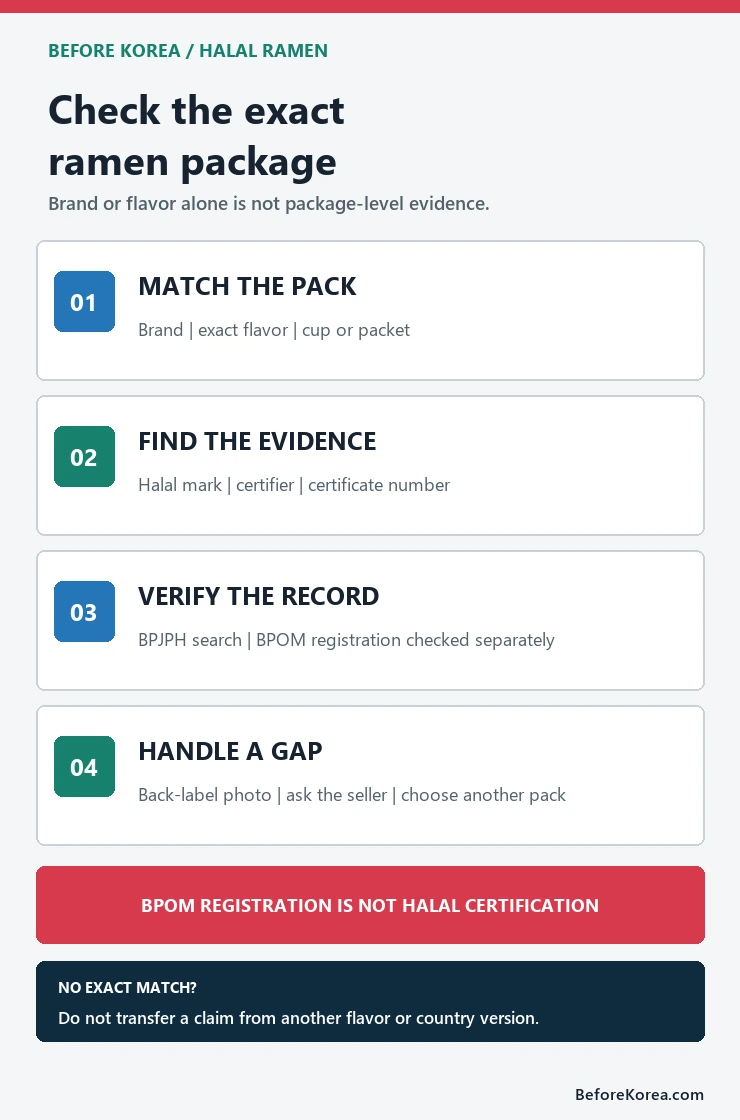
Freeze the exact ramen variant
| Field | Example mismatch | Decision impact |
|---|---|---|
| Flavor | Original vs spicy chicken | Different soup and seasoning |
| Format | Cup vs bag | Different formula or factory |
| Size | Single vs multipack | May use a different imported SKU |
| Market | Korea vs Indonesia export | Different label and certification route |
| Factory | Two production sites | Certificate scope may name only one |
Use a seven-step purchase gate
- Photograph the exact front, product name and barcode.
- Read ingredients for noodles, soup powder, oil and garnish separately.
- Find animal-source, alcohol-related and compound-seasoning terms.
- Read the separate allergen and shared-facility statements.
- Identify the halal issuer and search its current record.
- For imported stock, match the importer sticker and BPOM identity to this size and flavor.
- Buy only when the evidence meets your standard; otherwise choose a verified alternative.
Inspect every sachet
| Component | Common evidence problem | What to verify |
|---|---|---|
| Noodle block | Seasoning or shortening is assumed neutral | Full ingredients and oil source |
| Soup powder | Meat extract is inside a compound | Animal source and certificate scope |
| Liquid sauce | Alcohol-related or flavor carriers | Nested ingredients and accepted standard |
| Garnish | Dehydrated meat or fish is overlooked | Exact pieces and allergen line |
| Separate topping | Optional packet is treated as irrelevant | Whether certificate covers the whole retail kit |
Broth words that require escalation
육수, 사골, 돈골, 우골, 고기추출물, 닭육수, 쇠고기분말 and 돼지고기 name stock, bone or meat branches. Species alone does not establish slaughter or certification. Preserve the complete Korean phrase, not only the translated animal name.
Halal logo scope must match flavor and plant
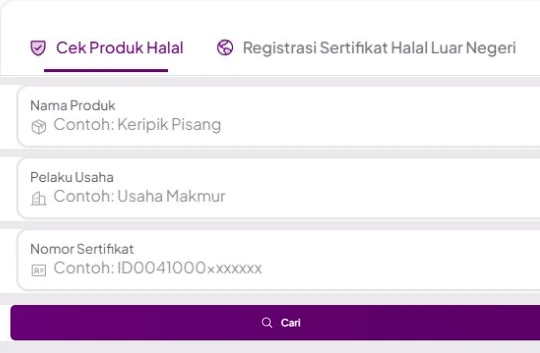
Search the issuer or destination authority by certificate number, producer and product. BPJPH’s certificate lookup supports product, business and number searches. If the result names only certain SKUs or a facility, do not extend it to another flavor merely because the brand is identical.
Use manufacturer catalogs as a lead, not the final physical match
A manufacturer halal product catalog can identify candidate products, but the package in hand still needs to match name, format, size, factory and current record. Catalog screenshots can outlive a formula or certificate and are weaker than a current database record tied to the physical SKU.
Korean domestic and export versions may diverge
The export package may have an importer label, destination registration, different seasoning or a halal mark that the Korean domestic package lacks. Conversely, identical-looking fronts may conceal different back panels. Do not remove an importer sticker or discard the outer multipack before the check is complete.
BPOM registration is an identity check
Use the BPOM search to confirm the Indonesian product identity and registrant. Registration helps detect a mismatched listing or package. It does not by itself answer the halal question, which needs the relevant halal record and scope.
MFDS allergen evidence has limits
MFDS explains separate allergen labeling and cross-contact warnings. Pork, chicken and beef can appear there, but a ramen may still require review of other animal-derived ingredients, flavor carriers, processing aids and certification. Absence of one allergen word is not a full halal determination.
Preparation does not repair an unresolved product
Discarding the soup packet, rinsing noodles or using only half the sauce changes how the food is prepared; it does not prove what the noodle block contains or whether the retail kit meets a certification standard. If you need a certified result, start with an exact certified SKU rather than trying to edit an unresolved one at the stove.
Restaurant ramen is a separate decision
A restaurant may use retail noodles with its own broth, toppings, oil, dumplings or shared utensils. A verified packet does not verify the restaurant bowl. Ask for the exact package and added ingredients; if staff cannot establish them, treat the bowl as unresolved.
Travel carry-on and customs check
Before carrying multipacks across a border, check the destination’s current food and animal-product rules through the relevant customs authority. Korea Customs provides an official entry point at Korea Customs Service. A halal decision does not establish that food may be imported.
A shelf comparison example
You find a cup with a visible halal mark and a bag without one. Do not compare only the brand. Search the cup’s issuer and product, photograph its factory and importer, and check the bag independently. If only the cup matches, buy that exact cup or another verified SKU.
Questions travelers ask
If the soup packet has meat, are plain noodles safe?
Not automatically; the noodle block and retail-kit standard must be checked separately.
Is every export pack halal?
No. Export destination and halal certification are separate facts.
Does one halal flavor cover the brand?
No. Match exact flavor, format, factory and current scope.
Source check and boundary
Reviewed August 24, 2026 using MFDS labeling guidance, BPJPH certificate search, BPOM product search, manufacturer halal catalog and KMF certification information. This page does not certify ramen or provide a religious ruling.