Plain laver and seasoned seaweed snacks are different purchase decisions. Match the exact SKU, then inspect oil, flavor powder, sweetener, emulsifier, shared-line notice, importer label and halal certificate before buying. The word seaweed or a green front image does not describe every coating.
Reviewed August 24, 2026 against current MFDS label information, BPJPH and BPOM search tools, certification guidance and Korea Customs. Product flavor, seasoning, factory and export version can change.
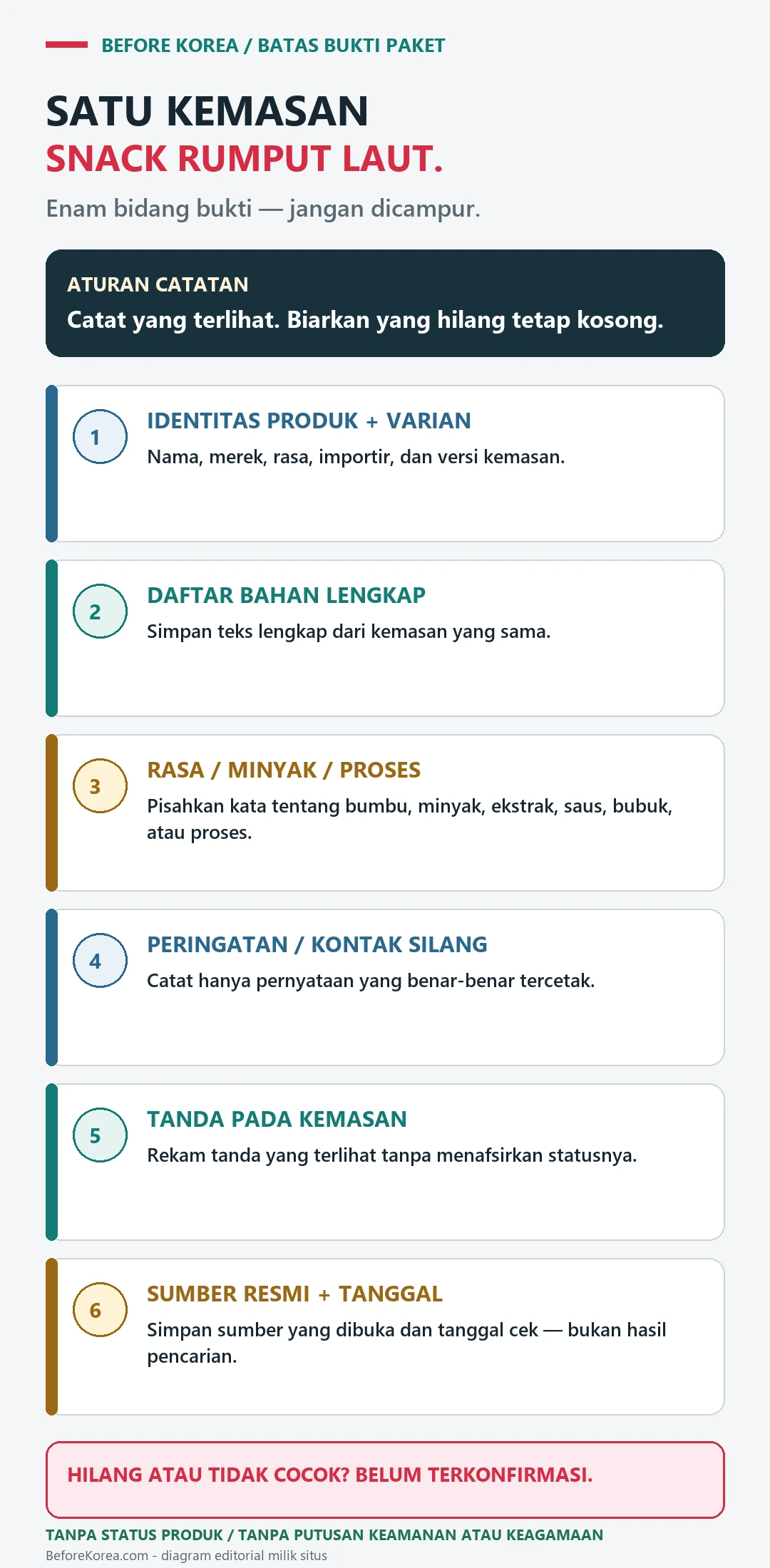
Classify the product before reading claims
| Product type | Typical added layer | First check |
|---|---|---|
| Unseasoned dried laver | May have no coating | Ingredients still confirm this SKU |
| Salted roasted laver | Oil and salt | Oil source and shared-line notice |
| Flavored seaweed snack | Powder, sauce or sweetener | Full compound seasoning |
| Seaweed chips or crisps | Starch, batter, binder | All ingredients and frying medium |
| Seaweed rice snack | Grain, glaze and flavor | Do not treat as plain laver |
Exact-SKU capture packet
- Front product name and flavor.
- Net weight, multipack count and barcode.
- Full Korean ingredients and parenthetical compounds.
- Allergen and shared-facility statement.
- Manufacturer, factory, importer and country panel.
- Halal logo, issuer, number, lot and date.
Oil is a named ingredient, not a visual guess
Common products use sesame, perilla, corn, canola or other vegetable oils, but a front photo cannot establish the current recipe. Read 식용유지, 참기름, 들기름 and the specific oil inside any seasoning blend. If an animal-derived fat or unspecified source matters under your standard, escalate rather than assuming all roasted laver uses the same oil.
Flavor powder can change the entire result
| Flavor cue | Possible hidden branch | Evidence action |
|---|---|---|
| Barbecue | Meat extract or smoke flavor carrier | Expand compound seasoning |
| Cheese | Milk plus enzymes or flavor system | Read source and certificate scope |
| Spicy | Sauce, alcohol-related ingredient or stock | Read more than chili words |
| Seafood | Fish, shellfish or mixed flavor | Match allergen and ingredient lines |
| Original | Still oil, salt and processing evidence | Do not treat original as unseasoned |
Use MFDS lines correctly
MFDS food-label guidance describes ingredient, allergen and cross-contact information. These fields help reconstruct the product. They do not function as a halal certificate, and an allergen statement may not reveal every ingredient relevant to an individual religious standard.
A certificate must resolve to this product
Identify issuer, certificate number, producer, product or product family, factory and validity. Search the current record through the stated body; BPJPH’s official search is a relevant surface for Indonesian certification evidence. Reject a match that names a different flavor, weight, producer or factory.
Importer stickers are valuable identity evidence
For stock sold outside Korea, the sticker can link the Korean product to a local registrant and market version. Match product name, weight, producer and barcode. Verify a stated Indonesian registration through BPOM. Registration and halal status are separate checks and should be recorded separately.
Multipacks create an outer-inner mismatch risk
The outer bag may carry the legal label and certification mark while the inner sachet shows only a brand. Keep the outer package until all inner units are used. Do not combine loose sachets from two variants or rely on a seller’s outer-bag photo after receiving unmarked units.
Shared equipment is its own decision field
A facility statement may name milk, shrimp, fish, wheat, soy, pork, beef or other products handled on the line. It is not the same as a declared ingredient. Preserve the exact wording and apply the traveler’s standard or trusted authority’s guidance rather than silently upgrading or dismissing the warning.
Seaweed at a restaurant is not the retail SKU
A side dish may be seasoned in the kitchen with oil, sauce, stock or toppings and handled with shared utensils. A certified packaged snack does not verify a restaurant’s gim. Ask about the exact preparation; if the answer is unknown, choose a separately sealed verified product.
Online purchase gate
- Request current front and back photos from the actual seller stock.
- Match flavor, weight, barcode, producer and importer.
- Verify certificate or registration in the relevant current database.
- Confirm the delivered package before opening; return or decline when the variant differs.
A convenience-store example
Three products sit together: plain laver, sesame-oil roasted laver and barbecue seaweed chips. Treat them as three formulas. If only the sesame-oil SKU matches an accepted certificate and current package, do not transfer that result to the barbecue chips or the visually simpler plain pack.
Customs is a separate gate
A product that meets your dietary standard may still face destination food-import rules. Check current official information before carrying large quantities; Korea Customs Service is the Korean official starting point. Keep retail packaging and ingredient labels intact.
Questions travelers ask
Is plain seaweed automatically halal?
No automatic conclusion: identify whether it is truly unseasoned and apply the evidence standard you use.
Does vegetable oil settle the whole product?
No. Flavor powder, compounds, shared handling and certificate scope remain separate.
Can one brand logo cover every flavor?
No. Verify the exact SKU, producer and current scope.
Source check and boundary
Reviewed August 24, 2026 using MFDS food labeling, BPJPH certificate search, BPOM product search, KMF certification information and Korea Customs. This page does not certify a snack or issue a religious ruling.