Luggage storage looks simple until every locker near the station is full, your suitcase is too large, or the storage app asks for a flow you did not prepare.
Find the exact locker bank or staffed counter
Use VISITKOREA T-luggage storage and delivery information to locate the storage area, then verify the exact station exit, floor, operating hours, locker size, and payment method on the day.
- VISITKOREA T-luggage storage and delivery information
- Visit Seoul luggage storage guide
- VISITKOREA
- VISITKOREA transportation information
- VISITKOREA 1330 Travel Helpline
Measure the bag and plan the retrieval time
Measure the bag, note the storage and retrieval times, save the station layout, and choose a staffed or nearby backup for full lockers.
- Station or neighborhood
- Bag dimensions
- Storage duration
- Opening and retrieval time
Use lockers for small bags and short gaps, staffed storage for larger luggage or longer gaps, and delivery only when timing is clear. Always check size, hours, payment, and pickup deadline.
A carry-on and a large checked suitcase are different storage problems. Station lockers may be convenient, but large lockers can fill first. If your plan depends on storage, check the station and have a staffed alternative ready.
Check access before leaving the bag
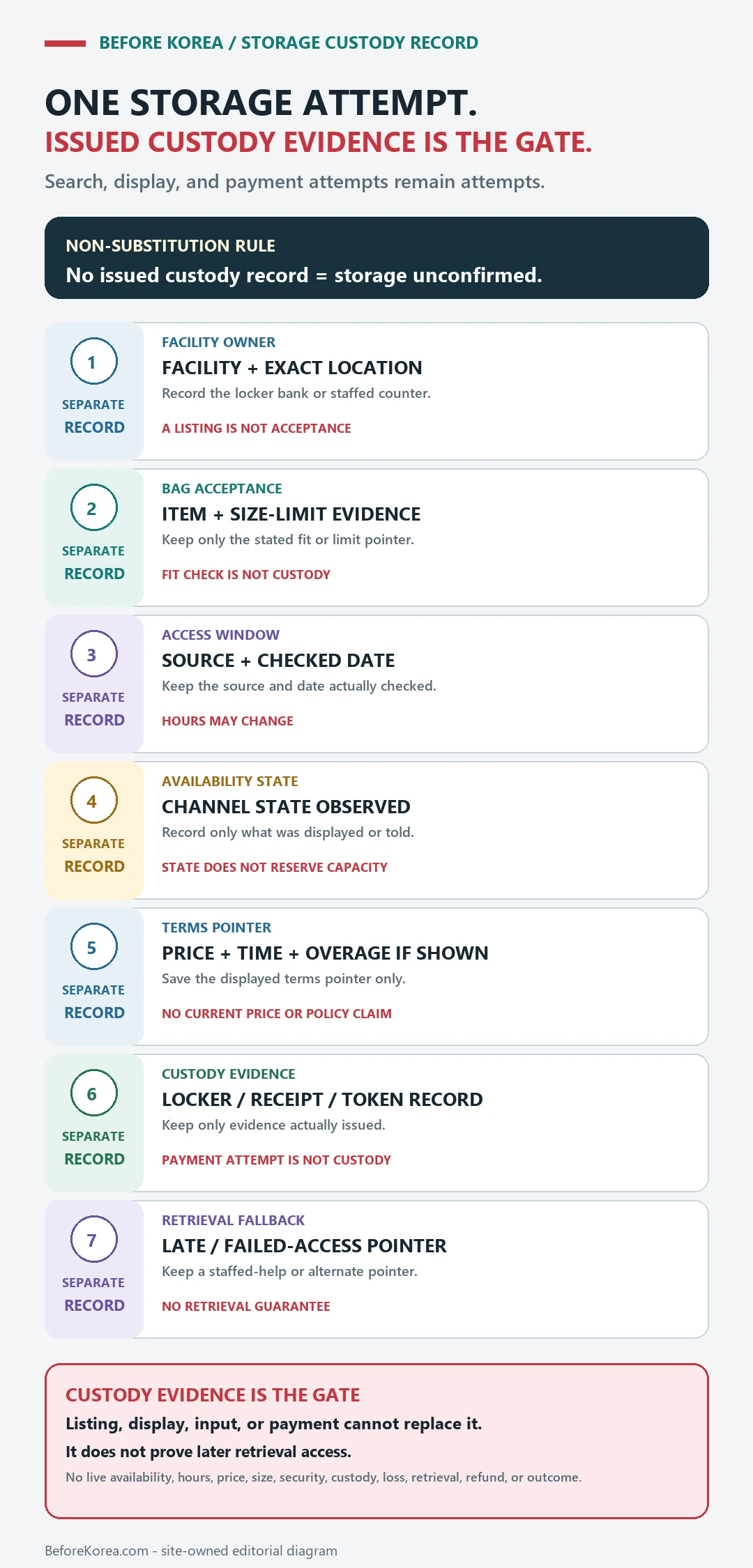
- Match the station, terminal, or neighborhood and identify the exact locker bank or staffed counter.
- Compare the bag dimensions with the stated locker or counter limit before carrying it through the station.
- Check opening hours, maximum storage period, payment method, and whether retrieval is possible after a gate or building closes.
- Photograph or record the locker location and keep the key, code, receipt, and support number secure.
- Use the backup counter or another station when the needed size is full; do not leave passports, medicine, or irreplaceable valuables unattended.
Capacity and closing time decide whether storage works
Storage works only when the bag fits and the traveler can return before access closes. Distance between the locker and the actual train, bus, hotel, or airport route should be included in the decision.
| Trip detail | Why it matters |
|---|---|
| Exact location | Station exits, floors, and gate hours affect access |
| Bag dimensions | The needed locker or counter category must fit the bag |
| Retrieval time | Access may end before the wider station or area closes |
| Capacity fallback | Keep a staffed counter or nearby location as a second option |
For Korea luggage lockers and storage guide for travelers, published locations do not guarantee same-day capacity, a suitable locker size, or access after the station or counter closes.
If every suitable locker is full
Check staffed storage, another exit or nearby station, the accommodation, or a verified reservation service with clear opening and retrieval terms.
Do not split critical documents or medication into a location that may close before the next departure.
Related guides
- Korea Airport Train Guide
- Korea Travel Checklist for First-Time Visitors
- Korea Airport Practical Checklist: Train, Bus, Taxi, SIM, WiFi, Cash, Customs, and Luggage
Store the bag where you can still retrieve it after the show
On a concert day, the best storage point is not always the one nearest the venue. Choose a place that fits the bag, remains accessible after the expected finish and sits on the route you will actually take home.
| Decision | Check before storing | Stop condition |
|---|---|---|
| Take the bag to the venue | Exact event bag and prohibited-item notice | The notice does not clearly permit its size or contents |
| Use a subway locker | Bag dimensions, availability and retrieval hours | Retrieval depends on a station area that closes first |
| Use staffed storage or a hotel | Closing time, receipt and late pickup terms | The counter closes before the return route reaches it |
| Use a route-side backup | A second location away from the venue crowd | It adds a transfer that fails after the show |
The Seoul Metropolitan Government’s subway storage page lists T-Luggage and T-Locker locations, access conditions and current service information. Compare that source with the exact event notice before deciding where the bag goes.
A listed locker does not guarantee a free compartment, a fit for your suitcase or access after the performance. Keep a staffed or hotel-based backup.
Last checked: August 7, 2026. Recheck storage access and the event’s bag rule before leaving the hotel.
Choose a Korea luggage locker only after fit, access and retrieval all pass
| Decision | Evidence | Next action |
|---|---|---|
| Locker | Exact station and unit show availability and fit | Store and save location and expiry |
| Staffed storage | Bag or traveler cannot use the locker flow | Verify desk hours and receipt |
| Different station | Target concourse is full or inaccessible | Check an official nearby alternative before moving |
| Do not store | Valuables, medicine, documents or prohibited item | Keep it under personal control |
A locker is usable only if the exact unit is reachable, available, large enough, payable and recoverable at the traveler's return time. The decision record was checked against Seoul subway storage facilities, VISITKOREA T-luggage information, Seoul public transportation.
Seoul's official surface distinguishes hourly T-Locker, staffed T-Luggage and monthly T-Storage services. The official page states that locker availability and use method can differ between new and old lockers. Storage and retrieval are unavailable outside the listed access hours, so the return route matters as much as the drop-off. Operator restrictions and compensation terms limit what should be placed in storage. Source review completed August 24, 2026. Dates, eligibility, price, inventory, access and operating rules must be rechecked on the exact current first-party page before action.