Start with the first thing that can block the day
For a first Korea trip, the useful checklist is not a long packing list. It is a risk checklist. Before departure, settle five things: entry paperwork, phone data, map/navigation, money/transit, and your first route from the airport. If those five are ready, most first-day stress becomes manageable.
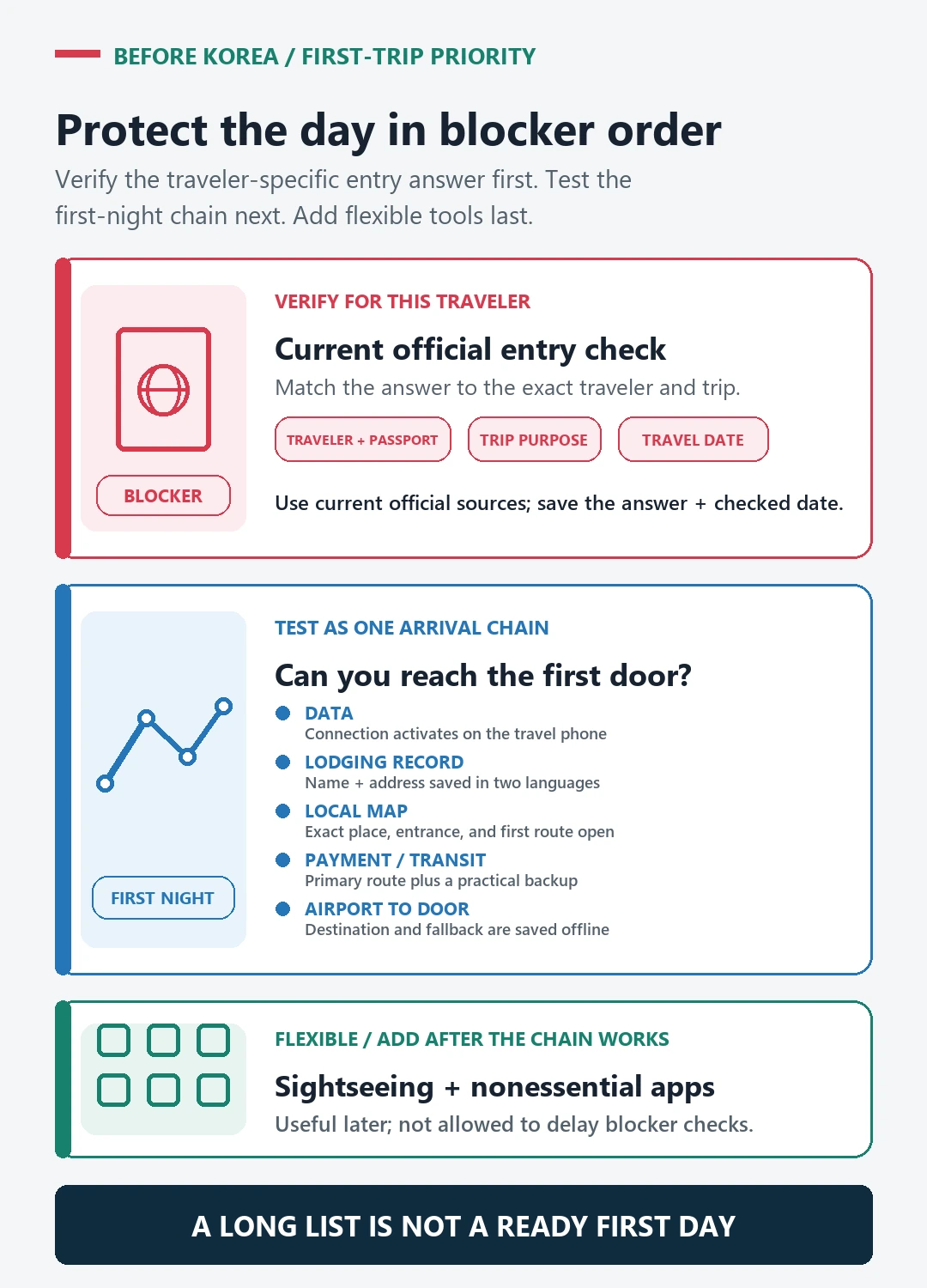
Who this guide is really for
This is for first-time visitors who want to avoid the problems that usually appear after landing: no working data, a hotel address that does not search well, a card that fails at a kiosk, a late arrival with no planned transfer, or a tax/refund/app rule discovered too late.
This guide is intentionally practical. It does not try to be a complete Korea travel guide. It tells you what to prepare before the trip so that your first day in Korea is not spent fixing preventable problems.
The five decisions to make before departure
| Decision | What to decide | Why it matters | Best verification source |
|---|---|---|---|
| Entry admin | Whether you need to submit the Korea e-Arrival card or other entry information before arrival. | Immigration forms and timing are not the thing to solve while tired in the arrival hall. | VISITKOREA e-Arrival notice |
| Connectivity | Roaming, eSIM, SIM card, or portable Wi-Fi, plus a fallback if setup fails. | Maps, translation, airport transport, hotel contact, and payment troubleshooting all depend on working data. | VISITKOREA travel basics |
| Navigation | Which map app you will use and whether your hotel/destinations are saved in Korean as well as English. | Korean place names, station exits, and branch names can decide whether a route is actually usable. | Naver Map guide |
| Money and transit | How you will pay for subway/bus rides, small purchases, and backup cash needs. | Not every card or app flow works smoothly for every foreign visitor in every place. | T-money guide |
| First route | Train, airport bus, taxi, or another transfer from the airport to your accommodation. | The best route depends on terminal, arrival time, luggage, destination, and walking distance after the last stop. | Incheon Airport to Seoul guide |
72-hour pre-departure checklist
1. Entry and arrival information
Check official entry requirements for your passport, stay purpose, and arrival date. Korea introduced an e-Arrival card system for inbound passengers starting February 24, 2025, according to VISITKOREA. Do not rely on old screenshots of paper forms; use the official e-Arrival or immigration source close to travel.
- Save your accommodation address in English and Korean.
- Keep your first-night accommodation contact details offline.
- Check whether arrival forms, visa-free entry conditions, or airline document checks apply to your situation.
- If anything is legal, immigration, medical, or visa-related, verify with the official authority rather than a travel blog.
2. Phone data and backup access
Your phone is your map, translation tool, booking reference, payment helper, and emergency contact device. Prepare data before you depend on airport Wi-Fi. If using eSIM, check phone compatibility and activation timing before departure. If using a physical SIM or portable Wi-Fi, check pickup location, opening hours, and what happens after a delayed flight.
- Download app updates before the flight.
- Save booking confirmations and hotel address offline.
- Keep one low-tech backup: a printed or screenshot route from the airport to your hotel.
- Do not assume a local phone number will be available unless the product clearly includes it.
3. Maps and Korean names
A global map app can still be useful for orientation, but Korea travel is easier when you prepare a local map app and Korean place names. Save the airport terminal, hotel, nearest station, and your first meal or destination before boarding.
- Save place names in Korean when available from official pages or booking confirmations.
- Check final walking distance, station exit, and whether the route uses stairs.
- For time-sensitive plans, test the route at a similar day/time before travel.
- Treat opening hours on map listings as a hint, not final proof.
4. Money, cards, and transit
For public transport, Korea uses transportation cards such as Tmoney, EZL, WOWPASS, and other options. VISITKOREA describes these as rechargeable prepaid cards that do not require an account and can be useful for public transportation. The practical question is not only which card exists, but how you will buy, charge, use, and refund it.
- Carry some Korean won cash for top-ups or small fallback payments.
- Bring more than one payment method if possible.
- Avoid loading more transit balance than you can reasonably use before leaving.
- For shopping-heavy trips, read the tax refund rules before the first large purchase, not at the airport.
5. Airport transfer
VISITKOREA lists airport-to-Seoul options including AREX, Seoul subway, airport limousine bus, and taxi. Your best option depends on the final destination, not only the airport departure point. A train to a major station may be fast, but a bus can be easier if it stops near your hotel. A taxi can be useful with luggage or late arrival, but you should prepare the address and payment backup.
First 90 minutes after landing
| Moment | Do this | Why |
|---|---|---|
| Before immigration | Open your offline documents and confirm accommodation address. | You may not want to depend on live data immediately. |
| After baggage | Confirm your data connection before leaving the terminal. | A broken data plan is easier to solve at the airport than on a sidewalk. |
| Before buying transport | Compare the route you planned with current time and luggage reality. | A delayed flight can make the original plan worse. |
| Before taxi or bus | Show the Korean destination name/address, not only an English hotel name. | Similar names and branch names can cause route mistakes. |
| At hotel | Save the nearest station, convenience store, and return route. | The second trip out is easier once your home base is set. |
Different travelers need different backups
- Solo first-timer: prioritize offline address, map backup, and a transfer route that is easy to follow while tired.
- Family or group: prioritize luggage, seating, walking distance, and one shared plan everyone can find if phones separate.
- Shopping-focused traveler: understand tax refund eligibility, passport needs, receipt/voucher handling, and baggage space before buying.
- Food-focused traveler: prepare translation for allergies, dietary limits, spice tolerance, and restaurant ordering basics without pretending apps can solve every situation.
- Short layover or late arrival: build the plan around timing and backup transport, not sightseeing ambition.
Common mistakes this checklist prevents
- Arriving with an app installed but not opened or configured.
- Saving only English place names for a destination that is easier to find in Korean.
- Choosing an airport route that is fast to a station but awkward to the actual hotel.
- Assuming foreign cards, mobile wallets, or app payments will work everywhere.
- Buying tax-refund-eligible goods without keeping receipts, vouchers, passport details, or export requirements in mind.
- Using old blog prices or app screenshots as if they were official current rules.
If you land late and mobile data does not work
Hypothetical example: your flight arrives later than planned and mobile data does not connect. Before travel, save one offline note with your terminal, hotel name and Korean address, the route you intended to take, the destination stop, the final walking directions, and the hotel’s check-in contact. After baggage claim, compare the actual time with the route you saved. If the original plan no longer fits, use the airport’s current transport information and your offline hotel details to choose the next workable option.
The note is a recovery tool, not a timetable or a promise that arrival will take 90 minutes. Keep enough information to show staff or a driver the destination, and update the note if your terminal, accommodation, or check-in plan changes before departure.
Read next for the parts of the trip that usually overlap
This topic works best when it is not handled alone. Use the related guides below to connect the decision with maps, money, food, shopping, transit, and app backup planning.
- Incheon Airport to Seoul
- Korea eSIM vs SIM Card
- Payment in Korea
- Return to the related Before Korea hub
- Check the Before Korea Source Library
Related Before Korea guides
- Korea Travel Apps
- Naver Map in Korea
- T-money Card in Korea
- Incheon Airport to Seoul
- Korea Tax Refund Guide
- Before You Visit hub
Official links to check
Use these official links when the next step matters. This guide explains what to watch for, but app downloads, eligibility, prices, routes, policies, and service rules can change.
- K-ETA official site: Use only the official K-ETA site for eligibility and application steps.
- Korea e-Arrival Card official site: Check whether you need to submit an electronic arrival card before entry.
- Korea Immigration Service: Use this for official immigration and entry-related notices.
- Q-CODE official site: Check current health declaration requirements when they apply.
- Korea Customs Service English site: Use this for traveler customs, duty-free, cash, medicine, and declaration rules.
- VISITKOREA official travel site: Use this for current tourism notices, transport basics, and traveler support.
- Incheon Airport official transport page: Check airport-side transport counters, trains, buses, and taxi information.
- AREX official site: Check airport train routes, tickets, and operating information.
- Seoul official airport-to-city transport page: Check official Seoul guidance for airport train, bus, and taxi options.
- NAVER Map web: Use the web map to test place names, Korean addresses, routes, and station exits.
- NAVER Map on Google Play: Download the Android app from Google Play.
- NAVER Map on the App Store: Download the iPhone app from the App Store.
FAQ
Do I need to plan every day before visiting Korea?
No. Plan the arrival day and the systems you will use every day: map, data, money, transit, and official source checks. Sightseeing can stay flexible.
Should I install every Korean app before I arrive?
No. Install only the apps tied to real decisions: navigation, translation, transit, weather, messaging if needed, and specific bookings. Too many apps can create more account and verification problems than they solve.
What should I verify again right before travel?
Verify entry requirements, e-Arrival details, airport route timing, transit card information, weather, store or venue hours, tax refund rules, and any reservation or app account requirement that affects money or access.
Source links to verify
- VISITKOREA official travel information
- VISITKOREA e-Arrival notice
- VISITKOREA transportation cards
- VISITKOREA airport transportation guide
- VISITKOREA comprehensive tax refund guide
Last updated
Last updated: 2026-05-23. Korea travel, transport, app, shopping, and refund details can change. Re-check official sources close to the day you act, especially when money, eligibility, route timing, or account access is involved.
This guide is written as practical preparation content. It does not claim personal hands-on testing, a personal visit, or official legal advice unless explicitly stated.
Lock the first-time Korea trip into dated entry, arrival and first-day checks
| Decision | Evidence | Next action |
|---|---|---|
| Entry | Passport, visa or K-ETA route and declaration duty | Confirm with Immigration |
| Arrival | Terminal, address and transport window | Choose a working route |
| First day | Payment, connectivity and offline records | Test before leaving the airport |
| Unclear | One required condition has no current proof | Stop and ask the owning source |
A useful first-time checklist connects each required decision to its official owner and a backup, rather than collecting generic tips. The decision record was checked against Korea Immigration Service, official e-Arrival Card, Incheon Airport transport.
Entry requirements depend on the traveler's own passport and status. The official e-Arrival Card service is separate from K-ETA eligibility. Airport transport must be matched to terminal, operating time, destination and baggage. Source review completed August 24, 2026. Dates, eligibility, price, inventory, access and operating rules must be rechecked on the exact current first-party page before action.