In Korea, good public etiquette usually means staying aware of shared space: keep noise moderate, queue calmly, do not block transit flow, handle trash responsibly, respect priority seats, and follow smoking or food rules in the place you are using.
Last checked: June 1, 2026. Re-check the official or primary source page before acting, because routes, prices, labels, rules, app screens, eligibility, and store/service policies can change.
Most etiquette is reading the room early
Visitors do not need to memorize a long list of rules to be considerate in Korea. The better habit is to pause for a few seconds, notice the local flow, and avoid taking up more noise, space, or time than the situation expects.
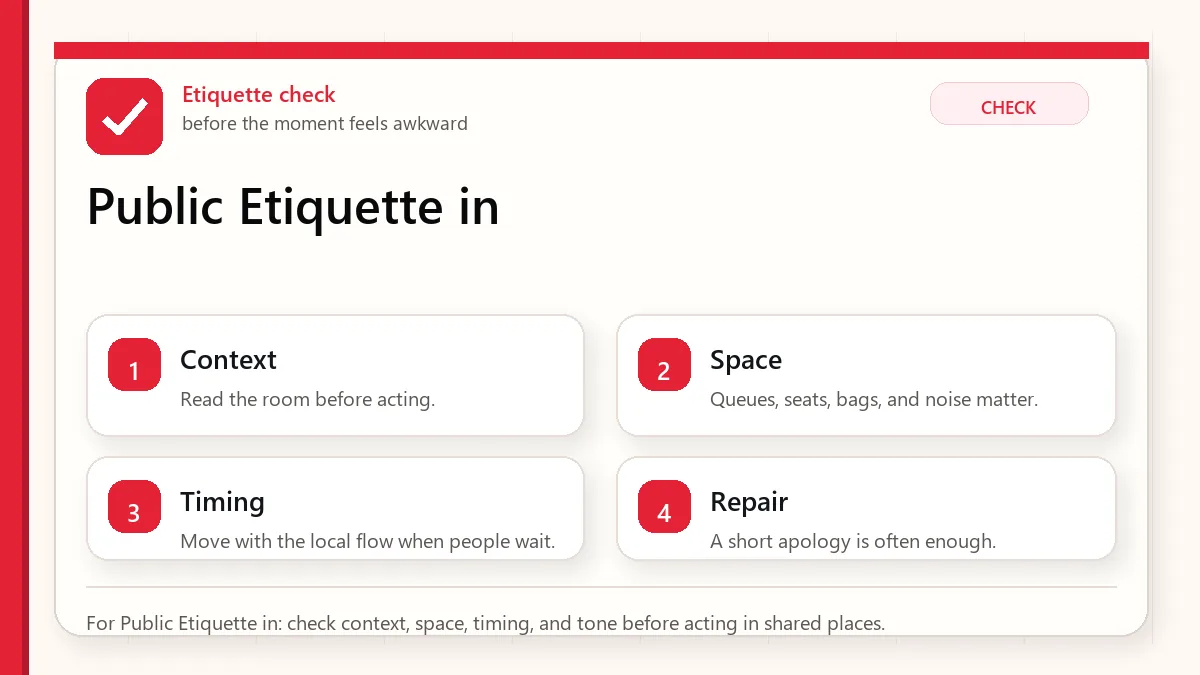
For Public Etiquette in: check context, space, timing, and tone before acting in shared places.
Shared-space etiquette by location
Place
Better habit
Why
Subway/bus
Keep bags close, let people exit first, avoid blocking doors.
Transit flow matters in crowded cities.
Cafes
Order before occupying space when expected and keep noise reasonable.
Cafes can be busy work and study spaces.
Street
Step aside before stopping for maps or photos.
Sidewalks and station exits move fast.
Queues
Follow the visible line and wait your turn.
Line discipline reduces conflict.
Trash
Carry small trash until proper disposal is available.
Public bins may be limited in some areas.
Checks before entering a shared space
Observe how people move before stopping in a crowded place.
Keep a small bag for personal trash.
Use headphones for videos and calls.
Check smoking signs and designated areas.
Use translation or signs when a rule is unclear.
Move with the local rhythm
Let passengers exit before boarding.
Stand to the side on escalators or follow local signage and flow.
Keep conversation volume lower in transit and quiet spaces.
Do not leave cups, food, or trash on random ledges.
At cafes, understand whether seating is for customers only.
If corrected, adjust calmly rather than arguing.
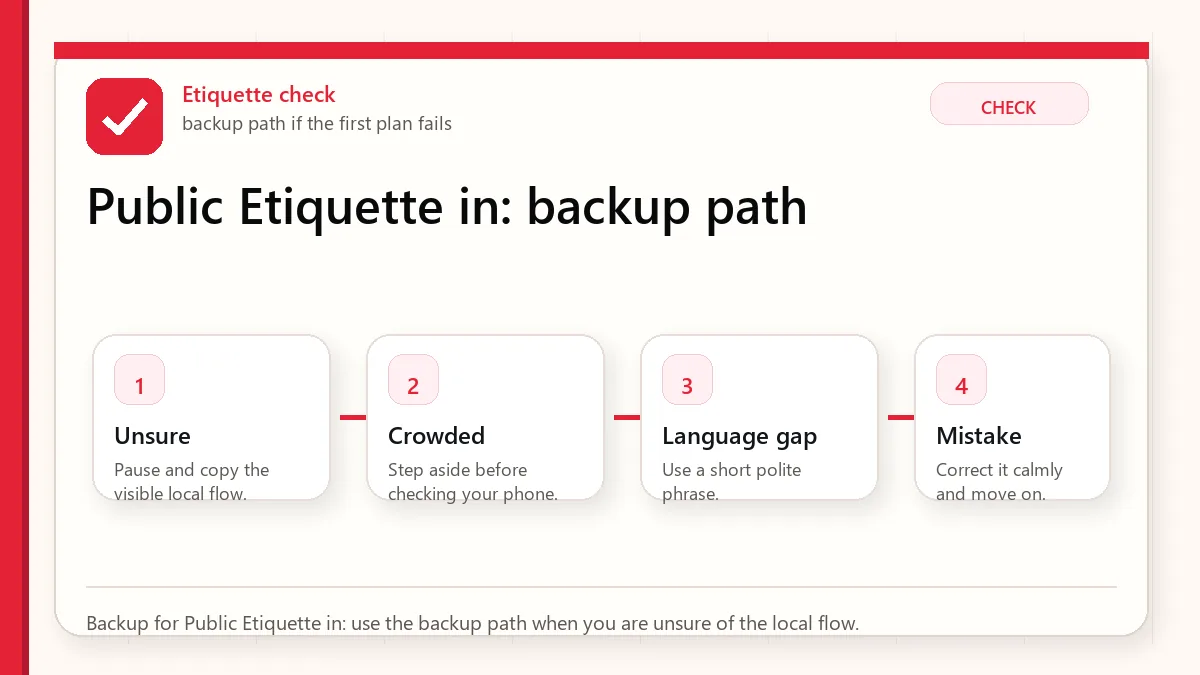
Backup for Public Etiquette in: use the backup path when you are unsure of the local flow.
Where visitors accidentally stand out
You block a station exit while checking your phone
Step to the wall or a wider area before navigating.
You cannot find a trash bin
Carry the trash until you find a proper bin, store, hotel, or station area that accepts it.
You sit in a priority area
Move if someone who needs it boards, and follow signage.
You are unsure about smoking
Use designated smoking areas only and check local signs.
Use the setting to decide the behavior
Situation
Better approach
What to verify
Crowded commute
Keep bag close and minimize phone-stopping.
Doors, stairs, and escalators.
Cafe work session
Buy appropriately and keep noise low.
Outlet and seat rules.
Street photography
Avoid blocking storefronts or pedestrians.
Privacy and flow.
Nightlife area
Stay aware of noise and trash.
Local rules and safety.
What not to assume about public space
Do not assume public trash bins are everywhere.
Do not assume loud calls are acceptable in quiet transit spaces.
Do not assume cafe seating rules are identical across stores.
Do not assume smoking is allowed just because you are outdoors.
Small habits that make shared spaces feel easier
Observe the rhythm before acting
Many etiquette problems are not about complicated rules. They happen because a visitor moves faster than the local flow: boarding before others exit, standing in a doorway, speaking loudly in a quiet carriage, or blocking a shop counter while deciding. A few seconds of observation usually tells you where to stand, when to move, and whether a space is meant for quick use or lingering.
Shared spaces are the real test
Cafes, trains, elevators, convenience stores, and narrow streets are where small habits become noticeable. Keep bags close, leave priority seating available, avoid sudden stops in walking lanes, and handle trash carefully because public bins can be less available than expected. These habits are simple, but they make the trip smoother for both visitor and local people nearby.
Read next when etiquette connects to transit, food, or stores
This topic works best when it is not handled alone. Use the related guides below to connect the decision with maps, money, food, shopping, transit, and app backup planning.
Last updated: 2026-05-23. Re-check official sources close to the day you travel, buy, eat, or use an app. Details involving prices, eligibility, transport, app features, opening hours, and refund rules can change.
For your first subway or bus ride in Korea, prepare a transportation card, use a local route app, check the station exit or bus stop direction, and leave extra time. The hardest part is usually not the train ride; it is choosing the right entrance, exit, platform, or bus direction.
Last checked: June 1, 2026. Re-check the official operator, app, fare, or route page before acting, because routes, prices, labels, rules, app screens, eligibility, and store/service policies can change.
The ride is simple when the direction and exit are clear
Korea's public transport can be very visitor-friendly, but the small navigation details matter: the correct platform direction, bus stop side, transfer path, exit number, and card balance. This guide is for avoiding the mistakes that add twenty minutes to a five-minute ride.
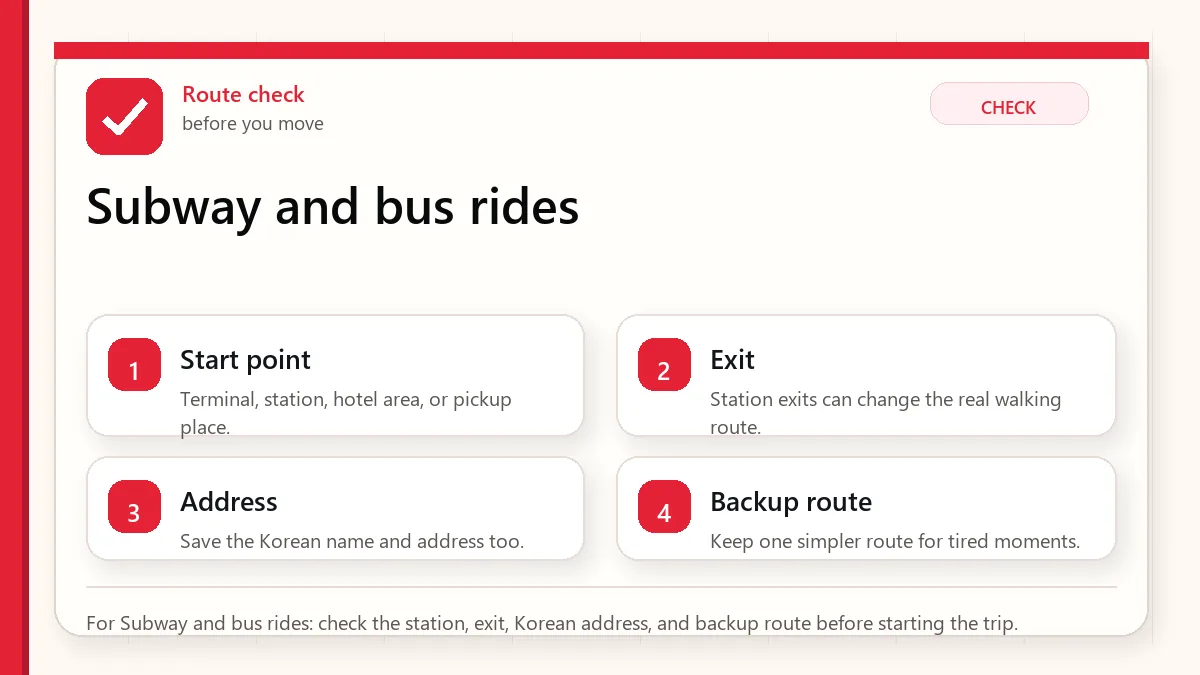
For Subway and bus rides: check the station, exit, Korean address, and backup route before starting the trip.
Subway vs bus for visitors
Mode
Best for
Main challenge
Preparation
Subway
Predictable city movement and station-based routes.
Large stations, transfers, exits, and stairs.
Route app, exit number, transit card.
Bus
Direct neighborhood routes and places away from subway.
Correct direction, stop names, and traffic.
Map app, stop confirmation, tap habits.
Taxi backup
Late-night, luggage, or complex route situations.
Address communication and fare expectation.
Korean address and payment backup.
Checks before the first tap
Prepare a transport card or verified payment method.
Save your destination in Korean and English.
Check route at the time you plan to travel.
Look for final station exit, not only station name.
Avoid first-time complex transfers when carrying heavy luggage.
Move through transit one decision at a time
Use a local map app to choose route.
Check line color, direction, transfer station, and exit number.
Tap in and out as required.
Stand aside while checking your phone.
For buses, confirm the stop is on the correct side of the road.
After arrival, save the return route while still oriented.
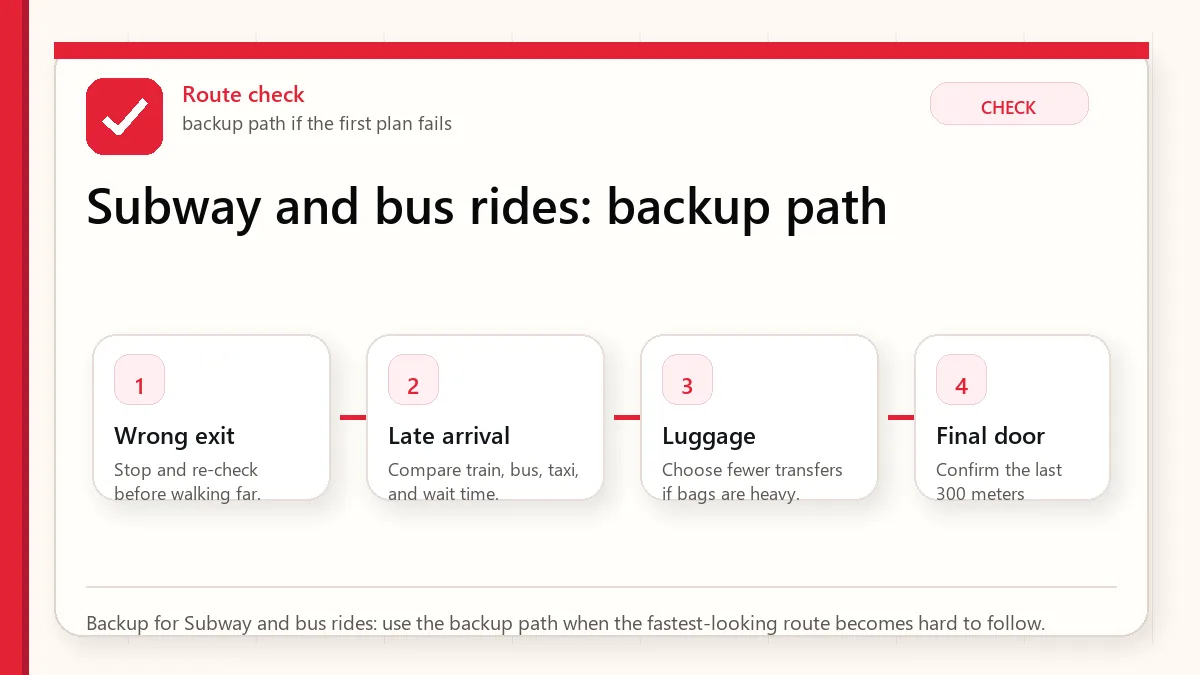
Backup for Subway and bus rides: use the backup path when the fastest-looking route becomes hard to follow.
Where first rides usually go wrong
Wrong station exit
Re-check the exit number before leaving the paid area if possible. A wrong exit can add a long walk.
Wrong bus direction
Check the next stops in the app and the road side before boarding.
Transit card balance is low
Top up before late-night travel or long routes.
Transfer is too complex with luggage
Use a simpler route, airport bus, or taxi when luggage makes public transport inefficient.
Choose subway or bus based on recoverability
Situation
Better approach
What to verify
First subway ride
Choose a simple route with few transfers.
Line direction and exit.
Hotel with luggage
Prefer fewer transfers over fastest time.
Elevator availability and walking distance.
Bus route
Confirm stop direction and destination.
Traffic and correct side of road.
Late night
Check last service and taxi backup.
Final train/bus time.
What not to assume from a route result
Do not assume a station name is enough; exit number matters.
Do not assume the fastest route is best with luggage.
Do not assume every bus stop across the street serves the same direction.
Do not stand in gate or stair flow while checking directions.
Transit details that make the city feel calmer
The exit number matters more than visitors expect
In large Korean stations, choosing the wrong exit can add a long walk, stairs, confusing underground passages, or an extra street crossing. When using a map app, do not stop at the station name. Check the suggested exit number and nearby landmark. This is especially useful when carrying luggage, meeting someone, or finding a small restaurant in a dense area.
Bus routes need one extra check
Buses can be efficient, but first-time visitors should confirm the direction, stop name, and whether the bus is local, trunk, express, or airport-related. The same road can have stops on opposite sides, and getting on in the wrong direction can waste more time than taking the subway. If you feel unsure, the subway is usually easier to recover from because stations are clearer and more forgiving.
Read next when transit connects to maps, T-money, or cash
This topic works best when it is not handled alone. Use the related guides below to connect the decision with maps, money, food, shopping, transit, and app backup planning.
Use these official links when the next step matters. This guide explains what to watch for, but app downloads, eligibility, prices, routes, policies, and service rules can change.
T-money official site: Check current card, top-up, refund, and mobile T-money information.
Last updated: 2026-05-23. Re-check official sources close to the day you travel, buy, eat, or use an app. Details involving prices, eligibility, transport, app features, opening hours, and refund rules can change.
For most first-time visitors, a simple physical transportation card is still the safest public-transport backup in Korea. Tmoney is widely known, but the better question is how you will buy it, top it up, avoid overloading it, and handle refund or leftover balance before leaving.
The transit-card details that keep rides simple
T-money is not only a card to tap. For visitors, it is part of a small system involving purchase, top-up, transfer habits, refunds, and backup cash.
Area
What to check
What to avoid
Buying
Get a transit card from a convenient channel.
Design cards and tourist products can differ.
Top-up
Know whether your top-up point accepts your method.
Cash can still matter.
Riding
Tap in and out where required.
Transfer benefits can depend on correct tapping.
Leaving
Refund remaining balance when practical.
Small balances may not be worth stress.
The checks that deserve your attention
Buy before your first subway/bus ride.
Keep small cash for top-up.
Check balance before late-night rides.
Do not treat T-money as a full replacement for cards/cash.
VISITKOREA describes Korean transportation cards such as Tmoney, EZL, WOWPASS, and Climate Card as rechargeable prepaid cards that do not require an account. That matters for visitors because it separates transit access from more complicated local app, bank, or phone verification steps.
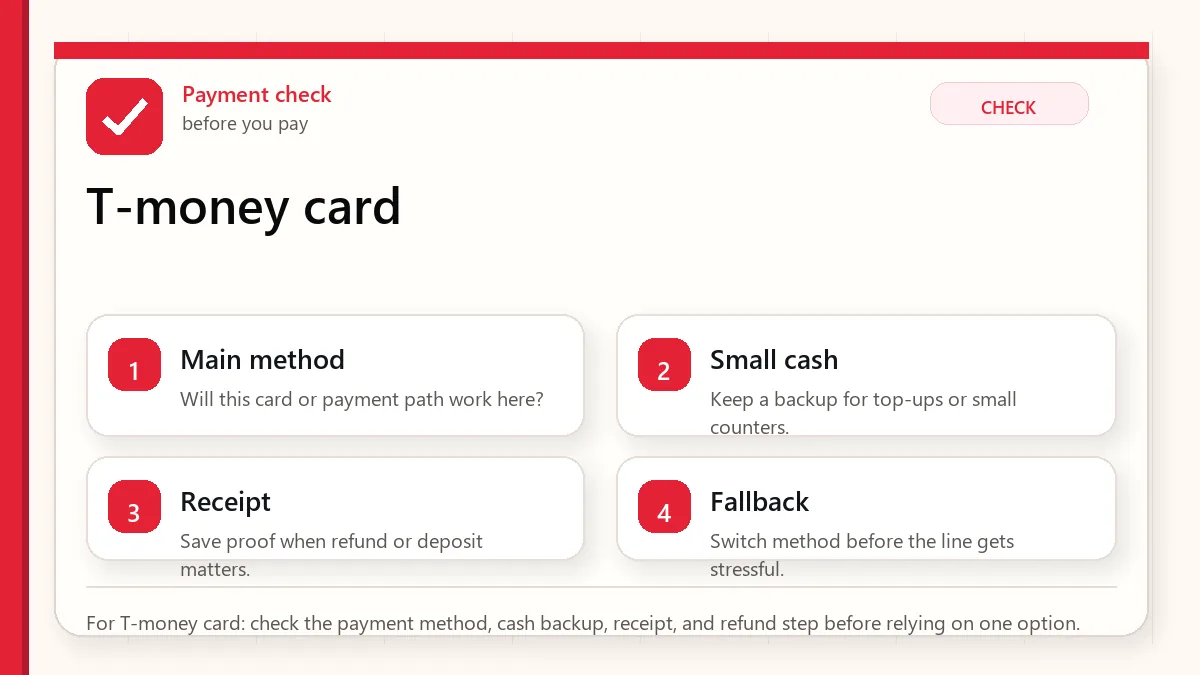
For T-money card: check the payment method, cash backup, receipt, and refund step before relying on one option.
A card does not solve every payment situation. It is mainly a practical way to reduce friction on subway and bus rides and, depending on card type and affiliated stores, some small payments. You still need a backup payment method.
Which card type fits which traveler?
Traveler situation
Best starting point
Why
Watch out
First-time visitor staying in several areas
Standard Tmoney or similar transport card
Simple, flexible, and familiar for subway/bus use.
Top-up and refund rules can vary; keep cash backup.
Visitor who wants currency/payment plus transport in one product
WOWPASS or similar visitor card
May combine prepaid payment, currency exchange, and transport functions.
Check kiosk locations, activation, fees, and refund rules before relying on it.
Seoul-heavy trip with many rides in a short period
Climate Card if your routes fit the covered area
Can be attractive for frequent Seoul transit use.
Coverage, payment methods, and refund rules have restrictions. Check Seoul’s official page.
Short intense Seoul transit itinerary
Mpass only if the route and usage limit make sense
VISITKOREA lists Mpass as a foreigner-exclusive time-limited option.
Pass rules, purchase location, and included transport should be checked before buying.
The visitor mistake: choosing by brand instead of use case
A transport card is not a souvenir decision. It is an operations decision. Choose based on how many rides you will take, where you will travel, whether you need currency/payment features, and how easily you can get leftover balance back.
If you only ride a few times, keep the card simple and avoid overloading balance.
If you stay mostly in Seoul and ride many times, compare short-term unlimited options carefully.
If you shop heavily, separate transport convenience from card/payment and tax-refund planning.
If you travel beyond Seoul, check whether your chosen option covers your actual routes.
Buying and topping up
VISITKOREA says Tmoney and EZL cards can be purchased and charged at convenience stores nationwide, and Tmoney can also be reloaded through subway ticket vending machines. However, travelers should treat payment method, machine language, and top-up limits as practical details to verify locally.
Carry Korean won cash for top-up backup, especially on the first day.
Do not load a large amount just because you are nervous. Load enough for the next few rides, then adjust.
Keep the card easy to reach when entering and exiting gates.
If traveling with kids or teens, check discount registration rules before assuming reduced fares apply.
Using it on subway and bus
The basic habit is simple: tap when required, keep enough balance, and do not block gates while searching for the card. The deeper habit is to watch transfers. Transportation cards can provide transfer benefits, but transfer timing and conditions are rules, not guesses.
Tap with the same card consistently for a trip.
Keep a separate mental note of remaining balance if you are traveling late or away from major stations.
Do not assume airport express, intercity, taxi, or store acceptance is identical across every card and location.
For anything outside ordinary subway/bus use, verify the current card-specific rules.
Refund and leftover balance strategy
The best refund strategy is not needing a refund. VISITKOREA notes that refund of over KRW 50,000 for Tmoney is only possible at Tmoney Town near Seoul Station. For visitors, that means large leftover balances can become inconvenient.
Balance habit
Why it helps
Top up in smaller amounts after the first day.
You learn your real daily ride cost instead of guessing.
Keep enough for the return route.
Running out late at night is more annoying than carrying a small leftover.
Spend down before the airport.
Refund rules, counters, and time pressure can make last-minute recovery stressful.
Check card-specific refund rules.
Tmoney, EZL, WOWPASS, Climate Card, and passes do not all behave the same.
When a transport card is not enough
Airport transfer may require a separate ticket, route check, or payment method depending on option.
Some taxis may accept cards, but destination communication and route trust still matter.
Shopping, restaurants, and attractions need a separate payment plan.
Mobile transit setup may depend on phone model, app region, payment source, or local verification.
The card habits that make transit feel less stressful
A transit card is a movement tool, not just a souvenir
T-money is useful because it reduces repeated ticket buying and makes subway and bus transfers easier. The practical habit is to check balance before a long ride or airport movement, especially if you are traveling with luggage or late at night. A card with too little balance can turn a simple trip into a delay.
Top-up planning prevents small stress
Visitors often forget that transit convenience still needs preparation. Know where you can top up, whether cash is required, and how much you expect to ride that day. Keep small won notes available if you rely on machines or stores for top-up. At the end of the trip, think about whether to keep the card for another visit or spend down the balance.
Read next when transit connects to money or airport arrival
This topic works best when it is not handled alone. Use the related guides below to connect the decision with maps, money, food, shopping, transit, and app backup planning.
Use these official links when the next step matters. This guide explains what to watch for, but app downloads, eligibility, prices, routes, policies, and service rules can change.
T-money official site: Check current card, top-up, refund, and mobile T-money information.
It can be convenient, but it is not always necessary. The important thing is knowing where you will get or top up a card after arrival and carrying a backup payment method.
Can I use only my foreign credit card for transport?
Do not assume that. Prepare a local transportation card or a verified visitor-friendly option unless you have confirmed your exact payment method works for the transport you plan to use.
How much should I load?
Start with a modest amount that covers the first day or two, then adjust. Avoid large leftover balances unless you understand refund rules and locations.
Last updated: 2026-05-23. Korea travel, transport, app, shopping, and refund details can change. Re-check official sources close to the day you act, especially when money, eligibility, route timing, or account access is involved.
This guide is written as practical preparation content. It does not claim personal hands-on testing, a personal visit, or official legal advice unless explicitly stated.
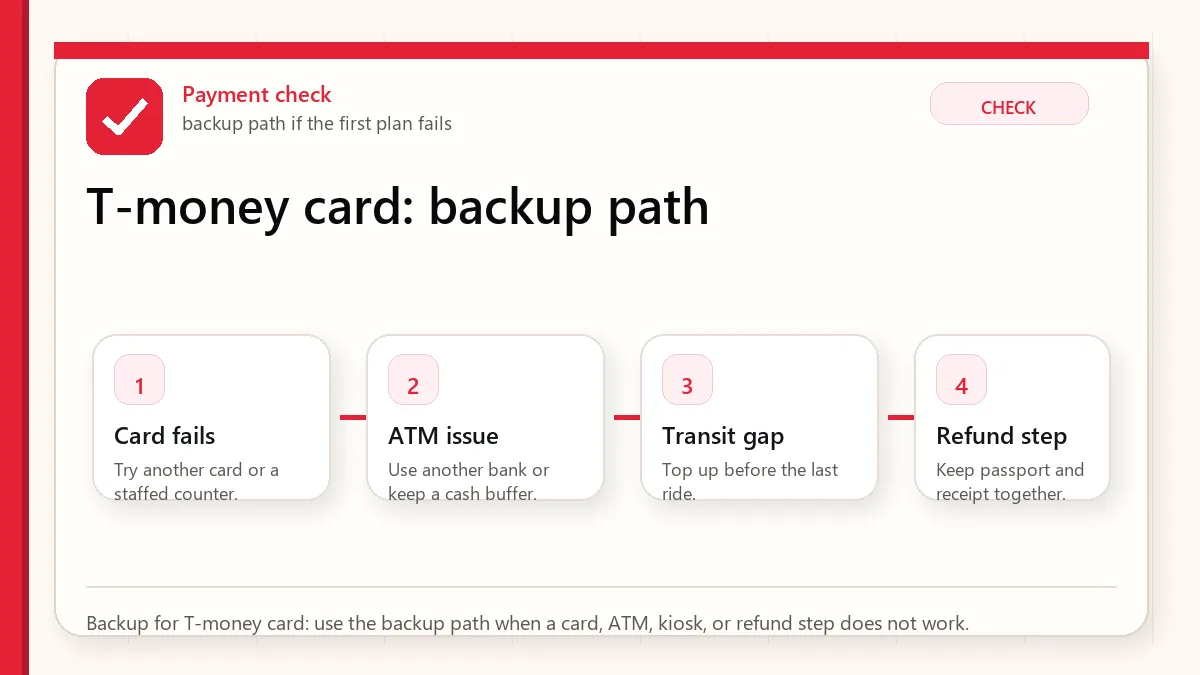
Backup for T-money card: use the backup path when a card, ATM, kiosk, or refund step does not work.
For a first Korea trip, the useful checklist is not a long packing list. It is a risk checklist. Before departure, settle five things: entry paperwork, phone data, map/navigation, money/transit, and your first route from the airport. If those five are ready, most first-day stress becomes manageable.
What makes this checklist worth using
The practical value of this checklist is not that it names every possible travel task. It helps you identify the few tasks that can block the first day if they are left unresolved.
Area
What to check
What to avoid
Entry
Verify official entry requirements, e-Arrival/K-ETA status, passport validity, and customs basics.
Do not rely on social media comments for nationality-specific rules.
Phone
Choose data setup and app login plan before departure.
Data-only service may not solve phone-number verification.
Maps
Save Korean names, hotel address, station exits, and first route.
English place search can be uneven.
Money
Prepare card plus cash plus transit plan.
A single card is not a full payment strategy.
The checks that deserve your attention
Confirm entry admin from official pages.
Open Naver Map and translation apps before flying.
Save hotel address in Korean.
Choose airport transfer by fatigue and luggage, not only speed.
Failure cases to plan around
No working data after landing.
Hotel name does not search.
Card fails at a kiosk.
Airport bus/train timing no longer fits late arrival.
This is for first-time visitors who want to avoid the problems that usually appear after landing: no working data, a hotel address that does not search well, a card that fails at a kiosk, a late arrival with no planned transfer, or a tax/refund/app rule discovered too late.
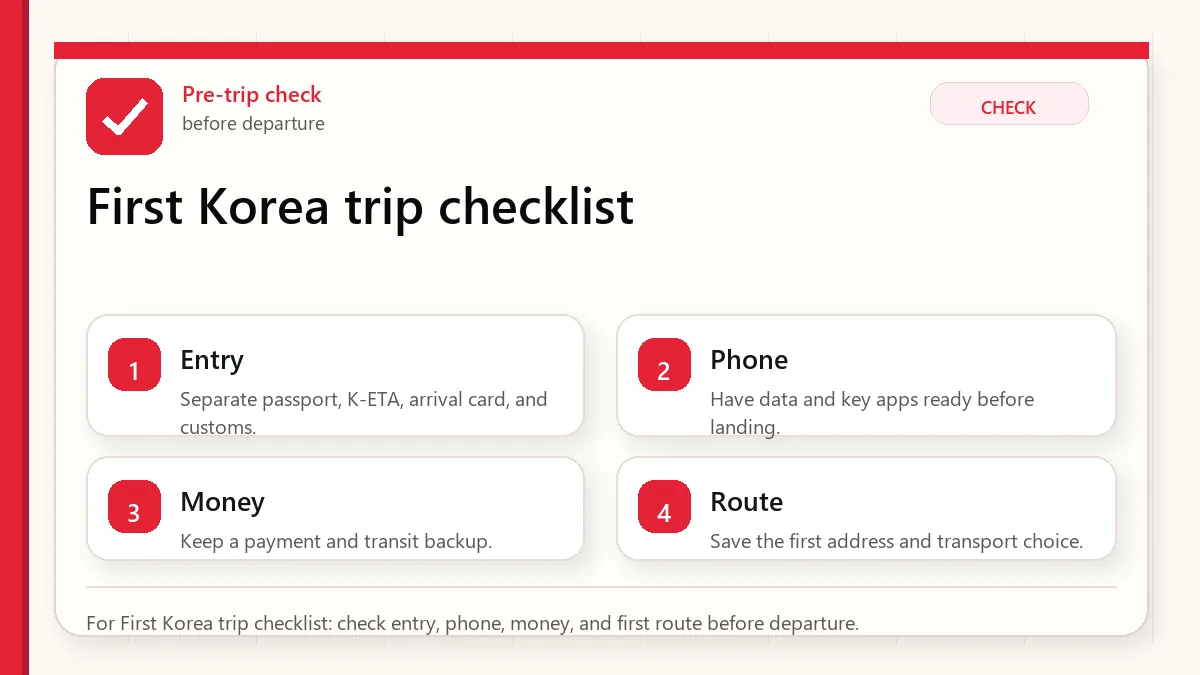
For First Korea trip checklist: check entry, phone, money, and first route before departure.
This guide is intentionally practical. It does not try to be a complete Korea travel guide. It tells you what to prepare before the trip so that your first day in Korea is not spent fixing preventable problems.
The five decisions to make before departure
Decision
What to decide
Why it matters
Best verification source
Entry admin
Whether you need to submit the Korea e-Arrival card or other entry information before arrival.
Immigration forms and timing are not the thing to solve while tired in the arrival hall.
Check official entry requirements for your passport, stay purpose, and arrival date. Korea introduced an e-Arrival card system for inbound passengers starting February 24, 2025, according to VISITKOREA. Do not rely on old screenshots of paper forms; use the official e-Arrival or immigration source close to travel.
Save your accommodation address in English and Korean.
Keep your first-night accommodation contact details offline.
Check whether arrival forms, visa-free entry conditions, or airline document checks apply to your situation.
If anything is legal, immigration, medical, or visa-related, verify with the official authority rather than a travel blog.
2. Phone data and backup access
Your phone is your map, translation tool, booking reference, payment helper, and emergency contact device. Prepare data before you depend on airport Wi-Fi. If using eSIM, check phone compatibility and activation timing before departure. If using a physical SIM or portable Wi-Fi, check pickup location, opening hours, and what happens after a delayed flight.
Download app updates before the flight.
Save booking confirmations and hotel address offline.
Keep one low-tech backup: a printed or screenshot route from the airport to your hotel.
Do not assume a local phone number will be available unless the product clearly includes it.
3. Maps and Korean names
A global map app can still be useful for orientation, but Korea travel is easier when you prepare a local map app and Korean place names. Save the airport terminal, hotel, nearest station, and your first meal or destination before boarding.
Save place names in Korean when available from official pages or booking confirmations.
Check final walking distance, station exit, and whether the route uses stairs.
For time-sensitive plans, test the route at a similar day/time before travel.
Treat opening hours on map listings as a hint, not final proof.
4. Money, cards, and transit
For public transport, Korea uses transportation cards such as Tmoney, EZL, WOWPASS, and other options. VISITKOREA describes these as rechargeable prepaid cards that do not require an account and can be useful for public transportation. The practical question is not only which card exists, but how you will buy, charge, use, and refund it.
Carry some Korean won cash for top-ups or small fallback payments.
Bring more than one payment method if possible.
Avoid loading more transit balance than you can reasonably use before leaving.
For shopping-heavy trips, read the tax refund rules before the first large purchase, not at the airport.
5. Airport transfer
VISITKOREA lists airport-to-Seoul options including AREX, Seoul subway, airport limousine bus, and taxi. Your best option depends on the final destination, not only the airport departure point. A train to a major station may be fast, but a bus can be easier if it stops near your hotel. A taxi can be useful with luggage or late arrival, but you should prepare the address and payment backup.
First 90 minutes after landing
Moment
Do this
Why
Before immigration
Open your offline documents and confirm accommodation address.
You may not want to depend on live data immediately.
After baggage
Confirm your data connection before leaving the terminal.
A broken data plan is easier to solve at the airport than on a sidewalk.
Before buying transport
Compare the route you planned with current time and luggage reality.
A delayed flight can make the original plan worse.
Before taxi or bus
Show the Korean destination name/address, not only an English hotel name.
Similar names and branch names can cause route mistakes.
At hotel
Save the nearest station, convenience store, and return route.
The second trip out is easier once your home base is set.
Different travelers need different backups
Solo first-timer: prioritize offline address, map backup, and a transfer route that is easy to follow while tired.
Family or group: prioritize luggage, seating, walking distance, and one shared plan everyone can find if phones separate.
Shopping-focused traveler: understand tax refund eligibility, passport needs, receipt/voucher handling, and baggage space before buying.
Food-focused traveler: prepare translation for allergies, dietary limits, spice tolerance, and restaurant ordering basics without pretending apps can solve every situation.
Short layover or late arrival: build the plan around timing and backup transport, not sightseeing ambition.
Common mistakes this checklist prevents
Arriving with an app installed but not opened or configured.
Saving only English place names for a destination that is easier to find in Korean.
Choosing an airport route that is fast to a station but awkward to the actual hotel.
Assuming foreign cards, mobile wallets, or app payments will work everywhere.
Buying tax-refund-eligible goods without keeping receipts, vouchers, passport details, or export requirements in mind.
Using old blog prices or app screenshots as if they were official current rules.
The small preparations that make day one easier
Build the trip around recoverable mistakes
A first Korea trip does not need to be perfect. It needs to be recoverable. If a map search fails, you have a Korean address. If a card fails, you have cash and a second card. If mobile data fails, you have airport Wi-Fi and saved documents. If a route changes, you know the nearest station and hotel address. This mindset is more useful than trying to memorize every rule.
Do one final check close to departure
Some details are stable, but others change: weather, airport process, app verification, transport schedules, tax refund rules, opening hours, and travel notices. A checklist is strongest when it is reviewed once early for planning and once again shortly before departure for current details. Keep the final version offline so the first day does not depend on perfect mobile data.
Read next for the parts of the trip that usually overlap
This topic works best when it is not handled alone. Use the related guides below to connect the decision with maps, money, food, shopping, transit, and app backup planning.
Use these official links when the next step matters. This guide explains what to watch for, but app downloads, eligibility, prices, routes, policies, and service rules can change.
K-ETA official site: Use only the official K-ETA site for eligibility and application steps.
Do I need to plan every day before visiting Korea?
No. Plan the arrival day and the systems you will use every day: map, data, money, transit, and official source checks. Sightseeing can stay flexible.
Should I install every Korean app before I arrive?
No. Install only the apps tied to real decisions: navigation, translation, transit, weather, messaging if needed, and specific bookings. Too many apps can create more account and verification problems than they solve.
What should I verify again right before travel?
Verify entry requirements, e-Arrival details, airport route timing, transit card information, weather, store or venue hours, tax refund rules, and any reservation or app account requirement that affects money or access.
Last updated: 2026-05-23. Korea travel, transport, app, shopping, and refund details can change. Re-check official sources close to the day you act, especially when money, eligibility, route timing, or account access is involved.
This guide is written as practical preparation content. It does not claim personal hands-on testing, a personal visit, or official legal advice unless explicitly stated.
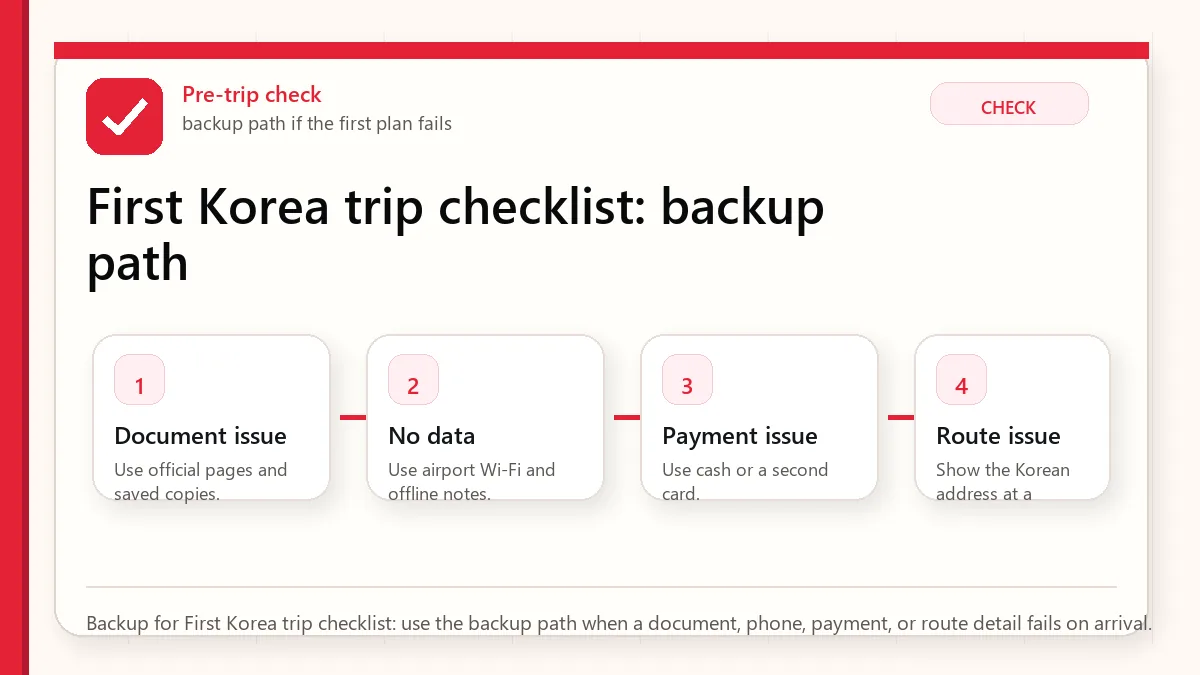
Backup for First Korea trip checklist: use the backup path when a document, phone, payment, or route detail fails on arrival.