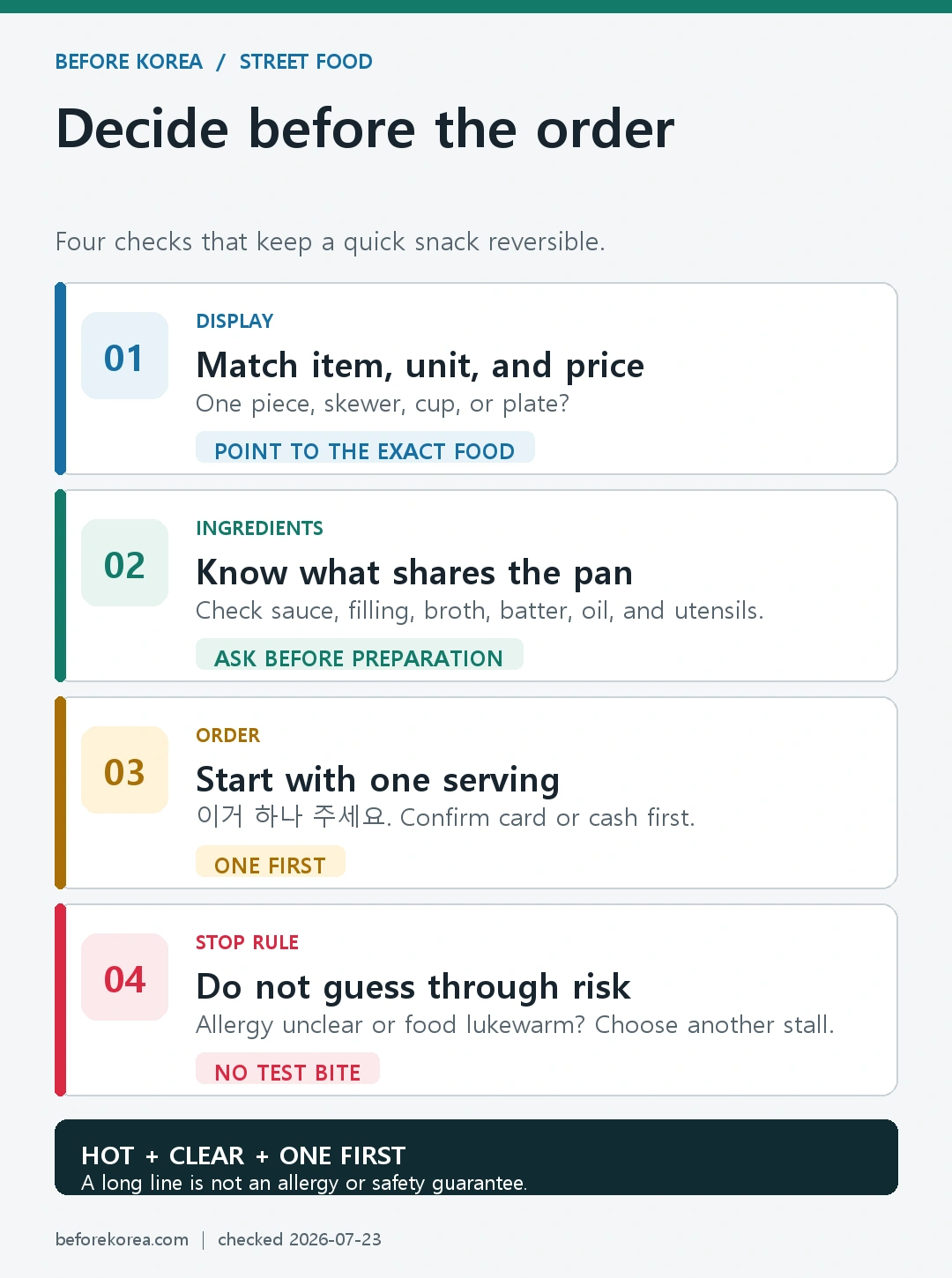
Use a Korean street-food stall as a short transaction: identify the exact food, read the displayed price and quantity, decide whether the handling fits your needs, order one item, confirm payment, and keep a recovery path. Popularity and a long queue do not answer ingredient, allergy, cooking or price questions.
Reviewed August 24, 2026 against current Korea Tourism Organization, Seoul Metropolitan Government, MFDS and CDC primary guidance. Stall menus, payment, portions, ingredients and opening times can change on the same day.

Make a stall decision before joining the line
| Decision | Evidence at this stall | Leave the line when |
|---|---|---|
| Exact food | Korean name plus the item in the pan | Name and food cannot be matched |
| Price and quantity | Current sign, unit, count or weight | Price or serving unit remains unclear |
| Cooking state | Batch being cooked and served | Food is held in a condition you cannot accept |
| Ingredient restriction | Responsible answer for the exact item | Allergen or religious condition cannot be verified |
| Payment | Current sign or staff confirmation | The required method is unavailable |
Match the name to the pan
Point to the exact Korean menu line and then to the actual tray, pot or grill. Similar red sauces can cover different bases; gimbap can contain different fillings; mandu can be meat, seafood or vegetable; sundae is not the same food as sweet Western-style sausage. Do not order from an English nickname alone when the ingredient decision matters.
Read price, unit and portion together
Seoul’s Gwangjang Market price-transparency notice describes displaying quantity or weight with prices. Treat that as the useful pattern: check whether the number is per piece, skewer, cup, plate, 100 grams or set. A photo model and a real serving can still differ, so confirm before the vendor starts cooking or plating.
One-stall price check
- Photograph or remember the displayed Korean item and price.
- Confirm the unit or number of pieces.
- Ask whether toppings, sauce, packaging or table use changes the total.
- State the quantity once and watch the vendor repeat it.
- Check the payment result before walking away.
Payment is a stall fact
VISITKOREA’s current shopping guidance says cards are widely used but some traditional-market and street businesses may accept only cash. The 2026 K-tourism market service campaign includes fixed pricing and card acceptance at participating markets, but it is not a promise for every stall. Carry a modest backup and ask before food preparation.
Choose food that is cooked and served hot
| What you see | What it can tell you | What it cannot prove |
|---|---|---|
| Active boiling, frying or grilling | Current batch is receiving heat | Safe holding before or after cooking |
| Steam | Food is warm | Internal temperature or ingredient safety |
| Long queue | Fast turnover may occur | Correct handling or allergy control |
| Gloves or tongs | A tool is being used | No cross-contact between foods |
| Covered tray | Some environmental protection | Time and temperature control |
Use a stop rule for food handling
CDC travel food and water guidance favors food cooked thoroughly and served hot and warns about raw or undercooked foods. Skip food that has sat at an uncertain temperature, has visible cross-contact you cannot accept, or would need a vendor to give a safety guarantee they cannot verify.
Allergy and religious restrictions are separate checks
A dish being non-spicy, vegetarian-looking or popular with Muslim travelers does not prove its ingredients, broth, sauce, oil or shared tools. MFDS packaged-food allergen labeling helps with sealed products, but an unpackaged stall requires a responsible ingredient and cross-contact answer. If the answer is uncertain, choose a different food rather than reducing the question to a phrase translation.
Build a first round, not a feast
Buy one or two clearly identified items first. Confirm portion, heat, sweetness, spice and payment before ordering more. This limits waste, duplicate charges and the pressure to eat an unsuitable item. Keep an independently verified backup meal for a traveler with a medical or religious restriction.
Shared seating and returnable dishes
Before sitting, determine whether stools belong to one vendor, whether food from another stall is allowed, and where trays or utensils must be returned. Do not leave waste on an unrelated counter. If the market uses reusable dishes, return them to the exact stall or marked collection point.
When the order is wrong
- Do not add sauce or start eating while the problem is still recoverable.
- Show the menu line, quantity and payment record.
- State whether the issue is wrong item, wrong count, ingredient condition or duplicate payment.
- Ask what the stall can do before demanding a specific remedy.
- For a medical reaction, prioritize the traveler’s emergency plan and 119 over a purchase dispute.
A practical Gwangjang Market example
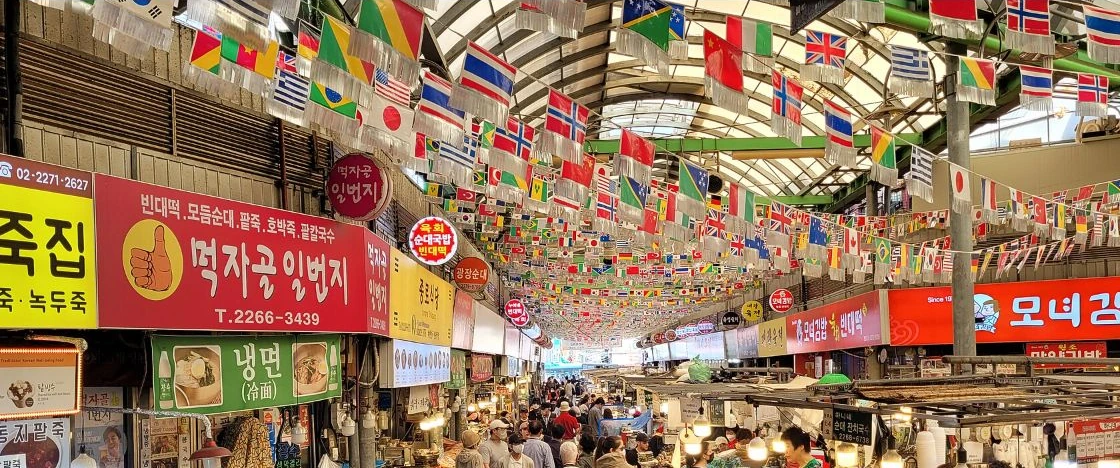
A sign shows a plate price, but two adjacent stalls use different quantities. Photograph the exact stall sign, ask how many pieces or grams are included, order one plate, confirm whether takeaway packaging changes the price, and pay once. The city initiative supports clearer quantity displays; it does not make neighboring stalls interchangeable.
Questions travelers ask
Does every market stall take cards?
No universal promise applies. Check the current stall before preparation.
Is a busy stall automatically safer?
No. Turnover is only one clue; cooking, holding and the traveler’s restrictions still matter.
Can I rely on a translated menu photo?
Use it to identify a candidate, then match the current Korean name, item, price and portion at the stall.
Source check and boundary
Reviewed August 24, 2026: KTO traditional-market service campaign, Seoul Gwangjang price and quantity measures, VISITKOREA payment guidance, CDC food and water precautions and MFDS allergen labeling. This guide does not certify a stall, diagnose illness or promise prices, hours, ingredients or payment acceptance.