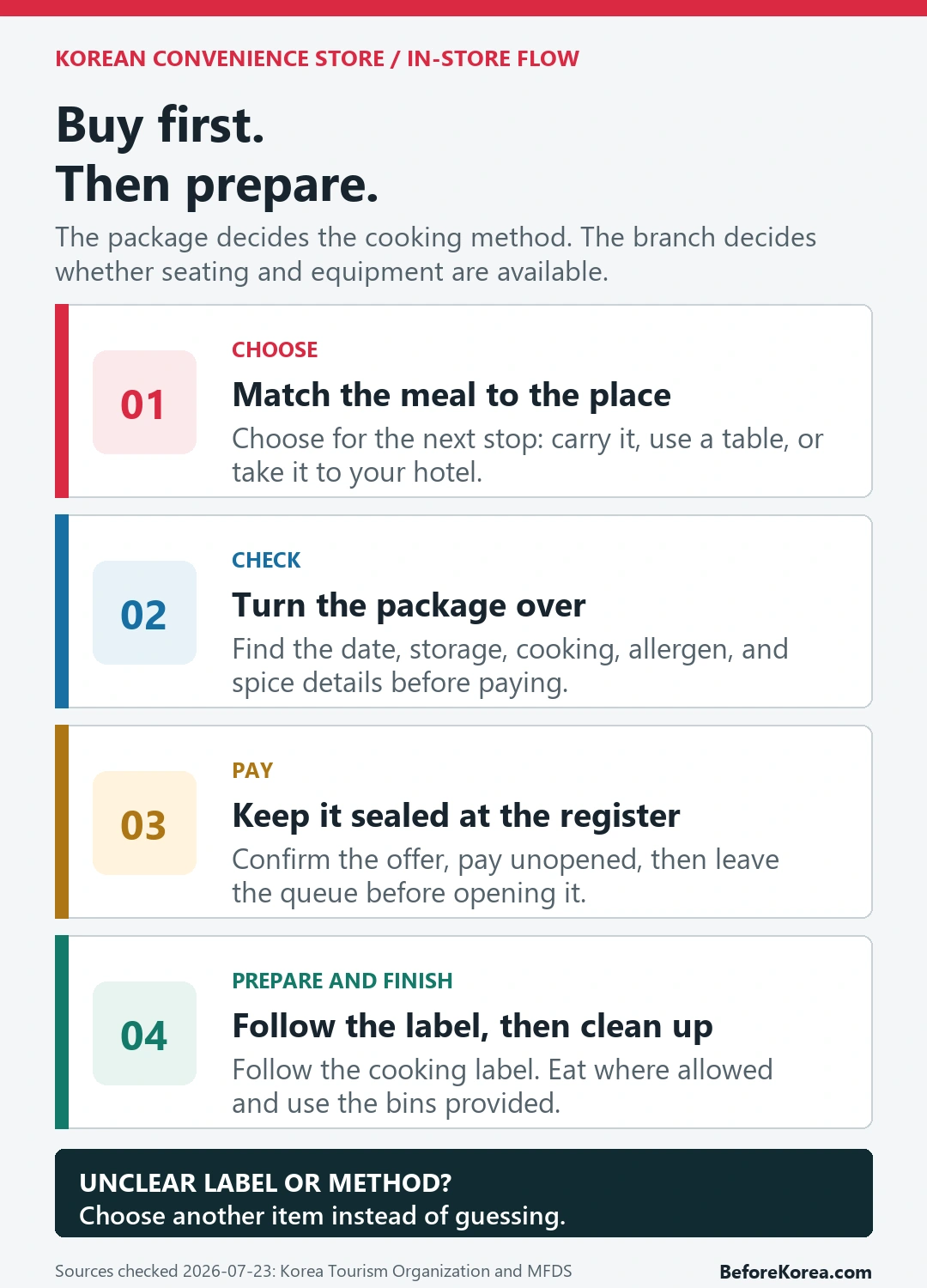
Korean convenience-store food is easy to use when you follow the order of the store: choose an item, read its label, pay before opening it, and then heat it or add hot water only as the package directs. Check for seating and waste bins before opening a meal. If an allergy or dietary restriction matters, use the original Korean label and staff confirmation rather than trusting the package photo or a machine translation alone.
This guide is for a traveler standing in a Korean convenience store with packaged food in hand. It covers the practical gap between seeing an appealing product and knowing whether you can safely pay for, prepare, and eat it there. Product ranges, promotions, equipment, seating, and store policies differ by branch, even within the same chain.
Choose food by how you will eat it
Start with the next 20 minutes, not with the brightest package. If you will walk or ride the subway, choose something sealed and easy to carry. If you have a table and the store provides a microwave or hot-water station, a lunch box or cup ramyeon becomes practical. If you have nowhere to sit, do not open soup, sauce, or a large tray just because the store sells it.
| Your situation | A practical choice | Check before paying |
|---|---|---|
| Eating while moving | Sealed drink, sandwich, snack, or triangle gimbap | Leak risk, refrigeration, filling, and date |
| Using a store table | Dosirak, refrigerated meal, or cup ramyeon | Seats, microwave or hot water, and cooking line |
| Taking food to a hotel | Ready meal that matches the room facilities | Hotel food rules, utensils, and reheating access |
| Buying a gift or flight snack | Factory-sealed shelf-stable item | Ingredients, fragility, liquid limits, and destination customs rules |
A refrigerator shelf, freezer, and room-temperature display are different storage instructions. Keep chilled food chilled and do not carry a ready meal for hours because it looked fine when purchased. When the trip will be long, choose a shelf-stable item whose sealed label you can verify.
Check the label before you take it to the register
Turn the package over before paying. Find the date or time, storage condition, ingredient and allergen area, and cooking instruction. Korea’s Ministry of Food and Drug Safety explains that packaged-food labels provide information such as the product name, ingredients, date, net contents, storage and handling instructions, safety warnings, and nutrition information. Its English overview also explains that specified allergens are listed near the ingredient information.
- Date and time: a short-life item can show a time as well as a date. Do not interpret an unfamiliar number sequence by guesswork.
- Storage: check whether the product belongs refrigerated, frozen, or at room temperature.
- Cooking: look for a microwave time, wattage, hot-water line, or instruction to remove part of the packaging.
- Allergens: inspect the original label even when a translation app produces a reassuring summary.
- Spice: package color is not a reliable scale. Look for flavor names and warnings, then choose a smaller portion when uncertain.
A phone camera can help locate text, but translations of ingredients, traces, and cooking directions can be incomplete. Photograph both the front and the full label while you still have the package. For a serious allergy, uncertainty is a reason to choose another product, not a reason to test the translation.
Pay before you heat or open anything
Bring the unopened item to the register first. After payment, move away from the queue and use the branch’s self-service area if it has one. This order keeps unpaid goods out of the microwave area and gives you a chance to ask about utensils, a bag, hot water, or the correct machine while the package is still intact.
The safest flow is simple: choose, read, pay, prepare, then eat and clean up. Do not copy another customer when that person’s container or product is different from yours.
Promotion signs need a second look. A Korean 1+1 offer generally means one additional qualifying item with one purchased item; 2+1 generally means one additional qualifying item with two purchased items. The exact products, dates, membership conditions, and register result control the offer. If you take only one item from a 1+1 display, the cashier may not automatically choose the second item for you.
Prepare ramyeon and ready meals without guessing
Use only the preparation method printed for that product. A cup that takes hot water is not automatically microwave-safe. A tray that can be microwaved may still require you to remove a sauce packet, peel back a film, or loosen a lid. Never put metal, foil, an unopened sealed container, or an unknown package in the microwave.
For cup ramyeon
- Confirm whether the package says hot water, microwave, or both.
- Open only as far as the printed instruction requires and remove any packet that should not stay inside.
- Add seasoning and water in the order shown, stopping at the marked fill line.
- Wait or cook for the printed time; use a tray if the cup is hot to carry.
- Empty leftovers only where the store provides an appropriate disposal point.
For dosirak and refrigerated meals
Look for the microwave time and wattage before removing the outer label. Check whether sauce, egg, pickles, cutlery, or a small sealed packet should be removed first. Heat for the stated time rather than adding a long extra cycle because one section still feels cool. Steam and sauce can escape quickly when the film is lifted.
What the main food types actually offer
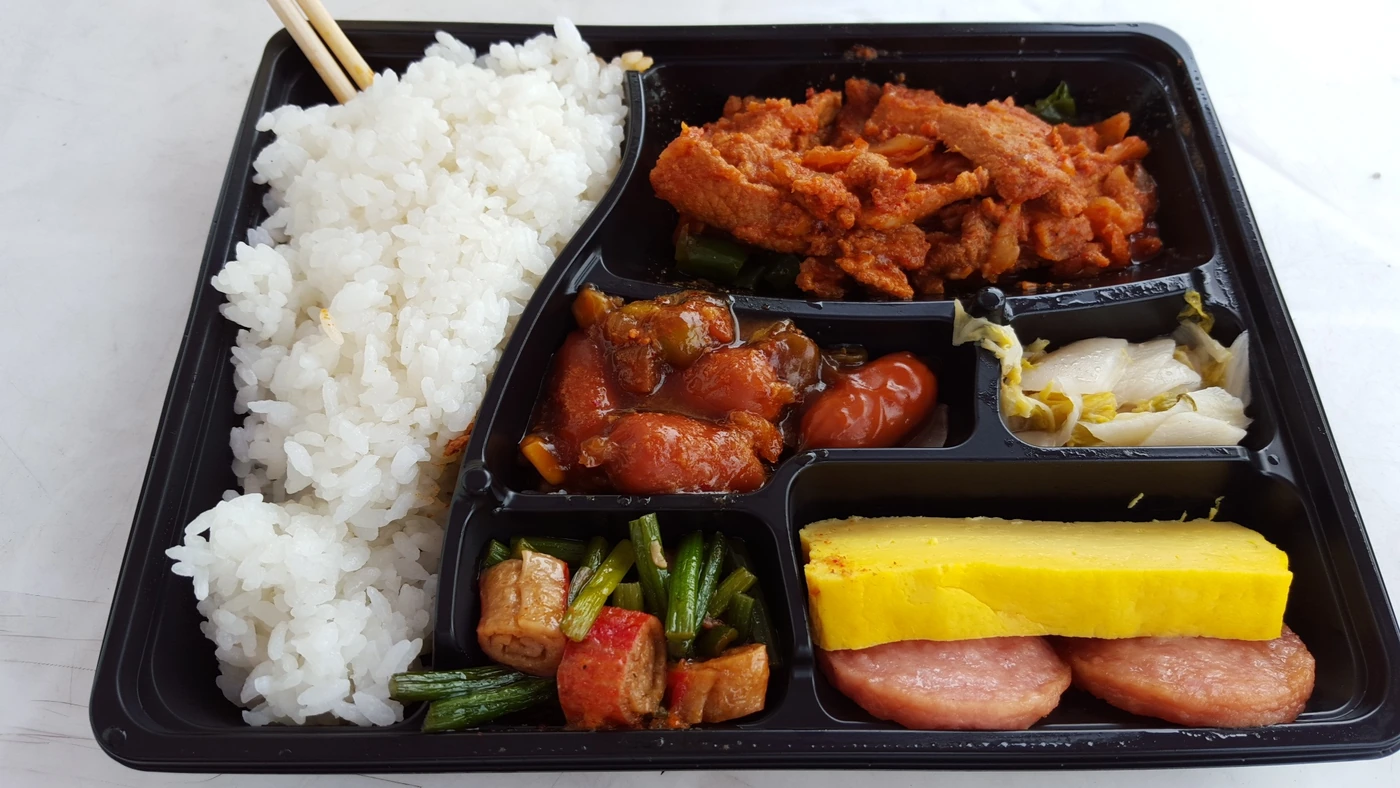
A convenience-store dosirak is a ready meal arranged in a compartment tray, often with rice and several side dishes. The actual ingredients and heating steps come from the current package, not from a photo or from the word dosirak itself.

| Food type | What makes it useful | Where travelers get caught |
|---|---|---|
| Dosirak | A complete tray meal with several components | Heating the wrong packet, missing allergens, or carrying it too long |
| Samgak gimbap | A compact triangle of rice with a labeled filling | Choosing by wrapper color or opening the numbered wrapper out of order |
| Roll gimbap | A portable sliced or unsliced rice roll | Assuming every filling is meat-free or mild |
| Cup ramyeon | A hot meal where hot water is available | Confusing hot-water and microwave directions |
| Sandwich or refrigerated snack | Simple food with no cooking step | Ignoring the short date, dairy, egg, or meat ingredients |
| Frozen or ready-to-heat dish | More variety when a suitable microwave is available | Not removing the outer sleeve, film, or sauce packet as directed |
The Korea Tourism Organization’s convenience-store feature is useful for understanding product variety and chain-specific releases, but it also warns that its product details were written earlier and may have changed. Treat viral product lists as ideas, not as an inventory promise. A branch may sell out, discontinue an item, or stock a different version.
Treat allergies and dietary rules as a separate decision
Convenience-store food is packaged for the Korean market. Front-of-package English, a familiar brand, or a picture of vegetables does not prove that the item is vegetarian, vegan, halal, gluten-free, nut-free, or suitable for a medical diet. Broth, seasoning, sauce, fish products, meat extracts, egg, milk, soy, wheat, and shared manufacturing lines can matter even when they are not obvious in the photo.
For a preference, you can compare labels and choose the clearest product. For a serious allergy or strict religious or medical restriction, raise the standard: read the complete Korean label, check the separate allergen statement and cross-contact warning, and ask a fluent person or the manufacturer when the answer remains unclear. Store staff may not be able to certify a product’s suitability.
The MFDS Food Labeling System overview explains the information required on Korean food labels and the country’s allergen-labeling method. Use it to understand what to look for, but use the current product package for the item you are about to eat.
Seating, waste, and late-night shopping vary by branch
Some branches have counters, tables, microwaves, hot water, sinks, or sorting bins. Others are tiny shops built only for quick purchases. A table visible outside may belong to another business or may be closed at certain hours. Look before opening a meal, and follow the signs at that branch.
- Keep the register area clear while deciding where to eat.
- Use only equipment provided for customers and wipe a spill immediately.
- Sort liquid, food waste, recyclables, and general waste only according to the bins actually provided.
- Do not leave an open cup or tray on an outdoor table because no bin is visible.
- At an unmanned or late-night location, choose a product you already know how to prepare if no help is available.
A convenience store is a useful backup after a late arrival, but it is not guaranteed to solve every problem. Payment acceptance, cash availability, hot-water access, and seating can all differ. Keep a second payment method and know whether your accommodation allows food in the room.
Work through common traveler situations
You arrived late and need dinner
Choose water and one straightforward meal before experimenting with several unfamiliar items. Confirm the hotel allows food, and avoid a product that needs equipment the room does not have. A sealed sandwich or gimbap can be a better arrival meal than a large cup of soup when you are carrying luggage.
The cooking line will not translate clearly
Do not guess from the package shape. Show the unopened product to staff and point to the microwave or hot-water station. If the method still is not clear, switch to food that requires no heating. The small cost of changing the item is better than damaging the package, machine, or meal.
The product looks mild but you avoid spicy food
Check the flavor name and use a translation app on the ingredient and warning area. Bright red is not the only sign of heat, and a cute design is not evidence that a food is mild. Start with a small portion and keep a non-spicy backup rather than buying a large viral product first.
A promotion does not appear at checkout
Recheck whether the second item is the same qualifying size and flavor, whether the promotion date is current, and whether a membership or chain app is required. Ask before paying or accept the normal price; do not open the product while disputing the offer.
Questions travelers ask at Korean convenience stores
Can I eat inside every Korean convenience store?
No. Some branches provide seating and others do not. Confirm the eating area before opening food that needs a table or creates liquid waste.
Do staff heat the food for me?
Do not assume they will. Many branches provide self-service equipment. Pay first, follow the package, and ask with the unopened item when you need help.
Are Korean food labels available in English?
Some products include English, but complete ingredients and preparation details may remain in Korean. Use translation as an aid and apply a stricter check for allergies or dietary rules.
Can I take convenience-store food through airport security or customs?
That depends on the product, liquid limits, airline rules, and the destination’s customs and quarantine restrictions. A product being sealed or sold in Korea does not guarantee it can enter another country.
Official sources and useful Before Korea guides
For current product culture and examples, see the Korea Tourism Organization’s convenience-store feature; its page notes that older product details may have changed. For the underlying label fields and allergen method, use the Ministry of Food and Drug Safety Food Labeling System.
Continue with Translation Apps in Korea, Korean Spicy Food Levels, Payment in Korea, and How to Order Food in Korea.
Sources checked July 23, 2026. Recheck the current package and the branch in front of you. Product ingredients, dates, promotions, cooking directions, equipment, and seating can change without this guide changing at the same time.