Tag: korean food

  • Before You Eat Korean Food

    Before You Eat Korean Food

    Start with the moment you order

    Eating in Korea is easier when you understand the systems around the food: ordering flow, shared dishes, self-service water, side dishes, payment timing, and allergy limits. Before you choose a restaurant, decide whether the risk is language, ingredients, spice level, queue pressure, or not knowing how the meal is served.

    Last checked: June 1, 2026. Re-check the latest product label, restaurant information, and official/public database before acting, because routes, prices, labels, rules, app screens, eligibility, and store/service policies can change.

    Last updated: May 23, 2026. Rules, app flows, prices, and eligibility can change, so re-check official sources close to your trip.
    Layered red check decision graphic for You Eat Food.
    For You Eat Food: check ordering flow, ingredients, portion, and payment before choosing the meal.

    How to use this hub guide

    This hub is for visitors who want to enjoy Korean food with fewer awkward moments and safer choices. It links the BBQ, ordering, allergy, kiosk, cafe, convenience store, and street-food guides.

    It does not rank restaurants or pretend to have visited specific places. The point is to help you recognize the pattern when you are standing in front of a menu, machine, grill, or busy counter.

    The checks that decide the safer food choice

    If you are decidingCheck this firstWatch out for
    First restaurant mealHow to Order Food in Korea and kiosk basicsAssuming every place has English service
    Korean BBQPortions, cuts, grill flow, side dishes, and staff helpOrdering too much or misunderstanding shared-table rhythm
    Food allergiesWritten Korean allergy notes, simpler dishes, and backup mealsCross-contact and hidden broths/sauces are real risks
    Late-night or budget mealConvenience-store meals, cafes, or simple restaurantsChoosing only by viral food lists

    The small check that changes the answer

    • Prepare allergy phrases in Korean if allergy risk is serious.
    • Learn whether you order at table, counter, kiosk, or QR code before sitting down.
    • Expect some side dishes to be shared and some water/utensils to be self-service.
    • Ask about spice before sauce is mixed in when possible.
    • Keep one low-risk backup meal idea for tired or sensitive days.

    An ordering path that keeps the meal manageable

    Read the ordering system first

    Look for kiosk, counter, table bell, QR code, or staff seating. The system matters more than memorizing perfect Korean phrases.

    Separate curiosity from safety

    Trying new food is part of travel, but allergies, spice tolerance, and dietary restrictions need a more cautious plan.

    Use photos and translation as support

    Menu photos, Papago/Google Translate, and saved dish names can help, but they do not guarantee allergen accuracy.

    Let the meal move at local pace

    Many casual restaurants expect efficient dining. If you want to linger, a cafe after the meal may feel more natural.
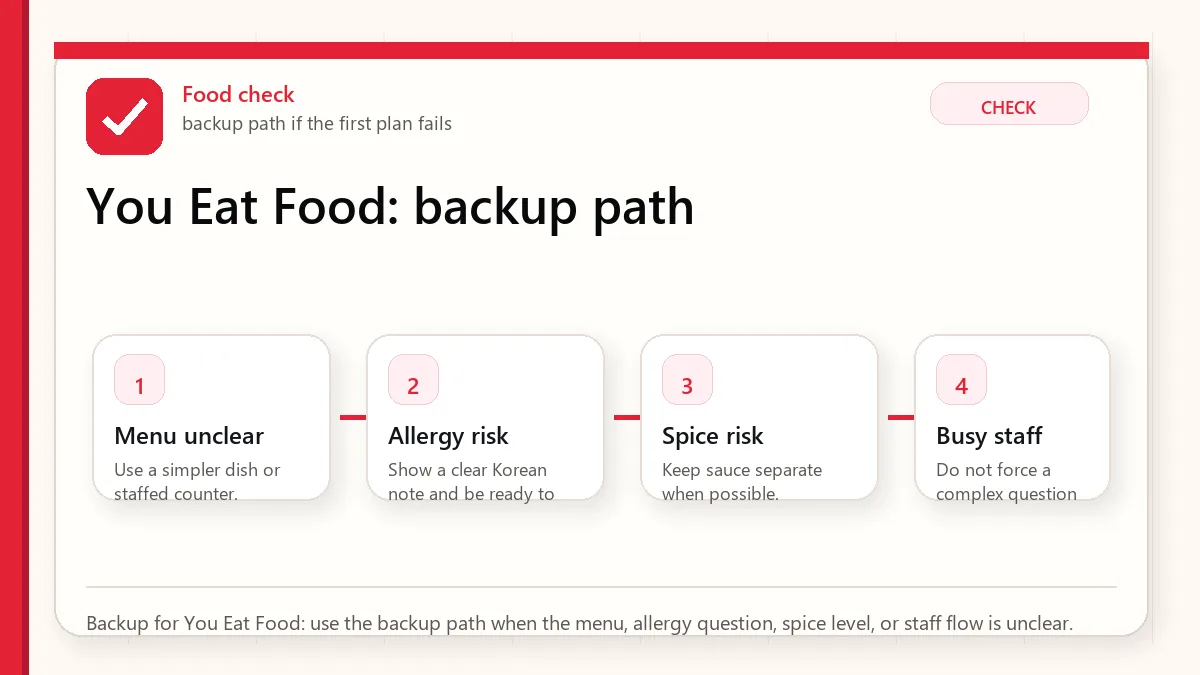
    Layered red check backup flow graphic for You Eat Food.
    Backup for You Eat Food: use the backup path when the menu, allergy question, spice level, or staff flow is unclear.

    What this means in the real moment

    The kiosk has no English

    Use camera translation, match dish photos, or choose a staffed counter if the order has dietary risk.

    The food is too spicy

    Stop adding sauce, ask for plain rice or water, and choose milder dishes next time rather than trying to prove tolerance.

    You are unsure about allergens

    Do not rely on guessing. Use a written allergy card and choose simpler food or a different restaurant if staff cannot confirm.

    A safer way to make the decision

    SituationSafer defaultWhy
    First-time touristStart with ordering flow and BBQ basicsThe mechanics are often more confusing than the dish names
    Sensitive eaterRead allergy and spice guides before restaurant listsHidden sauces and broths matter
    Budget travelerUse convenience stores and simple restaurants carefullyCheap meals can still be satisfying with the right expectations

    Sources to re-check

    Use these pages for facts that can change by date, operator, airport, app version, store, or traveler status.

    Where to go next

    FAQ

    Do Korean restaurants expect tipping?

    Tipping is generally not customary in Korea. Check the bill and local context rather than importing tipping habits from home.

    Are allergies easy to communicate?

    They can be difficult. Use Korean written notes, simple dishes, and avoid high-risk restaurants when the consequence would be serious.

    Is Korean BBQ hard for first timers?

    Not if you understand portions, shared side dishes, and whether staff or guests handle the grill.
  • Korean Street Food Guide

    Korean Street Food Guide

    Start with the moment you order

    Try Korean street food in small portions first, bring small cash, watch how locals order, check spice and allergens, and choose stalls that look busy, clean, and organized. Street food is fun, but it is still food handling in a fast-moving environment.

    Last checked: June 1, 2026. Re-check the latest product label, restaurant information, and official/public database before acting, because routes, prices, labels, rules, app screens, eligibility, and store/service policies can change.

    Street food is best when you keep the first order small

    The pleasure of Korean street food is the quick, informal try. The risk is treating a crowded stall like a slow restaurant: too many questions, too much food, no cash, unclear spice, or allergy uncertainty. A small first order keeps the experience fun and reversible.

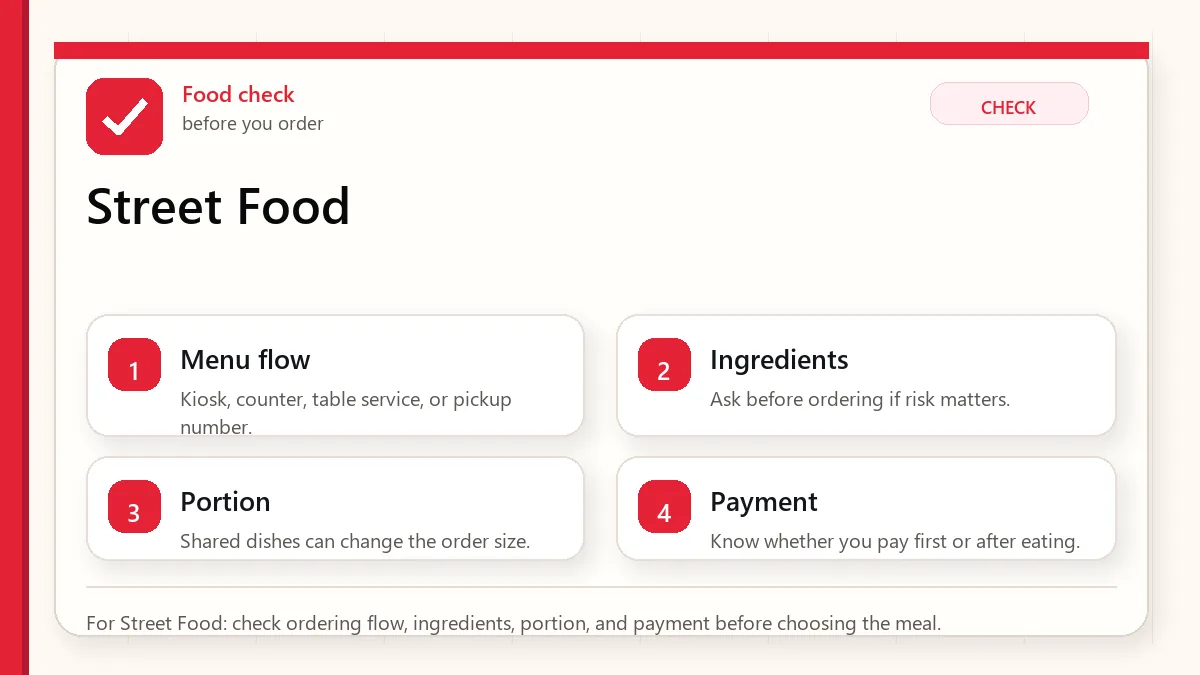
    Layered red check decision graphic for Street Food.
    For Street Food: check ordering flow, ingredients, portion, and payment before choosing the meal.

    Common street food and what to check

    FoodWhy visitors try itCheck first
    TteokbokkiIconic spicy rice cakes.Spice level and sauce intensity.
    Eomuk/fish cakeWarm, quick snack.Seafood base and broth.
    HotteokSweet filled pancake.Heat, nuts, and oil.
    GimbapPortable rice roll.Filling, freshness, and storage.
    Fried snacksEasy sharing food.Oil freshness and sauce.

    Checks before stepping up to the stall

    • Carry small cash in case card is not accepted.
    • Use translation for allergies and dietary limits.
    • Start with one or two items, not a full table of food.
    • Watch ordering flow before stepping forward.
    • Avoid stalls if food handling or storage makes you uncomfortable.

    Order without blocking the stall flow

    • Choose a stall with steady turnover and clean handling.
    • Point or order simply.
    • Confirm quantity before payment.
    • Eat hot foods carefully; fillings and broth can burn.
    • Dispose of skewers, cups, and trash where the stall or area provides.
    • Move aside after ordering so others can buy.
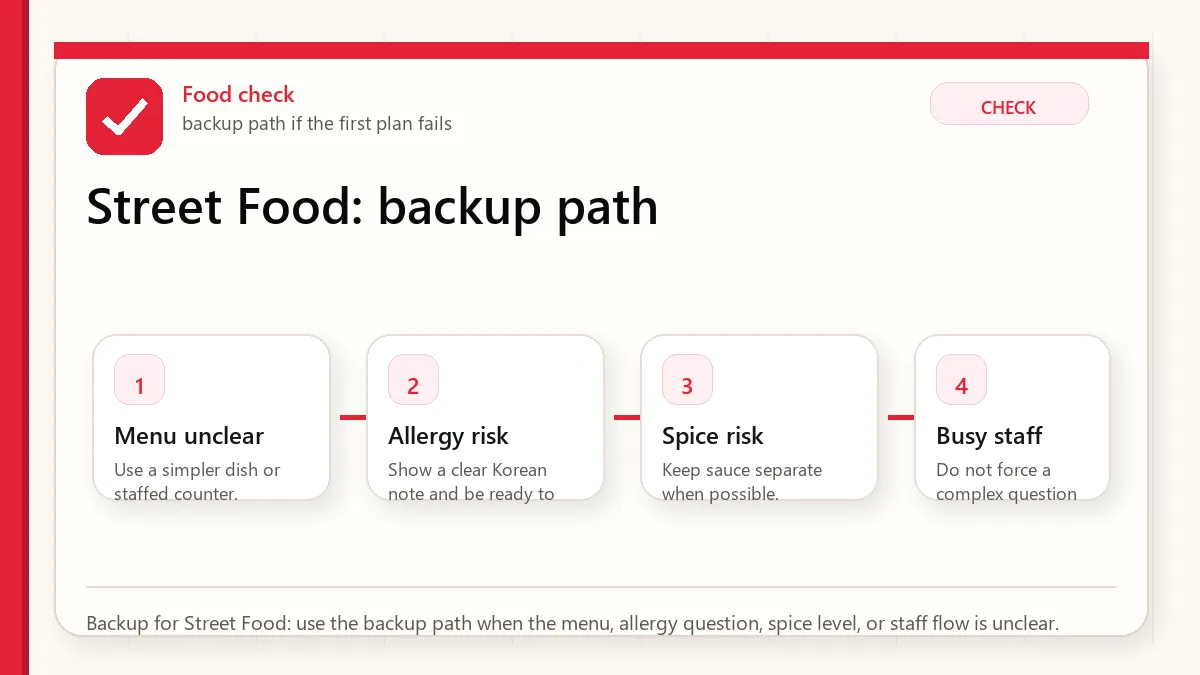
    Layered red check backup flow graphic for Street Food.
    Backup for Street Food: use the backup path when the menu, allergy question, spice level, or staff flow is unclear.

    Where street food plans usually go wrong

    You order too much

    Street food is best sampled. Share or buy in small rounds.

    It is spicier than expected

    Stop early, drink water, and choose a mild next item.

    You have a serious allergy

    If the stall cannot confirm ingredients, skip it. Shared oil and utensils can be a risk.

    No trash bin is visible

    Keep packaging until you find proper disposal rather than leaving it nearby.

    Choose the stall based on your risk level

    SituationBetter approachWhat to verify
    First-time visitorTry mild and popular items first.Spice and payment.
    Food market visitShare multiple small dishes.Crowds and hygiene.
    Winter tripWarm snacks and broth can be appealing.Heat and seafood ingredients.
    Dietary restrictionsUse dedicated restaurants when possible.Hidden broth and shared utensils.

    What not to assume from a busy line

    • Do not assume every street food stall accepts cards.
    • Do not assume seafood-free unless confirmed.
    • Do not assume mild-looking food is not spicy.
    • Do not assume trash disposal is obvious in every area.

    Small stall details that make street food easier to enjoy

    Street food is easiest when you keep the order simple

    Busy stalls are not the best place for a long custom order. Pointing, using the item name, asking price first, and stepping aside after paying usually works better than trying to redesign the dish. If you need allergy or dietary confirmation, a restaurant with staff time and clearer ingredients may be safer than a crowded stall.

    Use the crowd as one signal, not the only signal

    A line can suggest popularity, but visitors should still notice food handling, turnover, posted prices, and whether the stall looks set up for quick service. If the item is unfamiliar, start with a small portion and avoid buying multiple spicy or oily foods at once. Street food is best treated as a snack path, not as a full plan when you have strict food limits.

    Read next when street food connects to spice, cash, or ordering

    This topic works best when it is not handled alone. Use the related guides below to connect the decision with maps, money, food, shopping, transit, and app backup planning.

    Related Before Korea guides

    FAQ

    Is Korean street food safe?

    Many visitors enjoy it, but use basic judgment: turnover, cleanliness, heat, storage, and your own dietary risks.

    Do street food stalls take cards?

    Some may, but small cash is a safer backup.

    What should spice-sensitive visitors try first?

    Start with non-red, sweet, or grilled items and ask before ordering red-sauce dishes.

    Source links to verify

    Last updated

    Last updated: 2026-05-23. Re-check official sources close to the day you travel, buy, eat, or use an app. Details involving prices, eligibility, transport, app features, opening hours, and refund rules can change.

  • Korean Convenience Store Food Guide

    Korean Convenience Store Food Guide

    Start with the moment you order

    Korean convenience stores are useful for quick meals, snacks, drinks, transit top-ups, and late-night basics. For food, the key is reading labels, understanding heating or self-service steps, checking allergens, and not assuming every store has seating or English help.

    Search intent check: korean convenience store food

    Searchers arriving for korean convenience store food usually want a fast official-source path, not a broad background article. The page should make the next check obvious in the first screen.

    • Traveler Decision: make this visible near the top of the page.
    • App Or Official Source: make this visible near the top of the page.
    • Backup Plan Before Arrival: make this visible near the top of the page.

    Operating note: this section was added after global Keyword Planner review so the page better matches the main query cluster.

    Last checked: June 1, 2026. Re-check the latest product label, restaurant information, and official/public database before acting, because routes, prices, labels, rules, app screens, eligibility, and store/service policies can change.

    The store is easy, but the small rules still matter

    Korean convenience stores are useful because they are fast, bright, and everywhere. The reader problem is not finding food. It is knowing how to heat it, where to eat it, how to read enough of the label, and how to avoid making a mess of the store flow.

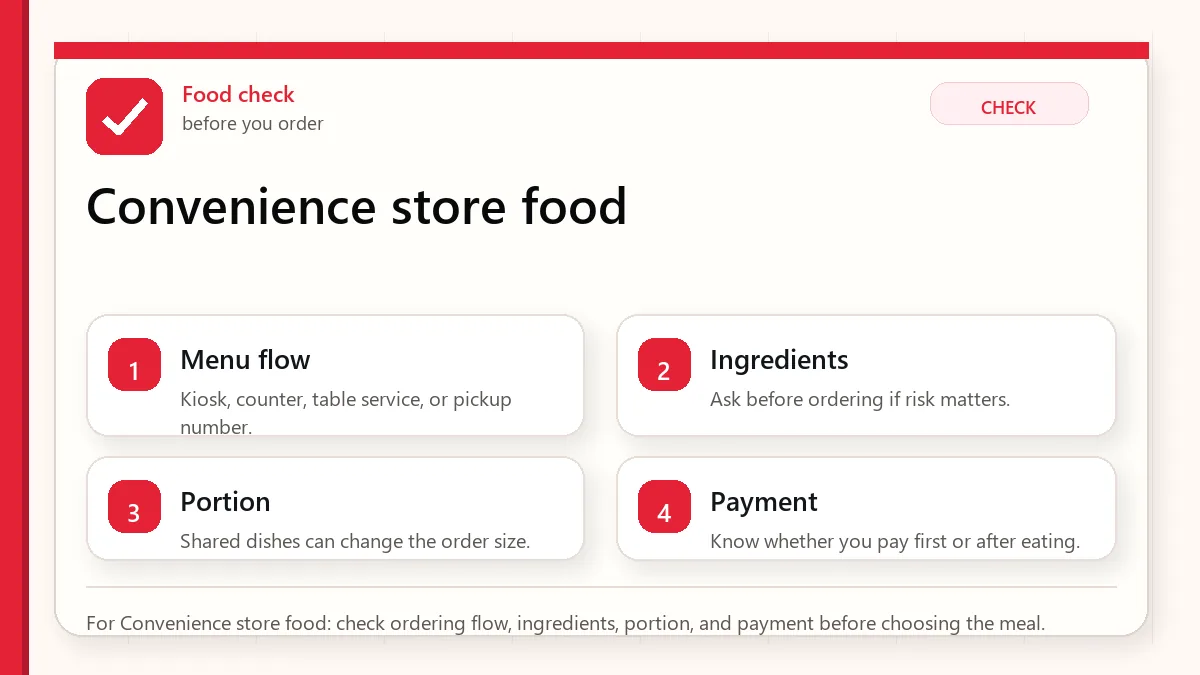
    Layered red check decision graphic for Convenience store food.
    For Convenience store food: check ordering flow, ingredients, portion, and payment before choosing the meal.

    Convenience store food types

    Food typeWhy it is usefulCheck
    Cup ramyeonEasy, cheap, and iconic.Spice level, hot water station, eating area.
    Dosirak lunch boxMore complete quick meal.Heating instructions and ingredients.
    Gimbap or triangle ricePortable meal or snack.Filling, expiry time, and refrigeration.
    Drinks and coffeeQuick caffeine and hydration.Sugar, dairy, and size.
    Desserts/snacksGood souvenirs and easy gifts.Allergens, fragility, and customs at home.

    Checks before heating or eating

    • Use translation for labels if you have allergies or dietary restrictions.
    • Check expiry date and whether the item needs heating.
    • Look for seating before opening hot food.
    • Carry a payment backup.
    • Avoid assuming every product is mild because the package looks cute.

    Use the store without disrupting the flow

    • Choose item and check whether it is refrigerated, frozen, or shelf-stable.
    • Read heating instructions or ask staff if unsure.
    • Use hot water and microwave areas carefully and cleanly.
    • Eat only where seating or store rules allow.
    • Dispose of packaging in the right bins if provided.
    • Save names of products you liked for later shopping.
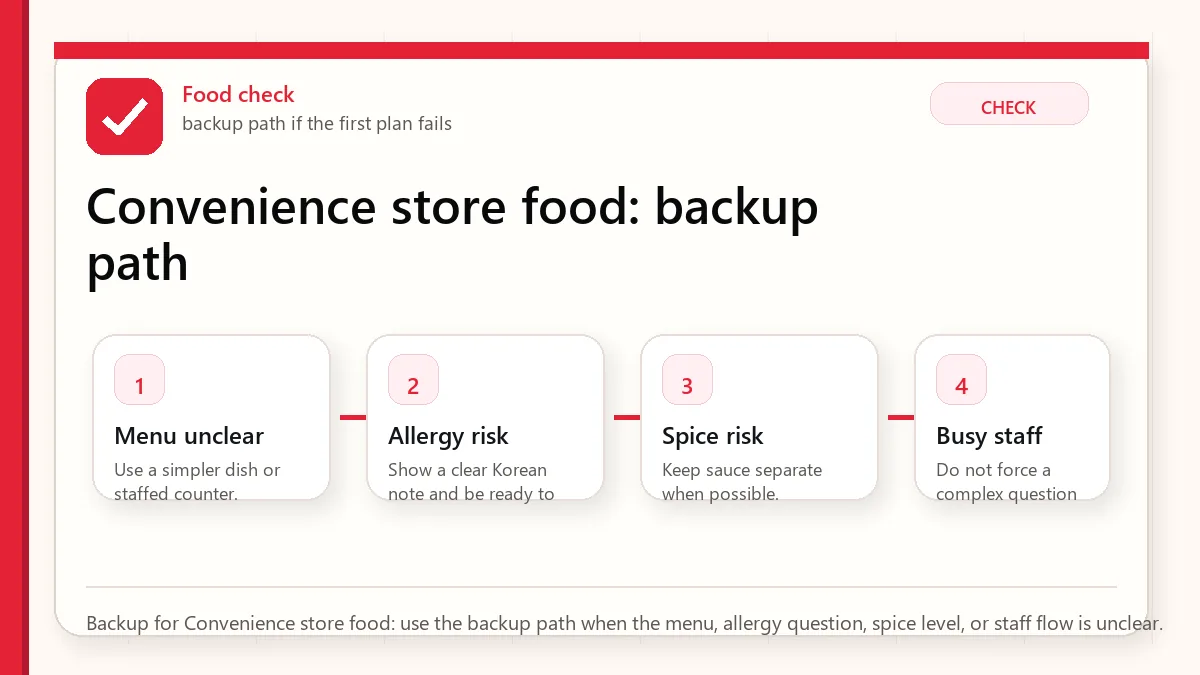
    Layered red check backup flow graphic for Convenience store food.
    Backup for Convenience store food: use the backup path when the menu, allergy question, spice level, or staff flow is unclear.

    Where convenience-store food gets confusing

    You bought the wrong spicy item

    Start with smaller portions and use translation for flavor names.

    You do not know how to heat it

    Look for microwave time icons or ask staff with the package in hand.

    No seating is available

    Do not open messy food until you know where you can eat it.

    Allergen risk is unclear

    Choose safer packaged items with readable labels or skip it.

    Choose food based on how much certainty you need

    SituationBetter approachWhat to verify
    Late-night arrivalUse convenience store for simple food and water.Payment and hotel eating rules.
    Budget mealChoose dosirak or gimbap with drink.Heating and expiry.
    Food souvenirChoose sealed snacks.Customs rules and fragility.
    Spice-sensitiveAvoid famous spicy products first.Flavor and chili warnings.

    What not to assume from packaging or photos

    • Do not assume every convenience store has seats.
    • Do not assume staff can explain ingredients in English.
    • Do not assume all ramyeon is equally spicy.
    • Do not assume public trash disposal is the same as your home country.

    Small store details that make the experience cleaner

    Convenience stores work best when you understand the self-service flow

    Many stores are designed for fast decisions. Choose the item, pay, use the microwave or hot-water area if available, eat only where seating is allowed, and clean up without leaving packaging behind. If you are not sure whether an item should be heated before or after paying, watch another customer or ask with a simple phrase.

    Labels are helpful but not complete for every visitor need

    Package labels can help with calories, allergens, expiry dates, and cooking instructions, but translated text can be incomplete or awkward. If you have a strict allergy, religious food rule, or medical restriction, convenience-store food should be approached carefully. Choose simpler packaged items where ingredients are easier to confirm, and use a translation app as a support tool rather than a guarantee.

    Read next when convenience food connects to translation or payment

    This topic works best when it is not handled alone. Use the related guides below to connect the decision with maps, money, food, shopping, transit, and app backup planning.

    Related Before Korea guides

    FAQ

    Can I eat inside Korean convenience stores?

    Some stores have seating, some do not. Check before opening food that needs a table.

    Are labels available in English?

    Not always. Use translation and avoid risky foods if allergies are serious.

    Can convenience stores top up transit cards?

    Many convenience stores can help with transport cards, but details vary by card and store.

    Source links to verify

    Last updated

    Last updated: 2026-05-23. Re-check official sources close to the day you travel, buy, eat, or use an app. Details involving prices, eligibility, transport, app features, opening hours, and refund rules can change.

  • Korean Spicy Food Levels

    Korean Spicy Food Levels

    Start with the moment you order

    Korean spicy food is not one fixed level. Spice depends on dish, sauce, restaurant, broth, and whether chili paste, chili powder, or fresh peppers are used. If you are sensitive, choose known mild dishes, ask about spice before payment, and avoid assuming red color is the only clue.

    Last checked: June 1, 2026. Re-check the latest product label, restaurant information, and official/public database before acting, because routes, prices, labels, rules, app screens, eligibility, and store/service policies can change.

    The problem is not spice itself, but surprise spice

    Spicy Korean food can be part of the fun, but it is better when you choose the level instead of discovering it too late. This guide is for reading menu clues, controlling sauce, and keeping one mild option available so the meal stays enjoyable.

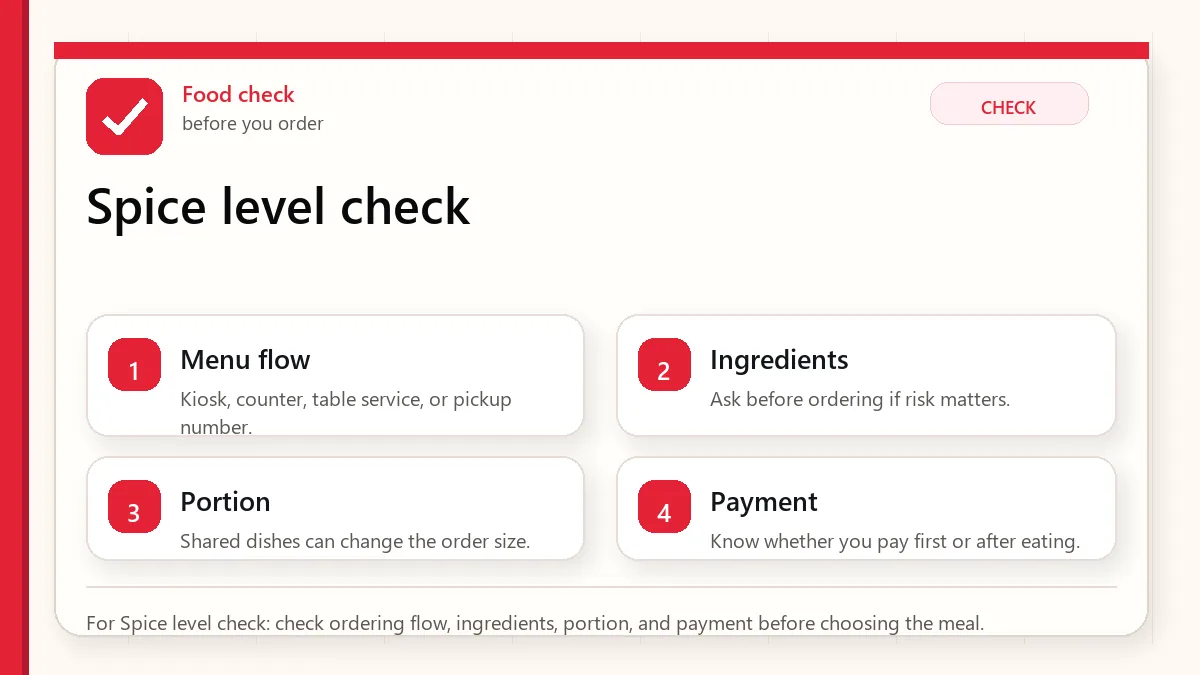
    Layered red check decision graphic for Spice level check.
    For Spice level check: check ordering flow, ingredients, portion, and payment before choosing the meal.

    Spice risk by dish type

    Dish or categorySpice riskSafer move
    TteokbokkiOften spicy-sweet and sauce-heavy.Ask for mild if available or share a small portion.
    Kimchi dishesCan be mild to hot depending on stew, fried rice, or side dish.Ask whether the dish is spicy, not just whether it includes kimchi.
    Fried chicken saucesSauce can change the whole dish.Order sauce separate or choose plain/soy/garlic style.
    Soups and stewsBroth heat can build slowly.Choose clear or non-red broths when unsure.
    Convenience foodsPackage images and names may exaggerate or hide heat.Use translation and start with smaller servings.

    Checks before ordering something red or sauced

    • Know your own spice tolerance honestly.
    • Save a phrase for ‘not spicy’ or ‘mild’.
    • Check whether sauce can be served separately.
    • Keep rice, dairy drink, or mild side dish as backup if available.
    • Do not order the viral spicy item as your first meal after arrival.

    Explore spice without turning the meal into a test

    • Look for red sauces, chili icons, and words related to spicy heat.
    • Ask staff or use translation before ordering.
    • Start with shared portions when trying spicy street food.
    • Avoid stacking spicy soup, spicy side dishes, and spicy main dish in one meal.
    • If a dish is too hot, stop early rather than forcing it.
    • Record safe dishes you liked for later meals.
    Layered red check backup flow graphic for Spice level check.
    Backup for Spice level check: use the backup path when the menu, allergy question, spice level, or staff flow is unclear.

    Where spice surprises visitors

    The first bite seems fine but heat builds

    Slow down. Soups and sauces can build over several minutes.

    You cannot explain spice tolerance

    Use simple words like mild or not spicy, plus translation. Avoid long explanations in a busy line.

    The dish cannot be made mild

    Choose another dish instead of asking for a version the restaurant does not make.

    You bought a very spicy convenience item

    Treat it as a tasting item, not a full meal, and have water or a mild snack ready.

    Choose the right caution for the dish

    SituationBetter approachWhat to verify
    Low spice toleranceStart with non-red dishes and sauce separate.Hidden chili in marinades or side dishes.
    Food adventurerTry spicy items in small portions first.Do not schedule intense food before long transit.
    Group mealOrder one spicy dish and other mild dishes.Shared tolerance differs.
    Sensitive stomachAvoid spice-heavy meals on arrival day.Travel fatigue and dehydration.

    What not to assume about color and heat

    • Do not assume all Korean food is spicy.
    • Do not assume every red dish is equally spicy.
    • Do not assume ‘mild’ means the same thing to every restaurant.
    • Do not assume you can return food because it is too spicy.

    Small choices that make spicy food easier to enjoy

    Color is only a rough clue

    A red dish can be mild, sharp, sweet, smoky, or extremely hot depending on sauce, chili paste, pepper powder, broth, and cooking style. The safest approach is to combine clues: menu wording, staff warning, dish category, sauce amount, and whether the food is served with broth. If you are sensitive to spice, do not gamble on a large shared dish as your first test.

    Build an escape route into the order

    A practical meal plan includes at least one less-spicy item, rice, soup, or side that gives you a break. Ask for sauce on the side where that makes sense, and avoid stacking spicy stew, spicy noodles, and spicy side dishes in the same meal. Visitors often enjoy Korean food more when spice is treated as a choice to explore gradually rather than a challenge to survive.

    Read next when spice connects to BBQ, ordering, or translation

    This topic works best when it is not handled alone. Use the related guides below to connect the decision with maps, money, food, shopping, transit, and app backup planning.

    Related Before Korea guides

    FAQ

    Is Korean food always spicy?

    No. Korea has many mild dishes, soups, noodles, rice dishes, grilled meats, and snacks.

    Can restaurants make spicy food mild?

    Sometimes, but not always. Some sauces and broths are prepared in advance.

    What should I order if I cannot eat spice?

    Look for grilled meats, plain rice dishes, non-red soups, some noodle dishes, or convenience foods with clear labels.

    Source links to verify

    Last updated

    Last updated: 2026-05-23. Re-check official sources close to the day you travel, buy, eat, or use an app. Details involving prices, eligibility, transport, app features, opening hours, and refund rules can change.

  • Korean BBQ Etiquette Guide

    Korean BBQ Etiquette Guide

    Start with the moment you order

    At Korean BBQ, treat the table as a shared cooking and eating space. Order enough for the group, follow the restaurant’s grill style, accept staff help when offered, use serving tools when provided, and do not treat side dishes or sauces as unlimited private plates.

    Last checked: June 1, 2026. Re-check the latest product label, restaurant information, and official/public database before acting, because routes, prices, labels, rules, app screens, eligibility, and store/service policies can change.

    The table rhythm that makes BBQ feel easier

    Korean BBQ is not difficult, but it is shared, fast-moving, and more structured than it may look at first. The useful preparation is knowing the minimum order, grill rhythm, staff help, side dishes, and payment flow before everyone at the table is already waiting.

    Layered red check decision graphic for Korean BBQ table flow.
    For Korean BBQ table flow: check ordering flow, ingredients, portion, and payment before choosing the meal.

    Korean BBQ table basics

    MomentWhat to doWhy
    OrderingCheck minimum order and portion style.Many BBQ restaurants expect meat orders by portion or person.
    GrillingLet staff guide you if they manage the grill.Some restaurants prefer staff to cook or cut meat.
    SharingUse tongs/scissors/serving tools when available.The table is shared, so hygiene and flow matter.
    Side dishesAsk politely for refills if needed.Banchan is shared and should not be wasted.
    PaymentCheck whether payment happens at table or counter.Restaurant flow varies.

    Checks before the first order

    • Check whether the restaurant specializes in beef, pork, chicken, or another style.
    • Look for minimum order notes if eating alone.
    • Prepare allergy or dietary phrases if needed.
    • Do not assume every BBQ restaurant has the same grill rules.
    • Carry a backup payment method.

    Move through the meal without making it awkward

    • Order meat based on group size and appetite.
    • Wait for staff instructions before adjusting unfamiliar grill equipment.
    • Use separate tools for raw meat and cooked meat when provided.
    • Wrap cooked meat with lettuce, sauces, and side dishes if you like, but do not overfill shared plates.
    • Order additional items after seeing portion size.
    • Check final bill before leaving.
    Layered red check backup flow graphic for Korean BBQ table flow.
    Backup for Korean BBQ table flow: use the backup path when the menu, allergy question, spice level, or staff flow is unclear.

    Where first BBQ meals usually get uncomfortable

    You are not sure who cooks

    Pause and watch staff. If they start cooking, let them. If not, cook carefully and ask if unsure.

    You are dining alone

    Some BBQ restaurants have minimum orders or may be less solo-friendly. Check before entering.

    You have dietary restrictions

    Korean BBQ can involve shared grills, marinades, seafood sauces, or side dishes. Confirm ingredients rather than guessing.

    Smoke or smell bothers you

    Choose a restaurant with ventilation, avoid delicate clothing, and plan accordingly.

    Read the table before changing the flow

    SituationBetter approachWhat to verify
    First-time groupChoose a popular restaurant with staff-guided grilling.Minimum order and payment method.
    Solo travelerSearch for solo-friendly BBQ or non-grill alternatives.Minimum portion and seating policy.
    Pork restrictionConfirm meat type and shared grill risk.Marinades and side dishes.
    Budget travelerCheck menu price before sitting.Per-portion pricing and add-ons.

    What not to assume at a BBQ restaurant

    • Do not assume every side dish is vegetarian.
    • Do not assume staff will cook at every restaurant.
    • Do not assume one portion equals one full meal for every person.
    • Do not assume all sauces are mild or allergy-safe.

    Small table details that make the meal feel smoother

    The minimum order sets the meal

    Many Korean BBQ restaurants expect a minimum amount of meat, often based on portions or people. A visitor who orders too little can create confusion before the meal even starts. Check the menu structure first: meat type, portion size, minimum order, side dishes, stew, rice, and whether staff help with grilling. This makes the meal feel calmer and more respectful.

    Let the table flow guide you

    BBQ is social and shared, so the rhythm matters. Tongs, scissors, grill changes, side dishes, wrapping vegetables, and staff assistance all have a flow. If staff are managing the grill, let them. If your table is expected to cook, turn pieces carefully and avoid mixing raw and cooked utensils where separate tools are provided. When unsure, watching nearby tables usually helps.

    Read next when BBQ connects to ordering, spice, or etiquette

    This topic works best when it is not handled alone. Use the related guides below to connect the decision with maps, money, food, shopping, transit, and app backup planning.

    Related Before Korea guides

    FAQ

    Do staff cook Korean BBQ for you?

    Sometimes. It depends on the restaurant and meat style. Follow staff cues and ask politely if unsure.

    Can I eat Korean BBQ alone?

    Sometimes, but some places have minimum orders. Solo-friendly BBQ or non-grill meat restaurants may be easier.

    Are side dishes free?

    Many restaurants provide banchan and may refill some items, but do not waste food and ask politely.

    Source links to verify

    Last updated

    Last updated: 2026-05-23. Re-check official sources close to the day you travel, buy, eat, or use an app. Details involving prices, eligibility, transport, app features, opening hours, and refund rules can change.