The safest way to pay in Korea is to carry a small stack, not one perfect method: a primary international card, a second card stored separately, some Korean won, and a transportation card plan for subway and bus travel. Cards are widely accepted, but a foreign card can still fail at one kiosk, one small shop, or one ATM. When that happens, switch payment routes instead of repeating the same transaction.
This guide is for the actual checkout moment: deciding what to present, reading a currency choice, handling a declined card, and knowing when cash or a staffed counter is the sensible fallback. It does not promise that a particular card, wallet, ATM, or app will work. Acceptance, fees, card-network support, machine software, and issuer security controls can change.
Build a payment stack before the first purchase
Set up four separate jobs. Your main card handles most purchases. A second card protects you from an issuer block or network problem. Korean won covers cash-only moments and transit-card top-ups. A transportation card handles ordinary subway and bus gates. Keeping those jobs separate makes a single failure inconvenient rather than trip-stopping.
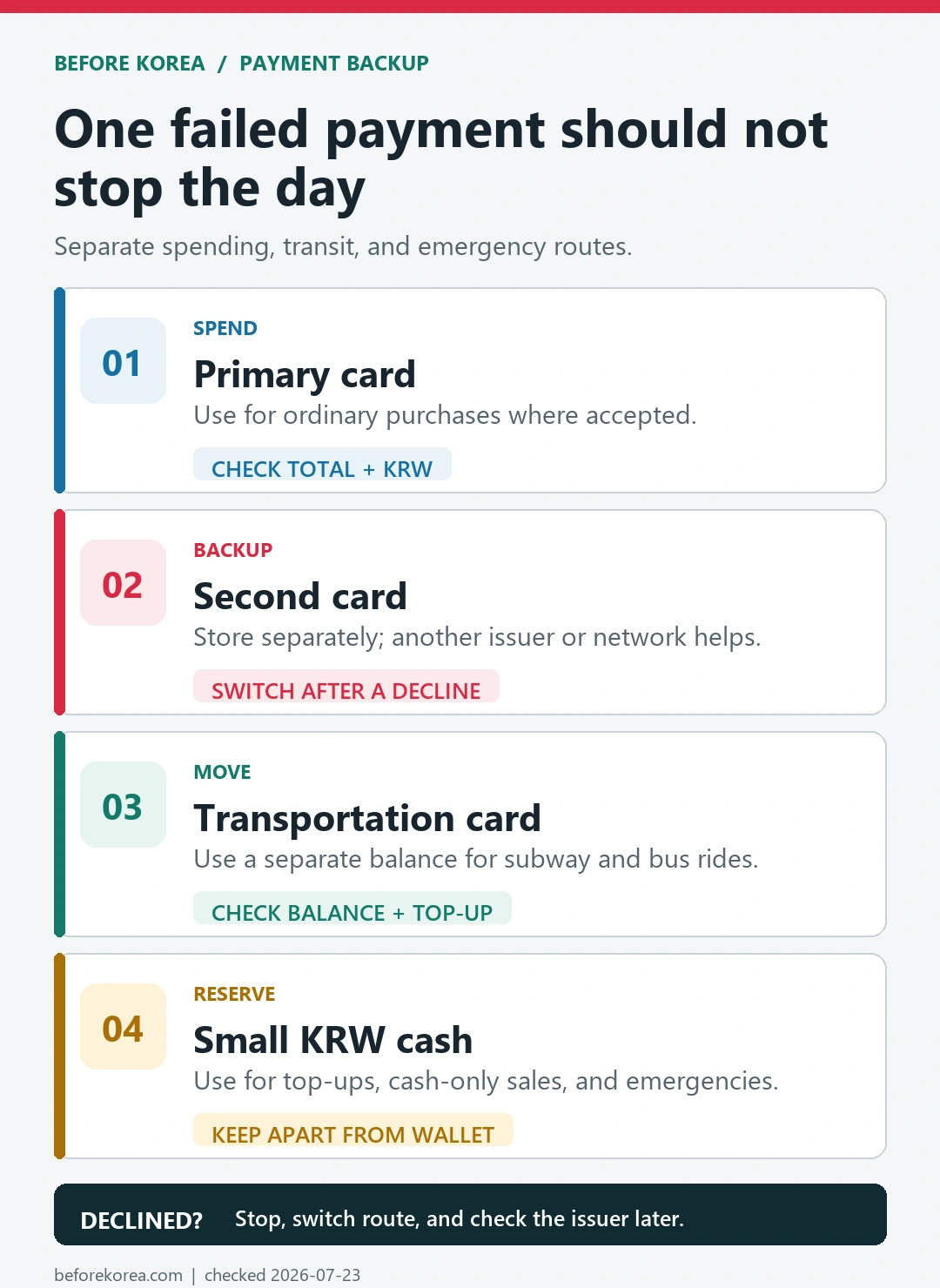
| Payment tool | Use it for | Do not expect it to solve |
|---|---|---|
| Primary international card | Hotels, larger shops, restaurants, and many everyday purchases | Every unattended kiosk, local app, or transit-card top-up |
| Second card | A decline, lost card, damaged chip, or network exception | A problem that affects the same issuer or account |
| Small amount of KRW cash | Cash-only vendors, top-ups, and an immediate fallback | Lost-wallet protection or large documented purchases |
| Transportation card | Routine subway and bus rides | All retail purchases or every intercity ticket |
Before departure, confirm that overseas purchases and cash withdrawals are enabled, learn the correct PIN, check the issuer’s foreign-transaction and ATM fees, and save the issuer’s contact number somewhere you can reach without the card. If possible, use cards from different networks or issuers and keep them in different places. A phone wallet is convenient only when the phone, merchant terminal, card issuer, and wallet service all cooperate, so it should not be your only route.
Use cards widely, but plan for the exception
The Korea Tourism Organization says credit cards are widely used at major hotels, department stores, and general shops, while advising travelers to check availability before a purchase. Its shopping guidance also notes that some traditional-market businesses and street shops may accept only cash. The practical reading is not “cards always work” or “Korea requires cash.” It is “start with a card, then keep a modest cash fallback.”
Look for the card-network logos on the door, register, or terminal, but treat them as an indication rather than a guarantee. A foreign-issued card may work at a staffed register and fail at the merchant’s self-service kiosk. Contactless payment may be enabled on one terminal and unavailable on the next. If the terminal asks for a signature or PIN, follow that terminal and your card issuer’s instructions rather than copying the customer before you.
- Before ordering: ask whether your card is accepted when you do not have another way to pay.
- At a staffed register: let the cashier see the physical card if tapping or inserting it yourself is unclear.
- At a kiosk: move to a staffed counter after one clean retry with another card; do not build a queue while forcing the same failed route.
- For a large purchase: check the amount and currency before approving, then keep the receipt until the transaction appears correctly.
Read the terminal before you approve the charge
A card terminal or ATM may offer to convert the amount into your home currency. This is dynamic currency conversion, usually shortened to DCC. Visa explains that a DCC screen should show the amount in local and home currency, the exchange rate, and any additional fee or markup, and that the customer must be allowed to accept or decline the conversion.
In Korea, the local currency is Korean won (KRW). Paying in KRW leaves the conversion to your card issuer; choosing your home currency uses the rate offered at the terminal or ATM. Neither choice should be made from the flag icon or the apparently familiar number alone. Compare the displayed rate and markup with your issuer’s terms. If the conversion details are missing or the choice is being made for you, stop and ask for the transaction in KRW or cancel before approval.
- Confirm the purchase or withdrawal amount in KRW.
- Identify whether the second amount is an optional home-currency conversion.
- Read the exchange rate and extra fee or markup, if shown.
- Choose deliberately; do not let a cashier, terminal, or ATM choose the currency without your consent.
- Check the approved currency on the receipt and keep it if the amount matters.
A cancelled prompt is safer than approving an amount you do not understand. If the screen is moving too quickly, ask the cashier to restart or use a different payment method.
Keep Korean won for the gaps cards do not cover
You do not need to carry the whole trip budget in cash. Keep enough won for the next cash-dependent task, a small purchase, and a short emergency. Useful examples include a market stall that confirms it is cash-only, a transportation-card purchase or top-up, or food from a vendor whose card reader is unavailable.
The right amount depends on your route, accommodation, and risk tolerance, so a fixed “daily cash” figure becomes misleading quickly. Refill before you reach the last note, store emergency cash away from the main wallet, and avoid exchanging a large balance that you will need to spend down before departure.
For foreign-currency exchange, the Korea Tourism Organization directs visitors to banks or authorized exchange service centers and notes that bank hours and acceptance of older foreign banknotes can vary. Check the counter’s displayed rate, fee, hours, and receipt before handing over money. An airport counter can be convenient for arrival cash, but convenience alone does not establish the best rate.
Treat an ATM withdrawal as a checked transaction
Use an ATM that visibly supports international cards or displays a matching network logo. A “Global ATM” label is helpful, but it still does not guarantee that your exact card, issuer, PIN, withdrawal amount, or network will be accepted. Prefer a machine at a bank, airport, or other location where you can get help if the card is retained or the transaction does not complete normally.
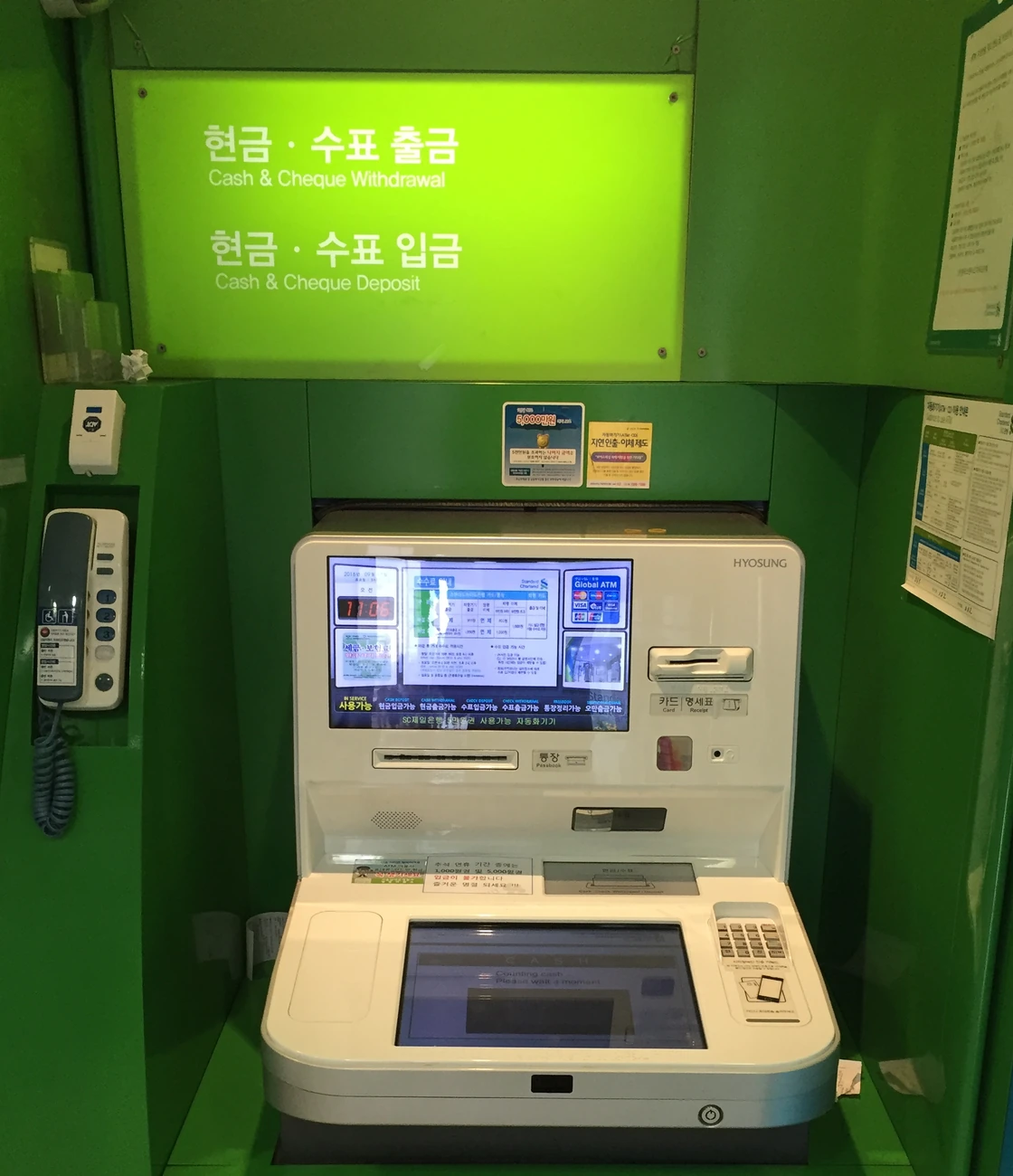

- Check that overseas ATM withdrawals are enabled and that you know the card’s PIN.
- Confirm the machine shows a network carried by your card.
- Choose the account type and withdrawal amount carefully; prompts differ by machine and issuer.
- Read the machine fee and any currency-conversion offer before accepting.
- Take the card, cash, and receipt, then confirm the withdrawal in your banking app when safe.
If the machine declines the card, do not repeat the same request several times. Check the issuer app for a security block, reduce the requested amount if a limit may be involved, or try a different bank’s international ATM. Stop if the amount, currency, or fee is unclear. The companion Cash, Cards, and ATMs in Korea guide covers withdrawal and exchange planning in more depth.
Keep transit payment separate from ordinary shopping
A foreign card that buys dinner does not automatically work as a tap-in card at a subway gate or bus reader. The Korea Tourism Organization’s 2026 transportation guide separates ordinary foreign-card payment from transit-card use. It lists foreign-issued card acceptance for several ticket machines and counters, but directs routine subway and bus users to a transportation card; it also lists cash for standard prepaid T-money purchase or top-up.
Equipment is changing, so use the machine and route in front of you as the final check. A new ticket machine that accepts a foreign card for one ticket is not proof that every station machine accepts it, and it does not turn the same bank card into a normal bus or subway tap card. Set up a transportation card early, keep enough cash for a top-up, and check the balance before a transfer-heavy day.
See T-money Card in Korea for purchase, top-up, balance, transfer, and refund decisions. Recheck the current transportation provider when a particular pass or foreign-card feature is essential to your route.
Recover quickly when a card, kiosk, or app fails
A card is declined at a staffed register
Check that the amount is correct, then use the second card or cash. Look at the issuer app after moving away from the register. A decline does not tell you whether the cause was the merchant terminal, card network, issuer setting, fraud control, or available balance.
The kiosk rejects a card that worked elsewhere
Use a staffed counter if one exists. The merchant may be able to process the same purchase through a different terminal. If there is no staff and the transaction is not essential, leave rather than trying several unclear prompts or entering card details repeatedly.
A local app will not accept your card or identity check
Switch to the merchant’s website, a traveler-facing service, phone assistance, or in-person payment. Some services depend on a supported foreign card, phone number, identity check, or account configuration. Do not spend an hour forcing an app when a staffed route solves the actual need.
An ATM shows an unfamiliar fee or home-currency amount
Cancel before confirmation and compare another machine. Your own bank may add a separate withdrawal or foreign-transaction fee later, so the ATM screen is not always the full trip cost.
Match the payment method to the moment
| Situation | Start with | Check before committing |
|---|---|---|
| Airport arrival | Card for a supported ticket or service; small KRW backup | The exact machine, route, exchange rate, and operating hours |
| Hotel check-in | Physical card used for the booking | Deposit, preauthorization, accepted card, and final charge currency |
| Restaurant or cafe | International card | Total amount and whether payment is at the table or counter |
| Traditional market or street stall | Ask first; use small cash when required | Price and payment method before ordering |
| Convenience store | Card, with cash backup | Promotion result and total before approving |
| Subway or bus | Transportation card | Balance, top-up method, and route-specific ticket machine |
| ATM | International-enabled bank or airport ATM | Network, amount, machine fee, currency choice, and issuer limit |
| Online booking or local app | Foreign-card-friendly route | Authentication, refund terms, final currency, and confirmation |
For shopping that may qualify for a tourist tax refund, payment is only the first step. Store participation, eligibility, passport details, receipts, export confirmation, and the refund route can matter. Use the current Korea Tax Refund Guide before a major purchase rather than assuming the card transaction creates an automatic refund.
Questions travelers ask about paying in Korea
Are foreign credit cards widely accepted in Korea?
Yes, especially at major hotels, department stores, restaurants, and general shops, but acceptance is not universal. Carry a second card and some won for exceptions.
How much cash should I carry?
There is no reliable fixed amount for every traveler. Carry enough for your next cash-dependent purchase or transit top-up plus a small emergency, then replenish deliberately instead of holding the entire trip budget.
Can I tap my foreign bank card directly on the subway or bus?
Do not plan on a normal foreign bank card working as the standard subway or bus tap card. Use a transportation card unless the current operator explicitly supports another method for that route or machine.
Should I choose KRW or my home currency on a terminal?
Compare the displayed DCC rate and markup with your card issuer’s conversion and fees. KRW leaves conversion to the issuer; the home-currency option uses the rate offered at the terminal or ATM. Decline or cancel when the information is incomplete.
Can I rely only on a phone wallet or Korean payment app?
No. Support depends on the device, wallet, issuer, merchant terminal, and sometimes local account or identity requirements. Carry a physical card and cash backup.
Official sources and related Before Korea guides
For general card acceptance and authorized currency exchange, use the Korea Tourism Organization’s Korean Currency and Exchange information. Its Shopping in Korea guide explains the cash exception at some markets and street shops. The agency’s 2026 transportation and payment guide separates foreign-card ticket purchases from routine transportation-card use. Visa’s DCC explanation describes the currency choice and the information a conversion offer should display.
Continue with Cash, Cards, and ATMs in Korea, T-money Card in Korea, Korea Tax Refund Guide, and Before You Shop in Korea.
Sources checked August 24, 2026. Check the current terminal, ATM, operator, merchant, and card issuer before approval. Acceptance, fees, limits, exchange rates, app requirements, and transportation-payment features can change without this guide changing at the same time.