Tag: cards

  • Cash, Cards, and ATMs in Korea

    Cash, Cards, and ATMs in Korea

    Start with what can fail at payment

    Korea is card-friendly, but visitors should still carry some Korean won cash. Use cards for larger purchases when accepted, cash for backup and transit top-ups, and airport or authorized exchange services when you need money immediately after arrival.

    Last checked: June 1, 2026. Re-check the official provider, store, customs, or payment page before acting, because routes, prices, labels, rules, app screens, eligibility, and store/service policies can change.

    Money problems usually happen at the least convenient moment

    Korea is easy to pay in until the one exception appears: a foreign card block, an ATM that does not cooperate, a transit top-up that wants cash, or a small purchase where you did not prepare backup won. This guide is for keeping that exception small.
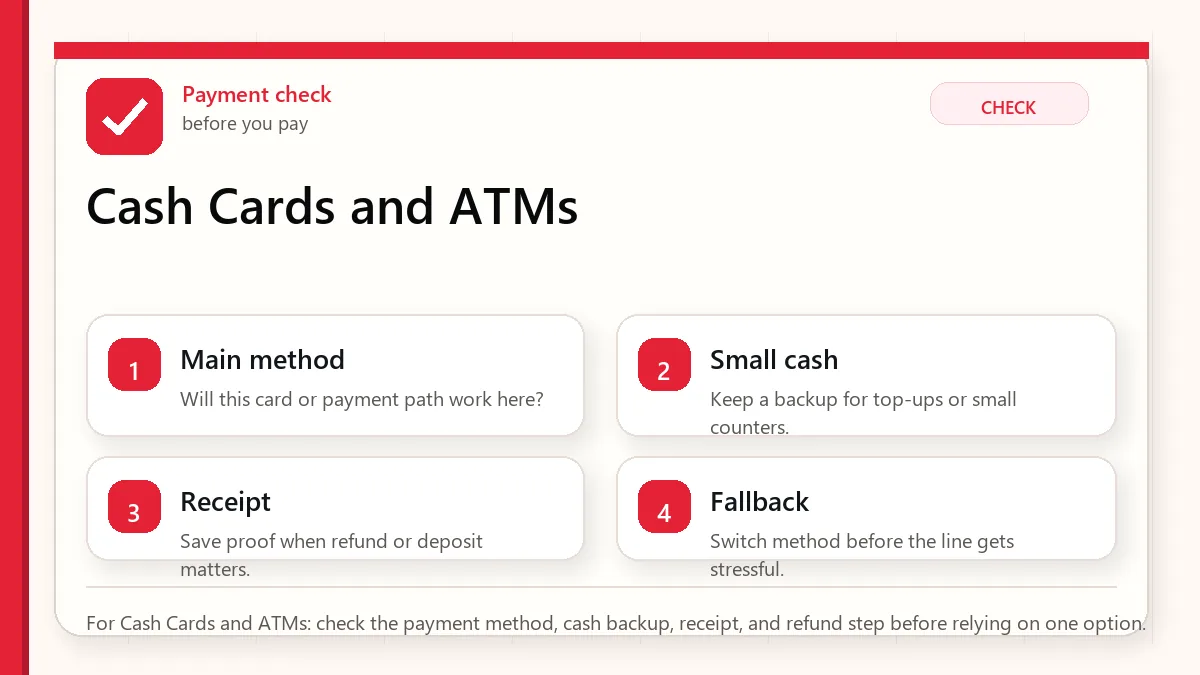
    Layered red check decision graphic for Cash Cards and ATMs.
    For Cash Cards and ATMs: check the payment method, cash backup, receipt, and refund step before relying on one option.

    Money tools for Korea visitors

    ToolUse it forRiskBackup
    Credit/debit cardHotels, shops, restaurants, online-style purchases.Foreign card rejection or bank block.Second card and cash.
    Korean won cashSmall shops, markets, transit top-ups, emergencies.Loss and over-exchanging.Carry modest amount.
    Airport exchangeImmediate arrival cash.Rates and hours vary.Check official airport bank info.
    ATM withdrawalGetting cash during trip.Machine compatibility and bank fees.Use bank/airport ATMs and know your bank settings.

    Checks before relying on your main card

    • Check your bank’s overseas card and ATM settings.
    • Bring more than one card if possible.
    • Carry enough arrival cash or exchange at airport.
    • Know your daily ATM limit and fees.
    • Separate backup card/cash from your main wallet.

    Carry money in a way that gives you options

    • Use official exchange or bank counters when exchanging significant amounts.
    • Withdraw a modest amount rather than carrying all trip cash.
    • Keep small notes for street food, markets, or transit top-up.
    • Keep receipts for major purchases and tax refund.
    • Check statements for foreign transaction fees.
    • If an ATM fails, try another bank/airport ATM rather than repeated attempts at one machine.
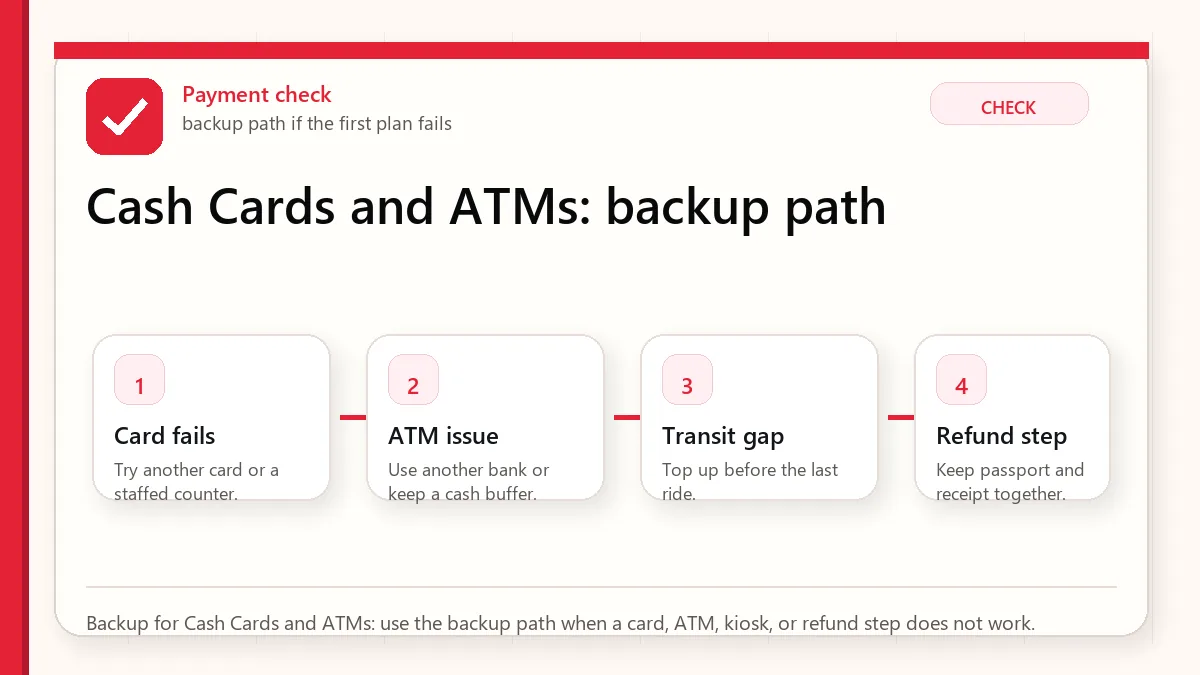
    Layered red check backup flow graphic for Cash Cards and ATMs.
    Backup for Cash Cards and ATMs: use the backup path when a card, ATM, kiosk, or refund step does not work.

    Where cash and ATM plans usually fail

    ATM rejects your card

    Check network logo, overseas withdrawal settings, and try a different bank ATM.

    Card fails at a kiosk

    Try staffed counter, another card, or cash if accepted.

    You run out of small cash

    Exchange or withdraw before late-night travel and transit card top-ups.

    You over-exchange

    Spend down cash on transport and small purchases before departure, but keep enough for airport needs.

    Use different money habits for different parts of the day

    SituationBetter approachWhat to verify
    Arrival dayExchange or withdraw enough for first-day backup.Airport exchange hours and route needs.
    Transit-heavy tripKeep cash for card top-ups if needed.Top-up method and balance.
    Shopping dayUse card and keep passport/receipt for tax refund.Refund eligibility.
    Market or street foodUse small cash.Card acceptance.

    What not to assume about ATMs and cash

    • Do not assume every ATM accepts every foreign card.
    • Do not assume Korea being card-friendly means cash is useless.
    • Do not assume exchange counters have identical hours.
    • Do not assume your bank will allow overseas transactions by default.

    Small money habits that prevent avoidable stress

    Plan money by moment, not by trip average

    A visitor rarely needs the same payment setup all day. Airport arrival, subway top-up, convenience-store snacks, restaurant bills, shopping receipts, and late-night taxis each create different risks. A practical plan is to separate money into moments: arrival cash, daily spending card, transit top-up cash, emergency reserve, and one backup card stored away from the main wallet.

    Check the weak points before you leave

    The most common failure is not that Korea is impossible for foreign cards; it is that one card, one ATM, one kiosk, or one bank setting fails at the wrong moment. Before departure, confirm overseas use with your bank, know your withdrawal limit, and keep the card issuer phone number somewhere offline. That preparation is boring, but it prevents a payment problem from becoming a travel problem.

    Read next when cash connects to payment, transit, or tax refund

    This topic works best when it is not handled alone. Use the related guides below to connect the decision with maps, money, food, shopping, transit, and app backup planning.

    Related Before Korea guides

    Official links to check

    Use these official links when the next step matters. This guide explains what to watch for, but app downloads, eligibility, prices, routes, policies, and service rules can change.

    FAQ

    Do I need cash in Korea?

    Yes, as backup. Cards are widely used, but cash can still matter for top-ups, small purchases, and emergencies.

    Where should I exchange money?

    VISITKOREA recommends banks or authorized exchange service centers, and airport exchange is often easiest on arrival.

    Are foreign cards accepted?

    Many major businesses accept international cards, but check availability and keep a backup.

    Source links to verify

    Last updated

    Last updated: 2026-05-23. Re-check official sources close to the day you travel, buy, eat, or use an app. Details involving prices, eligibility, transport, app features, opening hours, and refund rules can change.
  • Payment in Korea: Cards, Cash, ATMs

    Payment in Korea: Cards, Cash, ATMs

    Start with what can fail at payment

    Bring at least two ways to pay in Korea: an international card and a cash backup. Add a transportation card plan for subway and bus rides. Do not assume local mobile payment apps will work for every foreign visitor.

    A payment plan that survives the awkward counter moment

    Payment in Korea is usually easy until one card terminal, kiosk, transit machine, or app flow refuses to cooperate. The plan should assume a small failure will happen somewhere.

    AreaWhat to checkWhat to avoid
    Daily purchasesPrimary card plus backup card.Foreign card support can vary.
    TransitT-money/card top-up method and small cash.Transit is its own payment system.
    ATMsKnow one global-friendly ATM option before you need it.ATM fees and acceptance vary.
    ShoppingPassport/receipt plan for tax refund.Refund paperwork is harder to fix later.

    The checks that deserve your attention

    • Tell your bank about travel if needed.
    • Carry a second card separately.
    • Keep a small cash buffer.
    • Do not assume mobile wallet support everywhere.

    Failure cases to plan around

    • Card declined at kiosk.
    • Transit top-up requires cash.
    • ATM rejects a card.
    • Tax-refund receipt gets lost.

    Official and practical source checks

    Read next

    The payment moment visitors underestimate

    Payment usually feels simple until one machine, one card, or one app flow refuses to cooperate. This guide is for the moment at a kiosk, transit machine, small shop, restaurant counter, or ATM when a backup plan is more useful than another general tip.

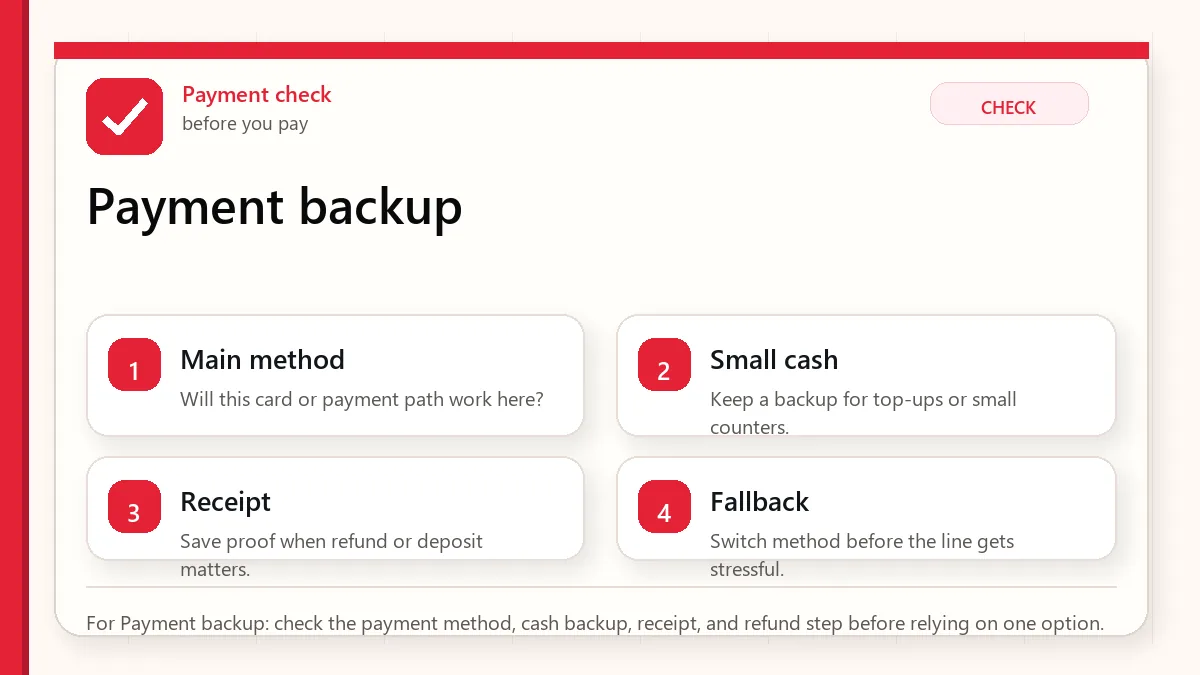
    Layered red check decision graphic for Payment backup.
    For Payment backup: check the payment method, cash backup, receipt, and refund step before relying on one option.

    Payment methods and where they fit

    MethodUseful forWeak pointBackup
    International credit/debit cardHotels, department stores, many shops and restaurants.Small stores or machines may reject some foreign cards.Second card and some cash.
    Korean won cashTransit card top-ups, small stores, street food, emergency fallback.Not ideal for large purchases or lost-wallet risk.Use modest amounts and keep separately.
    Transportation cardSubway and bus rides.It is not a full payment strategy.T-money guide
    Mobile payment appsSome local services and convenience flows.Local verification, account, or card requirements.Card/cash plus web alternatives.

    Checks worth doing before you rely on one card

    • Notify your bank if needed and check international transaction settings.
    • Carry more than one card on separate networks if possible.
    • Prepare Korean won cash for the first day.
    • Know how you will pay for subway and bus rides.
    • Read tax refund rules before major shopping.

    Build a simple payment backup plan

    • Use a card for larger, documented purchases when accepted.
    • Use cash as a backup, not as your only plan.
    • Set up a transit card early if using public transport.
    • Keep receipts for purchases that may involve refunds, tax refund, or returns.
    • If a kiosk rejects your card, try a staffed counter before assuming the store cannot serve you.
    • Review foreign transaction fees after the first day so surprises do not accumulate.
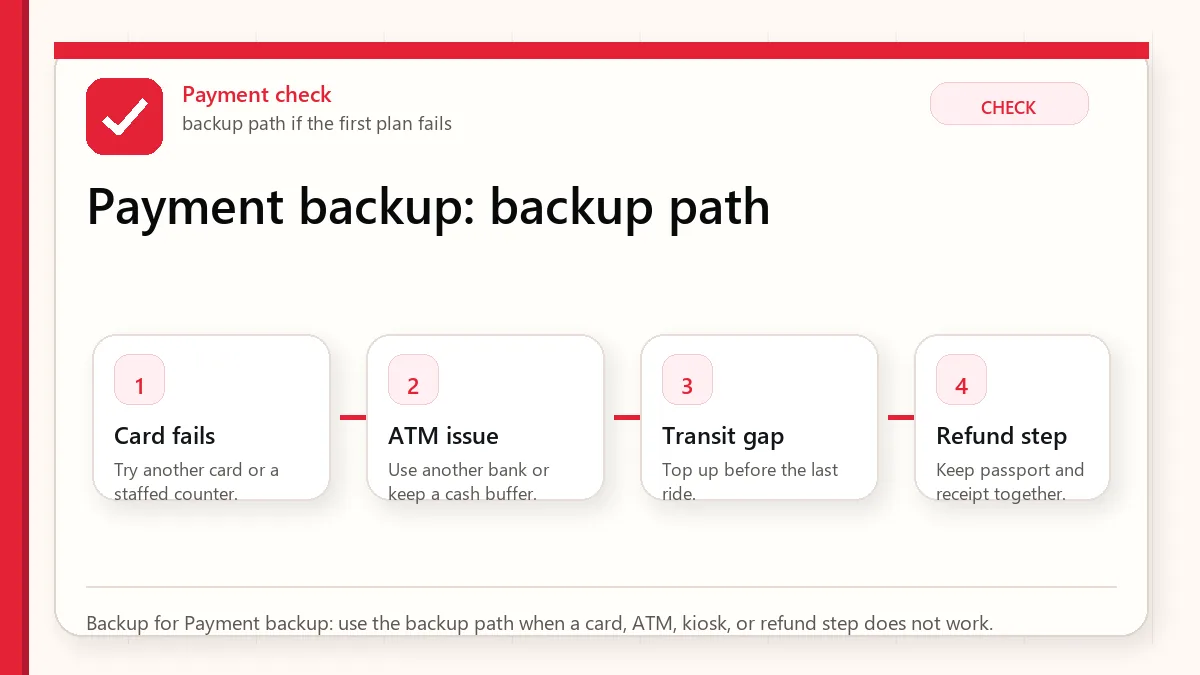
    Layered red check backup flow graphic for Payment backup.
    Backup for Payment backup: use the backup path when a card, ATM, kiosk, or refund step does not work.

    Where payment usually gets awkward

    A kiosk rejects your card

    Try another card, a staffed counter, or cash. Some machines behave differently from staffed payment terminals.

    You cannot top up transit with card

    Carry cash for transit card top-up backup, especially early in the trip.

    Mobile payment setup fails

    Use card or cash. Do not spend travel time forcing a local app that was not built for short-term visitors.

    ATM withdrawal fails

    Try a bank/airport ATM with international card support and check your bank’s overseas withdrawal settings.

    Use the right payment habit for the moment

    SituationBetter approachWhat to verify
    Airport arrivalUse card for major transport or cash exchange for immediate backup.Exchange counters and ATM locations/hours.
    Street food or marketCarry small cash.Whether card is accepted before ordering.
    K-beauty shoppingUse card but keep passport/receipt for tax refund.Store participation and refund path.
    Subway/bus dayUse transportation card.Balance and top-up method.

    What not to assume about cards and cash

    • Do not assume every foreign card works at every kiosk.
    • Do not assume mobile wallets replace a transit card.
    • Do not assume cash is unnecessary because Korea is card-friendly.
    • Do not assume tax refund is automatic just because you paid by card.

    Payment details that keep small problems small

    Payment in Korea is convenient until the exception appears

    Many visitors can use cards smoothly in hotels, major shops, cafes, and restaurants. The weak point is the exception: a kiosk that rejects foreign cards, a transit top-up that needs cash, a bank security block, or a smaller place with limited payment options. A good plan assumes payment will usually work but prepares for the one moment it does not.

    Separate spending payment from movement payment

    Transit, taxis, restaurants, shopping, and online-style bookings may not behave the same way. A foreign credit card that works in one setting may not solve transit card top-up or a small-market purchase. Keep a simple structure: main card for larger payments, backup card in another bag, modest cash, and a transit card plan.

    Read next when payment connects to transit or shopping

    This topic works best when it is not handled alone. Use the related guides below to connect the decision with maps, money, food, shopping, transit, and app backup planning.

    Related Before Korea guides

    Official links to check

    Use these official links when the next step matters. This guide explains what to watch for, but app downloads, eligibility, prices, routes, policies, and service rules can change.

    FAQ

    Are credit cards widely accepted in Korea?

    VISITKOREA says major hotels, department stores, and general shops widely accept cards, but visitors should still check service availability before purchases.

    How much cash should I carry?

    Carry enough for small purchases, transit top-ups, and a first-day emergency, but avoid carrying unnecessary large amounts.

    Can I rely on mobile payments?

    Not as your only plan. Local mobile payments may require local verification, app setup, or supported cards.

    Source links to verify

    Last updated

    Last updated: 2026-05-23. Re-check official sources close to the day you travel, buy, eat, or use an app. Details involving prices, eligibility, transport, app features, opening hours, and refund rules can change.