A good first Korea plan is not a huge itinerary. It is a set of small decisions made before the pressure starts: entry paperwork, phone data, navigation, payment, transit, lodging area, and what you will do if one piece fails.
Check the current rule for before you visit Korea
Use VISITKOREA for the step it actually controls, then confirm the remaining entry, customs, airport, payment, or transport step with the responsible source. No single page covers the whole arrival.
- VISITKOREA
- VISITKOREA official tourism portal
- Visit Seoul practical information
- e-Arrival card
- K-ETA official site
- Incheon Airport official site
Put the first hour of the trip in one place
Keep the arrival time, terminal, hotel address in Korean, entry documents, data access, payment backup, and first transport choice together before landing.
- Traveler situation
- Current official rule
- Payment or document requirement
- Practical backup
Use this hub if you are building your first Korea trip from scratch or if your plan has scattered notes but no clear order. The goal is to make the first 24 hours easier, because that is when most preventable problems show up.
This page links the most important Before Korea guides together. Read the broad checklist first, then move into airport transfer, T-money, eSIM, maps, money, and etiquette depending on the part of the trip that still feels uncertain.
Work through the airport in the order you will face it
- Complete the current entry and customs requirements for the traveler before focusing on transport or shopping.
- Check the arrival terminal, baggage plan, SIM or WiFi pickup, and the closing time of any counter you expect to use.
- Save the hotel address in Korean and compare train, bus, and taxi options with the actual arrival time and luggage.
- Keep one payment method and one route that do not depend on the same phone, app, or staffed counter.
- Before leaving the airport, confirm the first transfer, destination, and contact method that will still work after a delay.
A useful arrival plan survives one failed step
A useful arrival plan is a short sequence that still works after a late flight, a closed counter, a failed card, or weak data. Check each step against the actual terminal and arrival time.
| Trip detail | Why it matters |
|---|---|
| If you are deciding | Check this first: Watch out for. |
| Whether you are ready to enter Korea | e-Arrival card and K-ETA status: Third-party lookalike sites and outdated visa notes. |
| How you will get online | Roaming, eSIM, SIM, or Wi-Fi before airport exit: A data-only plan may not solve phone-number verification. |
| How you will move on day one | Airport route, hotel address, transit card, and backup cash: Late arrivals and heavy luggage change the best answer. |
Rules, prices, screens, and service availability affecting before you visit Korea can change, so use the current linked source before making the final decision.
If an airport step is unclear or unavailable
Identify which part failed: entry, customs, baggage, data, payment, or transport. Use the official counter or page responsible for that step instead of restarting the entire plan.
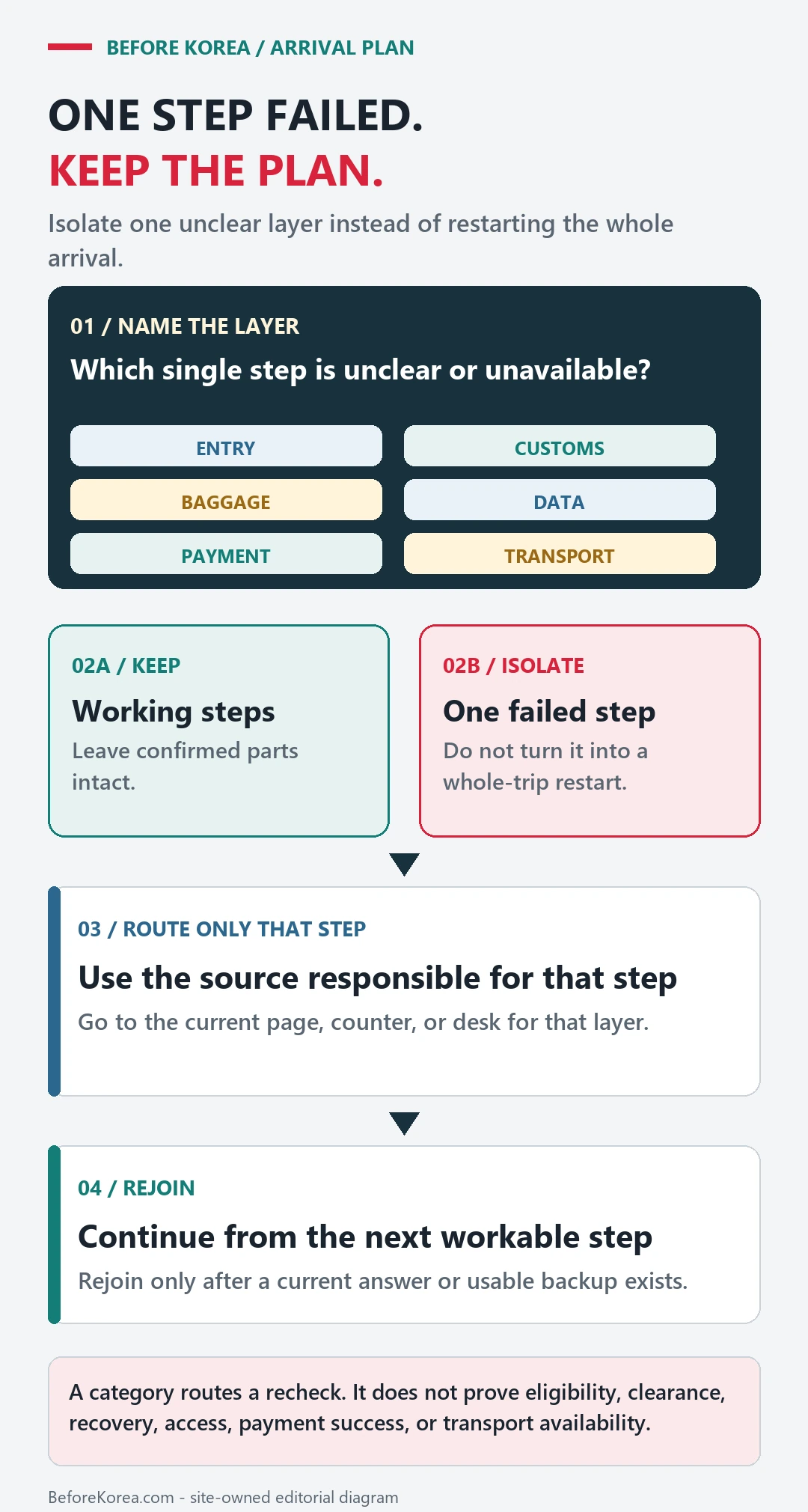
Keep the Korean hotel address and a direct contact method available. Airport information staff, the airline desk, and the accommodation can solve different parts of the arrival problem.
Related guides
Use the before-you-visit hub to route each decision to its owning source
| Decision | Evidence | Next action |
|---|---|---|
| Entry question | Passport or status dependent | Open Immigration |
| Time-sensitive condition | Weather, operation or availability | Check the dated owner |
| Travel help | Non-emergency information or interpretation | Use 1330 |
| Emergency | Immediate police, fire or medical danger | Use 112 or 119 |
The hub is useful when it identifies the next official check and the moment to stop, not when it repeats every subguide. The decision record was checked against VISITKOREA Travel Basics, Korea Meteorological Administration, 1330 Travel Helpline.
VISITKOREA Travel Basics is a routing surface across multiple travel topics. KMA owns current Korean weather and warning information. 1330 is for tourist information and non-life-threatening travel help, not a substitute for 112 or 119 emergencies. Source review completed August 24, 2026. Dates, eligibility, price, inventory, access and operating rules must be rechecked on the exact current first-party page before action.