Entry preparation should be boring by the time you fly. The important work is checking the official status for your nationality, travel purpose, K-ETA or visa requirement, e-Arrival Card, customs items, and health or safety notices. Do this before packing, because airport staff cannot fix every missing requirement at the counter.
Use the authority responsible for each arrival step
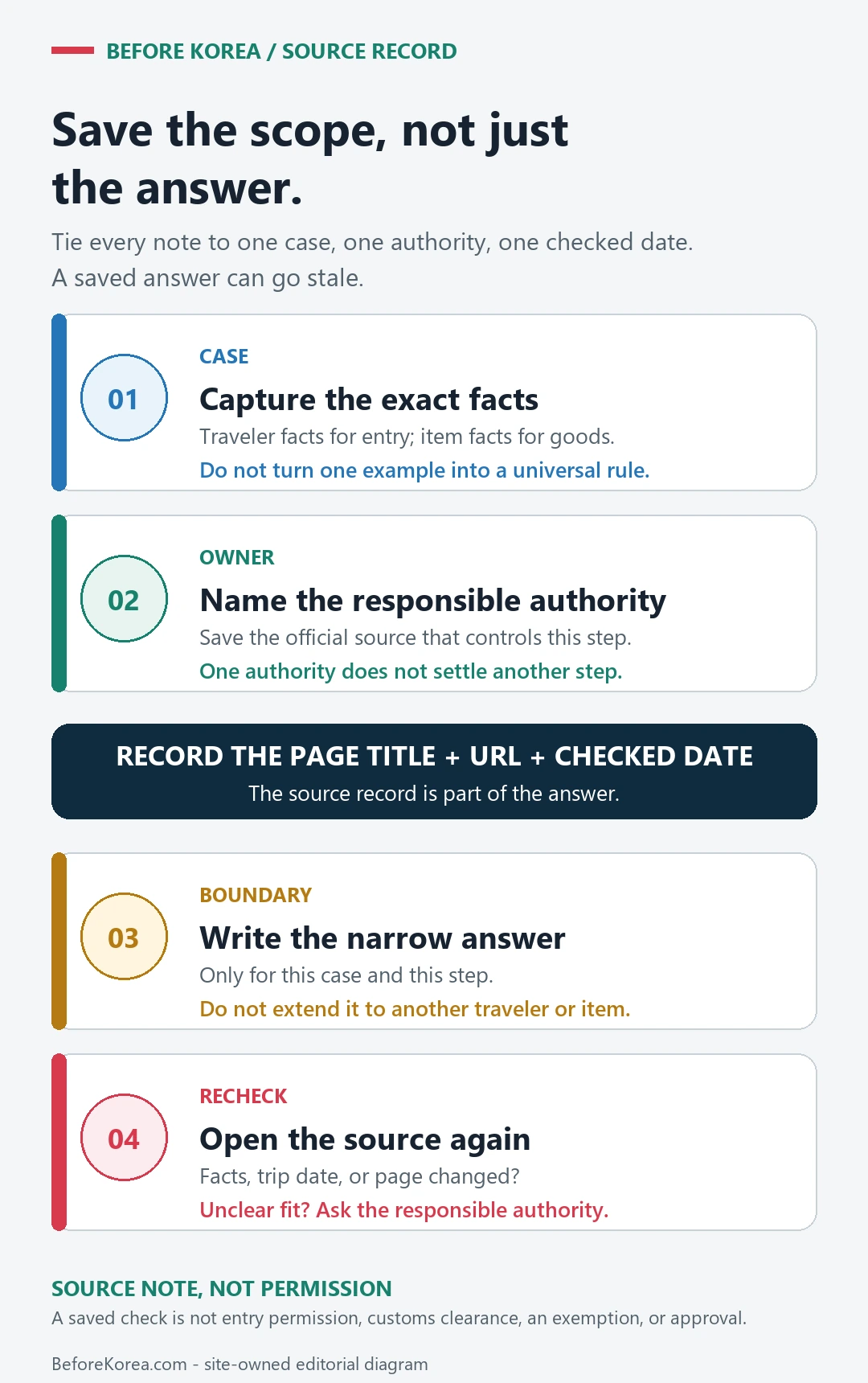
Use Korean Embassy notice on K-ETA temporary exemption for the exact entry or customs step it controls. Immigration permission, an arrival form, customs declaration, quarantine, and airline document checks are separate processes.
- Korean Embassy notice on K-ETA temporary exemption
- Korea Customs Service English site
- Korea e-Arrival Card official site
- K-ETA official site
- Korea Immigration Service
- VISITKOREA
List documents and goods before completing the forms
Keep the passport, arrival date and flight, Korean accommodation address, required entry approval, and a list of food, medicine, cash, duty-free purchases, and other goods being carried.
- Passport and traveler status
- Arrival date and flight
- Goods, cash, food, or medicine carried
- Required entry or declaration channel
Some travelers may be exempt during a specific period, some may still choose to apply for convenience, and some may need a different visa route entirely. The safer habit is to use the official K-ETA flow and your nearest Korean mission’s notices as verification, then avoid repeating the answer as if it applies to every passport.
Visitors often think customs only matters when entering Korea, but it also matters when leaving with tax-refund goods. Keep the mental link between entry documents, shopping receipts, and departure paperwork; the trip is smoother when documents do not scatter.
Complete entry and customs in the order they apply
- Confirm the current entry document or digital form for the traveler’s passport, purpose, and arrival date.
- Review prohibited, restricted, declarable, and duty-free categories on the Korean authority’s current traveler page.
- Keep prescriptions, product labels, receipts, quantities, and values where an officer can inspect them without unpacking the entire bag.
- Submit the required form through the official channel and choose the declaration route that matches the goods actually carried.
- Ask customs or quarantine staff before leaving the controlled area when an item or threshold is unclear; do not hide or discard evidence of the item.
Entry permission and customs clearance are separate
The arrival step is complete only when the traveler meets both the entry requirement and the applicable declaration or inspection rule. Passing one desk does not settle a different authority’s decision.
| Trip detail | Why it matters |
|---|---|
| Traveler and arrival | Determines which entry form, exemption, and arrival process applies |
| Goods carried | Food, medicine, cash, gifts, and purchases may have different declaration rules |
| Quantity and value | Allowances and declaration thresholds depend on the actual amount |
| Official channel | Use the current form, declaration lane, or officer for the relevant step |
For Korea entry requirements, entry permission does not settle customs, quarantine, or duty, and an allowance for one traveler or item may not apply to another.
If the form, threshold, or item category is unclear
Return to the responsible Korean authority’s current traveler guidance and compare the exact item, quantity, value, origin, and purpose rather than relying on a general travel summary.
Use the official help desk or declaration channel before exit when the facts do not fit a published example; declaring an uncertain item is safer than assuming silence means permission.
Related guides
- Full Korea travel checklist
- Before You Visit Korea hub
- Korea Entry Form Guide for Travelers: e-Arrival Card, K-ETA, and Arrival Details
Current 2026 entry-status checkpoint
As checked August 24, 2026, the official K-ETA notice extends the temporary exemption for the countries and regions already covered through December 31, 2026 (KST). That is not a permanent nationality rule and it does not waive a visa when the traveler’s purpose or status requires one. The official application flow displays an exemption message after the passport information page is scanned for an affected passport.
| Question | Official route | Do not infer |
|---|---|---|
| Do I need a visa or K-ETA? | Official K-ETA flow and the Korean mission responsible for the passport and purpose | That another traveler with the same flight has the same status |
| Do I need an arrival declaration? | Official e-Arrival target guide and Navigator | That K-ETA exemption equals arrival-card exemption |
| Do I declare goods or cash? | Korea Customs traveler guidance | That immigration approval clears goods |
| Which help line handles an immigration question? | Immigration Contact Center 1345 | That a translation app is an official decision |
A traveler who is temporarily exempt from K-ETA may still have to submit the e-Arrival Card unless another exclusion applies. A traveler with a valid K-ETA is generally listed as excluded from the arrival card, but a person holding K-ETA and entering with a visa must follow the official target guide for that visa entry. Use the document that will actually be valid on the arrival date.
Use only the official free e-Arrival site
Korea Immigration Service warned about fake e-Arrival Card websites in March 2026. It identifies https://www.e-arrivalcard.go.kr as the only official website and states that the official service does not request payment. Type or verify that domain before uploading a passport image.
- Check passport validity and visa or K-ETA status for the exact purpose.
- Use the e-Arrival Navigator within the live submission window.
- Keep the immigration form separate from customs and quarantine declarations.
- Save the submission and source URLs, then recheck when the passport, flight, purpose or accommodation changes.
Current source review, August 24, 2026: the K-ETA temporary exemption extension, official e-Arrival target guide, fake-site warning and 1345 contact surface were rechecked. Entry authorization is decided by the competent authority and border officers, not by this checklist.