Do not avoid an entire Korean product category. Skip the specific item when you cannot verify how you will carry it home, use it, return it, or legally bring it into your destination. The purchases most likely to disappoint are oversized liquids for a carry-on-only trip, tax-refund goods you plan to open before departure, incompatible appliances, fitted clothing without measurements, bulk beauty or food sets you will not finish, and heavy or fragile bargains with no safe packing plan.
A famous store, a long queue, a limited-edition sign, or a possible tax refund does not solve those problems. This guide gives each category a fair exception: buy it when the product, trip, and after-trip use all pass the check.
Checked August 24, 2026. Airline rules, destination-country restrictions, store return terms, tax-refund procedures, stock, and product labels can change. Confirm the live rule that applies to your flight and destination before paying.
Quick answer: six purchases to reconsider
| Purchase | Skip it when | Buy it when |
|---|---|---|
| Liquid, gel, paste, or spray | The container is over 100 ml and you have no workable checked-bag or duty-free route | Your baggage route and destination rule are clear |
| Tax-refund item | You need to open or use it before an outbound-goods check | You can keep the item and documents in the condition required by the current process |
| Plug-in appliance | The input label, plug, frequency, warranty, or battery transport is unclear | The device explicitly matches the power and service conditions at home |
| Fitted clothing or shoes | There is no centimeter measurement, try-on, or acceptable return path | You can compare actual measurements and accept the return risk |
| Bulk cosmetics, food, or supplements | Shade, ingredients, expiry, use rate, storage, or destination entry is uncertain | You understand every unit and can realistically use or gift it |
| Heavy or fragile souvenir | Packing, excess baggage, breakage, and replacement cost erase the bargain | It has a protected place in your luggage and real value after the trip |
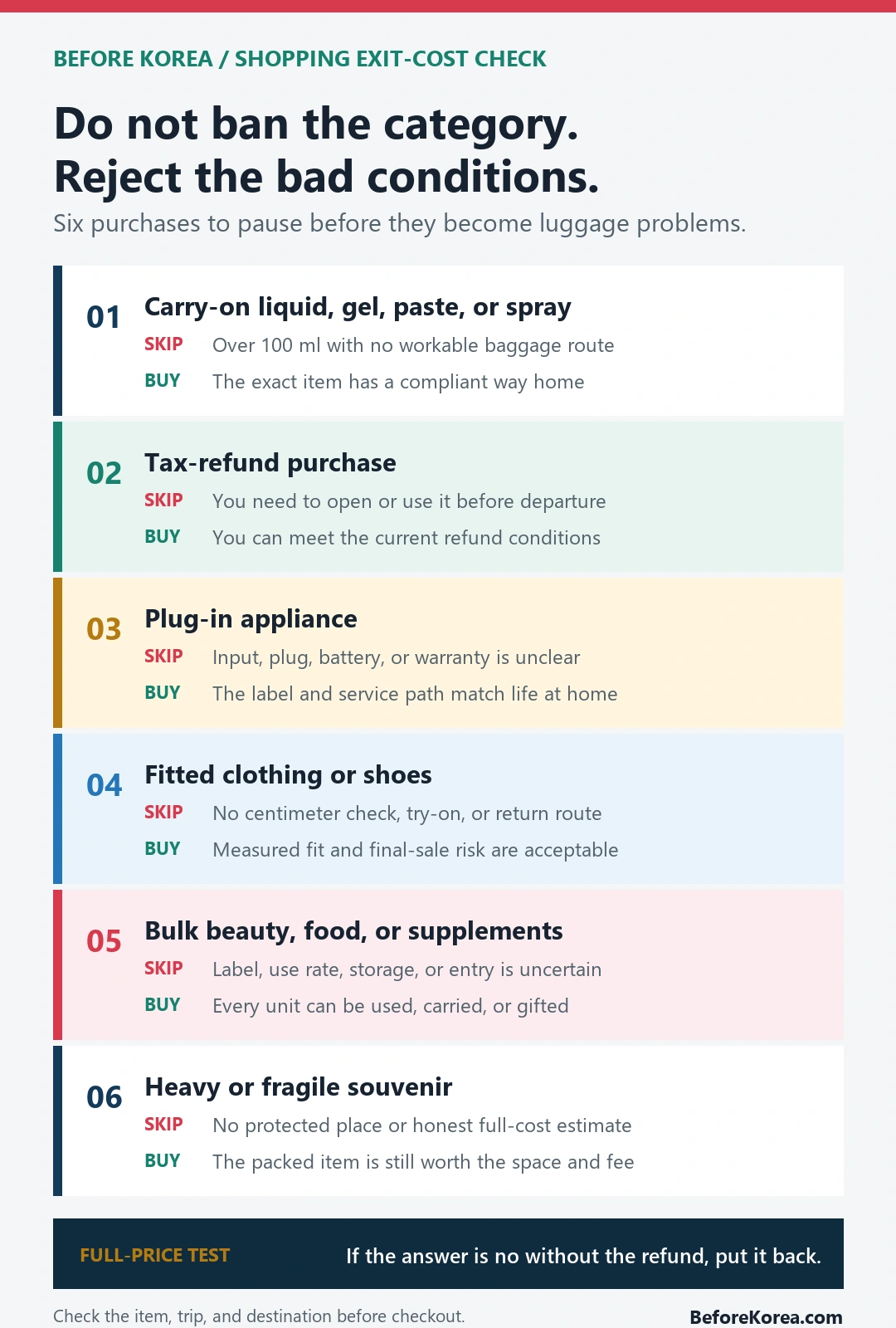
The right answer is often not this size, not this quantity, or not on this trip. A 50 ml skincare product can be sensible for a carry-on traveler while a large bundle of the same product is not. A dual-voltage charger can be useful while a single-voltage heat tool may become dead weight.
Carry-on only: avoid oversized liquids and gels
For international flights departing Incheon, the airport’s official liquid and gel guidance says each carry-on container must be 100 ml or less and placed in one transparent 20 cm by 20 cm zip bag per person. The container size controls even when only a small amount remains.
The airport lists perfume, toner, lotion, sunscreen, lip gloss, shampoo, toothpaste, kimchi, gochujang, and doenjang among examples that can fall under liquid, gel, or paste restrictions. That makes large beauty bottles, sauces, and wet foods poor impulse buys for a traveler with only cabin baggage.
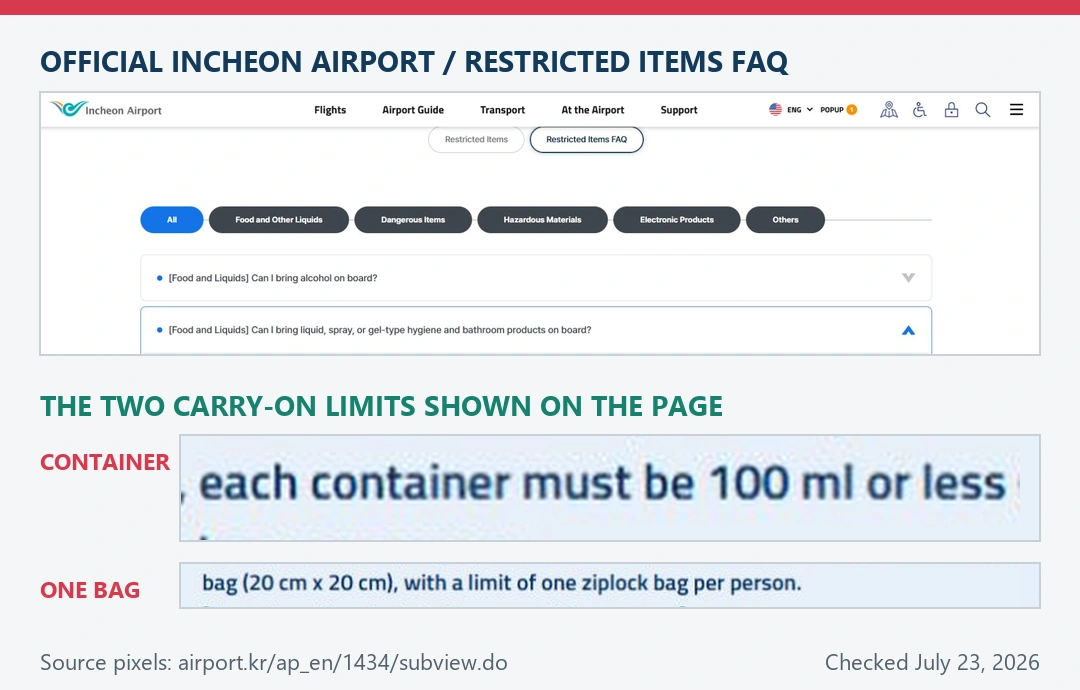
This is not a blanket ban on those products. A checked bag, a compliant small container, or a properly handled duty-free purchase may change the decision. Ask the airline how the exact item must travel, and separately check whether your destination allows the product to enter.
Do not open a tax-refund item you may need to show
Korea Customs Service says goods presented for outbound-shipment confirmation in its tax-refund process should be unopened and unused. It lists the passport, sales certificate, and purchased goods as the required items for that check, and says eligible duty-free items must be taken out of Korea within three months of purchase.
Refund routes differ. Some purchases receive an immediate refund, while others use downtown, airport, kiosk, or later refund procedures. The current VISITKOREA comprehensive tax-refund guide explains those routes and the applicable conditions. Follow the receipt and provider instructions for your purchase rather than assuming every tax-free sign works the same way.
If you need the product during the trip, decide whether using it matters more than a possible refund. Never buy an item you do not want at full price merely because the checkout screen shows a refund estimate. Our Korea tax-refund guide for tourists covers the sequence in more detail.
A Korean plug is not proof an appliance will work at home
VISITKOREA’s electricity guide states that Korea uses 220 volts at 60 hertz and outlets with two round holes. That describes use in Korea, not compatibility in your destination.
- Read the product’s input label. A marking such as 100-240V, 50/60Hz is different from a single-voltage label.
- Check whether you need only a plug adapter or an actual voltage converter.
- Confirm that warranty service, replacement parts, menus, and required apps work outside Korea.
- For devices with lithium batteries, check the airline’s cabin and checked-baggage rules before purchase.
Phone chargers and laptop power supplies are often designed for more than one voltage, but never infer that from the connector. Hair dryers, curling irons, kitchen appliances, and heating products deserve a line-by-line label check because an adapter changes the plug shape, not the voltage a device accepts.
Skip fitted clothing when the measurement path is missing
Do not reject Korean fashion because of a stereotype that everything runs small. Reject the individual purchase when the fit cannot be tested or measured and a return would be impractical.
For tops, compare shoulder, chest, sleeve, and total length in centimeters with clothing that already fits. For pants, add waist, hip, rise, thigh, and inseam. Treat “free size” as one sold size, not a promise that it fits everyone. The Korea shirt-size guide explains how to compare 95, 100, 105, free size, and flat garment measurements.
Ask whether the exact item can be tried on, exchanged, or returned before payment. Sale status, opened packaging, hygiene rules, branch policy, and the time left in your trip can all affect the practical return route. If the answer is unclear, buy only at a price you can accept as final.
Do not let a bundle decide your beauty purchase
K-beauty is not a bad buy. The risky purchase is a large set chosen before you confirm shade, ingredients, skin tolerance, printed dates, storage, and how quickly you will use every unit. A two-for-one offer saves nothing when the second product expires unopened or causes a reaction.
- For a new formula, start with one unit or a smaller size.
- Check the seal, printed expiry or use-by information, and period-after-opening symbol.
- Read the ingredient list when you have known allergies or sensitivities.
- Confirm that the shade works in ordinary light, not only under a store display.
Use the Korean cosmetic expiration-date guide to distinguish manufacture, use-by, and after-opening clues. A missing tester or uncertain label is a reason to choose another item, not a reason to guess.
Destination customs decides whether food and supplements can enter
A product sold legally in Korea is not automatically admissible in another country. Meat, fresh produce, seeds, plants, alcohol, medicines, and supplements can face destination-specific declaration, quantity, ingredient, or permit rules. The shop cannot make that decision for your border authority.
The Ministry of Food and Drug Safety food-labeling page explains that Korean food and health-functional-food labels include information such as ingredients, expiry or quality-retention dates, storage, intake instructions, and precautions. Read those fields, but also search the destination customs or agriculture authority for the exact product and ingredient.
If you cannot identify the ingredients or find the destination rule, leave the item. The Korea customs declaration guide for travelers can organize the questions, but your destination’s current rule controls what may enter.
Heavy and fragile bargains often cost twice
Ceramics, glass, cookware, bottled drinks, books, large character goods, and home decor can be excellent purchases. They become poor ones when excess-baggage cost, protective packing, breakage risk, and the loss of suitcase space exceed the value you will get at home.
Before paying, assign the item a real packing location. If it needs a new suitcase, estimate that suitcase and airline fee now. If it is fragile, ask for protective wrapping and decide whether damage would make the purchase worthless. Photograph the item and price, walk away, and return only if it still earns the space.
Use the 90-second exit-cost check
- Name the use: say who will use the exact item and when.
- Read the product: verify size, quantity, ingredients, dates, voltage, battery, and seller.
- Map the trip: choose checked bag, carry-on, airport pickup, or shipping before checkout.
- Check both borders: Korea’s departure process and the destination’s entry rule answer different questions.
- Accept the return risk: know the exchange route and whether you can live with a final sale.
- Ignore the refund: if you would not buy at the full price, put it back.
A good Korea purchase is usually clearly labeled, easy to carry, compatible with life at home, bought from an identifiable seller, and worth the price without a complicated refund. For positive ideas, use What to Buy in Korea Without Wasting Luggage Space and the broader Before You Shop in Korea planning guide.
Questions travelers ask
Are Korean cosmetics a bad buy?
No. Buy a formula and quantity you can evaluate and use. Skip a large bundle when shade, ingredients, expiry, seal, or carry-on route is uncertain.
Should tourists avoid electronics in Korea?
No. Read the input label and confirm voltage, frequency, plug, warranty, language, app region, and battery transport. An adapter alone does not make a single-voltage device compatible.
Can I carry kimchi or gochujang in hand luggage?
Incheon Airport lists kimchi and gochujang among liquid or gel examples for international-departure screening. A carry-on container must generally be 100 ml or less under that guidance. Also check airline handling and destination entry rules.
Can I use a tax-refund item during the trip?
If your refund route requires outbound-goods confirmation, Korea Customs Service says the purchased goods should be unopened and unused. Immediate and other refund routes can differ, so follow the current receipt and provider instructions for the exact purchase.
What should I never buy in Korea?
Do not buy an item when the seller or price is unclear, the product cannot be safely carried or legally admitted, compatibility cannot be verified, or the downside would be unacceptable if no return or tax refund is available.
Official sources checked
This independent guide was checked against Korea Customs Service tax-refund guidance, the VISITKOREA comprehensive tax-refund guide, Incheon Airport liquid and gel guidance, VISITKOREA electricity information, and the MFDS food-labeling system. Your airline, seller, refund receipt, product label, and destination authority control the final decision.
Current source review, August 24, 2026: The purchase decision remains a two-border check. Incheon Airport cabin-baggage rules, Korea’s tourist refund evidence, and the destination authority’s import rule are separate; the exact airline and destination decide the final route.