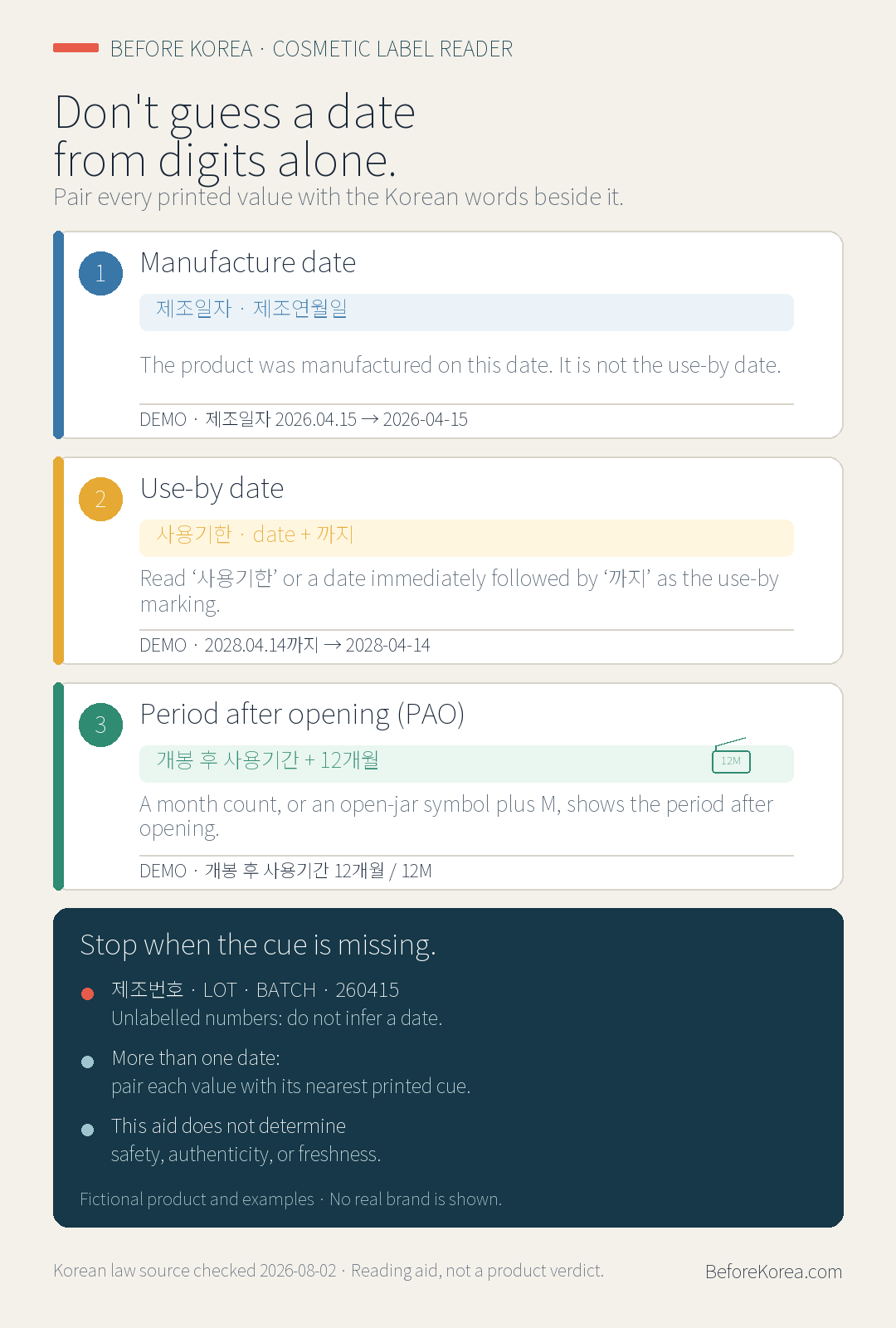
On Korean cosmetics, read the word beside a number before treating that number as an expiration date. 제조일자 is a manufacturing date, 사용기한 or a date followed by 까지 is a use-by date, and 개봉 후 사용기간 or an open-jar mark such as 12M is a period counted from first opening.
A line marked 제조번호, LOT, or BATCH is a traceability code, not a date to decode. If the wording is missing or several dates appear, keep each line with its nearby label and ask the seller or brand instead of guessing.
Checked August 2, 2026 against the current Korean Cosmetics Act, its Enforcement Rule labeling annex, and MFDS labeling guidance.
This guide is for buyers standing in Olive Young, a brand shop, duty-free, a department store, a pharmacy-style store, or an online product page trying to understand Korean date labels. It does not claim to replace official cosmetic safety guidance. It gives you a careful buying workflow so you do not overbuy near-expiry products, misunderstand opened-use symbols, or bring home skincare you will not use in time.
Start with the label and skin risk
Check whether the product shows a manufacture date, an expiry/use-by date, or a period-after-opening symbol. Korean labels may include words such as 제조 or 제조일자 for manufacture date, 사용기한 for usable period or expiry, 까지 for “until,” and 개봉 후 for “after opening.” If a product is unsealed, damaged, unusually discounted, missing a box, or close to the printed date, do not buy it unless you fully understand the risk and will use it quickly.
Read the Korean word before the date
These are fictional layout examples, not photographs of a real product. Match the whole printed line, including the word beside the date or period.
This decoder explains visible label wording only. It does not determine safety, freshness, authenticity, storage history, skin compatibility, or whether a product should be used.
| What the package shows | Label type | What it means | What to do next |
|---|---|---|---|
| 사용기한 2028.12.31 | Use-by date | Use by the printed date; this is not a manufacture date. | Check the seal, storage directions, and current product condition too. |
| 2028.12.31까지 | Use-by date | 까지 means “until” in this date-label context. | Read the whole line and do not reverse the date order. |
| 개봉 후 사용기간 12개월 | Period after opening | Twelve months counted from first opening. | Record when you first opened it; do not count from purchase. |
| Open-jar symbol + 12M | Period after opening | Twelve months from first opening when the mark is used as a PAO symbol. | Also check any separately printed use-by date. |
| 제조일자 2026.08.02 | Manufacturing date | The date the product was made; not a use-by date. | Look elsewhere for 사용기한 or PAO wording. |
| 제조연월일 2026.08.02 | Manufacturing date | Year, month, and day of manufacture. | Do not add a generic shelf-life rule. |
| 제조번호 AB12C3 | Batch or lot number | A traceability code, even though it begins with 제조. | Do not turn it into a calendar date. |
| 사용기한: 제품에 별도 표시 | Location pointer | The date is printed separately on the individual product or another stated location. | Find the referenced container; this line is not the date itself. |
| 240802 / AB12C3 with no label | Unresolved code | The number alone does not identify the date type. | Photograph the full package and ask the brand. |
Download and cite the decoder
The resource bundle contains the four language SVG originals, the label glossary CSV, a blank package-record worksheet, machine-readable decoder rules, methodology, license, and checksums.
You may save the files for personal checking and cite this page with a link. Contact Before Korea before republishing or adapting the graphic or data files.
What the official rules establish — and what they do not
The Korean Cosmetics Act, Article 10 lists the manufacturing number and either a use-by date or a period after opening among package information. When a period after opening is displayed, the manufacturing date is displayed with it.
The Enforcement Rule, Annex 4 explains how the manufacturing number, use-by date, and PAO information must be distinguished and displayed. The MFDS cosmetics labeling page provides the agency overview of required package information.
For current practical examples, see the 2026 MFDS outer-package labeling Q&A and the 2025 MFDS cosmetics FAQ. Product-specific stability evidence and instructions control; there is no universal rule that lets this page add 24, 30, or 36 months to a manufacturing date.
Those sources establish labeling duties. They do not provide a universal public formula for decoding every manufacturer’s batch code, and this page does not certify a product’s condition or authenticity.
Manufacture date vs expiry date
A manufacture date tells you when the product was made. It does not automatically tell you when the product should be used by, because shelf life depends on product type, formula, packaging, storage, and official labeling. An expiry or use-by date is more direct for a buyer because it tells you the date you should not ignore.
If you see only a manufacture date and cannot confidently understand the product’s shelf life, ask staff or choose a product with clearer labeling. Do not guess based on internet rules such as “all creams last three years.” Rules of thumb may be wrong for specific formulas, functional cosmetics, sunscreen, opened testers, or poorly stored items.
Period after opening
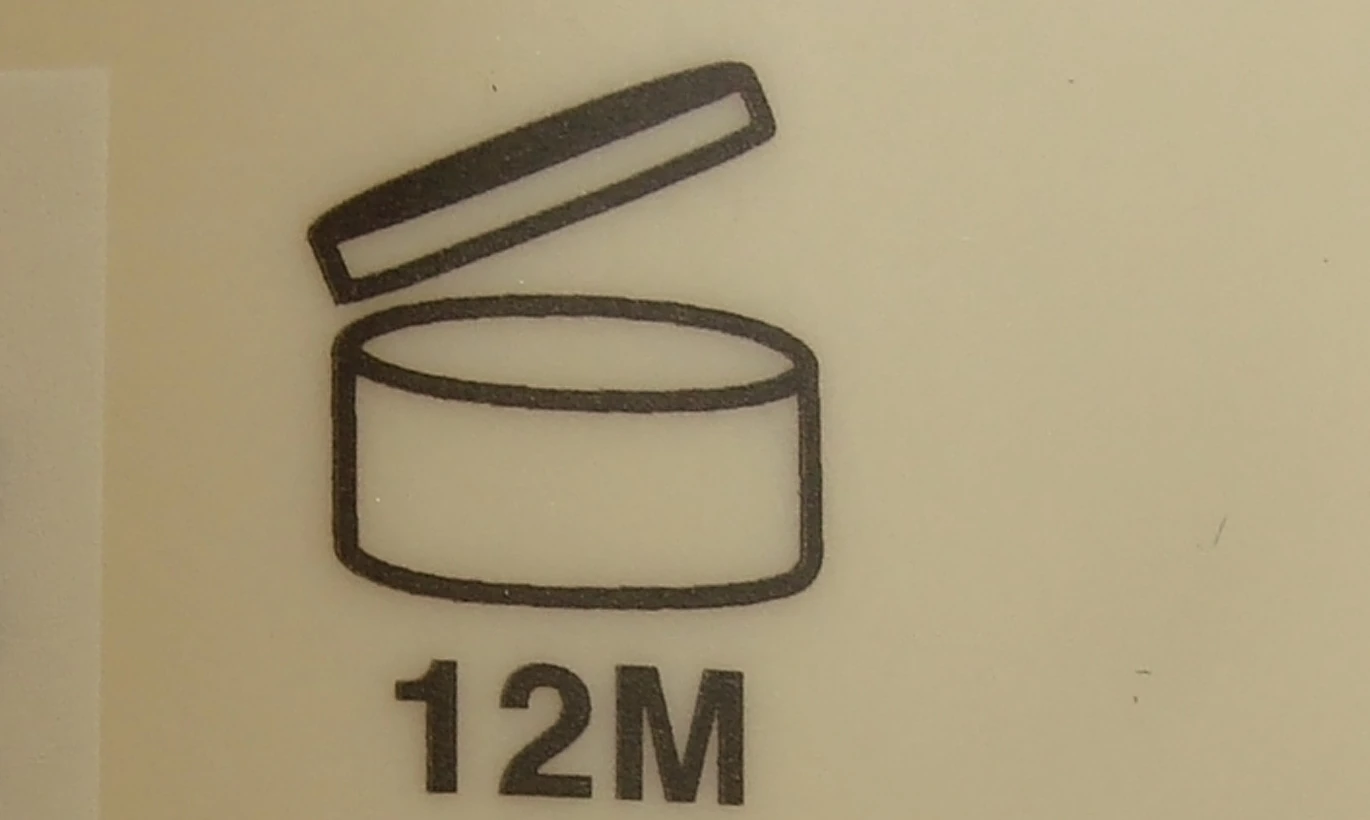
Some cosmetics use a period-after-opening idea, often shown with an open-jar style symbol or wording that tells you how long the product is recommended after opening. The common pattern is a number plus M, such as 6M or 12M, meaning months after opening. This is different from the unopened shelf date. If a product is unopened, the printed expiry date matters. Once opened, the after-opening period becomes important too.

Travelers often forget this because they buy several serums at once. If you open five products after returning home, the after-opening clock starts on all of them. A better plan is to open one product at a time and write the opening month on the box or bottle if you are serious about using it carefully.
Date format and reading risk
Korean product dates may be written with year, month, and day, sometimes using Korean characters such as 년, 월, 일, or punctuation. Read the whole line rather than grabbing the first number you recognize. If you see “2026.08.15까지,” the “까지” means until that date. If you see a line connected to 제조, it may be a manufacture date instead.
When in doubt, ask staff: “Is this the expiration date?” You can show a translation app sentence in Korean if needed. For skincare you will put on your face, guessing is not worth it.
Store checks before buying
- Seal: Avoid products with broken seals, damaged boxes, missing caps, or signs of leakage.
- Date: Check the printed date before you pay, especially on discount shelves.
- Tester confusion: Do not assume a tester represents the freshness of unopened stock.
- Receipt: Keep the receipt until you inspect everything at the hotel.
- Storage: Avoid leaving cosmetics in hot luggage, cars, or direct sunlight.
Online and duty-free caution
Online shopping can make date checking harder because you may not see the exact product label before purchase. Buy from official stores or trusted sellers, read return rules, and be careful with unusually cheap listings. For duty-free, check pickup timing, baggage rules, and whether you can inspect the product before leaving the airport area.
Do not buy a product only because it is popular online. A product can be authentic and still be a poor buy for you if the date is close, the size is too large, the formula does not match your skin needs, or you already bought more than you can use.
What to avoid
Avoid open-box products unless the store clearly sells them that way with reliable handling. Avoid buying sunscreen, eye products, or active skincare close to expiry unless you will use them very soon. Avoid marketplace sellers with unclear origin, no date visibility, or prices that feel too good to explain. Avoid carrying large hauls in hot checked luggage for long periods.
How this helps your K-beauty budget
Expiration checks are not only about safety. They prevent waste. Many visitors buy more skincare than they can use because the store environment is exciting and the unit price feels better than home. A simple date check slows the decision down. If you already have unopened products at home, choose smaller sizes, travel kits, or one focused category instead of duplicating every step of a routine.
FAQ
What does 제조 mean on Korean cosmetics?
It means manufactured or manufacture-related. It is not automatically the expiry date. Look for expiry wording or ask staff if you are unsure.
What does 까지 mean?
It means until. On a cosmetic date label, it often marks the date limit connected to the product wording around it.
Is a manufacture date enough?
Not always for a foreign shopper. If you cannot confirm shelf life or expiry, choose a clearer product or ask staff before buying.
Should I buy near-expiry K-beauty if it is cheap?
Only if you understand the date, the product is sealed, the seller is trustworthy, and you will use it quickly. For most tourists, near-expiry impulse buys are not worth the luggage space.