The hardest part of taking KTX is often not the train. It is the moment when the booking page asks for card verification, the route you want is sold out, or you are not sure whether the station name on your map is the same station on your ticket.
Search KTX on the official operator site
Use KORAIL official English site for the official KTX timetable and ticket inventory. Confirm the Seoul-side station because KTX and SRT can serve different terminals even when the destination city is similar.
Confirm the station pair before choosing the train
Keep the travel date, departure and arrival stations, passenger count, luggage, preferred time, foreign-card backup, and a bus or later-train alternative.
- Arrival or departure point
- Destination in Korean
- Travel time
- Luggage and payment backup
KTX and SRT are both high-speed rail options, but they do not always use the same Seoul-side station. KTX commonly uses Seoul Station, Yongsan, Cheongnyangni, or other KORAIL stations depending on the route. SRT uses Suseo Station in southeast Seoul. For a tourist, the best train is not automatically the fastest train on paper. The better train is the one you can reach from your hotel without a stressful transfer.
The safest backup is simple: write down the train number, date, departure station, arrival station, and preferred time range, then buy at a staffed counter. If you are traveling on a busy weekend or holiday period, do this earlier than you think you need to.
Complete payment and verify the issued ticket
- Search the route on the official operator site and confirm the station names, train number, date, and departure time.
- Compare KTX with SRT only after adding the trip from the hotel to Seoul Station, Yongsan, or Suseo.
- Choose the passenger and seat details, then review change and refund conditions before payment.
- Complete payment on the official channel and verify that a ticket or reservation record was actually issued.
- Save the ticket offline and recheck the station, platform display, and holiday disruption before departure.
A search result or payment attempt is not a reservation
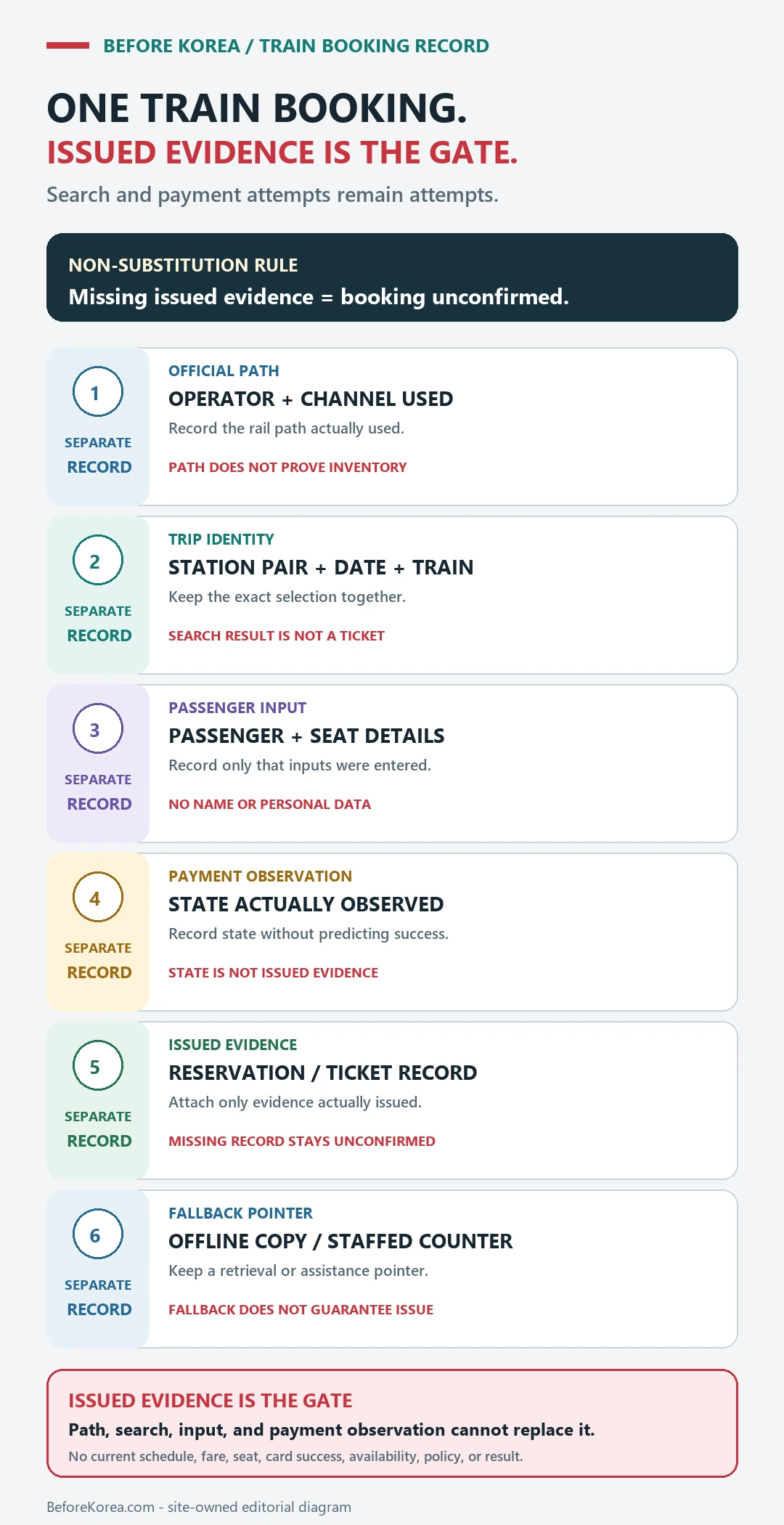
A completed train plan has an issued ticket for the correct station pair and date, plus enough time to reach the departure station. A payment attempt or search result is not a reservation.
| Trip detail | Why it matters |
|---|---|
| Station pair | Confirm the exact Seoul-side and destination stations |
| Issued ticket | A completed payment must produce a valid reservation record |
| Access time | Include the trip from the hotel to the departure platform |
| Fallback | Check adjacent trains, SRT, or express bus when inventory is gone |
If the foreign card fails or the train is sold out
Try another supported card or the staffed station counter without using an unofficial seller that changes the fare or refund terms.
Check adjacent times, another Seoul terminal, SRT where relevant, or an express bus while preserving the same destination plan.
Related guides
- Incheon Airport to Seoul: Train, Bus, Taxi
- Korea Airport Train Guide
- Foreign Card Not Working in Korea
Current official KTX booking boundary
Use the exact station pair, operating train, departure date and an issued ticket. KORAIL’s current foreign-language site provides reservation and ticket retrieval in multiple languages, while the official ticketing guide identifies the website, KORAIL Talk, vending machines and train-station counters as purchase routes. A search result, card authorization or screenshot of a timetable is not an issued ticket.
Treat the 2026 rail integration as time-sensitive
On August 24, 2026, the official SRT booking homepage displayed notices about the high-speed rail integration, including KORAIL+ app operation from August 3 and a transition for services departing from September 1. That notice is a dated checkpoint, not a permanent instruction. Open the current operator page for the actual travel date before deciding whether to use KORAIL, SRT or another route.
Use the official KORAIL reservation page for live inventory. Keep passenger spelling, email or retrieval information, payment observation and the issued ticket separate. Recheck the departure station and live platform display on travel day.