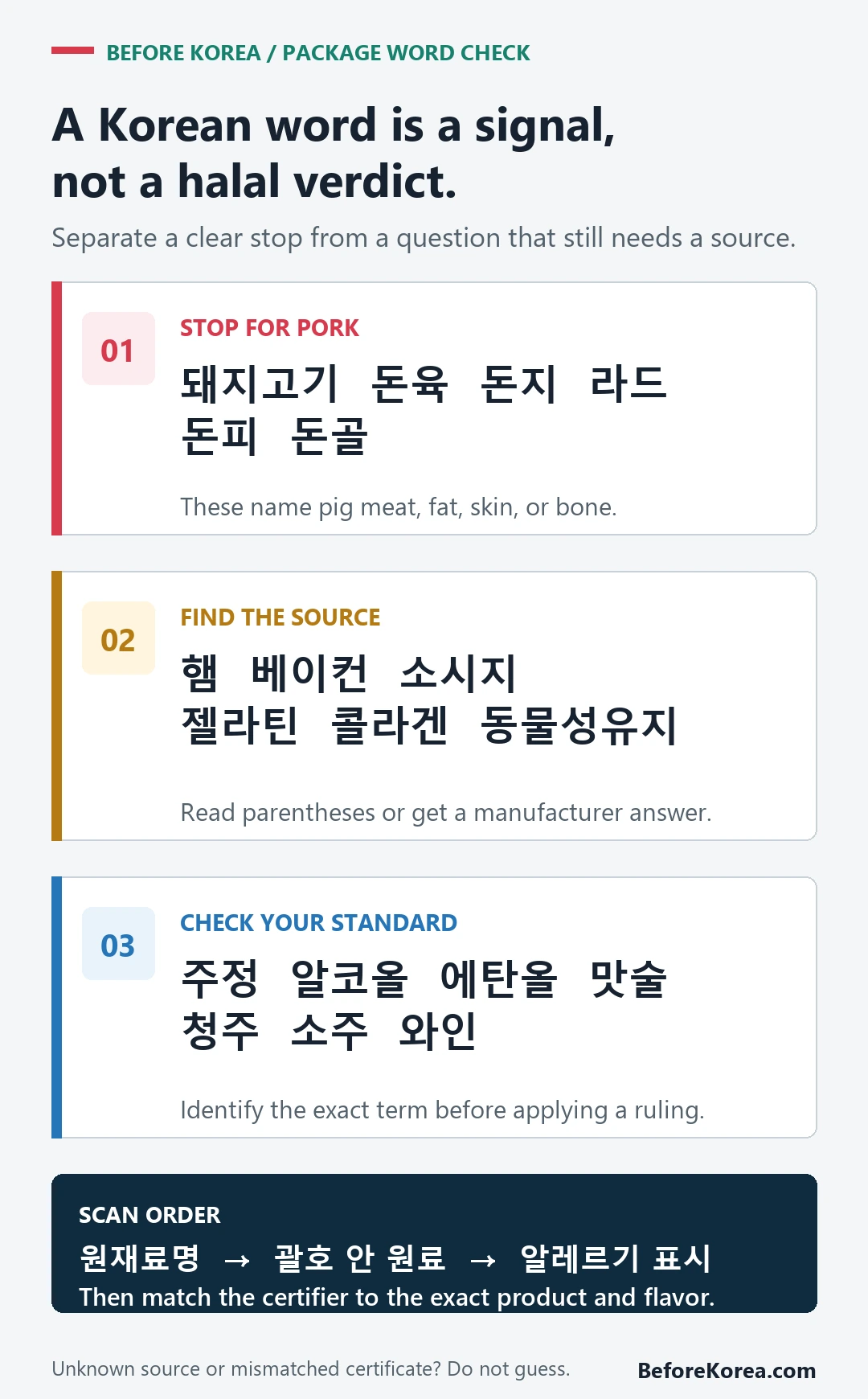
A Korean ingredient word is a search flag, not a halal verdict. Use it to locate the exact ingredient, compound seasoning, allergen statement and manufacturer record for the package in your hand, then verify any halal claim by product, factory, market and certificate scope. A word list cannot certify an unlabeled product.
Reviewed August 24, 2026 against current MFDS food-label information, the Korea Muslim Federation certification page, BPJPH’s certificate search and BPOM’s product database. Packages, recipes, factories, importers and certificate status can change without preserving an old online photo.
Start with the exact package identity
| Capture | Where to find it | Why it matters |
|---|---|---|
| Korean product name | Front and legal information panel | Separates similar flavors |
| Manufacturer and factory | 제조원 or 제조업소 | Certification can be site-specific |
| Market and importer | Import sticker or export panel | Formula and approval can differ |
| Lot and date | Inkjet or stamped code | Ties evidence to the physical item |
| Certificate number or logo | Package plus issuer database | Must resolve to the same product scope |
Read labels in evidence order
- Photograph the front, full ingredients, separate allergen line, manufacturer, importer sticker and date code.
- Match the exact flavor, size and market version before translating isolated words.
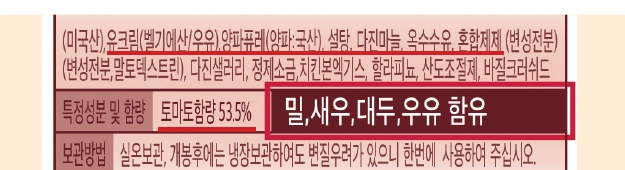
- Expand every parenthetical compound seasoning instead of stopping at the first familiar ingredient.
- Search the stated certificate number, product or producer in the issuer’s current database.
- Record unresolved ingredients and do not convert uncertainty into a yes.
High-signal animal-source words
| Korean label term | Plain meaning | Next check |
|---|---|---|
| 돼지고기 / 돈육 / 돈골 | Pork / pork meat / pork bone | Reject if pork is outside your standard |
| 돈지 / 돼지기름 | Pork fat or lard | Check compound oils and soup bases |
| 육수 / 고기추출물 | Meat stock / meat extract | Identify animal and certificate scope |
| 닭고기 / 닭추출물 | Chicken / chicken extract | Source and slaughter standard may matter |
| 쇠고기 / 우육 / 소고기 | Beef | Do not infer halal source from species alone |
| 젤라틴 | Gelatin | Determine animal, fish or other source |
| 동물성유지 | Animal fat | Unspecified source requires escalation |
Alcohol-related words need context
Words such as 주정 (ethanol), 알코올 (alcohol), 맛술 or 요리술 (cooking alcohol), 미림, 럼, 브랜디 and 와인 deserve a package-level check. A translated word alone does not establish amount, production function, residual level or a religious ruling. Preserve the full ingredient line and ask the certification body or a trusted religious authority under the traveler’s standard.
Compound seasonings hide the decisive branch
Ramen soup powder, barbecue seasoning, kimchi seasoning, seafood flavor, cheese flavor and artificial flavor can each contain nested ingredients. Read text inside parentheses and any continuation on another panel. ‘Vegetable flavor’ on the front is marketing evidence, not a complete ingredient specification.
The allergen line helps, but is not a halal list
MFDS food-label guidance explains Korea’s separate allergen labeling and includes pork, chicken and beef among listed allergens. This makes the line useful for locating some animal ingredients. It does not cover every halal-sensitive ingredient, certify slaughter, or turn absence from the allergen line into halal proof.
Separate contains from shared-facility warnings
함유 means the product contains the named item. 같은 제조시설 or 혼입 가능 notices concern possible cross-contact in a shared process. These are different evidence classes. Record both exactly and apply the traveler’s own standard; do not rewrite a facility warning as a declared ingredient or ignore it as irrelevant.
A halal logo needs a database match
Identify the issuer, certificate number if present, company, product or product family, production site and validity. The Korea Muslim Federation certification page describes its certification process, while BPJPH’s official certificate search provides a current lookup surface. A logo copied from another flavor or an old social post is not evidence for today’s package.
Imported sticker and Korean panel can describe different obligations
An importer sticker may add local registration, distributor and translated ingredients, but it can also cover part of the original panel. Compare product name, net weight, producer and country. A BPOM number can be checked in the official BPOM database; registration is useful product-identity evidence, not a substitute for halal certification.
Do not treat absence as proof
No visible pork word may mean the product has no pork, or it may mean the decisive issue is another animal source, processing aid, flavor carrier, alcohol-related ingredient, cross-contact or certification scope. The correct result can be verified halal, unacceptable under the user’s rule, or unresolved. ‘Probably fine’ is not a fourth evidence class.
Use a three-result decision
- Verified: the exact product and current package match a certificate or evidence standard you accept.
- Not suitable: a declared ingredient or condition conflicts with your standard.
- Unresolved: identity, compound ingredient, source, certificate scope or current status cannot be matched.
Store decision example
Two bags share the same brand and front color, but one says cheese flavor and the other original. Photograph each legal name and ingredient panel separately. If only the original flavor appears under the certificate scope, do not extend that result to cheese flavor. Choose the verified SKU or leave the unresolved one.
Online listing decision example
A marketplace page shows a halal logo in one image but ships from multiple sellers. Ask for current front, back, lot and importer photos of the item that will be sent. Match them to the certificate record before paying. A product review or search snippet cannot identify the warehouse variant.
Questions Muslim travelers ask
Does 돼지고기 always mean pork?
Yes, it names pork; also check pork-derived stock, fat and compound seasonings.
Is an allergen-free line a halal guarantee?
No. Allergen labeling and halal certification answer different questions.
Can I trust a halal logo photo?
Only after matching the issuer’s current record to the exact product, producer and scope.
Source check and boundary
Reviewed August 24, 2026 using MFDS food labeling, KMF certification information, BPJPH certificate search and BPOM product search. This guide does not issue a halal ruling or certify a product. It gives an evidence workflow; the traveler or trusted authority decides the religious standard.