Useful Korean travel phrases work best as transaction controls: identify the exact place or item, ask one question, require a visible answer, and preserve the order, fare, price or address needed to recover. Romanization can help you begin, but the Korean text on screen is the handoff evidence.
Reviewed August 24, 2026 against National Institute of Korean Language materials and the current 1330 Korea Travel Helpline. Pronunciation varies; phrases do not certify ingredients, prices, safety, routes or payment status.
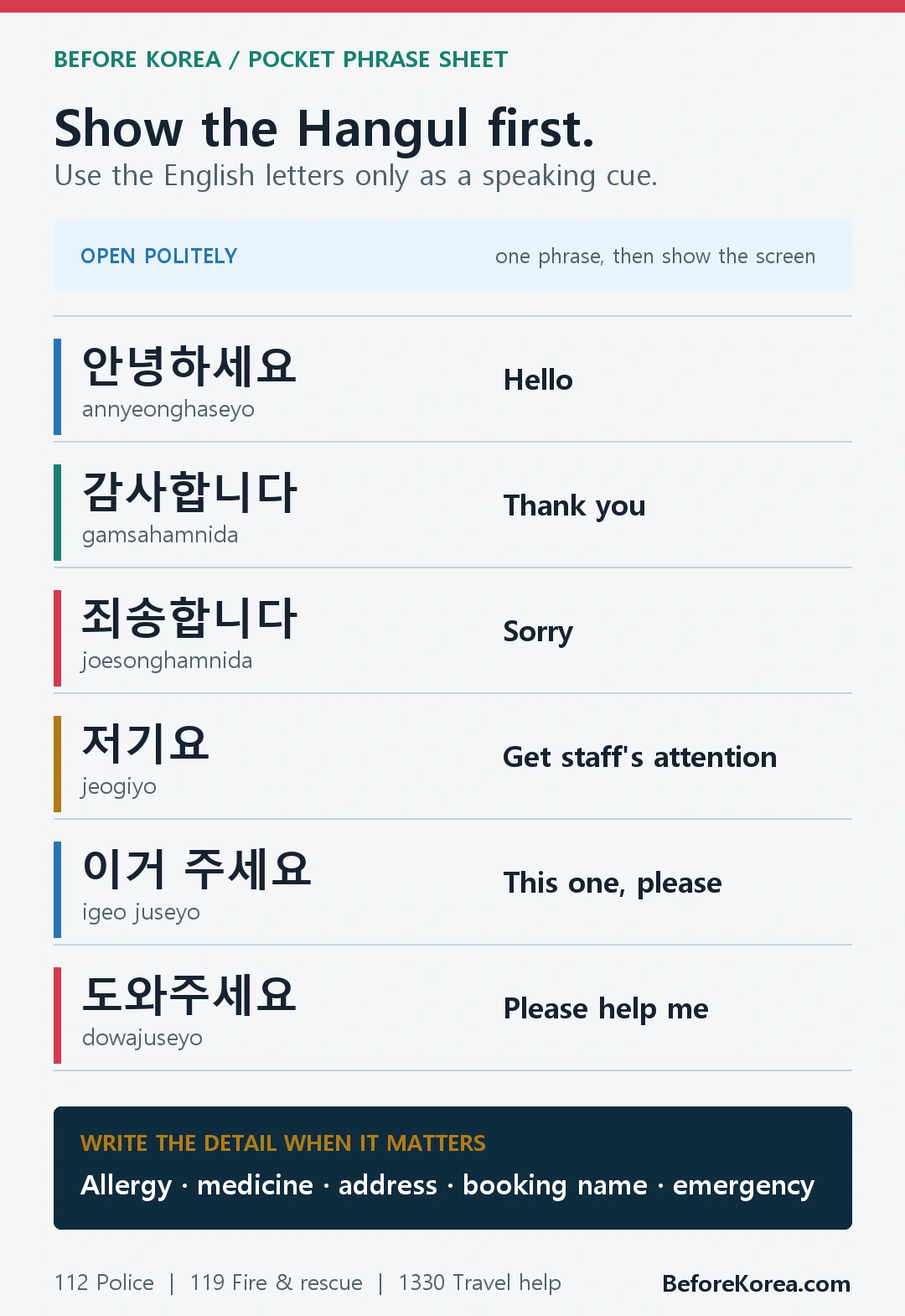
Use a phrase packet, not a memorized performance
| Keep together | Example evidence | Recovery value |
|---|---|---|
| Korean text | 이 주소로 가 주세요 | Can be shown without speaking |
| Plain meaning | Please go to this address | Prevents using the wrong sentence |
| Exact object | Korean road address or menu item | Connects phrase to the transaction |
| Expected answer | Yes/no, number, item or screen | Lets you verify response |
| Stop rule | Do not proceed if identity is unclear | Prevents polite but wrong action |
Romanization is a pronunciation aid
The National Institute of Korean Language romanization system explains transcription based on standard Korean pronunciation. Romanized spelling is not a reversible substitute for the exact Hangul name in every situation. Keep Hangul for addresses, branches, foods and restrictions, and use romanization only to help start the exchange.
Core confirmation phrases
| Purpose | Hangul | Meaning |
|---|---|---|
| Confirm object | 이거 맞아요? | Is this the right one? |
| Ask price | 얼마예요? | How much is it? |
| Ask location | 어디예요? | Where is it? |
| Ask for help | 도와주세요. | Please help me. |
| Ask to repeat | 다시 말씀해 주세요. | Please say that again. |
| Say you do not understand | 잘 모르겠어요. | I am not sure / I do not understand. |
| Stop | 잠시만요. | Please wait a moment. |
Restaurant packet
Show the exact menu item, then use 이거 하나 주세요 (One of this, please). For a change, write the ingredient or option and use 빼 주세요 (Please leave it out), but do not treat the phrase as proof the kitchen can or did comply. Keep the submitted order number and recheck the dish on arrival.
Allergy and medical restrictions
A phrase can request a responsible answer; it cannot produce evidence the staff do not have. Show the exact allergen in Korean, ask whether it is in the dish or shared handling, and use 먹으면 안 돼요 (I must not eat it). If the answer remains uncertain, stop. For symptoms, use the traveler’s emergency plan and 119 rather than continuing a menu discussion.
Taxi packet
Use 이 주소로 가 주세요 (Please go to this address) while showing the full Korean road address, business name and phone. Confirm 여기 맞아요? (Is this the right place?) only after checking the destination evidence. Keep the meter or app record; a phrase cannot resolve a wrong branch without an exact address.
Shop and market packet
Point to the exact product and use 이거 얼마예요? (How much is this?). Confirm quantity, unit and total on the display. 카드 돼요? (Can I pay by card?) is a question, not a promise that a foreign card or the first attempt will succeed. Keep the receipt until item and payment match.
Cafe and kiosk packet
For hot or iced, show 따뜻한 것 (hot) or 차가운 것 (cold) together with the exact drink. At a kiosk, staff help may be requested with 도와주세요, but preserve the cart and payment state before restarting. If an order number exists, show it rather than trying to reconstruct every option from memory.
Ask for numbers and written answers
Use 적어 주세요 (Please write it down) when a price, platform, floor, gate, phone or time is hard to hear. A written number reduces mistakes between similar sounds. Repeat the number on your own screen and ask 맞아요? (Is that correct?) before leaving.
When the answer is longer than the phrase
Do not nod automatically. Use 다시 말씀해 주세요, ask for the key word in writing, or show two explicit choices. A yes/no format is useful only when the underlying question is exact. ‘Is it okay?’ is too vague for an allergy, payment, route or reservation decision.
A recovery sequence
- Pause with 잠시만요.
- Show the receipt, order number, item, fare or address.
- Name one mismatch in your own language and translate only that point.
- Ask the other person to point, write or show the corrected result.
- Confirm the final object and payment state before continuing.
Do not use politeness to hide uncertainty
-요 endings make many travel requests appropriately polite, but politeness does not require agreeing. Say 잘 모르겠어요 when you do not understand, and keep the transaction paused. Avoid slang, speech copied from dramas, or casual 반말 with strangers when a simple neutral request is available.
Escalate when a short phrase is insufficient
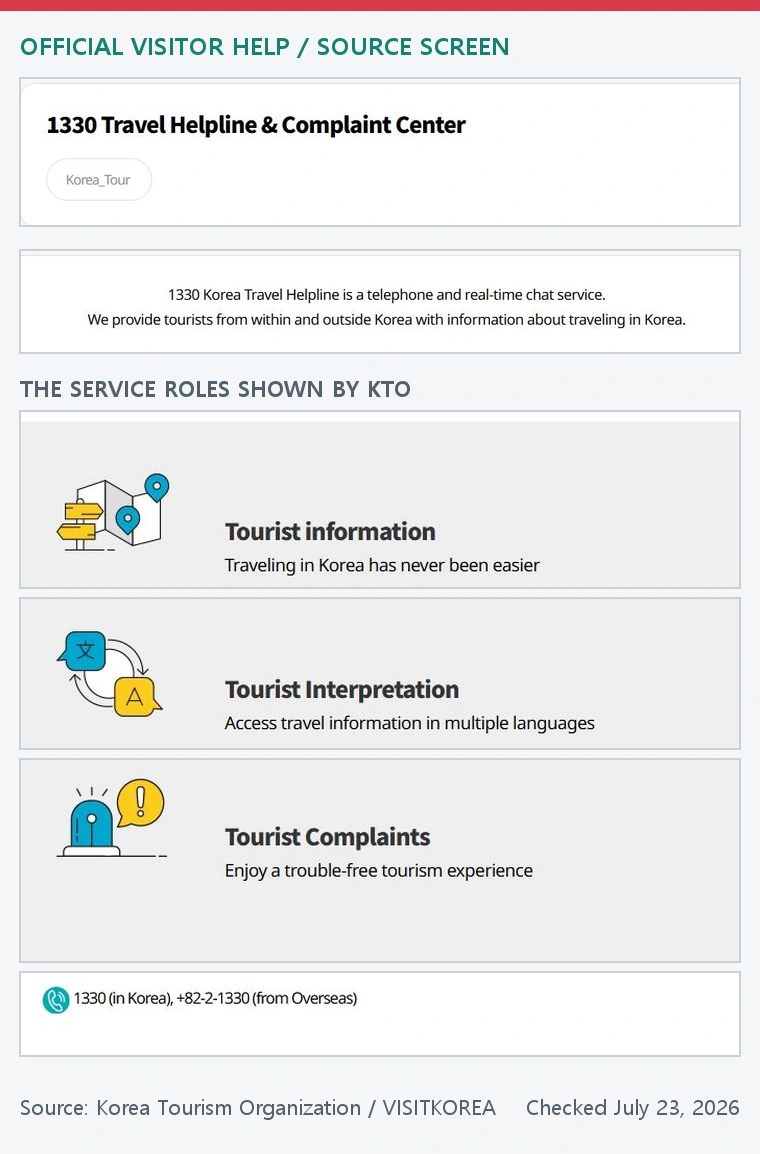
The 1330 Korea Travel Helpline provides travel information, interpretation support and a complaint route through phone and text channels. Keep the business, branch, address, time and transaction evidence ready. 1330 is not a replacement for 112 police or 119 emergency response.
Official phrase references
The National Institute of Korean Language practical expressions guide covers transport, shopping, tourism, restaurants, hospital-pharmacy situations and requests for help. Use it as a language reference, then update the object-specific details on your own screen. Old examples do not decide a current price, route, product or service.
Questions travelers ask
Do I need perfect pronunciation?
No. Keep exact Hangul and transaction evidence visible; use speech to open the exchange.
Is romanization enough for an address?
No. Show the Korean road address and branch identity.
Can a translated allergy card guarantee safety?
No. It states a condition; the exact dish and handling still need responsible verification.
Source check and boundary
Reviewed August 24, 2026 using NIKL practical expressions, NIKL romanization guidance, KTO 1330 support and KTO taxi information. This page is a communication tool, not translation certification, medical advice, or a guarantee that a request will be understood or accepted.