A foreign card failure in Korea usually happens at the least convenient moment: a self-service kiosk, a transport-card reload point, a small shop, a hotel deposit, or an ATM that does not like your card network. That is why the practical question is not “Can I pay by card in Korea?” The better question is “What do I do when the one terminal in front of me rejects my foreign card?”
Last checked: June 1, 2026. Re-check the official provider, store, customs, or payment page before acting, because routes, prices, labels, rules, app screens, eligibility, and store/service policies can change.
Last updated: May 24, 2026.
The answer is not panic. Most failures are solvable if you understand the pattern. Staffed mainstream commerce is usually easy. Unattended and domestic-optimized systems are where friction appears.
Start with what can fail at payment
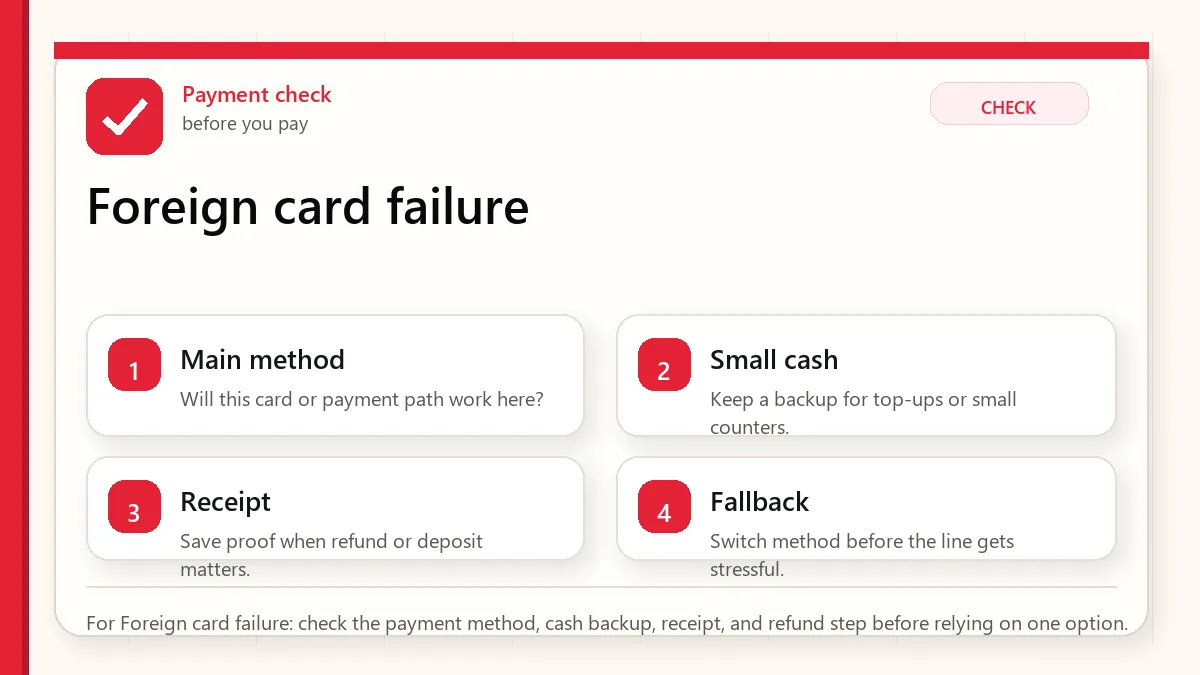
If your foreign card fails in Korea, try a physical chip insert before a phone tap, try a second card from a different issuer, move to a staffed counter if the failure happened at a kiosk, and keep a small cash buffer for taxis, markets, transit-card top-ups, or emergency food. For a longer trip, a prepaid visitor tool such as WOWPASS can become a useful fallback, but it should not replace normal card and cash planning.
Why cards fail even when Korea feels cashless
Korea’s card culture is strong. Hotels, department stores, convenience stores, chains, pharmacies, and most staffed restaurants are usually comfortable with cards. The problem is that visitors meet payment systems built for domestic cards, domestic verification, legacy transport rails, or Korean app accounts. A store can be “card friendly” and still have one kiosk that rejects your card.
Think in layers. Your first layer is a physical Visa or Mastercard. Your second layer is a different issuer or network. Your third layer is cash. Your fourth layer is a local-style prepaid or transit card. Your last layer is changing the purchase channel: staffed counter, another branch, taxi stand, hotel desk, or another machine.
Payment failure decision table
| Where it failed | Likely reason | Best next move |
|---|---|---|
| Restaurant kiosk | Domestic card routing, old reader, contactless issue. | Try chip insert, then ask staff or order at the counter. |
| Subway or transport reload machine | T-money and local transit systems may not accept every foreign card. | Use cash top-up or buy a single ticket where available. |
| Hotel check-in | Authorization hold, debit-card limit, issuer fraud block. | Use credit card, ask hold amount, avoid tying up debit cash. |
| Taxi | Reader issue, network mismatch, app payment not set. | Try another card, T-money where accepted, or cash backup. |
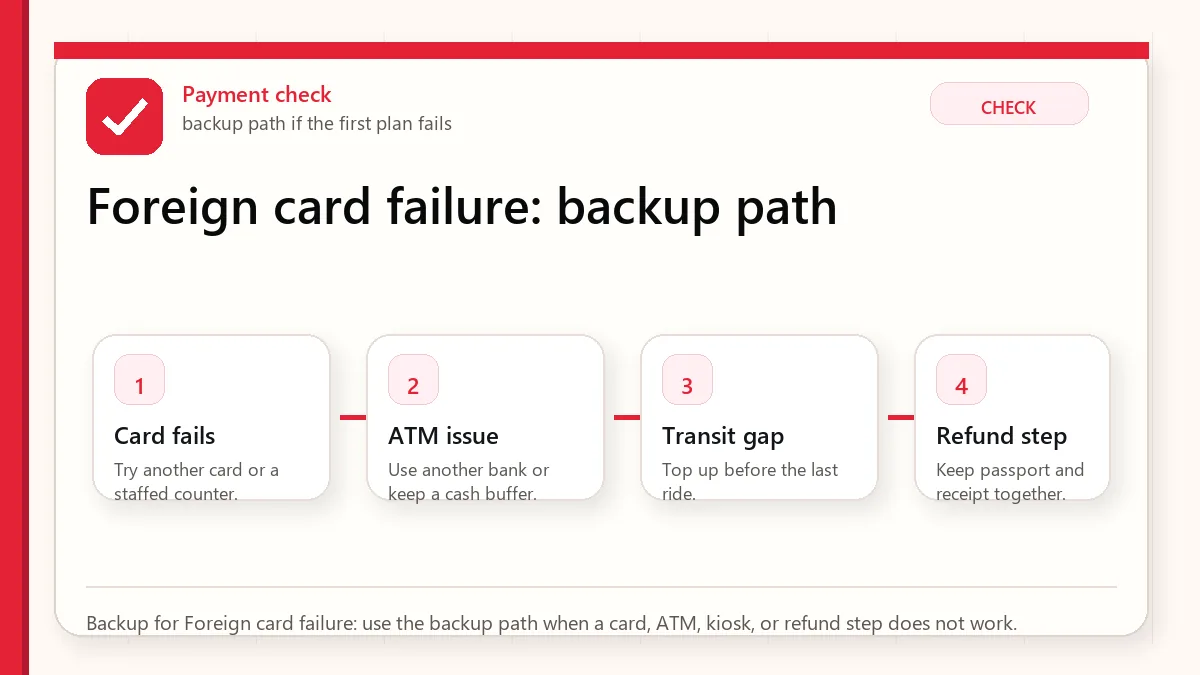
| ATM | Network mismatch, low machine limit, issuer block. | Find a bank-branded Global ATM and try another network card. |
How much cash should you carry?
For a short urban trip in Seoul or Busan, a working cash buffer of roughly KRW 50,000 to 100,000 per adult is usually enough if you also have two cards. For markets, smaller cities, late-night taxis, heavy transit-card top-ups, or nervous first arrivals, KRW 150,000 to 200,000 gives more breathing room. This is not because Korea is cash-heavy. It is because cash solves a few sharp problems quickly.
The best visitor payment stack
- Two physical cards from different issuers, ideally Visa or Mastercard as the primary network.
- One ATM-capable debit card with international withdrawal enabled.
- A small KRW cash buffer, separated from your wallet’s main card pocket.
- A T-money or EZL-style transit card for transport and small partner payments.
- Optional WOWPASS if you want a local-style prepaid payment layer and currency-exchange utility.
Apple Pay, Samsung Wallet, and contactless reality
Phone wallets can work where terminals support the right contactless technology, but they are not a universal workaround. If your phone tap fails, use the physical card. If the physical card fails, try another issuer. If the merchant terminal is domestic-only or the kiosk is old, the problem may not be your bank at all.
Hotel deposit warning
Use a credit card rather than a debit card for hotel holds when possible. A debit-card hold can lock real cash for days after checkout, which is a bad surprise if that card is also your ATM card. Ask the hotel whether the deposit is a hold, a charge, or a refundable payment.
The real failure pattern
Most payment problems in Korea are not a simple “foreign cards do not work” situation. The pattern is more uneven. A foreign card may work at a hotel, department store, pharmacy, museum, or staffed restaurant, then fail at a transport recharge machine, a self-order kiosk, a parking machine, a small neighborhood shop, or an online checkout that expects a Korean card verification flow. This is why visitors get confused: the same card can be accepted in one place and rejected ten minutes later.
The most common practical split is offline card acceptance versus local payment infrastructure. Offline card terminals are often fine when the merchant accepts international networks and the card is activated for overseas use. Local online payments, QR payments, delivery apps, and some kiosk flows can be harder because they may expect Korean identity verification, a Korean phone number, a domestic card issuer, or app-based authentication that foreign visitors cannot complete.
A field sequence that saves time
If a card fails, do not keep repeating the same tap. First try chip insertion if contactless fails, or contactless if chip fails. Second, ask for a staffed counter if the machine is the problem. Third, try a second card from a different network or bank. Fourth, reduce the transaction to the essential item if the terminal seems to reject a mixed purchase. Fifth, switch to a backup method: cash, a prepaid travel card, T-money for eligible transport and convenience-store purchases, or another person in your group.
The key is to separate a card problem from a channel problem. If a card fails at one kiosk but works at a staffed counter, your card is probably usable. If it fails at several staffed merchants, call your bank, check overseas usage settings, or move to the backup card. If a local app asks for Korean identity verification, changing cards often will not solve it.
How much backup is sensible
Before Korea recommends a modest cash buffer, not a cash-heavy trip. A visitor does not need to carry a large amount every day, but arriving with enough Korean won for a meal, transit recharge, small taxi gap, or convenience-store purchase removes stress. Keep this cash separate from your main wallet, and avoid making airport arrival your first experiment with a brand-new payment setup.
Official links to check
Use these official links when the next step matters. This guide explains what to watch for, but app downloads, eligibility, prices, routes, policies, and service rules can change.
- T-money official site: Check current card, top-up, refund, and mobile T-money information.
- WOWPASS official site: Check current prepaid card, exchange, app, and transit-card features.
- Korea Customs traveler tax refund page: Check official tax refund steps before relying on store or airport assumptions.
- VISITKOREA official travel site: Use this for current tourism notices, transport basics, and traveler support.
- Kakao T official service page: Check Kakao's official Kakao T service information.
- Kakao T on Google Play: Download the Android app from Google Play.
- Kakao T on the App Store: Download the iPhone app from the App Store.
- k.ride official site: Check Kakao Mobility's visitor-focused ride app information.
- k.ride on Google Play: Download the Android app from Google Play.
- k.ride on the App Store: Download the iPhone app from the App Store.
- Uber Korea ride page: Check current Uber ride availability and account support for Korea.
- Baemin official site: Check Baemin service information before assuming delivery will work for your stay.
FAQ
Do I need cash in Korea?
Yes, but usually not a lot. Treat cash as a backup for transit loading, markets, taxis, and payment failures.
Why did my card work at a convenience store but fail at a kiosk?
Different terminals can route payments differently. Staffed counters often have better fallback options than self-service machines.
Is WOWPASS necessary?
No, but it can be useful if your cards are unreliable or you want a prepaid local-style spending layer.