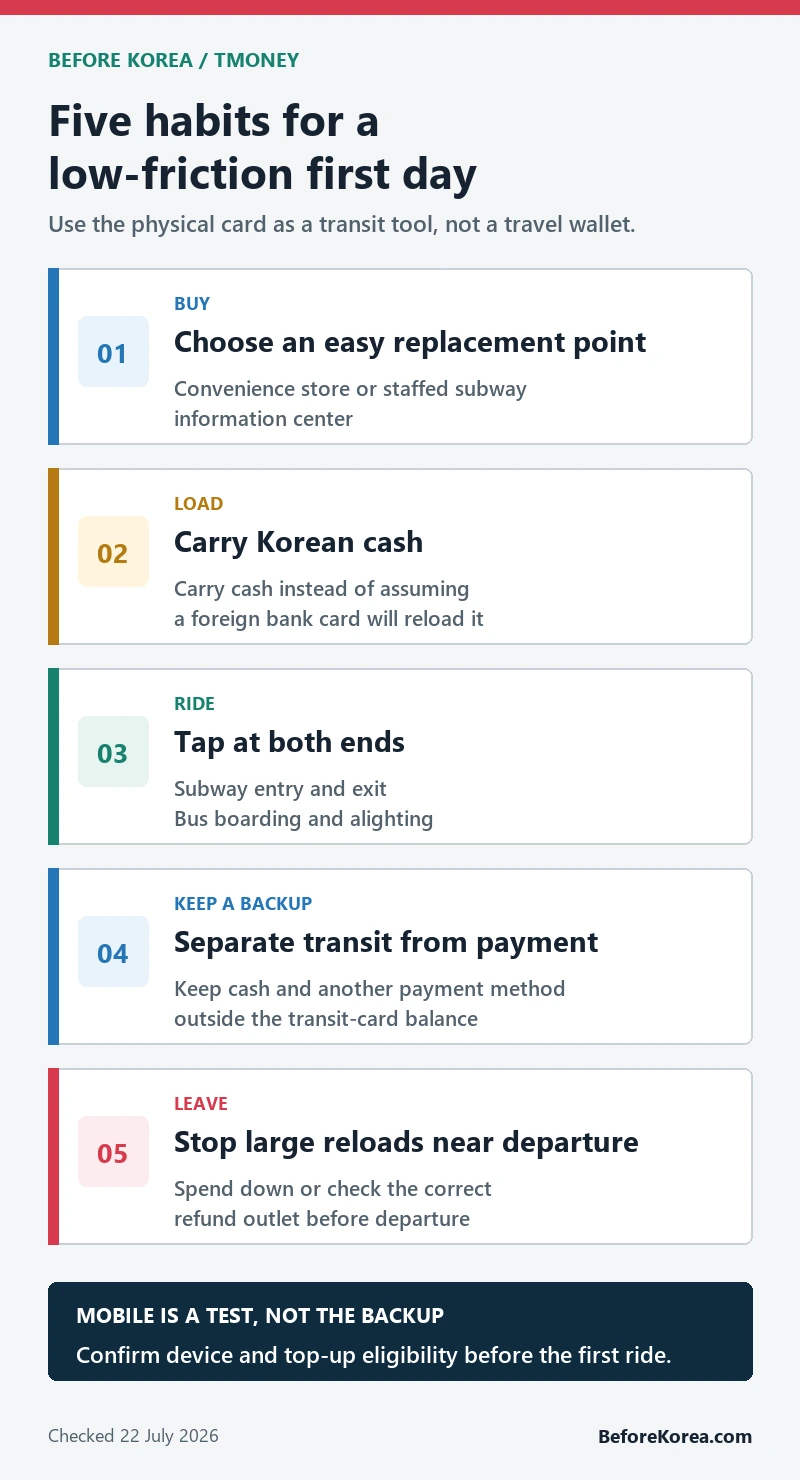
For a visitor, the low-risk T-money setup is a physical card, Korean cash for the first purchase and reload, and another payment method kept separately. Tap at both ends of a subway or bus journey, stop making large reloads near departure, and do not assume a foreign bank card or a phone will solve every transit-payment problem.
Checked 22 July 2026. The Korea Tourism Organization’s current visitor-payment sheet labels prepaid Tmoney purchase and top-up as cash only and says foreign-issued cards are not accepted for either. Apple currently says a South Korea-issued credit or debit card is required to purchase or top up Tmoney in Apple Wallet. Recheck both before travel because payment support can change.
The low-friction first-day setup
Buy the card where you could replace it without crossing the city, put on only enough value for the first part of the trip, and test it on an ordinary ride. That setup is less elegant than trying to make one phone do everything, but it keeps a dead battery, unsupported payment card, or failed account setup from becoming a transport problem.
| Moment | Safer action | Mistake it prevents |
|---|---|---|
| Buying | Use a convenience store or staffed subway information center listed by KTO. | Searching for a special design while carrying luggage and no usable transit card. |
| First reload | Carry Korean won and add a modest amount. | Discovering at the machine that a foreign card is not accepted. |
| Riding | Tap when entering or boarding and again when exiting. | Losing a transfer benefit or leaving an incomplete journey record. |
| Paying elsewhere | Keep cash and a bank card outside the T-money balance. | Treating a transit card as a universal travel wallet. |
| Leaving Korea | Stop large reloads and check the correct refund outlet before departure day. | Being left with a balance that is inconvenient to recover. |
If two people are traveling together, separate cards make fare and transfer handling easier to understand. Keep the cards in different pockets so one person does not accidentally present both to the same reader.
Buy the card you can replace easily
The KTO transportation-card guide lists convenience stores nationwide and information centers in Seoul subway stations on Lines 1 to 8 as Tmoney retail points. It gives a general card price of KRW 3,000 to KRW 5,000. A particular design, airport counter, or shop can differ, so look for the product name and ask whether the amount you pay includes stored value.
Do not confuse a normal reloadable T-money card with an unlimited pass. A Climate Card, Mpass, or other tourist product has its own geography, validity period, and purchase rules. Standard T-money is the conservative choice when the itinerary crosses regions or the number of rides is still uncertain.
Carry cash for the first load
The clearest current visitor rule comes from KTO’s 2026 public-transport payment guide: prepaid Tmoney is available at convenience stores and subway stations, foreign-issued credit cards are not accepted for purchase or top-up, and the listed method is cash. That is the baseline to plan around even if a newer machine offers additional choices.
The station machine shown below is a real 2024 example, not a promise that every machine has the same screen, language, or payment hardware. Its bilingual header identifies both ticket vending and transportation-card reload, while the physical controls show why looking for the card-reload option matters before inserting money.
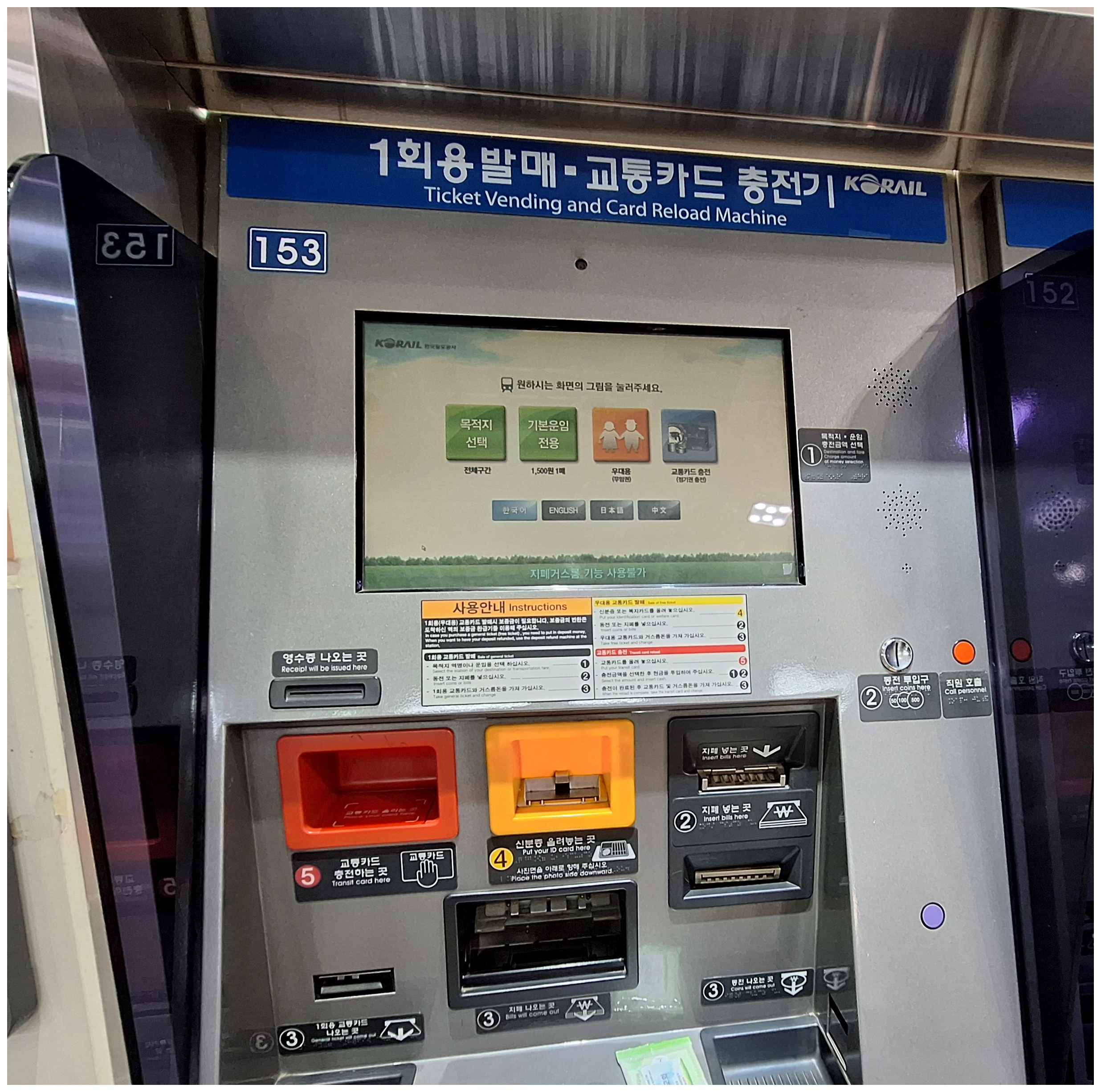

KTO also says T-money can be reloaded at subway ticket-vending machines and lists a maximum stored reload amount of KRW 500,000. That ceiling is not a target. A smaller first balance is easier to replace, track, and spend down; add more after you know the card works on your route.
Tap twice, especially on buses
Subway gates make the sequence visible: tap to enter and tap to leave. On a city bus, the second tap is easier to forget. The KTO city-bus guide tells riders to tap at the front-door terminal when boarding and at the rear-door terminal when getting off.
In Seoul, KTO says a qualifying transfer must follow the exit tap within 30 minutes from 07:00 to 21:00 or within one hour from 21:00 to 07:00. It also warns that transfer policy varies by city and that boarding the same bus route again does not receive the same free-transfer treatment. Build the habit around the exit tap, not around memorizing one city’s allowance.
Keep T-money in its proper role
T-money works on public transport and at participating merchants displaying the mark, but that does not make it a replacement for a bank card or cash. A restaurant, hotel deposit, online booking, delivery app, and intercity ticket can each use a different payment route. Keep enough separation that a lost transit card does not also contain the day’s entire spending plan.
The same rule applies at the airport. AREX Express, an all-stop train, an airport bus, and a subway connection are not interchangeable products merely because they all move toward Seoul. Check the route and ticket type first, then use T-money only where that service accepts it.
Plan the last balance before the airport
Refund friction is mostly a planning problem. The KTO card guide says a T-money refund over KRW 50,000 is available only at Tmoney Town in Seoul Station. It does not mean every smaller refund is available at every shop, at every hour, or without a fee. Check the current outlet and amount rules before relying on a refund.
- Two or three days before departure, stop adding large round amounts.
- Keep enough value for the airport journey plus a small margin.
- Use participating small purchases only when you already wanted the item.
- If the balance is substantial, check the official refund location before packing.
Do not create a shopping problem to solve a transit-card balance. Leaving a small amount for a future trip can be more sensible than buying something unnecessary or missing a train to find a refund counter.
Mobile T-money is useful only after a real test
Apple Wallet now makes Tmoney more visible to iPhone users, but the top-up condition matters. Apple Support, published 4 February 2026, says a South Korea-issued credit or debit card is required to purchase or top up Tmoney from Apple Wallet. That excludes the simple foreign-card setup many short-term visitors expect.
Apple also warns that after a supported physical transit card is transferred into Wallet, the physical card might no longer work. Do not try that conversion immediately before a journey unless you have confirmed eligibility, have enough battery, and know where to buy a replacement.
Android support can depend on the official app, device, NFC configuration, account, and current service conditions. Use the official Tmoney foreigner guide for the current route. If mobile T-money is already set up and passes a real reader test, it can be convenient. Until then, the physical card is the backup, not the other way around.
When a tap or reload fails
- Pause and read the balance or error shown by the reader instead of tapping several cards in quick succession.
- Check that you are using the transit-card area, not a bank-card or ticket slot.
- If the balance is low, reload with Korean cash at a staffed counter, convenience store, or compatible station machine.
- If the journey record appears incomplete, use the station help point rather than forcing another gate.
- Keep the card until the issue is resolved; its number and recent use may be more useful than a description of the design.
Questions travelers usually discover too late
Can I buy or reload physical T-money with my foreign card?
Do not plan on it. KTO’s current visitor-payment guide says foreign-issued cards are not accepted for prepaid Tmoney purchase or top-up and lists cash only. A new machine may add options, but Korean cash remains the dependable visitor fallback.
Do I need to tap off a bus if I am not transferring?
Make the exit tap automatic. It closes the ride correctly and preserves any transfer treatment that applies. Regional fare rules differ, so skipping it because one journey seemed flat-priced is a poor travel habit.
Is the KRW 500,000 reload limit a recommended balance?
No. It is the maximum listed by KTO for station-machine reloads, not a suggested tourist amount. Load for the trip in smaller stages and reduce the balance before departure.
Should I choose mobile T-money instead of a physical card?
Only after confirming the device and payment requirements and testing a real reader. A short-term visitor with foreign payment cards should not assume Apple Wallet top-up will work, because Apple currently requires a South Korea-issued card.
Check the current rule before changing your setup
- KTO International Visitors’ Use of Public Transportation and Booking/Payment Services: current foreign-card and cash-only payment matrix.
- KTO Transportation Cards: retail points, general card price, reload ceiling, coverage, and high-balance refund note.
- KTO City Bus: boarding, alighting, and Seoul transfer timing.
- Apple Support: Add a transit card to Apple Wallet: current Tmoney purchase, top-up, and transfer conditions.
- Tmoney foreigner guide: provider instructions for the card and current service routes.
Continue planning the first day
Start with the full T-money Card in Korea guide, then match the card to the route in Incheon Airport to Seoul. Keep transit separate from the wider payment plan for Korea, and test any phone-dependent option with Before You Use Korean Apps.