Start with the situation, not a rule list
In Korea, good public etiquette usually means staying aware of shared space: keep noise moderate, queue calmly, do not block transit flow, handle trash responsibly, respect priority seats, and follow smoking or food rules in the place you are using.
Last checked: June 1, 2026. Re-check the official or primary source page before acting, because routes, prices, labels, rules, app screens, eligibility, and store/service policies can change.
Most etiquette is reading the room early
Visitors do not need to memorize a long list of rules to be considerate in Korea. The better habit is to pause for a few seconds, notice the local flow, and avoid taking up more noise, space, or time than the situation expects.
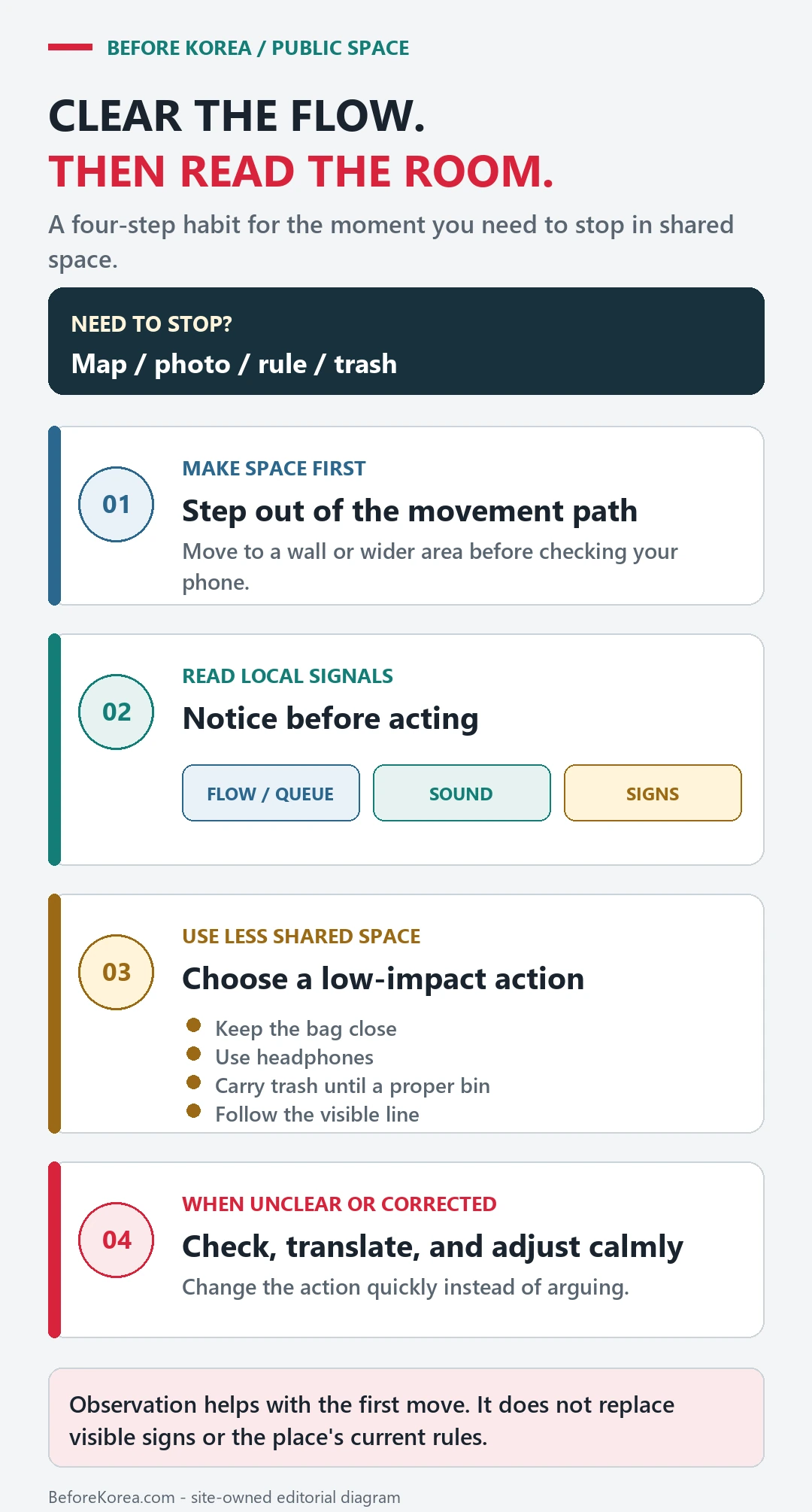
Shared-space etiquette by location
| Place | Better habit | Why |
|---|---|---|
| Subway/bus | Keep bags close, let people exit first, avoid blocking doors. | Transit flow matters in crowded cities. |
| Cafes | Order before occupying space when expected and keep noise reasonable. | Cafes can be busy work and study spaces. |
| Street | Step aside before stopping for maps or photos. | Sidewalks and station exits move fast. |
| Queues | Follow the visible line and wait your turn. | Line discipline reduces conflict. |
| Trash | Carry small trash until proper disposal is available. | Public bins may be limited in some areas. |
Checks before entering a shared space
- Observe how people move before stopping in a crowded place.
- Keep a small bag for personal trash.
- Use headphones for videos and calls.
- Check smoking signs and designated areas.
- Use translation or signs when a rule is unclear.
Move with the local rhythm
- Let passengers exit before boarding.
- Stand to the side on escalators or follow local signage and flow.
- Keep conversation volume lower in transit and quiet spaces.
- Do not leave cups, food, or trash on random ledges.
- At cafes, understand whether seating is for customers only.
- If corrected, adjust calmly rather than arguing.
Where visitors accidentally stand out
You block a station exit while checking your phone
Step to the wall or a wider area before navigating.
You cannot find a trash bin
Carry the trash until you find a proper bin, store, hotel, or station area that accepts it.
You sit in a priority area
Move if someone who needs it boards, and follow signage.
You are unsure about smoking
Use designated smoking areas only and check local signs.
Use the setting to decide the behavior
| Situation | Better approach | What to verify |
|---|---|---|
| Crowded commute | Keep bag close and minimize phone-stopping. | Doors, stairs, and escalators. |
| Cafe work session | Buy appropriately and keep noise low. | Outlet and seat rules. |
| Street photography | Avoid blocking storefronts or pedestrians. | Privacy and flow. |
| Nightlife area | Stay aware of noise and trash. | Local rules and safety. |
What not to assume about public space
- Do not assume public trash bins are everywhere.
- Do not assume loud calls are acceptable in quiet transit spaces.
- Do not assume cafe seating rules are identical across stores.
- Do not assume smoking is allowed just because you are outdoors.
Small habits that make shared spaces feel easier
Observe the rhythm before acting
Many etiquette problems are not about complicated rules. They happen because a visitor moves faster than the local flow: boarding before others exit, standing in a doorway, speaking loudly in a quiet carriage, or blocking a shop counter while deciding. A few seconds of observation usually tells you where to stand, when to move, and whether a space is meant for quick use or lingering.
Shared spaces are the real test
Cafes, trains, elevators, convenience stores, and narrow streets are where small habits become noticeable. Keep bags close, leave priority seating available, avoid sudden stops in walking lanes, and handle trash carefully because public bins can be less available than expected. These habits are simple, but they make the trip smoother for both visitor and local people nearby.
Read next when etiquette connects to transit, food, or stores
This topic works best when it is not handled alone. Use the related guides below to connect the decision with maps, money, food, shopping, transit, and app backup planning.
- Korea Subway and Bus Guide
- Korean Convenience Store Food
- Korean Street Food Guide
- Return to the related Before Korea hub
- Check the Before Korea Source Library
Related Before Korea guides
FAQ
Is Korea strict about public etiquette?
Many rules are common-sense shared-space habits. Observing local flow prevents most problems.
Can I eat on public transport?
Avoid messy or strong-smelling food on transit. Follow signs and local norms.
What if I make a mistake?
Adjust politely and move on. Most etiquette issues are solved by paying attention quickly.
Source links to verify
- VISITKOREA Tourist-Friendly Korea
- VISITKOREA transportation cards
- VISITKOREA official travel information
Last updated
Last updated: 2026-05-23. Re-check official sources close to the day you travel, buy, eat, or use an app. Details involving prices, eligibility, transport, app features, opening hours, and refund rules can change.
Use the current place signal to choose low-impact public behavior in Korea
| Decision | Evidence | Next action |
|---|---|---|
| Explicit rule | Current sign, announcement, barrier or staff direction | Follow it |
| Repeated flow | Queue, exit-first movement, tray return or quiet carriage pattern | Match it without blocking |
| Ambiguous cue | One person’s behavior or no visible instruction | Choose the reversible low-impact action |
| Consequence matters | Smoking, restricted area, heritage, safety or conflict | Ask identifiable staff |
Public etiquette is an operational loop: clear the movement path, read the explicit signal, reduce impact and adjust quickly. The decision record was checked against Seoul subway earphone etiquette notice, Seoul Hangang visitor rules, Seoul City Wall visitor etiquette.
Seoul Metro's current campaign asks passengers to use earphones for phone audio on the subway. Seoul's Hangang guidance identifies littering, excessive noise and use outside designated areas as rule issues, with multilingual signs posted in many areas. Seoul City Wall guidance tells visitors to carry trash when needed, keep quiet in residential areas and follow narrow-path etiquette. The current place sign and staff direction override a general travel custom. Source review completed August 24, 2026. Dates, eligibility, price, inventory, access and operating rules must be rechecked on the exact current first-party page before action.