A useful Korean food allergy card names the exact allergen in both English and Korean, asks about hidden ingredients and shared equipment separately, and gives restaurant staff permission to say they cannot confirm. Show it before ordering. The card improves communication; it does not prove that a dish or kitchen is safe.
Prepare the wording at home, keep a screenshot that works offline, and print a copy if your allergy is serious. Do not type only “nuts,” “seafood,” or another broad category when one specific ingredient can trigger a reaction. The person checking the kitchen needs the actual food name.
Reviewed August 24, 2026. This is a travel communication template, not medical advice or a restaurant-safety guarantee. Follow the emergency and medication plan provided by your clinician.
Copy this card before your trip
Replace every bracketed field with the exact Korean name of your allergen. If several foods can trigger a reaction, list each one instead of using a loose category.
저는 [식품명] 알레르기가 있어서 먹을 수 없습니다.
소스, 육수, 양념, 고명에 [식품명]이 포함되어 있는지 확인해 주세요.
같은 조리기구, 그릴 또는 튀김기름을 사용하는지도 확인해 주세요.
확실하지 않으면 주문 전에 말씀해 주세요.
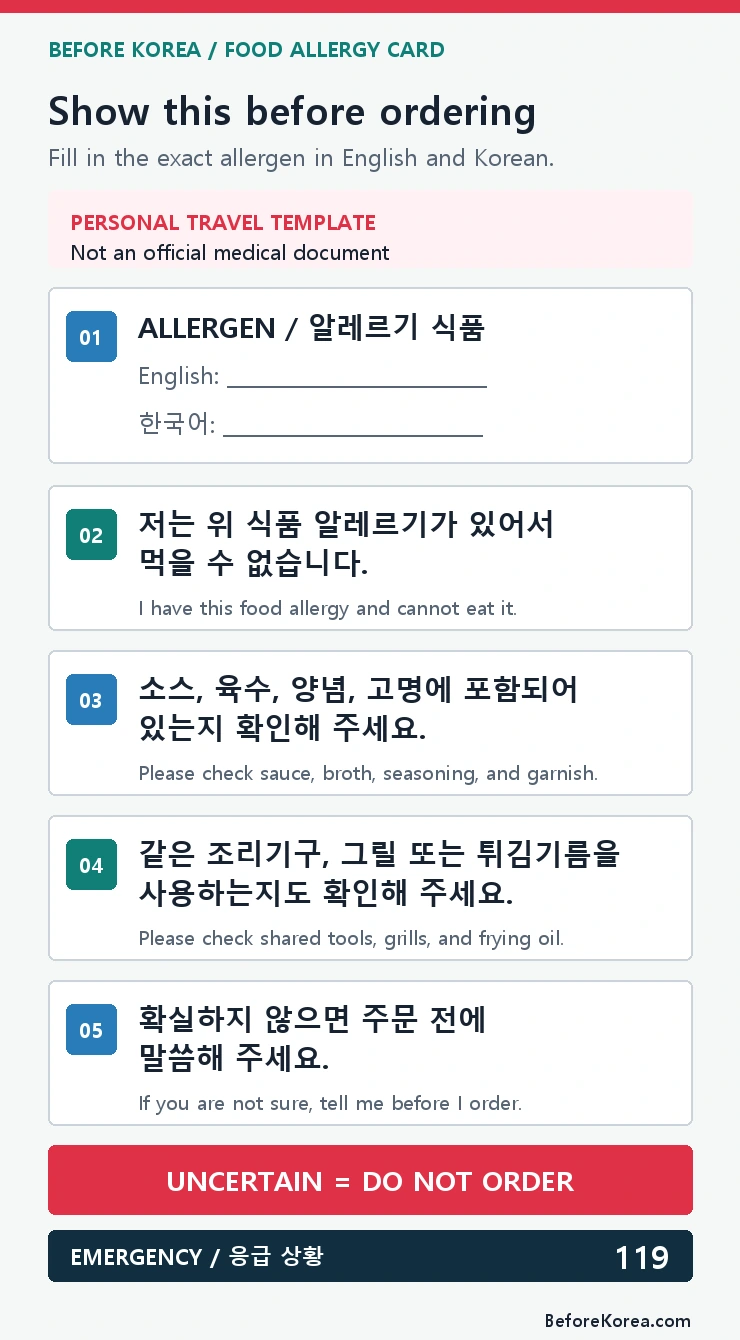
English meaning: “I have an allergy to [food] and cannot eat it. Please check whether [food] is included in the sauce, broth, seasoning, or garnish. Please also check whether the same tools, grill, or frying oil are used. If you are not sure, tell me before I order.”
If it is medically accurate for you, add 소량만 들어가도 위험할 수 있습니다. This means “Even a small amount may be dangerous.” Do not add a severity statement merely to get faster service. The card should describe your real risk.
Fill the blank with the exact allergen
Use the ingredient name your doctor or allergy plan identifies. “Tree nuts” and “shellfish” do not map neatly to one precise Korean ingredient, so list the individual nuts, crustaceans, mollusks, or fish that matter to you. Have a fluent Korean speaker or qualified translation service review uncommon ingredient names before travel.
| English | Korean to verify | Important distinction |
|---|---|---|
| Peanut | 땅콩 | Do not replace with the broad word for nuts |
| Walnut | 호두 | List separately from peanut or pine nut |
| Pine nut | 잣 | List separately from other nuts |
| Almond | 아몬드 | State it by name if it is one of your allergens |
| Egg | 달걀 / 계란 | Both Korean words are commonly used |
| Milk | 우유 | Ask about dairy ingredients as your medical plan requires |
| Wheat | 밀 | Do not assume a dish is wheat-free from its name |
| Soybean | 대두 / 콩 | Can appear in sauce, paste, tofu, and seasoning |
| Shrimp | 새우 | A crustacean; name it separately |
| Crab | 게 | A crustacean; name it separately |
| Mollusks | 조개류 | Also list the exact species, such as 굴 (oyster), if relevant |
| Sesame | 참깨 / 참기름 | Ask about both seeds and oil when both matter |
| Fish | 생선, plus the species name | Use the exact fish name whenever possible |
This is a vocabulary aid, not a complete regulated-allergen list and not a substitute for an individual medical plan. Korea’s labeling rules and restaurant practices are different questions, and a word on a card cannot rule out cross-contact.
Ask about ingredients and cross-contact separately
One question asks whether the allergen is an ingredient. A second asks whether the kitchen uses the same equipment, grill, or oil. A dish can pass the first question and still fail the second. Keep both lines on the card if cross-contact matters for your allergy.
- 이 음식에 [식품명]이 들어가나요? — Does this dish contain [food]?
- 소스와 육수도 확인해 주세요. — Please check the sauce and broth too.
- 같은 조리기구나 튀김기름을 사용하나요? — Do you use the same cooking tools or frying oil?
- 주방에 확인해 주실 수 있나요? — Could you check with the kitchen?
- 확실하지 않으면 말씀해 주세요. — Please tell me if you are not sure.
Do not ask only “Is this safe?” That invites a broad yes-or-no answer without showing what must be checked. Point to the dish, show the exact allergen, and ask about the relevant sauce, stock, garnish, oil, or equipment.
Use the card before ordering
- Prepare the Korean ingredient names before the trip; do not improvise a life-safety translation at the table.
- Show the card before placing an order, while the restaurant can still decline or suggest a different dish.
- Point to one dish and ask staff to check that item, including its sauce, broth, seasoning, and garnish.
- Ask separately about shared grills, tongs, pans, cutting boards, or frying oil when cross-contact matters.
- Listen for a checked answer. A quick “probably” or “I think so” is not confirmation.
- If staff cannot confirm, thank them and choose another dish or restaurant.
Busy street stalls, buffets, shared fryers, marinated barbecue, complex stews, kiosk-only ordering, and delivery can make detailed checks difficult. That does not mean every item is unsafe. It means the information and control needed for your individual risk may not be available. The Korean restaurant kiosk guide explains why a screen-based order is a different workflow from speaking with staff.
Packaged food needs a different check
A restaurant card is for a conversation; a packaged product has a label. Korea’s Ministry of Food and Drug Safety explains that food labels can identify regulated allergen ingredients and can carry a warning when unavoidable mixing may occur in a shared manufacturing process. Read the Korean ingredient and allergen areas on the package rather than relying on the front image or product name.
Camera translation can help you locate words, but glare, small type, line breaks, and over-labels can hide context. For a serious allergy, do not make a decision from one translated word alone. See the separate Korean convenience-store food label guide for that workflow.
When staff cannot confirm
“I do not know” is useful safety information. Do not negotiate until uncertainty sounds like certainty. Choose another option when staff cannot identify the sauce or broth, cannot check a supplier product, cannot separate shared equipment, or cannot communicate the question to the kitchen.
- Carry a safe backup snack for travel days and late-night arrivals.
- Prefer a calmer ordering setting where staff can read the card and check one dish.
- Keep allergies separate from preferences, halal checks, vegetarian requests, or spice preferences.
- Use the broader Korean food allergies guide to compare restaurant situations before choosing where to eat.
Keep an emergency plan separate from the card
The restaurant card explains what to avoid; it is not an emergency treatment plan. Carry prescribed medication and follow the instructions from your clinician. Keep your location, emergency contacts, insurance details, and medication accessible to your travel companion.
VISITKOREA lists 119 for fire and medical emergencies. Its current guidance for international visitors says callers who do not speak Korean can say “English please” or “Interpreter please” to request interpretation. In a life-threatening emergency, call 119 rather than using a general travel inquiry service.
Official sources and related guides
- Korea MFDS food-labeling system — official English overview of labeling and allergen-warning context.
- Food Safety Korea allergen-labeling explainer — Korean government food-safety guidance; re-check current rules before relying on a label.
- VISITKOREA disaster and safety services for international visitors — current 119 and interpretation guidance.
- Translation apps in Korea — how to prepare offline translation support without treating it as proof.
- Korean BBQ costs, portions, and allergy questions — checks for marinades, sauces, side dishes, and shared grills.
FAQ
Is a Korean allergy card a safety guarantee?
No. It helps staff understand the question. It cannot verify every ingredient, supplier product, cooking surface, or cross-contact path.
Can I write only “tree nuts” or “shellfish”?
For a serious allergy, list the exact nuts, crustaceans, mollusks, or fish that matter to you. Broad English categories can lose precision when translated.
What should I do if the restaurant is not sure?
Treat uncertainty as the answer. Choose another dish or restaurant rather than asking staff to promise something they cannot verify.
Build and verify the food allergy card
This page is the card-writing tool. The broader Korea allergy workflow—pre-travel medical planning, packaged-food labels, restaurant decisions and emergency preparation—belongs in the linked food-allergy guide. Here, the output should be one short card that staff can read before cooking and that never implies a kitchen is certified safe.
| Card line | What it must contain | Unsafe shortcut |
|---|---|---|
| Exact allergen | The medically relevant food name in English and reviewed Korean | A broad word such as nuts or seafood |
| Hidden ingredients | Sauce, broth, seasoning, garnish and premixed base | Asking only whether the visible topping contains it |
| Shared equipment | Knife, board, tongs, grill, pot and frying oil as relevant | Treating ingredient absence as cross-contact control |
| Permission to refuse | Please tell me if you cannot confirm | Pressuring staff to guess or say yes |
| Emergency limit | Follow the traveler’s clinician-provided plan and use 119 when indicated | Using the card as treatment advice |
Verify the Korean text before departure
Have a fluent Korean speaker or qualified translation service check the filled allergen names, especially uncommon fish, shellfish, seeds, additives and derived ingredients. Keep Korean and English together. Do not translate drug names, doses, passport details or emergency instructions from memory at the restaurant.
Do not confuse required packaged-food labels with a restaurant guarantee
MFDS food-labeling guidance identifies the foods covered by Korea’s required allergen labeling and explains same-facility warnings. A restaurant recipe, unlabeled side dish, sauce base or cross-contact route can still require direct questions. An allergen absent from the Korean required list can still be medically important and should still appear on the personal card.
Checked August 24, 2026: MFDS allergen-labeling guidance, the CDC Yellow Book 2026 severe-allergy travel guidance and Korea’s official 119 emergency route. The card is a communication aid; the traveler’s clinician-provided medication and emergency plan controls.