Choose T-money when you want flexible pay-per-ride travel, WOWPASS when you also need a prepaid merchant-payment backup, and Climate Card only when most of your planned rides are inside its covered Seoul network. These are not three versions of the same product. T-money is stored transit value, WOWPASS combines a spending card with a separate T-money function, and Climate Card is a time-limited pass.
This guide was checked on July 23, 2026. Prices, sales locations, accepted payment methods, and route coverage can change. Check the current official page before buying, especially if your plan depends on one airport segment or a station near the edge of Seoul.
Pick by route and payment need
Start with two questions: where will you travel, and do you need help paying in shops as well as on public transport? A visitor moving between Seoul, Busan, and Gyeongju usually benefits from a simple stored-value card. A visitor staying in central Seoul and taking many covered rides may save money with a pass. A visitor worried that a foreign bank card may fail at a shop may want a separate prepaid payment backup.
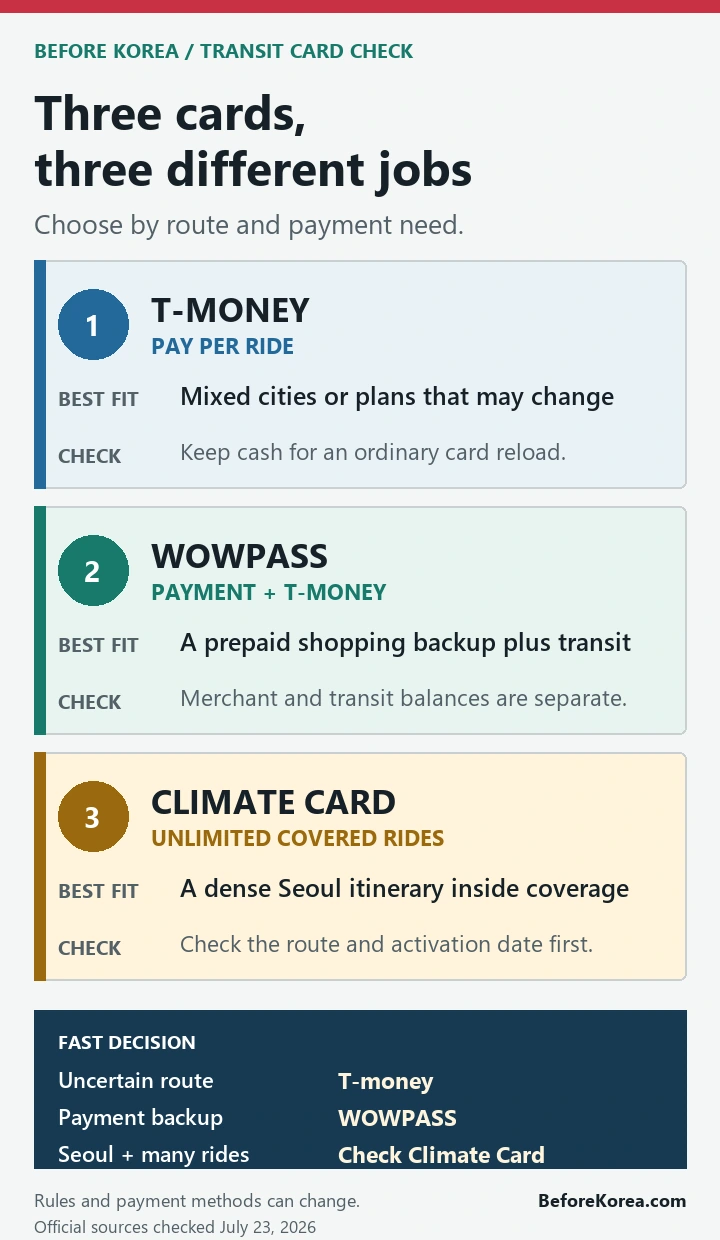
- Choose T-money for mixed cities, uncertain plans, or a simple tap-and-pay transit routine.
- Choose WOWPASS when a prepaid shopping card is useful and you understand that its shopping and transit balances are separate.
- Choose Climate Card for a dense Seoul itinerary after checking every important route against the official coverage rules.
There is no penalty for choosing the uncomplicated option. A small saving is not worth a missed train, an unusable pass, or an hour spent solving a top-up problem.
T-money is the flexible pay-per-ride baseline
T-money stores value and deducts the fare when you tap. It is the easiest baseline for travelers whose route may change because you are not committing to a fixed number of days or a Seoul-only coverage map. It is commonly used on subways and buses and can also be accepted for other small payments, but acceptance is not a promise that every transport operator or shop in Korea will take it.
The Korea Tourism Organization’s May 2026 transportation guide says ordinary T-money cards can be bought and reloaded at convenience stores and subway locations, and tells travelers to use cash for those purchases and reloads. Carry enough Korean won for the first card and one additional reload even if most of the rest of your trip will be paid by card.
Tap correctly at both ends of a subway trip and when boarding and leaving a bus where required. The exit tap is not cosmetic: it can affect transfer discounts and fare calculation. Check your balance before a long transfer or the final ride of the evening rather than discovering a shortfall at the gate.
WOWPASS combines two tools, not one balance
WOWPASS is useful for a different reason. It offers a prepaid merchant-payment function aimed at visitors and includes a T-money function for transport. According to the official WOWPASS guide, the merchant balance and the T-money transit balance are separate. Loading money for shopping does not automatically mean that the transport side is ready for the subway.
At a shop, follow the current card-payment instructions. At a subway gate or bus reader, use the T-money function. Check both balances in the current official app or at the appropriate machine before relying on the card. Product features and reload methods can change, so the app screen on the day you use it is more reliable than an old travel video.
WOWPASS makes the most sense when the merchant-payment backup is something you actually need. If your international cards work reliably and you only need transit, buying another financial product may add setup without solving a real problem.
Climate Card wins only when the route is covered
Climate Card is an unlimited-use pass for covered transport, not a universal Korea transit card. Seoul’s official page includes Seoul-based subway service, specified nearby sections, Seoul-licensed buses, and selected pass options. It excludes the Shinbundang Line, intercity and airport buses, buses licensed outside Seoul, and subway travel outside the stated coverage except for limited listed cases.
For short visits, the official prices checked on July 23, 2026 were KRW 5,000 for one day, KRW 8,000 for two days, KRW 10,000 for three days, KRW 15,000 for five days, and KRW 20,000 for seven days. A physical card costs an additional KRW 3,000. Short-term passes do not include Ttareungi bicycle service or Hangang Bus.
The short-term pass begins on the day it is charged and cannot be charged in advance. Do not load it the evening before your first sightseeing day just to finish setup early. Also check the licensed operator, not only the geographic location: a bus traveling through Seoul is not automatically covered if it is licensed elsewhere.
Compare the real trip in five minutes
A fixed claim such as “four rides a day makes the pass cheaper” becomes stale when fares or routes change. Use your actual itinerary instead. Add the current fares for the rides you expect to take on each pass day, then compare that total with the current pass price plus the physical-card fee. Count only journeys that the Climate Card actually covers.
- List the station or bus-stop pair for each important journey.
- Mark any airport, Sinbundang, intercity, or outside-Seoul segment for separate checking.
- Total the current pay-per-ride fares for covered journeys.
- Add the KRW 3,000 physical-card cost to the Climate Card comparison if you do not already have one.
- Choose the pass only when the saving is clear enough to survive one taxi ride, a changed plan, or a low-transit day.
The pass can still be worthwhile for convenience even when the cash saving is modest. Make that a conscious choice rather than assuming “unlimited” means every route is included.
What changed for overseas cards in 2026
Older guides often say that Climate Card purchase and top-up require cash or a Korean card. Seoul’s visitor notice says that from March 17, 2026, overseas-issued credit and debit cards can be used to buy or recharge Climate Card at ticket vending machines on subway Lines 1 through 8. For Line 1, the notice specifies the Cheongnyangni-to-Seoul Station section.
This change does not mean every machine, station, card product, or ordinary T-money reload accepts a foreign card. Read the machine labels and keep cash as a fallback. If an older page conflicts with the dated 2026 notice, use the newer notice for the covered machines and ask station staff when the machine does not show the expected option.
Treat the airport trip as a separate decision
Do not make your first ride from Incheon Airport depend on a card comparison you have not finished. Airport buses are outside Climate Card coverage, and airport-rail coverage has direction and station restrictions. Buy the airport train or bus option that fits your arrival time and luggage, then set up the daily transit card after reaching an area with staffed stations and convenient stores.
If you intend to use Climate Card on an airport-rail segment, check the exact boarding station, exit station, and direction on the current Seoul coverage page. A rule that allows exiting at a station does not necessarily allow boarding there. For a late arrival, a separate airport ticket plus T-money for the next day is the lower-stress default.
Buy, load, and test without overfunding
- Save the official product page and the Korean address of your first destination before landing.
- Buy only the card whose immediate job is clear.
- Load a modest amount or the exact pass period you need.
- Check the displayed balance and receipt before leaving the machine or counter.
- Make one normal tap while station or store help is nearby.
- Keep the card separate from other contactless cards so the reader detects the intended one.
For WOWPASS, verify the merchant and T-money balances separately. For T-money, keep cash for reloads. For Climate Card, confirm the activation date and the last usable day. A small first load reduces end-of-trip refund work and makes a lost card less expensive.
Three itineraries and the card that fits
Four days in Seoul with flexible sightseeing
Start with T-money if you have not mapped every route. Check Climate Card only after listing the stations for your busiest days. A four-day stay does not automatically match a pass duration, so compare the actual one-, two-, or three-day blocks you would activate.
Seven Seoul days with several rides every day
Climate Card deserves a route check here. Confirm that the hotel, major attractions, and evening destinations sit inside coverage, then compare the seven-day price and physical-card fee with current fares. Keep a separate payment method for excluded routes and shopping.
Seoul plus Busan, with shopping concerns
T-money is the simpler transit baseline for the changing itinerary. Add WOWPASS only if its prepaid merchant function solves a real card-acceptance concern. Do not buy Climate Card for the whole trip; at most, compare it with a particularly dense Seoul portion.
Questions travelers ask
Can I use a foreign contactless card directly at every subway gate?
No. Do not treat a foreign bank card as a universal replacement for a Korean transit card. Prepare T-money, an approved visitor product, or the correct pass and use overseas-card support only where the current operator specifically provides it.
Do I need both T-money and WOWPASS?
Usually not. WOWPASS already includes a T-money function, but its transit balance is separate from its merchant balance. A separate T-money card may still be useful for another traveler or as a simple backup, not because the two products must be paired.
Is Climate Card always cheaper for a Seoul-only trip?
No. It depends on the covered routes, ride count, activation days, and physical-card cost. Walking-heavy days and excluded lines can erase the expected saving.
Official sources and related Before Korea guides
Check the Seoul Metropolitan Government Climate Card page for current coverage, prices, and activation rules. Read the dated March 2026 overseas-card notice for eligible vending machines. The Korea Tourism Organization transportation guide covers current visitor payment basics, and the WOWPASS official guide explains the separate merchant and T-money functions.
For the next step, read T-money Card in Korea, T-money Tourist Mistakes, Payment in Korea, and the Korea Subway and Bus Guide. Use those guides for the detailed tap, cash-backup, and route-planning routines after choosing the card type.