Korea uses 220V electricity at 60Hz, and its outlets have two round holes. A phone or laptop charger whose INPUT label includes 220V and 60Hz may use Korea’s supply, although a physical plug adapter may still be needed. A fitting plug does not prove that an appliance, cable, or dock is compatible, so check the exact label and manufacturer instructions before connecting it.
Last checked: August 7, 2026. Device specifications, recalls, USB-C requirements, and outlet conditions can change. Recheck the exact model and current official source before use.
Before Korea is an independent travel guide. We do not sell, certify, or electrically test chargers, adapters, converters, appliances, cables, or docks.
Check a charger or device for Korea
Use the INPUT line on the wall charger or on the device that connects directly to the outlet. Do not use the charger’s OUTPUT line for the first question. This check sorts the information you select; it does not inspect the item or certify the setup.
South Korea · 220V / 60Hz
Will this charger work in Korea?
Use the exact input label on the charger, not its country of purchase. This beta checks wall-power readiness and a wired USB charging path separately.
Korea wall power
Wired charging
Rating bottleneck
What to do next
What this result does not prove
This is a specification check, not a product certification or electrical inspection. It does not measure actual battery input, temperature, battery health, cable condition, outlet condition, firmware behavior, or charging time. Stop using damaged, loose, wet, recalled, counterfeit-suspected, or overheating equipment.
Sources checked August 7, 2026: VISITKOREA electricity and voltage, USB-IF Power Delivery, USB-IF cable guidance, and Apple fast-charge guidance.
If the label is missing, unreadable, or does not clearly include both 220V and 60Hz, stop and check the exact manufacturer manual. Do not test a questionable device in a hotel outlet.
Use six separate checks for one exact device
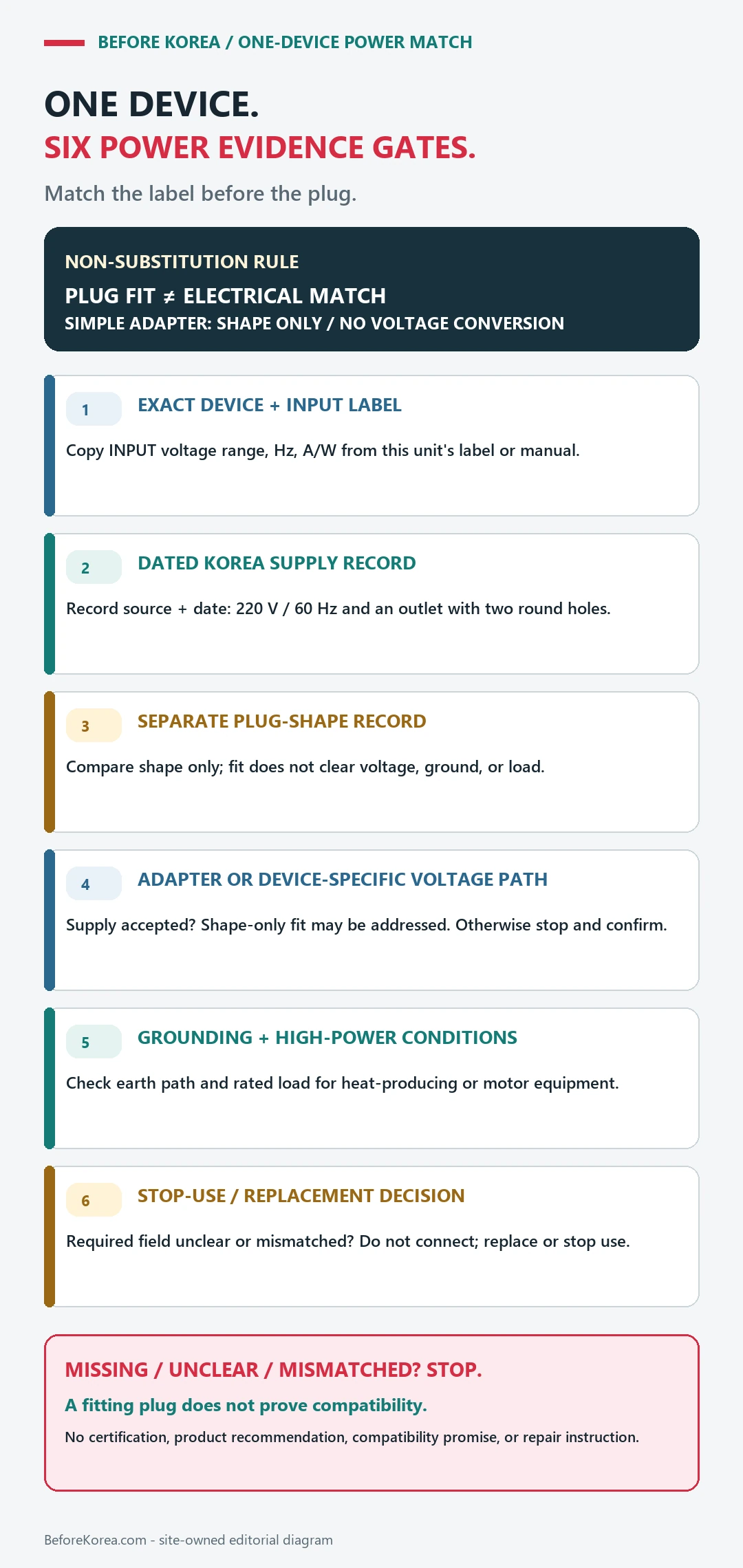
Read INPUT before OUTPUT
The INPUT line tells you what wall supply the charger or appliance accepts. On a detachable phone or laptop charger, read the charger brick. On an appliance that plugs directly into the wall, read the appliance label. The OUTPUT line matters later, when checking what the charger can deliver to the device.
| INPUT-label evidence | What it establishes | Next step |
|---|---|---|
100–240V, 50/60Hz | The printed range includes Korea’s 220V and 60Hz supply. | Check plug fit, grounding, condition, power needs, and manufacturer limits. |
220–240V, 50/60Hz | The printed range includes Korea’s supply. | Check the same remaining conditions. |
100–120V only | The printed range does not include 220V. | Do not connect it to a Korean outlet. |
| Missing or unclear | Wall-input compatibility is not established. | Find the exact manual or use a known-compatible alternative. |
The country where a product was purchased is not evidence of its input range. Read the exact item.
A plug adapter changes shape only
A plug adapter can make one plug shape fit another outlet. It does not change voltage, frequency, maximum power, grounding requirements, or the condition of the device. If the device requires an earth connection, the complete plug-and-outlet path must maintain it.
Do not stack loose adapters, force pins, or keep using an item that sparks, smells burnt, becomes unusually hot, has exposed conductors, or will not sit securely.
USB-C wattage is a chain, not one number
After the wall-input check, compare the device requirement, the maximum output of the exact charger port, and the cable’s supported power. On a multi-port charger, the printed total is not necessarily the output available from one port while other ports are in use.
A 65W USB-C charger does not force 65W into an iPhone; the device and charger negotiate a supported contract. Likewise, a legacy 100W-rated USB-C cable remains a 100W rating ceiling in a 140W charger path. Neither number proves the battery’s real-time input.
A dock or monitor has additional gates: the host port, DisplayPort Alt Mode, Thunderbolt or USB4 where required, dock power delivery, exact cable, display count and resolution, operating system, drivers, and firmware. A USB-C connector by itself proves none of them.
Hair tools, motors, and battery chargers need a stricter stop rule
Hair dryers, straighteners, curling irons, kettles, steamers, and motor appliances can depend on wattage, frequency, switching design, and grounding as well as voltage. Even when the voltage range includes 220V, use the exact manufacturer instructions. Do not choose a generic converter from this page.
This checker does not assess medical equipment, industrial equipment, e-bike or e-scooter battery chargers, or loose-cell chargers. Use only the exact manufacturer-specified power supply and qualified support for those products.
What this checker does not prove
This checker does not:
- inspect the charger, cable, adapter, device, hotel outlet, or building wiring;
- certify a product or confirm its recall, counterfeit, or damage status;
- prove grounding continuity, surge protection, or available outlet power;
- confirm a proprietary fast-charge mode, data speed, video output, or dock compatibility;
- decide airline rules for power banks or spare batteries; or
- replace the exact manufacturer manual, an electrician, biomedical support, or emergency guidance.
If an item is already smoking, sparking, swollen, wet, burnt-smelling, or dangerously hot, stop using it and move away from it. Do not use this checker to troubleshoot a live fault.
Pack the complete charging path
Keep the exact charger, the cable tested with that device, and any required shape-only plug adapter together. Check each high-power appliance separately. An adapter that works for a phone charger is not evidence for a hair tool.
Use the Korea packing list by season for weather, medicine, walking shoes, batteries, and luggage planning. Airline and airport battery rules are separate from wall-power compatibility.
Official sources to check
- VISITKOREA: Electricity and Voltage — Korea’s 220V, 60Hz supply and two-round-hole outlet description.
- KEPCO electricity supply terms — official Korean supply-voltage and frequency terms.
- USB-IF: USB Power Delivery and Cables and Connectors — charging negotiation and current USB-C cable guidance.
- Apple fast-charge guidance — product-scoped adapter and cable conditions used by the checker.
- VESA DisplayPort Alt Mode guidance — why USB-C display support is a separate capability.
- U.S. CPSC micromobility charger warning — basis for excluding generic e-bike and e-scooter charger matching.