There is no honest single daily cost for Korea. Build your number from the trip you have actually planned: accommodation per traveler per night + local transport + food and cafes + paid activities. Keep airport and intercity travel on the days when they occur, keep shopping outside the daily-cost figure, and treat a KRW cash buffer as payment backup rather than extra spending money.
This method gives you a number you can defend. It also shows exactly what to change if the total is too high. A generic “budget traveler” range cannot tell you whether your hotel, airport transfer, Korean barbecue dinner, or cosmetics shopping is doing the damage.
Official transport and payment sources were checked on August 24, 2026. Hotel, restaurant, attraction, exchange-rate, and operator prices are not frozen in this guide; use your live booking and menu prices before paying.
Use a formula instead of a Korea-wide average
Start with four ordinary-day lines. Then add costs that happen only on a particular date. This prevents an airport taxi or a large shopping purchase from making every day look more expensive than it really is.
| Budget line | How to calculate it | What not to hide inside it |
|---|---|---|
| Accommodation | Room total divided by travelers, then divided by nights | Early check-in, breakfast, resort fee, or local tax unless included |
| Local movement | Likely subway and bus rides, plus planned taxis | Airport transfer, KTX, intercity bus, or car rental |
| Food and cafes | Specific meals and drinks from menus near the itinerary | Celebration dinner, nightlife, or food gifts |
| Activities | Tickets and reservations assigned to their actual day | Shopping presented as an “experience” |
| Reserve | A small contingency based on the trip’s real failure points | A shopping allowance or money you expect to spend |
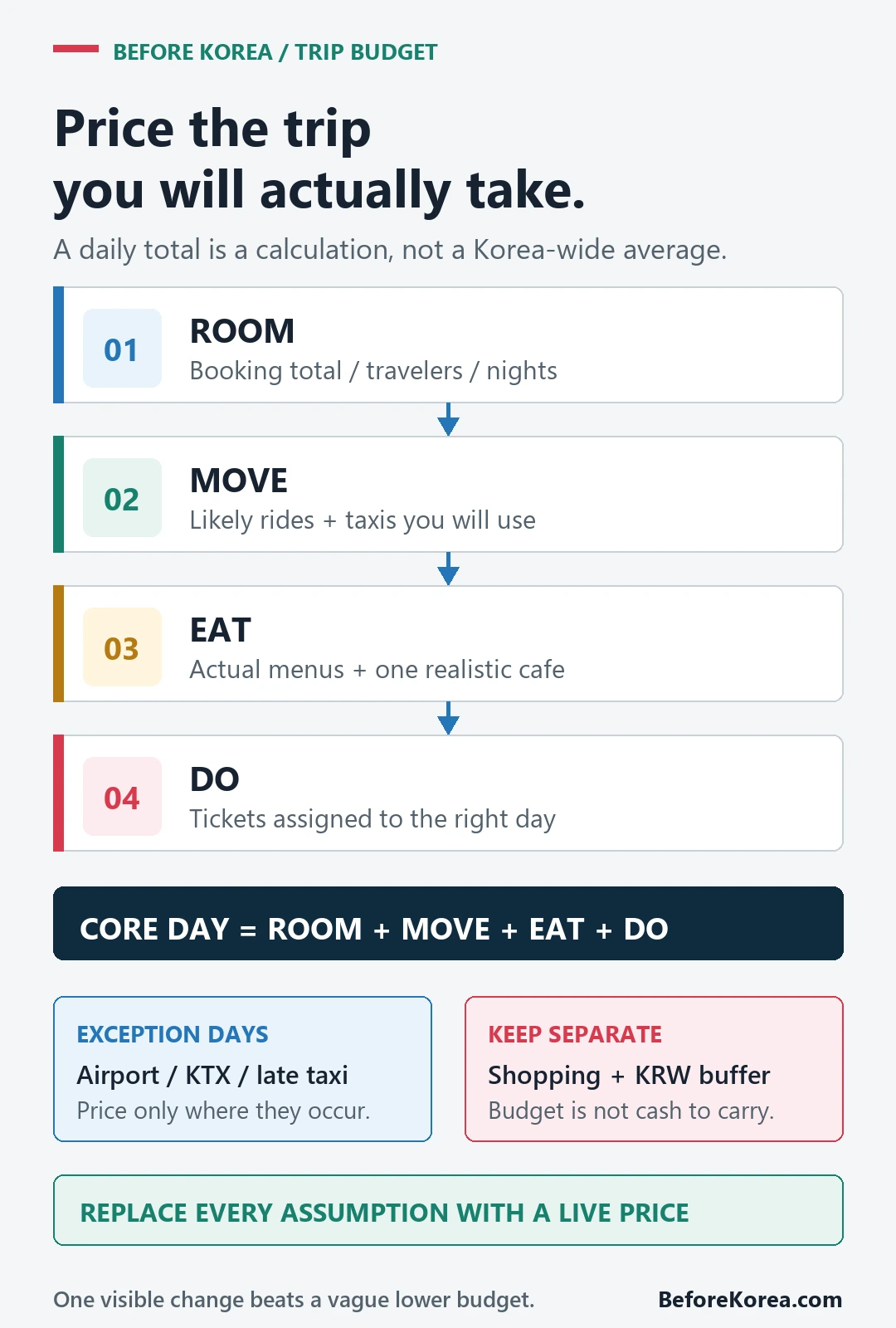
The core equation is simple: room share + movement + meals and cafes + activities = ordinary day. Calculate arrival day, departure day, long-distance travel day, and major shopping day separately. For a family, divide the room by the people who actually share it, but keep adult and child tickets separate when operators price them differently.
Calculate accommodation per traveler per night
Accommodation is usually the largest fixed line, so use the final checkout total rather than the first search result. Include taxes and fees shown before payment. Check whether breakfast, an extra bed, luggage storage, or late check-in has a separate charge. If the reservation is refundable, record both the current price and the final free-cancellation date.
For example, a room costing KRW 840,000 for five nights and shared by two travelers contributes KRW 84,000 per traveler per night: 840,000 / 2 / 5. Do not divide six calendar days into the room total when the booking is for five nights. That small denominator mistake makes comparisons unreliable.
Location belongs in the calculation too. A cheaper room can lose its advantage if it creates repeated cross-city rides, late taxis, or an awkward airport transfer. Put the hotel and the two or three most important neighborhoods into your map before deciding that the lower nightly price is the cheaper trip.
Anchor transport to fares you can verify
Use official fares as anchors, then price the routes you will actually take. Seoul’s official subway page lists the adult base fare at KRW 1,550 by transit card and KRW 1,650 for a cash single-journey ticket, effective June 28, 2025. Longer distance can add to the base fare, so multiplying every ride by KRW 1,550 is a planning floor, not a guarantee.
The same Seoul page says the integrated transfer fare depends on tapping the card when boarding and exiting. A missed tap or a route outside the covered system can change the result. Use the official Seoul subway fare page for the current base and distance rules.
If you are comparing a stored-value card with a short-term Climate Card, include the card purchase price and the route limits. Seoul currently lists short-term loads of KRW 5,000 for one day, KRW 8,000 for two days, KRW 10,000 for three days, KRW 15,000 for five days, and KRW 20,000 for seven days. A physical Climate Card costs another KRW 3,000. The current policy page also says the 30-day prepaid Climate Card can be recharged only through August 31, 2026, while the short-term visitor passes remain listed; do not use an old 30-day comparison without rechecking the live policy. The short-term pass follows calendar days and published coverage, so it is not automatically cheaper because the word “unlimited” appears in the description.
Since March 17, 2026, Seoul says internationally issued cards can be used at 440 new vending machines in 273 stations on Lines 1-8 for short-term Climate Card purchases or loads and single-journey tickets. The city states that international-card payments carry an average service fee of about 3.7%. This newer announcement matters because older travel pages may still describe station purchases as cash-only. Keep a second payment method even when your planned station is covered.
| Transport item | Put it in the budget as | Verify before travel |
|---|---|---|
| Ordinary Seoul subway or bus | Expected rides and distance-based fare | Current fare and transfer rules |
| T-money card | Card purchase plus stored value | Current card price and reload method |
| Short-term Climate Card | Physical card plus selected pass and any payment fee | Dates, coverage, excluded routes, and machine payment |
| Airport railroad, bus, or taxi | Arrival or departure day only | Terminal, hotel area, timetable, and live operator price |
| KTX or intercity bus | Long-distance day only | Booked ticket and station transfer |
For the product details, compare the official Climate Card page, Seoul’s March 2026 international-card update, and the VISITKOREA transportation-card overview. Before Korea’s narrower Climate Card guide for tourists explains the current tourist-pass decision. Use the subway and bus guide for transfer behavior and the T-money tourist guide for stored-value card setup rather than turning this budget page into a transit manual.
Set food and cafe envelopes from actual menus
A national food average is a weak planning tool. One traveler eats hotel breakfast and convenience-store snacks; another books Korean barbecue, drinks alcohol, and visits two specialty cafes. Build a daily food envelope from places near the route, not from a social-media total that may exclude drinks, side orders, or a minimum order.
- Pick one normal breakfast, lunch, dinner, and cafe or snack for the neighborhood.
- Record the price of an item you would genuinely order, including a required portion or table minimum.
- Add drinks, service format, and group-sharing rules that apply to your party.
- Use a separate line for one premium meal instead of inflating every ordinary day.
If menus are not yet available, use a temporary worksheet assumption and label it. For example, KRW 8,000 breakfast + KRW 15,000 lunch + KRW 25,000 dinner + KRW 10,000 cafe and snacks = KRW 58,000. That is an example allowance, not a claim about Korea’s average prices. Replace each line when you select real venues.
Keep shopping outside the daily-cost number
Cosmetics, fashion, stationery, character goods, food gifts, and duty-free purchases can exceed meals and transport without looking like one large decision. Give shopping its own trip cap. If shopping is included inside a daily number, you cannot tell whether the cost of visiting Korea is high or whether the purchase list is high.
Use three columns: intended item, maximum price, and decision day. Photograph an unplanned item and reconsider it later instead of buying it because the store is busy. A possible tax refund should be recorded only after the purchase is eligible and the procedure is understood; it should not be used to justify a higher shelf price in advance.
Separate the cash buffer from the trip budget
Your trip budget is what you expect to spend. Your cash buffer is one way to keep moving when a card, machine, terminal, or small merchant does not work as expected. They are not the same number, and carrying KRW cash does not mean Korea is a cash-only destination.
VISITKOREA says most places accept credit cards, including small purchases, except for some small family-run businesses. Build the buffer around your itinerary: one local-transport reload, one meal, and the specific cash-only or payment-failure situation you would struggle to solve. Keep a backup card separate from the main wallet. Do not carry the whole trip budget as cash merely because an old guide says every transit machine requires it.
Read the VISITKOREA payment overview, then use Before Korea’s payment guide and cash, cards, and ATM guide for card-decline and withdrawal planning.
Price arrival and long-distance days separately
Arrival day often contains costs that never repeat: airport transport, a transport card, SIM or eSIM setup, luggage storage, early check-in, and a tired meal near the hotel. Departure day may add luggage handling, a reserved airport route, or an extra night if the flight time is awkward. Do not divide these items across every day and then call the result a normal daily cost.
Price each airport option to the actual hotel area. The cheapest train ticket can still require stairs, a transfer, and a taxi for a group with luggage. The Incheon Airport to Seoul comparison covers the route choices; use the AREX timetable or the relevant bus operator immediately before travel.
Do the same for a KTX day, theme-park day, guided tour, ski trip, or late-night event. A separate exception-day total is more useful than pretending that every Korea day has the same pattern.
Run a worked example before booking
Consider two travelers sharing a five-night room with a final total of KRW 840,000. One ordinary Seoul day contains four base-fare transit rides, the temporary KRW 58,000 food and cafe envelope above, and KRW 20,000 of booked activities. The calculation per traveler is transparent:
| Worked-example line | Calculation | Per traveler |
|---|---|---|
| Room share | 840,000 / 2 travelers / 5 nights | KRW 84,000 |
| Local transport floor | 4 rides x KRW 1,550 base fare | KRW 6,200 |
| Food and cafe allowance | Temporary menu worksheet | KRW 58,000 |
| Booked activities | Actual tickets assigned to this day | KRW 20,000 |
| Ordinary-day subtotal | 84,000 + 6,200 + 58,000 + 20,000 | KRW 168,200 |
This is a calculation example, not a recommended Korea budget. It excludes airfare, airport transfer, long-distance travel, shopping, insurance, and reserve. The subway line uses base fares only; real routes can cost more. Replace the room, menu, route, and ticket assumptions with your own figures and the result becomes your planning number.
Fix the costs that most often break the plan
| Warning sign | What it usually means | Practical correction |
|---|---|---|
| The hotel looks cheap but every route is long | Location cost is missing | Compare travel time, transfers, and likely taxi use |
| The food line has one round number | Menus and drinks were not checked | Price one real day near the itinerary |
| Airport transfer is inside “transport per day” | An exception cost is being averaged | Move it to arrival or departure day |
| The cash amount equals the trip total | Budget and payment method are confused | Use card-first planning with a separate KRW buffer |
| Shopping has no cap | The daily number cannot control the trip | Create a trip-wide shopping envelope and decision day |
| A pass is chosen before routes are listed | The product is driving the itinerary | Count covered rides and excluded legs first |
When the total is too high, change one visible assumption. Move the hotel, remove a taxi, replace a premium meal, reduce a paid attraction, or lower the shopping cap. Do not erase the reserve or pretend the airport day is ordinary just to make the spreadsheet look comfortable.
Questions to settle before you go
How much money do I need per day in Korea?
Add your room share, planned local movement, menu-based food allowance, and actual tickets. There is no responsible universal answer without those inputs. Use a separate number for shopping and a separate total for airport or long-distance days.
Should I bring cash or use cards?
Use cards as the main payment method if they work internationally, carry a second card separately, and keep a modest KRW buffer for the specific places and failures in your itinerary. The buffer is not the full trip budget.
Is the Climate Card always cheaper?
No. Compare the physical-card price, pass load, any international-card fee, calendar-day validity, route coverage, and excluded airport or regional legs with the rides you will actually take.
How should a family calculate the budget?
Divide shared room and taxi costs by the people using them, but keep age-based transport and attraction prices separate. Add room-size, extra-bed, breakfast, luggage, and convenience costs that a solo estimate would miss.
Source record: Seoul Metropolitan Government subway fare page, Climate Card policy page, and March 2026 international-card announcement; Korea Tourism Organization transportation-card and payment guidance; Airport Railroad official timetable. Each source is linked at the point where it supports a decision. Last reviewed August 24, 2026.