Tag: bus

  • Korea Subway and Bus Guide

    Korea Subway and Bus Guide

    Start with the route you will actually take

    For your first subway or bus ride in Korea, prepare a transportation card, use a local route app, check the station exit or bus stop direction, and leave extra time. The hardest part is usually not the train ride; it is choosing the right entrance, exit, platform, or bus direction.

    Last checked: June 1, 2026. Re-check the official operator, app, fare, or route page before acting, because routes, prices, labels, rules, app screens, eligibility, and store/service policies can change.

    The ride is simple when the direction and exit are clear

    Korea's public transport can be very visitor-friendly, but the small navigation details matter: the correct platform direction, bus stop side, transfer path, exit number, and card balance. This guide is for avoiding the mistakes that add twenty minutes to a five-minute ride.
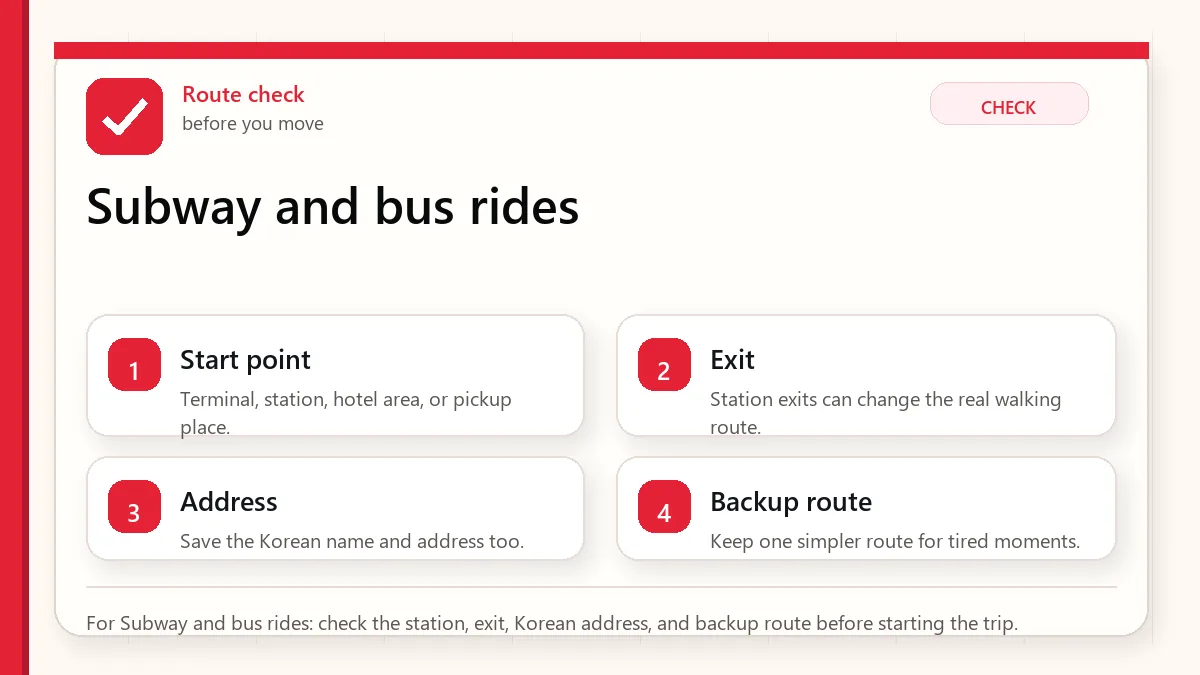
    Layered red check decision graphic for Subway and bus rides.
    For Subway and bus rides: check the station, exit, Korean address, and backup route before starting the trip.

    Subway vs bus for visitors

    ModeBest forMain challengePreparation
    SubwayPredictable city movement and station-based routes.Large stations, transfers, exits, and stairs.Route app, exit number, transit card.
    BusDirect neighborhood routes and places away from subway.Correct direction, stop names, and traffic.Map app, stop confirmation, tap habits.
    Taxi backupLate-night, luggage, or complex route situations.Address communication and fare expectation.Korean address and payment backup.

    Checks before the first tap

    • Prepare a transport card or verified payment method.
    • Save your destination in Korean and English.
    • Check route at the time you plan to travel.
    • Look for final station exit, not only station name.
    • Avoid first-time complex transfers when carrying heavy luggage.

    Move through transit one decision at a time

    • Use a local map app to choose route.
    • Check line color, direction, transfer station, and exit number.
    • Tap in and out as required.
    • Stand aside while checking your phone.
    • For buses, confirm the stop is on the correct side of the road.
    • After arrival, save the return route while still oriented.
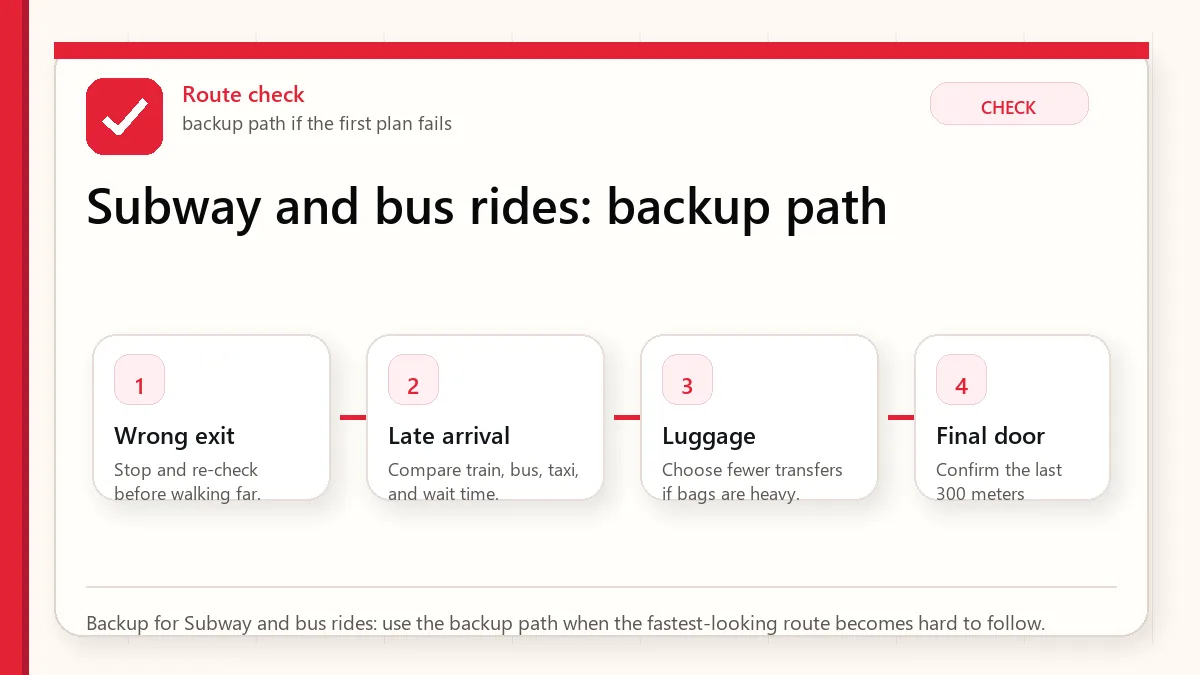
    Layered red check backup flow graphic for Subway and bus rides.
    Backup for Subway and bus rides: use the backup path when the fastest-looking route becomes hard to follow.

    Where first rides usually go wrong

    Wrong station exit

    Re-check the exit number before leaving the paid area if possible. A wrong exit can add a long walk.

    Wrong bus direction

    Check the next stops in the app and the road side before boarding.

    Transit card balance is low

    Top up before late-night travel or long routes.

    Transfer is too complex with luggage

    Use a simpler route, airport bus, or taxi when luggage makes public transport inefficient.

    Choose subway or bus based on recoverability

    SituationBetter approachWhat to verify
    First subway rideChoose a simple route with few transfers.Line direction and exit.
    Hotel with luggagePrefer fewer transfers over fastest time.Elevator availability and walking distance.
    Bus routeConfirm stop direction and destination.Traffic and correct side of road.
    Late nightCheck last service and taxi backup.Final train/bus time.

    What not to assume from a route result

    • Do not assume a station name is enough; exit number matters.
    • Do not assume the fastest route is best with luggage.
    • Do not assume every bus stop across the street serves the same direction.
    • Do not stand in gate or stair flow while checking directions.

    Transit details that make the city feel calmer

    The exit number matters more than visitors expect

    In large Korean stations, choosing the wrong exit can add a long walk, stairs, confusing underground passages, or an extra street crossing. When using a map app, do not stop at the station name. Check the suggested exit number and nearby landmark. This is especially useful when carrying luggage, meeting someone, or finding a small restaurant in a dense area.

    Bus routes need one extra check

    Buses can be efficient, but first-time visitors should confirm the direction, stop name, and whether the bus is local, trunk, express, or airport-related. The same road can have stops on opposite sides, and getting on in the wrong direction can waste more time than taking the subway. If you feel unsure, the subway is usually easier to recover from because stations are clearer and more forgiving.

    Read next when transit connects to maps, T-money, or cash

    This topic works best when it is not handled alone. Use the related guides below to connect the decision with maps, money, food, shopping, transit, and app backup planning.

    Related Before Korea guides

    Official links to check

    Use these official links when the next step matters. This guide explains what to watch for, but app downloads, eligibility, prices, routes, policies, and service rules can change.

    FAQ

    Do I need a transit card?

    It is highly practical for subway and bus travel. Prepare one or a verified alternative before relying on public transport.

    Are subway signs in English?

    VISITKOREA notes many public places including subway stations and bus stops have English signs, but apps and Korean names still help.

    Is bus harder than subway?

    Often yes for first-time visitors because direction, stop names, and traffic add uncertainty.

    Source links to verify

    Last updated

    Last updated: 2026-05-23. Re-check official sources close to the day you travel, buy, eat, or use an app. Details involving prices, eligibility, transport, app features, opening hours, and refund rules can change.
  • T-money Card in Korea: Tourist Guide

    T-money Card in Korea: Tourist Guide

    Start with what can fail at payment

    For most first-time visitors, a simple physical transportation card is still the safest public-transport backup in Korea. Tmoney is widely known, but the better question is how you will buy it, top it up, avoid overloading it, and handle refund or leftover balance before leaving.

    The transit-card details that keep rides simple

    T-money is not only a card to tap. For visitors, it is part of a small system involving purchase, top-up, transfer habits, refunds, and backup cash.

    AreaWhat to checkWhat to avoid
    BuyingGet a transit card from a convenient channel.Design cards and tourist products can differ.
    Top-upKnow whether your top-up point accepts your method.Cash can still matter.
    RidingTap in and out where required.Transfer benefits can depend on correct tapping.
    LeavingRefund remaining balance when practical.Small balances may not be worth stress.

    The checks that deserve your attention

    • Buy before your first subway/bus ride.
    • Keep small cash for top-up.
    • Check balance before late-night rides.
    • Do not treat T-money as a full replacement for cards/cash.

    Failure cases to plan around

    • Insufficient balance at gate.
    • No cash for top-up.
    • Wrong card expectation outside Seoul.
    • Forgetting to tap out where needed.

    Official and practical source checks

    Read next

    What a transportation card solves

    VISITKOREA describes Korean transportation cards such as Tmoney, EZL, WOWPASS, and Climate Card as rechargeable prepaid cards that do not require an account. That matters for visitors because it separates transit access from more complicated local app, bank, or phone verification steps.

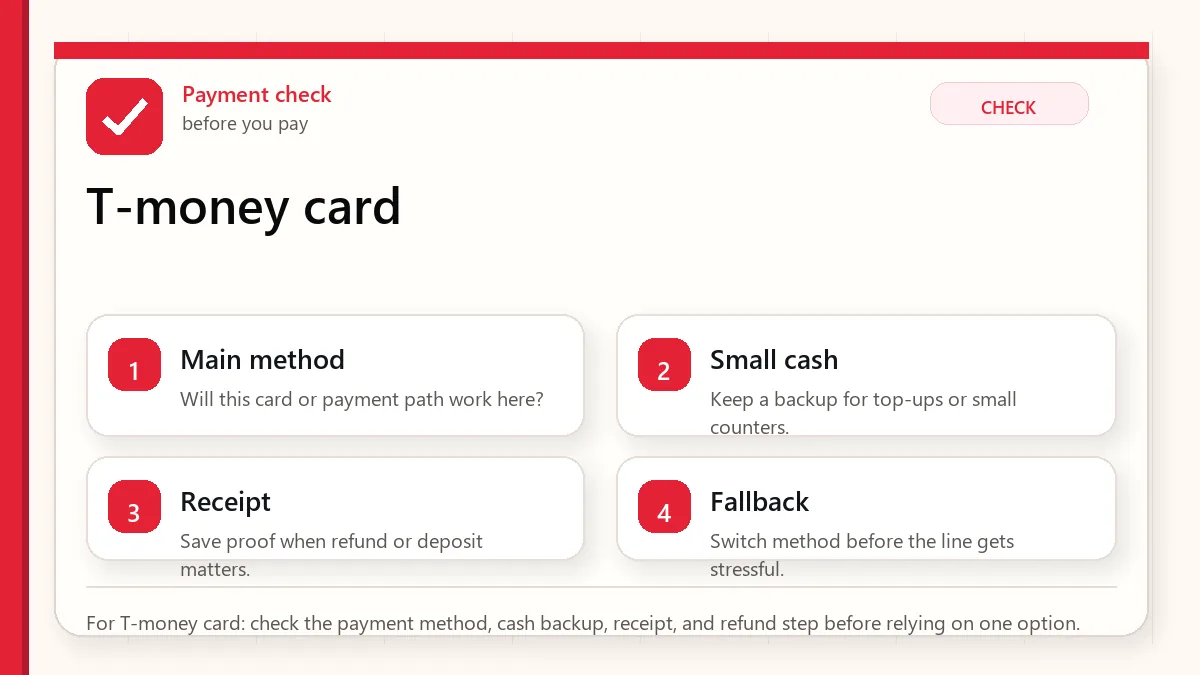
    Layered red check decision graphic for T-money card.
    For T-money card: check the payment method, cash backup, receipt, and refund step before relying on one option.

    A card does not solve every payment situation. It is mainly a practical way to reduce friction on subway and bus rides and, depending on card type and affiliated stores, some small payments. You still need a backup payment method.

    Which card type fits which traveler?

    Traveler situationBest starting pointWhyWatch out
    First-time visitor staying in several areasStandard Tmoney or similar transport cardSimple, flexible, and familiar for subway/bus use.Top-up and refund rules can vary; keep cash backup.
    Visitor who wants currency/payment plus transport in one productWOWPASS or similar visitor cardMay combine prepaid payment, currency exchange, and transport functions.Check kiosk locations, activation, fees, and refund rules before relying on it.
    Seoul-heavy trip with many rides in a short periodClimate Card if your routes fit the covered areaCan be attractive for frequent Seoul transit use.Coverage, payment methods, and refund rules have restrictions. Check Seoul’s official page.
    Short intense Seoul transit itineraryMpass only if the route and usage limit make senseVISITKOREA lists Mpass as a foreigner-exclusive time-limited option.Pass rules, purchase location, and included transport should be checked before buying.

    The visitor mistake: choosing by brand instead of use case

    A transport card is not a souvenir decision. It is an operations decision. Choose based on how many rides you will take, where you will travel, whether you need currency/payment features, and how easily you can get leftover balance back.

    • If you only ride a few times, keep the card simple and avoid overloading balance.
    • If you stay mostly in Seoul and ride many times, compare short-term unlimited options carefully.
    • If you shop heavily, separate transport convenience from card/payment and tax-refund planning.
    • If you travel beyond Seoul, check whether your chosen option covers your actual routes.

    Buying and topping up

    VISITKOREA says Tmoney and EZL cards can be purchased and charged at convenience stores nationwide, and Tmoney can also be reloaded through subway ticket vending machines. However, travelers should treat payment method, machine language, and top-up limits as practical details to verify locally.

    • Carry Korean won cash for top-up backup, especially on the first day.
    • Do not load a large amount just because you are nervous. Load enough for the next few rides, then adjust.
    • Keep the card easy to reach when entering and exiting gates.
    • If traveling with kids or teens, check discount registration rules before assuming reduced fares apply.

    Using it on subway and bus

    The basic habit is simple: tap when required, keep enough balance, and do not block gates while searching for the card. The deeper habit is to watch transfers. Transportation cards can provide transfer benefits, but transfer timing and conditions are rules, not guesses.

    • Tap with the same card consistently for a trip.
    • Keep a separate mental note of remaining balance if you are traveling late or away from major stations.
    • Do not assume airport express, intercity, taxi, or store acceptance is identical across every card and location.
    • For anything outside ordinary subway/bus use, verify the current card-specific rules.

    Refund and leftover balance strategy

    The best refund strategy is not needing a refund. VISITKOREA notes that refund of over KRW 50,000 for Tmoney is only possible at Tmoney Town near Seoul Station. For visitors, that means large leftover balances can become inconvenient.

    Balance habitWhy it helps
    Top up in smaller amounts after the first day.You learn your real daily ride cost instead of guessing.
    Keep enough for the return route.Running out late at night is more annoying than carrying a small leftover.
    Spend down before the airport.Refund rules, counters, and time pressure can make last-minute recovery stressful.
    Check card-specific refund rules.Tmoney, EZL, WOWPASS, Climate Card, and passes do not all behave the same.

    When a transport card is not enough

    • Airport transfer may require a separate ticket, route check, or payment method depending on option.
    • Some taxis may accept cards, but destination communication and route trust still matter.
    • Shopping, restaurants, and attractions need a separate payment plan.
    • Mobile transit setup may depend on phone model, app region, payment source, or local verification.

    The card habits that make transit feel less stressful

    A transit card is a movement tool, not just a souvenir

    T-money is useful because it reduces repeated ticket buying and makes subway and bus transfers easier. The practical habit is to check balance before a long ride or airport movement, especially if you are traveling with luggage or late at night. A card with too little balance can turn a simple trip into a delay.

    Top-up planning prevents small stress

    Visitors often forget that transit convenience still needs preparation. Know where you can top up, whether cash is required, and how much you expect to ride that day. Keep small won notes available if you rely on machines or stores for top-up. At the end of the trip, think about whether to keep the card for another visit or spend down the balance.

    Read next when transit connects to money or airport arrival

    This topic works best when it is not handled alone. Use the related guides below to connect the decision with maps, money, food, shopping, transit, and app backup planning.

    Related Before Korea guides

    Official links to check

    Use these official links when the next step matters. This guide explains what to watch for, but app downloads, eligibility, prices, routes, policies, and service rules can change.

    FAQ

    Should I buy Tmoney before arriving in Korea?

    It can be convenient, but it is not always necessary. The important thing is knowing where you will get or top up a card after arrival and carrying a backup payment method.

    Can I use only my foreign credit card for transport?

    Do not assume that. Prepare a local transportation card or a verified visitor-friendly option unless you have confirmed your exact payment method works for the transport you plan to use.

    How much should I load?

    Start with a modest amount that covers the first day or two, then adjust. Avoid large leftover balances unless you understand refund rules and locations.

    Source links to verify

    Last updated

    Last updated: 2026-05-23. Korea travel, transport, app, shopping, and refund details can change. Re-check official sources close to the day you act, especially when money, eligibility, route timing, or account access is involved.

    This guide is written as practical preparation content. It does not claim personal hands-on testing, a personal visit, or official legal advice unless explicitly stated.

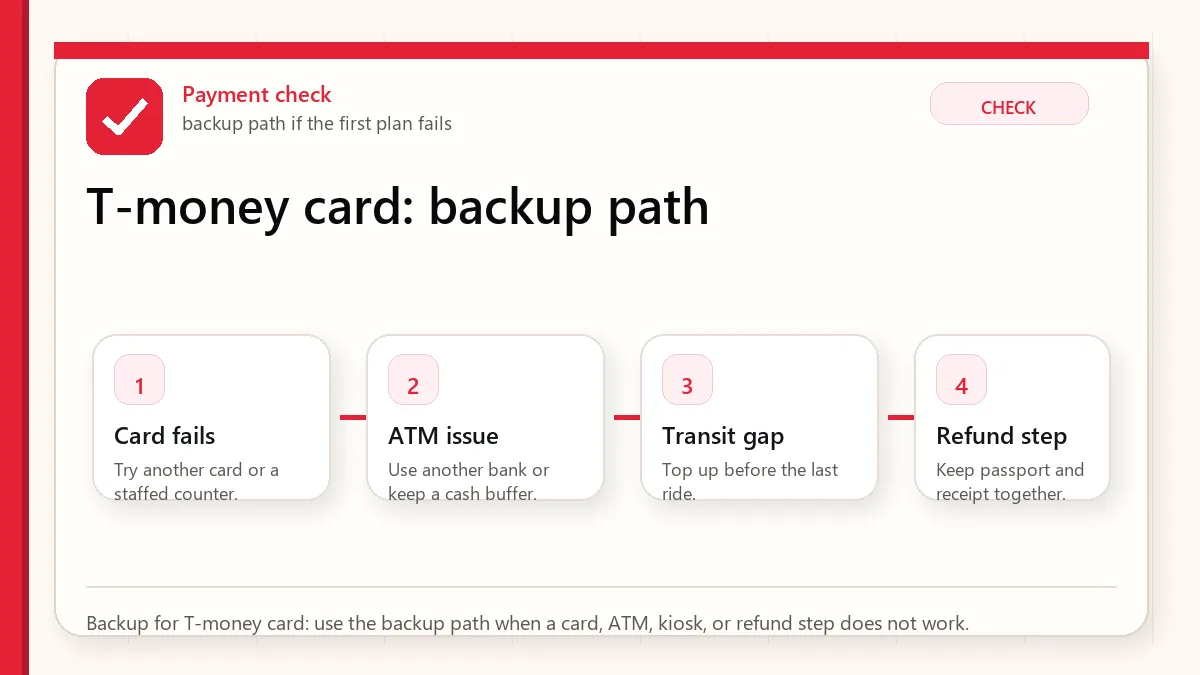
    Layered red check backup flow graphic for T-money card.
    Backup for T-money card: use the backup path when a card, ATM, kiosk, or refund step does not work.