Foreigners can use KakaoTalk, but the important travel question is not only whether the app opens. Before Korea, check whether you can verify your account, receive messages from hotels or clinics, manage storage and notifications, and avoid making KakaoTalk your only contact method.
Last checked: June 2, 2026. KakaoTalk account, phone-number, privacy, and app-store flows can change. Check the official app page and your current app screen before relying on it for reservations.
The practical answer for visitors
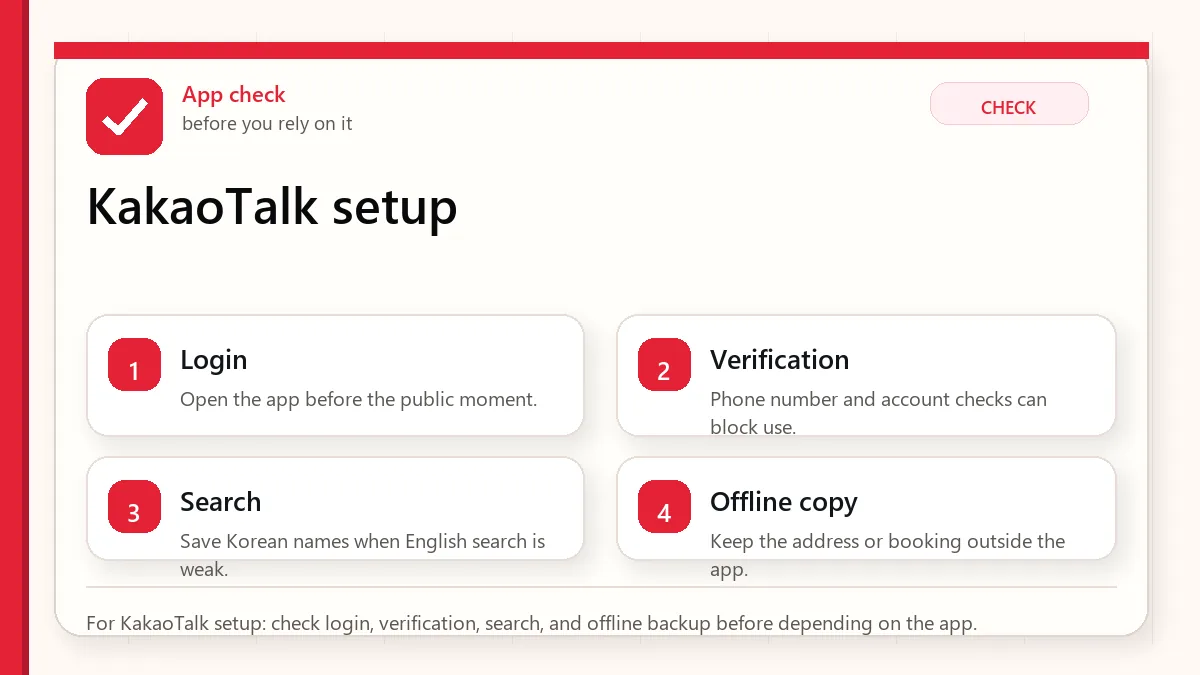
Install KakaoTalk before arrival if you need to communicate with Korean contacts, clinics, salons, language exchanges, guesthouses, or local services. But keep email, phone, WhatsApp, Instagram DM, booking-app messages, or hotel front desk contact as a backup. A messenger app should not be the only way to reach a time-sensitive reservation.
Where foreigners usually get stuck
| Problem | What it means | Before Korea check |
|---|---|---|
| Phone verification | You may need SMS or account confirmation | Test signup before your first appointment |
| Friend/contact flow | People may search by phone, ID, QR, or link | Ask the business which contact method they use |
| Notifications | Silent or blocked notifications can make you miss a message | Enable alerts for important chats |
| Storage | Chat media can take phone space | Keep storage free before a long trip |
| Scams or wrong contacts | Popular messengers attract impersonation risk | Confirm official accounts and avoid sending payment details blindly |
KakaoTalk is useful, but it does not solve Korean verification
Some visitors think KakaoTalk alone will unlock Korean apps. It will not. Korean services may separately require a Korean mobile number, real-name verification, carrier identity verification, a local payment method, or an ARC-linked account. KakaoTalk can help communication, but it is not a universal identity key.
This matters for taxi apps, delivery apps, shopping, bookings, and hospital or beauty appointments. If a service asks for NICE, PASS, mobile identity verification, or a Korean carrier number, KakaoTalk itself may not be enough.
A Korean phone number is not one product
Visitors often buy an eSIM and assume they now have the same phone setup as a Korean resident. That is not always true. A data-only eSIM gives internet. A tourist SIM may give a temporary phone number. A prepaid voice/SMS plan may receive calls and texts. A resident carrier plan tied to local identity may pass checks that tourist products do not. These are different layers.
For KakaoTalk messaging, internet and account access may be enough. For delivery, payment, age checks, coupons, or domestic login flows, the app may expect more than messaging. This is why a traveler can chat normally but still fail at Baemin, Coupang Eats, local shopping, or reservation verification.
How to avoid losing access while changing SIMs
The risky moment is usually not installation. It is changing phones, changing SIMs, reinstalling the app, or losing access to the number tied to the account. Do not experiment with KakaoTalk account settings right before a clinic appointment, fan event, private class, or host meetup.
- Confirm the account works before departure.
- Keep access to the registered phone number until the trip is stable.
- Write down your email, password recovery path, and backup contact method.
- Do not delete and reinstall the app during a time-sensitive problem unless official support tells you to.
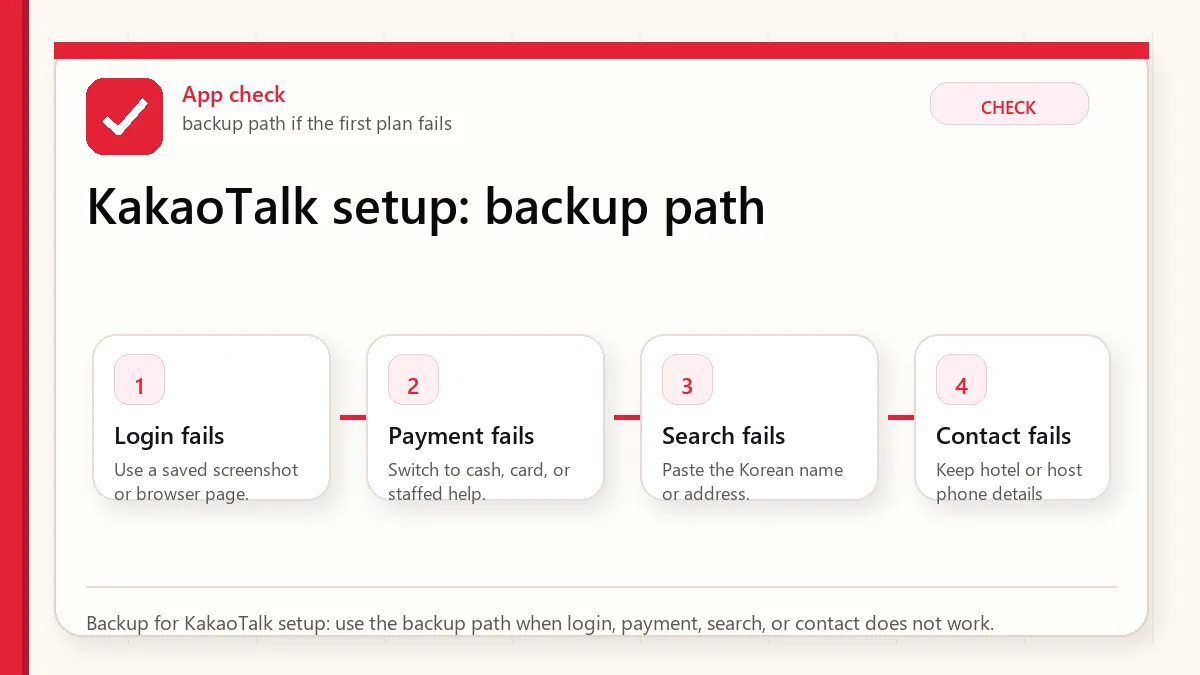
- Save critical appointment details outside KakaoTalk.
What to ask a Korean business
| Situation | Ask this before the trip | Why |
|---|---|---|
| Clinic or salon appointment | Can you confirm by email or phone if KakaoTalk fails? | Appointments are time-sensitive and may require identity or deposit handling |
| Guesthouse or local host | Can I also reach you through booking-app messages? | Travelers may change SIMs after arrival |
| Private class or tour | Can you send the exact meeting point outside KakaoTalk too? | Map links and pickup points should not live in one app only |
| Restaurant or event | Do you use KakaoTalk Channel or a normal account? | Search and contact methods differ |
Privacy and wrong-contact caution
KakaoTalk is normal infrastructure in Korea, but you should still treat unknown accounts carefully. Verify official channels, avoid sending passport or card images unless you know why they are needed, and do not pay through an informal chat link without confirming the business.
What to set up before a reservation
- Download KakaoTalk from the official store or Kakao page.
- Confirm you can log in and receive messages.
- Add a profile name that a Korean business can recognize.
- Save your hotel and appointment details outside KakaoTalk too.
- Prepare one fallback contact method for urgent changes.
When KakaoTalk helps most
KakaoTalk is most helpful when a Korean contact already expects to use it: a clinic follow-up, salon confirmation, private lesson, guesthouse message, or a friend in Korea. It is less helpful when the service requires Korean real-name verification or when you do not have a Korean phone/contact route.
Official links
- Official KakaoTalk service page: Start here for Kakao's own download/service page.
- KakaoTalk on Google Play: Check the current Android listing.
- KakaoTalk on the App Store: Check the current iPhone listing.
- Kakao Customer Service: Use Kakao's help center for current account issues.
Related guides
- Korea phone number for apps
- Korea travel apps setup
- Can foreigners use Baemin in Korea?
- Kakao T vs Uber in Korea
FAQ
Can foreigners use KakaoTalk in Korea?
Yes, many foreigners can use KakaoTalk. The practical risk is whether your account, phone number, notifications, and contact method work for the exact service you need.
Do I need KakaoTalk before visiting Korea?
Not always. It is useful for local communication, but you should also keep email, booking-app messages, and a phone/SMS backup.
Does KakaoTalk replace Korean identity verification?
No. KakaoTalk is a messenger. Korean apps may still require phone, carrier, NICE/PASS, ARC, or payment verification separately.