“What not to do in Korea” can sound dramatic, but most mistakes are ordinary travel mistakes: choosing the wrong airport route, blocking a subway door, relying on one payment method, assuming Google Maps will answer every question, or treating a shoes-off space like a regular room. Korea is not hard to visit, but it rewards visitors who prepare for local systems before arrival.
Last checked: June 1, 2026. Re-check the official or primary source page before acting, because routes, prices, labels, rules, app screens, eligibility, and store/service policies can change.
Last updated: May 24, 2026.
Start with the situation, not a rule list
Do not treat Korea as a country where every familiar travel habit will work automatically. Do not rely on one card, one map app, one airport route, one pair of fashion shoes, or one translation method. Do not be loud on transit, do not sit in priority seats casually, do not step into clean indoor spaces with outdoor shoes, do not leave tips on restaurant tables, and do not photograph strangers without care.
Mistakes by type
| Mistake type | Example | Better move |
|---|---|---|
| Logistics | Choosing AREX Express only because it is fastest on paper. | Choose by hotel area, transfers, luggage, and arrival time. |
| Payment | Arriving with only one phone wallet. | Carry two cards and a small KRW cash buffer. |
| Transit etiquette | Standing in the doorway while checking a route. | Step aside first, then check your phone. |
| Restaurant flow | Waiting forever for staff to bring the bill. | Look for counter payment or use the table call button. |
| Cultural space | Walking into a temple hall with shoes or a loud voice. | Pause, observe, and follow posted rules. |
Do not confuse inconvenience with disrespect
Some problems are not cultural mistakes at all. A foreign card failing at a kiosk, a delivery app asking for a Korean phone number, or a subway transfer feeling difficult with luggage are system-friction problems. Treat them practically. Move to a staffed counter, use a backup payment method, save Korean addresses, and build extra time into arrival day.
Do not overpack your schedule
First-time Korea itineraries often look reasonable on a map and exhausting in real life. Subway exits can be far apart. Cafes may have waits. Popular streets can be crowded. Palace, market, shopping, dinner, and nightlife in one day may leave you tired before the best part begins. The better approach is one anchor area in the morning, one flexible neighborhood in the afternoon, and a simple dinner plan near your route.
Do not rely on one app
Install more than one tool before arrival. Naver Map or KakaoMap can be stronger for local places and transit. Papago is useful for menus and signs. Your hotel booking app holds the address. A taxi or ride app can help late at night. Google Maps is still useful for orientation, but it should not be your only Korea navigation plan.
Do not make tipping awkward
Korea is generally a no-tipping country. Leaving cash on a restaurant table can make staff think you forgot your money. For ordinary restaurants, taxis, cafes, salons, and delivery, pay the listed price and say thank you. Private tours or luxury services can be different, but they are exceptions, not the rule.
Do not photograph people as background props
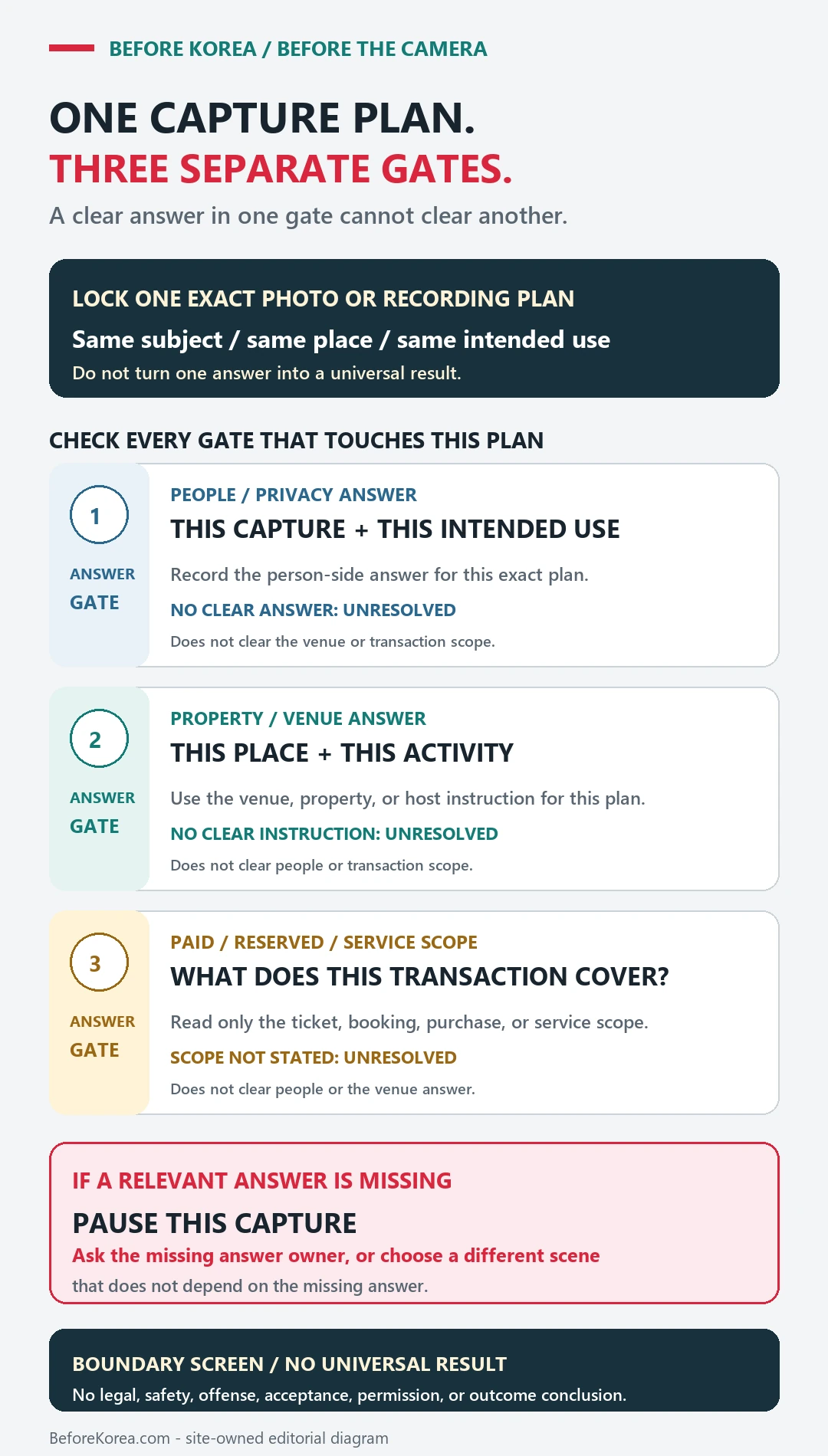
Korea is extremely photogenic, especially around markets, cafes, palaces, and shopping streets. That does not mean every staff member, child, older resident, or stranger in hanbok is part of your content. Shoot wider scenes, wait for a clear moment, or ask permission when a person is the subject. Be extra careful inside small shops, restaurants, and religious spaces.
What is serious versus simply awkward
Not every mistake has the same weight. Sitting briefly in the wrong seat, using the wrong restaurant door, or mispronouncing a phrase is usually just awkward. Smoking in prohibited areas, ignoring safety barriers, filming people closely without permission, or bringing restricted medicine without checking rules can be much more serious. Separate social discomfort from legal or safety risk so you do not worry about the wrong things.
For most first-time visitors, the highest-impact mistakes are practical rather than cultural. A failed card can stop dinner. A bad airport route can ruin arrival night. A wrong hotel area can add an hour of travel every day. A medicine rule you did not check can become an airport problem. Handle those first, then refine your etiquette.
The traveler’s recovery script
If something goes wrong, use a simple sequence: stop doing the thing, step aside, apologize briefly, and follow the corrected flow. You rarely need a long explanation. In a restaurant, show the menu item. In a subway station, move away from the gate. In a shop, use the payment method staff points to. Calm recovery is part of good etiquette.
FAQ
What is the biggest first-time Korea mistake?
Trying to solve every trip problem after landing. Payment, maps, hotel area, airport route, and phone setup should be prepared before departure.
Are Koreans offended easily by tourists?
No. Most small mistakes are fine if you notice, apologize, and adjust. Loud, careless, or repeated behavior is the real issue.
Should I avoid Korea if I do not speak Korean?
No. Learn a few phrases, install translation tools, and keep addresses saved in Korean where possible.
Related Before Korea guides
- Korea travel mistakes
- Payment in Korea
- T-money Card in Korea
- Naver Map in Korea
- Korea entry requirements
- Incheon Airport to Seoul
Source links to verify
- Seoul Metropolitan Government – Public Transportation
- Seoul Metropolitan Government – Modes of Transport
- Seoul Metropolitan Government – Foods Prohibited from Carry On
- Visit Korea – Tourist-Friendly Korea
Know when to stop and get help
| Decision | Evidence | Next action |
|---|---|---|
| Unofficial form | Payment or passport requested by a clone | Leave and use official site |
| Identity mismatch | Name or document does not match | Correct before proceeding |
| Unsafe movement | Wrong platform, closed route or no recovery time | Stop and reroute |
| Immediate danger | Crime, fire or medical emergency | Call 112 or 119 |
A wrong name on a booking, a request to pay an unofficial entry form, or a closed transport route needs a different response from an etiquette mistake. Use the next step for the problem you actually face. Official references: VISITKOREA emergency FAQ, Seoul public transport, Immigration fake-site warning.
Immediate police, fire and medical emergencies use 112 or 119. Korea Immigration warned that the official e-Arrival Card does not request payment. Source review completed August 24, 2026. Dates, eligibility, price, inventory, access and operating rules must be rechecked on the exact current first-party page before action.