A standard physical T-money card is a practical default for most visitors who want ordinary subway and bus travel without buying a ticket for every ride. Buy the card from a recognized seller, load only a modest working balance, tap the same card when required, and keep a second payment method for anything the transit card does not cover.
This guide was checked on July 23, 2026. Card products, prices, reload methods, participating transport, refund locations, and visitor passes can change. The rules below distinguish a standard T-money card from the Climate Card, Mpass, WOWPASS, mobile products, and single-journey tickets; those products should not be treated as interchangeable.
Is T-money the right card for your trip?
Choose a standard T-money card when you want flexible pay-as-you-go travel on ordinary public transport and do not need an unlimited Seoul pass or a combined foreign-currency product. VISITKOREA describes T-money and other Korean transportation cards as rechargeable prepaid cards that do not require a bank account. It also says T-money and EZL cards can be purchased and charged at convenience stores nationwide.
- Standard T-money: a simple starting point for pay-as-you-go subway and bus use, with acceptance at participating transport and affiliated stores.
- Climate Card: compare this separately if your trip is concentrated in covered Seoul routes and enough rides fit a one- to seven-day or longer pass.
- WOWPASS or another visitor product: compare fees, reload paths, app requirements, refund rules, and payment functions if you want more than transit.
- Mpass: check the current issuance location, ride limit, valid period, and eligible transport before assuming it beats ordinary pay-as-you-go travel.
Do not decide from the artwork on the card. A character design, travel bundle, pass, and standard stored-value card can look equally convenient while following different rules. Ask what product it is, not only whether it has a T-money logo.
Buy the standard card without overcomplicating it
VISITKOREA currently lists nationwide convenience stores such as GS25, CU, and 7-ELEVEN, plus information centers in Seoul subway stations on Lines 1 to 8, as retail locations for a general T-money card. It lists a typical card price of KRW 3,000 to 5,000. The purchase price is separate from the travel balance you load, and special designs or visitor products can cost more.
- Say that you want a standard T-money transportation card, not only a souvenir or an unlimited pass.
- Confirm the product name and purchase price before paying.
- Ask whether the seller can load the first balance and which payment method that location accepts.
- Keep the receipt until you have checked that the card works and the loaded balance is correct.
- Carry the card where you can reach it without holding up a gate or bus reader.
If a shop offers a travel card with extra benefits, read the current terms before switching products. A discount list does not automatically make the card easier to reload, use outside Seoul, or refund.
Load a small working balance
Start with enough for the next day or two instead of loading a large amount out of anxiety. VISITKOREA says a standard T-money card can be reloaded through subway ticket vending machines, while Seoul’s public transportation guide says station reload devices offer multiple languages and that accepted payment methods depend on the device. Keep Korean won cash as a backup until you have confirmed the exact machine or store you will use.
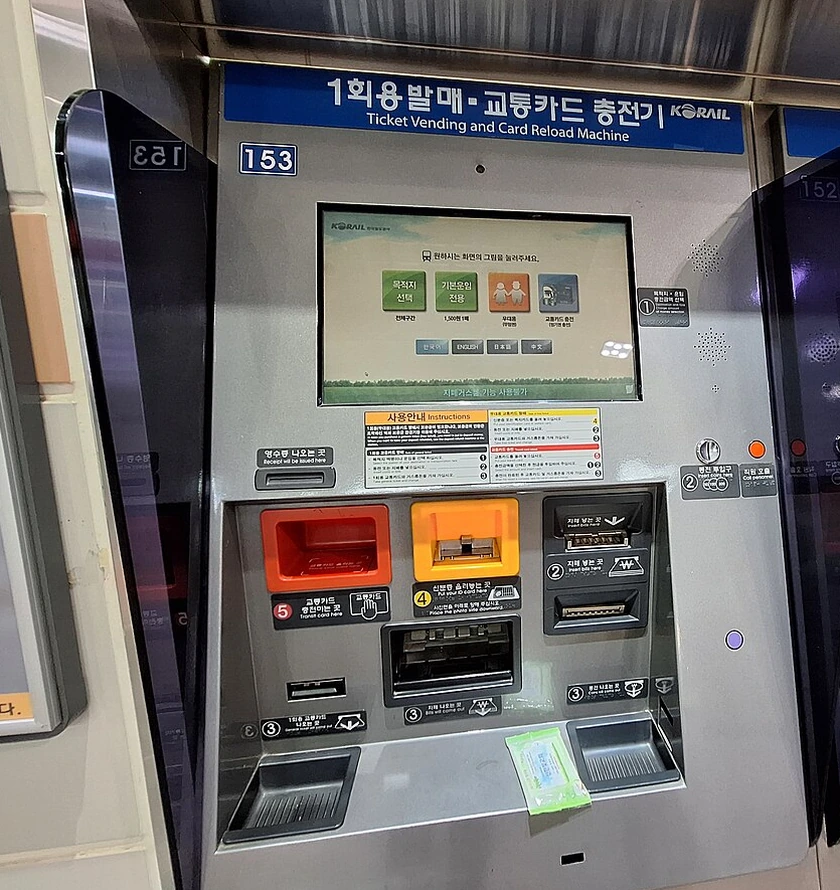

Do not generalize a newer payment announcement to every card. Seoul announced international-card support for Climate Card purchases or short-term reloads and single-journey tickets on specified new machines in March 2026. That announcement does not say that every ordinary T-money reload point accepts every foreign card.
- Check the balance shown after loading before you leave the counter or machine.
- Keep one small cash reserve separate from the card balance.
- Reload before a late-night or airport trip rather than waiting for a gate rejection.
- Do not put a large departure-day budget on the card unless you have verified where and how it can be refunded.
Tap the same card when you board and leave
At a subway gate, tap the card presented for that passenger. On a Seoul bus, the city guide tells riders to tap when boarding and again at the rear-door reader before getting off. The exit tap is part of fare and transfer handling, not a decorative extra step.
- Use the same card throughout a connected trip.
- Wait for the reader response instead of waving the card past it.
- Keep other contactless cards away from the reader to reduce card-clash errors.
- If a reader rejects the tap, read the displayed message or ask staff before repeatedly tapping different cards.
- Do not assume airport express, intercity rail, intercity bus, taxi, or retail acceptance follows the same rule as an ordinary city subway or bus.
When a gate keeps the card from opening, first check balance and card orientation, then use the staffed gate or help point. Buying a second card immediately can split your balance and make the original problem harder to trace.
Use this six-step routine
- Choose the product. Decide between standard pay-as-you-go T-money and a route-limited or time-limited pass.
- Buy from a recognized channel. Confirm the product name and separate card price.
- Load a modest balance. Verify the amount on the reader, receipt, or screen.
- Tap one card consistently. Tap at the required entry and exit points.
- Check before the next critical trip. Reload before late-night travel, an airport transfer, or a long day of rides.
- Close out deliberately. Spend down, keep, or refund the balance under the current card rules.
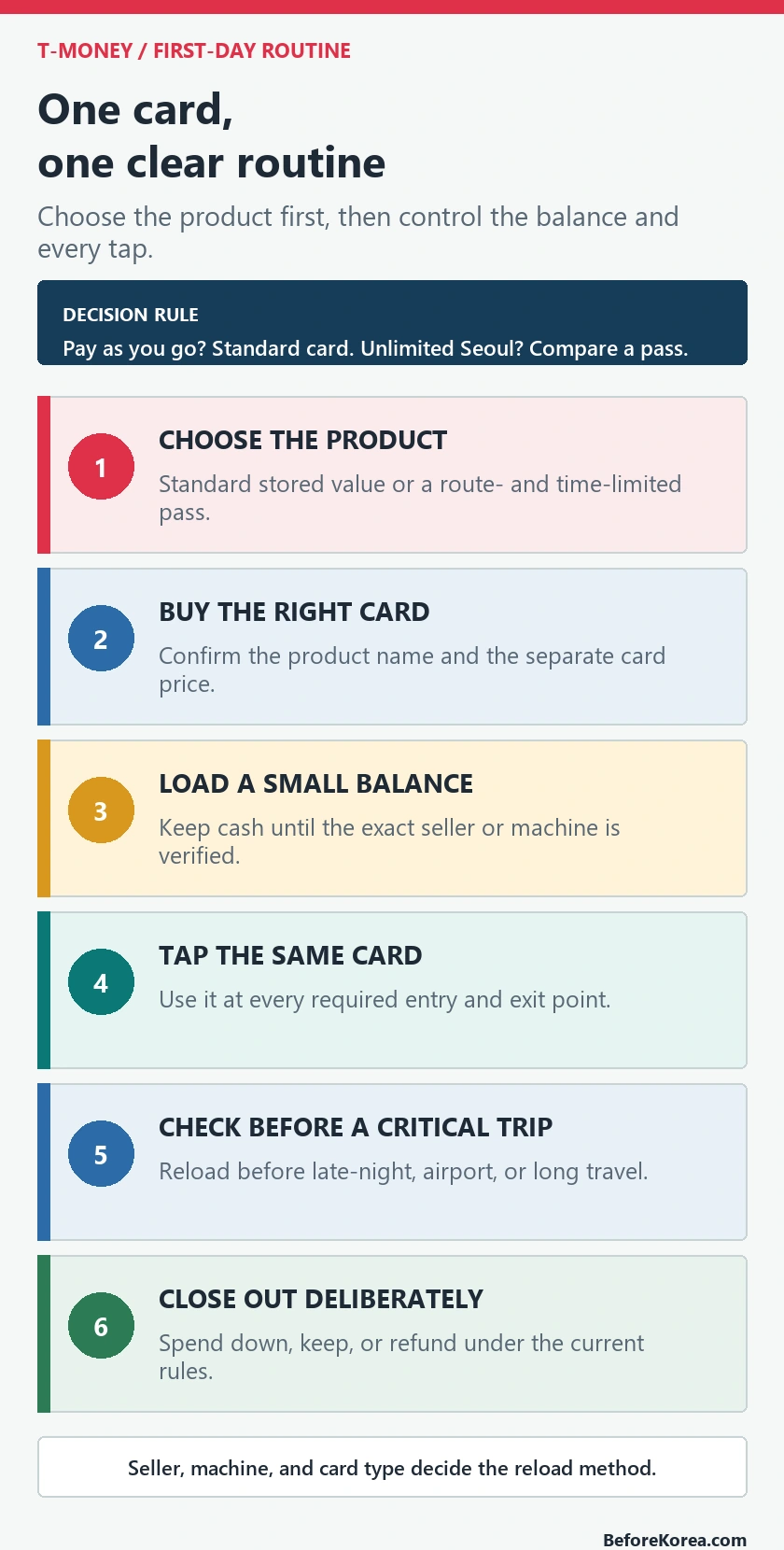
This routine is intentionally simple. The card is most useful when it removes small decisions from each ride; it becomes stressful when the product, balance, and refund plan are left unclear.
Protect transfer discounts in Seoul
Seoul’s official transport guidance ties integrated fares to correct card taps. Its current modes-of-transport page says the rider must tap when boarding and getting off, and that the transfer must normally begin within 30 minutes of the previous exit tap, extended to 60 minutes from 9 p.m. to 7 a.m. It also states that the same bus route does not receive the transfer treatment when re-boarded.
Use those as Seoul rules, not a promise for every city or operator in Korea. When the itinerary moves outside ordinary Seoul transit, check the local operator and the exact service. A card being accepted does not prove that the same transfer window or discount applies.
Handle children and teenagers before the first ride
VISITKOREA says a traveler under 18 must register a date of birth when purchasing a T-money or EZL card to receive the applicable youth discount. Do this at purchase instead of assuming the reader will infer age from the person holding the card.
- Tell the seller that the card is for a child or teenager before the first load.
- Ask what identification or date-of-birth information the seller needs under the current rule.
- Use one correctly registered card per passenger unless transit staff instruct otherwise.
- Recheck the current age categories and fare rule if a birthday falls during the trip.
Keep the last-day balance small
The easiest refund is the balance you did not over-load. Reduce reload amounts as departure approaches, but keep enough for the final confirmed route. VISITKOREA currently warns that a T-money refund over KRW 50,000 is available only at Tmoney Town near Seoul Station. Lower-balance channels and fees can differ, so check the current T-money refund table rather than relying on an old travel post.
- Estimate the final subway, bus, or airport movement before the last reload.
- Check whether a participating store purchase can legitimately use a small leftover balance.
- Leave time for a refund during service hours; do not make it an airport-gate task.
- Keep the card for a future trip only if you are comfortable holding the remaining value and rechecking validity later.
Do not confuse T-money with every visitor pass
A standard T-money card stores value and charges fares as you travel. The Climate Card is a separate Seoul pass with its own coverage, validity, purchase, registration, and refund rules. WOWPASS and similar products can add payment or currency features. Mpass has its own time period and ride limits. A mobile T-money product can depend on device, operating system, app availability, account setup, and payment source.
Compare the exact product against your itinerary. A Seoul-only unlimited pass can be poor value for a traveler making few rides or spending days outside covered routes. A multifunction visitor card can add setup and refund steps that a traveler using only subway and bus does not need. A physical standard card remains a sensible fallback when the phone setup has not been verified before arrival.
Questions travelers ask
Can I buy a T-money card at Incheon Airport?
Airport retail and transport counters can change, so check the current airport or seller information on your arrival day. If the first seller is closed or offers only a bundled product, buy the first ticket needed for the city and obtain a standard card from a recognized convenience store or station channel afterward.
Can I load T-money with a foreign credit card?
Do not assume every ordinary T-money reload point accepts it. Payment support varies by seller, machine, and product. Keep Korean won cash until the exact reload point confirms your card; international-card support announced for Climate Card and single-journey products should not be generalized to standard T-money.
How much should I load first?
Load a modest amount for the next day or two, then adjust after seeing your real route and fare pattern. The right number depends on distance, transfers, airport travel, and how many people need separate cards.
Do I tap off a Seoul bus?
Yes. Seoul’s official bus guide tells riders to tap the reader by the rear door before exiting, including to preserve transfer handling. Follow the local operator’s instruction when traveling elsewhere.
Can one card pay for several people?
Some bus situations allow the driver to set a multi-passenger fare, but the rules for transfers and subway use are limited. The simplest visitor setup is one correctly registered card per rider, especially when transferring between bus and subway.
Official sources and related guides
Check the current VISITKOREA transportation-card comparison, the Seoul Metropolitan Government guides to using public transportation and fares and transfers, the official Climate Card page, and the T-money English site. The March 2026 scope of international-card support is described in Seoul’s official payment update.
Continue with the Korea Subway and Bus Guide, Cash, Cards, and ATMs in Korea, Payment in Korea, and Incheon Airport to Seoul.