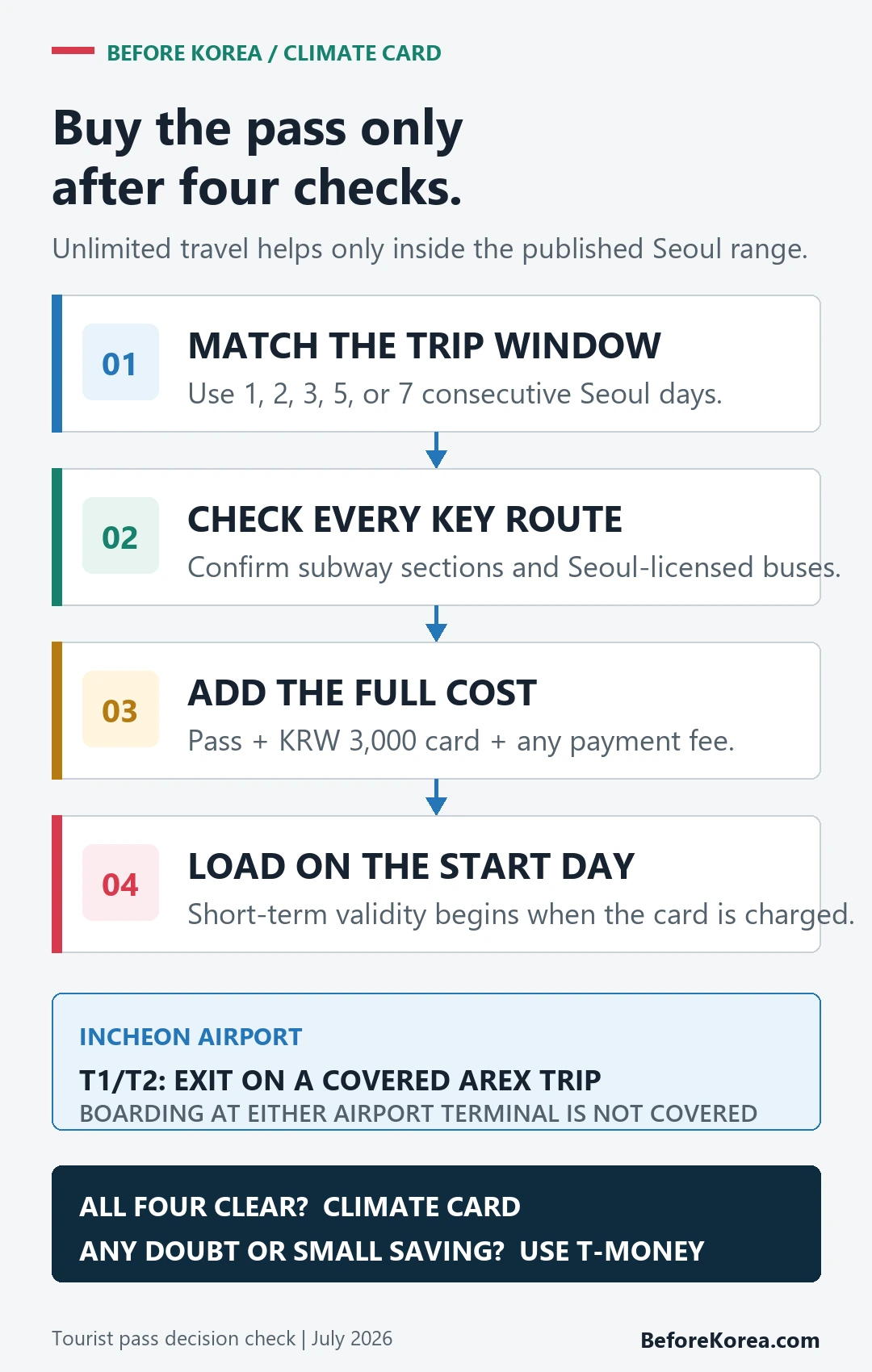
A short-term Climate Card can be useful when most of your trip is on covered Seoul subways and Seoul-licensed buses for 1, 2, 3, 5, or 7 consecutive calendar days. It is not a nationwide rail pass, it does not cover airport buses, and the pass starts on the day you load it. If your plans include only a few rides or several days outside Seoul, a stored-value T-money card is usually the simpler choice.
Last checked: August 24, 2026.
The tourist pass is continuing in 2026
There are two different products behind the Climate Card name. Seoul stops new prepaid 30-day recharges after August 31, 2026. Existing prepaid passes can remain valid through September 29, and postpaid benefits continue through September 30. The 30-day service ends on October 1, while the 1-, 2-, 3-, 5-, and 7-day tourist passes continue. That distinction matters because older pages and videos often discuss the 30-day product as if it were the only Climate Card.
For the current transition dates, see Seoul’s July 2026 service notice (Korean). For tourist prices, coverage, and purchase instructions, use the city’s official English Climate Card page.
What the short-term pass costs
The fare below is the amount loaded onto the pass. A physical Climate Card costs another KRW 3,000, so include that card price when comparing the pass with T-money.
| Pass | Load amount | Validity |
|---|---|---|
| 1 day | KRW 5,000 | Load day only |
| 2 days | KRW 8,000 | 2 consecutive calendar days |
| 3 days | KRW 10,000 | 3 consecutive calendar days |
| 5 days | KRW 15,000 | 5 consecutive calendar days |
| 7 days | KRW 20,000 | 7 consecutive calendar days |
Short-term passes do not include Ttareungi bike rental or Hangang Bus service. The city’s official page also says the short-term period begins on the date of charging and cannot be charged in advance. A 1-day pass loaded late in the evening still expires after the final covered service that day; it is not a rolling 24-hour ticket.
Buy and load the card at the station
Most short-stay visitors will use a physical card. Seoul lists new card vending machines on subway Lines 1-8 as physical-card sales points, with additional convenience-store sales around some other lines. Look at the machine menu before paying: the physical card purchase and the short-term pass load are separate amounts.
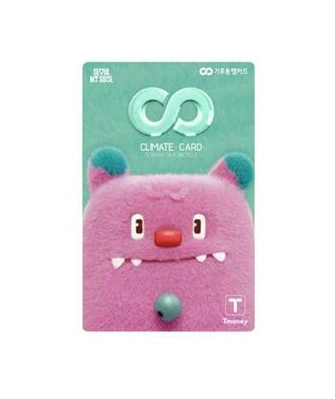
Since March 17, 2026, internationally issued Visa and Mastercard credit or debit cards have been accepted at 440 new transit-card machines in 273 stations on Lines 1-8. Seoul says the option covers physical Climate Card purchases and 1-, 2-, 3-, 5-, and 7-day loads, with an average service fee of about 3.7%. Read the city’s international-card announcement before relying on that payment method, because an older machine or a card issuer decline may still require a backup.
- Bring a second payment method rather than assuming every machine accepts your card.
- Load the pass only when you are ready to start using it.
- Keep the card after the pass expires; the same physical card can be loaded again.
Check airport and regional legs separately
The word “unlimited” applies only inside the published service range. Airport buses, the Sinbundang Line, intercity buses, non-Seoul-licensed buses, and subway travel outside the covered range are excluded. A Seoul-licensed bus may remain covered outside the city boundary, but a subway trip can fail when the destination is outside the allowed section.
Incheon Airport has a direction-specific exception. The official page says a rider who boards within the covered AREX range may exit at Terminal 1 or Terminal 2, but cannot board at either airport terminal with the Climate Card. In practical terms, do not plan to start your Climate Card journey at Incheon Airport. Use another airport transfer ticket or T-money for the inbound trip, then load the Climate Card when its Seoul days begin.
Coverage can change by station and line section. Check each important destination on the official service-range list instead of assuming that every station carrying a familiar line number is included.
Make the decision from your itinerary
Buy the Climate Card only after the trip window, route coverage, and total cost all work in your favor. “Unlimited” is valuable when it removes repeated covered fares; it does not compensate for excluded routes or an awkward start date.
| Choose the Climate Card when… | Choose T-money when… |
|---|---|
| Your Seoul days fit a 1-, 2-, 3-, 5-, or 7-day pass exactly | Your schedule is flexible or split across several cities |
| Most important subway and bus legs are inside the service range | Airport, regional, or excluded routes make up much of the trip |
| The pass, physical card, and payment fee cost less than realistic rides | The saving is small after adding the card and payment fee |
| You are comfortable carrying a backup for uncovered travel | You want one stored-value card with less setup |
Do the comparison with the rides you are likely to take, not a packed theoretical schedule. A pass that saves only a small amount can stop being the better choice after one day trip outside Seoul or one route change.
Use it without losing access
- Confirm the pass duration and every essential route before buying.
- Pay KRW 3,000 for the physical card if you do not already have one.
- Load the short-term pass on the day you want its calendar-day validity to begin.
- Tap when boarding and when exiting on both subway and bus trips.
- Keep T-money or another payment option for uncovered routes and machine problems.
Always tap out with the same card. Seoul’s current official pages are not fully consistent about how missed tap-outs affect short-term passes, so do not rely on a presumed exception or a fixed 24-hour penalty. If a tap was missed, ask station staff which rule applies to the pass in use.
Related Korea transit guides
Sources checked August 24, 2026: Seoul Metropolitan Government Climate Card policy page, March 2026 international-card announcement, and July 2026 service-transition notice. Recheck the official coverage page before travel because station and payment availability can change.