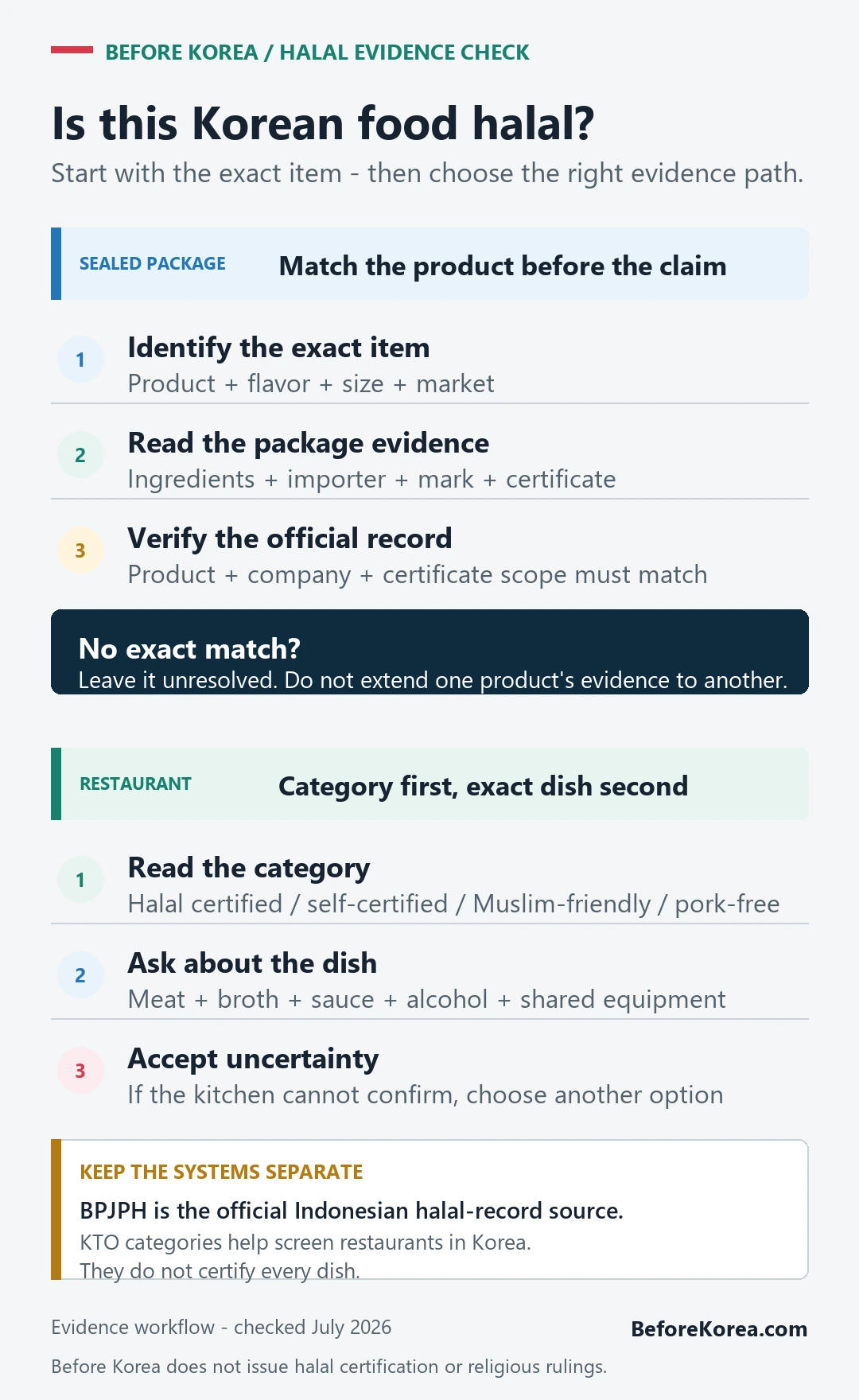
A Korean snack, packaged food, or restaurant dish is not confirmed halal just because the brand is familiar, the seller says “no pork,” or another version carries a halal mark. Match the evidence to the exact product, flavor, package, market, or restaurant you will use. For packaged food, verify the certification record and package details. For a restaurant in Korea, read the official restaurant category and still check the exact dish, broth, sauce, alcohol, and shared cooking surface.
Last checked: August 24, 2026. Before Korea is not a halal certification body and does not issue religious rulings. This page is a practical evidence-checking workflow. Use the current package, restaurant, recognized certifier, and official database close to the day you buy or eat.
Flying to or from Korea? An airline special-meal request is a separate task from checking a restaurant or sealed package. Use the Korean Air and Asiana Muslim meal request guide to check the operating carrier, deadline, each flight leg and confirmation before departure.
Use the correct path: package or restaurant
Start by deciding what you are actually checking. A factory-sealed snack has a product name, ingredients, production market, importer, and certification scope. A restaurant meal has a kitchen, recipe, supplier, preparation method, and possible cross-contact. Evidence from one path cannot automatically answer the other.
- Packaged Korean food: match the exact item and package, then verify any halal mark or certificate in the relevant official system.
- Restaurant in Korea: identify the restaurant category, then ask about the exact dish and how it is prepared.
- Marketplace or social-media claim: treat it only as a lead until the current package or official record matches.
Checking a sealed package? Use the exact-record guide
If you have a Korean snack, ramen cup, sauce, or other sealed product, continue with the exact-package BPOM and BPJPH check. It shows which package fields must match, how to read a partial or conflicting official result, and what to ask a seller before buying. It also includes worked Buldak and YOPOKKI examples as verification exercises, not product verdicts.
BPOM applies to Indonesian food registration. A Korean domestic package may not carry a BPOM number, so use the mark and certifier printed on that exact unit and read the Korean label. Return to this travel guide for restaurant categories, dish questions, and shared-kitchen checks.
Read ingredient words as warnings, not a complete verdict
A Korean ingredient list can reveal reasons to stop or ask more questions. Pork-related terms, lard, gelatin, meat extract, broth base, alcohol, and compound seasoning deserve attention. But translating one word is not enough to certify the product. Processing aids, sub-ingredients, flavor bases, and the scope of a certificate may not be obvious from a quick camera translation.
Use the Korean food label words Muslims should check as a store-side reading aid. Then return to the exact package and official evidence. If the label is too small, covered by an importer sticker, or different from the seller photo, ask for a clear current image before paying.
For restaurants, read the category before the menu
The Korea Tourism Organization’s Muslim-friendly travel page currently separates restaurants into four groups. Those labels are not interchangeable:
- Halal Certified: certified by an accredited halal certification agency such as the Korea Muslim Federation.
- Self-certified: the Muslim restaurant owner states that all food is halal.
- Muslim Friendly: some halal dishes are provided, and alcohol may be sold.
- Pork Free: no halal menu is offered, pork is not used, and alcohol may be sold.
KTO also warns that some hotel restaurants or buffets categorized as Muslim-friendly may serve dishes containing pork. Use the category to narrow the search, not to skip the dish-level check.
For a branch-by-branch check, use the Korean restaurant halal question and evidence log. It turns the VisitKorea category and pictograms into dish-level questions, Korean phrases and a downloadable record without treating a staff answer as certification.
Before ordering, ask about the meat source, broth, sauce, marinade, cooking alcohol, shared grill, fryer, utensils, and side dishes that matter to your standard. A dish name such as vegetable bibimbap or seafood soup does not reveal every stock, garnish, or cooking surface.
Make the final decision from the weakest evidence
- Matched official record: the exact item, company, and certificate scope align. Save the date and record you checked.
- Package mark only: record the mark and issuer, then look for the matching official record if your standard requires certification.
- Pork-free or seller claim only: this does not answer alcohol, gelatin, broth, meat source, shared equipment, or certification.
- Different package or unclear scope: treat the product as unresolved and choose a clearly matched alternative.
- Restaurant staff cannot confirm: accept the uncertainty and order something else or leave.
This approach is deliberately conservative. It prevents a true statement about one package, one certificate, or one restaurant category from becoming a false claim about an entire brand or menu.
Buying online or bringing food home
Ask the seller for photos of the actual item that will ship, not a catalog image. Check the product name, ingredients, manufacturer, importer, halal mark, certificate number, lot or best-before details, and whether the listing combines several flavors under one page. Keep the evidence with the order receipt in case the delivered package differs.
For Indonesian shopping, continue with Cara Cek BPOM dan BPJPH untuk Snack Korea and Snack Korea Halal: Cara Cek Sebelum Membeli. For common product-specific checks, use the Korean ramen guide, seaweed snack guide, and gochujang guide.
Questions Muslim travelers ask
Is a Korean snack halal if another flavor has a halal logo?
Not automatically. Match the product name, flavor, package, company, market, and certificate scope to the item you will buy.
Is BPOM registration the same as halal certification?
No. BPOM registration and halal certification are separate checks. Use BPOM for the product-registration trail and BPJPH or the relevant halal authority for halal certification evidence.
Does pork-free mean halal in a Korean restaurant?
No. Pork-free does not answer questions about other meat, broth, gelatin, alcohol, sauces, shared equipment, or certification.
Can I trust a Muslim-friendly restaurant label?
Use it as a category, not a blanket guarantee. KTO says Muslim-friendly restaurants may provide some halal dishes and may sell alcohol. Check the exact dish and current restaurant information.
What should I do when the package or official record does not match?
Do not force the match. Treat it as unresolved, ask the manufacturer, importer, seller, or certifier, and choose a product with clearer evidence when you need certainty.
Official sources checked August 24, 2026: BPJPH halal-product search and consumer verification guidance; BPOM product lookup; Korea Tourism Organization Muslim-friendly restaurant categories; Korean Ministry of Food and Drug Safety English site.