Category: Before You Eat

Practical Korean food guides for BBQ, convenience store food, etiquette, menus, and dietary questions.

  • How to Order Food in Korea: Kiosks, BBQ, Payment

    How to Order Food in Korea: Kiosks, BBQ, Payment

    Ordering food in Korea is easier when you stop waiting for a restaurant to behave exactly like restaurants at home. Many Korean restaurants are efficient, active, and system-based. The menu might be on a wall, a kiosk, a tablet, a QR code, or a laminated sheet. Utensils may be inside a table drawer. Water may be self-service. Staff may expect you to press a call button when you need them. Payment may happen at the front counter after the meal.

    Search intent check: how to order food in korea

    Searchers arriving for how to order food in korea usually want a fast official-source path, not a broad background article. The page should make the next check obvious in the first screen.

    • Traveler Decision: make this visible near the top of the page.
    • App Or Official Source: make this visible near the top of the page.
    • Backup Plan Before Arrival: make this visible near the top of the page.

    Operating note: this section was added after global Keyword Planner review so the page better matches the main query cluster.

    Last checked: June 1, 2026. Re-check the official provider, store, customs, or payment page before acting, because routes, prices, labels, rules, app screens, eligibility, and store/service policies can change.

    Last updated: May 24, 2026.
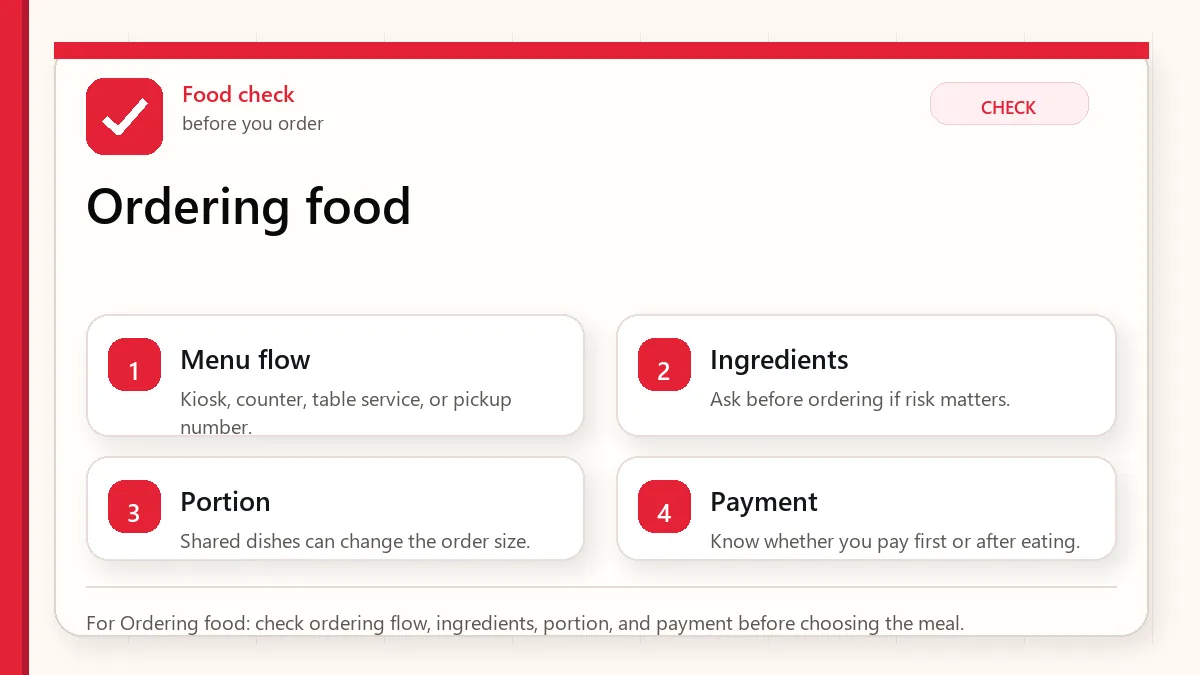
    Layered red check decision graphic for Ordering food.
    For Ordering food: check ordering flow, ingredients, portion, and payment before choosing the meal.

    Start with what can fail at payment

    Choose the restaurant, check whether ordering is by staff, kiosk, or table tablet, look for utensil drawers and water stations, use jeogiyo or the call button when ready, order with pointing plus igeo juseyo, and pay at the counter when you leave unless a kiosk or table system already handled payment. Do not leave a tip on the table.

    The Korean restaurant flow

    StepWhat to look forTourist move
    Before sittingQueue machine, staff greeting, empty table, shoes-off area.Pause and follow the visible flow.
    At the tableCall button, utensil drawer, water pitcher, self-service sign.Set up the table before calling staff.
    OrderingMenu photos, English option, kiosk, QR, tablet.Point clearly or use translation.
    During mealBanchan, shared dishes, scissors, tongs, grill.Use serving tools and follow staff cues.
    PaymentCounter, kiosk receipt, table number card.Take the bill or table card to the counter.

    Table drawers, water, and banchan

    Many casual restaurants keep chopsticks, spoons, napkins, and wet tissues in a drawer under the table. If the table looks empty, check the side before assuming staff forgot. Water may be self-service, often marked with a Korean sign or placed at a visible station. Side dishes, called banchan, often arrive automatically, and some can be refilled, but do not waste them. Ask politely if you need more.

    How to call staff

    If the table has a button, press it once and wait. If there is no button, raise a hand and say jeogiyo. This is not rude in Korea when done calmly. Do not shout across the room aggressively, snap fingers, or wave money. The Korean restaurant service model gives customers more control over when staff come to the table.
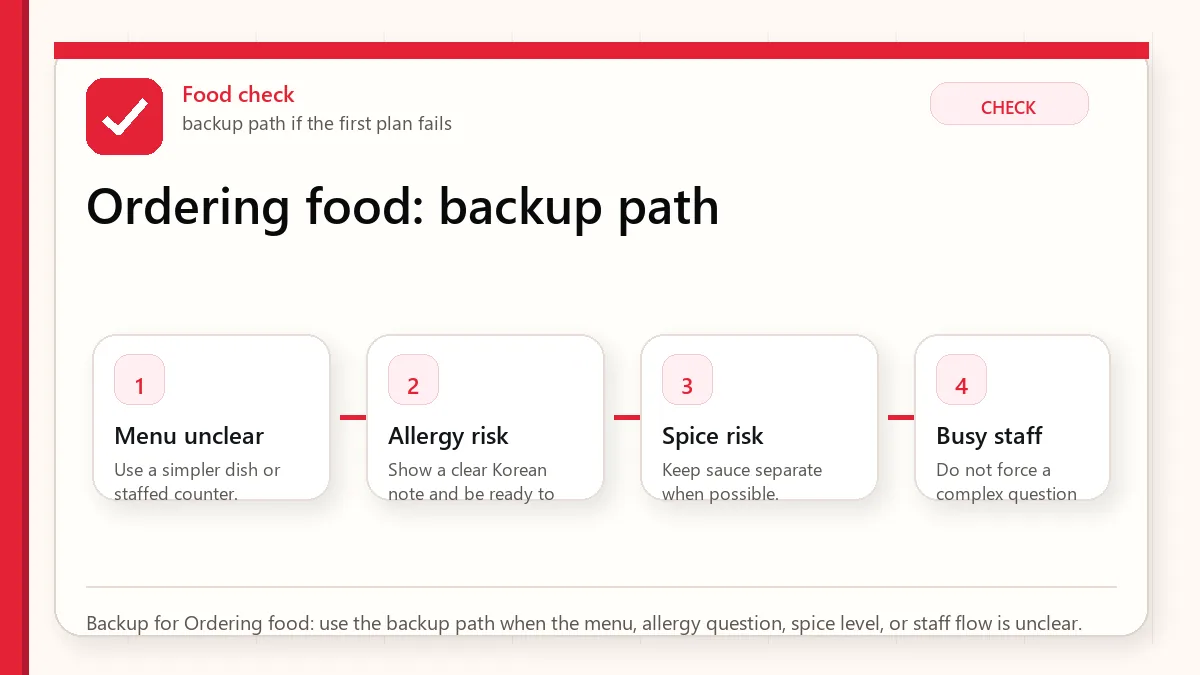
    Layered red check backup flow graphic for Ordering food.
    Backup for Ordering food: use the backup path when the menu, allergy question, spice level, or staff flow is unclear.

    Kiosks and payment friction

    Self-order kiosks are common in fast-casual restaurants, food courts, bakeries, and some chains. They may have English, but not always. Foreign cards can sometimes fail, especially at unattended terminals. If the kiosk fails, look for a staffed counter, another payment option, or a simpler order. Keep cash or a second card as backup.

    Shared dishes and BBQ

    Korean dining often uses shared dishes. Use serving tongs or spoons where available. At BBQ restaurants, staff may grill the first round or control the timing, especially in specialist places. Let them lead unless they clearly leave the tools to you. Keep raw meat tools separate from eating utensils when possible. If you have allergies or dietary restrictions, ask before grilling begins because sauces, marinades, and shared surfaces matter.

    Useful phrases

    • Jeogiyo – excuse me, used to call staff.
    • Igeo juseyo – this one, please.
    • Mul jom juseyo – water, please.
    • Deol maepge hae juseyo – please make it less spicy.
    • Yeongsujeung juseyo – receipt, please.

    Dining confidence comes from reading the table

    Before looking at the menu, read the table. A call button means you control when staff come. A drawer means utensils are probably already there. A water station means you may be expected to self-serve. A small table number card or receipt may be needed for payment. These clues tell you how the restaurant works before language becomes an issue.

    This is why some visitors feel ignored when they are not being ignored at all. Staff may simply be waiting for you to press the button, call them, or come to the counter. Korean dining service often protects the table from constant interruption. Once you understand that, the experience feels less confusing and more efficient.

    Allergies and dietary limits need a different approach

    For spice preference, a simple phrase may help. For allergies, vegetarian limits, halal concerns, or gluten questions, spoken phrases are not enough. Show written Korean text and choose simpler dishes when staff cannot confirm ingredients. Shared broths, marinades, side dishes, grills, and sauces can all create hidden problems. A polite restaurant is not automatically a safe restaurant for a serious dietary restriction.

    FAQ

    Do Korean restaurants bring the bill to the table?

    Sometimes, but many expect you to pay at the front counter. Watch what other customers do.

    Is it rude to call staff with jeogiyo?

    No, when said calmly. It is a normal way to get attention in many restaurants.

    Should I tip after eating in Korea?

    No. Ordinary Korean restaurants do not expect tips.

    Delivery app reality check for visitors

    Food delivery can look like the easiest answer when you are tired, but it is not always the easiest tourist flow. Korean delivery apps may ask for a local phone number, identity verification, domestic payment, a precise Korean address, and rider communication. If Baemin becomes part of your food plan, read Can Foreigners Use Baemin in Korea? before relying on it for a late-night meal.

    For first meals after arrival, keep a lower-friction backup: a restaurant near the hotel, a food court, a convenience store meal, or a place where you can order face to face. Delivery is useful when it works, but it should not be the only way your group can eat.

    Related Before Korea guides

    Source links to verify

  • Korean BBQ Etiquette Guide

    Korean BBQ Etiquette Guide

    Start with the moment you order

    At Korean BBQ, treat the table as a shared cooking and eating space. Order enough for the group, follow the restaurant’s grill style, accept staff help when offered, use serving tools when provided, and do not treat side dishes or sauces as unlimited private plates.

    Last checked: June 1, 2026. Re-check the latest product label, restaurant information, and official/public database before acting, because routes, prices, labels, rules, app screens, eligibility, and store/service policies can change.

    The table rhythm that makes BBQ feel easier

    Korean BBQ is not difficult, but it is shared, fast-moving, and more structured than it may look at first. The useful preparation is knowing the minimum order, grill rhythm, staff help, side dishes, and payment flow before everyone at the table is already waiting.

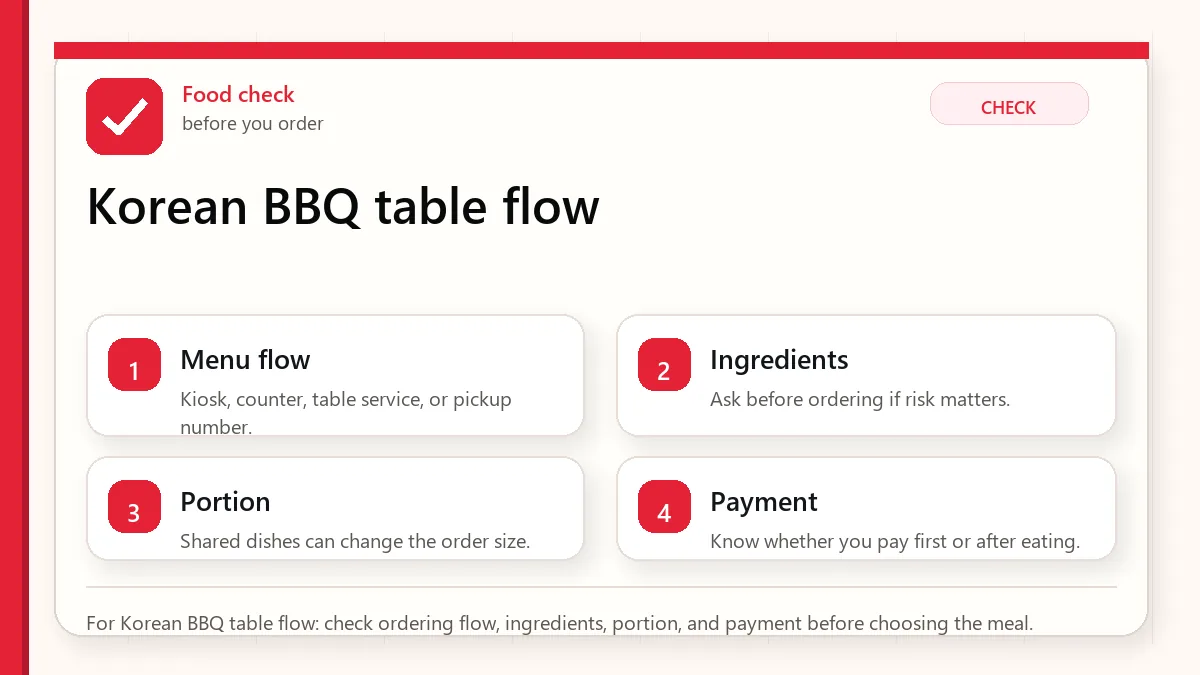
    Layered red check decision graphic for Korean BBQ table flow.
    For Korean BBQ table flow: check ordering flow, ingredients, portion, and payment before choosing the meal.

    Korean BBQ table basics

    MomentWhat to doWhy
    OrderingCheck minimum order and portion style.Many BBQ restaurants expect meat orders by portion or person.
    GrillingLet staff guide you if they manage the grill.Some restaurants prefer staff to cook or cut meat.
    SharingUse tongs/scissors/serving tools when available.The table is shared, so hygiene and flow matter.
    Side dishesAsk politely for refills if needed.Banchan is shared and should not be wasted.
    PaymentCheck whether payment happens at table or counter.Restaurant flow varies.

    Checks before the first order

    • Check whether the restaurant specializes in beef, pork, chicken, or another style.
    • Look for minimum order notes if eating alone.
    • Prepare allergy or dietary phrases if needed.
    • Do not assume every BBQ restaurant has the same grill rules.
    • Carry a backup payment method.

    Move through the meal without making it awkward

    • Order meat based on group size and appetite.
    • Wait for staff instructions before adjusting unfamiliar grill equipment.
    • Use separate tools for raw meat and cooked meat when provided.
    • Wrap cooked meat with lettuce, sauces, and side dishes if you like, but do not overfill shared plates.
    • Order additional items after seeing portion size.
    • Check final bill before leaving.
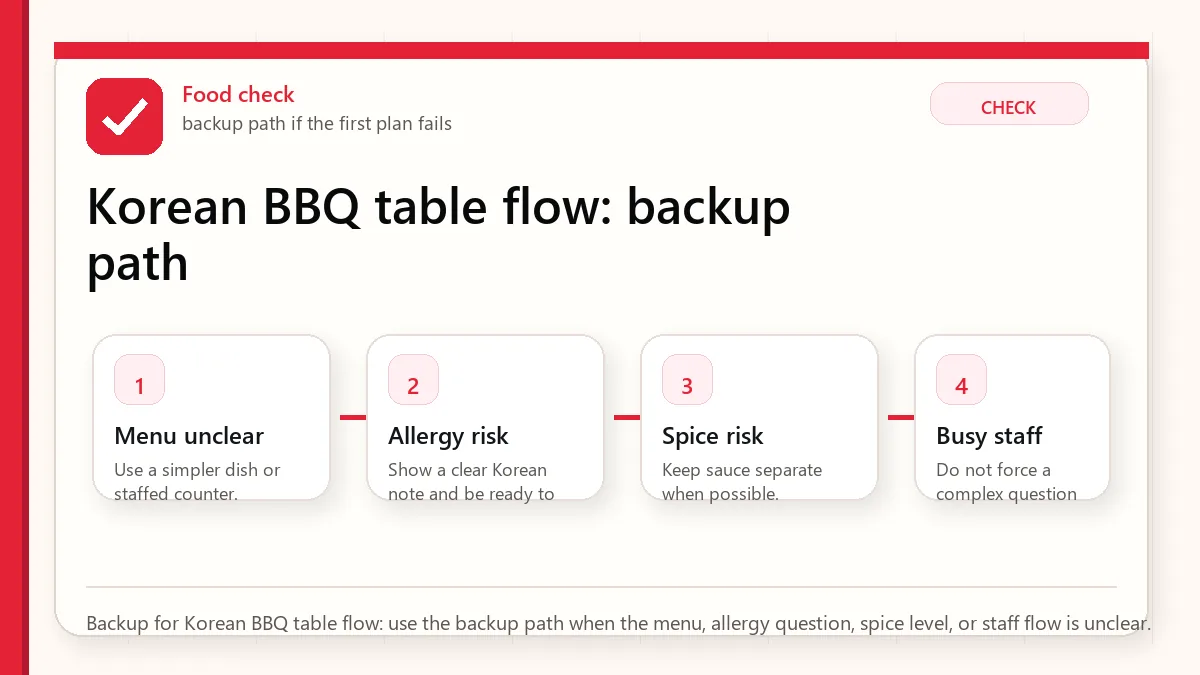
    Layered red check backup flow graphic for Korean BBQ table flow.
    Backup for Korean BBQ table flow: use the backup path when the menu, allergy question, spice level, or staff flow is unclear.

    Where first BBQ meals usually get uncomfortable

    You are not sure who cooks

    Pause and watch staff. If they start cooking, let them. If not, cook carefully and ask if unsure.

    You are dining alone

    Some BBQ restaurants have minimum orders or may be less solo-friendly. Check before entering.

    You have dietary restrictions

    Korean BBQ can involve shared grills, marinades, seafood sauces, or side dishes. Confirm ingredients rather than guessing.

    Smoke or smell bothers you

    Choose a restaurant with ventilation, avoid delicate clothing, and plan accordingly.

    Read the table before changing the flow

    SituationBetter approachWhat to verify
    First-time groupChoose a popular restaurant with staff-guided grilling.Minimum order and payment method.
    Solo travelerSearch for solo-friendly BBQ or non-grill alternatives.Minimum portion and seating policy.
    Pork restrictionConfirm meat type and shared grill risk.Marinades and side dishes.
    Budget travelerCheck menu price before sitting.Per-portion pricing and add-ons.

    What not to assume at a BBQ restaurant

    • Do not assume every side dish is vegetarian.
    • Do not assume staff will cook at every restaurant.
    • Do not assume one portion equals one full meal for every person.
    • Do not assume all sauces are mild or allergy-safe.

    Small table details that make the meal feel smoother

    The minimum order sets the meal

    Many Korean BBQ restaurants expect a minimum amount of meat, often based on portions or people. A visitor who orders too little can create confusion before the meal even starts. Check the menu structure first: meat type, portion size, minimum order, side dishes, stew, rice, and whether staff help with grilling. This makes the meal feel calmer and more respectful.

    Let the table flow guide you

    BBQ is social and shared, so the rhythm matters. Tongs, scissors, grill changes, side dishes, wrapping vegetables, and staff assistance all have a flow. If staff are managing the grill, let them. If your table is expected to cook, turn pieces carefully and avoid mixing raw and cooked utensils where separate tools are provided. When unsure, watching nearby tables usually helps.

    Read next when BBQ connects to ordering, spice, or etiquette

    This topic works best when it is not handled alone. Use the related guides below to connect the decision with maps, money, food, shopping, transit, and app backup planning.

    Related Before Korea guides

    FAQ

    Do staff cook Korean BBQ for you?

    Sometimes. It depends on the restaurant and meat style. Follow staff cues and ask politely if unsure.

    Can I eat Korean BBQ alone?

    Sometimes, but some places have minimum orders. Solo-friendly BBQ or non-grill meat restaurants may be easier.

    Are side dishes free?

    Many restaurants provide banchan and may refill some items, but do not waste food and ask politely.

    Source links to verify

    Last updated

    Last updated: 2026-05-23. Re-check official sources close to the day you travel, buy, eat, or use an app. Details involving prices, eligibility, transport, app features, opening hours, and refund rules can change.