Category: Before You Eat

Practical Korean food guides for BBQ, convenience store food, etiquette, menus, and dietary questions.

  • Korean Food Allergy Card: What to Write Before Eating in Korea

    Korean Food Allergy Card: What to Write Before Eating in Korea

    A Korean food allergy card should do one job clearly: tell restaurant staff what you cannot eat, ask them to check hidden ingredients, and make it acceptable for them to say they cannot confirm. Translation alone is not enough in Korea because broths, sauces, marinades, shared grills, seafood paste, nuts, sesame, wheat, egg, milk, soy, and cross-contact can be invisible from the menu name.

    Last checked: June 2, 2026. Restaurant recipes, packaged-food labels, and allergen notices can change. Use this as a communication tool, not medical advice.
    Layered red check decision graphic for Food allergy card.
    For Food allergy card: check the exact label, local sticker, date, size or ingredient detail, and proof needed for this product.

    What to write on the card

    Card lineWhy it mattersExample
    My allergyName the exact allergen, not a broad diet preferenceI am allergic to peanuts and tree nuts.
    SeverityStaff need to know whether trace exposure is dangerousEven a small amount can cause a serious reaction.
    Hidden ingredientsKorean food may use broth, sauce, paste, oil, or powderPlease check sauce, broth, marinade, garnish, and frying oil.
    Cross-contactShared grills, tongs, pans, and fryers can matterIf you cannot confirm, please tell me before I order.
    Emergency noteTravelers need a backup planIf I feel sick, please call 119.

    A practical English card text

    I have a serious food allergy to: [ALLERGEN]. Please check the ingredients, sauce, broth, marinade, garnish, cooking oil, and shared cooking tools. If you are not sure, please tell me before I order. If I have a reaction, please call 119.

    A Korean phrase to show staff

    저는 [알레르기 식품] 알레르기가 있습니다. 소스, 육수, 양념, 고명, 조리기구, 튀김기름에 들어가는지 확인 부탁드립니다. 확실하지 않으면 주문 전에 알려 주세요. 응급 상황이면 119에 전화해 주세요.

    Do not rely on this Korean text blindly for a life-threatening condition. Have a native speaker, medical professional, or trusted translation service review your exact allergen wording before travel.

    Common allergen words to prepare

    EnglishKoreanWhere it may appear
    Peanut땅콩Sauce, dessert, snack, garnish
    Tree nut견과류Bakery, dessert, salad, packaged snacks
    Egg계란 / 달걀Kimbap, toast, pancakes, noodles, sauces
    Milk우유Cafe drinks, bakery, dessert, cream sauce
    WheatNoodles, dumplings, fried food, sauces
    Soy대두 / 콩Soy sauce, tofu, soybean paste, marinades
    Shellfish갑각류Broth, seafood dishes, sauces
    Sesame참깨 / 참기름Garnish, oil, dipping sauce, side dishes

    This table is a starting point, not a medical translation service. If your allergy is severe, prepare the exact Korean wording for your allergen and show it with your English text.

    Where Korean meals hide allergens

    Food situationWhat to ask aboutWhy it can be missed
    Korean BBQMarinade, dipping sauce, shared grill, side dishesThe meat may look plain while sauce or banchan carries the risk
    Tteokbokki or street foodFish cake, broth, sauce, wheat, seafood, eggSauce and broth are not visible from the name
    Convenience-store mealsLabel, allergen notice, heating instructionsTranslation apps may miss warnings or facility notes
    Bakery/cafe itemsMilk, egg, wheat, nuts, sesame, cross-contactDisplay items may not show full ingredient details
    Soup/stew/noodle dishesBroth base, seafood, soy, wheat, egg, garnishThe broth can be the main risk

    How to use the card at a restaurant

    1. Show the card before ordering, not after food arrives.
    2. Point to the exact dish you want and ask whether it can be checked.
    3. If the staff look unsure, choose a simpler dish or leave.
    4. Do not ask for a guarantee from a restaurant that cannot verify ingredients.
    5. Carry medication and emergency instructions according to your doctor's advice.

    The answer you should accept

    A useful allergy card does not force the staff to say yes. It gives them a safe way to say no or unsure. If the restaurant cannot check broth, sauce, oil, or cross-contact, that is an answer. For high-risk allergies, treat uncertainty as a reason to choose another food.

    Packaged food needs a different check

    For convenience-store meals and packaged snacks, ask a different question: can you read the label well enough to decide? Look for the ingredient list, allergen notice, manufacturing facility note, expiration date, and heating instructions. A product can look simple from the front package but still contain milk, wheat, soy, sesame, seafood extract, or nut traces.

    Use a translation app for the label, but do not let the camera translation be the only check for a serious allergy. Small Korean text, line breaks, and packaging glare can make machine translation miss important words.

    What to do when staff cannot confirm

    The safest response is not to negotiate. Thank the staff and choose a lower-risk option. A restaurant that cannot verify sauce, broth, or cross-contact may still be a good restaurant; it is just not a good choice for your allergy risk that day.

    • Choose plain packaged food with a readable label over an unclear mixed dish.
    • Choose a restaurant with simpler preparation if cross-contact matters.
    • Carry safe snacks for late-night or travel days.
    • Keep emergency medication and instructions accessible according to your medical plan.
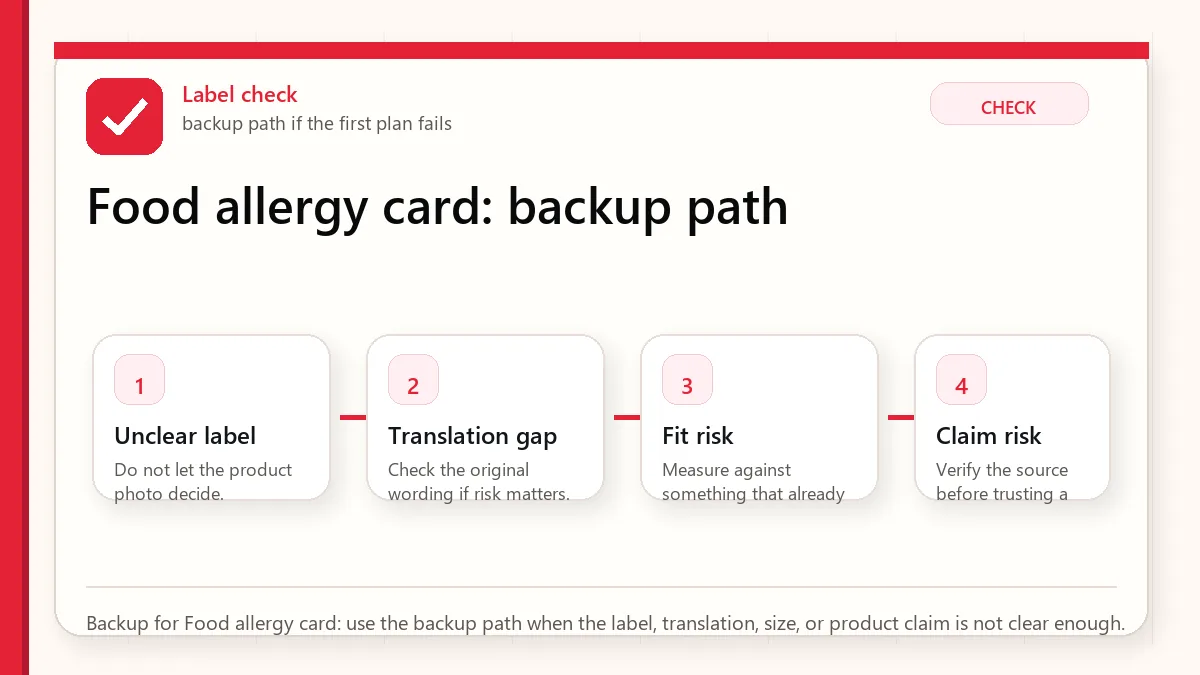
    Layered red check backup flow graphic for Food allergy card.
    Backup for Food allergy card: use the backup path when the label, translation, size, or product claim is not clear enough.

    Official and safety links

    Related guides

    FAQ

    Is a translation app enough for food allergies in Korea?

    No. A translation app can help, but a prepared allergy card is clearer and gives staff time to check hidden ingredients and cross-contact risk.

    Should I ask if a dish is safe?

    Ask staff to check specific ingredients, sauce, broth, oil, and shared tools. If they cannot confirm, choose another option.

    What emergency number should travelers know in Korea?

    119 is Korea's emergency number. Follow your doctor's travel plan for medication and emergency care.
  • Korean Restaurant Kiosk Guide

    Korean Restaurant Kiosk Guide

    Korean restaurant kiosks are common in fast-food chains, casual restaurants, food courts, noodle shops, burger shops, cafes, and some local franchises. They make ordering fast for locals, but they can trap visitors with hidden language buttons, menu options, set menus, spicy add-ons, foreign card errors, and order numbers that appear only on the receipt.

    Last checked: June 1, 2026. Re-check the latest product label, restaurant information, and official/public database before acting, because routes, prices, labels, rules, app screens, eligibility, and store/service policies can change.

    Last updated: May 24, 2026.

    The goal is not to master every kiosk. The goal is to slow the first thirty seconds down enough to avoid the wrong mode, wrong quantity, wrong option, or impossible payment step.

    Layered red check decision graphic for Restaurant Kiosk.
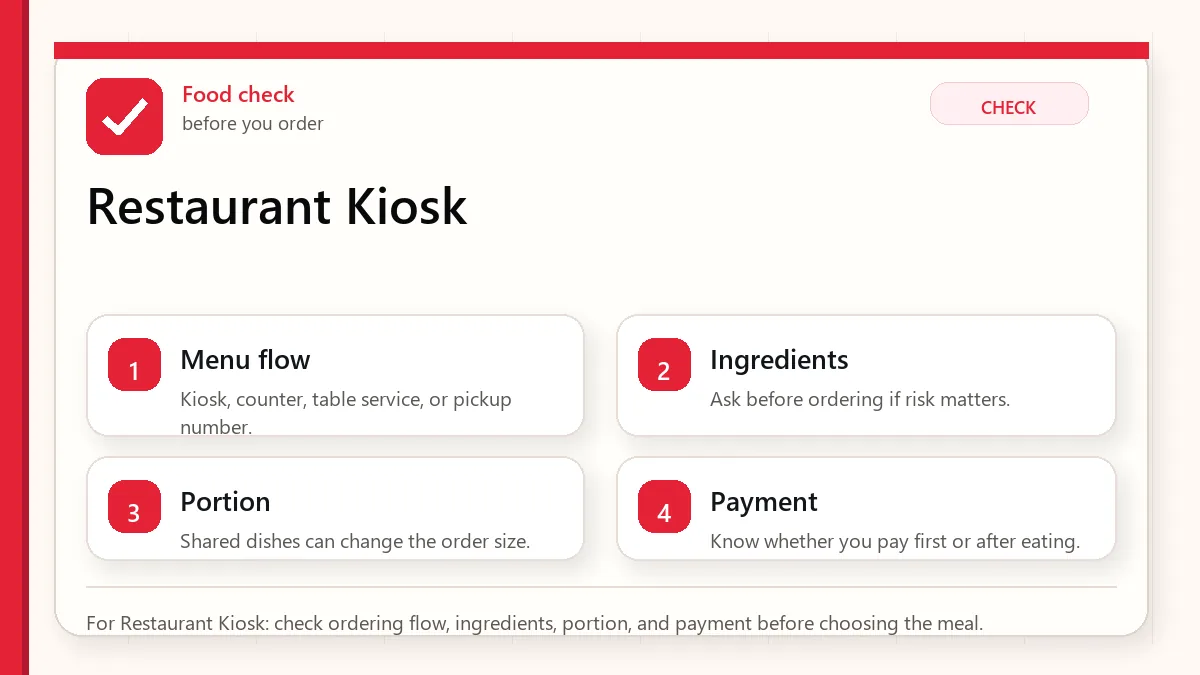
    For Restaurant Kiosk: check ordering flow, ingredients, portion, and payment before choosing the meal.

    Start with the moment you order

    Look first for a language button, then choose dine-in or takeout, select by photo or category, review the cart, pay, and keep the receipt or order number. If you have allergies or dietary restrictions, do not rely on the kiosk alone. Ask staff before paying, because kiosks often show limited ingredient detail.

    Common Korean kiosk words

    KoreanMeaningWhy it matters
    매장Dine inChoose this if you are eating inside.
    포장TakeoutChoose this if you want the food packed.
    주문OrderStart or confirm an order.
    결제PaymentFinal payment step.
    카드CardUse for credit or debit card payment.
    현금CashNot every kiosk accepts cash.
    영수증ReceiptMay show your order number.
    주문번호Order numberWatch the pickup screen for this.
    품절Sold outThe item is unavailable.
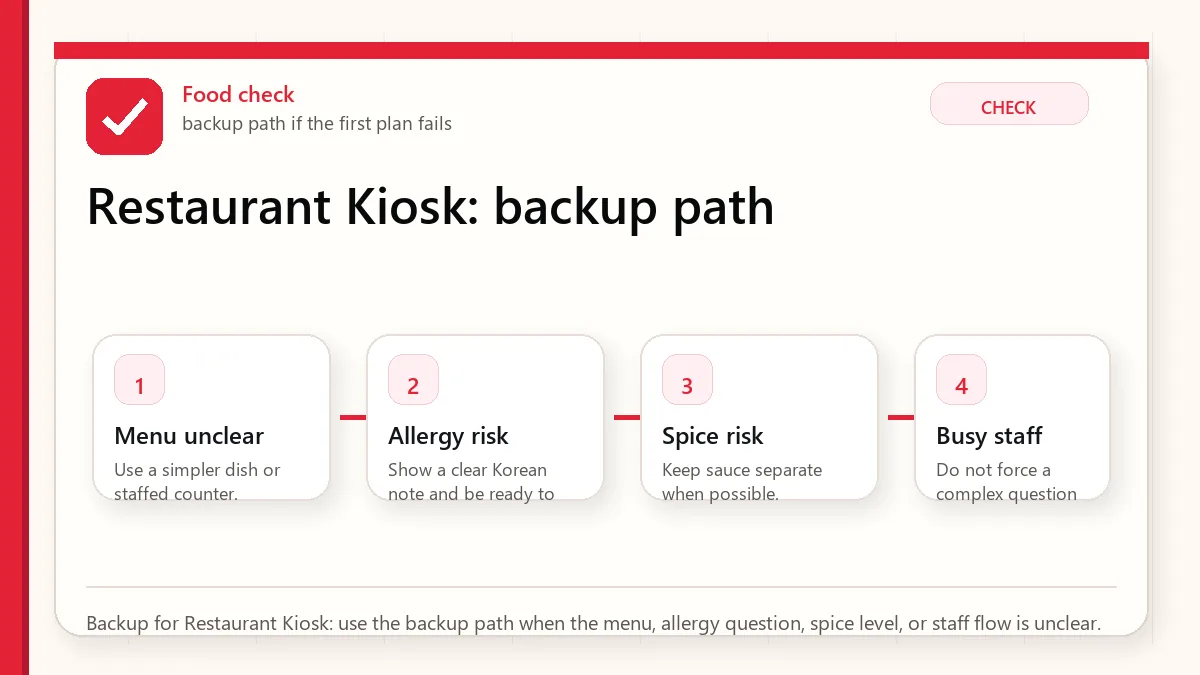
    Layered red check backup flow graphic for Restaurant Kiosk.
    Backup for Restaurant Kiosk: use the backup path when the menu, allergy question, spice level, or staff flow is unclear.

    The safest kiosk flow

    1. Step back and find the language button before touching menu items.
    2. Choose dine-in or takeout. This is often the first decision.
    3. Pick the category: burger, noodles, rice, coffee, set menu, side, drink, dessert.
    4. Use menu photos, but check options such as size, spice, sauce, hot/iced, and add-ons.
    5. Open the cart and confirm quantity. Accidental double orders are common.
    6. Pay by card if supported. If the card fails, ask staff rather than repeating the same error endlessly.
    7. Take the receipt and watch for your order number on the screen or listen for it being called.

    Where visitors get stuck

    • No English button: Use camera translation, but avoid complex dishes if you cannot read options.
    • Foreign card declined: Try another card, use the counter if available, or choose a restaurant with staff ordering.
    • Takeout vs dine-in mistake: Staff can sometimes fix it, but not always during a rush.
    • Hidden spicy option: Some dishes have default spice or sauce choices that photos do not reveal.
    • Allergy uncertainty: Kiosks rarely provide enough kitchen detail for serious allergies.

    Allergy and dietary caution

    A kiosk is a bad place to negotiate a serious allergy. If the restaurant is busy and the machine is the only ordering channel, choose a safer restaurant or ask staff before submitting payment. Many sauces, broths, batters, and toppings are not obvious from photos.

    FAQ

    Do Korean kiosks accept foreign cards?

    Many do, but not all. Some machines fail with certain foreign cards even when the restaurant itself can accept card at the counter.

    What if I make a wrong order?

    Ask staff immediately and show the receipt. If food preparation has started, changes may be difficult.

    Can I order in English at the counter instead?

    Sometimes. Chains and tourist areas may help, but some restaurants expect kiosk-only ordering during busy periods.

    Screen order patterns

    Many kiosks follow a predictable pattern: dine-in or takeout, language, category, item, options, cart, membership or coupon, payment, receipt. The membership screen is where visitors often freeze. If you do not have a Korean membership number, look for skip, no membership, continue, or payment buttons.

    Card errors and what they mean

    A declined card does not always mean your bank blocked the transaction. The kiosk may not support your card type, may require chip insertion in a specific direction, may fail with contactless, or may be tied to a domestic payment rail. Try inserting the card, try another card, and then ask staff. Do not repeatedly tap the same card for five minutes while the line grows.

    Receipts are not optional

    Take the receipt even if you normally avoid paper. It may contain your order number, pickup counter, refund proof, or item list. In food courts, several counters can share one seating area, and the receipt is how you prove where your food should appear.

    When to abandon the kiosk

    Leave the kiosk flow if you have a serious allergy, cannot understand required options, cannot confirm payment, or suspect you selected the wrong mode. It is better to ask staff or choose another restaurant than to buy a meal you cannot eat.

    Related Before Korea guides

    Use these guides together rather than treating one article as the whole plan.

    Sources checked for this update

    Before Korea treats operational details as changeable. Check the official pages below before a trip or a large purchase.

  • Korean Cafe Etiquette for Visitors

    Korean Cafe Etiquette for Visitors

    Start with the moment you order

    Korean cafes can be relaxed, stylish, crowded, or study-like depending on the place. A good cafe visit comes from reading the room: order first, choose seating carefully, and do not treat every cafe as an unlimited workspace.

    Last checked: June 1, 2026. Re-check the official or primary source page before acting, because routes, prices, labels, rules, app screens, eligibility, and store/service policies can change.

    Last updated: May 23, 2026. Rules, app flows, prices, and eligibility can change, so re-check official sources close to your trip.

    Layered red check decision graphic for Cafe Etiquette for.
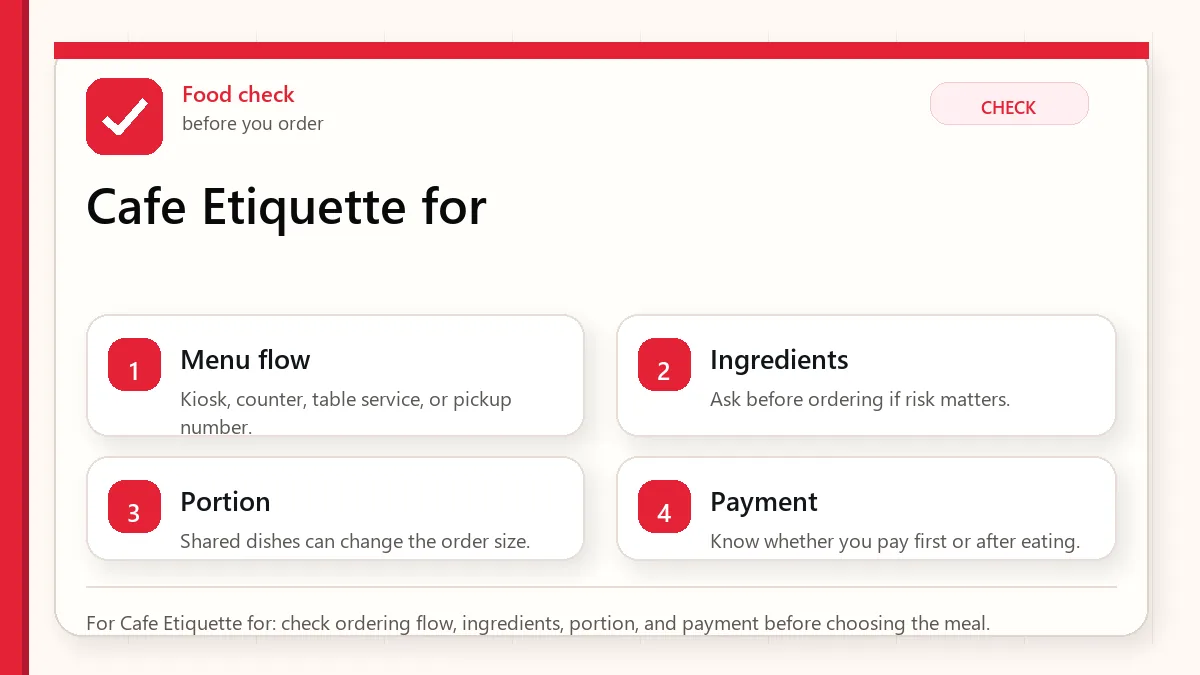
    For Cafe Etiquette for: check ordering flow, ingredients, portion, and payment before choosing the meal.

    Where visitors usually feel unsure

    This matters when the rule is less important than the local rhythm: queue, noise, seat, shared table, greeting, payment, or how quickly people expect the line to move. Pause, read the room, and use the smallest polite action that solves the moment.

    The small check that changes the answer

    • Order before sitting if the cafe layout suggests counter-first service.
    • Do not occupy large tables during crowded periods if you are alone.
    • Use outlets and laptop time with awareness of crowding.
    • Keep voices low in study-like cafes and be quicker in tiny popular cafes.
    • Save the relevant page or screenshot before you need it in public.
    • Re-check volatile details near travel day because policies and app flows change.

    A cafe can be a rest stop, workspace, or quick drink place

    Read the room before opening the laptop

    Some cafes welcome long laptop sessions; others are crowded, small, or designed for quick turnover. The same behavior can feel normal in one cafe and inconsiderate in another.

    Seats have social meaning

    A four-person table, window photo spot, or limited outlet seat may be in high demand. Choosing a smaller seat when alone is a simple way to avoid friction.

    Cafes are good recovery infrastructure

    For travelers, cafes are not just aesthetic stops. They are where you recover from weather, check maps, translate menus, charge a phone, and slow the day down.

    A calmer way to handle the social moment

    Notice the setting before choosing the action

    Notice the setting first: queue, seat, noise level, shared space, or staff rhythm. The smaller polite action is usually the safer one.

    Use official guidance only where rules, safety, or transport signs apply

    For signs, transport rules, and venue instructions, follow the posted rule first. For softer manners, read the local flow.

    Use a short polite phrase if the moment feels unclear

    The backup is a small repair: pause, step aside, say a short apology, or ask with a simple phrase.

    Do not overexplain when a small adjustment is enough

    More rules can make you stiff. Watch the room, keep space, and adjust quietly.

    Layered red check backup flow graphic for Cafe Etiquette for.
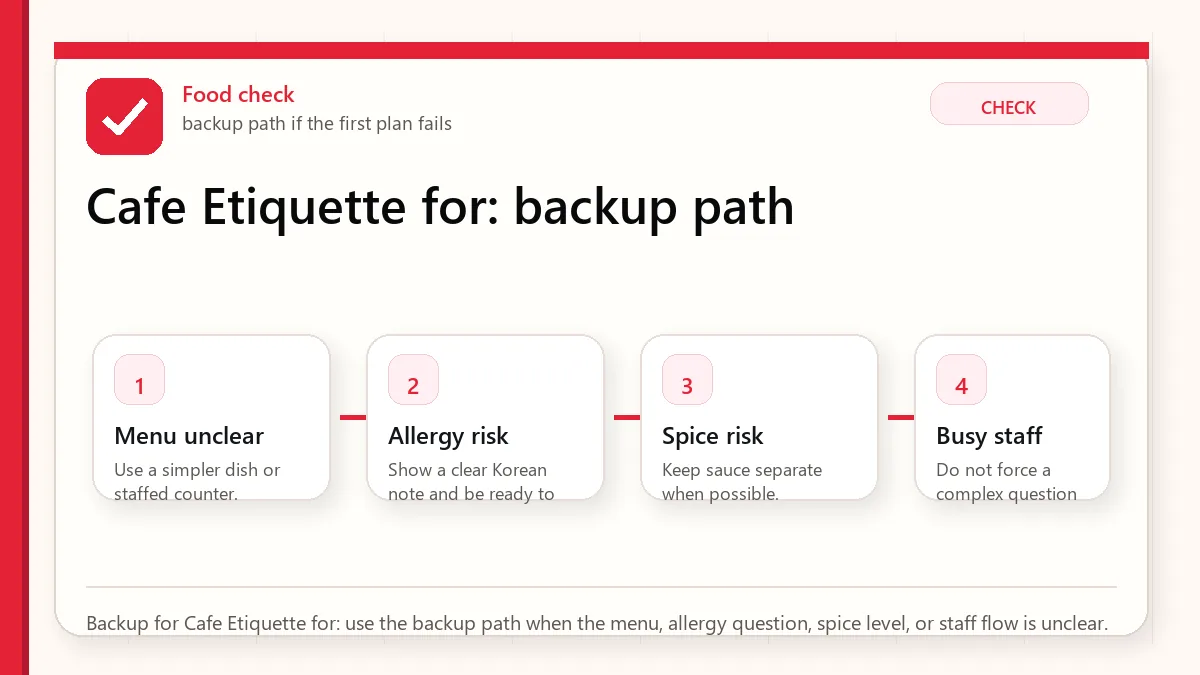
    Backup for Cafe Etiquette for: use the backup path when the menu, allergy question, spice level, or staff flow is unclear.

    What this means in the real moment

    The first plan depends on one fragile detail

    If one card, one app login, one translation scan, or one store policy controls the whole plan, add a backup before the trip.

    The information is technically correct but not practical

    A rule can be true and still be hard to use when you are tired, carrying luggage, or standing in a busy line. Plan for the human moment, not only the policy.

    A visitor copies advice from a different travel style

    A resident, Korean speaker, business traveler, or frequent visitor may solve problems differently from a first-time tourist. Use advice that matches your situation.

    A safer way to make the decision

    SituationSafer defaultWhy
    Short first tripChoose convenience and fewer moving partsRecovery time is limited
    Budget-conscious tripSeparate must-pay costs from nice-to-have extrasSmall purchases add up quickly
    Higher-risk situationUse official sources and conservative backupsHealth, entry, tax, and payment issues are not good places to gamble

    Sources to re-check

    Use these pages for facts that can change by date, operator, airport, app version, store, or traveler status.

    Where to go next

    FAQ

    Can I rely on one answer for every visitor?

    No. Korea travel details can depend on nationality, app version, store, airport, phone setup, card issuer, and date.

    Should I solve this after arriving?

    Try not to. Anything involving entry, phone data, maps, payment, allergies, or airport transfer is easier to prepare before the first pressure moment.

    What is the safest habit?

    Keep the official source, the practical guide, and a simple backup together. That combination is more useful than memorizing many tips.

  • Korean Convenience Store Meal Guide

    Korean Convenience Store Meal Guide

    Start with the first thing that can block the day

    Korean convenience stores are useful when restaurants feel difficult, but they still require small decisions: label reading, microwave use, seating, payment, freshness, and allergy caution. Decide first whether you need a safe backup meal, a quick snack, or a heated dish, because each choice changes what you should check on the package.

    Last checked: June 1, 2026. Re-check the latest product label, restaurant information, and official/public database before acting, because routes, prices, labels, rules, app screens, eligibility, and store/service policies can change.

    Last updated: May 23, 2026. Rules, app flows, prices, and eligibility can change, so re-check official sources close to your trip.

    Layered red check decision graphic for Convenience Store Meal.
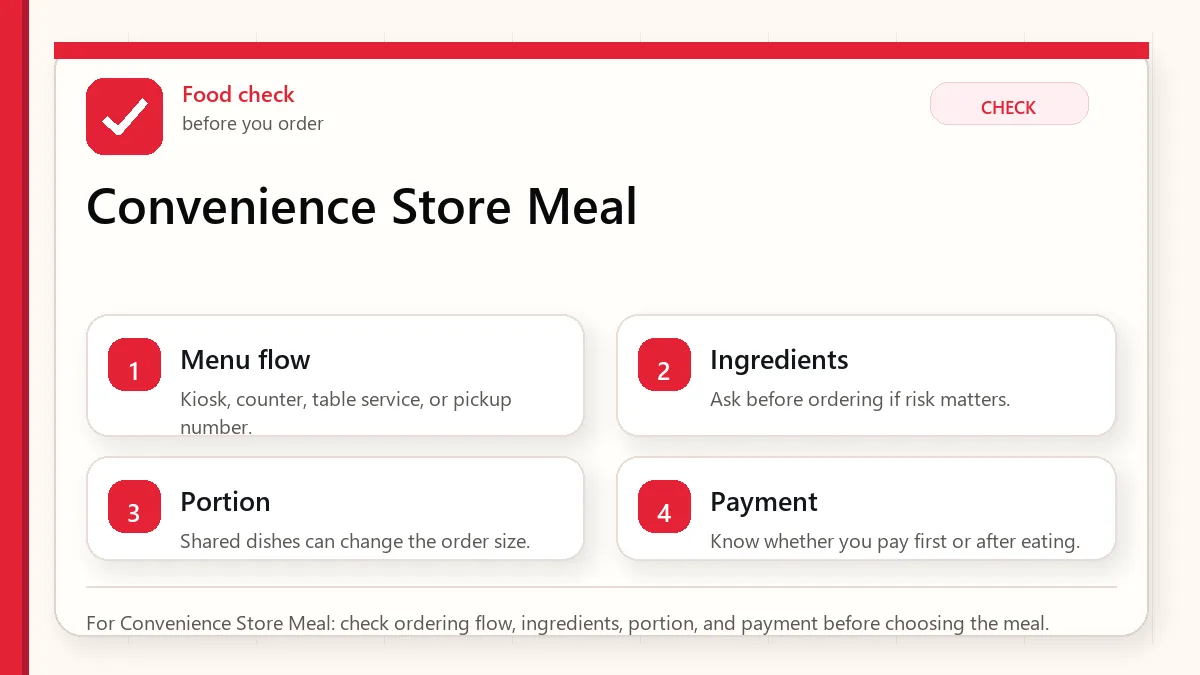
    For Convenience Store Meal: check ordering flow, ingredients, portion, and payment before choosing the meal.

    Where label decisions usually fail

    This matters when a product, food, cosmetic, clothing item, or package looks easy to understand but the useful detail is on the label, sticker, measurement, date, ingredient list, or return rule. Check the evidence before you pay.

    The small check that changes the answer

    • Use translation for labels and heating instructions before buying.
    • Check whether the store has microwave, hot water, seating, or eating space.
    • Be careful with allergens in sauces, ramen packets, kimbap fillings, and prepared meals.
    • Keep convenience stores as a useful backup, not the whole food plan.
    • Save the relevant page or screenshot before you need it in public.
    • Re-check volatile details near travel day because policies and app flows change.

    Convenience-store meals work best with a small system

    Breakfast is where convenience stores shine

    For early starts, a convenience store can solve coffee, water, fruit, yogurt, kimbap, or a simple packaged meal before restaurants open. It is practical when you choose deliberately.

    Heating rules matter

    Some meals are meant to be microwaved, some need hot water, and some are ready to eat. Watch what locals do near the microwave area and use translation before removing lids or sauce packets.

    Late-night choices should be gentle

    After travel or drinking, the easiest spicy ramen may not be the best body decision. Keep a mild option, water, and something familiar in mind.

    A label check that prevents regret later

    Decide what the label must prove

    Decide what the label must prove: size, date, ingredient, warning, seller, or return rule. Do not let the product photo answer a label question.

    Use official or package information for claims that can change

    For product claims, ingredients, certification, dates, and returns, use the package, brand, store, or official source over copied screenshots.

    Photograph the label or keep the receipt when proof matters

    The backup is proof: a photo of the label, a receipt, the product name, or a safer option you can choose instead.

    Do not buy only from a familiar-looking claim

    More product claims do not equal more certainty. Check the specific label in front of you.

    Layered red check backup flow graphic for Convenience Store Meal.
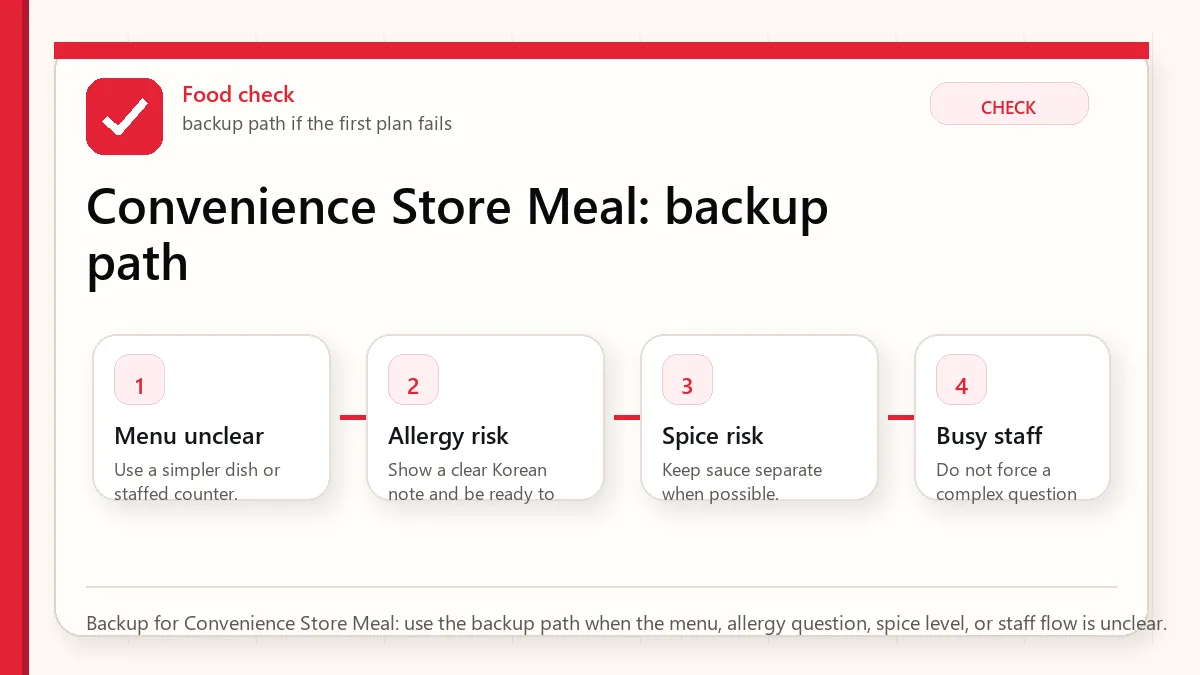
    Backup for Convenience Store Meal: use the backup path when the menu, allergy question, spice level, or staff flow is unclear.

    What this means in the real moment

    The first plan depends on one fragile detail

    If one card, one app login, one translation scan, or one store policy controls the whole plan, add a backup before the trip.

    The information is technically correct but not practical

    A rule can be true and still be hard to use when you are tired, carrying luggage, or standing in a busy line. Plan for the human moment, not only the policy.

    A visitor copies advice from a different travel style

    A resident, Korean speaker, business traveler, or frequent visitor may solve problems differently from a first-time tourist. Use advice that matches your situation.

    A safer way to make the decision

    SituationSafer defaultWhy
    Short first tripChoose convenience and fewer moving partsRecovery time is limited
    Budget-conscious tripSeparate must-pay costs from nice-to-have extrasSmall purchases add up quickly
    Higher-risk situationUse official sources and conservative backupsHealth, entry, tax, and payment issues are not good places to gamble

    Sources to re-check

    Use these pages for facts that can change by date, operator, airport, app version, store, or traveler status.

    Where to go next

    FAQ

    Can I rely on one answer for every visitor?

    No. Korea travel details can depend on nationality, app version, store, airport, phone setup, card issuer, and date.

    Should I solve this after arriving?

    Try not to. Anything involving entry, phone data, maps, payment, allergies, or airport transfer is easier to prepare before the first pressure moment.

    What is the safest habit?

    Keep the official source, the practical guide, and a simple backup together. That combination is more useful than memorizing many tips.

  • Korean Food Allergy Card Guide

    Korean Food Allergy Card Guide

    If you have food allergies in Korea, do not rely only on spoken English or a translation app at the table. Prepare a Korean allergy card, choose food situations where staff can confirm ingredients, and treat uncertainty as a real warning sign.

    Korean allergy card: what to put on it

    A Korean allergy card should say the allergy clearly in Korean, explain the consequence if exposed, and ask staff to check sauces, broth, marinades, frying oil, and shared equipment. Keep it short enough for a busy restaurant worker to read.

    Card lineWhy it helps
    I have a serious allergy to…Names the ingredient without relying on pronunciation
    Please check sauce, broth, and seasoningKorean dishes often hide allergens in base ingredients
    If unsure, please tell meGives staff permission to say no instead of guessing

    Do not use a translated card as medical proof. Carry medication and avoid restaurants that cannot confirm ingredients.

    Korean allergy card: what it should say

    A Korean allergy card should name the allergen clearly in Korean, state that you cannot eat it, and ask staff to check sauces, broth, seasoning, oil, and shared cooking surfaces. Do not rely on the main ingredient name only, because Korean dishes can contain hidden stock, paste, garnish, or seafood-based seasoning.

    • Prepare the card in Korean and English.
    • Show it before ordering, not after food arrives.
    • Ask about broth, sauce, paste, and cross-contact.
    • Keep emergency medication and local emergency contact information accessible.

    For the shorter page, see Korean allergy card.

    Last checked: June 1, 2026. Re-check the official provider, store, customs, or payment page before acting, because routes, prices, labels, rules, app screens, eligibility, and store/service policies can change.

    Last updated: May 27, 2026. Menus, ingredients, kitchen handling, staff answers, and packaged-food labels can change, so re-check before ordering.

    Layered red check decision graphic for Food allergy card.
    For Food allergy card: check the exact label, local sticker, date, size or ingredient detail, and proof needed for this product.

    This guide is written for visitors searching broad terms like korean allergies or more urgent phrases like food allergy in Korean. The real intent is safety. A useful article should not only translate one sentence. It should help a traveler decide when to ask, when to avoid, and when uncertainty itself is the warning.

    Start with the hard truth

    Korea can be a wonderful food destination, but serious allergy travel needs caution. Many restaurants are small, busy, and optimized for speed. Staff may not know every ingredient in a sauce, broth, batter, side dish, or supplier product. A server may answer based on the visible main ingredient, not hidden components or shared cooking surfaces. This is not carelessness; it is how complex restaurant food often works.

    If your allergy can cause severe reactions, do not treat any blog, translation app, or casual staff answer as a medical guarantee. Bring your medication, know local emergency numbers and travel insurance details, and choose lower-risk food situations. Before Korea can help you prepare questions, but it cannot make a restaurant safe.

    Use a Korean allergy card

    A written allergy card is the single most useful preparation tool. It should be short, specific, and calm. Do not write a long paragraph. Write what you cannot eat, what happens if you eat it, and whether cross-contact matters. Keep it in Korean, English, and as an offline screenshot. Print one if your allergy is serious.

    English meaningKorean textHow to use it
    I have a food allergy.저는 음식 알레르기가 있습니다.First line of the card.
    I cannot eat this ingredient.이 재료를 먹을 수 없습니다.Put the ingredient name beside it.
    Even a small amount can be dangerous.소량도 위험할 수 있습니다.Use only if medically true.
    Please check the sauce, broth, and seasoning.소스, 육수, 양념도 확인해 주세요.Important for Korean food.
    If you are not sure, please tell me.확실하지 않으면 말씀해 주세요.Gives staff permission to be honest.

    Allergens that hide in Korean food

    Many visitors think only about the main dish name. In Korea, risk often hides in the support system: soup stock, soy sauce, gochujang, doenjang, marinades, frying batter, powdered seasoning, fish sauce, anchovy broth, shrimp paste, sesame oil, garnish, banchan, and shared grills. A dish that looks simple may not be simple.

    • Wheat and gluten: soy sauce, noodles, dumplings, batter, pancakes, fried foods, gochujang, and processed sauces can matter.
    • Soy: soy sauce, doenjang, tofu, marinades, soup bases, and side dishes.
    • Seafood and shellfish: anchovy broth, seafood stock, shrimp paste, fish cake, sauces, stews, kimchi variations, and cross-contact.
    • Peanuts and tree nuts: less universal than some cuisines, but can appear in desserts, sauces, toppings, snacks, and fusion foods.
    • Sesame: sesame oil and seeds are common finishing ingredients.
    • Egg and milk: bakery items, batter, mayo-like sauces, desserts, cafe drinks, and processed foods.
    Layered red check backup flow graphic for Food allergy card.
    Backup for Food allergy card: use the backup path when the label, translation, size, or product claim is not clear enough.

    Packaged food labels help, but read them carefully

    Korea’s MFDS food labeling system includes allergen labeling rules for packaged foods. MFDS lists allergen labeling foods such as eggs, milk, buckwheat, peanuts, soybeans, wheat, mackerel, crab, shrimp, pork, peach, tomato, sulfurous acid in specified cases, walnuts, chicken, beef, squid, clams including oyster, abalone, and mussels, and pine nut. The label system can help with packaged snacks, convenience store food, sauces, and grocery items.

    But labels are not the same as a restaurant kitchen. Packaged food has a printed ingredient and allergen environment. Restaurant food can change by branch, prep, sauce, stock, garnish, and shared surfaces. Use packaged labels when possible, but still be cautious with heating, mixed foods, and items prepared in-store.

    Restaurant ordering strategy

    Show the allergy card before ordering, not after the food arrives. Choose a calmer restaurant time if possible. Point to the dish you want and let staff check. If the answer is hesitant, vague, or based only on a quick glance at the menu, treat that uncertainty as useful information. A polite exit is better than a risky meal.

    For serious allergies, avoid situations where detailed ingredient confirmation is unrealistic: loud night markets, very busy street stalls, tiny kiosk-only shops, all-you-can-eat buffets, shared fryer menus, marinated BBQ, complex stews, and places where staff cannot slow down. This may feel limiting, but it is better than forcing a restaurant to provide certainty it does not have.

    Kiosks and delivery are weaker for allergies

    Kiosks can be convenient for ordinary ordering, but they are not ideal for serious allergy negotiation. The menu may not show hidden ingredients, and custom request boxes can be ignored or misunderstood. Delivery apps create the same problem at a distance. You lose the face-to-face moment where staff can ask the kitchen, read the card, or say no.

    If you must use a kiosk, order only when the allergy risk is low and the ingredient path is obvious. If the allergy is serious, choose counter ordering, packaged food with clear labels, a restaurant with published allergen information, or a place where staff can directly discuss the issue.

    Useful Korean ingredient words

    IngredientKoreanRomanization
    Peanut땅콩ttangkong
    Walnut호두hodu
    Pine nutjat
    Milk우유uyu
    Egg계란 / 달걀gyeran / dalgyal
    Wheatmil
    Soybean대두 / 콩daedu / kong
    Shrimp새우saeu
    Crabge
    Squid오징어ojingeo
    Sesame참깨 / 깨chamkkae / kkae

    Do not depend only on romanization. Put the Korean characters on your card. Staff need to read the Korean quickly, not decode your pronunciation.

    Lower-risk food habits

    • Choose simpler dishes with fewer sauces when possible.
    • Prefer places that can slow down and answer clearly.
    • Use packaged food labels for snacks and convenience store meals.
    • Keep your allergy card visible and concise.
    • Carry safe backup food if your allergy is serious.
    • Do not let social pressure push you into uncertain shared dishes.

    What to do when staff are unsure

    Thank them and choose another option. Uncertainty is not rude; it is useful. A staff member who says “I am not sure” is giving you better information than someone who guesses. Your card should include a sentence that invites honesty: 확실하지 않으면 말씀해 주세요 – if you are not sure, please tell me.

    When traveling with friends, explain this before meals. The group should understand that changing restaurants is part of the plan, not a dramatic failure. A serious allergy trip works better when the group accepts flexibility.

    The allergy safety ladder

    Think in layers. The safest layer is food you can identify and verify before eating. The next layer is a calm restaurant where staff can read your Korean allergy card and check ingredients. The riskier layer is fast ordering, kiosks, delivery, shared grills, street stalls, and complex stews where hidden ingredients and cross-contact are harder to discuss.

    Food situationWhy it can be difficultSafer move
    Packaged convenience store foodLabels help, but small print and mixed ingredients still matter.Read allergen labels and use camera translation carefully.
    Simple counter restaurantStaff may be able to check one dish directly.Show the card before ordering and accept “not sure” as a no.
    Korean BBQPlain meat may be simple, but sauces, sides, and shared grills add risk.Favor plain meat only when staff can confirm sides and surfaces.
    Kiosks and deliveryYou lose the face-to-face explanation moment.Avoid for serious allergies unless the restaurant has clear allergen handling.
    Street food and marketsIngredients, oil, and surfaces are hard to verify in crowds.Choose only very low-risk items or skip.

    A clearer allergy card format

    Use a card that is direct and readable. Put the ingredient names in Korean, not only English. A practical structure is: “I have a severe allergy to ___.” “Even a small amount can be dangerous.” “Please check sauce, broth, seasoning, frying oil, and shared surfaces.” “If you are not sure, please tell me.” Then list the exact Korean ingredient names.

    Do not overload the card with every food you dislike. Keep allergy and preference separate. If you are vegetarian, halal, gluten-free by preference, or avoiding spice, make a separate note. Allergy cards should be treated as safety documents, not general menu customization.

    Official and internal checks to use with this guide

    Use the MFDS food labeling page linked below for packaged-food allergen context, then connect this guide with Korean Food Allergy Card, Papago vs Google Translate in Korea, Korean restaurant kiosk guide, Korean BBQ costs, portions, and allergies, and Korean convenience store food labels and allergies.

    FAQ

    How do I say food allergy in Korean?

    You can write 음식 알레르기 for food allergy. A full card should say exactly which ingredient you cannot eat.

    Can I rely on Papago or Google Translate for allergies?

    Use translation apps as support, not as your only safety layer. Prepare a reviewed Korean card before the meal.

    Are Korean packaged foods labeled for allergens?

    Packaged foods can include allergen labeling under MFDS rules, but you still need to read carefully and consider cross-contact warnings.

    Is Korean BBQ safe for allergies?

    It depends. Plain unseasoned meat may be simpler, but marinades, sauces, soybean paste, shared grills, side dishes, and staff uncertainty can create risk.

    Related guides

    Sources and verification notes

    Use these sources to re-check app, identity, labeling, or travel details close to the day you act. App flows and eligibility can change.

  • Korean BBQ Ordering Guide

    Korean BBQ Ordering Guide

    Start with the moment you order

    Korean BBQ feels easier when you understand the table system before the meat arrives: portions are shared, side dishes are part of the meal, staff may help with the grill, and ordering too much is easy.

    Last checked: June 1, 2026. Re-check the latest product label, restaurant information, and official/public database before acting, because routes, prices, labels, rules, app screens, eligibility, and store/service policies can change.

    Last updated: May 23, 2026. Rules, app flows, prices, and eligibility can change, so re-check official sources close to your trip.

    Layered red check decision graphic for BBQ Ordering.
    For BBQ Ordering: check ordering flow, ingredients, portion, and payment before choosing the meal.

    Where food plans usually get uncertain

    This matters when the menu photo is easy but the real problem is ordering flow, hidden ingredients, spice level, shared table rhythm, payment, or whether staff can confirm a question clearly. Choose the situation as carefully as the dish.

    What to check before you rely on it

    • Start with modest portions and add more if needed.
    • Notice whether staff expects to handle the grill or guests do.
    • Use side dishes as part of the meal, not as separate appetizers.
    • Check whether payment is per table, at counter, or split-friendly before assuming.
    • Save the relevant page or screenshot before you need it in public.
    • Re-check volatile details near travel day because policies and app flows change.

    Korean BBQ is a shared system, not just grilled meat

    Portions are easier to add than undo

    First-time groups often order too much because every cut sounds important. Start with a reasonable amount, watch the table rhythm, and add more after you understand appetite and cooking speed.

    The grill has social rules

    Some restaurants expect staff to cut and turn meat; others let guests handle it. Watch the first few minutes and follow the restaurant’s pattern instead of grabbing tools immediately.

    Side dishes are functional

    Banchan, lettuce, garlic, sauces, and wraps balance richness and spice. They are not only decoration, and some can often be refilled depending on the restaurant.

    An ordering path that keeps the meal manageable

    Decide what needs to be clear before ordering

    Decide what must be clear before ordering: ingredient risk, spice, portion, staff help, payment, or pickup flow.

    Use reliable sources when ingredients, safety, or store rules matter

    For allergy, food safety, opening hours, and store rules, use the most current source you can verify and keep uncertainty visible.

    Keep a simple meal or staffed counter as the fallback

    The backup should be easy to explain: a Korean allergy note, a mild dish, a staffed restaurant, or a convenience-store fallback.

    Do not force a busy food situation to solve every question

    More menu options can increase uncertainty. Choose the situation where staff, ingredients, and payment are easiest to understand.

    Layered red check backup flow graphic for BBQ Ordering.
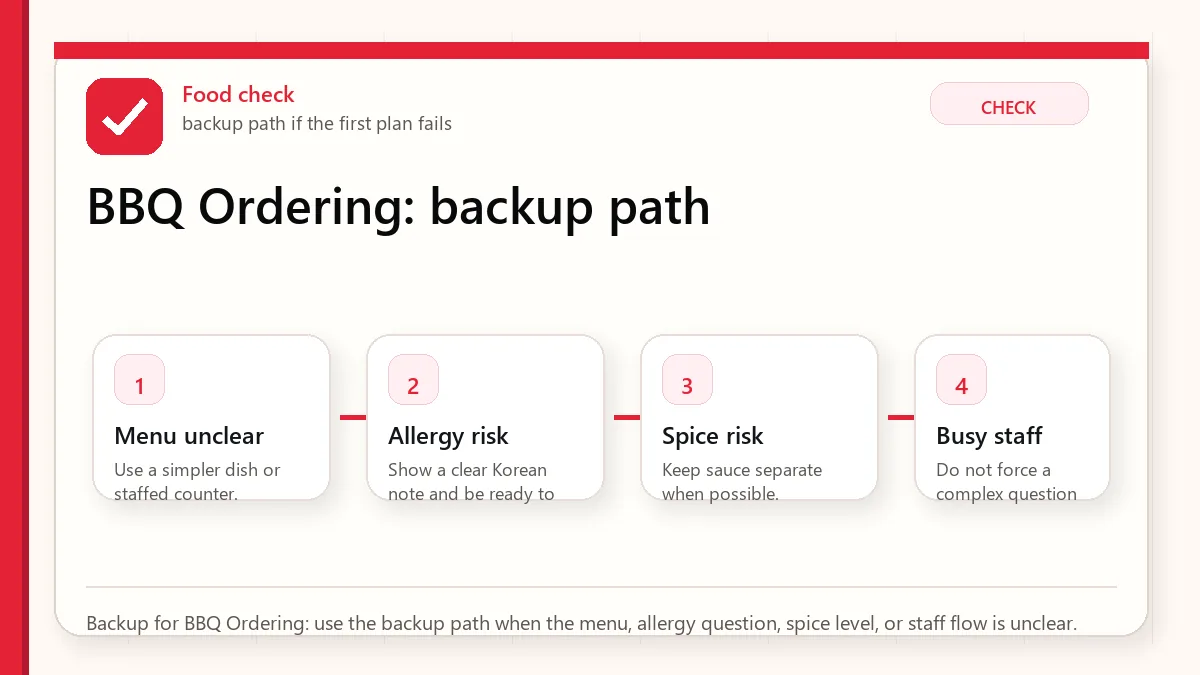
    Backup for BBQ Ordering: use the backup path when the menu, allergy question, spice level, or staff flow is unclear.

    The small check that changes the answer

    The first plan depends on one fragile detail

    If one card, one app login, one translation scan, or one store policy controls the whole plan, add a backup before the trip.

    The information is technically correct but not practical

    A rule can be true and still be hard to use when you are tired, carrying luggage, or standing in a busy line. Plan for the human moment, not only the policy.

    A visitor copies advice from a different travel style

    A resident, Korean speaker, business traveler, or frequent visitor may solve problems differently from a first-time tourist. Use advice that matches your situation.

    What this means in the real moment

    SituationSafer defaultWhy
    Short first tripChoose convenience and fewer moving partsRecovery time is limited
    Budget-conscious tripSeparate must-pay costs from nice-to-have extrasSmall purchases add up quickly
    Higher-risk situationUse official sources and conservative backupsHealth, entry, tax, and payment issues are not good places to gamble

    Sources to re-check

    Use these pages for facts that can change by date, operator, airport, app version, store, or traveler status.

    Where to go next

    FAQ

    Can I rely on one answer for every visitor?

    No. Korea travel details can depend on nationality, app version, store, airport, phone setup, card issuer, and date.

    Should I solve this after arriving?

    Try not to. Anything involving entry, phone data, maps, payment, allergies, or airport transfer is easier to prepare before the first pressure moment.

    What is the safest habit?

    Keep the official source, the practical guide, and a simple backup together. That combination is more useful than memorizing many tips.

  • Before You Eat Korean Food

    Before You Eat Korean Food

    Start with the moment you order

    Eating in Korea is easier when you understand the systems around the food: ordering flow, shared dishes, self-service water, side dishes, payment timing, and allergy limits. Before you choose a restaurant, decide whether the risk is language, ingredients, spice level, queue pressure, or not knowing how the meal is served.

    Last checked: June 1, 2026. Re-check the latest product label, restaurant information, and official/public database before acting, because routes, prices, labels, rules, app screens, eligibility, and store/service policies can change.

    Last updated: May 23, 2026. Rules, app flows, prices, and eligibility can change, so re-check official sources close to your trip.

    Layered red check decision graphic for You Eat Food.
    For You Eat Food: check ordering flow, ingredients, portion, and payment before choosing the meal.

    How to use this hub guide

    This hub is for visitors who want to enjoy Korean food with fewer awkward moments and safer choices. It links the BBQ, ordering, allergy, kiosk, cafe, convenience store, and street-food guides.

    It does not rank restaurants or pretend to have visited specific places. The point is to help you recognize the pattern when you are standing in front of a menu, machine, grill, or busy counter.

    The checks that decide the safer food choice

    If you are decidingCheck this firstWatch out for
    First restaurant mealHow to Order Food in Korea and kiosk basicsAssuming every place has English service
    Korean BBQPortions, cuts, grill flow, side dishes, and staff helpOrdering too much or misunderstanding shared-table rhythm
    Food allergiesWritten Korean allergy notes, simpler dishes, and backup mealsCross-contact and hidden broths/sauces are real risks
    Late-night or budget mealConvenience-store meals, cafes, or simple restaurantsChoosing only by viral food lists

    The small check that changes the answer

    • Prepare allergy phrases in Korean if allergy risk is serious.
    • Learn whether you order at table, counter, kiosk, or QR code before sitting down.
    • Expect some side dishes to be shared and some water/utensils to be self-service.
    • Ask about spice before sauce is mixed in when possible.
    • Keep one low-risk backup meal idea for tired or sensitive days.

    An ordering path that keeps the meal manageable

    Read the ordering system first

    Look for kiosk, counter, table bell, QR code, or staff seating. The system matters more than memorizing perfect Korean phrases.

    Separate curiosity from safety

    Trying new food is part of travel, but allergies, spice tolerance, and dietary restrictions need a more cautious plan.

    Use photos and translation as support

    Menu photos, Papago/Google Translate, and saved dish names can help, but they do not guarantee allergen accuracy.

    Let the meal move at local pace

    Many casual restaurants expect efficient dining. If you want to linger, a cafe after the meal may feel more natural.

    Layered red check backup flow graphic for You Eat Food.
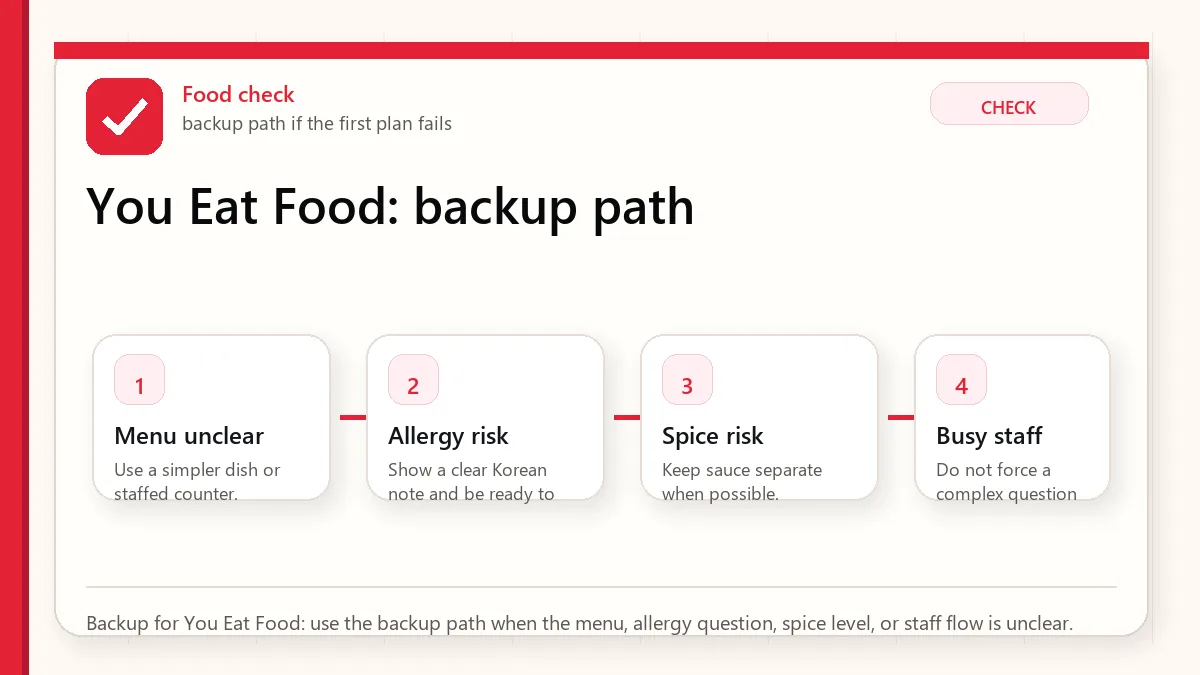
    Backup for You Eat Food: use the backup path when the menu, allergy question, spice level, or staff flow is unclear.

    What this means in the real moment

    The kiosk has no English

    Use camera translation, match dish photos, or choose a staffed counter if the order has dietary risk.

    The food is too spicy

    Stop adding sauce, ask for plain rice or water, and choose milder dishes next time rather than trying to prove tolerance.

    You are unsure about allergens

    Do not rely on guessing. Use a written allergy card and choose simpler food or a different restaurant if staff cannot confirm.

    A safer way to make the decision

    SituationSafer defaultWhy
    First-time touristStart with ordering flow and BBQ basicsThe mechanics are often more confusing than the dish names
    Sensitive eaterRead allergy and spice guides before restaurant listsHidden sauces and broths matter
    Budget travelerUse convenience stores and simple restaurants carefullyCheap meals can still be satisfying with the right expectations

    Sources to re-check

    Use these pages for facts that can change by date, operator, airport, app version, store, or traveler status.

    Where to go next

    FAQ

    Do Korean restaurants expect tipping?

    Tipping is generally not customary in Korea. Check the bill and local context rather than importing tipping habits from home.

    Are allergies easy to communicate?

    They can be difficult. Use Korean written notes, simple dishes, and avoid high-risk restaurants when the consequence would be serious.

    Is Korean BBQ hard for first timers?

    Not if you understand portions, shared side dishes, and whether staff or guests handle the grill.

  • Korean Street Food Guide

    Korean Street Food Guide

    Start with the moment you order

    Try Korean street food in small portions first, bring small cash, watch how locals order, check spice and allergens, and choose stalls that look busy, clean, and organized. Street food is fun, but it is still food handling in a fast-moving environment.

    Last checked: June 1, 2026. Re-check the latest product label, restaurant information, and official/public database before acting, because routes, prices, labels, rules, app screens, eligibility, and store/service policies can change.

    Street food is best when you keep the first order small

    The pleasure of Korean street food is the quick, informal try. The risk is treating a crowded stall like a slow restaurant: too many questions, too much food, no cash, unclear spice, or allergy uncertainty. A small first order keeps the experience fun and reversible.

    Layered red check decision graphic for Street Food.
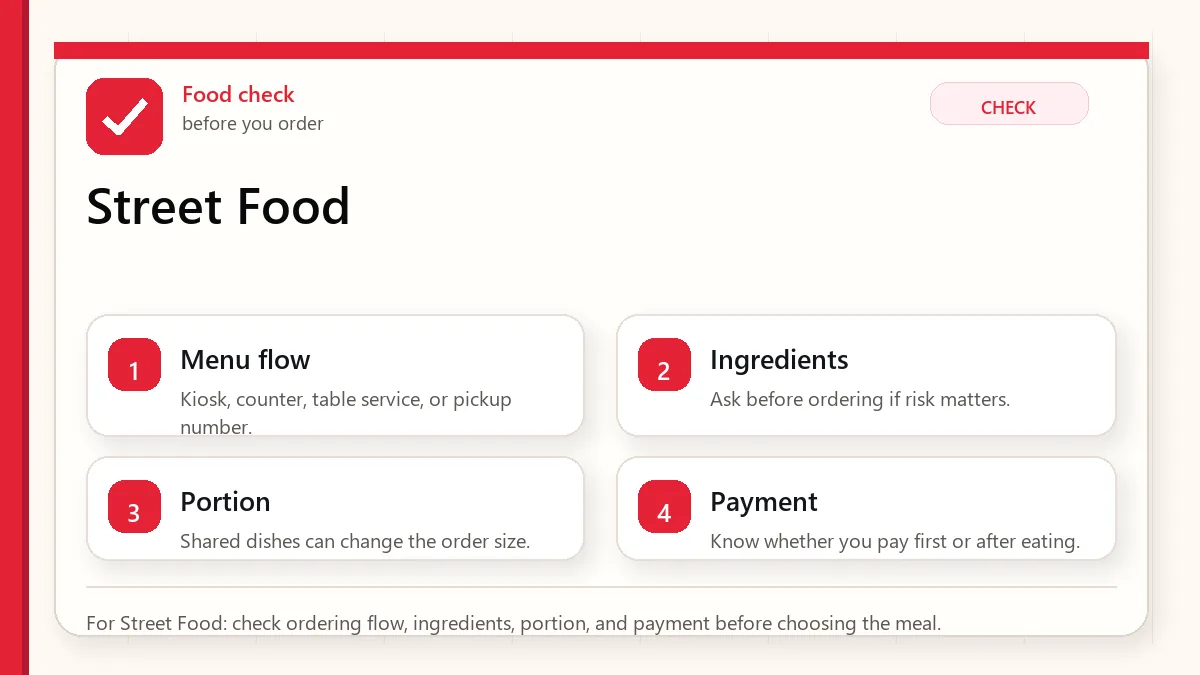
    For Street Food: check ordering flow, ingredients, portion, and payment before choosing the meal.

    Common street food and what to check

    FoodWhy visitors try itCheck first
    TteokbokkiIconic spicy rice cakes.Spice level and sauce intensity.
    Eomuk/fish cakeWarm, quick snack.Seafood base and broth.
    HotteokSweet filled pancake.Heat, nuts, and oil.
    GimbapPortable rice roll.Filling, freshness, and storage.
    Fried snacksEasy sharing food.Oil freshness and sauce.

    Checks before stepping up to the stall

    • Carry small cash in case card is not accepted.
    • Use translation for allergies and dietary limits.
    • Start with one or two items, not a full table of food.
    • Watch ordering flow before stepping forward.
    • Avoid stalls if food handling or storage makes you uncomfortable.

    Order without blocking the stall flow

    • Choose a stall with steady turnover and clean handling.
    • Point or order simply.
    • Confirm quantity before payment.
    • Eat hot foods carefully; fillings and broth can burn.
    • Dispose of skewers, cups, and trash where the stall or area provides.
    • Move aside after ordering so others can buy.
    Layered red check backup flow graphic for Street Food.
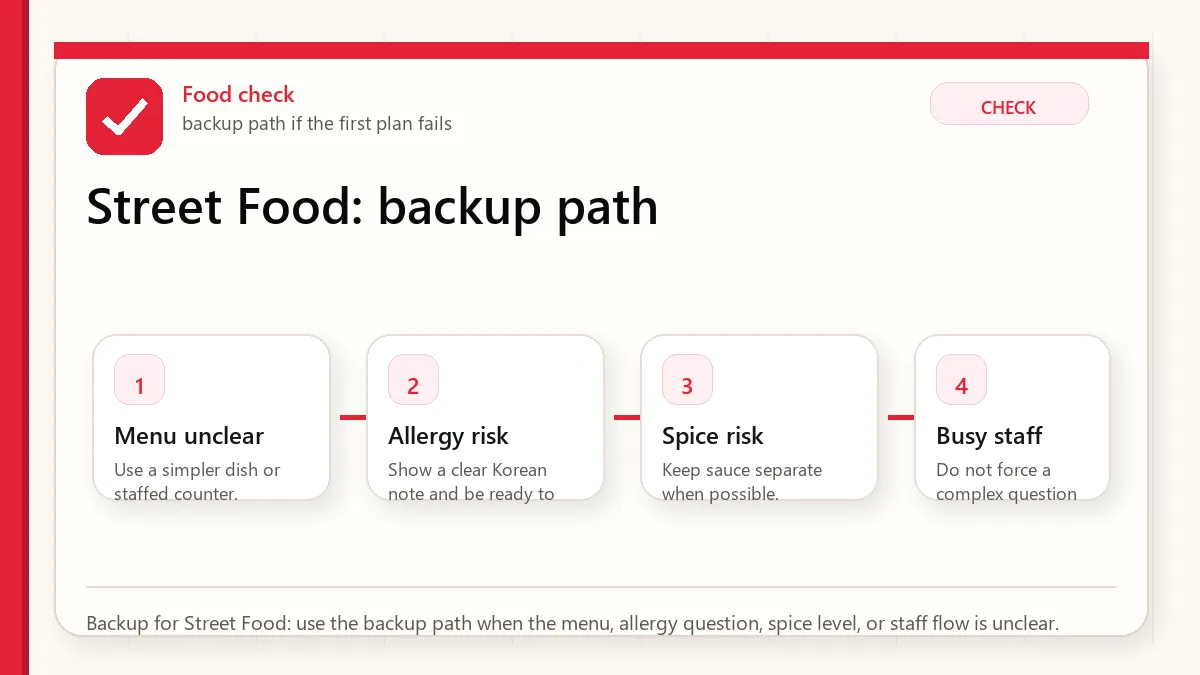
    Backup for Street Food: use the backup path when the menu, allergy question, spice level, or staff flow is unclear.

    Where street food plans usually go wrong

    You order too much

    Street food is best sampled. Share or buy in small rounds.

    It is spicier than expected

    Stop early, drink water, and choose a mild next item.

    You have a serious allergy

    If the stall cannot confirm ingredients, skip it. Shared oil and utensils can be a risk.

    No trash bin is visible

    Keep packaging until you find proper disposal rather than leaving it nearby.

    Choose the stall based on your risk level

    SituationBetter approachWhat to verify
    First-time visitorTry mild and popular items first.Spice and payment.
    Food market visitShare multiple small dishes.Crowds and hygiene.
    Winter tripWarm snacks and broth can be appealing.Heat and seafood ingredients.
    Dietary restrictionsUse dedicated restaurants when possible.Hidden broth and shared utensils.

    What not to assume from a busy line

    • Do not assume every street food stall accepts cards.
    • Do not assume seafood-free unless confirmed.
    • Do not assume mild-looking food is not spicy.
    • Do not assume trash disposal is obvious in every area.

    Small stall details that make street food easier to enjoy

    Street food is easiest when you keep the order simple

    Busy stalls are not the best place for a long custom order. Pointing, using the item name, asking price first, and stepping aside after paying usually works better than trying to redesign the dish. If you need allergy or dietary confirmation, a restaurant with staff time and clearer ingredients may be safer than a crowded stall.

    Use the crowd as one signal, not the only signal

    A line can suggest popularity, but visitors should still notice food handling, turnover, posted prices, and whether the stall looks set up for quick service. If the item is unfamiliar, start with a small portion and avoid buying multiple spicy or oily foods at once. Street food is best treated as a snack path, not as a full plan when you have strict food limits.

    Read next when street food connects to spice, cash, or ordering

    This topic works best when it is not handled alone. Use the related guides below to connect the decision with maps, money, food, shopping, transit, and app backup planning.

    Related Before Korea guides

    FAQ

    Is Korean street food safe?

    Many visitors enjoy it, but use basic judgment: turnover, cleanliness, heat, storage, and your own dietary risks.

    Do street food stalls take cards?

    Some may, but small cash is a safer backup.

    What should spice-sensitive visitors try first?

    Start with non-red, sweet, or grilled items and ask before ordering red-sauce dishes.

    Source links to verify

    Last updated

    Last updated: 2026-05-23. Re-check official sources close to the day you travel, buy, eat, or use an app. Details involving prices, eligibility, transport, app features, opening hours, and refund rules can change.

  • Korean Convenience Store Food Guide

    Korean Convenience Store Food Guide

    Start with the moment you order

    Korean convenience stores are useful for quick meals, snacks, drinks, transit top-ups, and late-night basics. For food, the key is reading labels, understanding heating or self-service steps, checking allergens, and not assuming every store has seating or English help.

    Search intent check: korean convenience store food

    Searchers arriving for korean convenience store food usually want a fast official-source path, not a broad background article. The page should make the next check obvious in the first screen.

    • Traveler Decision: make this visible near the top of the page.
    • App Or Official Source: make this visible near the top of the page.
    • Backup Plan Before Arrival: make this visible near the top of the page.

    Operating note: this section was added after global Keyword Planner review so the page better matches the main query cluster.

    Last checked: June 1, 2026. Re-check the latest product label, restaurant information, and official/public database before acting, because routes, prices, labels, rules, app screens, eligibility, and store/service policies can change.

    The store is easy, but the small rules still matter

    Korean convenience stores are useful because they are fast, bright, and everywhere. The reader problem is not finding food. It is knowing how to heat it, where to eat it, how to read enough of the label, and how to avoid making a mess of the store flow.

    Layered red check decision graphic for Convenience store food.
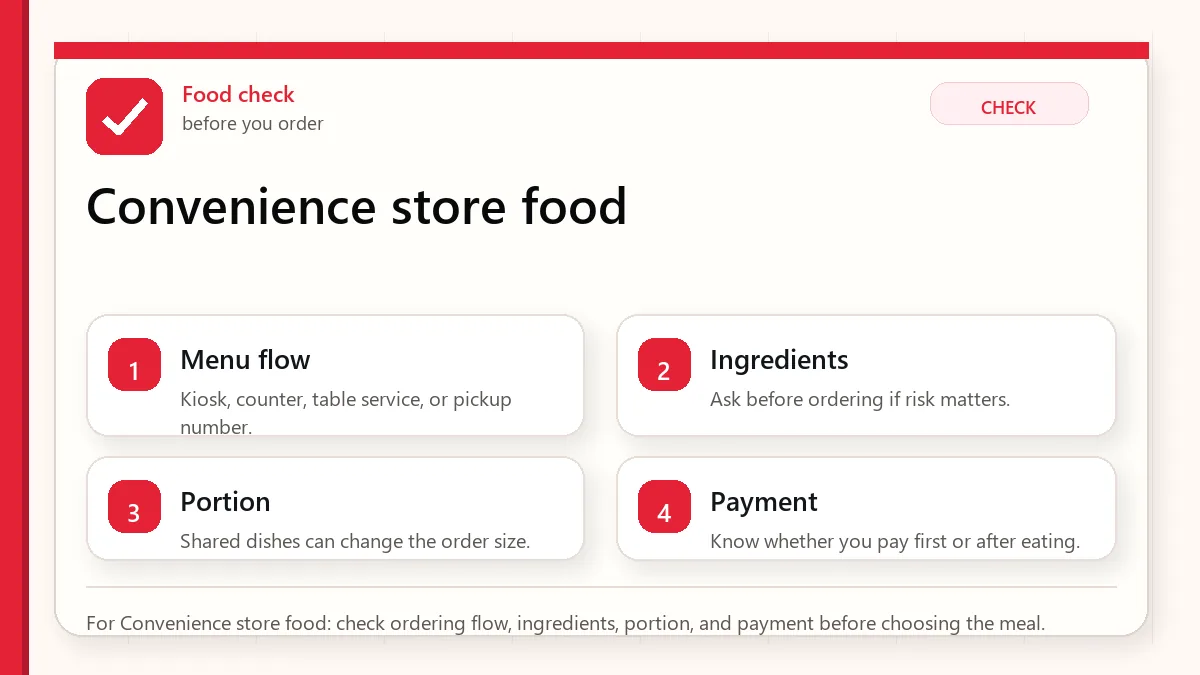
    For Convenience store food: check ordering flow, ingredients, portion, and payment before choosing the meal.

    Convenience store food types

    Food typeWhy it is usefulCheck
    Cup ramyeonEasy, cheap, and iconic.Spice level, hot water station, eating area.
    Dosirak lunch boxMore complete quick meal.Heating instructions and ingredients.
    Gimbap or triangle ricePortable meal or snack.Filling, expiry time, and refrigeration.
    Drinks and coffeeQuick caffeine and hydration.Sugar, dairy, and size.
    Desserts/snacksGood souvenirs and easy gifts.Allergens, fragility, and customs at home.

    Checks before heating or eating

    • Use translation for labels if you have allergies or dietary restrictions.
    • Check expiry date and whether the item needs heating.
    • Look for seating before opening hot food.
    • Carry a payment backup.
    • Avoid assuming every product is mild because the package looks cute.

    Use the store without disrupting the flow

    • Choose item and check whether it is refrigerated, frozen, or shelf-stable.
    • Read heating instructions or ask staff if unsure.
    • Use hot water and microwave areas carefully and cleanly.
    • Eat only where seating or store rules allow.
    • Dispose of packaging in the right bins if provided.
    • Save names of products you liked for later shopping.
    Layered red check backup flow graphic for Convenience store food.
    Backup for Convenience store food: use the backup path when the menu, allergy question, spice level, or staff flow is unclear.

    Where convenience-store food gets confusing

    You bought the wrong spicy item

    Start with smaller portions and use translation for flavor names.

    You do not know how to heat it

    Look for microwave time icons or ask staff with the package in hand.

    No seating is available

    Do not open messy food until you know where you can eat it.

    Allergen risk is unclear

    Choose safer packaged items with readable labels or skip it.

    Choose food based on how much certainty you need

    SituationBetter approachWhat to verify
    Late-night arrivalUse convenience store for simple food and water.Payment and hotel eating rules.
    Budget mealChoose dosirak or gimbap with drink.Heating and expiry.
    Food souvenirChoose sealed snacks.Customs rules and fragility.
    Spice-sensitiveAvoid famous spicy products first.Flavor and chili warnings.

    What not to assume from packaging or photos

    • Do not assume every convenience store has seats.
    • Do not assume staff can explain ingredients in English.
    • Do not assume all ramyeon is equally spicy.
    • Do not assume public trash disposal is the same as your home country.

    Small store details that make the experience cleaner

    Convenience stores work best when you understand the self-service flow

    Many stores are designed for fast decisions. Choose the item, pay, use the microwave or hot-water area if available, eat only where seating is allowed, and clean up without leaving packaging behind. If you are not sure whether an item should be heated before or after paying, watch another customer or ask with a simple phrase.

    Labels are helpful but not complete for every visitor need

    Package labels can help with calories, allergens, expiry dates, and cooking instructions, but translated text can be incomplete or awkward. If you have a strict allergy, religious food rule, or medical restriction, convenience-store food should be approached carefully. Choose simpler packaged items where ingredients are easier to confirm, and use a translation app as a support tool rather than a guarantee.

    Read next when convenience food connects to translation or payment

    This topic works best when it is not handled alone. Use the related guides below to connect the decision with maps, money, food, shopping, transit, and app backup planning.

    Related Before Korea guides

    FAQ

    Can I eat inside Korean convenience stores?

    Some stores have seating, some do not. Check before opening food that needs a table.

    Are labels available in English?

    Not always. Use translation and avoid risky foods if allergies are serious.

    Can convenience stores top up transit cards?

    Many convenience stores can help with transport cards, but details vary by card and store.

    Source links to verify

    Last updated

    Last updated: 2026-05-23. Re-check official sources close to the day you travel, buy, eat, or use an app. Details involving prices, eligibility, transport, app features, opening hours, and refund rules can change.

  • Korean Spicy Food Levels

    Korean Spicy Food Levels

    Start with the moment you order

    Korean spicy food is not one fixed level. Spice depends on dish, sauce, restaurant, broth, and whether chili paste, chili powder, or fresh peppers are used. If you are sensitive, choose known mild dishes, ask about spice before payment, and avoid assuming red color is the only clue.

    Last checked: June 1, 2026. Re-check the latest product label, restaurant information, and official/public database before acting, because routes, prices, labels, rules, app screens, eligibility, and store/service policies can change.

    The problem is not spice itself, but surprise spice

    Spicy Korean food can be part of the fun, but it is better when you choose the level instead of discovering it too late. This guide is for reading menu clues, controlling sauce, and keeping one mild option available so the meal stays enjoyable.

    Layered red check decision graphic for Spice level check.
    For Spice level check: check ordering flow, ingredients, portion, and payment before choosing the meal.

    Spice risk by dish type

    Dish or categorySpice riskSafer move
    TteokbokkiOften spicy-sweet and sauce-heavy.Ask for mild if available or share a small portion.
    Kimchi dishesCan be mild to hot depending on stew, fried rice, or side dish.Ask whether the dish is spicy, not just whether it includes kimchi.
    Fried chicken saucesSauce can change the whole dish.Order sauce separate or choose plain/soy/garlic style.
    Soups and stewsBroth heat can build slowly.Choose clear or non-red broths when unsure.
    Convenience foodsPackage images and names may exaggerate or hide heat.Use translation and start with smaller servings.

    Checks before ordering something red or sauced

    • Know your own spice tolerance honestly.
    • Save a phrase for ‘not spicy’ or ‘mild’.
    • Check whether sauce can be served separately.
    • Keep rice, dairy drink, or mild side dish as backup if available.
    • Do not order the viral spicy item as your first meal after arrival.

    Explore spice without turning the meal into a test

    • Look for red sauces, chili icons, and words related to spicy heat.
    • Ask staff or use translation before ordering.
    • Start with shared portions when trying spicy street food.
    • Avoid stacking spicy soup, spicy side dishes, and spicy main dish in one meal.
    • If a dish is too hot, stop early rather than forcing it.
    • Record safe dishes you liked for later meals.
    Layered red check backup flow graphic for Spice level check.
    Backup for Spice level check: use the backup path when the menu, allergy question, spice level, or staff flow is unclear.

    Where spice surprises visitors

    The first bite seems fine but heat builds

    Slow down. Soups and sauces can build over several minutes.

    You cannot explain spice tolerance

    Use simple words like mild or not spicy, plus translation. Avoid long explanations in a busy line.

    The dish cannot be made mild

    Choose another dish instead of asking for a version the restaurant does not make.

    You bought a very spicy convenience item

    Treat it as a tasting item, not a full meal, and have water or a mild snack ready.

    Choose the right caution for the dish

    SituationBetter approachWhat to verify
    Low spice toleranceStart with non-red dishes and sauce separate.Hidden chili in marinades or side dishes.
    Food adventurerTry spicy items in small portions first.Do not schedule intense food before long transit.
    Group mealOrder one spicy dish and other mild dishes.Shared tolerance differs.
    Sensitive stomachAvoid spice-heavy meals on arrival day.Travel fatigue and dehydration.

    What not to assume about color and heat

    • Do not assume all Korean food is spicy.
    • Do not assume every red dish is equally spicy.
    • Do not assume ‘mild’ means the same thing to every restaurant.
    • Do not assume you can return food because it is too spicy.

    Small choices that make spicy food easier to enjoy

    Color is only a rough clue

    A red dish can be mild, sharp, sweet, smoky, or extremely hot depending on sauce, chili paste, pepper powder, broth, and cooking style. The safest approach is to combine clues: menu wording, staff warning, dish category, sauce amount, and whether the food is served with broth. If you are sensitive to spice, do not gamble on a large shared dish as your first test.

    Build an escape route into the order

    A practical meal plan includes at least one less-spicy item, rice, soup, or side that gives you a break. Ask for sauce on the side where that makes sense, and avoid stacking spicy stew, spicy noodles, and spicy side dishes in the same meal. Visitors often enjoy Korean food more when spice is treated as a choice to explore gradually rather than a challenge to survive.

    Read next when spice connects to BBQ, ordering, or translation

    This topic works best when it is not handled alone. Use the related guides below to connect the decision with maps, money, food, shopping, transit, and app backup planning.

    Related Before Korea guides

    FAQ

    Is Korean food always spicy?

    No. Korea has many mild dishes, soups, noodles, rice dishes, grilled meats, and snacks.

    Can restaurants make spicy food mild?

    Sometimes, but not always. Some sauces and broths are prepared in advance.

    What should I order if I cannot eat spice?

    Look for grilled meats, plain rice dishes, non-red soups, some noodle dishes, or convenience foods with clear labels.

    Source links to verify

    Last updated

    Last updated: 2026-05-23. Re-check official sources close to the day you travel, buy, eat, or use an app. Details involving prices, eligibility, transport, app features, opening hours, and refund rules can change.