Quick answer: if you searched for navermap, use Naver Map as the first map check for local movement inside Korea. It is usually stronger than a general map search for Korean place names, public transit, walking routes, address details, and local navigation.
Source note: This page targets the exact search query navermap. Use it as a practical route guide, then confirm current details inside the official app, agency, provider, airline, registry, or local source before making a decision.
When this search matters
Need
What to do
What can go wrong
Find a restaurant, cafe, clinic, or shop
Search the Korean name or copy it from the official page.
English names may not match the local listing.
Use public transit
Compare subway, bus, walking time, and transfer exits.
A generic map may miss local route details.
Use taxi or driving navigation
Confirm the Korean road-name address or building name.
A nearby branch or similar name can send you to the wrong place.
How to check
Search the place in Naver Map using the Korean name where possible.
Confirm the branch, address, opening hours, and nearest station or exit.
For travel days, compare route time with subway, bus, taxi, or walking options.
Save the Korean address for taxi drivers, hotel staff, or delivery apps.
Quick answer: if you searched for naver maps, use Naver Map as the first map check for local movement inside Korea. It is usually stronger than a general map search for Korean place names, public transit, walking routes, address details, and local navigation.
Source note: This page targets the exact search query naver maps. Use it as a practical route guide, then confirm current details inside the official app, agency, provider, airline, registry, or local source before making a decision.
When this search matters
Need
What to do
What can go wrong
Find a restaurant, cafe, clinic, or shop
Search the Korean name or copy it from the official page.
English names may not match the local listing.
Use public transit
Compare subway, bus, walking time, and transfer exits.
A generic map may miss local route details.
Use taxi or driving navigation
Confirm the Korean road-name address or building name.
A nearby branch or similar name can send you to the wrong place.
How to check
Search the place in Naver Map using the Korean name where possible.
Confirm the branch, address, opening hours, and nearest station or exit.
For travel days, compare route time with subway, bus, taxi, or walking options.
Save the Korean address for taxi drivers, hotel staff, or delivery apps.
Quick answer: if you searched for naver map, use Naver Map as the first map check for local movement inside Korea. It is usually stronger than a general map search for Korean place names, public transit, walking routes, address details, and local navigation.
Source note: This page targets the exact search query naver map. Use it as a practical route guide, then confirm current details inside the official app, agency, provider, airline, registry, or local source before making a decision.
When this search matters
Need
What to do
What can go wrong
Find a restaurant, cafe, clinic, or shop
Search the Korean name or copy it from the official page.
English names may not match the local listing.
Use public transit
Compare subway, bus, walking time, and transfer exits.
A generic map may miss local route details.
Use taxi or driving navigation
Confirm the Korean road-name address or building name.
A nearby branch or similar name can send you to the wrong place.
How to check
Search the place in Naver Map using the Korean name where possible.
Confirm the branch, address, opening hours, and nearest station or exit.
For travel days, compare route time with subway, bus, taxi, or walking options.
Save the Korean address for taxi drivers, hotel staff, or delivery apps.
A Korea airport taxi can be the easiest arrival choice when you have luggage, children, a late flight, or a hotel far from convenient train stops. It can also be the most expensive option if you choose it without checking route, traffic, tolls, and taxi type.
Last checked: June 1, 2026. Re-check the official operator, app, fare, or route page before acting, because routes, prices, labels, rules, app screens, eligibility, and store/service policies can change.
Last updated: May 26, 2026.
This guide helps you decide when airport taxi is worth paying for and how to reduce avoidable confusion at Incheon Airport or Gimpo Airport.
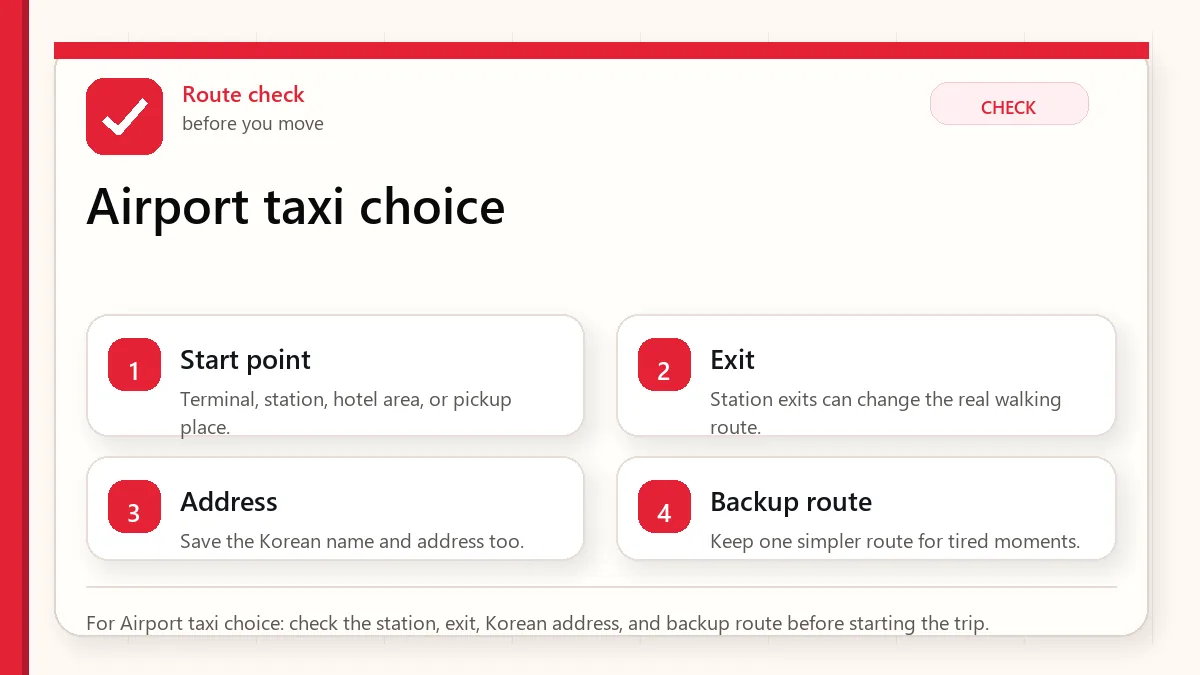
For Airport taxi choice: check the station, exit, Korean address, and backup route before starting the trip.
Start with what can fail at payment
Use an airport taxi when convenience and direct door-to-door travel matter more than cost. Compare AREX and airport bus first unless your flight time, luggage, or hotel location strongly favors taxi.
When this matters
This matters when you want a safer airport taxi plan without depending on random arrivals-hall advice.
Decision table
Situation
Best move
Why it matters
Late-night landing
Taxi may be practical
Trains and buses may be limited.
Heavy luggage or family
Door-to-door helps
Transfers can be harder than the fare difference.
Solo budget trip
Compare AREX or bus
Taxi may cost far more than transit.
Hotel in hard-to-reach area
Taxi can reduce stress
The final transfer may be the problem.
How to make the decision
Use the table as a filter, not as a rule to memorize. The right answer depends on your exact route, phone setup, luggage, arrival time, payment method, and how much uncertainty you can tolerate on that day. For this topic, the first question is: late-night landing. If that sounds like your situation, the safest starting point is to taxi may be practical because trains and buses may be limited..
The second question is whether the choice still works when the trip becomes less ideal: late arrival, rain, low battery, no Korean phone call, a crowded station, a tired group, or a hotel address that is hard to explain. Those imperfect moments are where travelers usually lose time.
Step-by-step setup
Before arrival, compare airport taxi, AREX, and airport bus for your exact hotel address.
Use official taxi stands, hotel-arranged transfer, or known app flows rather than informal offers.
Save destination in Korean and confirm terminal and hotel area.
Ask about tolls, late-night surcharge, and larger taxi needs if relevant.
Keep payment backup and receipt after the ride.
Before you rely on it
Do one small test before the situation becomes urgent. Search the destination, open the app, check the route, confirm the address, read the current official page, or ask the hotel desk while you still have time. A five-minute test at the hotel is easier than troubleshooting in a taxi line, subway transfer, airport terminal, or restaurant doorway.
Also separate what is convenient from what is required. A tool can be convenient without being essential. A card can be useful without replacing every payment method. A phone number can help without solving real-name verification. A train can be fast without being the easiest route with luggage. That distinction is the main habit that prevents bad decisions.
Where travelers get stuck
Accepting unclear offers instead of using official pickup channels.
Not confirming whether the vehicle fits luggage and passengers.
Ignoring tolls or late-night surcharge.
Using taxi when a direct airport train would be faster during traffic.
Not saving the hotel phone number for destination clarification.
Realistic travel scenario
If you land at 10 p.m. with two large bags and a hotel in Gangnam, a taxi may be worth it. If you land at 2 p.m. and stay near Seoul Station or Hongdae, the airport train may be simpler and cheaper.
Backup plan if the first choice fails
Have one fallback that does not depend on the same weak point. If the app fails, use a saved Korean address, hotel desk, official counter, taxi stand, convenience store, or simpler route. If payment fails, switch to another card or cash. If translation fails, use shorter sentences and confirm with a person. If timing fails, choose the option that protects the flight, hotel check-in, medicine, or safety issue first.
Most likely failure: Accepting unclear offers instead of using official pickup channels.
Fastest prevention step: Before arrival, compare airport taxi, AREX, and airport bus for your exact hotel address.
Most useful saved item: Hotel address and phone number
Best mindset: solve the next practical step instead of trying to force the perfect plan.
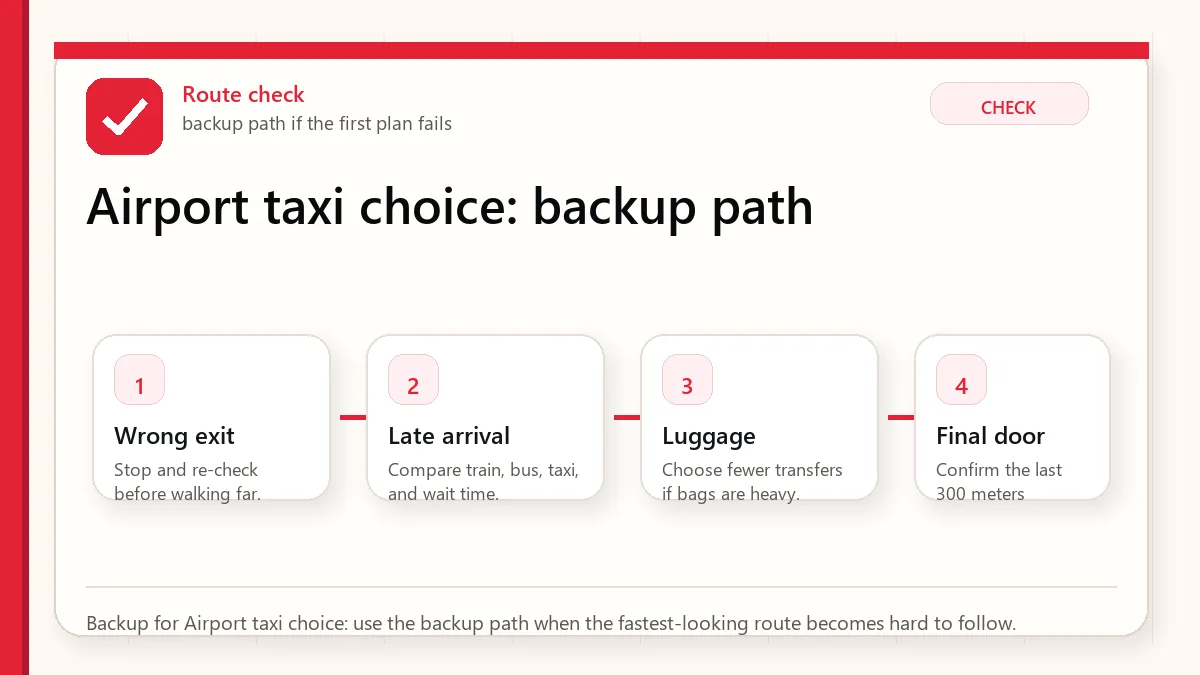
Backup for Airport taxi choice: use the backup path when the fastest-looking route becomes hard to follow.
What to save before you need it
Hotel address and phone number
Official taxi stand or app pickup info
Route estimate
Flight arrival time
Airport train or bus backup
FAQ
Are airport taxis safe in Korea?
Use official taxi stands, reputable app flows, or hotel-arranged transfers. Avoid unclear approaches and confirm destination before riding.
Is airport taxi faster than AREX?
Not always. Traffic can make taxi slower, while AREX can be predictable for certain hotel areas.
Can I pay by card?
Often yes, but keep a backup card and some cash because payment problems can still happen.
Use these official links when the next step matters. This guide explains what to watch for, but app downloads, eligibility, prices, routes, policies, and service rules can change.
App screens, entry rules, fares, and official procedures can change. Use the links below to re-check details before you rely on one route, app, card, or declaration step.
The Korea airport bus is often the most comfortable choice for visitors with luggage, especially when the stop is near the hotel. But it is not automatically better than the airport train or taxi. The route must fit your exact area.
In short: an Incheon airport bus is often easier than a train when your hotel is near a limousine bus stop, you have large bags, or you arrive late. Check the route number, terminal, first/last bus time, and walking distance from the final stop before you choose it.
When the Incheon airport bus is the better choice
Choose the airport bus when it stops near your hotel or neighborhood and saves a subway transfer with luggage. Choose AREX or subway when your destination is close to Seoul Station, Hongdae, or another station with a simple transfer. If you are arriving after a long flight, the easier route is usually the one with fewer stairs, fewer transfers, and a clear final stop.
For airport buses, choose by stop location first. A limousine bus is comfortable with luggage only if the route stops near your actual hotel or district. Check the route number, terminal, first/last bus, and walking distance before you leave the arrivals hall.
Check the exact airport bus route before you land
If your search is specifically airport limousine Korea, use Airport Limousine Korea for the route-number, terminal, stop, first-bus, last-bus, and fare checks before comparing the bus with AREX or taxi.
When the airport bus is better than AREX
Airport limousine bus Seoul is usually the better search intent when your hotel is close to a bus stop, you have heavy luggage, or you want fewer transfers after a long flight. The train is often faster to Seoul Station, but the bus can be simpler if it stops near your hotel district.
Check the exact hotel or neighborhood stop name.
Confirm the first and last bus for your arrival time.
Compare total walking distance, not only ride time.
Keep a train or taxi backup if landing late.
What to check before choosing a bus
If you searched “airport limousine bus Seoul” or “korea airport limousine bus,” first confirm the bus stop name, route number, first/last bus time, and whether your hotel is closer to a bus stop or a subway/AREX route. Airport buses can be easier with luggage, but they are only convenient if the stop is close enough to your hotel.
Search your hotel name plus “airport limousine bus” and confirm the route number.
Check the stop location on Naver Map before you arrive.
Compare bus travel time with AREX and taxi for your arrival hour.
Save a screenshot of the stop name in English and Korean.
Last checked: June 1, 2026. Re-check the official operator, app, fare, or route page before acting, because routes, prices, labels, rules, app screens, eligibility, and store/service policies can change.
Last updated: May 26, 2026.
Airport limousine buses can reduce transfers, stairs, and long station walks. They can also be slower in traffic or confusing if you choose the wrong stop.
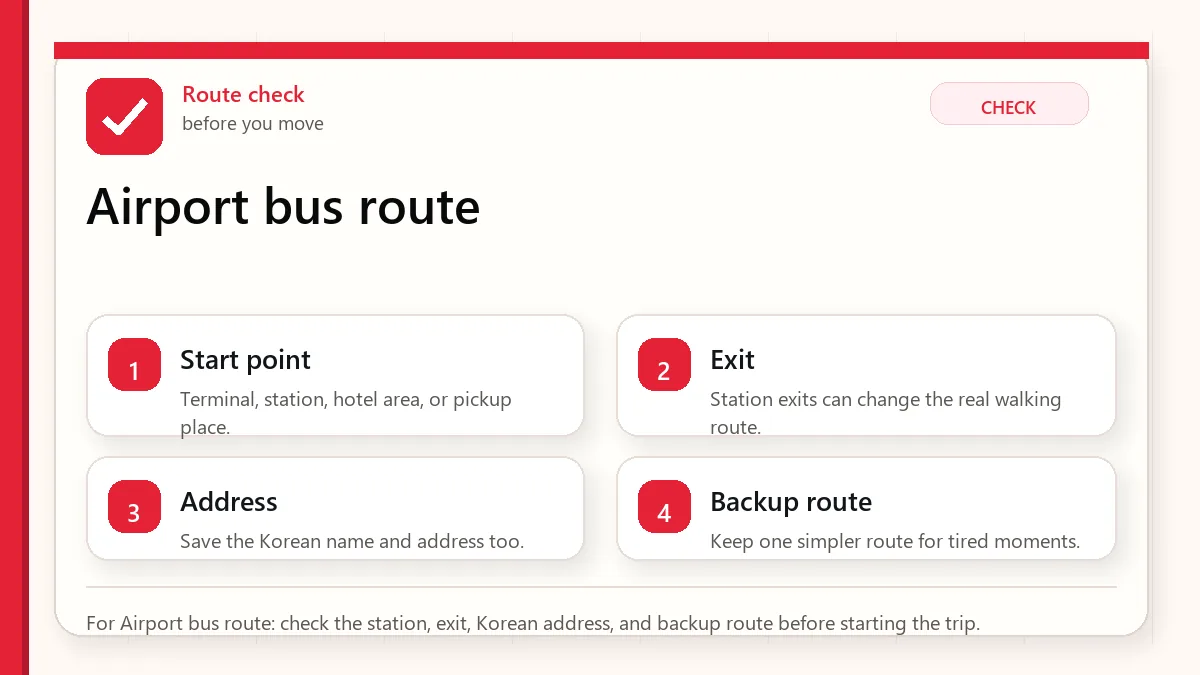
For Airport bus route: check the station, exit, Korean address, and backup route before starting the trip.
Start with your first transfer after landing
Choose an airport bus when it stops close to your hotel area and you value luggage comfort over speed. Choose train or taxi when timing, traffic, or final walking distance makes the bus weaker.
When this choice matters most
This matters when you are comparing airport bus, AREX, subway, and taxi after landing at Incheon Airport.
Bus, train, or taxi: which one fits
Situation
Best move
Why it matters
Hotel near bus stop
Airport bus is strong
Less walking with luggage.
Rush hour arrival
Compare train time
Traffic can make buses slower.
Late-night arrival
Check schedule first
Not every bus route fits late flights.
Unclear hotel area
Map the stop before buying
A far bus stop can erase the advantage.
How to choose without guessing
Use the table as a filter, not as a rule to memorize. The right answer depends on your exact route, phone setup, luggage, arrival time, payment method, and how much uncertainty you can tolerate on that day. For this topic, the first question is: hotel near bus stop. If that sounds like your situation, the safest starting point is to airport bus is strong because less walking with luggage..
The second question is whether the choice still works when the trip becomes less ideal: late arrival, rain, low battery, no Korean phone call, a crowded station, a tired group, or a hotel address that is hard to explain. Those imperfect moments are where travelers usually lose time.
Before you leave the arrivals hall
Find your hotel area and the closest airport bus stop before landing.
Compare walking distance from bus stop and subway station.
Check operating hours and frequency for your arrival time.
Confirm ticket purchase method at the airport terminal.
Save the stop name and hotel address in Korean.
Before you rely on it
Do one small test before the situation becomes urgent. Search the destination, open the app, check the route, confirm the address, read the current official page, or ask the hotel desk while you still have time. A five-minute test at the hotel is easier than troubleshooting in a taxi line, subway transfer, airport terminal, or restaurant doorway.
Also separate what is convenient from what is required. A tool can be convenient without being essential. A card can be useful without replacing every payment method. A phone number can help without solving real-name verification. A train can be fast without being the easiest route with luggage. That distinction is the main habit that prevents bad decisions.
Where travelers get stuck
Choosing a bus because it goes to the district, not the actual hotel area.
Ignoring traffic when arrival time overlaps commute hours.
Getting off at a similarly named stop.
Not checking the last bus after immigration and baggage delay.
Assuming the return-to-airport stop is exactly the same as the arrival stop.
Realistic travel scenario
For Myeongdong, an airport bus may be easier if the stop is close to your hotel. For Hongdae, airport railroad can be very competitive. For Gangnam, bus comfort may beat a multi-transfer train route depending on traffic and exact address.
Backup plan if the first choice fails
Have one fallback that does not depend on the same weak point. If the app fails, use a saved Korean address, hotel desk, official counter, taxi stand, convenience store, or simpler route. If payment fails, switch to another card or cash. If translation fails, use shorter sentences and confirm with a person. If timing fails, choose the option that protects the flight, hotel check-in, medicine, or safety issue first.
Most likely failure: Choosing a bus because it goes to the district, not the actual hotel area.
Fastest prevention step: Find your hotel area and the closest airport bus stop before landing.
Most useful saved item: Hotel address
Best mindset: solve the next practical step instead of trying to force the perfect plan.
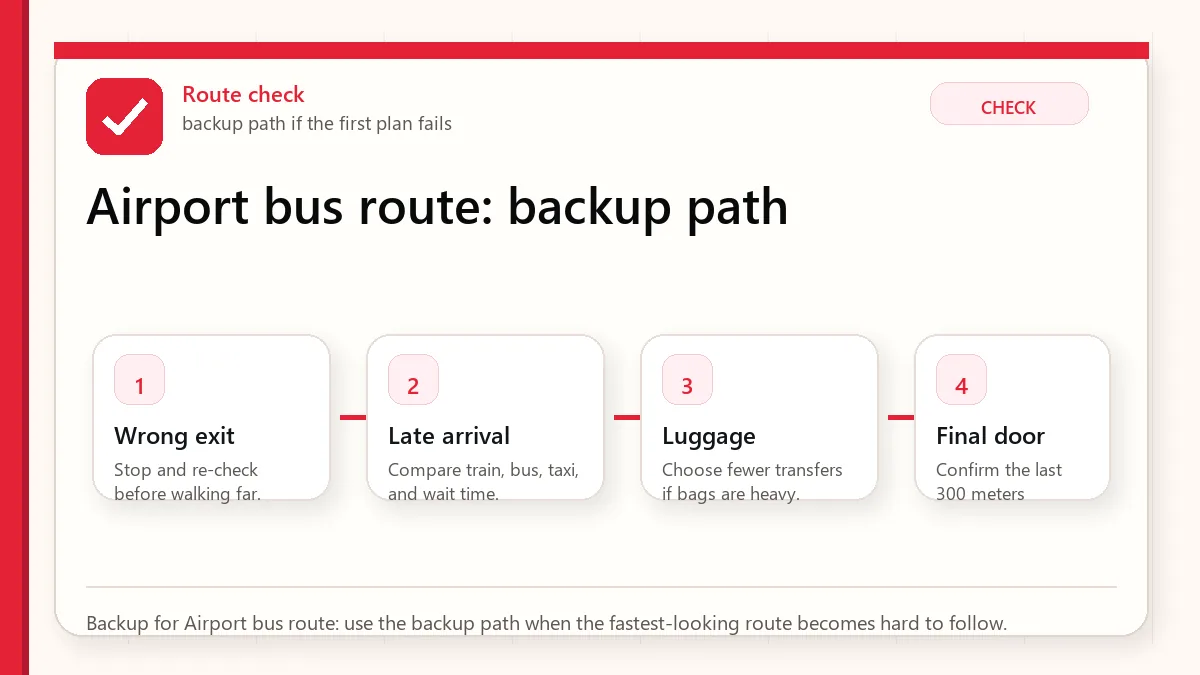
Backup for Airport bus route: use the backup path when the fastest-looking route becomes hard to follow.
What to save before you need it
Hotel address
Airport bus route number
Closest stop name
Last bus time
Backup AREX or taxi route
Airport limousine and airport bus searches
Queries like airport limousine Korea, Incheon airport bus, and bus Incheon airport usually mean the traveler is comparing comfort, luggage handling, and hotel-area access. Airport buses can be easier than trains when your hotel is near a stop, but routes and boarding points should be checked close to travel day.
Before choosing the bus, confirm the stop name, direction, operating hours, luggage rules, and whether your destination is closer to the bus stop or a subway station.
FAQ
Is airport bus better than AREX?
It depends on hotel location, luggage, traffic, and arrival time. Bus is often comfortable, train can be more predictable.
Can I bring luggage on airport buses?
Airport buses are designed for airport luggage, but size, crowding, and handling details still matter.
Should I buy the bus ticket before landing?
First-time visitors should confirm route, stop, and schedule before committing.
Use these official links when the next step matters. This guide explains what to watch for, but app downloads, eligibility, prices, routes, policies, and service rules can change.
App screens, entry rules, fares, and official procedures can change. Use the links below to re-check details before you rely on one route, app, card, or declaration step.
Korea luggage delivery is one of those services tourists discover after they already dragged a suitcase through subway stairs. It can be useful, but it is not magic. You need the right pickup point, delivery address, time window, baggage size, and backup plan.
In short: unaccompanied luggage to South Korea means your bag travels separately from you, so the service may involve customs, identity checks, storage rules, delivery windows, and restrictions on what can be shipped. Do not treat it like ordinary hotel luggage storage.
Before sending unaccompanied luggage to South Korea
Check whether the service is airport-to-hotel delivery, hotel-to-airport delivery, storage, or international shipping. Confirm who receives the bag, what ID is required, whether batteries/liquids/food are restricted, and what happens if your flight or hotel check-in time changes.
Do not mix up three different luggage problems: short-term storage, same-day delivery, and unaccompanied customs shipment. They use different counters, rules, cutoffs, and paperwork. Decide which one you need before handing off a bag.
Do not confuse luggage delivery with customs shipment
If your bags or household items arrive separately from you, use Unaccompanied Luggage to South Korea. That check is about customs, carrier paperwork, tracking, and declaration risk, not ordinary same-flight checked baggage.
Last checked: June 1, 2026. Re-check the official app, service, or app-store page before acting, because routes, prices, labels, rules, app screens, eligibility, and store/service policies can change.
Last updated: May 26, 2026.
This guide explains when luggage delivery or storage in Korea makes sense, when it is risky, and what details to confirm before you hand over a bag.
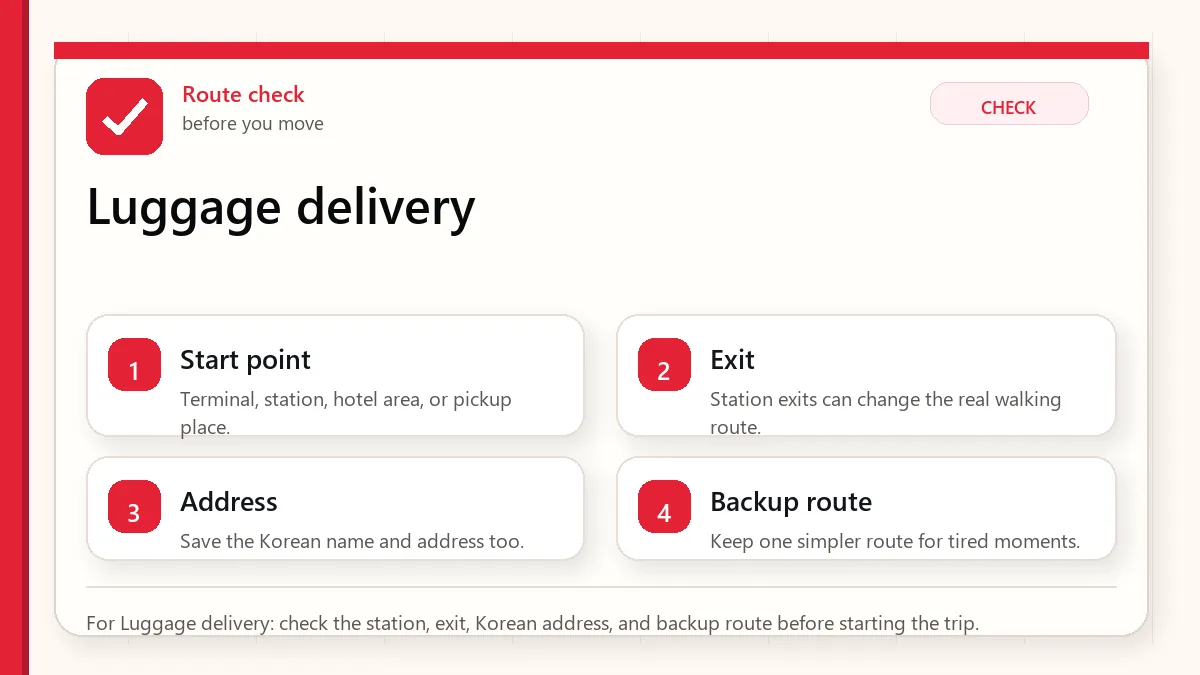
For Luggage delivery: check the station, exit, Korean address, and backup route before starting the trip.
Start with the first bag handoff
Use luggage delivery when it saves a real transfer problem, but confirm cutoff time, delivery address, bag size, storage rules, and what happens if your flight, hotel, or pickup time changes.
When luggage delivery actually helps
This matters when you are moving between airport, hotel, station, concert venue, clinic, shopping area, or another city while trying to keep the day light.
Storage, delivery, or customs shipment: which one fits
Situation
Best move
Why it matters
Early arrival before check-in
Consider hotel storage or delivery
Dragging luggage kills the first day.
Station-heavy itinerary
Use lockers or delivery only if route fits
Not every station locker fits large bags.
Same-day flight
Be conservative
A delayed bag can become a flight problem.
Changing hotels
Confirm both ends
Pickup and delivery rules matter equally.
How to choose the right luggage option
Use the table as a filter, not as a rule to memorize. The right answer depends on your exact route, phone setup, luggage, arrival time, payment method, and how much uncertainty you can tolerate on that day. For this topic, the first question is: early arrival before check-in. If that sounds like your situation, the safest starting point is to consider hotel storage or delivery because dragging luggage kills the first day..
The second question is whether the choice still works when the trip becomes less ideal: late arrival, rain, low battery, no Korean phone call, a crowded station, a tired group, or a hotel address that is hard to explain. Those imperfect moments are where travelers usually lose time.
Before you hand off your bag
Confirm the bag size, weight, number of bags, and whether fragile items are accepted.
Check pickup deadline and expected delivery time before paying.
Write the destination address in Korean and include hotel name and phone number.
Remove passport, medicine, chargers, valuables, cash, and anything needed before delivery.
Keep receipt, tracking page, and service counter photo if available.
Before you rely on it
Do one small test before the situation becomes urgent. Search the destination, open the app, check the route, confirm the address, read the current official page, or ask the hotel desk while you still have time. A five-minute test at the hotel is easier than troubleshooting in a taxi line, subway transfer, airport terminal, or restaurant doorway.
Also separate what is convenient from what is required. A tool can be convenient without being essential. A card can be useful without replacing every payment method. A phone number can help without solving real-name verification. A train can be fast without being the easiest route with luggage. That distinction is the main habit that prevents bad decisions.
Where travelers get stuck
Using delivery on a same-day international flight without enough buffer.
Leaving passport, medication, laptop, or a power bank inside the checked bag.
Assuming every hotel accepts luggage delivery automatically.
Not checking station locker size before arriving with a large suitcase.
Buying too much while relying on a delivery service you have not confirmed.
Realistic travel scenario
A traveler lands at Incheon in the morning and cannot check in until 3 p.m. If the hotel accepts luggage storage, that may be enough. If the hotel is far from the first sightseeing area, delivery can help. The key is not the service name. It is whether timing and address reliability are strong enough.
Backup plan if the first choice fails
Have one fallback that does not depend on the same weak point. If the app fails, use a saved Korean address, hotel desk, official counter, taxi stand, convenience store, or simpler route. If payment fails, switch to another card or cash. If translation fails, use shorter sentences and confirm with a person. If timing fails, choose the option that protects the flight, hotel check-in, medicine, or safety issue first.
Most likely failure: Using delivery on a same-day international flight without enough buffer.
Fastest prevention step: Confirm the bag size, weight, number of bags, and whether fragile items are accepted.
Most useful saved item: Hotel address and phone number
Best mindset: solve the next practical step instead of trying to force the perfect plan.
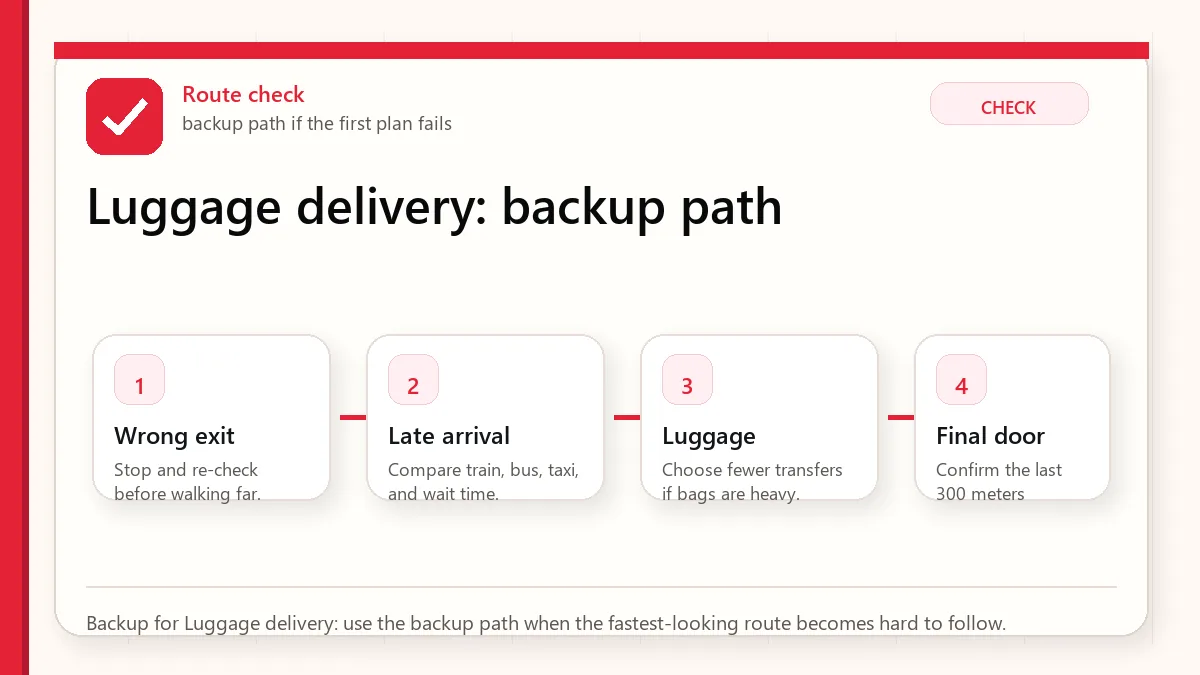
Backup for Luggage delivery: use the backup path when the fastest-looking route becomes hard to follow.
What to save before you need it
Hotel address and phone number
Delivery receipt or tracking page
Pickup counter location
Bag photo and tag
Backup plan if delivery is late
If your bags arrive separately from you
A search for unaccompanied luggage to South Korea is different from a same-day luggage delivery service inside Korea. Unaccompanied baggage can involve airline, customs, courier, and storage rules, while local luggage delivery usually moves bags between an airport, hotel, station, or address after arrival.
Before shipping or sending luggage, confirm customs responsibility, delivery address format, pickup deadline, storage limit, tracking, and what happens if the hotel cannot receive the bag.
FAQ
Is luggage delivery in Korea worth it?
It is worth it when it removes a real transfer burden. It is not worth it when timing uncertainty creates more stress than carrying the bag.
Can I send luggage from the airport to a hotel?
Some services may allow airport-to-hotel delivery, but rules, counters, and cutoff times can change. Check the current service before relying on it.
What should never go in delivered luggage?
Passport, money, cards, medicine, essential chargers, documents, and anything you need before the bag arrives.
Use these official links when the next step matters. This guide explains what to watch for, but app downloads, eligibility, prices, routes, policies, and service rules can change.
App screens, entry rules, fares, and official procedures can change. Use the links below to re-check details before you rely on one route, app, card, or declaration step.
The Korea airport train is one of the cleanest ways to leave Incheon Airport, but tourists often get confused by the difference between AREX Express and the all-stop airport railroad. Both are trains. They do not serve the same travel style.
AREX train stops and timetable check
For AREX train stops or AREX Seoul timetable, first decide between Express Train and All Stop Train. Express Train is for a direct airport-to-Seoul Station ride, while All Stop Train serves more stations and may be better if your connection is not Seoul Station.
Always check the current timetable before a late-night or early-morning arrival. If the train no longer fits your landing time, compare airport bus and taxi before leaving the arrivals hall.
Last checked: June 1, 2026. Re-check the official operator, app, fare, or route page before acting, because routes, prices, labels, rules, app screens, eligibility, and store/service policies can change.
Last updated: May 26, 2026.
The right choice depends on your hotel area, luggage, budget, transfer tolerance, arrival time, and whether Seoul Station is actually convenient for you. This guide helps you decide before you follow the first sign you see.
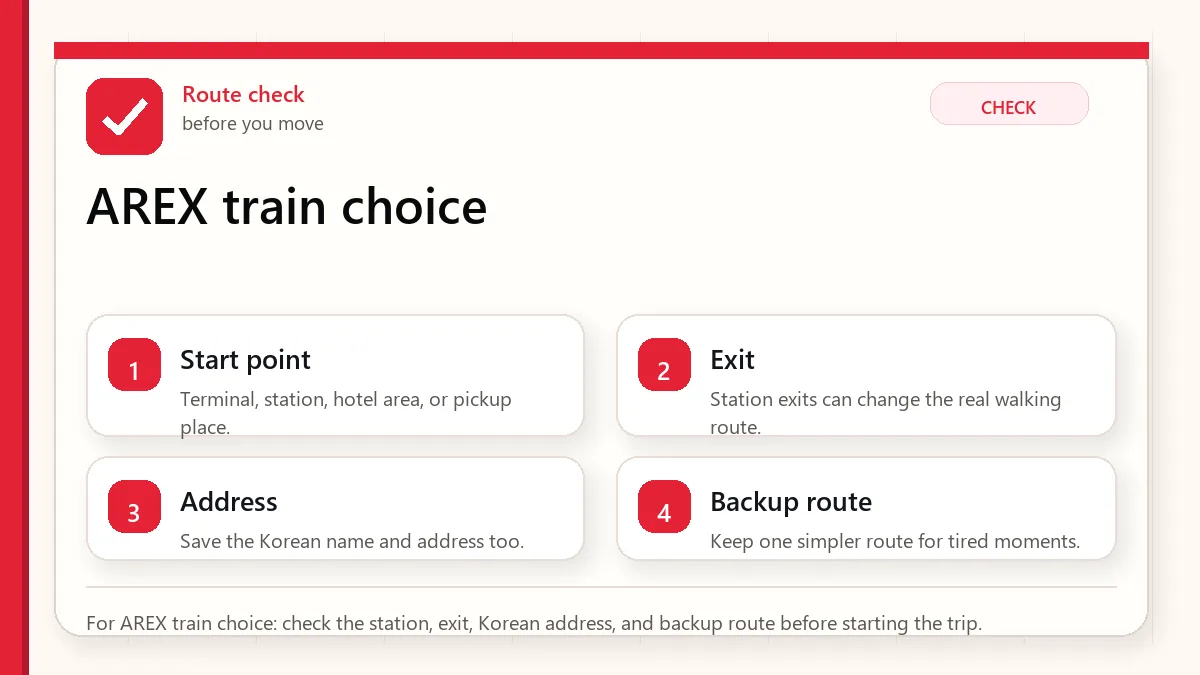
For AREX train choice: check the station, exit, Korean address, and backup route before starting the trip.
Start with the first transfer after landing
Choose AREX Express when Seoul Station is your clear transfer point and you want a reserved, direct airport train. Choose the all-stop train when your destination connects better through stations along the airport railroad line.
When this matters
This matters when you are arriving at Incheon Airport and deciding between train, bus, taxi, and hotel-area transfer routes.
Decision table
Situation
Best move
Why it matters
Staying near Seoul Station
AREX Express can be convenient
Direct service fits the destination.
Staying near Hongdae
All-stop may fit better
Hongik University is on the airport railroad line.
Heavy luggage
Reduce transfers
The best route is the one you can carry.
Late arrival
Check final train and bus backup
Schedules matter after immigration and baggage delay.
How to make the decision
Use the table as a filter, not as a rule to memorize. The right answer depends on your exact route, phone setup, luggage, arrival time, payment method, and how much uncertainty you can tolerate on that day. For this topic, the first question is: staying near seoul station. If that sounds like your situation, the safest starting point is to arex express can be convenient because direct service fits the destination..
The second question is whether the choice still works when the trip becomes less ideal: late arrival, rain, low battery, no Korean phone call, a crowded station, a tired group, or a hotel address that is hard to explain. Those imperfect moments are where travelers usually lose time.
Step-by-step setup
Before landing, identify your exact hotel area and nearest station.
Check whether Seoul Station is truly useful or just a famous transfer point.
Compare AREX Express, all-stop train, airport limousine bus, and taxi for your address.
Allow time for immigration, baggage claim, SIM pickup, restroom, and ticket purchase.
If you arrive late, check the last train before choosing a route.
Before you rely on it
Do one small test before the situation becomes urgent. Search the destination, open the app, check the route, confirm the address, read the current official page, or ask the hotel desk while you still have time. A five-minute test at the hotel is easier than troubleshooting in a taxi line, subway transfer, airport terminal, or restaurant doorway.
Also separate what is convenient from what is required. A tool can be convenient without being essential. A card can be useful without replacing every payment method. A phone number can help without solving real-name verification. A train can be fast without being the easiest route with luggage. That distinction is the main habit that prevents bad decisions.
Where travelers get stuck
Taking AREX Express only because it sounds faster, then making a hard transfer afterward.
Ignoring elevator access and walking distance with luggage.
Assuming Hongdae, Myeongdong, Gangnam, and Jamsil have the same airport-train convenience.
Forgetting that the best route changes at night.
Buying a ticket before checking terminal, train type, and hotel station.
Realistic travel scenario
If your hotel is in Hongdae, the all-stop train may avoid an unnecessary Seoul Station transfer. If your hotel is near Seoul Station, AREX Express can be very comfortable. If you stay in Gangnam, compare airport bus and taxi too because the train route may require transfers.
Backup plan if the first choice fails
Have one fallback that does not depend on the same weak point. If the app fails, use a saved Korean address, hotel desk, official counter, taxi stand, convenience store, or simpler route. If payment fails, switch to another card or cash. If translation fails, use shorter sentences and confirm with a person. If timing fails, choose the option that protects the flight, hotel check-in, medicine, or safety issue first.
Most likely failure: Taking AREX Express only because it sounds faster, then making a hard transfer afterward.
Fastest prevention step: Before landing, identify your exact hotel area and nearest station.
Most useful saved item: Hotel station and Korean address
Best mindset: solve the next practical step instead of trying to force the perfect plan.
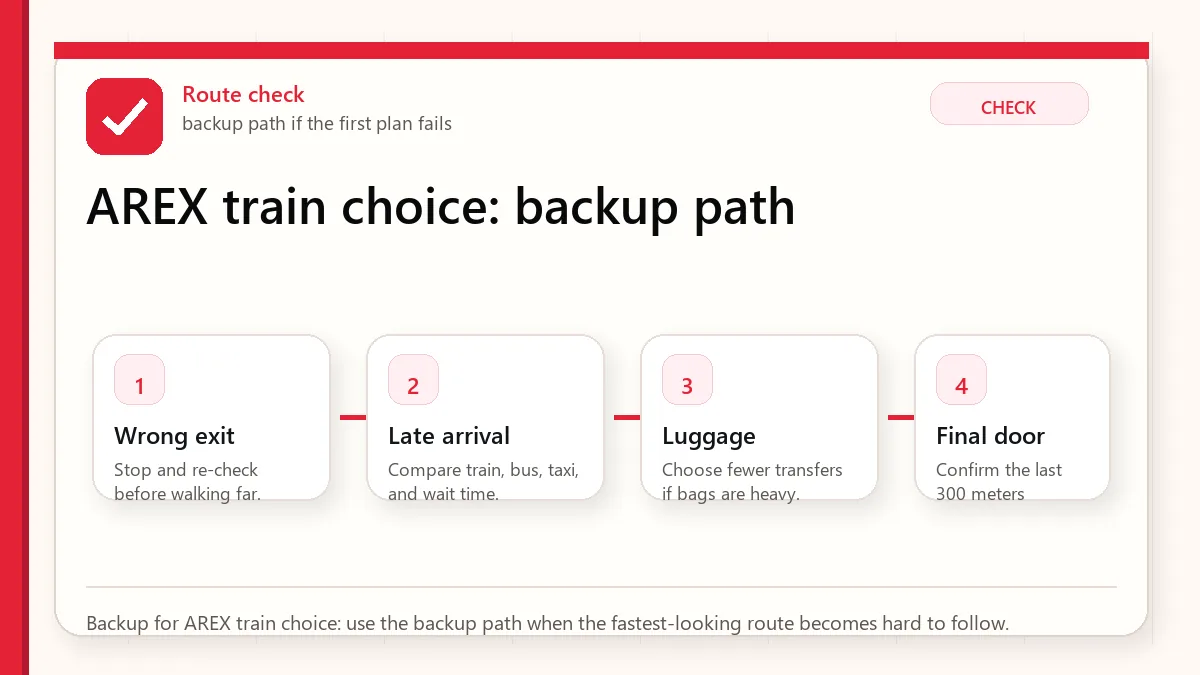
Backup for AREX train choice: use the backup path when the fastest-looking route becomes hard to follow.
What to save before you need it
Hotel station and Korean address
AREX or airport railroad route
Last train time
Airport bus backup
Taxi estimate for late arrival
AREX airport railroad route searches
Searches such as AREX train route, AREX all stop stations, AREX Incheon Airport Express, Incheon airport express train, and Seoul to Incheon airport train should be handled by separating the Express Train from the All Stop train. The Express Train is simpler for Seoul Station, while the All Stop train is often better for Gimpo Airport, Hongdae, digital media areas, and intermediate stations.
If your route includes Gimpo, Hongdae, or a transfer to another subway line, check the All Stop option before buying an Express ticket.
Train to Incheon Airport: AREX route, stations, and schedule checks
Quick answer: the main train to Incheon Airport is AREX. Use the Express train when you want the direct Seoul Station to Incheon Airport route, and use the All Stop train when you need intermediate stations, Gimpo Airport, Hongik University, Digital Media City, or other local connections.
Query
What to check
Best action
AREX route
Express vs All Stop line pattern
Confirm whether your station is served by the train type you plan to board.
AREX All Stop stations
Intermediate station list
Use All Stop if you need Gimpo Airport or a non-Seoul Station transfer.
AREX schedule
Departure time and last train
Check the official AREX source on the travel day.
Train to Incheon Airport
Terminal, luggage, and transfer time
Add time for walking, ticketing, and airport terminal movement.
Schedules, fares, and stopping patterns can change. For a same-day flight, verify the official AREX schedule before leaving and keep a taxi or airport bus backup if your arrival time is tight.
FAQ
Is AREX Express always better?
No. It is better when Seoul Station fits your route. The all-stop train can be better for destinations along the airport railroad line.
Can I take the airport train with luggage?
Yes, but transfer difficulty matters. Choose routes with fewer stairs and less walking if your bag is heavy.
Should I buy a ticket in advance?
It depends on your route and arrival confidence. First-time visitors should understand the train type before buying.
Use these official links when the next step matters. This guide explains what to watch for, but app downloads, eligibility, prices, routes, policies, and service rules can change.
WOWPASS official site: Check current prepaid card, exchange, app, and transit-card features.
Sources and official checks
App screens, entry rules, fares, and official procedures can change. Use the links below to re-check details before you rely on one route, app, card, or declaration step.
GSC is starting to show this page for “train to Incheon Airport.” The page should answer both directions: airport to Seoul and Seoul to airport. For departure day, the safer decision is not always the fastest train; it is the route with enough buffer for luggage, ticketing, and terminal movement.
Situation
Better default
Why
Leaving Seoul for a flight
Add a buffer before the train, not after it
Station transfer, ticketing, and airport terminal movement can absorb time.
Heavy luggage
Prioritize fewer transfers
A slightly slower route can be easier than a faster route with stairs or long walks.
Hotel near Seoul Station
AREX can be a strong default
The route is simpler when Seoul Station is already convenient.
Hotel far from Seoul Station
Compare airport bus or taxi backup
The first/last leg can decide the real travel time.
A Korea taxi fare search usually means one of two things: you are planning an airport ride, or you are standing outside wondering whether the taxi will be expensive. The answer depends on city, distance, time of day, taxi type, traffic, tolls, and whether a surcharge applies.
Last checked: June 1, 2026. Re-check the official app, service, or app-store page before acting, because routes, prices, labels, rules, app screens, eligibility, and store/service policies can change.
Last updated: May 26, 2026.
This guide is not a fixed fare chart. Taxi fares can change and local details vary. It gives tourists a practical way to estimate risk, avoid surprises, and decide when a taxi is worth it compared with subway, bus, airport train, or ride-hailing apps.
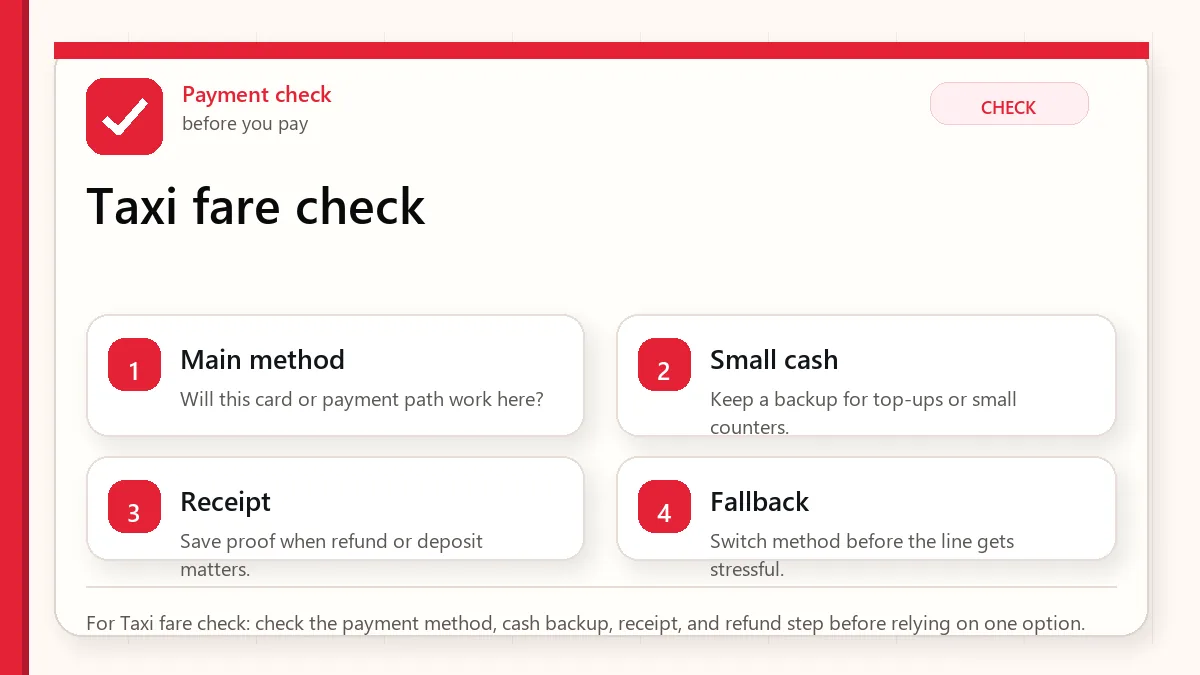
For Taxi fare check: check the payment method, cash backup, receipt, and refund step before relying on one option.
Start with what can fail at payment
Use the meter or official/app estimate, expect late-night and airport-related surcharges, and keep a payment backup because foreign cards may not work in every situation.
When this matters
This matters when you are comparing taxi, subway, airport train, bus, and app taxi options in Korea without wanting to memorize every fare rule.
Decision table
Situation
Best move
Why it matters
Short city ride
Check traffic and meter
A short ride can still feel slow in congestion.
Late night
Expect surcharge risk
Night rides can cost more and apps may be busy.
Airport route
Compare taxi with AREX or bus
Taxi is convenient but not always efficient.
Card uncertainty
Carry backup card or cash
Payment failure is a practical stress point.
How to make the decision
Use the table as a filter, not as a rule to memorize. The right answer depends on your exact route, phone setup, luggage, arrival time, payment method, and how much uncertainty you can tolerate on that day. For this topic, the first question is: short city ride. If that sounds like your situation, the safest starting point is to check traffic and meter because a short ride can still feel slow in congestion..
The second question is whether the choice still works when the trip becomes less ideal: late arrival, rain, low battery, no Korean phone call, a crowded station, a tired group, or a hotel address that is hard to explain. Those imperfect moments are where travelers usually lose time.
Step-by-step setup
Before taking a taxi, save the destination in Korean and check the rough route distance.
If using an app, compare the estimate with subway or airport train time.
Ask hotel staff which taxi type makes sense if you have luggage or a very early flight.
Check whether tolls, late-night surcharge, or airport pickup conditions may apply.
Keep a card backup and small cash buffer for payment problems.
Before you rely on it
Do one small test before the situation becomes urgent. Search the destination, open the app, check the route, confirm the address, read the current official page, or ask the hotel desk while you still have time. A five-minute test at the hotel is easier than troubleshooting in a taxi line, subway transfer, airport terminal, or restaurant doorway.
Also separate what is convenient from what is required. A tool can be convenient without being essential. A card can be useful without replacing every payment method. A phone number can help without solving real-name verification. A train can be fast without being the easiest route with luggage. That distinction is the main habit that prevents bad decisions.
Where travelers get stuck
Comparing only fare and ignoring traffic time.
Assuming an airport taxi is always faster than the airport train.
Not saving the destination in Korean.
Taking a taxi for a route that has a direct subway or airport railroad option.
Forgetting late-night surcharge when returning after clubs, concerts, or shopping.
Realistic travel scenario
From central Seoul to Incheon Airport, a taxi may be comfortable with luggage, but the airport railroad or limousine bus can be more predictable depending on your hotel area. For a 5 a.m. flight, convenience may matter more. For rush hour, a train route may be calmer.
Backup plan if the first choice fails
Have one fallback that does not depend on the same weak point. If the app fails, use a saved Korean address, hotel desk, official counter, taxi stand, convenience store, or simpler route. If payment fails, switch to another card or cash. If translation fails, use shorter sentences and confirm with a person. If timing fails, choose the option that protects the flight, hotel check-in, medicine, or safety issue first.
Most likely failure: Comparing only fare and ignoring traffic time.
Fastest prevention step: Before taking a taxi, save the destination in Korean and check the rough route distance.
Most useful saved item: Destination in Korean
Best mindset: solve the next practical step instead of trying to force the perfect plan.
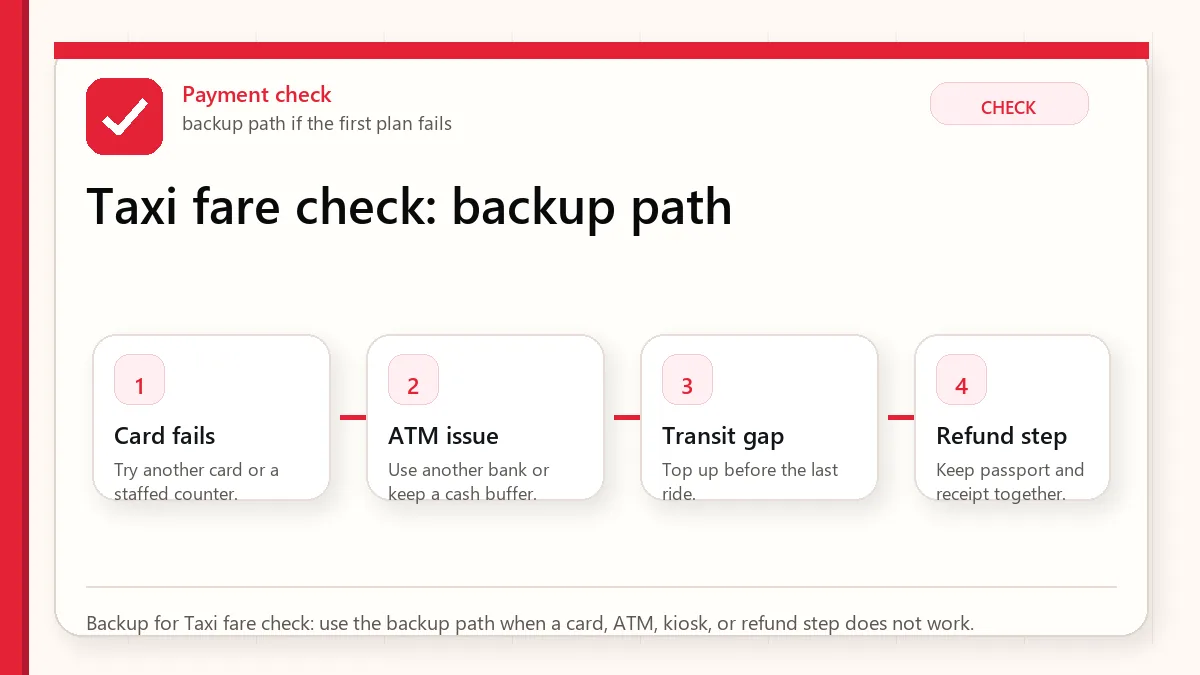
Backup for Taxi fare check: use the backup path when a card, ATM, kiosk, or refund step does not work.
What to save before you need it
Destination in Korean
Map route estimate
Taxi app estimate if available
Airport terminal and airline
Backup transit route
FAQ
Are taxis expensive in Korea?
They can be reasonable for short rides but become costly with distance, traffic, tolls, airport routes, and late-night surcharges.
Can I pay by foreign credit card?
Often yes, but not always smoothly. Keep another card and a small cash backup.
Is Kakao T required for taxis?
No, but it can help with destination entry and route confidence. Street taxis, hotel calls, and other services can still be useful.
App screens, entry rules, fares, and official procedures can change. Use the links below to re-check details before you rely on one route, app, card, or declaration step.
A Korea entry form can feel simple until you reach the fields that require exact travel details. Travelers often get stuck because they do not have the hotel address, phone number, flight information, passport details, or K-ETA status ready in one place.
Last checked: June 1, 2026. Re-check the current Korean government or customs page before acting, because routes, prices, labels, rules, app screens, eligibility, and store/service policies can change.
Last updated: May 26, 2026.
This guide separates the entry-form problem from the bigger entry-requirements problem. The form is a data-entry step. K-ETA, visa status, passport validity, customs, and health-related requirements can be separate checks.
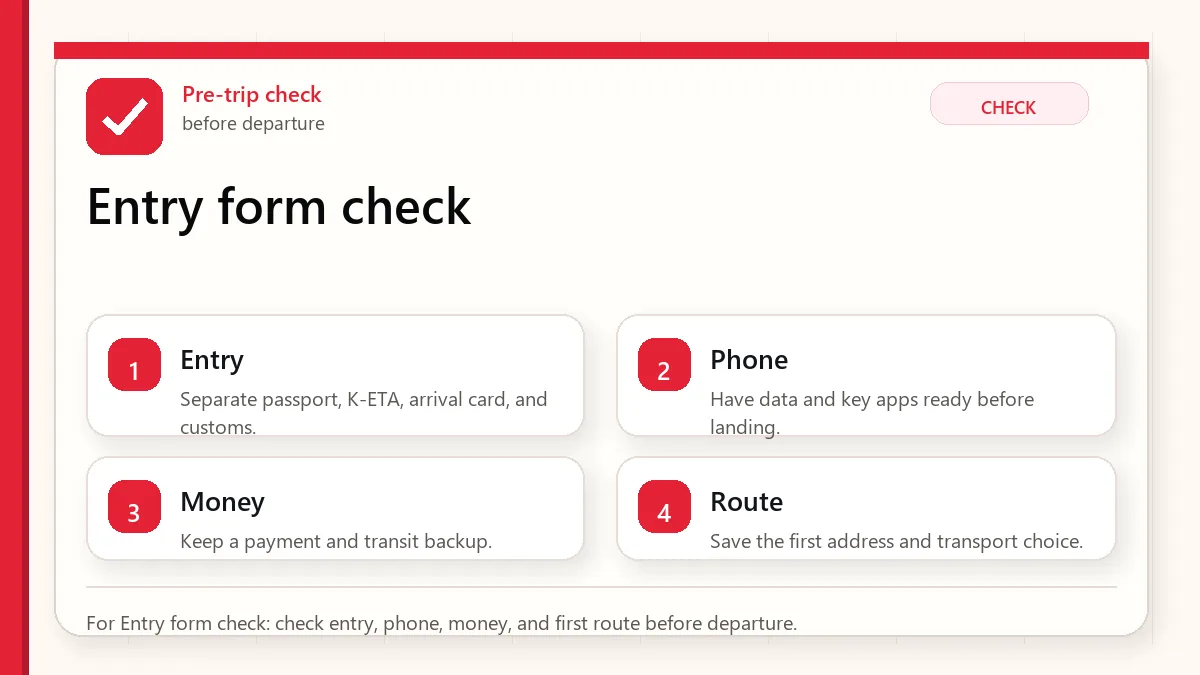
For Entry form check: check entry, phone, money, and first route before departure.
Start with what can fail at payment
Prepare passport information, flight details, accommodation address in Korea, contact information, and any required K-ETA or visa status before starting the entry form.
When this matters
This matters when you want a calm pre-flight checklist for Korea entry form details rather than rushing through official pages at the airport.
Decision table
Situation
Best move
Why it matters
You are visa-free eligible
Check K-ETA or exemption status
Entry form and entry permission are separate concerns.
You changed hotels
Use the first real stay address
Arrival details should match your actual plan.
Your flight changes
Update the details if required
Wrong arrival information can create confusion.
You are unsure about status
Use official sites only
Random travel forums can be outdated.
How to make the decision
Use the table as a filter, not as a rule to memorize. The right answer depends on your exact route, phone setup, luggage, arrival time, payment method, and how much uncertainty you can tolerate on that day. For this topic, the first question is: you are visa-free eligible. If that sounds like your situation, the safest starting point is to check k-eta or exemption status because entry form and entry permission are separate concerns..
The second question is whether the choice still works when the trip becomes less ideal: late arrival, rain, low battery, no Korean phone call, a crowded station, a tired group, or a hotel address that is hard to explain. Those imperfect moments are where travelers usually lose time.
Step-by-step setup
Check whether your nationality and trip purpose require K-ETA, visa, or another permission route.
Save your passport page, flight number, arrival date, and first accommodation address.
Write your accommodation phone number and Korean address in a note before starting the form.
Use the official e-Arrival Card or K-ETA channels rather than look-alike pages.
Keep confirmation screenshots where you can access them without mobile data.
Before you rely on it
Do one small test before the situation becomes urgent. Search the destination, open the app, check the route, confirm the address, read the current official page, or ask the hotel desk while you still have time. A five-minute test at the hotel is easier than troubleshooting in a taxi line, subway transfer, airport terminal, or restaurant doorway.
Also separate what is convenient from what is required. A tool can be convenient without being essential. A card can be useful without replacing every payment method. A phone number can help without solving real-name verification. A train can be fast without being the easiest route with luggage. That distinction is the main habit that prevents bad decisions.
Where travelers get stuck
Confusing e-Arrival Card with K-ETA or visa permission.
Using a booking platform nickname instead of the real accommodation name and address.
Waiting until boarding time to gather passport, flight, and hotel details.
Ignoring nationality-specific differences.
Relying on old screenshots because entry procedures can change.
Realistic travel scenario
A traveler books the first night in Hongdae but plans to move later. The entry detail should focus on the first actual address in Korea. The traveler should save the hotel name, road-name address, phone number, booking confirmation, and map link before starting the form.
Backup plan if the first choice fails
Have one fallback that does not depend on the same weak point. If the app fails, use a saved Korean address, hotel desk, official counter, taxi stand, convenience store, or simpler route. If payment fails, switch to another card or cash. If translation fails, use shorter sentences and confirm with a person. If timing fails, choose the option that protects the flight, hotel check-in, medicine, or safety issue first.
Most likely failure: Confusing e-Arrival Card with K-ETA or visa permission.
Fastest prevention step: Check whether your nationality and trip purpose require K-ETA, visa, or another permission route.
Most useful saved item: Passport information page
Best mindset: solve the next practical step instead of trying to force the perfect plan.
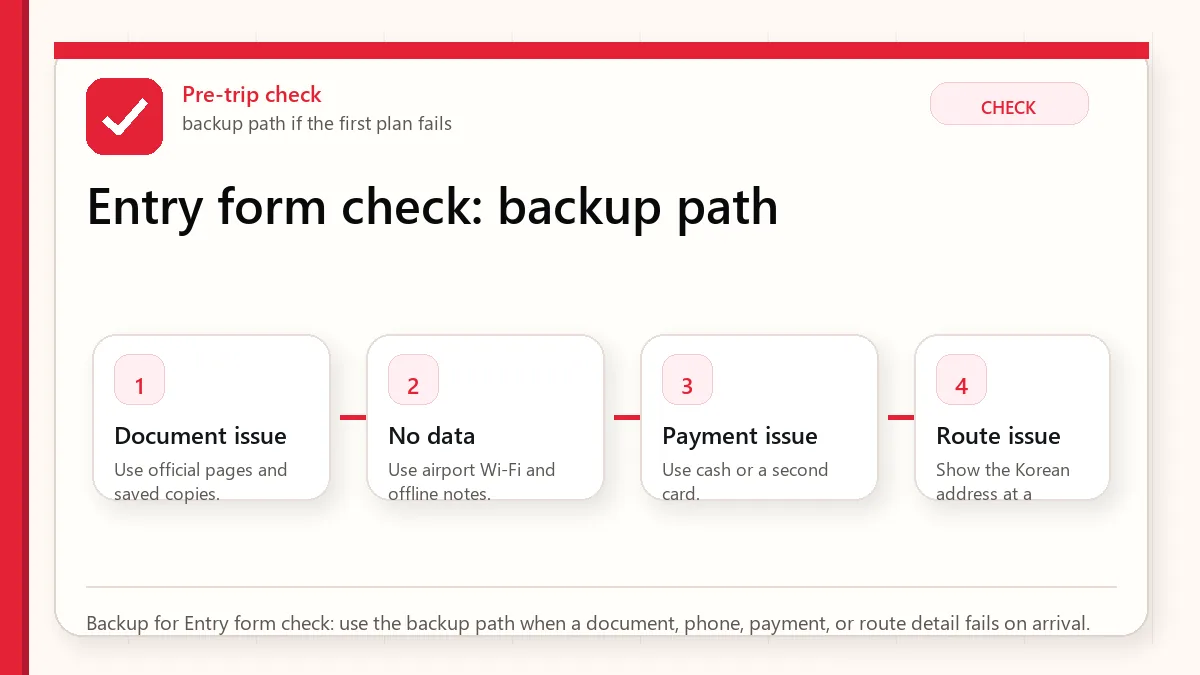
Backup for Entry form check: use the backup path when a document, phone, payment, or route detail fails on arrival.
What to save before you need it
Passport information page
Flight number and arrival date
First Korea accommodation address
Accommodation phone number
Entry form or K-ETA confirmation
FAQ
Is the Korea entry form the same as K-ETA?
No. Treat the entry form, K-ETA, visa status, and customs declaration as related but separate checks.
When should I prepare the entry form details?
Before departure, when you still have time to check your hotel address and official requirements calmly.
Can I use an English hotel address?
Keep both English and Korean versions if possible. Korean address text is useful for taxis, maps, and arrival questions.
Use these official links when the next step matters. This guide explains what to watch for, but app downloads, eligibility, prices, routes, policies, and service rules can change.
K-ETA official site: Use only the official K-ETA site for eligibility and application steps.
App screens, entry rules, fares, and official procedures can change. Use the links below to re-check details before you rely on one route, app, card, or declaration step.
A Korea customs declaration search usually happens right before departure or while standing near arrival. The problem is that travelers often think customs is only about expensive shopping, when it can also involve food, medicine, cash, alcohol, tobacco, commercial samples, and items for other people.
Last checked: June 1, 2026. Re-check the current Korean government or customs page before acting, because routes, prices, labels, rules, app screens, eligibility, and store/service policies can change.
Last updated: May 26, 2026.
This guide gives a practical way to think about Korea customs declaration without guessing. It is not legal advice and it does not replace the current Korea Customs Service rules. It helps you know what to check before you pack and what to declare if you are unsure.
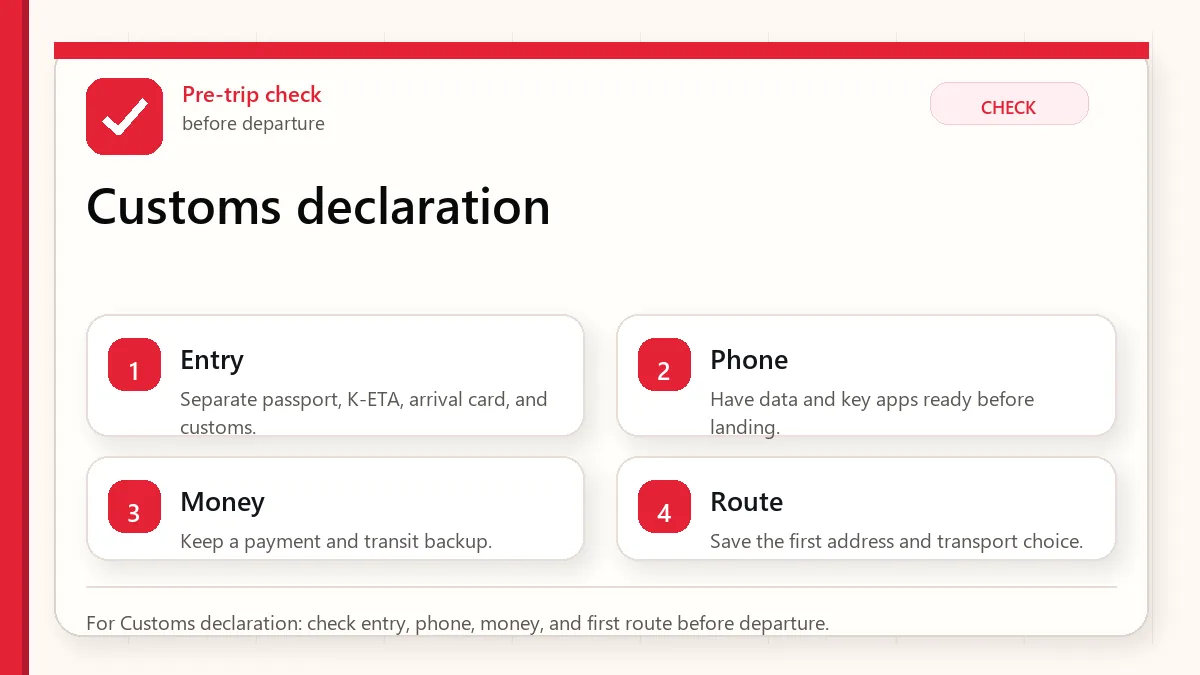
For Customs declaration: check entry, phone, money, and first route before departure.
Start with what can fail at payment
Declare when the item, amount, value, purpose, or category may need official review. If you are unsure, choose the official declaration path instead of trying to hide the item.
When this matters
This matters when you are carrying food gifts, medicine, supplements, duty-free purchases, high-value goods, business items, or cash and wanting to avoid a bad arrival moment.
Decision table
Situation
Best move
Why it matters
You carry medicine
Keep prescription and packaging
Officials may need to understand the item and purpose.
You carry food
Check restrictions before packing
Some animal, plant, and fresh products can be sensitive.
You bought duty-free goods
Keep receipts and know limits
Value and quantity can matter.
You carry large cash
Check declaration rules
Currency rules can apply even when money is yours.
How to make the decision
Use the table as a filter, not as a rule to memorize. The right answer depends on your exact route, phone setup, luggage, arrival time, payment method, and how much uncertainty you can tolerate on that day. For this topic, the first question is: you carry medicine. If that sounds like your situation, the safest starting point is to keep prescription and packaging because officials may need to understand the item and purpose..
The second question is whether the choice still works when the trip becomes less ideal: late arrival, rain, low battery, no Korean phone call, a crowded station, a tired group, or a hotel address that is hard to explain. Those imperfect moments are where travelers usually lose time.
Step-by-step setup
Before packing, separate personal items from gifts, resale items, commercial samples, and goods for someone else.
Keep medicine in original packaging with a prescription or doctor note when appropriate.
Do not pack restricted food casually because it is common in your home country.
Keep purchase receipts for expensive items and duty-free products.
Use the official customs declaration process if the category or amount is unclear.
Before you rely on it
Do one small test before the situation becomes urgent. Search the destination, open the app, check the route, confirm the address, read the current official page, or ask the hotel desk while you still have time. A five-minute test at the hotel is easier than troubleshooting in a taxi line, subway transfer, airport terminal, or restaurant doorway.
Also separate what is convenient from what is required. A tool can be convenient without being essential. A card can be useful without replacing every payment method. A phone number can help without solving real-name verification. A train can be fast without being the easiest route with luggage. That distinction is the main habit that prevents bad decisions.
Where travelers get stuck
Thinking sealed food is always allowed.
Removing medicine from packaging to save space.
Carrying goods for other people without knowing value or contents.
Forgetting that cash and monetary instruments may need declaration above certain thresholds.
Treating customs as a trick to avoid instead of a checkpoint to handle honestly.
Realistic travel scenario
A traveler brings vitamins, skincare gifts, snacks, and a duty-free bottle. None of these automatically means trouble, but the traveler should know what each item is, keep receipts, keep labels visible, and declare if the rules or quantity are not clearly within the normal personal-use range.
Backup plan if the first choice fails
Have one fallback that does not depend on the same weak point. If the app fails, use a saved Korean address, hotel desk, official counter, taxi stand, convenience store, or simpler route. If payment fails, switch to another card or cash. If translation fails, use shorter sentences and confirm with a person. If timing fails, choose the option that protects the flight, hotel check-in, medicine, or safety issue first.
Most likely failure: Thinking sealed food is always allowed.
Fastest prevention step: Before packing, separate personal items from gifts, resale items, commercial samples, and goods for someone else.
Most useful saved item: Medicine prescription or doctor note
Best mindset: solve the next practical step instead of trying to force the perfect plan.
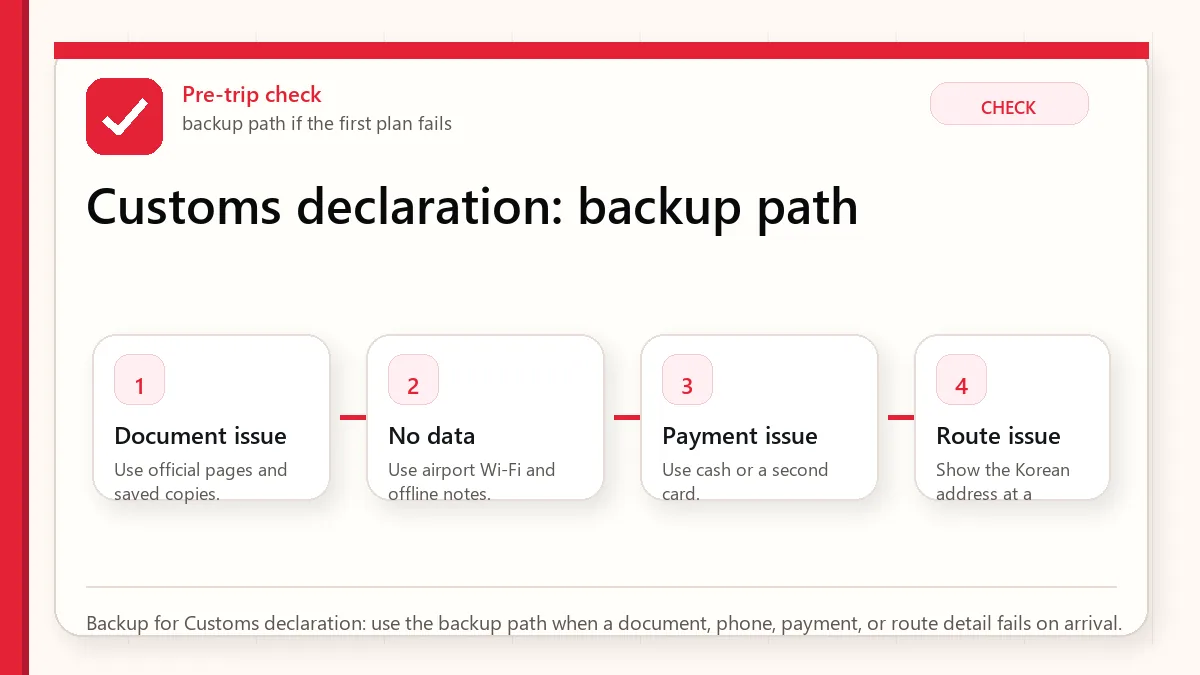
Backup for Customs declaration: use the backup path when a document, phone, payment, or route detail fails on arrival.
What to save before you need it
Medicine prescription or doctor note
Receipts for high-value goods
Customs declaration confirmation if submitted
Product labels for food or supplements
Official customs page saved offline
FAQ
Do all travelers need to fill a customs declaration?
Follow the current official process. Some travelers may have nothing to declare, while others should use the official declaration channel.
Can I bring Korean food gifts into Korea?
It depends on the product type and current restrictions. Check official customs guidance before packing animal, plant, fresh, or unclear food items.
Should I declare if I am unsure?
Yes, if the item may fall into a controlled or value-sensitive category. A declaration is safer than hiding uncertainty.
Use these official links when the next step matters. This guide explains what to watch for, but app downloads, eligibility, prices, routes, policies, and service rules can change.
Q-CODE official site: Check current health declaration requirements when they apply.
Sources and official checks
App screens, entry rules, fares, and official procedures can change. Use the links below to re-check details before you rely on one route, app, card, or declaration step.