Before flying to Korea, separate K-ETA, e-Arrival Card, visa-free entry, customs declaration, and Q-CODE instead of treating them as one form. The exact mix depends on your passport, trip date, airline, and items you carry.
Last checked: June 1, 2026. Re-check the current Korean government or customs page before acting, because routes, prices, labels, rules, app screens, eligibility, and store/service policies can change.
Last updated: May 27, 2026. Entry rules, forms, customs guidance, airport procedures, and eligibility details can change, so re-check official sources before travel.
Start with the official requirement for your trip
Start with your passport nationality. If you are visa-free, check whether K-ETA is required or temporarily exempt. If you do not hold K-ETA, check whether you need the e-Arrival Card. Then check passport validity, customs declaration triggers, and Q-CODE or health questionnaire rules if you are coming from a designated region. Use official websites, not travel-forum screenshots.
K-ETA vs e-Arrival Card
| System | What it does | Common mistake |
|---|---|---|
| K-ETA | Electronic travel authorization for eligible visa-free travelers when required. | Thinking approval guarantees entry or replaces visa rules. |
| e-Arrival Card | Online arrival-card submission for travelers who need arrival-card information. | Thinking K-ETA-exempt means form-exempt. |
| Visa | Permission path for travelers not covered by visa-free/K-ETA routes. | Trying to use K-ETA when nationality is not eligible. |
| Q-CODE | Health/quarantine information when required for designated regions. | Assuming old COVID rules are gone forever for every origin. |
| Customs declaration | Goods, currency, restricted items, food, plants, animal products, and allowance issues. | Thinking “tourist” means nothing to declare. |
The 2026 entry workflow
- Check whether your passport nationality is visa-free or visa-required.
- If visa-free, check whether you need K-ETA or are temporarily exempt.
- If K-ETA is required, apply only on the official K-ETA site or app.
- If you do not hold K-ETA, complete the e-Arrival Card if required.
- Check passport validity against your stay, visa application needs, and airline rules.
- Review customs triggers: high-value goods, restricted items, food, plants, animal products, and currency over USD 10,000 equivalent.
- Check Q-CODE or health questionnaire requirements close to departure if your travel history includes designated regions.
Passport validity: do not rely on a slogan
Travel blogs often say “six months required,” but official material can be more nuanced. For visa applications, Korean missions often ask for at least six months. For visa-free entry, the key risk is whether your passport comfortably covers the stay and whether the airline will board you. If your passport is close to expiry, verify with the official mission and airline before you travel.
Customs and food caution
Korea’s customs rules matter for tourists carrying large cash amounts, alcohol, tobacco, expensive purchases, animal products, plants, meat, fruits, medicines, or commercial-looking goods. If you are not sure, declare or ask. A small inconvenience at customs is better than a penalty for failing to declare.
Useful document pack
- Passport photo page screenshot and physical passport.
- K-ETA approval or visa evidence if applicable.
- e-Arrival Card completion screenshot if applicable.
- Hotel address in English and Korean.
- Return or onward flight information.
- Customs notes for high-value shopping, medicine, or special items.
Separate the four checks
Korea entry planning becomes easier when you separate four workflows: permission to travel, arrival information, customs, and health-related declarations. K-ETA belongs to the permission-to-travel layer for eligible visa-free travelers unless an exemption applies. The e-Arrival Card is arrival information. Customs declaration is about what you bring. Q-CODE is health-related and can matter when disease-control rules are active or when the traveler is asked to provide health information.
Travelers often make mistakes because they treat every form as the same form. They are not the same. One may be tied to your passport and boarding eligibility, another to immigration processing, another to goods and cash you carry, and another to public-health screening. Keeping them separate makes it easier to know what you have completed and what remains.
The three-day arrival window
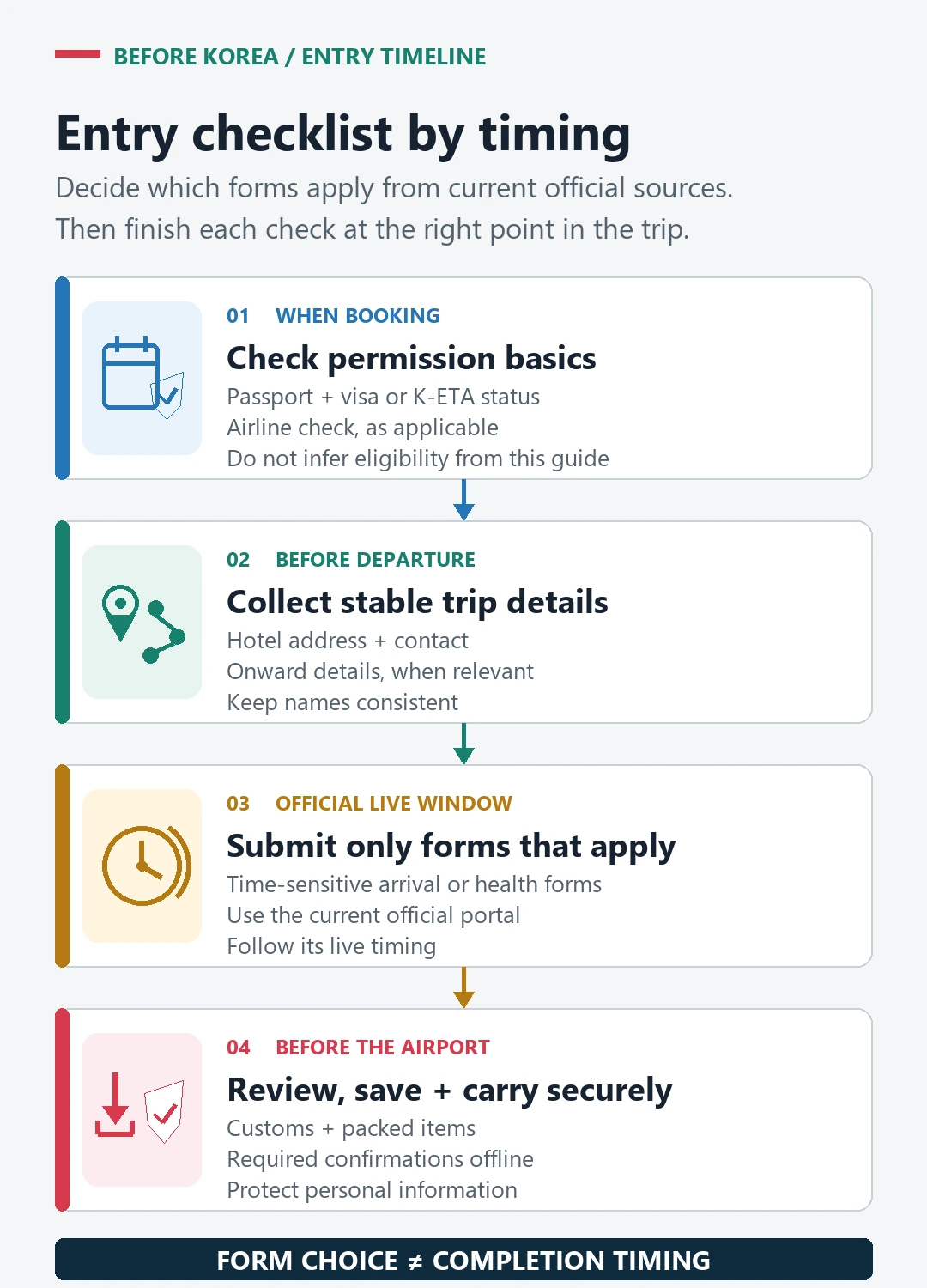
Some arrival information should be handled close to travel because it asks for final flight and accommodation details. Build a simple timeline: check passport, visa or K-ETA situation, and airline rules when you book; confirm hotel address and first-night contact information one week before travel; complete time-sensitive arrival forms within the official window before departure; then save confirmations offline before you go to the airport.
Do not rely only on a live internet connection at the departure airport. Keep a screenshot or PDF of important approvals, your hotel name and address in English and Korean if available, outbound or onward travel proof if relevant, and emergency contact details. This is not because entry is normally difficult; it is because a small document problem is much easier to fix before you stand in a line.
Customs and practical packing
Customs is where ordinary travelers accidentally create avoidable stress. Food, medication, high-value goods, large cash amounts, commercial quantities, and restricted items deserve attention before packing. If you carry prescription medicine, keep it in original packaging where possible and bring supporting documentation. If you plan to shop heavily in Korea, remember that your home country’s customs rules also matter on the return trip.
Official links to check
Use these official links when the next step matters. This guide explains what to watch for, but app downloads, eligibility, prices, routes, policies, and service rules can change.
- K-ETA official site: Use only the official K-ETA site for eligibility and application steps.
- Korea e-Arrival Card official site: Check whether you need to submit an electronic arrival card before entry.
- Korea Immigration Service: Use this for official immigration and entry-related notices.
- Q-CODE official site: Check current health declaration requirements when they apply.
- Korea Customs Service English site: Use this for traveler customs, duty-free, cash, medicine, and declaration rules.
- VISITKOREA official travel site: Use this for current tourism notices, transport basics, and traveler support.
FAQ
Do K-ETA holders need the e-Arrival Card?
In general, K-ETA holders are treated differently from travelers who need to submit arrival-card information. Check the official e-Arrival site for your situation.
Is the e-Arrival Card free?
The official e-Arrival Card is free. Be careful with unofficial pages that look like government services.
Can requirements change?
Yes. Entry, health, and customs rules can change, which is why this guide points you back to official portals.
Related guides
Separate Korea travel permission, arrival declaration and customs before departure
| Decision | Evidence | Next action |
|---|---|---|
| Permission | Passport, nationality and exact arrival date checked on the official visa or K-ETA route | Save the applicable result |
| Arrival declaration | Official e-Arrival navigator and current three-day window checked | Submit free on the official domain only if required |
| Customs | Packed goods, food, medicine, valuables and currency reviewed | Declare or ask when triggered |
| Mismatch | Names, passport number, purpose or dates differ across records | Stop and correct before the airport |
A correct Korea entry file is not one form: it is a dated record showing which permission, declaration and customs steps apply to the same traveler. The decision record was checked against K-ETA 2026 exemption notice, Korea e-Arrival declaration guide, Korea Customs Service.
The official K-ETA notice extends the current temporary exemption for affected countries and regions through December 31, 2026 KST. The official e-Arrival service is free, accepts submissions within three days before arrival, and provides a navigator for applicability. A valid K-ETA holder and a traveler entering with a visa can have different arrival-declaration outcomes, so the exact official navigator result controls. Customs concerns the goods and currency carried and remains separate from immigration permission. Source review completed August 24, 2026. Dates, eligibility, price, inventory, access and operating rules must be rechecked on the exact current first-party page before action.