Category: Before You Visit

Practical Korea travel guides for visitors before planning, arriving, and moving around Korea.

  • Korea Packing List by Season: Shoes, Weather, Adapters, Medicine, and Shopping Space

    Korea Packing List by Season: Shoes, Weather, Adapters, Medicine, and Shopping Space

    A Korea packing list should start with the trip you will actually take, not the outfit you imagine for photos. First-time visitors often underestimate walking, subway transfers, stairs, rain, winter wind, and shopping volume. The best packing strategy is practical: comfortable shoes, season-appropriate layers, a correct adapter, medicine checks, clean socks, and enough empty luggage space for what you buy.

    Last checked: June 1, 2026. Re-check the latest product label, store policy, and official refund or safety page before acting, because routes, prices, labels, rules, app screens, eligibility, and store/service policies can change.

    Last updated: May 24, 2026.
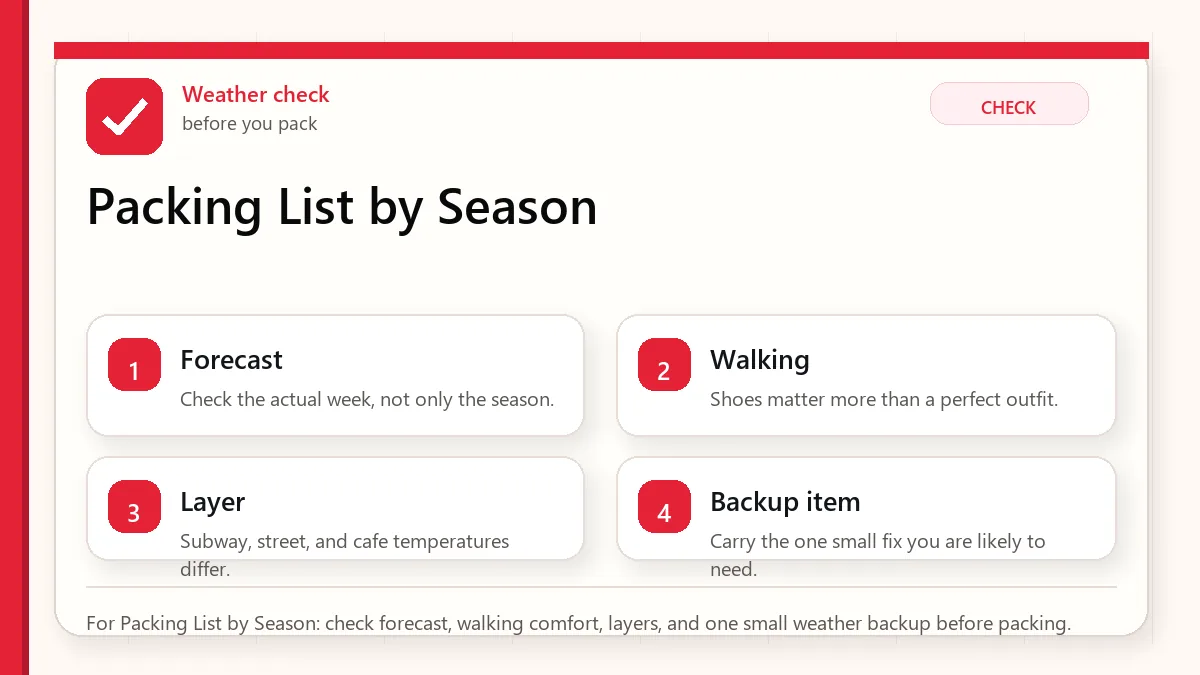
    Layered red check decision graphic for Packing List by Season.
    For Packing List by Season: check forecast, walking comfort, layers, and one small weather backup before packing.

    Start with the label and return risk

    Pack comfortable walking shoes, clean socks for shoes-off spaces, a Type C or Type F plug adapter for Korea’s 220V outlets, a small medicine kit after checking restrictions, a light rain layer for summer, warm windproof layers for winter, and extra luggage space if you plan to shop. Do not bring single-voltage high-heat appliances unless you know exactly what you are doing.

    Season packing table

    SeasonPackWatch out for
    SpringLight jacket, layers, comfortable shoes, allergy supplies.Temperature swings, crowded blossom weeks, dust days.
    SummerBreathable clothes, compact umbrella, quick-dry shoes, deodorant, sun protection.Humidity, heavy rain, slippery stairs.
    AutumnLight sweater, jacket, walking shoes, flexible layers.Warm afternoons and cool nights.
    WinterThermal layers, windproof coat, gloves, warm socks, grippy shoes.Dry cold, wind chill, icy hills.

    Shoes are the most important item

    Korea trips can become 15,000 to 25,000 step days quickly. Subway stations are deep, neighborhoods are hilly, palace grounds are wide, and shopping districts encourage long wandering. Bring shoes you have already tested. For general city travel, supportive sneakers are better than stiff boots or new fashion shoes. If you will visit traditional restaurants, temples, hanok stays, or guesthouses, shoes that slip on and off easily are more convenient.

    Power adapters and voltage

    Korea uses 220V electricity and round-pin Type C or Type F style outlets. Most modern phone, laptop, camera, and tablet chargers support 100-240V and only need a plug adapter. Many hair dryers, curling irons, and high-heat appliances from 110V countries are not safe unless they are dual voltage. Check the label before packing. A multi-port USB-C charger plus one good adapter is usually cleaner than carrying many small chargers.
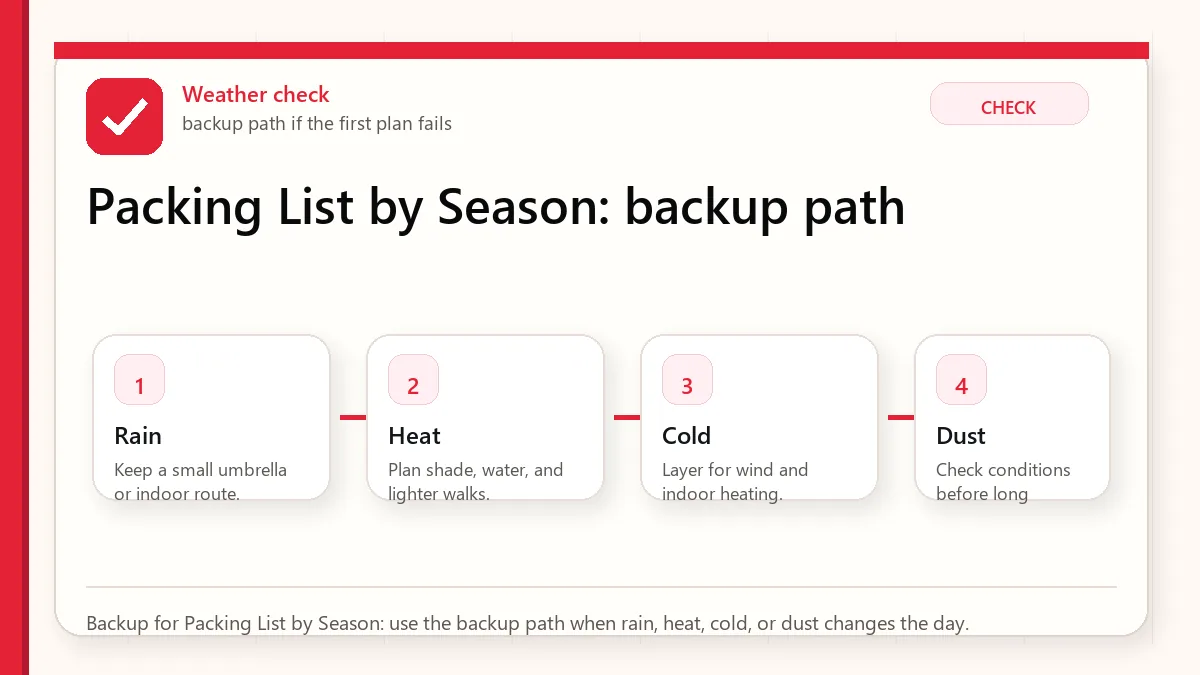
    Layered red check backup flow graphic for Packing List by Season.
    Backup for Packing List by Season: use the backup path when rain, heat, cold, or dust changes the day.

    Medicine and health packing

    Bring normal personal medicines in original packaging when possible, but do not assume every medication that is legal at home can enter Korea freely. Controlled medicines and some psychiatric, stimulant, opioid, or codeine-related medicines may require advance review or approval. Check official MFDS guidance before travel if your medicine is controlled, prescription-heavy, or unusual. Do not rely on social media comments for legal medicine rules.

    Rain, winter, and air quality

    Summer packing should account for humidity and sudden rain. A compact umbrella is easy to buy in Korea, but quick-dry clothing and shoes are harder to improvise mid-trip. Winter packing should focus on windproof warmth, not only a thick coat. Spring can bring dust or air-quality discomfort, so travelers with respiratory sensitivity may want masks and medication they already use.

    Leave shopping space

    K-beauty, snacks, stationery, and small design goods are easy to accumulate. If shopping is part of the trip, pack less at the start. Liquids and full-size skincare need checked-luggage planning. Power banks and spare batteries need cabin-handling rules. The best Korea packing list protects both your feet and your return luggage.

    Pack for surfaces, not just temperature

    Korea packing advice often focuses on weather, but surfaces matter just as much. You may walk across palace gravel, wet subway tiles, steep side streets, basement restaurants, polished mall floors, and long station corridors on the same day. Shoes that look fine in photos can become a trip problem after two days. Prioritize cushioning, grip, and a fit that survives swelling after long walks.

    Clean socks deserve their own place on the list. Shoes-off restaurants, hanok stays, temples, guesthouses, fitting rooms, and some clinics can all make socks visible. In summer, carrying a spare pair can make the day more comfortable. In winter, warm socks help more than many visitors expect because cold pavement and station platforms drain heat quickly.

    Pack one small repair layer

    A compact kit with blister pads, pain relief you are allowed to bring, a few bandages, tissues, and a small reusable bag can rescue long sightseeing days. This is not overpacking. It is insurance against the small discomforts that make travelers waste time searching for a pharmacy or convenience store when they are tired.

    Official links to check

    Use these official links when the next step matters. This guide explains what to watch for, but app downloads, eligibility, prices, routes, policies, and service rules can change.

    FAQ

    Can I buy forgotten items in Korea?

    Yes. Convenience stores, Daiso, pharmacies, malls, and electronics shops are easy to find in major cities.

    Do I need special shoes for Korea?

    You need comfortable, already-tested walking shoes. Slip-on convenience is helpful but support matters more.

    Should I bring a hair dryer to Korea?

    Usually no. Many hotels provide one. Single-voltage 110V heat appliances can be unsafe on Korea’s 220V system.

    Related Before Korea guides

    Source links to verify

  • Korean Phrases for Tourists: What to Say in Restaurants, Taxis, Shops, and Awkward Moments

    Korean Phrases for Tourists: What to Say in Restaurants, Taxis, Shops, and Awkward Moments

    You do not need fluent Korean for a good trip. You need a small set of phrases that reduce friction at exactly the right moments: greeting staff, ordering food, asking for help, paying, showing a taxi destination, explaining an allergy, and recovering when you bump into someone or make a small mistake.

    Last checked: June 1, 2026. Re-check the official operator, app, fare, or route page before acting, because routes, prices, labels, rules, app screens, eligibility, and store/service policies can change.

    Last updated: May 24, 2026.

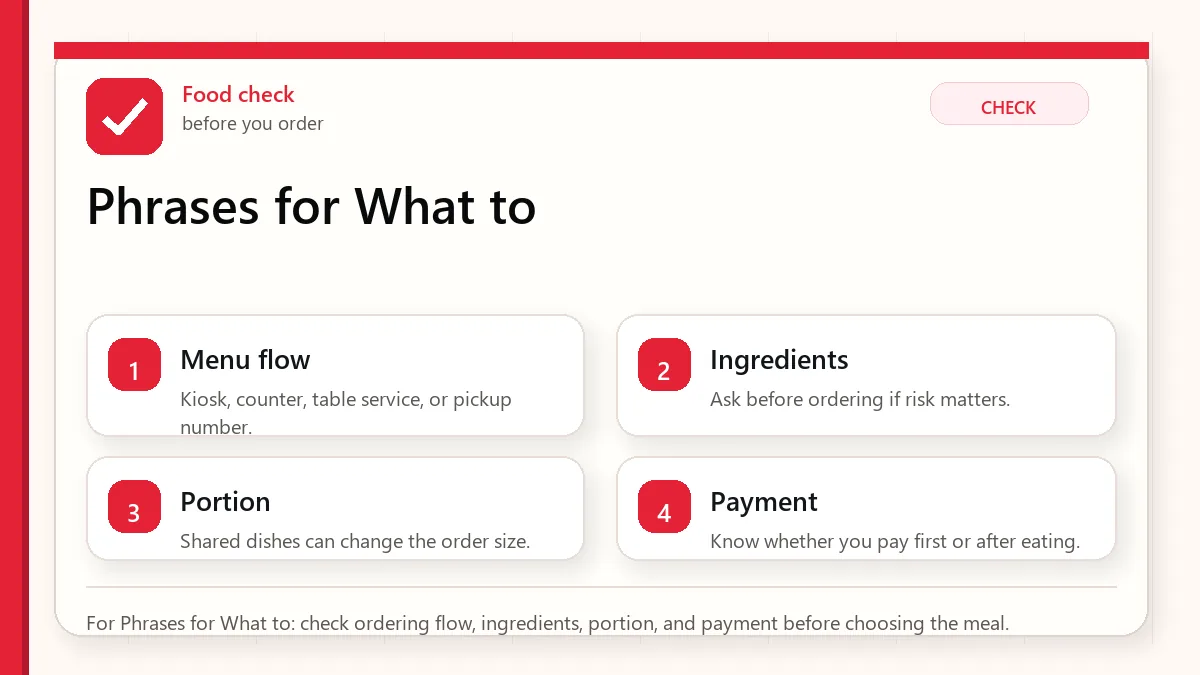
    Layered red check decision graphic for Phrases for What to.
    For Phrases for What to: check ordering flow, ingredients, portion, and payment before choosing the meal.

    Start with the pickup and payment fallback

    Start with annyeonghaseyo for hello, gamsahamnida for thank you, joesonghamnida for sorry, and juseyo for please give me. These four tools cover a surprising amount of tourist life. Use them with a calm voice, a small nod, and your phone ready for anything complicated.

    Core phrases

    KoreanRomanizationUse
    안녕하세요annyeonghaseyoHello, general polite greeting.
    감사합니다gamsahamnidaThank you.
    죄송합니다joesonghamnidaSorry, excuse me after a mistake.
    실례합니다sillyehamnidaExcuse me, when passing or asking attention politely.
    괜찮아요gwaenchanayoIt is okay, no problem.

    Restaurant phrases

    KoreanRomanizationMeaning
    저기요jeogiyoExcuse me, used to call staff.
    이거 주세요igeo juseyoThis one, please.
    물 좀 주세요mul jom juseyoWater, please.
    덜 맵게 해주세요deol maepge hae juseyoPlease make it less spicy.
    포장해 주세요pojanghae juseyoPlease make it to go.

    The easiest restaurant pattern is noun plus juseyo. Pointing at a menu photo and saying igeo juseyo is normal. If allergies matter, do not rely only on spoken Korean. Use a prepared allergy card with Korean text and show it before ordering.

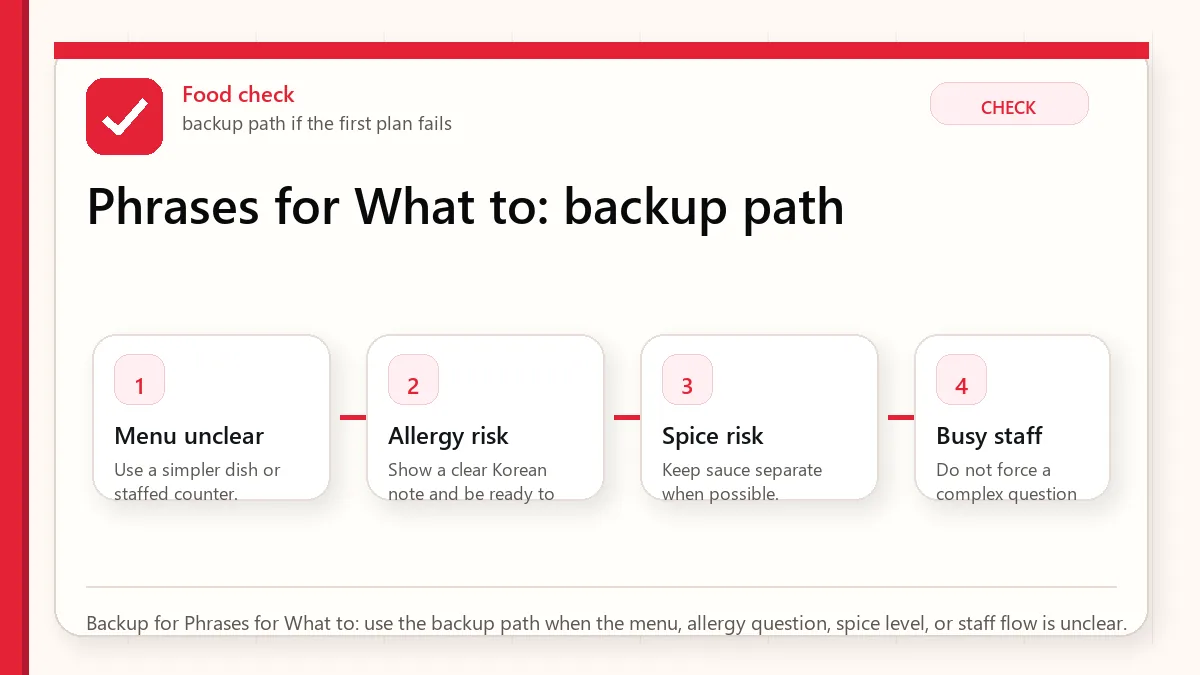
    Layered red check backup flow graphic for Phrases for What to.
    Backup for Phrases for What to: use the backup path when the menu, allergy question, spice level, or staff flow is unclear.

    Taxi, shopping, and payment phrases

    KoreanRomanizationUse
    여기로 가 주세요yeogiro ga juseyoPlease go here.
    카드 돼요?kadeu dwaeyo?Do you take card?
    영수증 주세요yeongsujeung juseyoReceipt, please.
    얼마예요?eolmayeyo?How much is it?
    괜찮습니다gwaenchanseumnidaNo thank you, or it is okay.

    Help and emergency phrases

    For real emergencies, call the relevant emergency number or ask nearby staff for help. For ordinary travel confusion, short phrases work better than long speeches. Dowajuseyo means please help me. Yeongeo haseyo? asks whether someone speaks English. If the situation is complicated, open your translation app and show a clear sentence.

    Pronunciation habits that help

    Do not worry about perfect pronunciation. Speak slowly, do not over-stretch vowels, and avoid shouting English words with Korean endings. Many Korean service workers understand context quickly if you point, show the address, or display a photo. The phrase is only one part of communication; the visual cue often does the rest.

    Use phrases as keys, not speeches

    Tourist Korean works best when it is short. A long translated paragraph can overwhelm a busy cashier or server, especially if the translation app makes the sentence too formal or strange. Use a phrase to open the interaction, then support it with pointing, a photo, a saved address, or a translated note. For example, in a taxi, yeogiro ga juseyo plus a Korean address is stronger than trying to explain the whole route out loud.

    For restaurants, learn patterns rather than isolated words. Igeo juseyo means this, please. Mul jom juseyo means water, please. Yeongsujeung juseyo means receipt, please. Once you understand that juseyo turns a thing into a polite request, you can use menus, photos, and gestures with more confidence.

    When not to rely on spoken phrases

    Do not rely only on pronunciation for allergies, medicine, legal issues, hotel addresses, or emergency details. Use written Korean for anything where accuracy matters. Save your hotel address in Hangul. Prepare allergy text before the meal. Keep your passport name and booking name consistent. Phrases are for everyday friction; written text is for precision.

    FAQ

    Is romanized Korean enough for tourists?

    Yes for basic phrases, but save important addresses and allergy text in Hangul too.

    Should I learn honorific grammar before visiting Korea?

    No. Use standard polite phrases and keep requests simple.

    What is the most useful Korean word for tourists?

    Juseyo is one of the most useful because it turns menu items, objects, and requests into polite tourist language.

    Related Before Korea guides

    Source links to verify

  • Tipping in Korea: What Tourists Should Actually Do in Restaurants, Taxis, Hotels, and Tours

    Tipping in Korea: What Tourists Should Actually Do in Restaurants, Taxis, Hotels, and Tours

    Tipping in Korea is one of the easiest rules for tourists to misunderstand. In many countries, tipping is a kindness or a social duty. In Korea, the normal rule is different: pay the listed price and say thank you. Leaving extra cash can confuse staff, make them think you forgot change, or create an awkward moment that neither side wanted.

    Last checked: June 1, 2026. Re-check the official operator, app, fare, or route page before acting, because routes, prices, labels, rules, app screens, eligibility, and store/service policies can change.

    Last updated: May 24, 2026.

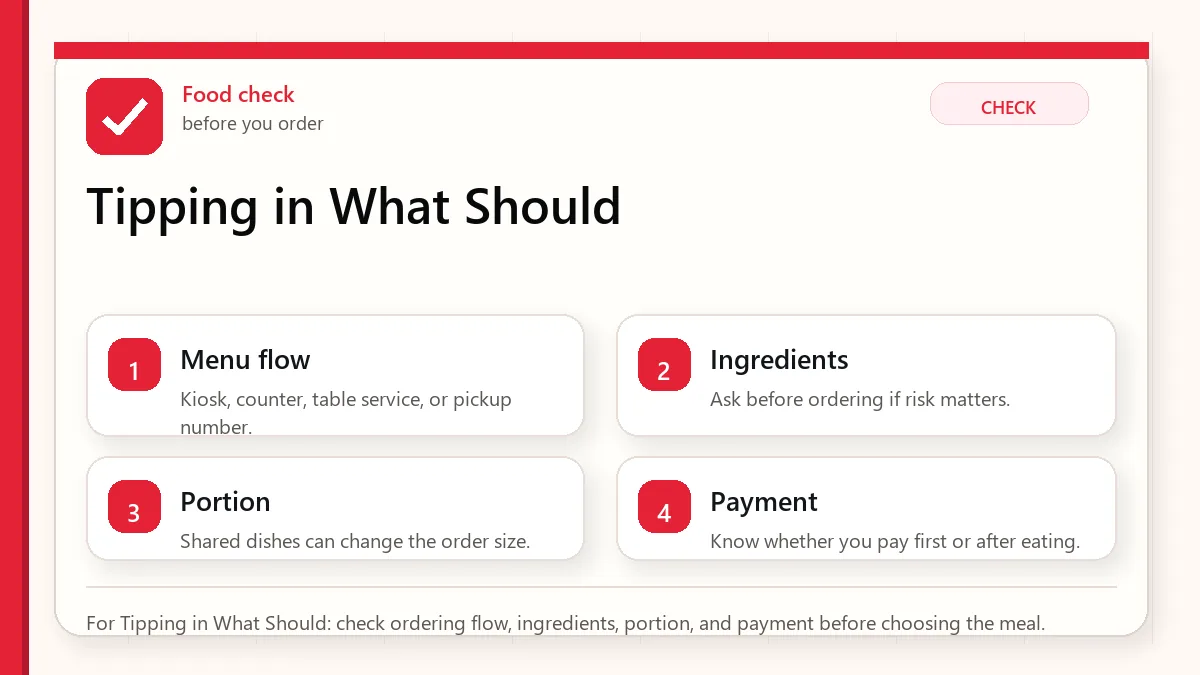
    Layered red check decision graphic for Tipping in What Should.
    For Tipping in What Should: check ordering flow, ingredients, portion, and payment before choosing the meal.

    Start with the pickup and payment fallback

    You generally do not tip in Korea. Do not tip at ordinary restaurants, cafes, taxis, salons, convenience stores, delivery situations, or casual services. For private tour guides, private drivers, high-end hotel luggage help, or a dedicated private-room server, a small discreet thank-you may be optional, but it should never feel required. If someone refuses, accept the refusal gracefully.

    Tipping by situation

    ServiceShould tourists tip?What to do instead
    Standard restaurantNo.Pay at the counter or kiosk and say thank you.
    CafeNo.Order clearly, return tray if required.
    TaxiNo.Pay the fare. Rounding small cash change is optional but not expected.
    HotelUsually no.Say thank you. Luxury luggage help can be a rare exception.
    Private guide or driverOptional in tourist-facing service.Use an envelope or discreet handover at the end.
    Salon or spaNo by default.Pay the listed price.

    Why no tipping feels normal in Korea

    Korean service culture is built around clear prices and professional roles. Good service is not treated as a separate add-on that customers must calculate at the end. That does not mean service workers are not appreciated. It means appreciation is usually expressed through polite words, smooth payment, and not creating extra confusion for staff during a busy shift.

    What can go wrong if you tip casually

    If you leave cash on a restaurant table, staff may chase after you to return it. If you hand loose money to someone who does not expect it, the gesture can feel uncomfortable rather than generous. If a tip jar appears in a tourist-heavy shop, you still should not assume tipping is expected everywhere. The safest visitor rule is simple: no tip unless the setting is clearly a private tourist service where gratuity is explicitly optional.

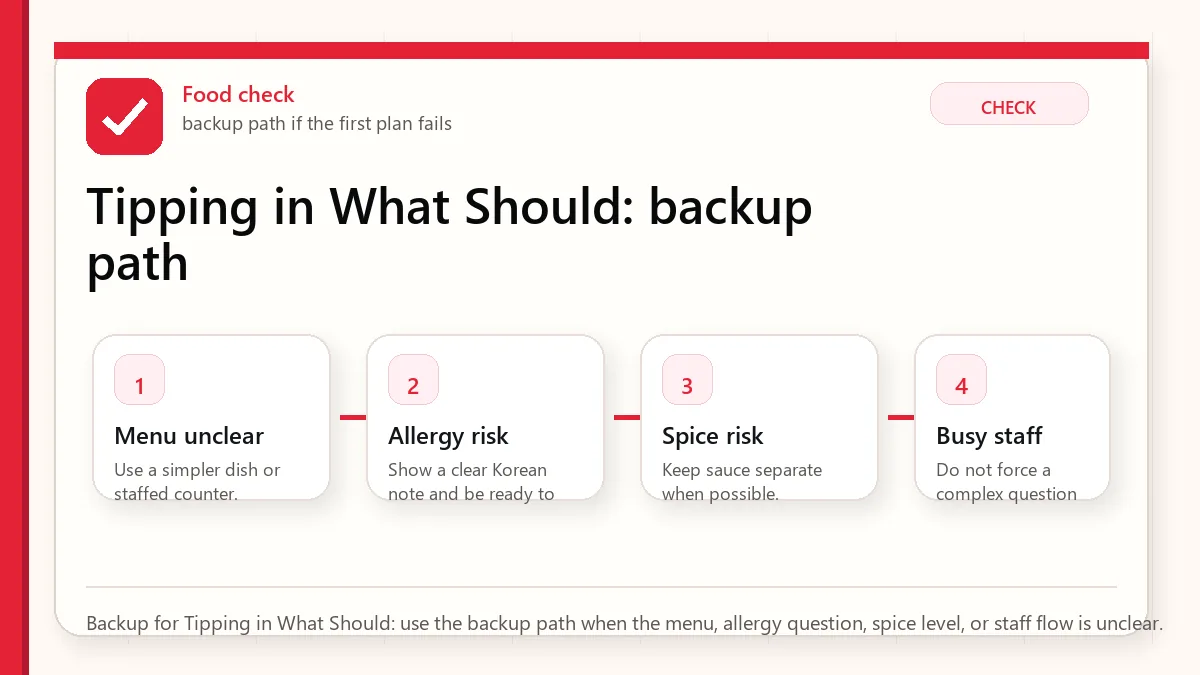
    Layered red check backup flow graphic for Tipping in What Should.
    Backup for Tipping in What Should: use the backup path when the menu, allergy question, spice level, or staff flow is unclear.

    How to show appreciation instead

    Use a clear thank you: gamsahamnida. Hand cards, cash, passports, receipts, or small items with two hands when it feels natural. Do not snap fingers, shout aggressively, or wave money. If staff helped you solve a hard problem, a sincere thank you and calm behavior usually mean more than trying to import a tipping ritual.

    If you choose to tip a private guide

    For a private guide, private driver, or highly personalized tourist-facing service, a small tip can be understood. Present it quietly at the end. A clean envelope is more graceful than loose bills. Use both hands. If the person hesitates or refuses, do not insist. Smile, say thank you, and stop. Pressuring someone to accept a tip makes the gesture about you, not them.

    Why tourists feel uncertain

    Tipping confusion often comes from mixed travel environments. A hotel may feel international, a tour guide may work mostly with foreigners, a restaurant may look upscale, and a taxi driver may help with luggage. Visitors then wonder whether Korean rules or international tourist rules apply. The safest answer is to start from the Korean baseline: no tip. Then only consider an exception if the service is private, personalized, and clearly outside an ordinary transaction.

    This is especially important in restaurants. A nice meal, attentive staff, or extra banchan does not create a tipping obligation. The listed price is the expected price. In fact, trying to force a tip can create more work for staff because they may need to return it or explain that it is not needed.

    Private service exceptions

    Private guides and drivers are the main gray area because they often operate inside international tourism norms. Even there, tipping should stay optional and discreet. Do not tip at the beginning as if buying better behavior. If you choose to offer something, do it at the end, privately, with a short thank you. A written review, punctuality, and clear communication can be just as valuable.

    FAQ

    Do you tip in Korean restaurants?

    No. Pay the listed price and do not leave cash on the table.

    Do taxi drivers in Korea expect tips?

    No. Pay the metered or app fare. Small cash rounding can happen, but it is not expected.

    What if a Korean worker refuses my tip?

    Accept it immediately. Say thank you and do not try to persuade them.

    Related Before Korea guides

    Source links to verify

  • What Not to Do in Korea as a Tourist: Mistakes That Actually Matter

    What Not to Do in Korea as a Tourist: Mistakes That Actually Matter

    “What not to do in Korea” can sound dramatic, but most mistakes are ordinary travel mistakes: choosing the wrong airport route, blocking a subway door, relying on one payment method, assuming Google Maps will answer every question, or treating a shoes-off space like a regular room. Korea is not hard to visit, but it rewards visitors who prepare for local systems before arrival.

    Last checked: June 1, 2026. Re-check the official or primary source page before acting, because routes, prices, labels, rules, app screens, eligibility, and store/service policies can change.

    Last updated: May 24, 2026.

    Layered red check decision graphic for What Not to Do.
    For What Not to Do: check context, space, timing, and tone before acting in shared places.

    Start with the situation, not a rule list

    Do not treat Korea as a country where every familiar travel habit will work automatically. Do not rely on one card, one map app, one airport route, one pair of fashion shoes, or one translation method. Do not be loud on transit, do not sit in priority seats casually, do not step into clean indoor spaces with outdoor shoes, do not leave tips on restaurant tables, and do not photograph strangers without care.

    Mistakes by type

    Mistake typeExampleBetter move
    LogisticsChoosing AREX Express only because it is fastest on paper.Choose by hotel area, transfers, luggage, and arrival time.
    PaymentArriving with only one phone wallet.Carry two cards and a small KRW cash buffer.
    Transit etiquetteStanding in the doorway while checking a route.Step aside first, then check your phone.
    Restaurant flowWaiting forever for staff to bring the bill.Look for counter payment or use the table call button.
    Cultural spaceWalking into a temple hall with shoes or a loud voice.Pause, observe, and follow posted rules.

    Do not confuse inconvenience with disrespect

    Some problems are not cultural mistakes at all. A foreign card failing at a kiosk, a delivery app asking for a Korean phone number, or a subway transfer feeling difficult with luggage are system-friction problems. Treat them practically. Move to a staffed counter, use a backup payment method, save Korean addresses, and build extra time into arrival day.

    Do not overpack your schedule

    First-time Korea itineraries often look reasonable on a map and exhausting in real life. Subway exits can be far apart. Cafes may have waits. Popular streets can be crowded. Palace, market, shopping, dinner, and nightlife in one day may leave you tired before the best part begins. The better approach is one anchor area in the morning, one flexible neighborhood in the afternoon, and a simple dinner plan near your route.

    Layered red check backup flow graphic for What Not to Do.
    Backup for What Not to Do: use the backup path when you are unsure of the local flow.

    Do not rely on one app

    Install more than one tool before arrival. Naver Map or KakaoMap can be stronger for local places and transit. Papago is useful for menus and signs. Your hotel booking app holds the address. A taxi or ride app can help late at night. Google Maps is still useful for orientation, but it should not be your only Korea navigation plan.

    Do not make tipping awkward

    Korea is generally a no-tipping country. Leaving cash on a restaurant table can make staff think you forgot your money. For ordinary restaurants, taxis, cafes, salons, and delivery, pay the listed price and say thank you. Private tours or luxury services can be different, but they are exceptions, not the rule.

    Do not photograph people as background props

    Korea is extremely photogenic, especially around markets, cafes, palaces, and shopping streets. That does not mean every staff member, child, older resident, or stranger in hanbok is part of your content. Shoot wider scenes, wait for a clear moment, or ask permission when a person is the subject. Be extra careful inside small shops, restaurants, and religious spaces.

    What is serious versus simply awkward

    Not every mistake has the same weight. Sitting briefly in the wrong seat, using the wrong restaurant door, or mispronouncing a phrase is usually just awkward. Smoking in prohibited areas, ignoring safety barriers, filming people closely without permission, or bringing restricted medicine without checking rules can be much more serious. Separate social discomfort from legal or safety risk so you do not worry about the wrong things.

    For most first-time visitors, the highest-impact mistakes are practical rather than cultural. A failed card can stop dinner. A bad airport route can ruin arrival night. A wrong hotel area can add an hour of travel every day. A medicine rule you did not check can become an airport problem. Handle those first, then refine your etiquette.

    The traveler’s recovery script

    If something goes wrong, use a simple sequence: stop doing the thing, step aside, apologize briefly, and follow the corrected flow. You rarely need a long explanation. In a restaurant, show the menu item. In a subway station, move away from the gate. In a shop, use the payment method staff points to. Calm recovery is part of good etiquette.

    FAQ

    What is the biggest first-time Korea mistake?

    Trying to solve every trip problem after landing. Payment, maps, hotel area, airport route, and phone setup should be prepared before departure.

    Are Koreans offended easily by tourists?

    No. Most small mistakes are fine if you notice, apologize, and adjust. Loud, careless, or repeated behavior is the real issue.

    Should I avoid Korea if I do not speak Korean?

    No. Learn a few phrases, install translation tools, and keep addresses saved in Korean where possible.

    Related Before Korea guides

    Source links to verify

  • Korea Etiquette for Tourists Before Visiting: What Actually Matters

    Korea Etiquette for Tourists Before Visiting: What Actually Matters

    Korea etiquette for tourists is not about memorizing a long list of cultural rules. Most visitors only need to understand a few everyday patterns: public spaces are shared quietly, shoes come off in certain clean indoor spaces, restaurants often expect customers to be more active, tipping is not the default, and small mistakes are usually recoverable if you stay calm and polite.

    Last checked: June 1, 2026. Re-check the official or primary source page before acting, because routes, prices, labels, rules, app screens, eligibility, and store/service policies can change.

    Last updated: May 24, 2026.

    Layered red check decision graphic for Etiquette for Visiting What.
    For Etiquette for Visiting What: check context, space, timing, and tone before acting in shared places.

    Start with the situation, not a rule list

    If you are visiting Korea for the first time, focus on five habits: keep your voice low on transit, let people exit before boarding, remove shoes when the floor or doorway clearly signals it, pay at the front counter when the restaurant flow points that way, and use simple polite phrases such as annyeonghaseyo, gamsahamnida, and joesonghamnida. These habits matter more than trying to perform every formal custom perfectly.

    The etiquette that matters most

    SituationGood tourist habitWhy it matters
    Subway and busQuiet voice, organized bag, clear boarding line.Transit is a dense shared space.
    Shoes-off spacesPause at the entrance and copy the local flow.Clean floor culture is still practical in homes, hanok stays, temples, and some restaurants.
    RestaurantsUse the call button, self-serve water when indicated, pay at the counter.Korean service is efficient and less table-interruptive.
    CafesOne drink per seated person, no outside food, return tray if required.Many cafes are small, high-turnover businesses.
    PhotosAvoid photographing strangers, staff, children, and private interiors without permission.Privacy matters even in photogenic spaces.

    Shoes-off etiquette

    The simplest rule is visual: if you see a lower entry area, shoe shelves, slippers, or other people removing shoes, stop and remove yours. Do not step onto the raised clean floor with outdoor shoes. Keep socks trip-ready, especially in summer, because bare feet can feel awkward in semi-public traditional spaces. If bathroom slippers are provided in a guesthouse or traditional stay, use them only inside the bathroom and do not walk back into the room wearing them.

    Public space etiquette

    Korean public life can be fast and crowded, but the expected sound level is often lower than visitors expect. On the subway, avoid long phone calls and loud group conversations. In cafes, restaurants, and hotel lobbies, match the room rather than your travel excitement. On sidewalks and station corridors, step aside before checking your phone or map. The mistake is not being foreign. The mistake is blocking a flow that everyone else is trying to use.

    Layered red check backup flow graphic for Etiquette for Visiting What.
    Backup for Etiquette for Visiting What: use the backup path when you are unsure of the local flow.

    Restaurant and cafe etiquette

    Many restaurants do not use the same service rhythm as Western restaurants. Staff may not check on you repeatedly. Look for a call button on the table, a utensil drawer, a water station, and a front counter for payment. If there is no button, raise a hand and say jeogiyo or yeogiyo. In cafes, the one-drink-per-person expectation is common when you sit down. Return trays and sort waste when the cafe has a visible return station.

    Temples, palaces, and traditional areas

    At temples, lower your voice, avoid running, follow photo restrictions, and remove shoes before entering halls when required. Palaces are more open and visitor-friendly, but they are still cultural spaces. Do not climb on walls, block narrow photo spots for a long time, or treat hanbok rental as permission to ignore staff directions. A small amount of restraint makes these places better for everyone.

    How to recover from a mistake

    Tourists make mistakes. The best recovery is short and plain: stop, step back, say sorry, and adjust. A small bow and joesonghamnida work better than a long explanation. Do not turn an etiquette correction into a debate. Most awkward moments disappear quickly when you respond lightly and move on.

    The difference between etiquette and performance

    A useful Korea etiquette guide should not make visitors feel they need to act like locals. Tourists are not expected to understand every age-based or social nuance. What people notice more is whether you are paying attention. Do you lower your voice when the train is quiet? Do you move out of the doorway before checking your phone? Do you notice shoes at the entrance before stepping inside? These small signals matter because they show that you are reading the space rather than treating every place as a tourist stage.

    Do not overperform etiquette either. Deep bows, exaggerated Korean phrases, or nervous apologies after every small interaction can feel unnatural. A calm greeting, a clear request, and a simple thank you are enough in most shops, cafes, hotels, and restaurants. The best visitor behavior is relaxed but observant.

    How to judge a new situation

    When you are unsure, pause for three seconds and watch the local flow. Where do people queue? Are they returning trays? Are they removing shoes? Are they paying first or after eating? Are they taking photos freely or keeping phones away? This “watch first” habit solves more problems than memorizing a long etiquette list. It also keeps your trip from feeling tense.

    FAQ

    Do tourists need to bow in Korea?

    A small nod or slight bow is enough for most tourist situations. You do not need formal deep bows.

    Is Korea strict about etiquette?

    Daily life is more flexible than etiquette lists suggest. Shared-space behavior matters more than perfect cultural performance.

    Can I speak English in Korea?

    Yes, but do not assume every staff member is comfortable in English. Use simple phrases, translation apps, and patience.

    Related Before Korea guides

    Source links to verify

  • Korea Travel Budget: Daily Cost, Cash Buffer, Transport, Food, and Shopping Reality

    Korea Travel Budget: Daily Cost, Cash Buffer, Transport, Food, and Shopping Reality

    Korea is not a rock-bottom budget destination, but it is still manageable because public transport is efficient, casual meals are widely available, and many cultural sites are inexpensive or free. The part that breaks budgets is usually not the subway. It is accommodation area, airport transfer choices, cafes, taxis, cosmetics, shopping, and the quiet habit of buying “just one more” small item every day.

    Last checked: June 1, 2026. Re-check the official operator, app, fare, or route page before acting, because routes, prices, labels, rules, app screens, eligibility, and store/service policies can change.

    Last updated: May 24, 2026.

    Layered red check decision graphic for Travel Budget Daily Cost.
    For Travel Budget Daily Cost: check the payment method, cash backup, receipt, and refund step before relying on one option.

    Start with the label and return risk

    Excluding international airfare, a careful backpacker can plan a low daily budget, a normal mid-range visitor should budget substantially more once accommodation is included, and families should model the trip by room cost rather than per-person meals alone. Carry cards as the main payment method, but keep a KRW cash buffer for transit top-ups, markets, taxis, and payment failures.

    Budget tiers

    Trip styleWhere money goesBefore Korea planning note
    Budget travelerGuesthouse or simple hotel, subway, cheap meals, limited cafes.Possible, but room location matters more than squeezing food too hard.
    Mid-range travelerShared hotel room, local meals, cafes, a few taxis, some shopping.The most realistic first-time Seoul profile.
    Family tripRoom size, airport transfer, easy meals, taxis, attraction timing.Budget by comfort and friction, not just per-person food cost.
    Shopping-heavy tripCosmetics, fashion, Daiso, snacks, tax refund planning.Keep shopping outside the daily living budget.
    Layered red check backup flow graphic for Travel Budget Daily Cost.
    Backup for Travel Budget Daily Cost: use the backup path when a card, ATM, kiosk, or refund step does not work.

    Food and cafe spending

    Food is the easiest part to control if you mix casual restaurants, convenience-store meals, street food, and normal cafes. The budget rises when you add Korean BBQ, dessert cafes, premium coffee stops, alcohol, hotel breakfasts, or trendy restaurants with queues. A practical day might be cheap breakfast, casual lunch, cafe, and one sit-down dinner. A more expensive day adds BBQ, dessert, taxi, and shopping.

    Transport spending

    Subway and bus travel is usually a small daily cost if you use a transport card and avoid unnecessary taxis. Taxis are useful late at night, with luggage, with children, or when the route is awkward. Airport transfer is a separate budget line: AREX all-stop is cheap, AREX Express is faster to Seoul Station, airport bus is often better for hotel areas, and taxi can be reasonable for groups.

    How much cash to bring

    Do not carry the entire trip budget in cash. Cards should do most of the work. A practical starting buffer is enough for transit-card loading, a taxi backup, a market purchase, and one card-failure day. Increase the buffer if you are visiting traditional markets, smaller cities, rural areas, or if your cards have a history of overseas declines.

    Shopping is not a daily-cost line

    Skincare, snacks, fashion, stationery, and souvenirs can quietly double a trip budget. Create a separate shopping envelope before entering Olive Young, Daiso, department stores, or duty-free. Tax refund can reduce the sting, but it should not justify unsuitable purchases.

    Build the budget from friction points

    Averages are useful, but a Korea travel budget becomes realistic only when it includes friction points. The first day may cost more because of airport transport, SIM or eSIM setup, T-money purchase, hotel check-in timing, and a low-energy meal near accommodation. Shopping days can distort the daily average. Long-distance rail days and theme-cafe days behave differently from neighborhood walking days.

    Instead of asking only “how much does Korea cost per day,” divide the budget into sleep, movement, food, coffee and snacks, paid attractions, shopping, and payment backup. This makes tradeoffs visible. A visitor can spend modestly on food and still overspend through taxis and cosmetics, or book cheap accommodation and lose time commuting across the city.

    Cash buffer versus cash budget

    Before Korea separates cash buffer from trip budget. Your trip budget is the total spending plan. Your cash buffer is the small amount you keep available for transit top-ups, tiny shops, market snacks, failed terminals, luggage lockers, or unexpected taxi situations. These are different. Carrying a sensible cash buffer does not mean Korea is a cash-only destination.

    Replenish cash during normal hours in a commercial area rather than waiting until a late-night problem. Also keep one backup card separate from the main wallet. The cheapest trip is not always the one with the smallest cash amount; it is the one with the fewest emergency mistakes.

    Where visitors accidentally overspend

    The most common overspending categories are not always luxury hotels. They are repeated cafe stops, convenience-store snacks, taxi rides caused by tired planning, small beauty purchases that add up, and buying duplicates because every product feels uniquely Korean. Put a daily shopping pause into the plan: if an item is not essential, photograph it, compare later, and buy it on the last shopping day if it still makes sense.

    Official links to check

    Use these official links when the next step matters. This guide explains what to watch for, but app downloads, eligibility, prices, routes, policies, and service rules can change.

    FAQ

    Is Seoul expensive?

    Seoul can be expensive through hotels, cafes, taxis, nightlife, and shopping. Basic transit and casual meals remain manageable.

    Do I need cash for every day?

    No. You need a cash buffer, not a cash-only trip plan.

    What is the biggest hidden cost?

    Accommodation area and shopping. A hotel in the wrong district can add taxis and fatigue; shopping can expand without feeling like a major purchase.

    Related Before Korea guides

    Source links to verify

  • Incheon Airport to Seoul Hotel Areas

    Incheon Airport to Seoul Hotel Areas

    The best route from Incheon Airport to Seoul depends on your hotel area, luggage, arrival time, and transfer tolerance. AREX, airport buses, taxis, and night options solve different problems, so choose by the door you need to reach, not only by speed.

    Last checked: June 1, 2026. Re-check the official operator, app, fare, or route page before acting, because routes, prices, labels, rules, app screens, eligibility, and store/service policies can change.

    Last updated: May 27, 2026. Routes, fares, stops, station exits, app listings, and operating hours can change, so re-check before you move.

    Layered red check decision graphic for Airport to hotel areas.
    For Airport to hotel areas: check the station, exit, Korean address, and backup route before starting the trip.

    Quick answer by hotel area

    Hotel areaBest first choiceWhen to change plans
    Seoul StationAREX Express or all-stop depending budget and timing.Taxi if you have several bags and a hotel not close to exits.
    Hongdae / MapoAREX all-stop to Hongik Univ. or Gongdeok.Airport bus if the stop is closer than the station exit.
    Myeongdong / NamdaemunAirport limousine bus if it stops near your hotel.AREX plus subway/taxi if traffic is the bigger concern.
    Gangnam / COEX6703 bus or taxi for groups.Train only if budget matters more than transfer friction.
    Jamsil6705A bus if it matches your hotel.Taxi if late, with children, or far from the bus stop.
    Layered red check backup flow graphic for Airport to hotel areas.
    Backup for Airport to hotel areas: use the backup path when the fastest-looking route becomes hard to follow.

    AREX Express vs all-stop train

    AREX Express is cleanest when Seoul Station is your destination or your transfer point. It is non-stop, seat-reserved, and easier mentally after a long flight. But if you are staying in Hongdae, Gongdeok, or Mapo, the all-stop train often wins because it stops where you actually need to go. Paying more for the express and then backtracking can be a beginner mistake.

    Why Myeongdong is a bus district

    Myeongdong is not directly on AREX. You can still use the train, but the final transfer can be awkward with bags. Airport buses are competitive because several routes serve hotel clusters around Myeongdong, Namdaemun, Lotte Hotel, Myeongdong Station, and nearby stops. The catch is exact frontage. A bus that is perfect for one Myeongdong hotel can be clumsy for another.

    When a taxi is not irrational

    A solo traveler usually saves money on rail or bus. A group of three or four going to one hotel may find a taxi surprisingly reasonable once you compare total party cost. It also avoids elevator hunts, station exits, and missed hotel stops. Taxi becomes especially logical late at night, with children, with more than one suitcase per person, or when your hotel is not close to a train or bus stop.

    Late-night arrival plan

    Late arrival compresses your choices. Check whether rail still runs, whether a night bus serves your district, and whether your hotel can receive a late check-in. If you land after normal rail and bus convenience fades, a taxi is not a luxury; it may be the practical arrival tool.

    Luggage and family checklist

    • Count bags before choosing the route, not after you reach the platform.
    • Check whether the station exit has elevators or escalators.
    • For buses, match the official stop list to the exact hotel area.
    • For families, consider bathroom breaks, stroller handling, and child fatigue.
    • Keep hotel address in Korean for taxi or help desk use.

    Choose by hotel area, not by headline speed

    The fastest advertised train is not always the fastest door-to-door route. Seoul Station is excellent for train access and onward rail, but it may still require a subway transfer or taxi to your hotel. Hongdae often fits the all-stop AREX well because the airport railroad goes directly toward Hongik University. Myeongdong can be smoother by airport bus if the stop is near your hotel. Gangnam and Jamsil often make airport buses or taxis more competitive because crossing the city by rail with luggage can be tiring.

    Before choosing, place your hotel on a map and answer three questions: how many transfers are required, whether the final station has elevators or escalators in the direction you need, and how far the walk is after exit. A ten-minute walk without luggage can become a rough arrival if you are carrying two suitcases through stairs, rain, or late-night streets.

    The luggage and arrival-time test

    Light travelers arriving during the day can prioritize speed and cost. Families, elderly travelers, first-time visitors, and people with large luggage should prioritize fewer transfers and a clear final stop. Late-night arrivals should check the last train and bus options before landing. If public transport is finished, the choice becomes taxi, late-night airport bus where available, or staying near the airport for the first night.

    Do not underestimate terminal difference. Incheon Terminal 2 adds time compared with Terminal 1 for some routes. Also include immigration, baggage claim, SIM or eSIM setup, ATM or T-money setup, and walking time inside the airport. Your actual “airport to hotel” time starts after the plane door opens, not when the train timetable begins.

    When taxi is rational

    A taxi is not always a luxury mistake. For three or four people, late arrival, heavy luggage, bad weather, or a hotel far from subway exits, taxi can be the cleanest option. The tradeoff is traffic, tolls, fare uncertainty, and the need to show the destination clearly. Keep your hotel address in Korean and confirm whether the driver understands the exact entrance, not just the neighborhood.

    Official links to check

    Use these official links when the next step matters. This guide explains what to watch for, but app downloads, eligibility, prices, routes, policies, and service rules can change.

    FAQ

    Is AREX always the best airport route?

    No. It is excellent for Seoul Station and Hongdae-style rail access, but buses or taxis can be better for Myeongdong, Gangnam, Jamsil, or heavy luggage.

    Should I buy bus tickets in advance?

    Check the current airport and operator rules, especially from Terminal 2. Some downtown routes may require or strongly favor advance ticketing.

    Can I use T-money from the airport?

    You can use a transport card on the all-stop rail and Seoul transit, but premium airport products and buses may have separate ticket rules.

    Related guides

    Source links to verify

  • Korea Entry Checklist: K-ETA and e-Arrival

    Korea Entry Checklist: K-ETA and e-Arrival

    Before flying to Korea, separate K-ETA, e-Arrival Card, visa-free entry, customs declaration, and Q-CODE instead of treating them as one form. The exact mix depends on your passport, trip date, airline, and items you carry.

    Search intent check: korea e arrival card

    Searchers arriving for korea e arrival card usually want a fast official-source path, not a broad background article. The page should make the next check obvious in the first screen.

    • Traveler Decision: make this visible near the top of the page.
    • App Or Official Source: make this visible near the top of the page.
    • Backup Plan Before Arrival: make this visible near the top of the page.

    Operating note: this section was added after global Keyword Planner review so the page better matches the main query cluster.

    Last checked: June 1, 2026. Re-check the current Korean government or customs page before acting, because routes, prices, labels, rules, app screens, eligibility, and store/service policies can change.

    Last updated: May 27, 2026. Entry rules, forms, customs guidance, airport procedures, and eligibility details can change, so re-check official sources before travel.

    Layered red check decision graphic for Entry documents.
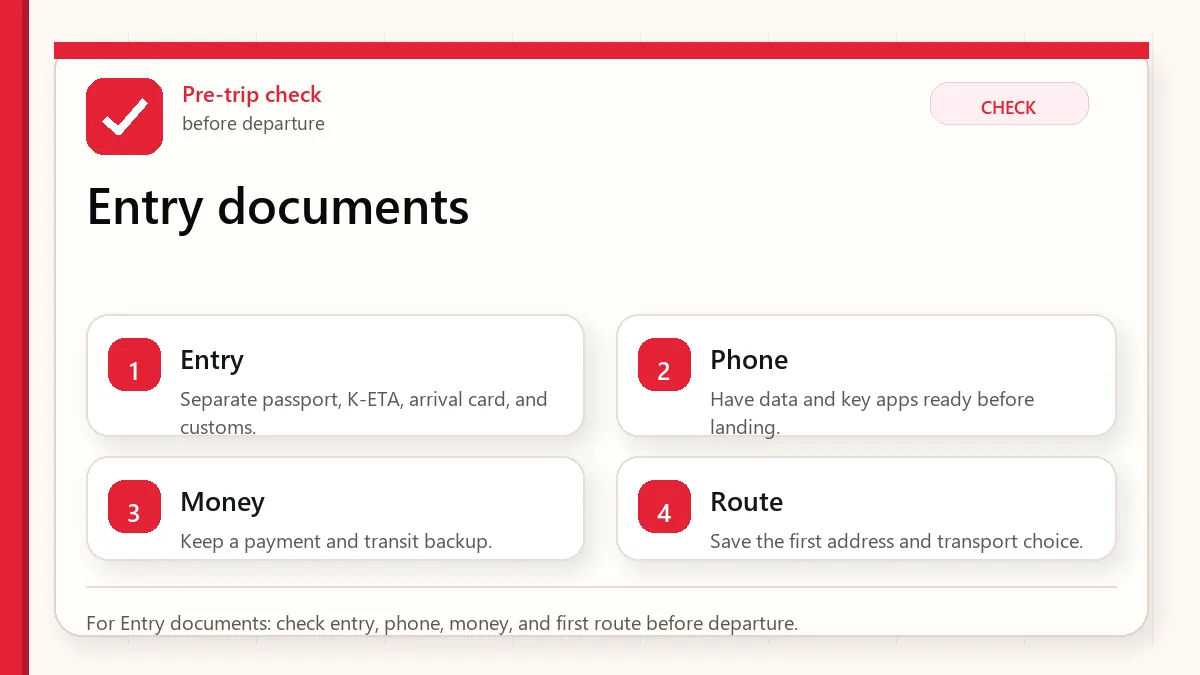
    For Entry documents: check entry, phone, money, and first route before departure.

    Start with the official requirement for your trip

    Start with your passport nationality. If you are visa-free, check whether K-ETA is required or temporarily exempt. If you do not hold K-ETA, check whether you need the e-Arrival Card. Then check passport validity, customs declaration triggers, and Q-CODE or health questionnaire rules if you are coming from a designated region. Use official websites, not travel-forum screenshots.

    K-ETA vs e-Arrival Card

    SystemWhat it doesCommon mistake
    K-ETAElectronic travel authorization for eligible visa-free travelers when required.Thinking approval guarantees entry or replaces visa rules.
    e-Arrival CardOnline arrival-card submission for travelers who need arrival-card information.Thinking K-ETA-exempt means form-exempt.
    VisaPermission path for travelers not covered by visa-free/K-ETA routes.Trying to use K-ETA when nationality is not eligible.
    Q-CODEHealth/quarantine information when required for designated regions.Assuming old COVID rules are gone forever for every origin.
    Customs declarationGoods, currency, restricted items, food, plants, animal products, and allowance issues.Thinking “tourist” means nothing to declare.
    Layered red check backup flow graphic for Entry documents.
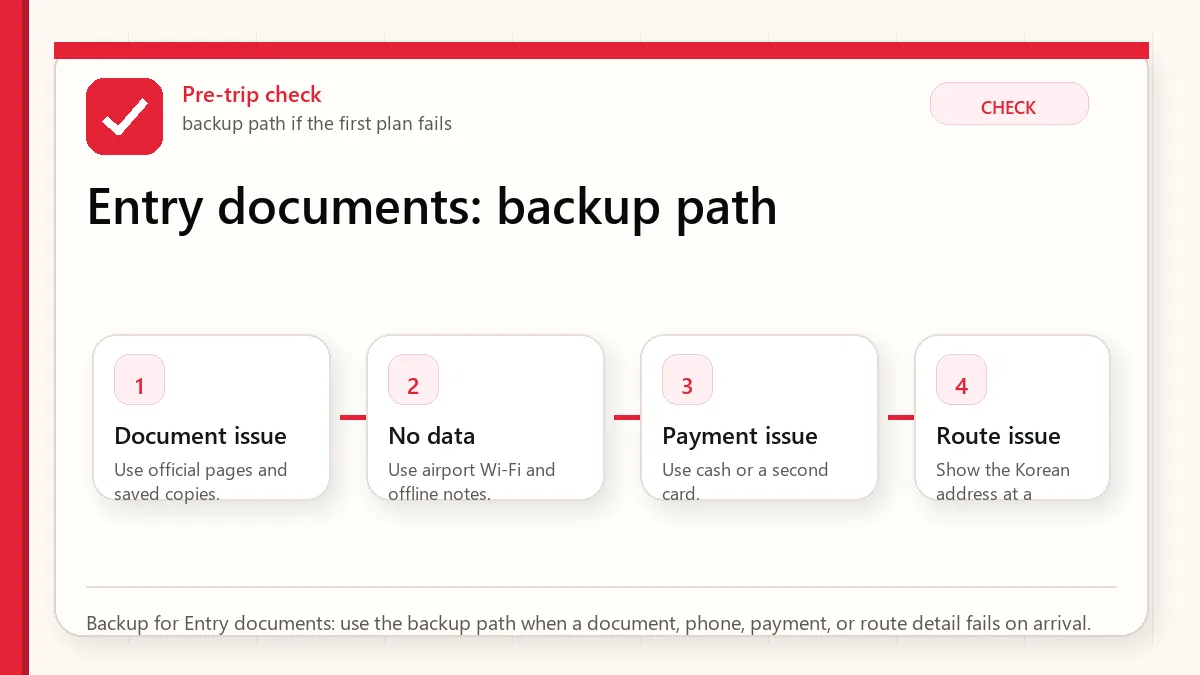
    Backup for Entry documents: use the backup path when a document, phone, payment, or route detail fails on arrival.

    The 2026 entry workflow

    1. Check whether your passport nationality is visa-free or visa-required.
    2. If visa-free, check whether you need K-ETA or are temporarily exempt.
    3. If K-ETA is required, apply only on the official K-ETA site or app.
    4. If you do not hold K-ETA, complete the e-Arrival Card if required.
    5. Check passport validity against your stay, visa application needs, and airline rules.
    6. Review customs triggers: high-value goods, restricted items, food, plants, animal products, and currency over USD 10,000 equivalent.
    7. Check Q-CODE or health questionnaire requirements close to departure if your travel history includes designated regions.

    Passport validity: do not rely on a slogan

    Travel blogs often say “six months required,” but official material can be more nuanced. For visa applications, Korean missions often ask for at least six months. For visa-free entry, the key risk is whether your passport comfortably covers the stay and whether the airline will board you. If your passport is close to expiry, verify with the official mission and airline before you travel.

    Customs and food caution

    Korea’s customs rules matter for tourists carrying large cash amounts, alcohol, tobacco, expensive purchases, animal products, plants, meat, fruits, medicines, or commercial-looking goods. If you are not sure, declare or ask. A small inconvenience at customs is better than a penalty for failing to declare.

    Useful document pack

    • Passport photo page screenshot and physical passport.
    • K-ETA approval or visa evidence if applicable.
    • e-Arrival Card completion screenshot if applicable.
    • Hotel address in English and Korean.
    • Return or onward flight information.
    • Customs notes for high-value shopping, medicine, or special items.

    Separate the four checks

    Korea entry planning becomes easier when you separate four workflows: permission to travel, arrival information, customs, and health-related declarations. K-ETA belongs to the permission-to-travel layer for eligible visa-free travelers unless an exemption applies. The e-Arrival Card is arrival information. Customs declaration is about what you bring. Q-CODE is health-related and can matter when disease-control rules are active or when the traveler is asked to provide health information.

    Travelers often make mistakes because they treat every form as the same form. They are not the same. One may be tied to your passport and boarding eligibility, another to immigration processing, another to goods and cash you carry, and another to public-health screening. Keeping them separate makes it easier to know what you have completed and what remains.

    The three-day arrival window

    Some arrival information should be handled close to travel because it asks for final flight and accommodation details. Build a simple timeline: check passport, visa or K-ETA situation, and airline rules when you book; confirm hotel address and first-night contact information one week before travel; complete time-sensitive arrival forms within the official window before departure; then save confirmations offline before you go to the airport.

    Do not rely only on a live internet connection at the departure airport. Keep a screenshot or PDF of important approvals, your hotel name and address in English and Korean if available, outbound or onward travel proof if relevant, and emergency contact details. This is not because entry is normally difficult; it is because a small document problem is much easier to fix before you stand in a line.

    Customs and practical packing

    Customs is where ordinary travelers accidentally create avoidable stress. Food, medication, high-value goods, large cash amounts, commercial quantities, and restricted items deserve attention before packing. If you carry prescription medicine, keep it in original packaging where possible and bring supporting documentation. If you plan to shop heavily in Korea, remember that your home country’s customs rules also matter on the return trip.

    Official links to check

    Use these official links when the next step matters. This guide explains what to watch for, but app downloads, eligibility, prices, routes, policies, and service rules can change.

    FAQ

    Do K-ETA holders need the e-Arrival Card?

    In general, K-ETA holders are treated differently from travelers who need to submit arrival-card information. Check the official e-Arrival site for your situation.

    Is the e-Arrival Card free?

    The official e-Arrival Card is free. Be careful with unofficial pages that look like government services.

    Can requirements change?

    Yes. Entry, health, and customs rules can change, which is why this guide points you back to official portals.

    Related guides

    Source links to verify

  • Myeongdong vs Hongdae: Where to Stay in Seoul

    Myeongdong vs Hongdae: Where to Stay in Seoul

    Myeongdong and Hongdae are two of the most common Seoul bases for first-time visitors. Both are practical, both have hotels, food, shopping, and transit, and both can be the right answer. The difference is the kind of friction each one removes.

    Hongdae or Myeongdong: quick choice

    Hongdae or Myeongdong is mostly a travel-style decision. Pick Myeongdong if you want the easiest first Seoul base for shopping, airport access, and first-time sightseeing. Pick Hongdae if nightlife, cafes, younger energy, and late meals matter more than being near classic central attractions.

    If you are split, use Myeongdong for a short first trip and Hongdae for a longer stay with more evenings out. For a more direct long-tail answer, see Hongdae or Myeongdong.

    Hongdae or Myeongdong: direct answer

    Choose Myeongdong for a first Seoul trip with shopping, central movement, and easier tourist routing. Choose Hongdae for nightlife, cafes, music, and a younger street atmosphere. The better answer is the one that reduces your repeated subway transfers, not the one that sounds more famous.

    Search intentBetter fitCheck before booking
    First-time Seoul, shopping, central landmarksMyeongdongWalking route from station exit to hotel.
    Nightlife, cafes, music, late eveningsHongdaeNoise level and exact distance from Hongik Univ. Station.
    Airport train convenienceOften Hongdae for AREX All Stop accessYour arrival time and luggage route.

    For the exact long-tail page, use Hongdae or Myeongdong. For map checks, use Naver Map Korea guide.

    Last checked: June 1, 2026. Re-check the official or primary source page before acting, because routes, prices, labels, rules, app screens, eligibility, and store/service policies can change.

    Last updated: May 24, 2026.

    Layered red check decision graphic for Myeongdong vs Hongdae Where.
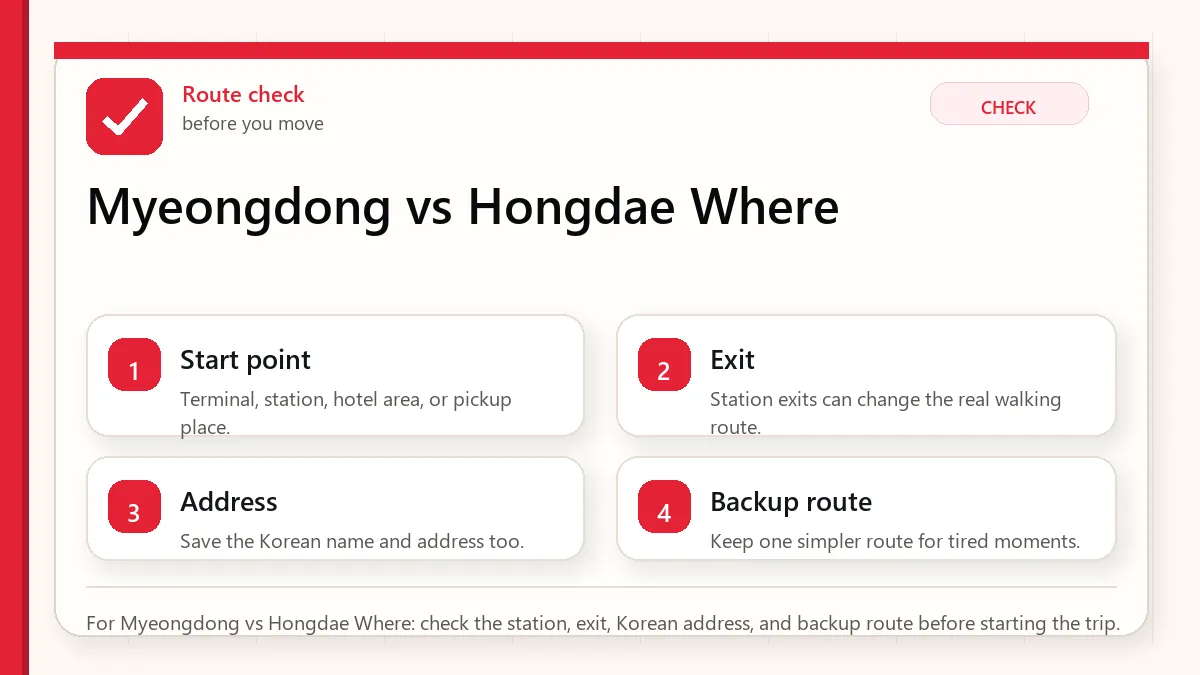
    For Myeongdong vs Hongdae Where: check the station, exit, Korean address, and backup route before starting the trip.

    Start with the route you will actually take

    Choose Myeongdong if you want central sightseeing, shopping convenience, easy first-day orientation, and a more classic tourist base. Choose Hongdae if you want nightlife, cafes, youth culture, music, and a direct airport-rail feeling. If sleep quality and quiet streets matter, check the exact hotel location in both areas.

    Best for different travelers

    Traveler typeBetter choiceWhy
    First trip, classic sightseeingMyeongdongCentral, predictable, close to many tourist routes.
    Nightlife and cafesHongdaeMore social and energetic after dark.
    Beauty and shopping focusMyeongdongDense cosmetics, department stores, and tourist shopping.
    Younger friend groupHongdaeCasual food, music, bars, and late-night streets.
    Family with small childrenMyeongdong or another calmer central baseHongdae can be noisy depending on the street.
    Airport rail priorityHongdaeHongik University Station is on the airport railroad line.
    Layered red check backup flow graphic for Myeongdong vs Hongdae Where.
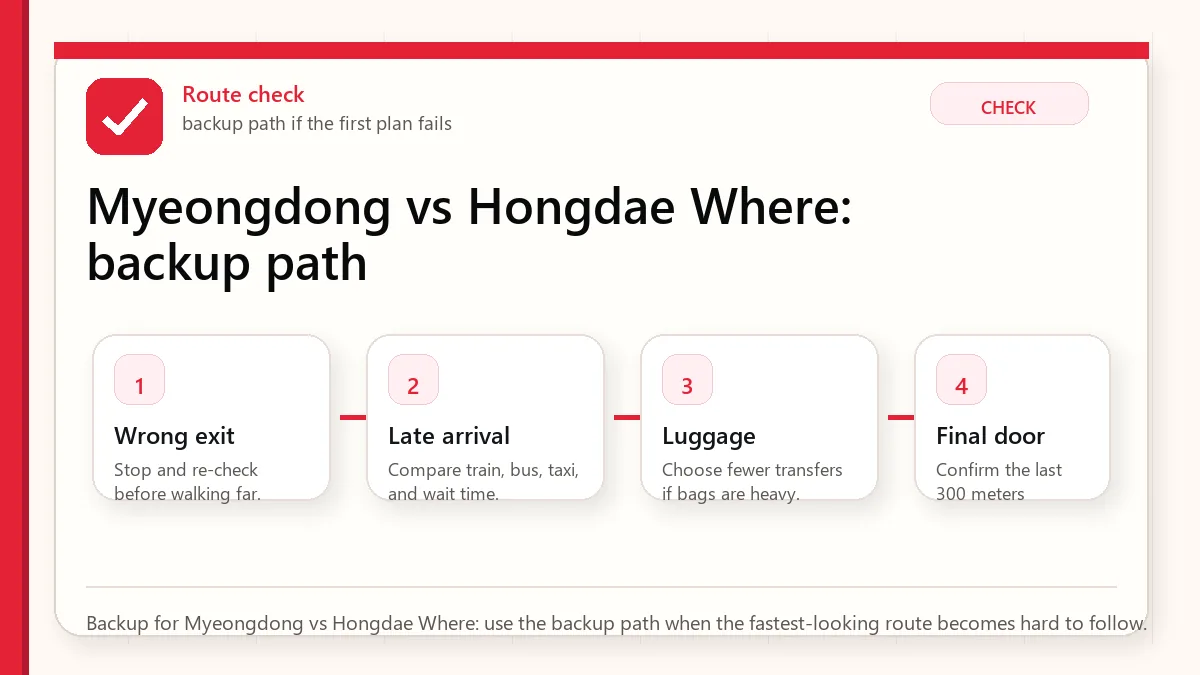
    Backup for Myeongdong vs Hongdae Where: use the backup path when the fastest-looking route becomes hard to follow.

    Why Myeongdong works

    Myeongdong is easy. It has hotels, cosmetics shops, money exchange, street food, cafes, department stores, and access to central Seoul. It is a forgiving area when you are jet-lagged and still learning Korean transit. For a first visit, that forgiveness has value.

    The downside is that Myeongdong can feel commercial. If you want a quieter, more local neighborhood, it may not be your favorite. But if your first priority is not getting lost or wasting energy, it remains a strong base.

    Why Hongdae works

    Hongdae feels younger and more casual. It is good for cafes, street energy, music, small shops, bars, and late-night food. The airport railroad connection is a real advantage for travelers with lighter luggage. It can also be more fun if your trip is less palace-and-department-store and more cafe-and-night-street.

    The downside is noise and crowds. A hotel close to the busiest nightlife streets may be tiring. A hotel slightly outside the loudest zone can give you the best of both worlds.

    How to choose your exact hotel

    • Check the walk from the nearest station exit, not only the station name.
    • Read recent reviews for noise, elevator wait, heating/cooling, and room size.
    • Use Naver Map to see whether the hotel is on a hill, side street, or main road.
    • Think about when you will return at night. A lively street at 10 p.m. can be loud at 1 a.m.

    Myeongdong, Hongdae, and Dongdaemun comparison searches

    Searches such as Dongdaemun vs Hongdae, Dongdaemun or Hongdae, Myeongdong or Hongdae to stay, and Hongdae to Myeongdong are usually not only about distance. They are about first-trip convenience, late-night transport, shopping, food, airport access, and how much nightlife or crowd energy the visitor wants.

    For a first Korea trip, compare the neighborhood by daily route, subway transfer burden, airport arrival time, and whether you prefer shopping convenience, youth nightlife, or market access.

    Dongdaemun vs Hongdae: which area fits your Seoul trip?

    Quick answer: choose Hongdae if you want nightlife, cafes, music, student energy, and easier west-side movement. Choose Dongdaemun if you want late-night shopping, fashion markets, design/plaza access, and a more central-east base near multiple subway lines.

    Traveler needHongdaeDongdaemun
    Nightlife and cafesStronger choice for bars, music, and casual food.Useful, but less youth-nightlife focused.
    ShoppingGood for street fashion and small shops.Stronger for malls, markets, and late-night fashion shopping.
    Airport movementConvenient if using Hongik University station and AREX All Stop.Often needs a transfer or airport bus check.
    First Seoul tripGood if you want a lively neighborhood base.Good if shopping and central subway movement matter more.

    If you are choosing only from search snippets, check your actual hotel station, late-night arrival time, and airport route before booking. The neighborhood name alone is less important than the station exit, walking distance, and luggage path.

    FAQ

    Is Myeongdong better than Hongdae?

    For classic first-time sightseeing, usually yes. For nightlife, cafes, and younger energy, Hongdae may be better.

    Is Hongdae safe at night?

    It is a popular nightlife area, but normal city judgment still matters. Stay aware, avoid isolated side streets late, and choose a hotel location that fits your comfort.

    Can I split my stay?

    For a longer trip, yes. But for a short first visit, moving hotels can waste more energy than it saves.

    Airport arrival feeling

    Hongdae has a psychological advantage for some arrivals because the airport railroad connection to Hongik University Station feels direct. Myeongdong can still be easy, but the final transfer or taxi approach may require more attention depending on your hotel. With heavy luggage, a slightly longer but simpler route often beats a route with stairs or a confusing transfer.

    Food and shopping difference

    Myeongdong is strong for cosmetics, street snacks, department stores, money exchange, and tourist shopping. Hongdae is stronger for casual cafes, bars, small fashion, young crowds, and late-night wandering. If your shopping list is Olive Young, skincare, and classic souvenirs, Myeongdong is efficient. If your trip is cafe hopping and evening energy, Hongdae feels more alive.

    Noise and sleep

    Both areas can be noisy, but the pattern differs. Myeongdong has daytime and evening commercial crowds. Hongdae can stay louder later into the night, especially around nightlife streets. Read hotel reviews for street noise, club noise, hallway noise, and window insulation. A beautiful room on the wrong street can feel worse than a simple room in a quieter block.

    Final recommendation

    For a first Seoul trip under four nights, Myeongdong is the safer default. For a second trip, younger group trip, or nightlife-focused trip, Hongdae can be more memorable. For a week or family trip, compare both against Jongno, Euljiro, and Jamsil before deciding.

    Related Before Korea guides

    Use these guides together rather than treating one article as the whole plan.

    Sources checked for this update

    Before Korea treats operational details as changeable. Check the official pages below before a trip or a large purchase.

  • Korea Travel Mistakes to Fix Before Arrival

    Korea Travel Mistakes to Fix Before Arrival

    The biggest Korea travel mistakes first-time visitors make are rarely dramatic. They are small assumptions that stack up: one payment method, one map app, one airport route, one pair of untested shoes, one impossible day plan, and no backup for a kiosk or transit-card problem. Korea is very travel-friendly, but it has its own operating system.

    Last checked: June 1, 2026. Re-check the current Korean government or customs page before acting, because routes, prices, labels, rules, app screens, eligibility, and store/service policies can change.

    Last updated: May 24, 2026.

    Layered red check decision graphic for Travel Mistakes to Fix.
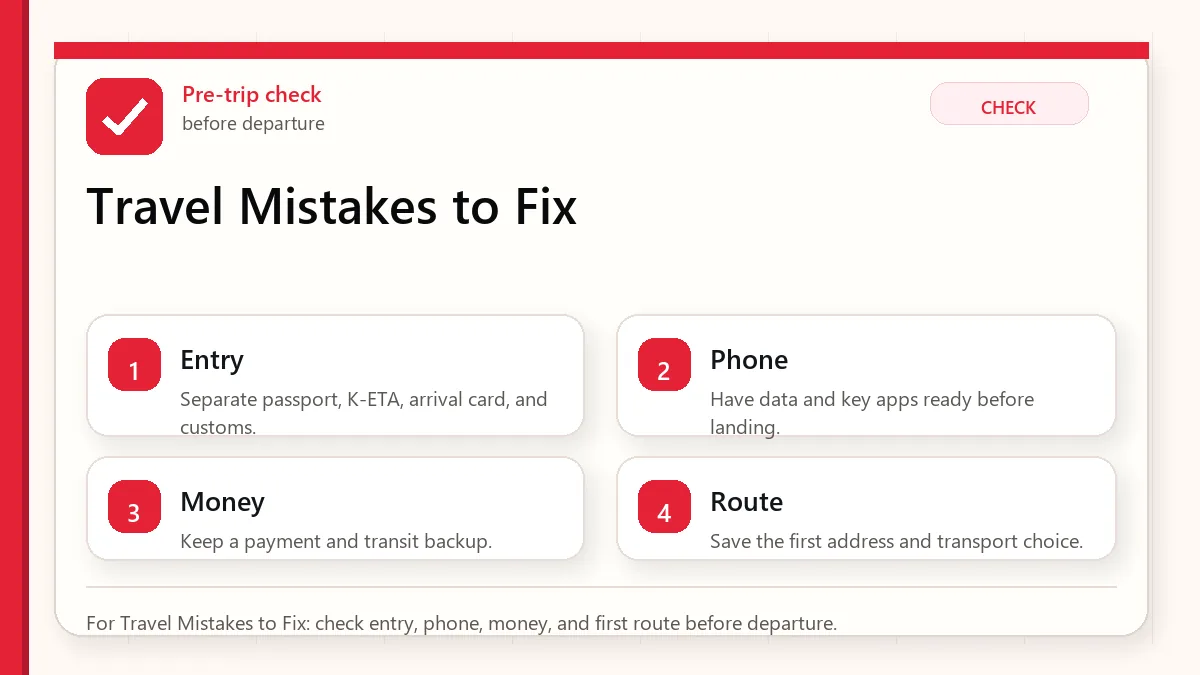
    For Travel Mistakes to Fix: check entry, phone, money, and first route before departure.

    Start with the situation, not a rule list

    Before you arrive, confirm entry requirements, save your hotel address in Korean and English, choose airport transport by hotel area and luggage, install Korean map and translation apps, prepare a T-money or transit plan, carry a small KRW cash buffer, and keep your first day simple. Do not use arrival day as the test day for every app, card, route, and reservation.

    The mistakes and fixes

    MistakeWhy it hurtsFix
    Ignoring entry paperwork until the airportSmall mismatches can become boarding stress.Check official requirements before departure.
    Choosing airport train by speed onlyTransfers with luggage can be tiring.Choose by hotel area, stairs, final walk, and arrival time.
    Using only one card or phone walletKiosks and transit top-ups can fail.Carry two cards and some KRW cash.
    Depending only on Google MapsLocal place search can be weaker.Install Naver Map or KakaoMap too.
    Overpacking the itinerarySeoul distances and station exits eat time.Plan by neighborhoods, not by wish list.

    Airport transport mistake

    AREX Express looks clean on paper because it is fast to Seoul Station. But if your hotel is in Myeongdong, Gangnam, Jamsil, or a hilly side street, the door-to-door route may involve stairs, transfers, and a tired final walk. Airport buses can be slower but easier with luggage. Taxis can be rational for groups, late arrivals, or heavy bags. Decide by final hotel area, not only by headline speed.

    T-money and cash mistake

    Many visitors arrive expecting every payment to work like a normal card city. Korea is card-friendly, but transit cards and some machines still create friction for foreigners. A small cash buffer is not old-fashioned; it is practical. Use it for transit top-ups, small shops, market food, or backup when a foreign card fails at a machine.

    Layered red check backup flow graphic for Travel Mistakes to Fix.
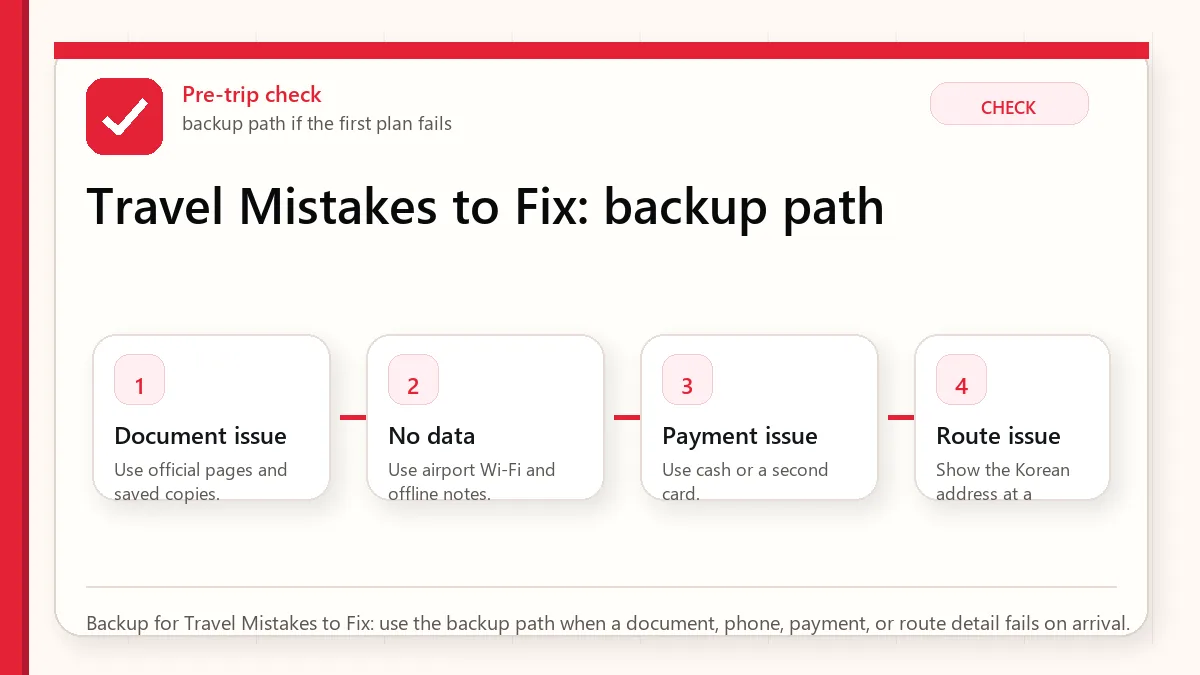
    Backup for Travel Mistakes to Fix: use the backup path when a document, phone, payment, or route detail fails on arrival.

    App and phone number mistake

    Some Korean apps are easy for tourists. Others become difficult because they expect Korean identity verification, local payment, or a Korean phone number. Install key apps before departure, but do not assume installation means full access. Keep alternatives: hotel front desk help, staff counters, browser translation, and saved Korean addresses.

    Itinerary mistake

    A Korea itinerary should be built around areas. Pair Gyeongbokgung with Insadong or Bukchon. Pair Hongdae with Yeonnam. Pair Seongsu with Seoul Forest. Pair Jamsil with Lotte World or Seokchon Lake. Avoid crossing the city several times in one day just because subway routes exist. The goal is not to prove you can move fast. The goal is to actually experience places.

    The first 24 hours deserve special protection

    Most first-time travel mistakes hurt most on arrival day because you are tired and carrying luggage. Do not schedule a complicated dinner, distant neighborhood, or prepaid activity immediately after landing. Keep the first evening close to your hotel, solve the transit card, test your payment backup, confirm your map app, and sleep. A boring first night often creates a better second day.

    Arrival day is also the wrong time to discover that your eSIM was not installed, your card needs overseas activation, or your hotel address is only saved in English. Test what you can before departure and screenshot what you cannot test.

    Build redundancy into the trip

    Redundancy is not pessimism. It is what makes a trip feel smooth. Use two payment methods, two map tools, a written hotel address, an offline copy of key documents, and one easy backup meal near the hotel. The more new systems a country has for you, the more valuable simple backups become.

    FAQ

    What should I prepare before flying to Korea?

    Entry checks, hotel address, airport route, eSIM or SIM plan, transit plan, map app, translation app, and payment backups.

    Is Korea easy for first-time travelers?

    Yes, especially if you prepare the local systems before arrival.

    How many Seoul neighborhoods should I visit per day?

    Usually one to two main areas per day is more enjoyable than chasing five across the city.

    Related Before Korea guides

    Source links to verify