Korea etiquette for tourists is not about memorizing a long list of cultural rules. Most visitors only need to understand a few everyday patterns: public spaces are shared quietly, shoes come off in certain clean indoor spaces, restaurants often expect customers to be more active, tipping is not the default, and small mistakes are usually recoverable if you stay calm and polite.
Last checked: June 1, 2026. Re-check the official or primary source page before acting, because routes, prices, labels, rules, app screens, eligibility, and store/service policies can change.
Last updated: May 24, 2026.
Start with the situation, not a rule list
If you are visiting Korea for the first time, focus on five habits: keep your voice low on transit, let people exit before boarding, remove shoes when the floor or doorway clearly signals it, pay at the front counter when the restaurant flow points that way, and use simple polite phrases such as annyeonghaseyo, gamsahamnida, and joesonghamnida. These habits matter more than trying to perform every formal custom perfectly.
The etiquette that matters most
| Situation | Good tourist habit | Why it matters |
|---|---|---|
| Subway and bus | Quiet voice, organized bag, clear boarding line. | Transit is a dense shared space. |
| Shoes-off spaces | Pause at the entrance and copy the local flow. | Clean floor culture is still practical in homes, hanok stays, temples, and some restaurants. |
| Restaurants | Use the call button, self-serve water when indicated, pay at the counter. | Korean service is efficient and less table-interruptive. |
| Cafes | One drink per seated person, no outside food, return tray if required. | Many cafes are small, high-turnover businesses. |
| Photos | Avoid photographing strangers, staff, children, and private interiors without permission. | Privacy matters even in photogenic spaces. |
Shoes-off etiquette
The simplest rule is visual: if you see a lower entry area, shoe shelves, slippers, or other people removing shoes, stop and remove yours. Do not step onto the raised clean floor with outdoor shoes. Keep socks trip-ready, especially in summer, because bare feet can feel awkward in semi-public traditional spaces. If bathroom slippers are provided in a guesthouse or traditional stay, use them only inside the bathroom and do not walk back into the room wearing them.
Public space etiquette
Korean public life can be fast and crowded, but the expected sound level is often lower than visitors expect. On the subway, avoid long phone calls and loud group conversations. In cafes, restaurants, and hotel lobbies, match the room rather than your travel excitement. On sidewalks and station corridors, step aside before checking your phone or map. The mistake is not being foreign. The mistake is blocking a flow that everyone else is trying to use.
Restaurant and cafe etiquette
Many restaurants do not use the same service rhythm as Western restaurants. Staff may not check on you repeatedly. Look for a call button on the table, a utensil drawer, a water station, and a front counter for payment. If there is no button, raise a hand and say jeogiyo or yeogiyo. In cafes, the one-drink-per-person expectation is common when you sit down. Return trays and sort waste when the cafe has a visible return station.
Temples, palaces, and traditional areas
At temples, lower your voice, avoid running, follow photo restrictions, and remove shoes before entering halls when required. Palaces are more open and visitor-friendly, but they are still cultural spaces. Do not climb on walls, block narrow photo spots for a long time, or treat hanbok rental as permission to ignore staff directions. A small amount of restraint makes these places better for everyone.
How to recover from a mistake
Tourists make mistakes. The best recovery is short and plain: stop, step back, say sorry, and adjust. A small bow and joesonghamnida work better than a long explanation. Do not turn an etiquette correction into a debate. Most awkward moments disappear quickly when you respond lightly and move on.
The difference between etiquette and performance
A useful Korea etiquette guide should not make visitors feel they need to act like locals. Tourists are not expected to understand every age-based or social nuance. What people notice more is whether you are paying attention. Do you lower your voice when the train is quiet? Do you move out of the doorway before checking your phone? Do you notice shoes at the entrance before stepping inside? These small signals matter because they show that you are reading the space rather than treating every place as a tourist stage.
Do not overperform etiquette either. Deep bows, exaggerated Korean phrases, or nervous apologies after every small interaction can feel unnatural. A calm greeting, a clear request, and a simple thank you are enough in most shops, cafes, hotels, and restaurants. The best visitor behavior is relaxed but observant.
How to judge a new situation
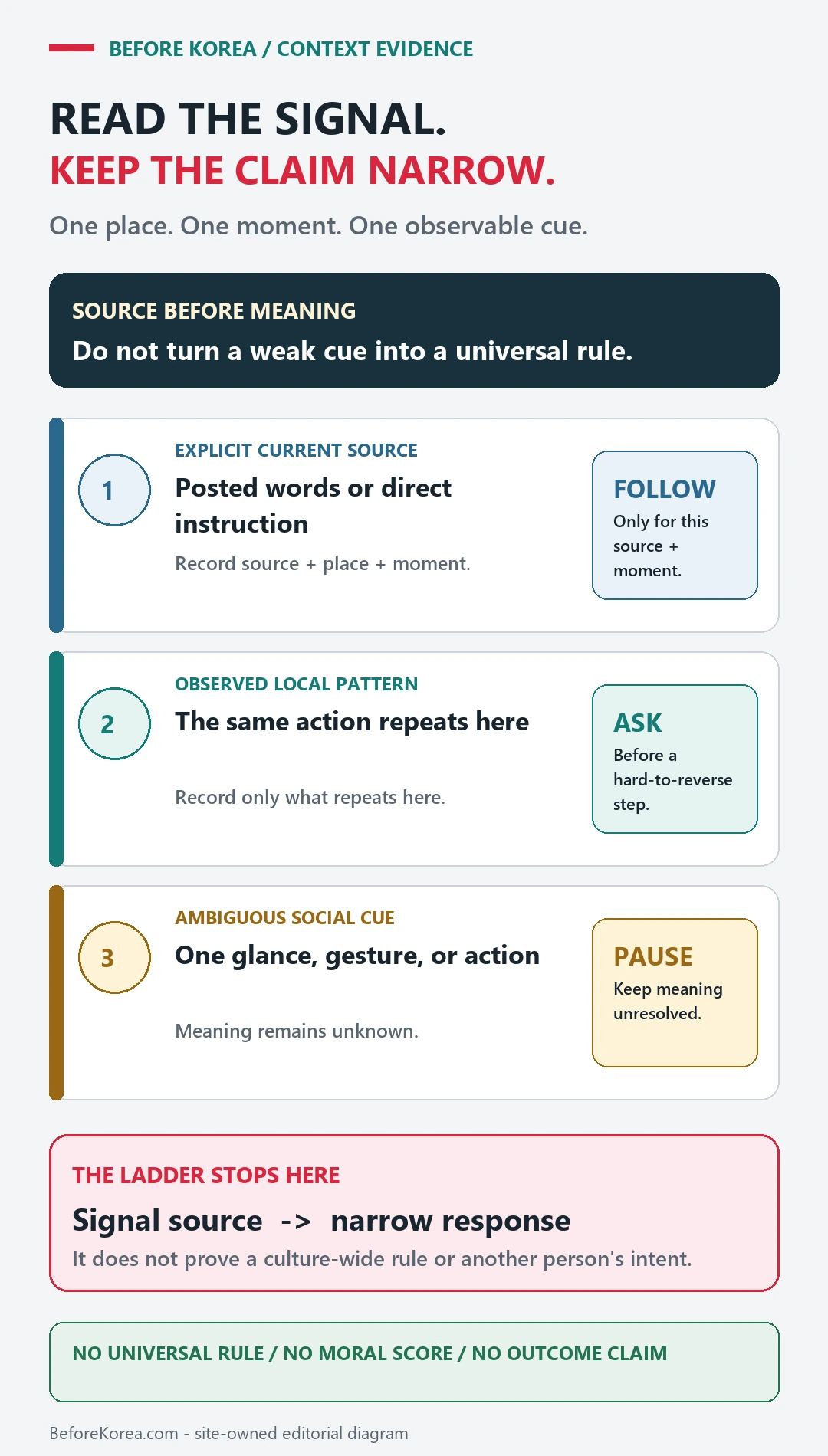
When you are unsure, pause for three seconds and watch the local flow. Where do people queue? Are they returning trays? Are they removing shoes? Are they paying first or after eating? Are they taking photos freely or keeping phones away? This “watch first” habit solves more problems than memorizing a long etiquette list. It also keeps your trip from feeling tense.
FAQ
Do tourists need to bow in Korea?
A small nod or slight bow is enough for most tourist situations. You do not need formal deep bows.
Is Korea strict about etiquette?
Daily life is more flexible than etiquette lists suggest. Shared-space behavior matters more than perfect cultural performance.
Can I speak English in Korea?
Yes, but do not assume every staff member is comfortable in English. Use simple phrases, translation apps, and patience.
Related Before Korea guides
- Public etiquette in Korea
- Korea subway and bus guide
- How to order food in Korea
- Korean cafe etiquette
- Before You Visit Korea
Source links to verify
- Visit Korea – Tourist-Friendly Korea
- Visit Korea – About Korean Food
- Seoul Metropolitan Government – Public Transportation
- Korea.net – Overview of Korea
Prepare five Korea etiquette habits before travel without performing a stereotype
| Decision | Evidence | Next action |
|---|---|---|
| Observe | Entrance, queue, payment, shoes and return flow | Pause before acting |
| Follow | Current venue sign or staff direction | Use the exact rule |
| Reduce impact | Noise, obstruction, waste and photography | Choose the lighter action |
| Recover | A mistake or correction occurs | Stop, apologize briefly and adjust |
The useful pre-trip kit is small: observe, respect the explicit instruction, keep shared impact low, ask when necessary and recover calmly. The decision record was checked against VISITKOREA travel basics and shoes-off note, VISITKOREA 2026 palace visitor guidelines, VISITKOREA 1330 traveler help.
VISITKOREA notes that shoes often come off before entering a home, while the exact entrance cue controls in practice. The current palace visitor guidance requires on-site instructions, restricted-area boundaries, preservation rules and considerate noise behavior. The official 1330 service provides tourist information, interpretation and complaint support in multiple languages. A simple apology and immediate correction are safer than arguing from a generic etiquette list. Source review completed August 24, 2026. Dates, eligibility, price, inventory, access and operating rules must be rechecked on the exact current first-party page before action.