Tag: Before You Eat

  • Korean BBQ Costs, Portions, Cuts, and Allergy Questions for First-Time Visitors

    Korean BBQ Costs, Portions, Cuts, and Allergy Questions for First-Time Visitors

    Korean BBQ is not just “grilled meat at the table.” For a first-time visitor, it is a system: meat ordered by serving weight, shared side dishes, wraps, dips, stews, noodles, rice, staff or self-grilling patterns, and a bill that can change quickly if you order premium beef or alcohol without noticing portion size.

    Last checked: June 1, 2026. Re-check the latest product label, restaurant information, and official/public database before acting, because routes, prices, labels, rules, app screens, eligibility, and store/service policies can change.

    Last updated: May 24, 2026.

    Layered red check decision graphic for BBQ Costs Portions Cuts.
    For BBQ Costs Portions Cuts: check the exact label, local sticker, date, size or ingredient detail, and proof needed for this product.

    Start with the risk you need staff to understand

    For pork BBQ, start with about one serving per adult, then add more after you see the actual tray. For premium beef or Hanwoo, start more cautiously because servings can be smaller and much more expensive. If you need gluten or allergy caution, favor plain unseasoned meat, salt, and clear staff confirmation; marinades, soy sauce, ssamjang, broths, and shared grills can create risk.

    Price bands to expect

    BBQ typeTypical feelingBudget warning
    All-you-can-eat pork or mixed meatBest for appetite and simple value.Quality and time rules vary by chain.
    Standard pork a la carteMost first-time friendly.Order one round first, then add.
    Jeju black porkMore destination-style and often pricier.Do not compare it directly to budget samgyeopsal.
    Premium Hanwoo or beefSmaller portions, richer cuts, higher bill.Check price per serving or per 100g before ordering.
    Layered red check backup flow graphic for BBQ Costs Portions Cuts.
    Backup for BBQ Costs Portions Cuts: use the backup path when the label, translation, size, or product claim is not clear enough.

    Portion strategy

    Many pork restaurants use serving units around the size of a single adult starting order. Premium beef often uses smaller serving weights, so the same number of plates may not feed the same number of people. Do not order the whole table at once. Start with the house recommendation, watch how filling it feels, then add another cut or finishing dish.

    Cuts visitors see often

    • Samgyeopsal: pork belly, fatty and classic.
    • Moksal: pork neck or shoulder, more balanced.
    • Hangjeongsal: rich pork special cut with a chewy-fatty texture.
    • Chadolbagi: thin beef brisket, quick-cooking.
    • Galbi or galbisal: rib or boneless rib, often pricier and sometimes marinated.
    • Hanwoo beef: premium Korean beef category where price rises fast.

    Staff grilling vs self-grilling

    If staff start cutting and turning the meat, let them handle the first round. Premium or curated restaurants often care about timing. If staff leave the tools to you, self-grill calmly, turn meat before it burns, and keep raw-meat tongs separate from eating utensils when possible.

    Gluten and allergy questions

    Korean BBQ can look simple, but hidden ingredients matter. Soy sauce often contains wheat. Ssamjang may contain soybean paste, chili paste, wheat, or other ingredients. Marinades are often soy-based. Shared grills and tongs can create cross-contact. If you need a lower-risk order, ask for plain unseasoned meat and use salt or plain sesame oil with salt only if ingredients are safe for you.

    Read the menu before choosing a table rhythm

    Korean BBQ feels casual, but the menu has structure. Look for the cut, the serving weight, whether there is a minimum order, whether the item is pork or beef, whether it is marinated, and whether side dishes, stew, rice, or noodles are included or separate. A table that orders too much at the beginning may feel pressured to finish, while a table that orders too little may keep interrupting the meal to call staff back.

    The safest first round is often one familiar cut and one house-recommended cut, then rice, stew, or noodles later if the group is still hungry. Premium beef should be treated more carefully because the price can climb quickly and the serving size may be smaller than visitors expect. Pork BBQ is usually the easier first Korean BBQ experience because the value and portion logic are more forgiving.

    A first-order template

    For two adults, start with the restaurant’s basic pork set or two servings of a classic cut, then add after seeing the portion. For a mixed group, avoid ordering the spiciest or most heavily marinated item first. If the restaurant specializes in one cut, follow the specialty unless someone has a dietary restriction. If staff grill, watch their timing and do not move pieces constantly unless they indicate you should take over.

    Finishing dishes matter. Naengmyeon, fried rice, doenjang jjigae, or rice can make the meal feel complete without adding another expensive meat round. Alcohol can also shift the bill. If budget matters, separate the meat plan from the drink plan before ordering.

    Allergy and cross-contact reality

    Plain grilled meat may look safe, but the table environment is shared. Marinades, soybean paste, chili paste, sesame oil blends, side dishes, tongs, scissors, grill surfaces, and soups can create cross-contact. If an allergy is serious, choose a simpler restaurant, avoid marinades, use written allergy language, and be prepared to leave if staff cannot clearly confirm.

    FAQ

    Can I eat Korean BBQ alone?

    Sometimes. Some restaurants allow solo diners or lunch sets; others expect two or more servings. Check before sitting.

    Is Korean BBQ all-you-can-eat?

    Some restaurants are AYCE, many are not. Check whether you are ordering a fixed buffet or individual servings.

    Do I tip at Korean BBQ?

    Tipping is generally not expected in Korea. Pay the bill as presented unless the restaurant has a special service rule.

    Related Before Korea guides

    Source links to verify

  • Korean Convenience Store Food Labels: Heating, Allergens, Dates, Seating, and What to Buy

    Korean Convenience Store Food Labels: Heating, Allergens, Dates, Seating, and What to Buy

    Korean convenience stores are one of the easiest ways to eat cheaply and practically in Korea. They are also one of the easiest places to make small mistakes: microwaving the wrong package, missing the allergen line, treating every triangle kimbap as hot food, assuming every store has seating, or buying a “2+1” deal you cannot carry.

    Last checked: June 1, 2026. Re-check the latest product label, restaurant information, and official/public database before acting, because routes, prices, labels, rules, app screens, eligibility, and store/service policies can change.

    Last updated: May 24, 2026.

    Layered red check decision graphic for Convenience Store Food Labels.
    For Convenience Store Food Labels: check the exact label, local sticker, date, size or ingredient detail, and proof needed for this product.

    Start with the package in your hand

    Choose convenience-store food by label first, photo second. Check the cooking directions, allergen line, date, storage instruction, and whether the package is microwave-safe. Use the store’s microwave or hot-water machine only when the label supports it. If you have allergies, packaged food is easier to inspect than restaurant sauces, but you still need translation and caution.

    What to buy by time of day

    TimeGood choicesWatch out for
    BreakfastSandwich, samgak kimbap, yogurt, boiled egg, banana milk, coffee.Too much sodium if you start with ramen every day.
    LunchDosirak, rice bowl, larger kimbap, salad plus protein item.Check microwave instructions and sauce packets.
    Late nightCup ramen, egg, yogurt, snack, drink, light boxed meal.Spicy ramen can be much hotter than expected.
    Souvenir shelfSealed snacks, tea, nuts, shelf-stable sweets.Liquids, fragile items, and unclear expiry dates.
    Layered red check backup flow graphic for Convenience Store Food Labels.
    Backup for Convenience Store Food Labels: use the backup path when the label, translation, size, or product claim is not clear enough.

    Label words worth recognizing

    • 소비기한 – use-by date. This is the modern date term visitors should recognize.
    • 원재료명 – ingredients.
    • 알레르기 유발물질 – allergens.
    • 전자레인지 – microwave.
    • 냉장보관 – keep refrigerated.
    • 뜨거운 물 – hot water.

    Heating mistakes

    Do not improvise with microwaves. If a cup-ramen lid contains foil, remove it according to the package instructions. If a sealed pouch or plastic container needs venting, follow the label. If the item says hot water only, do not decide that the microwave will be faster. Convenience-store machines are convenient, but the package remains the rulebook.

    Allergen caution

    Packaged food can be safer to inspect than a restaurant dish because ingredients and allergen lines exist. But the text is usually Korean, and exact ingredients vary by product. Common allergens can include egg, milk, buckwheat, peanut, soy, wheat, walnut, crab, shrimp, squid, mackerel, shellfish, peach, tomato, chicken, pork, beef, and sulfites. If your allergy is serious, do not guess from the front photo.

    Seating and trash etiquette

    Some convenience stores have seating; many do not. Buy first, sit only where seating is clearly provided, keep the stay short during busy times, wipe the table if needed, and sort trash according to the store bins. Do not bring outside trash and expect the store to handle it.

    Read the back, not the front

    Korean convenience-store packaging is designed to sell quickly. The front photo may show cheese, spice, rice, meat, or a clean-looking salad, but the practical information is usually on the back or side: use-by date, storage method, ingredients, allergens, microwave instructions, and whether sauce packets should be removed before heating. A visitor who shops only by the front photo is guessing.

    For low-risk choices, look for sealed items with clear dates, simple heating instructions, and familiar ingredients. If the product has multiple small packets, check whether any should be added after heating. If a container has a film lid, check whether it needs to be peeled, vented, or removed. Convenience-store food is convenient because the process is standardized, not because every package can be treated the same way.

    A safer traveler routine

    Choose the item, check the date, scan the allergen line with translation if needed, confirm heating method, pay, heat only according to the package, then eat in the designated area if the store has seating. Keep chopsticks, spoon, sauce, and receipt until you are done. If a machine, microwave, or hot-water area is crowded, wait your turn rather than rushing and damaging the package.

    For serious allergies, convenience stores can be both helpful and risky. Packaged labels provide more information than a handwritten restaurant menu, but the text is Korean and ingredients change by product. Use a prepared allergy card, translation app, and conservative choices. Do not rely on a flavor name such as “mild” or “cheese” to understand the full ingredient list.

    Do not make every meal a convenience-store meal

    Convenience stores are excellent for arrival night, breakfast gaps, late-night hunger, snacks, drinks, and budget control. They are not a complete food strategy for understanding Korea. Use them to make the trip easier, then balance with restaurants, markets, bakeries, cafes, and simple neighborhood meals when you have more time and energy.

    FAQ

    Is samgak kimbap heated?

    Usually it is eaten cold unless the package says otherwise. If you want a warm rice meal, choose a dosirak or bowl designed for heating.

    Can I pay with T-money at convenience stores?

    Many affiliated convenience stores accept T-money, but normal cards or cash remain useful backups.

    Are convenience-store meals healthy?

    They are convenient and often good value, but sodium can be high. Balance with water, fruit, yogurt, or lighter meals.

    Related Before Korea guides

    Source links to verify

  • Korean Food Allergy Card: What to Write Before Eating in Korea

    Korean Food Allergy Card: What to Write Before Eating in Korea

    A Korean food allergy card should do one job clearly: tell restaurant staff what you cannot eat, ask them to check hidden ingredients, and make it acceptable for them to say they cannot confirm. Translation alone is not enough in Korea because broths, sauces, marinades, shared grills, seafood paste, nuts, sesame, wheat, egg, milk, soy, and cross-contact can be invisible from the menu name.

    Last checked: June 2, 2026. Restaurant recipes, packaged-food labels, and allergen notices can change. Use this as a communication tool, not medical advice.

    Layered red check decision graphic for Food allergy card.
    For Food allergy card: check the exact label, local sticker, date, size or ingredient detail, and proof needed for this product.

    What to write on the card

    Card line Why it matters Example
    My allergy Name the exact allergen, not a broad diet preference I am allergic to peanuts and tree nuts.
    Severity Staff need to know whether trace exposure is dangerous Even a small amount can cause a serious reaction.
    Hidden ingredients Korean food may use broth, sauce, paste, oil, or powder Please check sauce, broth, marinade, garnish, and frying oil.
    Cross-contact Shared grills, tongs, pans, and fryers can matter If you cannot confirm, please tell me before I order.
    Emergency note Travelers need a backup plan If I feel sick, please call 119.

    A practical English card text

    I have a serious food allergy to: [ALLERGEN]. Please check the ingredients, sauce, broth, marinade, garnish, cooking oil, and shared cooking tools. If you are not sure, please tell me before I order. If I have a reaction, please call 119.

    A Korean phrase to show staff

    저는 [알레르기 식품] 알레르기가 있습니다. 소스, 육수, 양념, 고명, 조리기구, 튀김기름에 들어가는지 확인 부탁드립니다. 확실하지 않으면 주문 전에 알려 주세요. 응급 상황이면 119에 전화해 주세요.

    Do not rely on this Korean text blindly for a life-threatening condition. Have a native speaker, medical professional, or trusted translation service review your exact allergen wording before travel.

    Common allergen words to prepare

    English Korean Where it may appear
    Peanut 땅콩 Sauce, dessert, snack, garnish
    Tree nut 견과류 Bakery, dessert, salad, packaged snacks
    Egg 계란 / 달걀 Kimbap, toast, pancakes, noodles, sauces
    Milk 우유 Cafe drinks, bakery, dessert, cream sauce
    Wheat Noodles, dumplings, fried food, sauces
    Soy 대두 / 콩 Soy sauce, tofu, soybean paste, marinades
    Shellfish 갑각류 Broth, seafood dishes, sauces
    Sesame 참깨 / 참기름 Garnish, oil, dipping sauce, side dishes

    This table is a starting point, not a medical translation service. If your allergy is severe, prepare the exact Korean wording for your allergen and show it with your English text.

    Where Korean meals hide allergens

    Food situation What to ask about Why it can be missed
    Korean BBQ Marinade, dipping sauce, shared grill, side dishes The meat may look plain while sauce or banchan carries the risk
    Tteokbokki or street food Fish cake, broth, sauce, wheat, seafood, egg Sauce and broth are not visible from the name
    Convenience-store meals Label, allergen notice, heating instructions Translation apps may miss warnings or facility notes
    Bakery/cafe items Milk, egg, wheat, nuts, sesame, cross-contact Display items may not show full ingredient details
    Soup/stew/noodle dishes Broth base, seafood, soy, wheat, egg, garnish The broth can be the main risk

    How to use the card at a restaurant

    1. Show the card before ordering, not after food arrives.
    2. Point to the exact dish you want and ask whether it can be checked.
    3. If the staff look unsure, choose a simpler dish or leave.
    4. Do not ask for a guarantee from a restaurant that cannot verify ingredients.
    5. Carry medication and emergency instructions according to your doctor's advice.

    The answer you should accept

    A useful allergy card does not force the staff to say yes. It gives them a safe way to say no or unsure. If the restaurant cannot check broth, sauce, oil, or cross-contact, that is an answer. For high-risk allergies, treat uncertainty as a reason to choose another food.

    Packaged food needs a different check

    For convenience-store meals and packaged snacks, ask a different question: can you read the label well enough to decide? Look for the ingredient list, allergen notice, manufacturing facility note, expiration date, and heating instructions. A product can look simple from the front package but still contain milk, wheat, soy, sesame, seafood extract, or nut traces.

    Use a translation app for the label, but do not let the camera translation be the only check for a serious allergy. Small Korean text, line breaks, and packaging glare can make machine translation miss important words.

    What to do when staff cannot confirm

    The safest response is not to negotiate. Thank the staff and choose a lower-risk option. A restaurant that cannot verify sauce, broth, or cross-contact may still be a good restaurant; it is just not a good choice for your allergy risk that day.

    • Choose plain packaged food with a readable label over an unclear mixed dish.
    • Choose a restaurant with simpler preparation if cross-contact matters.
    • Carry safe snacks for late-night or travel days.
    • Keep emergency medication and instructions accessible according to your medical plan.
    Layered red check backup flow graphic for Food allergy card.
    Backup for Food allergy card: use the backup path when the label, translation, size, or product claim is not clear enough.

    Official and safety links

    Related guides

    FAQ

    Is a translation app enough for food allergies in Korea?

    No. A translation app can help, but a prepared allergy card is clearer and gives staff time to check hidden ingredients and cross-contact risk.

    Should I ask if a dish is safe?

    Ask staff to check specific ingredients, sauce, broth, oil, and shared tools. If they cannot confirm, choose another option.

    What emergency number should travelers know in Korea?

    119 is Korea's emergency number. Follow your doctor's travel plan for medication and emergency care.

  • Korean Restaurant Kiosk Guide

    Korean Restaurant Kiosk Guide

    Korean restaurant kiosks are common in fast-food chains, casual restaurants, food courts, noodle shops, burger shops, cafes, and some local franchises. They make ordering fast for locals, but they can trap visitors with hidden language buttons, menu options, set menus, spicy add-ons, foreign card errors, and order numbers that appear only on the receipt.

    Last checked: June 1, 2026. Re-check the latest product label, restaurant information, and official/public database before acting, because routes, prices, labels, rules, app screens, eligibility, and store/service policies can change.

    Last updated: May 24, 2026.

    The goal is not to master every kiosk. The goal is to slow the first thirty seconds down enough to avoid the wrong mode, wrong quantity, wrong option, or impossible payment step.

    Layered red check decision graphic for Restaurant Kiosk.
    For Restaurant Kiosk: check ordering flow, ingredients, portion, and payment before choosing the meal.

    Start with the moment you order

    Look first for a language button, then choose dine-in or takeout, select by photo or category, review the cart, pay, and keep the receipt or order number. If you have allergies or dietary restrictions, do not rely on the kiosk alone. Ask staff before paying, because kiosks often show limited ingredient detail.

    Common Korean kiosk words

    KoreanMeaningWhy it matters
    매장Dine inChoose this if you are eating inside.
    포장TakeoutChoose this if you want the food packed.
    주문OrderStart or confirm an order.
    결제PaymentFinal payment step.
    카드CardUse for credit or debit card payment.
    현금CashNot every kiosk accepts cash.
    영수증ReceiptMay show your order number.
    주문번호Order numberWatch the pickup screen for this.
    품절Sold outThe item is unavailable.
    Layered red check backup flow graphic for Restaurant Kiosk.
    Backup for Restaurant Kiosk: use the backup path when the menu, allergy question, spice level, or staff flow is unclear.

    The safest kiosk flow

    1. Step back and find the language button before touching menu items.
    2. Choose dine-in or takeout. This is often the first decision.
    3. Pick the category: burger, noodles, rice, coffee, set menu, side, drink, dessert.
    4. Use menu photos, but check options such as size, spice, sauce, hot/iced, and add-ons.
    5. Open the cart and confirm quantity. Accidental double orders are common.
    6. Pay by card if supported. If the card fails, ask staff rather than repeating the same error endlessly.
    7. Take the receipt and watch for your order number on the screen or listen for it being called.

    Where visitors get stuck

    • No English button: Use camera translation, but avoid complex dishes if you cannot read options.
    • Foreign card declined: Try another card, use the counter if available, or choose a restaurant with staff ordering.
    • Takeout vs dine-in mistake: Staff can sometimes fix it, but not always during a rush.
    • Hidden spicy option: Some dishes have default spice or sauce choices that photos do not reveal.
    • Allergy uncertainty: Kiosks rarely provide enough kitchen detail for serious allergies.

    Allergy and dietary caution

    A kiosk is a bad place to negotiate a serious allergy. If the restaurant is busy and the machine is the only ordering channel, choose a safer restaurant or ask staff before submitting payment. Many sauces, broths, batters, and toppings are not obvious from photos.

    FAQ

    Do Korean kiosks accept foreign cards?

    Many do, but not all. Some machines fail with certain foreign cards even when the restaurant itself can accept card at the counter.

    What if I make a wrong order?

    Ask staff immediately and show the receipt. If food preparation has started, changes may be difficult.

    Can I order in English at the counter instead?

    Sometimes. Chains and tourist areas may help, but some restaurants expect kiosk-only ordering during busy periods.

    Screen order patterns

    Many kiosks follow a predictable pattern: dine-in or takeout, language, category, item, options, cart, membership or coupon, payment, receipt. The membership screen is where visitors often freeze. If you do not have a Korean membership number, look for skip, no membership, continue, or payment buttons.

    Card errors and what they mean

    A declined card does not always mean your bank blocked the transaction. The kiosk may not support your card type, may require chip insertion in a specific direction, may fail with contactless, or may be tied to a domestic payment rail. Try inserting the card, try another card, and then ask staff. Do not repeatedly tap the same card for five minutes while the line grows.

    Receipts are not optional

    Take the receipt even if you normally avoid paper. It may contain your order number, pickup counter, refund proof, or item list. In food courts, several counters can share one seating area, and the receipt is how you prove where your food should appear.

    When to abandon the kiosk

    Leave the kiosk flow if you have a serious allergy, cannot understand required options, cannot confirm payment, or suspect you selected the wrong mode. It is better to ask staff or choose another restaurant than to buy a meal you cannot eat.

    Related Before Korea guides

    Use these guides together rather than treating one article as the whole plan.

    Sources checked for this update

    Before Korea treats operational details as changeable. Check the official pages below before a trip or a large purchase.

  • How to Order Food in Korea: Kiosks, BBQ, Payment

    How to Order Food in Korea: Kiosks, BBQ, Payment

    Ordering food in Korea is easier when you stop waiting for a restaurant to behave exactly like restaurants at home. Many Korean restaurants are efficient, active, and system-based. The menu might be on a wall, a kiosk, a tablet, a QR code, or a laminated sheet. Utensils may be inside a table drawer. Water may be self-service. Staff may expect you to press a call button when you need them. Payment may happen at the front counter after the meal.

    Last checked: June 1, 2026. Re-check the official provider, store, customs, or payment page before acting, because routes, prices, labels, rules, app screens, eligibility, and store/service policies can change.

    Last updated: May 24, 2026.

    Layered red check decision graphic for Ordering food.
    For Ordering food: check ordering flow, ingredients, portion, and payment before choosing the meal.

    Start with what can fail at payment

    Choose the restaurant, check whether ordering is by staff, kiosk, or table tablet, look for utensil drawers and water stations, use jeogiyo or the call button when ready, order with pointing plus igeo juseyo, and pay at the counter when you leave unless a kiosk or table system already handled payment. Do not leave a tip on the table.

    The Korean restaurant flow

    StepWhat to look forTourist move
    Before sittingQueue machine, staff greeting, empty table, shoes-off area.Pause and follow the visible flow.
    At the tableCall button, utensil drawer, water pitcher, self-service sign.Set up the table before calling staff.
    OrderingMenu photos, English option, kiosk, QR, tablet.Point clearly or use translation.
    During mealBanchan, shared dishes, scissors, tongs, grill.Use serving tools and follow staff cues.
    PaymentCounter, kiosk receipt, table number card.Take the bill or table card to the counter.

    Table drawers, water, and banchan

    Many casual restaurants keep chopsticks, spoons, napkins, and wet tissues in a drawer under the table. If the table looks empty, check the side before assuming staff forgot. Water may be self-service, often marked with a Korean sign or placed at a visible station. Side dishes, called banchan, often arrive automatically, and some can be refilled, but do not waste them. Ask politely if you need more.

    How to call staff

    If the table has a button, press it once and wait. If there is no button, raise a hand and say jeogiyo. This is not rude in Korea when done calmly. Do not shout across the room aggressively, snap fingers, or wave money. The Korean restaurant service model gives customers more control over when staff come to the table.

    Layered red check backup flow graphic for Ordering food.
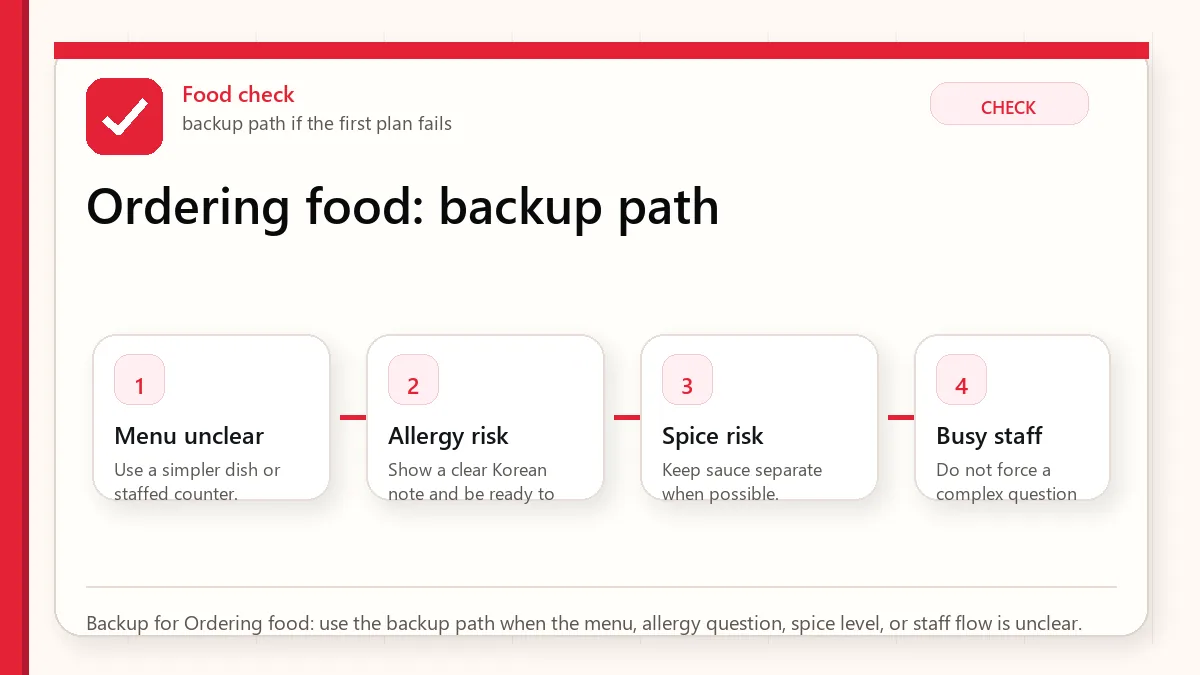
    Backup for Ordering food: use the backup path when the menu, allergy question, spice level, or staff flow is unclear.

    Kiosks and payment friction

    Self-order kiosks are common in fast-casual restaurants, food courts, bakeries, and some chains. They may have English, but not always. Foreign cards can sometimes fail, especially at unattended terminals. If the kiosk fails, look for a staffed counter, another payment option, or a simpler order. Keep cash or a second card as backup.

    Shared dishes and BBQ

    Korean dining often uses shared dishes. Use serving tongs or spoons where available. At BBQ restaurants, staff may grill the first round or control the timing, especially in specialist places. Let them lead unless they clearly leave the tools to you. Keep raw meat tools separate from eating utensils when possible. If you have allergies or dietary restrictions, ask before grilling begins because sauces, marinades, and shared surfaces matter.

    Useful phrases

    • Jeogiyo – excuse me, used to call staff.
    • Igeo juseyo – this one, please.
    • Mul jom juseyo – water, please.
    • Deol maepge hae juseyo – please make it less spicy.
    • Yeongsujeung juseyo – receipt, please.

    Dining confidence comes from reading the table

    Before looking at the menu, read the table. A call button means you control when staff come. A drawer means utensils are probably already there. A water station means you may be expected to self-serve. A small table number card or receipt may be needed for payment. These clues tell you how the restaurant works before language becomes an issue.

    This is why some visitors feel ignored when they are not being ignored at all. Staff may simply be waiting for you to press the button, call them, or come to the counter. Korean dining service often protects the table from constant interruption. Once you understand that, the experience feels less confusing and more efficient.

    Allergies and dietary limits need a different approach

    For spice preference, a simple phrase may help. For allergies, vegetarian limits, halal concerns, or gluten questions, spoken phrases are not enough. Show written Korean text and choose simpler dishes when staff cannot confirm ingredients. Shared broths, marinades, side dishes, grills, and sauces can all create hidden problems. A polite restaurant is not automatically a safe restaurant for a serious dietary restriction.

    FAQ

    Do Korean restaurants bring the bill to the table?

    Sometimes, but many expect you to pay at the front counter. Watch what other customers do.

    Is it rude to call staff with jeogiyo?

    No, when said calmly. It is a normal way to get attention in many restaurants.

    Should I tip after eating in Korea?

    No. Ordinary Korean restaurants do not expect tips.

    Delivery app reality check for visitors

    Food delivery can look like the easiest answer when you are tired, but it is not always the easiest tourist flow. Korean delivery apps may ask for a local phone number, identity verification, domestic payment, a precise Korean address, and rider communication. If Baemin becomes part of your food plan, read Can Foreigners Use Baemin in Korea? before relying on it for a late-night meal.

    For first meals after arrival, keep a lower-friction backup: a restaurant near the hotel, a food court, a convenience store meal, or a place where you can order face to face. Delivery is useful when it works, but it should not be the only way your group can eat.

    Related Before Korea guides

    Source links to verify