Author: user

  • Korea Tax Refund Calculator for Tourists

    Korea Tax Refund Calculator for Tourists

    A Korea tax refund calculator can help you decide whether a shopping receipt is worth keeping, but it should not promise an exact amount. Tourist tax refund depends on eligibility, the store, the purchase amount, the refund method, processing rules, and whether the goods are properly exported. If a calculator tells you a perfect number before the official system sees your receipt, treat it as a planning estimate only.

    Last checked: June 1, 2026. Re-check the official provider, store, customs, or payment page before acting, because routes, prices, labels, rules, app screens, eligibility, and store/service policies can change.

    Last updated: May 24, 2026.
    Layered red check decision graphic for Tax Refund Calculator for.
    For Tax Refund Calculator for: check the payment method, cash backup, receipt, and refund step before relying on one option.

    Start with what can fail at payment

    For a rough estimate, separate eligible tax-refund purchases from normal shopping, remember that sticker prices usually include VAT, and expect the actual refund to be lower than a simple 10 percent of the shelf price. Use the store receipt, refund slip, or airport kiosk for the final amount.

    Simple estimate method

    Use this as a conservative planning habit, not a guarantee:

    1. Add only purchases from participating tax-refund stores.
    2. Remove items that are clearly not eligible or not leaving Korea.
    3. Assume the refundable tax is a portion of the VAT-included price, not a clean 10 percent discount.
    4. Expect processing rules and agency handling to reduce the final amount.
    5. Ask whether immediate refund is available before paying.

    Example estimates

    Eligible shopping totalPlanning estimateBefore Korea advice
    KRW 30,000Small refundWorth it only if the process is automatic or instant.
    KRW 150,000Meaningful enough to keep documents carefullyAsk for tax refund at checkout and group receipts.
    KRW 500,000+Potentially worthwhileLeave airport time and keep goods easy to show.
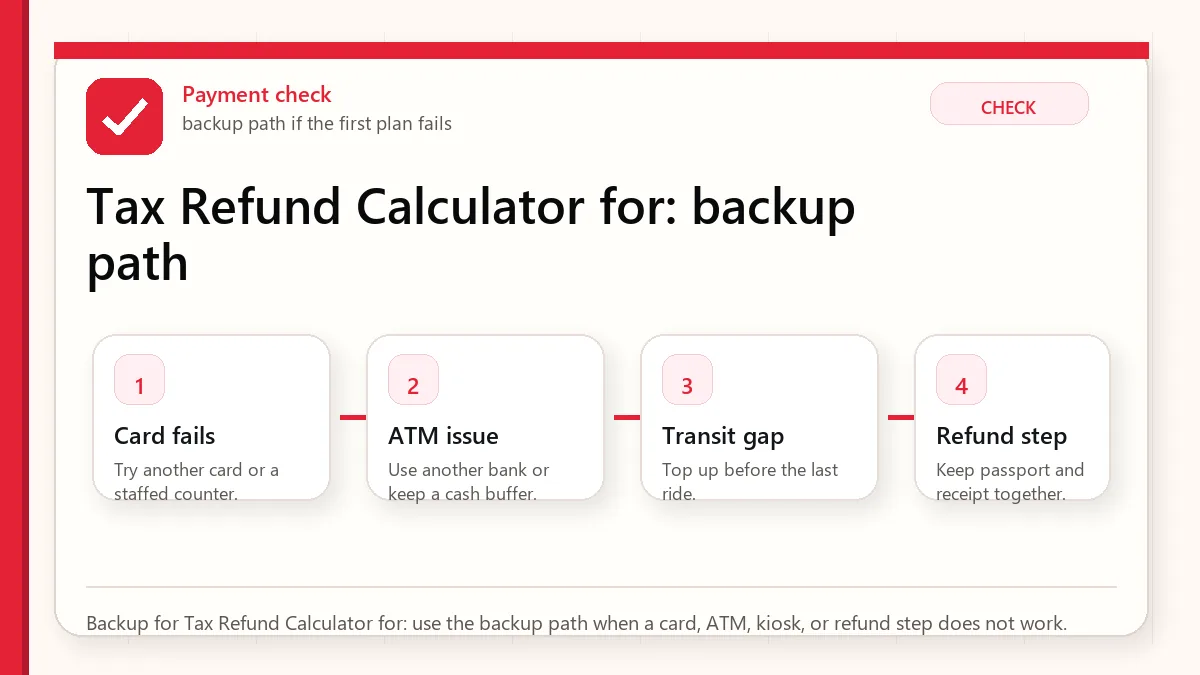
    Layered red check backup flow graphic for Tax Refund Calculator for.
    Backup for Tax Refund Calculator for: use the backup path when a card, ATM, kiosk, or refund step does not work.

    What lowers the refund?

    • The store may not participate in tax refund.
    • The purchase may fall below the threshold or outside the rules.
    • The item may not qualify or may not be exported properly.
    • Processing rules can make the refund lower than the simple VAT idea.
    • You may lose the refund by losing the receipt or missing the airport step.

    When the refund is worth your time

    The refund is worth planning when you are buying intentional items from a tax-refund-friendly store: skincare hauls, fashion, electronics accessories, gifts, or higher-value products. It is not worth twisting your itinerary around tiny receipts or buying extra products only to “save” a little tax.

    Official links to check

    Use these official links when the next step matters. This guide explains what to watch for, but app downloads, eligibility, prices, routes, policies, and service rules can change.

    FAQ

    Is there an official Korea tourist tax refund calculator?

    The official refund amount is determined through the store, refund agency, kiosk, or counter process. Online calculators should be treated as estimates.

    Can I combine receipts from different stores?

    Do not assume so. Keep each store’s receipt and refund paperwork together and follow the system instructions.

    Should I keep products unopened?

    For higher-value refundable goods, keep products, packaging, and receipts easy to show until the refund process is complete.

    Why the estimate and final refund differ

    The shelf price usually includes VAT, so a simple “10 percent off” calculation is already rough. On top of that, refund agencies and official systems can apply practical rules that change the final amount. The purchase may include non-eligible items, the store may process immediate refund differently, or the receipt may be split in a way that changes the threshold.

    For planning, estimate conservatively. For accounting, trust the refund slip or kiosk result. If you need an exact number before buying, ask the store to show the expected refund amount at checkout.

    Calculator habit for shopping days

    • Create one note called “Korea tax refund” on your phone.
    • After each eligible purchase, write store name and receipt amount.
    • Mark whether the refund was immediate or still pending.
    • Photograph the receipt in case the paper fades or gets lost.
    • Before packing, separate goods that may need inspection.

    When not to chase the refund

    Do not chase the refund when the receipt is tiny, the store process is unclear, the airport schedule is tight, or the product is something you are buying only because it “feels cheaper.” The best shopping decision is still product fit, price comparison, baggage space, and return practicality.

    Airport pressure example

    If your group reaches Incheon with two hours before departure, multiple check-in bags, and several refund forms, the refund may still be possible but it is no longer relaxed. A small refund can become stressful. For serious shopping days, pack receipts the night before and decide which refunds are worth processing.

    Related Before Korea guides

    Use these guides together rather than treating one article as the whole plan.

    Sources checked for this update

    Before Korea treats operational details as changeable. Check the official pages below before a trip or a large purchase.
  • Korean Restaurant Kiosk Guide

    Korean Restaurant Kiosk Guide

    Korean restaurant kiosks are common in fast-food chains, casual restaurants, food courts, noodle shops, burger shops, cafes, and some local franchises. They make ordering fast for locals, but they can trap visitors with hidden language buttons, menu options, set menus, spicy add-ons, foreign card errors, and order numbers that appear only on the receipt.

    Last checked: June 1, 2026. Re-check the latest product label, restaurant information, and official/public database before acting, because routes, prices, labels, rules, app screens, eligibility, and store/service policies can change.

    Last updated: May 24, 2026.

    The goal is not to master every kiosk. The goal is to slow the first thirty seconds down enough to avoid the wrong mode, wrong quantity, wrong option, or impossible payment step.

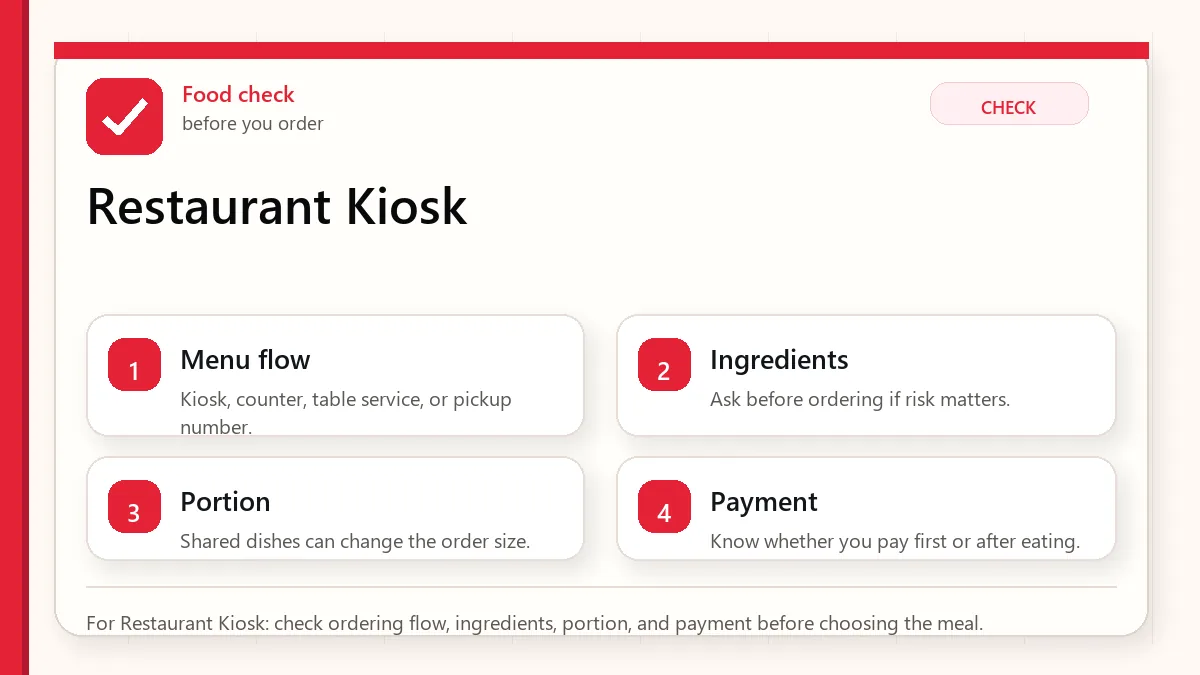
    Layered red check decision graphic for Restaurant Kiosk.
    For Restaurant Kiosk: check ordering flow, ingredients, portion, and payment before choosing the meal.

    Start with the moment you order

    Look first for a language button, then choose dine-in or takeout, select by photo or category, review the cart, pay, and keep the receipt or order number. If you have allergies or dietary restrictions, do not rely on the kiosk alone. Ask staff before paying, because kiosks often show limited ingredient detail.

    Common Korean kiosk words

    KoreanMeaningWhy it matters
    매장Dine inChoose this if you are eating inside.
    포장TakeoutChoose this if you want the food packed.
    주문OrderStart or confirm an order.
    결제PaymentFinal payment step.
    카드CardUse for credit or debit card payment.
    현금CashNot every kiosk accepts cash.
    영수증ReceiptMay show your order number.
    주문번호Order numberWatch the pickup screen for this.
    품절Sold outThe item is unavailable.
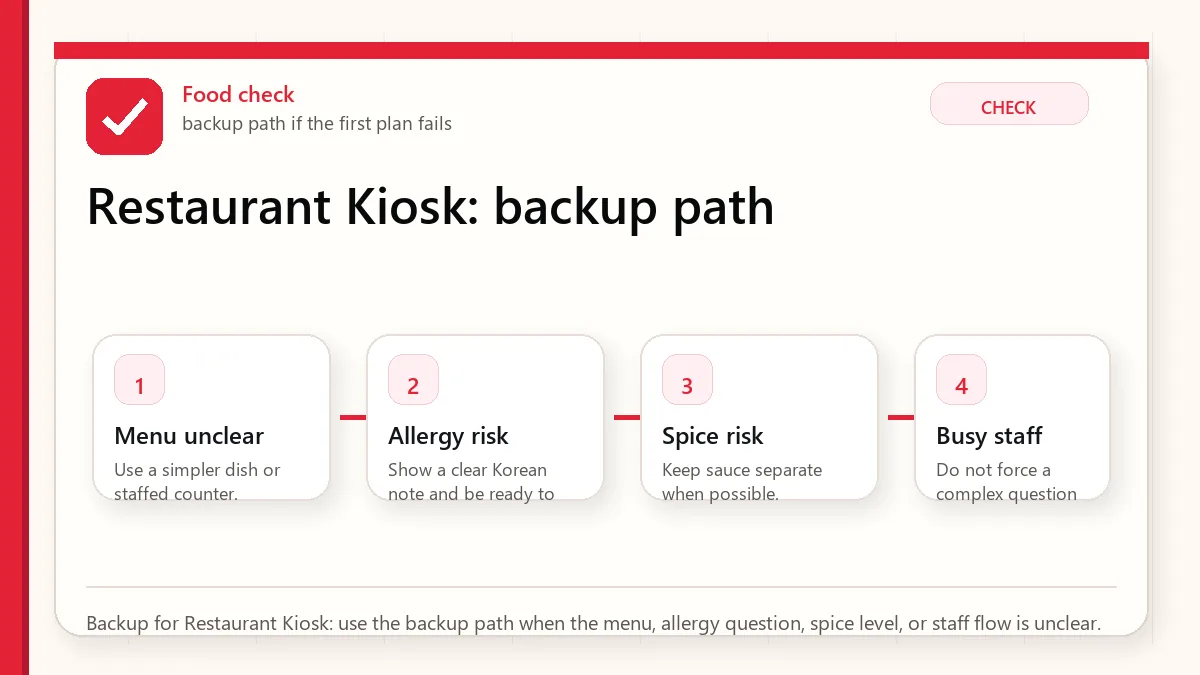
    Layered red check backup flow graphic for Restaurant Kiosk.
    Backup for Restaurant Kiosk: use the backup path when the menu, allergy question, spice level, or staff flow is unclear.

    The safest kiosk flow

    1. Step back and find the language button before touching menu items.
    2. Choose dine-in or takeout. This is often the first decision.
    3. Pick the category: burger, noodles, rice, coffee, set menu, side, drink, dessert.
    4. Use menu photos, but check options such as size, spice, sauce, hot/iced, and add-ons.
    5. Open the cart and confirm quantity. Accidental double orders are common.
    6. Pay by card if supported. If the card fails, ask staff rather than repeating the same error endlessly.
    7. Take the receipt and watch for your order number on the screen or listen for it being called.

    Where visitors get stuck

    • No English button: Use camera translation, but avoid complex dishes if you cannot read options.
    • Foreign card declined: Try another card, use the counter if available, or choose a restaurant with staff ordering.
    • Takeout vs dine-in mistake: Staff can sometimes fix it, but not always during a rush.
    • Hidden spicy option: Some dishes have default spice or sauce choices that photos do not reveal.
    • Allergy uncertainty: Kiosks rarely provide enough kitchen detail for serious allergies.

    Allergy and dietary caution

    A kiosk is a bad place to negotiate a serious allergy. If the restaurant is busy and the machine is the only ordering channel, choose a safer restaurant or ask staff before submitting payment. Many sauces, broths, batters, and toppings are not obvious from photos.

    FAQ

    Do Korean kiosks accept foreign cards?

    Many do, but not all. Some machines fail with certain foreign cards even when the restaurant itself can accept card at the counter.

    What if I make a wrong order?

    Ask staff immediately and show the receipt. If food preparation has started, changes may be difficult.

    Can I order in English at the counter instead?

    Sometimes. Chains and tourist areas may help, but some restaurants expect kiosk-only ordering during busy periods.

    Screen order patterns

    Many kiosks follow a predictable pattern: dine-in or takeout, language, category, item, options, cart, membership or coupon, payment, receipt. The membership screen is where visitors often freeze. If you do not have a Korean membership number, look for skip, no membership, continue, or payment buttons.

    Card errors and what they mean

    A declined card does not always mean your bank blocked the transaction. The kiosk may not support your card type, may require chip insertion in a specific direction, may fail with contactless, or may be tied to a domestic payment rail. Try inserting the card, try another card, and then ask staff. Do not repeatedly tap the same card for five minutes while the line grows.

    Receipts are not optional

    Take the receipt even if you normally avoid paper. It may contain your order number, pickup counter, refund proof, or item list. In food courts, several counters can share one seating area, and the receipt is how you prove where your food should appear.

    When to abandon the kiosk

    Leave the kiosk flow if you have a serious allergy, cannot understand required options, cannot confirm payment, or suspect you selected the wrong mode. It is better to ask staff or choose another restaurant than to buy a meal you cannot eat.

    Related Before Korea guides

    Use these guides together rather than treating one article as the whole plan.

    Sources checked for this update

    Before Korea treats operational details as changeable. Check the official pages below before a trip or a large purchase.
  • Korean Cafe Etiquette for Visitors

    Korean Cafe Etiquette for Visitors

    Start with the moment you order

    Korean cafes can be relaxed, stylish, crowded, or study-like depending on the place. A good cafe visit comes from reading the room: order first, choose seating carefully, and do not treat every cafe as an unlimited workspace.

    Last checked: June 1, 2026. Re-check the official or primary source page before acting, because routes, prices, labels, rules, app screens, eligibility, and store/service policies can change.

    Last updated: May 23, 2026. Rules, app flows, prices, and eligibility can change, so re-check official sources close to your trip.

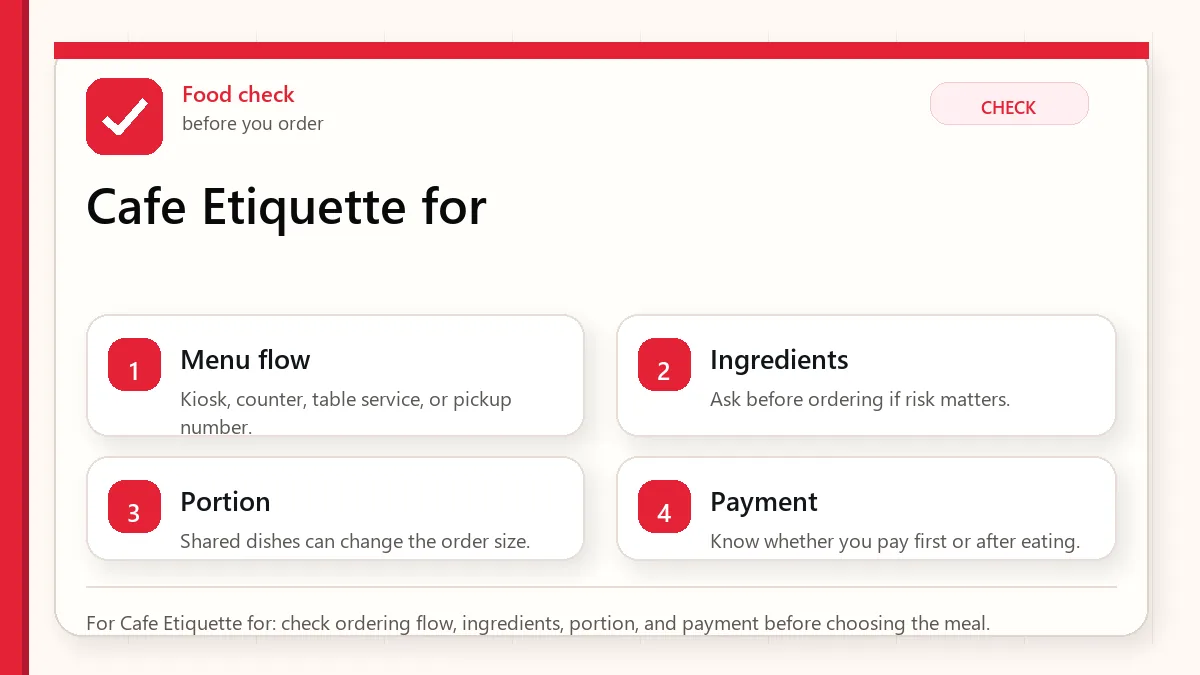
    Layered red check decision graphic for Cafe Etiquette for.
    For Cafe Etiquette for: check ordering flow, ingredients, portion, and payment before choosing the meal.

    Where visitors usually feel unsure

    This matters when the rule is less important than the local rhythm: queue, noise, seat, shared table, greeting, payment, or how quickly people expect the line to move. Pause, read the room, and use the smallest polite action that solves the moment.

    The small check that changes the answer

    • Order before sitting if the cafe layout suggests counter-first service.
    • Do not occupy large tables during crowded periods if you are alone.
    • Use outlets and laptop time with awareness of crowding.
    • Keep voices low in study-like cafes and be quicker in tiny popular cafes.
    • Save the relevant page or screenshot before you need it in public.
    • Re-check volatile details near travel day because policies and app flows change.

    A cafe can be a rest stop, workspace, or quick drink place

    Read the room before opening the laptop

    Some cafes welcome long laptop sessions; others are crowded, small, or designed for quick turnover. The same behavior can feel normal in one cafe and inconsiderate in another.

    Seats have social meaning

    A four-person table, window photo spot, or limited outlet seat may be in high demand. Choosing a smaller seat when alone is a simple way to avoid friction.

    Cafes are good recovery infrastructure

    For travelers, cafes are not just aesthetic stops. They are where you recover from weather, check maps, translate menus, charge a phone, and slow the day down.

    A calmer way to handle the social moment

    Notice the setting before choosing the action

    Notice the setting first: queue, seat, noise level, shared space, or staff rhythm. The smaller polite action is usually the safer one.

    Use official guidance only where rules, safety, or transport signs apply

    For signs, transport rules, and venue instructions, follow the posted rule first. For softer manners, read the local flow.

    Use a short polite phrase if the moment feels unclear

    The backup is a small repair: pause, step aside, say a short apology, or ask with a simple phrase.

    Do not overexplain when a small adjustment is enough

    More rules can make you stiff. Watch the room, keep space, and adjust quietly.

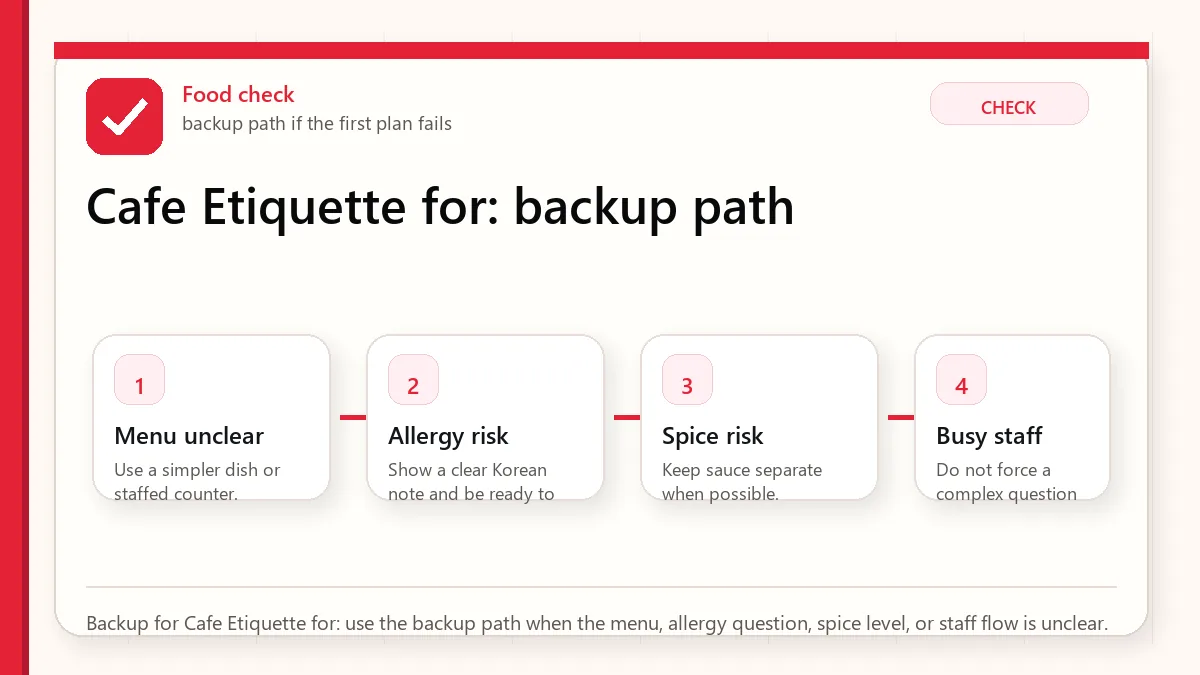
    Layered red check backup flow graphic for Cafe Etiquette for.
    Backup for Cafe Etiquette for: use the backup path when the menu, allergy question, spice level, or staff flow is unclear.

    What this means in the real moment

    The first plan depends on one fragile detail

    If one card, one app login, one translation scan, or one store policy controls the whole plan, add a backup before the trip.

    The information is technically correct but not practical

    A rule can be true and still be hard to use when you are tired, carrying luggage, or standing in a busy line. Plan for the human moment, not only the policy.

    A visitor copies advice from a different travel style

    A resident, Korean speaker, business traveler, or frequent visitor may solve problems differently from a first-time tourist. Use advice that matches your situation.

    A safer way to make the decision

    SituationSafer defaultWhy
    Short first tripChoose convenience and fewer moving partsRecovery time is limited
    Budget-conscious tripSeparate must-pay costs from nice-to-have extrasSmall purchases add up quickly
    Higher-risk situationUse official sources and conservative backupsHealth, entry, tax, and payment issues are not good places to gamble

    Sources to re-check

    Use these pages for facts that can change by date, operator, airport, app version, store, or traveler status.

    Where to go next

    FAQ

    Can I rely on one answer for every visitor?

    No. Korea travel details can depend on nationality, app version, store, airport, phone setup, card issuer, and date.

    Should I solve this after arriving?

    Try not to. Anything involving entry, phone data, maps, payment, allergies, or airport transfer is easier to prepare before the first pressure moment.

    What is the safest habit?

    Keep the official source, the practical guide, and a simple backup together. That combination is more useful than memorizing many tips.

  • Korean Convenience Store Meal Guide

    Korean Convenience Store Meal Guide

    Start with the first thing that can block the day

    Korean convenience stores are useful when restaurants feel difficult, but they still require small decisions: label reading, microwave use, seating, payment, freshness, and allergy caution. Decide first whether you need a safe backup meal, a quick snack, or a heated dish, because each choice changes what you should check on the package.

    Last checked: June 1, 2026. Re-check the latest product label, restaurant information, and official/public database before acting, because routes, prices, labels, rules, app screens, eligibility, and store/service policies can change.

    Last updated: May 23, 2026. Rules, app flows, prices, and eligibility can change, so re-check official sources close to your trip.

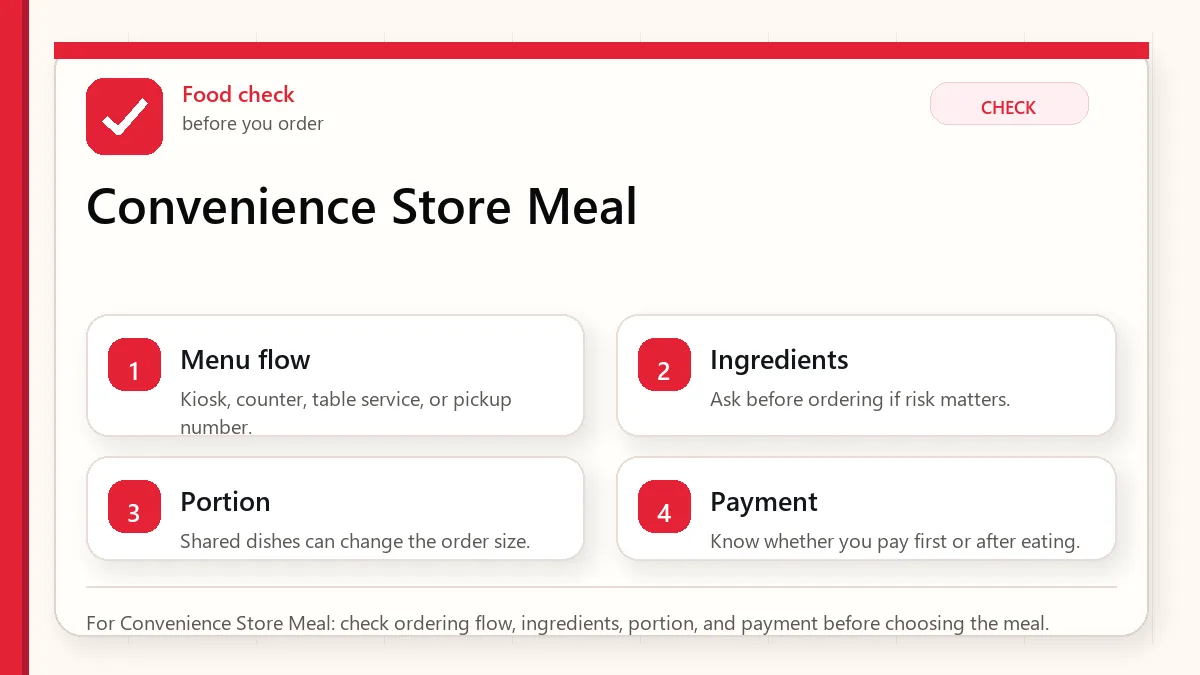
    Layered red check decision graphic for Convenience Store Meal.
    For Convenience Store Meal: check ordering flow, ingredients, portion, and payment before choosing the meal.

    Where label decisions usually fail

    This matters when a product, food, cosmetic, clothing item, or package looks easy to understand but the useful detail is on the label, sticker, measurement, date, ingredient list, or return rule. Check the evidence before you pay.

    The small check that changes the answer

    • Use translation for labels and heating instructions before buying.
    • Check whether the store has microwave, hot water, seating, or eating space.
    • Be careful with allergens in sauces, ramen packets, kimbap fillings, and prepared meals.
    • Keep convenience stores as a useful backup, not the whole food plan.
    • Save the relevant page or screenshot before you need it in public.
    • Re-check volatile details near travel day because policies and app flows change.

    Convenience-store meals work best with a small system

    Breakfast is where convenience stores shine

    For early starts, a convenience store can solve coffee, water, fruit, yogurt, kimbap, or a simple packaged meal before restaurants open. It is practical when you choose deliberately.

    Heating rules matter

    Some meals are meant to be microwaved, some need hot water, and some are ready to eat. Watch what locals do near the microwave area and use translation before removing lids or sauce packets.

    Late-night choices should be gentle

    After travel or drinking, the easiest spicy ramen may not be the best body decision. Keep a mild option, water, and something familiar in mind.

    A label check that prevents regret later

    Decide what the label must prove

    Decide what the label must prove: size, date, ingredient, warning, seller, or return rule. Do not let the product photo answer a label question.

    Use official or package information for claims that can change

    For product claims, ingredients, certification, dates, and returns, use the package, brand, store, or official source over copied screenshots.

    Photograph the label or keep the receipt when proof matters

    The backup is proof: a photo of the label, a receipt, the product name, or a safer option you can choose instead.

    Do not buy only from a familiar-looking claim

    More product claims do not equal more certainty. Check the specific label in front of you.

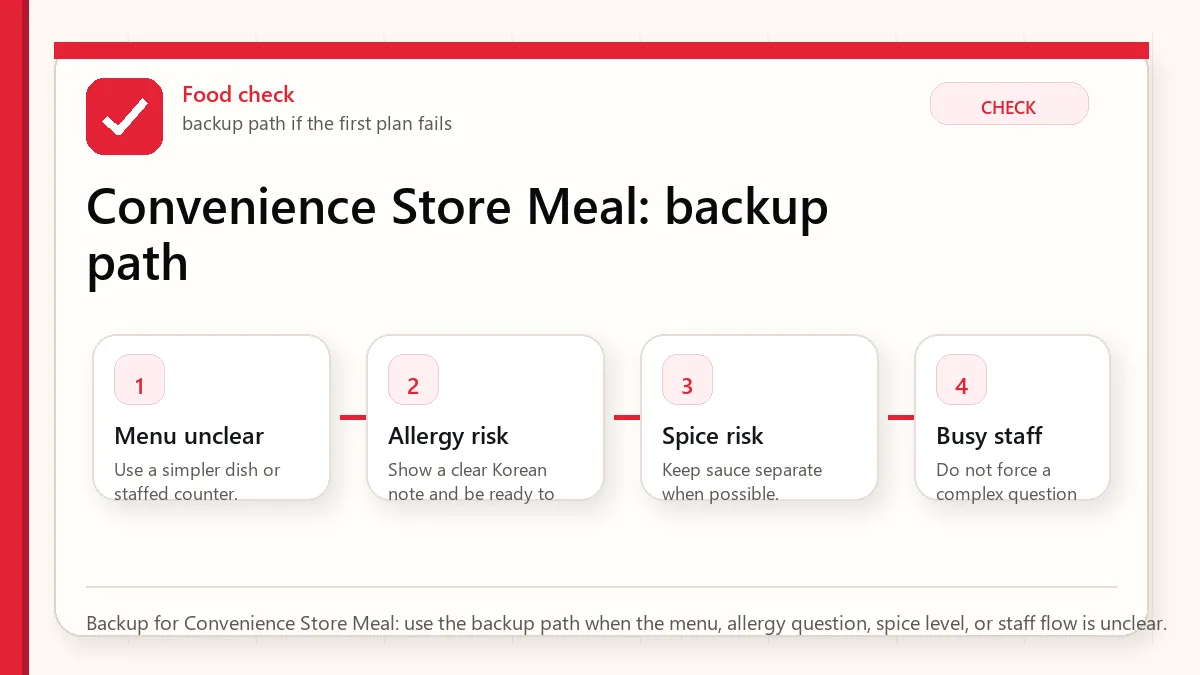
    Layered red check backup flow graphic for Convenience Store Meal.
    Backup for Convenience Store Meal: use the backup path when the menu, allergy question, spice level, or staff flow is unclear.

    What this means in the real moment

    The first plan depends on one fragile detail

    If one card, one app login, one translation scan, or one store policy controls the whole plan, add a backup before the trip.

    The information is technically correct but not practical

    A rule can be true and still be hard to use when you are tired, carrying luggage, or standing in a busy line. Plan for the human moment, not only the policy.

    A visitor copies advice from a different travel style

    A resident, Korean speaker, business traveler, or frequent visitor may solve problems differently from a first-time tourist. Use advice that matches your situation.

    A safer way to make the decision

    SituationSafer defaultWhy
    Short first tripChoose convenience and fewer moving partsRecovery time is limited
    Budget-conscious tripSeparate must-pay costs from nice-to-have extrasSmall purchases add up quickly
    Higher-risk situationUse official sources and conservative backupsHealth, entry, tax, and payment issues are not good places to gamble

    Sources to re-check

    Use these pages for facts that can change by date, operator, airport, app version, store, or traveler status.

    Where to go next

    FAQ

    Can I rely on one answer for every visitor?

    No. Korea travel details can depend on nationality, app version, store, airport, phone setup, card issuer, and date.

    Should I solve this after arriving?

    Try not to. Anything involving entry, phone data, maps, payment, allergies, or airport transfer is easier to prepare before the first pressure moment.

    What is the safest habit?

    Keep the official source, the practical guide, and a simple backup together. That combination is more useful than memorizing many tips.

  • Korean Food Allergy Card Guide

    Korean Food Allergy Card Guide

    If you have food allergies in Korea, do not rely only on spoken English or a translation app at the table. Prepare a Korean allergy card, choose food situations where staff can confirm ingredients, and treat uncertainty as a real warning sign.

    Last checked: June 1, 2026. Re-check the official provider, store, customs, or payment page before acting, because routes, prices, labels, rules, app screens, eligibility, and store/service policies can change.

    Last updated: May 27, 2026. Menus, ingredients, kitchen handling, staff answers, and packaged-food labels can change, so re-check before ordering.

    Layered red check decision graphic for Food allergy card.
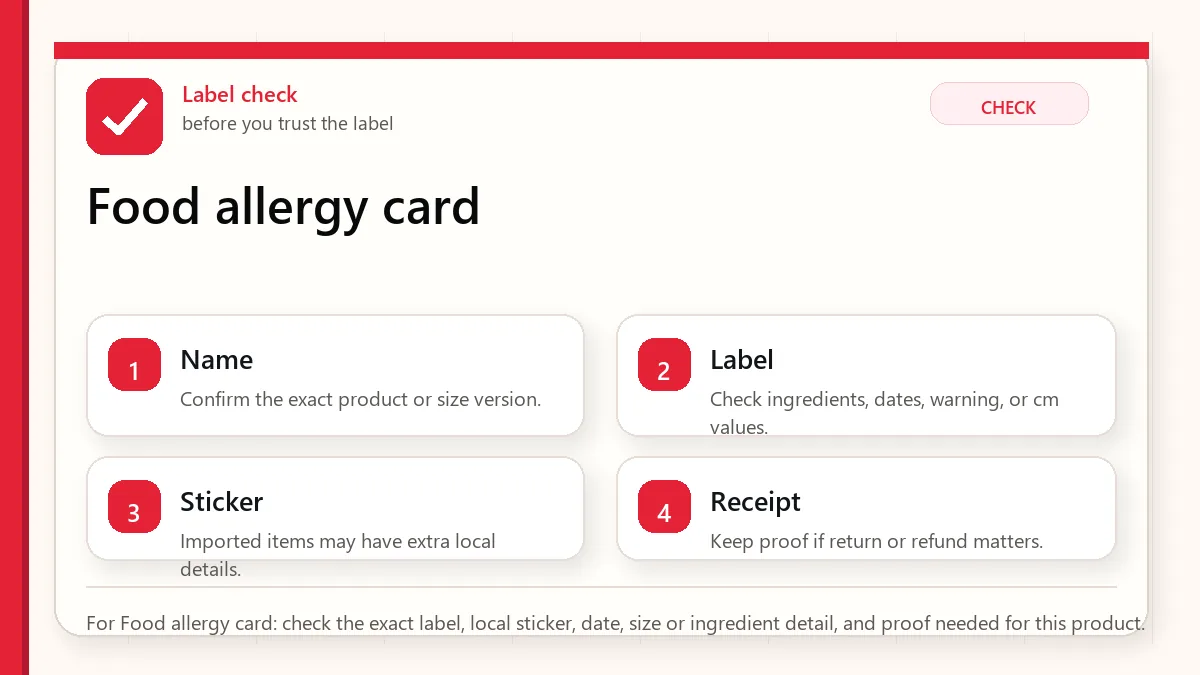
    For Food allergy card: check the exact label, local sticker, date, size or ingredient detail, and proof needed for this product.

    This guide is written for visitors searching broad terms like korean allergies or more urgent phrases like food allergy in Korean. The real intent is safety. A useful article should not only translate one sentence. It should help a traveler decide when to ask, when to avoid, and when uncertainty itself is the warning.

    Start with the hard truth

    Korea can be a wonderful food destination, but serious allergy travel needs caution. Many restaurants are small, busy, and optimized for speed. Staff may not know every ingredient in a sauce, broth, batter, side dish, or supplier product. A server may answer based on the visible main ingredient, not hidden components or shared cooking surfaces. This is not carelessness; it is how complex restaurant food often works.

    If your allergy can cause severe reactions, do not treat any blog, translation app, or casual staff answer as a medical guarantee. Bring your medication, know local emergency numbers and travel insurance details, and choose lower-risk food situations. Before Korea can help you prepare questions, but it cannot make a restaurant safe.

    Use a Korean allergy card

    A written allergy card is the single most useful preparation tool. It should be short, specific, and calm. Do not write a long paragraph. Write what you cannot eat, what happens if you eat it, and whether cross-contact matters. Keep it in Korean, English, and as an offline screenshot. Print one if your allergy is serious.

    English meaningKorean textHow to use it
    I have a food allergy.저는 음식 알레르기가 있습니다.First line of the card.
    I cannot eat this ingredient.이 재료를 먹을 수 없습니다.Put the ingredient name beside it.
    Even a small amount can be dangerous.소량도 위험할 수 있습니다.Use only if medically true.
    Please check the sauce, broth, and seasoning.소스, 육수, 양념도 확인해 주세요.Important for Korean food.
    If you are not sure, please tell me.확실하지 않으면 말씀해 주세요.Gives staff permission to be honest.

    Allergens that hide in Korean food

    Many visitors think only about the main dish name. In Korea, risk often hides in the support system: soup stock, soy sauce, gochujang, doenjang, marinades, frying batter, powdered seasoning, fish sauce, anchovy broth, shrimp paste, sesame oil, garnish, banchan, and shared grills. A dish that looks simple may not be simple.

    • Wheat and gluten: soy sauce, noodles, dumplings, batter, pancakes, fried foods, gochujang, and processed sauces can matter.
    • Soy: soy sauce, doenjang, tofu, marinades, soup bases, and side dishes.
    • Seafood and shellfish: anchovy broth, seafood stock, shrimp paste, fish cake, sauces, stews, kimchi variations, and cross-contact.
    • Peanuts and tree nuts: less universal than some cuisines, but can appear in desserts, sauces, toppings, snacks, and fusion foods.
    • Sesame: sesame oil and seeds are common finishing ingredients.
    • Egg and milk: bakery items, batter, mayo-like sauces, desserts, cafe drinks, and processed foods.
    Layered red check backup flow graphic for Food allergy card.
    Backup for Food allergy card: use the backup path when the label, translation, size, or product claim is not clear enough.

    Packaged food labels help, but read them carefully

    Korea’s MFDS food labeling system includes allergen labeling rules for packaged foods. MFDS lists allergen labeling foods such as eggs, milk, buckwheat, peanuts, soybeans, wheat, mackerel, crab, shrimp, pork, peach, tomato, sulfurous acid in specified cases, walnuts, chicken, beef, squid, clams including oyster, abalone, and mussels, and pine nut. The label system can help with packaged snacks, convenience store food, sauces, and grocery items.

    But labels are not the same as a restaurant kitchen. Packaged food has a printed ingredient and allergen environment. Restaurant food can change by branch, prep, sauce, stock, garnish, and shared surfaces. Use packaged labels when possible, but still be cautious with heating, mixed foods, and items prepared in-store.

    Restaurant ordering strategy

    Show the allergy card before ordering, not after the food arrives. Choose a calmer restaurant time if possible. Point to the dish you want and let staff check. If the answer is hesitant, vague, or based only on a quick glance at the menu, treat that uncertainty as useful information. A polite exit is better than a risky meal.

    For serious allergies, avoid situations where detailed ingredient confirmation is unrealistic: loud night markets, very busy street stalls, tiny kiosk-only shops, all-you-can-eat buffets, shared fryer menus, marinated BBQ, complex stews, and places where staff cannot slow down. This may feel limiting, but it is better than forcing a restaurant to provide certainty it does not have.

    Kiosks and delivery are weaker for allergies

    Kiosks can be convenient for ordinary ordering, but they are not ideal for serious allergy negotiation. The menu may not show hidden ingredients, and custom request boxes can be ignored or misunderstood. Delivery apps create the same problem at a distance. You lose the face-to-face moment where staff can ask the kitchen, read the card, or say no.

    If you must use a kiosk, order only when the allergy risk is low and the ingredient path is obvious. If the allergy is serious, choose counter ordering, packaged food with clear labels, a restaurant with published allergen information, or a place where staff can directly discuss the issue.

    Useful Korean ingredient words

    IngredientKoreanRomanization
    Peanut땅콩ttangkong
    Walnut호두hodu
    Pine nutjat
    Milk우유uyu
    Egg계란 / 달걀gyeran / dalgyal
    Wheatmil
    Soybean대두 / 콩daedu / kong
    Shrimp새우saeu
    Crabge
    Squid오징어ojingeo
    Sesame참깨 / 깨chamkkae / kkae

    Do not depend only on romanization. Put the Korean characters on your card. Staff need to read the Korean quickly, not decode your pronunciation.

    Lower-risk food habits

    • Choose simpler dishes with fewer sauces when possible.
    • Prefer places that can slow down and answer clearly.
    • Use packaged food labels for snacks and convenience store meals.
    • Keep your allergy card visible and concise.
    • Carry safe backup food if your allergy is serious.
    • Do not let social pressure push you into uncertain shared dishes.

    What to do when staff are unsure

    Thank them and choose another option. Uncertainty is not rude; it is useful. A staff member who says “I am not sure” is giving you better information than someone who guesses. Your card should include a sentence that invites honesty: 확실하지 않으면 말씀해 주세요 – if you are not sure, please tell me.

    When traveling with friends, explain this before meals. The group should understand that changing restaurants is part of the plan, not a dramatic failure. A serious allergy trip works better when the group accepts flexibility.

    The allergy safety ladder

    Think in layers. The safest layer is food you can identify and verify before eating. The next layer is a calm restaurant where staff can read your Korean allergy card and check ingredients. The riskier layer is fast ordering, kiosks, delivery, shared grills, street stalls, and complex stews where hidden ingredients and cross-contact are harder to discuss.

    Food situationWhy it can be difficultSafer move
    Packaged convenience store foodLabels help, but small print and mixed ingredients still matter.Read allergen labels and use camera translation carefully.
    Simple counter restaurantStaff may be able to check one dish directly.Show the card before ordering and accept “not sure” as a no.
    Korean BBQPlain meat may be simple, but sauces, sides, and shared grills add risk.Favor plain meat only when staff can confirm sides and surfaces.
    Kiosks and deliveryYou lose the face-to-face explanation moment.Avoid for serious allergies unless the restaurant has clear allergen handling.
    Street food and marketsIngredients, oil, and surfaces are hard to verify in crowds.Choose only very low-risk items or skip.

    A clearer allergy card format

    Use a card that is direct and readable. Put the ingredient names in Korean, not only English. A practical structure is: “I have a severe allergy to ___.” “Even a small amount can be dangerous.” “Please check sauce, broth, seasoning, frying oil, and shared surfaces.” “If you are not sure, please tell me.” Then list the exact Korean ingredient names.

    Do not overload the card with every food you dislike. Keep allergy and preference separate. If you are vegetarian, halal, gluten-free by preference, or avoiding spice, make a separate note. Allergy cards should be treated as safety documents, not general menu customization.

    Official and internal checks to use with this guide

    Use the MFDS food labeling page linked below for packaged-food allergen context, then connect this guide with Korean Food Allergy Card, Papago vs Google Translate in Korea, Korean restaurant kiosk guide, Korean BBQ costs, portions, and allergies, and Korean convenience store food labels and allergies.

    FAQ

    How do I say food allergy in Korean?

    You can write 음식 알레르기 for food allergy. A full card should say exactly which ingredient you cannot eat.

    Can I rely on Papago or Google Translate for allergies?

    Use translation apps as support, not as your only safety layer. Prepare a reviewed Korean card before the meal.

    Are Korean packaged foods labeled for allergens?

    Packaged foods can include allergen labeling under MFDS rules, but you still need to read carefully and consider cross-contact warnings.

    Is Korean BBQ safe for allergies?

    It depends. Plain unseasoned meat may be simpler, but marinades, sauces, soybean paste, shared grills, side dishes, and staff uncertainty can create risk.

    Related guides

    Sources and verification notes

    Use these sources to re-check app, identity, labeling, or travel details close to the day you act. App flows and eligibility can change.

  • Korean BBQ Ordering Guide

    Korean BBQ Ordering Guide

    Start with the moment you order

    Korean BBQ feels easier when you understand the table system before the meat arrives: portions are shared, side dishes are part of the meal, staff may help with the grill, and ordering too much is easy.

    Last checked: June 1, 2026. Re-check the latest product label, restaurant information, and official/public database before acting, because routes, prices, labels, rules, app screens, eligibility, and store/service policies can change.

    Last updated: May 23, 2026. Rules, app flows, prices, and eligibility can change, so re-check official sources close to your trip.

    Layered red check decision graphic for BBQ Ordering.
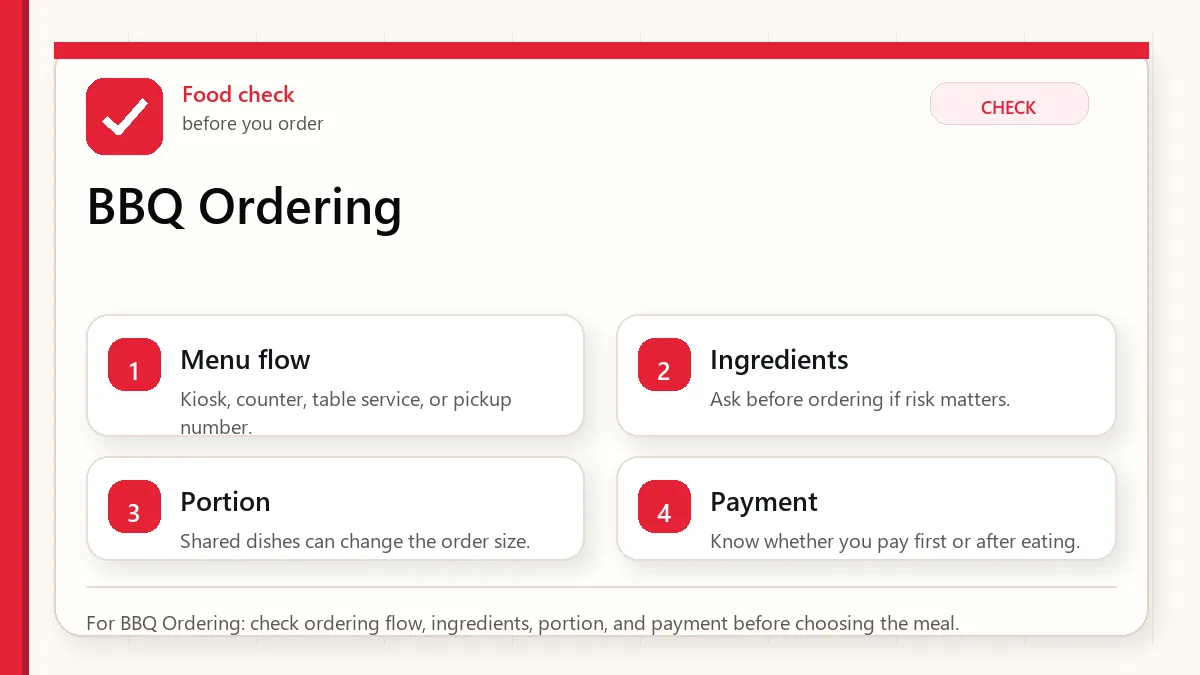
    For BBQ Ordering: check ordering flow, ingredients, portion, and payment before choosing the meal.

    Where food plans usually get uncertain

    This matters when the menu photo is easy but the real problem is ordering flow, hidden ingredients, spice level, shared table rhythm, payment, or whether staff can confirm a question clearly. Choose the situation as carefully as the dish.

    What to check before you rely on it

    • Start with modest portions and add more if needed.
    • Notice whether staff expects to handle the grill or guests do.
    • Use side dishes as part of the meal, not as separate appetizers.
    • Check whether payment is per table, at counter, or split-friendly before assuming.
    • Save the relevant page or screenshot before you need it in public.
    • Re-check volatile details near travel day because policies and app flows change.

    Korean BBQ is a shared system, not just grilled meat

    Portions are easier to add than undo

    First-time groups often order too much because every cut sounds important. Start with a reasonable amount, watch the table rhythm, and add more after you understand appetite and cooking speed.

    The grill has social rules

    Some restaurants expect staff to cut and turn meat; others let guests handle it. Watch the first few minutes and follow the restaurant’s pattern instead of grabbing tools immediately.

    Side dishes are functional

    Banchan, lettuce, garlic, sauces, and wraps balance richness and spice. They are not only decoration, and some can often be refilled depending on the restaurant.

    An ordering path that keeps the meal manageable

    Decide what needs to be clear before ordering

    Decide what must be clear before ordering: ingredient risk, spice, portion, staff help, payment, or pickup flow.

    Use reliable sources when ingredients, safety, or store rules matter

    For allergy, food safety, opening hours, and store rules, use the most current source you can verify and keep uncertainty visible.

    Keep a simple meal or staffed counter as the fallback

    The backup should be easy to explain: a Korean allergy note, a mild dish, a staffed restaurant, or a convenience-store fallback.

    Do not force a busy food situation to solve every question

    More menu options can increase uncertainty. Choose the situation where staff, ingredients, and payment are easiest to understand.

    Layered red check backup flow graphic for BBQ Ordering.
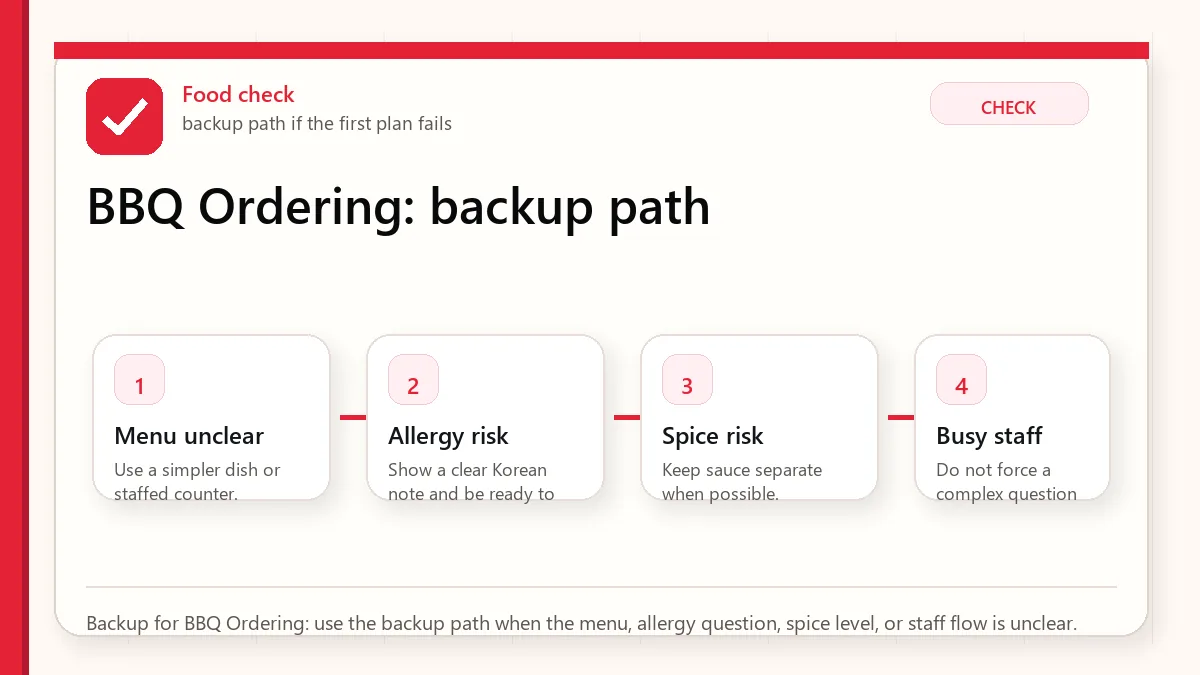
    Backup for BBQ Ordering: use the backup path when the menu, allergy question, spice level, or staff flow is unclear.

    The small check that changes the answer

    The first plan depends on one fragile detail

    If one card, one app login, one translation scan, or one store policy controls the whole plan, add a backup before the trip.

    The information is technically correct but not practical

    A rule can be true and still be hard to use when you are tired, carrying luggage, or standing in a busy line. Plan for the human moment, not only the policy.

    A visitor copies advice from a different travel style

    A resident, Korean speaker, business traveler, or frequent visitor may solve problems differently from a first-time tourist. Use advice that matches your situation.

    What this means in the real moment

    SituationSafer defaultWhy
    Short first tripChoose convenience and fewer moving partsRecovery time is limited
    Budget-conscious tripSeparate must-pay costs from nice-to-have extrasSmall purchases add up quickly
    Higher-risk situationUse official sources and conservative backupsHealth, entry, tax, and payment issues are not good places to gamble

    Sources to re-check

    Use these pages for facts that can change by date, operator, airport, app version, store, or traveler status.

    Where to go next

    FAQ

    Can I rely on one answer for every visitor?

    No. Korea travel details can depend on nationality, app version, store, airport, phone setup, card issuer, and date.

    Should I solve this after arriving?

    Try not to. Anything involving entry, phone data, maps, payment, allergies, or airport transfer is easier to prepare before the first pressure moment.

    What is the safest habit?

    Keep the official source, the practical guide, and a simple backup together. That combination is more useful than memorizing many tips.

  • What Not to Buy in Korea

    What Not to Buy in Korea

    Start with the label and return risk

    The best shopping advice sometimes starts with what not to buy. A product can be popular, cute, discounted, or Korea-themed and still be a poor purchase if it creates authenticity, size, ingredient, return, luggage, or customs risk. Check the exit cost before the checkout price.

    Last checked: June 1, 2026. Re-check the latest product label, store policy, and official refund or safety page before acting, because routes, prices, labels, rules, app screens, eligibility, and store/service policies can change.

    Last updated: May 23, 2026. Rules, app flows, prices, and eligibility can change, so re-check official sources close to your trip.

    Layered red check decision graphic for What Not to Buy.
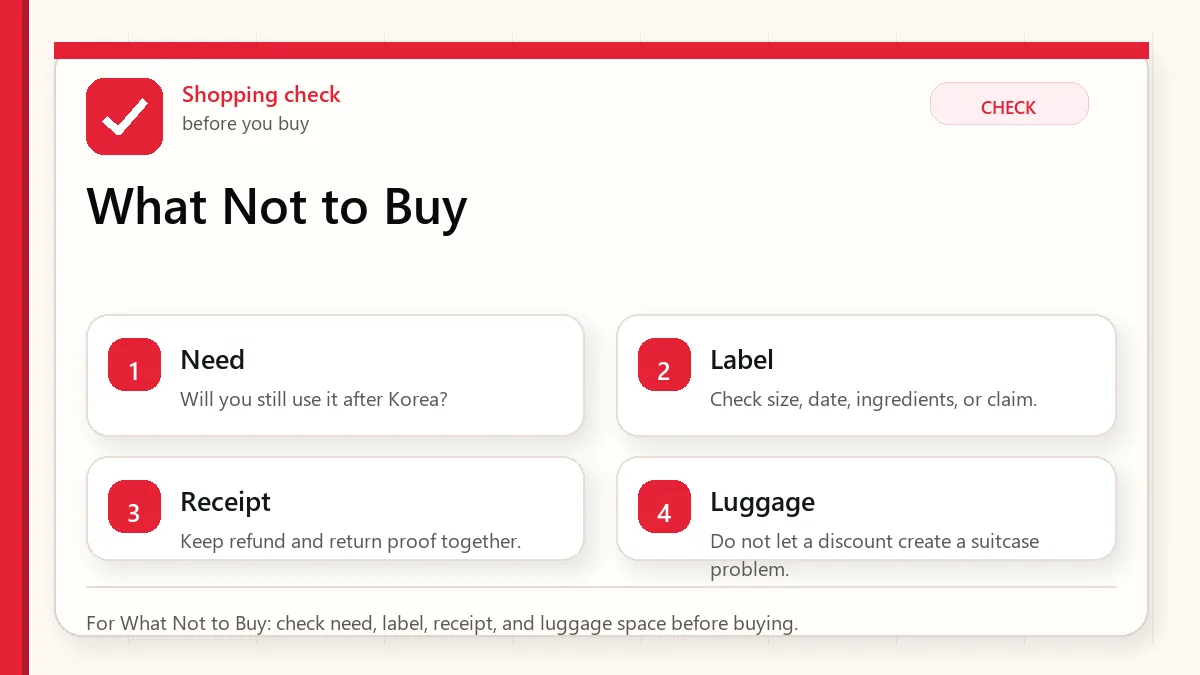
    For What Not to Buy: check need, label, receipt, and luggage space before buying.

    Where shopping decisions usually drift

    This matters when a store, discount, ranking, or viral product makes the decision feel easier than it is. Check fit, label, receipt, authenticity, tax refund, and luggage space before the purchase becomes a suitcase problem.

    What to check before you rely on it

    • Skip products that have no clear use after the trip.
    • Avoid skincare that conflicts with your known sensitivities.
    • Be careful with bulky, fragile, or liquid-heavy gifts.
    • Do not buy only because an item appears in a viral short video.
    • Save the relevant page or screenshot before you need it in public.
    • Re-check volatile details near travel day because policies and app flows change.

    A good no saves luggage, money, and regret

    The suitcase test is honest

    If an item is heavy, fragile, liquid, or awkwardly shaped, it needs to be genuinely worth the space. A cute object in Seoul can feel less charming when it forces repacking at midnight.

    The recipient test is kinder

    For gifts, choose items the person can understand and use. A niche beauty active, strong flavor, or size-dependent clothing item can be thoughtful only if it matches the person.

    The refund test prevents false savings

    If you would not buy the item without a possible refund, the refund is probably doing too much work in the decision.

    A shopping path that still makes sense after Korea

    Decide what the purchase must be useful for

    Decide what the purchase has to survive: luggage, skin, size, receipt, refund, gifting, or use after the trip.

    Use store, brand, or official rules when refund and authenticity matter

    For refund, tax-free, return, and authenticity questions, use the store, brand, or official rule that controls the purchase.

    Keep the receipt and leave space for a better option later

    The backup is restraint: keep the receipt, compare one more store, leave luggage space, or skip the item.

    Do not buy only because Korea makes it feel special

    More deals can make the basket worse. Buy what still makes sense after you leave the store.

    Layered red check backup flow graphic for What Not to Buy.
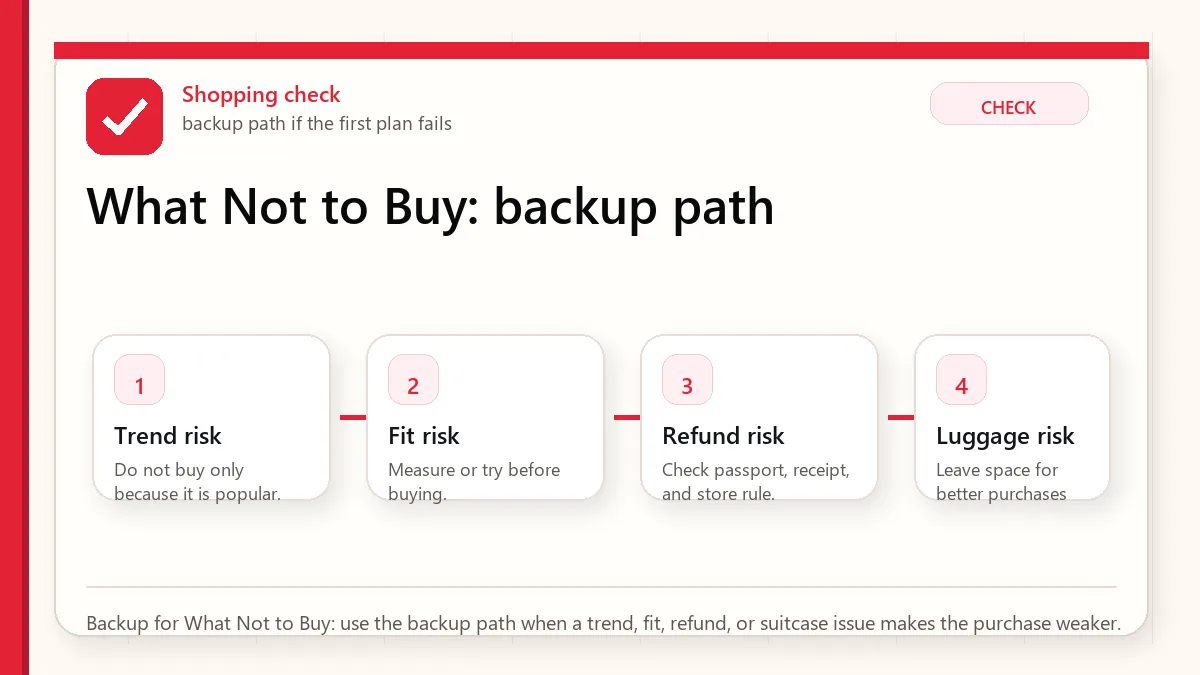
    Backup for What Not to Buy: use the backup path when a trend, fit, refund, or suitcase issue makes the purchase weaker.

    The small check that changes the answer

    The first plan depends on one fragile detail

    If one card, one app login, one translation scan, or one store policy controls the whole plan, add a backup before the trip.

    The information is technically correct but not practical

    A rule can be true and still be hard to use when you are tired, carrying luggage, or standing in a busy line. Plan for the human moment, not only the policy.

    A visitor copies advice from a different travel style

    A resident, Korean speaker, business traveler, or frequent visitor may solve problems differently from a first-time tourist. Use advice that matches your situation.

    What this means in the real moment

    SituationSafer defaultWhy
    Short first tripChoose convenience and fewer moving partsRecovery time is limited
    Budget-conscious tripSeparate must-pay costs from nice-to-have extrasSmall purchases add up quickly
    Higher-risk situationUse official sources and conservative backupsHealth, entry, tax, and payment issues are not good places to gamble

    Sources to re-check

    Use these pages for facts that can change by date, operator, airport, app version, store, or traveler status.

    Where to go next

    Official links to check

    Use these official links when the next step matters. This guide explains what to watch for, but app downloads, eligibility, prices, routes, policies, and service rules can change.

    FAQ

    Can I rely on one answer for every visitor?

    No. Korea travel details can depend on nationality, app version, store, airport, phone setup, card issuer, and date.

    Should I solve this after arriving?

    Try not to. Anything involving entry, phone data, maps, payment, allergies, or airport transfer is easier to prepare before the first pressure moment.

    What is the safest habit?

    Keep the official source, the practical guide, and a simple backup together. That combination is more useful than memorizing many tips.

  • Where to Buy Korean Products in Korea

    Where to Buy Korean Products in Korea

    Start with the label and return risk

    Where you buy in Korea matters because the same product decision changes with price, authenticity, tax refund, return policy, staff help, language support, and luggage timing. Start by choosing the store type that matches your risk: official counter for proof, big retailer for service, or small shop only when the return risk is low.

    Last checked: June 1, 2026. Re-check the latest product label, store policy, and official refund or safety page before acting, because routes, prices, labels, rules, app screens, eligibility, and store/service policies can change.

    Last updated: May 23, 2026. Rules, app flows, prices, and eligibility can change, so re-check official sources close to your trip.

    Layered red check decision graphic for Where to Buy Products.
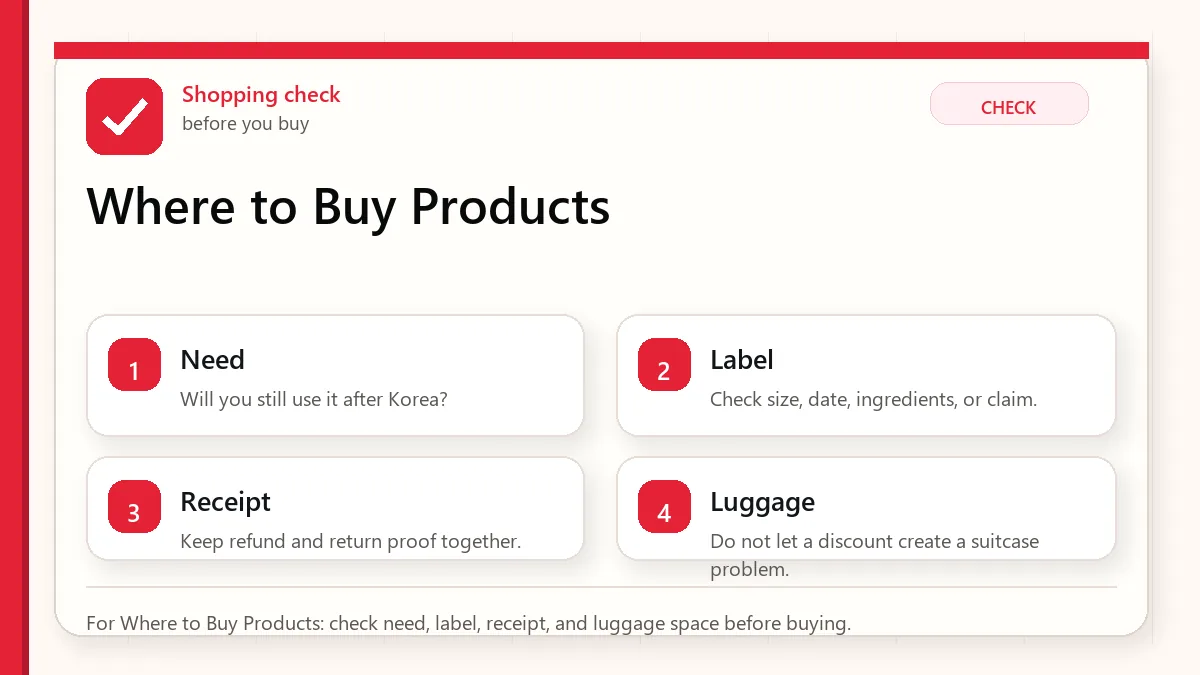
    For Where to Buy Products: check need, label, receipt, and luggage space before buying.

    Where shopping decisions usually drift

    This matters when a store, discount, ranking, or viral product makes the decision feel easier than it is. Check fit, label, receipt, authenticity, tax refund, and luggage space before the purchase becomes a suitcase problem.

    What this means in the real moment

    • Use Olive Young for convenient beauty comparison, not every possible product category.
    • Use department stores or brand shops when authenticity, service, or premium items matter.
    • Use Daiso and markets for small practical items, but keep expectations realistic.
    • Use duty-free when timing, pickup, and item category actually fit your trip.
    • Save the relevant page or screenshot before you need it in public.
    • Re-check volatile details near travel day because policies and app flows change.

    Different stores solve different shopping problems

    Convenience has value

    A store with clear layout, easy payment, and staff familiarity with tourists can be worth more than a tiny price difference elsewhere, especially on a short trip.

    Markets are better for browsing than certainty

    Traditional markets can be fun and good for snacks, small goods, and atmosphere, but they may not be ideal for products where authenticity, warranty, or return policy matters.

    Duty-free is not always simpler

    Duty-free can be useful for certain items, but pickup timing, airport flow, and comparison shopping matter. Do not choose duty-free only because the phrase sounds cheaper.

    A shopping path that still makes sense after Korea

    Decide what the purchase must be useful for

    Decide what the purchase has to survive: luggage, skin, size, receipt, refund, gifting, or use after the trip.

    Use store, brand, or official rules when refund and authenticity matter

    For refund, tax-free, return, and authenticity questions, use the store, brand, or official rule that controls the purchase.

    Keep the receipt and leave space for a better option later

    The backup is restraint: keep the receipt, compare one more store, leave luggage space, or skip the item.

    Do not buy only because Korea makes it feel special

    More deals can make the basket worse. Buy what still makes sense after you leave the store.

    Layered red check backup flow graphic for Where to Buy Products.
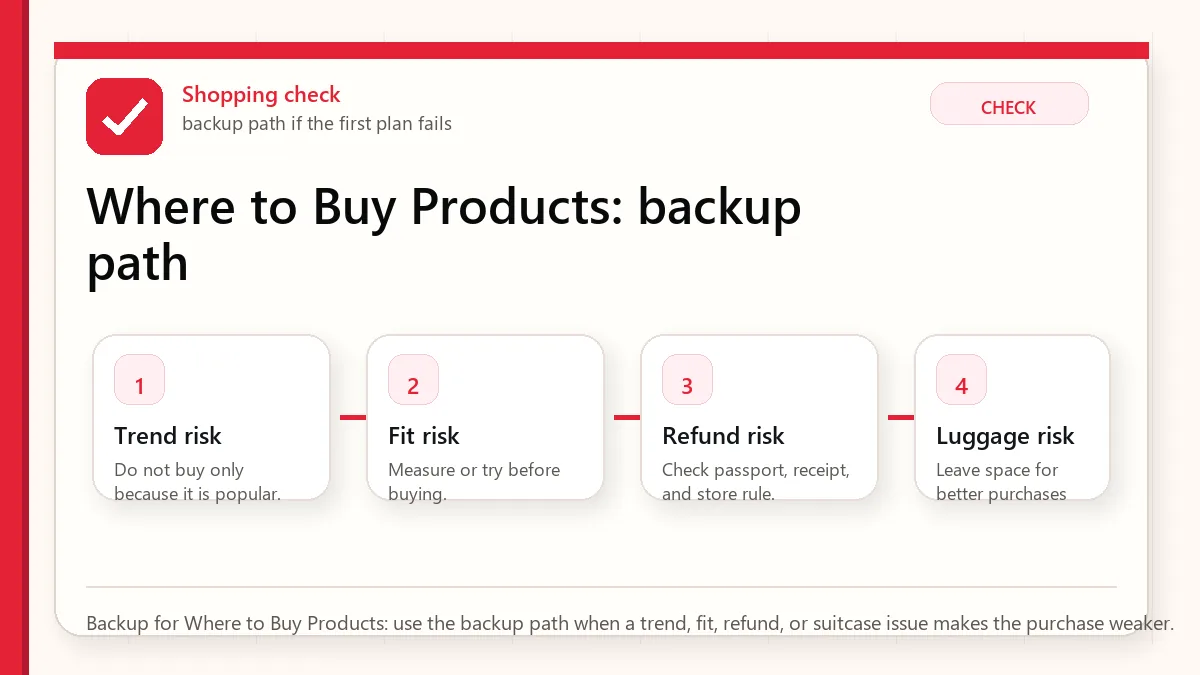
    Backup for Where to Buy Products: use the backup path when a trend, fit, refund, or suitcase issue makes the purchase weaker.

    A safer way to make the decision

    The first plan depends on one fragile detail

    If one card, one app login, one translation scan, or one store policy controls the whole plan, add a backup before the trip.

    The information is technically correct but not practical

    A rule can be true and still be hard to use when you are tired, carrying luggage, or standing in a busy line. Plan for the human moment, not only the policy.

    A visitor copies advice from a different travel style

    A resident, Korean speaker, business traveler, or frequent visitor may solve problems differently from a first-time tourist. Use advice that matches your situation.

    The backup that keeps the problem small

    SituationSafer defaultWhy
    Short first tripChoose convenience and fewer moving partsRecovery time is limited
    Budget-conscious tripSeparate must-pay costs from nice-to-have extrasSmall purchases add up quickly
    Higher-risk situationUse official sources and conservative backupsHealth, entry, tax, and payment issues are not good places to gamble

    Sources to re-check

    Use these pages for facts that can change by date, operator, airport, app version, store, or traveler status.

    Where to go next

    Official links to check

    Use these official links when the next step matters. This guide explains what to watch for, but app downloads, eligibility, prices, routes, policies, and service rules can change.

    FAQ

    Can I rely on one answer for every visitor?

    No. Korea travel details can depend on nationality, app version, store, airport, phone setup, card issuer, and date.

    Should I solve this after arriving?

    Try not to. Anything involving entry, phone data, maps, payment, allergies, or airport transfer is easier to prepare before the first pressure moment.

    What is the safest habit?

    Keep the official source, the practical guide, and a simple backup together. That combination is more useful than memorizing many tips.

  • K-Beauty Expiration Dates and Authenticity

    K-Beauty Expiration Dates and Authenticity

    Start with the label and skin risk

    A good skincare deal is only good if the product is fresh enough, sealed properly, bought from a trustworthy channel, and suitable for your skin. Before you buy, check the date mark, seller proof, return rule, ingredient risk, and whether the discount is worth losing easy after-sale help.

    Last checked: June 1, 2026. Re-check the latest product label, store policy, and official refund or safety page before acting, because routes, prices, labels, rules, app screens, eligibility, and store/service policies can change.

    Last updated: May 23, 2026. Rules, app flows, prices, and eligibility can change, so re-check official sources close to your trip.

    Layered red check decision graphic for K-Beauty Expiration Dates and.
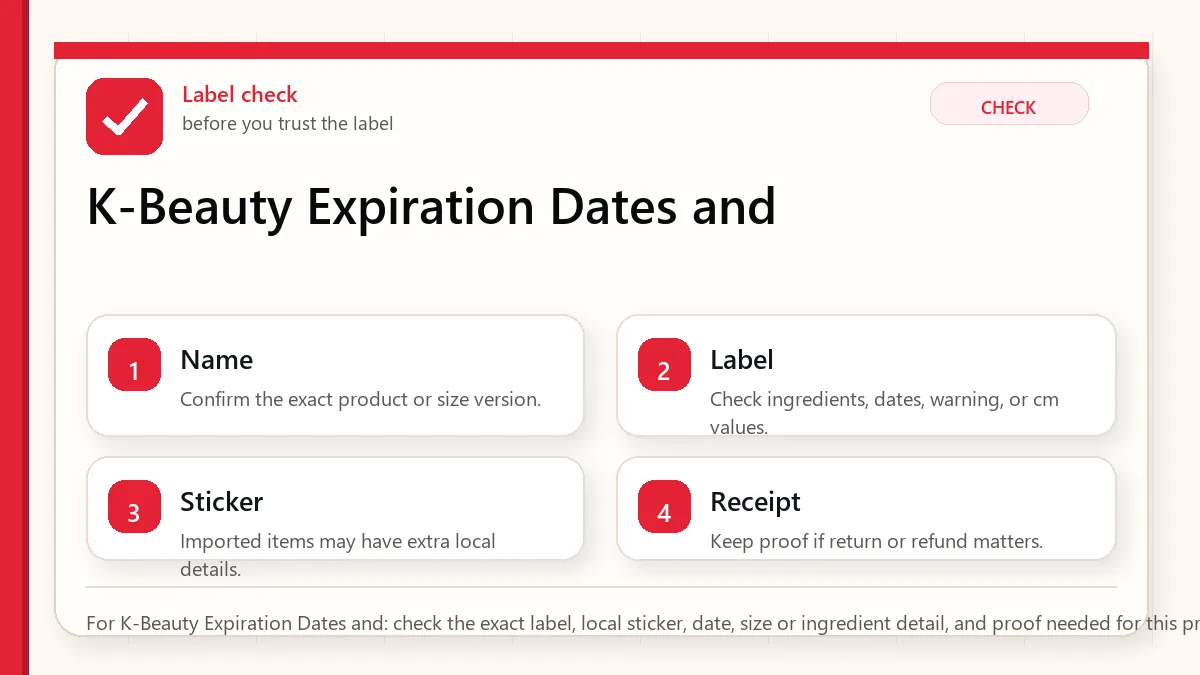
    For K-Beauty Expiration Dates and: check the exact label, local sticker, date, size or ingredient detail, and proof needed for this product.

    Where label decisions usually fail

    This matters when a product, food, cosmetic, clothing item, or package looks easy to understand but the useful detail is on the label, sticker, measurement, date, ingredient list, or return rule. Check the evidence before you pay.

    What to check before you rely on it

    • Look for date markings and period-after-opening symbols before buying multiples.
    • Check seals, packaging condition, and seller clarity.
    • Avoid products that are unusually cheap from unclear channels.
    • Do not stockpile more than you can reasonably finish.
    • Save the relevant page or screenshot before you need it in public.
    • Re-check volatile details near travel day because policies and app flows change.

    Fresh, sealed, and understandable beats cheap

    Date marks need context

    Korean cosmetics can use manufacturing dates, expiration dates, or period-after-opening symbols depending on the product. If you cannot tell what the mark means, ask staff or buy less.

    Authenticity is also about the channel

    Buying from clear retail channels reduces uncertainty. The risk is not only fake products; it is also old stock, damaged packaging, or products stored poorly.

    Overbuying creates its own expiration problem

    Even authentic products can become waste if you buy too many. Skincare has a use pace; your suitcase excitement does not change that pace.

    A label check that prevents regret later

    Decide what the label must prove

    Decide what the label must prove: size, date, ingredient, warning, seller, or return rule. Do not let the product photo answer a label question.

    Use official or package information for claims that can change

    For product claims, ingredients, certification, dates, and returns, use the package, brand, store, or official source over copied screenshots.

    Photograph the label or keep the receipt when proof matters

    The backup is proof: a photo of the label, a receipt, the product name, or a safer option you can choose instead.

    Do not buy only from a familiar-looking claim

    More product claims do not equal more certainty. Check the specific label in front of you.

    Layered red check backup flow graphic for K-Beauty Expiration Dates and.
    Backup for K-Beauty Expiration Dates and: use the backup path when the label, translation, size, or product claim is not clear enough.

    The small check that changes the answer

    The first plan depends on one fragile detail

    If one card, one app login, one translation scan, or one store policy controls the whole plan, add a backup before the trip.

    The information is technically correct but not practical

    A rule can be true and still be hard to use when you are tired, carrying luggage, or standing in a busy line. Plan for the human moment, not only the policy.

    A visitor copies advice from a different travel style

    A resident, Korean speaker, business traveler, or frequent visitor may solve problems differently from a first-time tourist. Use advice that matches your situation.

    What this means in the real moment

    SituationSafer defaultWhy
    Short first tripChoose convenience and fewer moving partsRecovery time is limited
    Budget-conscious tripSeparate must-pay costs from nice-to-have extrasSmall purchases add up quickly
    Higher-risk situationUse official sources and conservative backupsHealth, entry, tax, and payment issues are not good places to gamble

    Sources to re-check

    Use these pages for facts that can change by date, operator, airport, app version, store, or traveler status.

    Where to go next

    Official links to check

    Use these official links when the next step matters. This guide explains what to watch for, but app downloads, eligibility, prices, routes, policies, and service rules can change.

    FAQ

    Can I rely on one answer for every visitor?

    No. Korea travel details can depend on nationality, app version, store, airport, phone setup, card issuer, and date.

    Should I solve this after arriving?

    Try not to. Anything involving entry, phone data, maps, payment, allergies, or airport transfer is easier to prepare before the first pressure moment.

    What is the safest habit?

    Keep the official source, the practical guide, and a simple backup together. That combination is more useful than memorizing many tips.

  • Korean Skincare Ingredients Guide

    Korean Skincare Ingredients Guide

    Start with the label and skin risk

    Ingredient reading is not about becoming a chemist in a store aisle. It is about slowing down enough to know what role a product plays, what might irritate your skin, and whether the label supports the claim. Start with your skin risk, then check the ingredient list and patch-test plan.

    Last checked: June 1, 2026. Re-check the latest product label, store policy, and official refund or safety page before acting, because routes, prices, labels, rules, app screens, eligibility, and store/service policies can change.

    Last updated: May 23, 2026. Rules, app flows, prices, and eligibility can change, so re-check official sources close to your trip.

    Layered red check decision graphic for Skincare Ingredients.
    For Skincare Ingredients: check the exact label, local sticker, date, size or ingredient detail, and proof needed for this product.

    Where label decisions usually fail

    This matters when a product, food, cosmetic, clothing item, or package looks easy to understand but the useful detail is on the label, sticker, measurement, date, ingredient list, or return rule. Check the evidence before you pay.

    A safer way to make the decision

    • Know your personal triggers before entering the store.
    • Avoid buying multiple strong active products just because they are popular.
    • Check whether the product role duplicates something you already own.
    • If your skin is reactive, buy fewer new products and introduce them slowly after travel.
    • Save the relevant page or screenshot before you need it in public.
    • Re-check volatile details near travel day because policies and app flows change.

    Ingredient checks protect the trip after the purchase

    The product role matters first

    A serum, toner, essence, ampoule, moisturizer, and mask are not interchangeable just because packaging looks similar. Decide what the product is supposed to do in your routine before judging the ingredient list.

    Popularity is not compatibility

    A product can be loved online and still be wrong for your skin, climate, medication, or current routine. Sensitive visitors should treat trends as suggestions, not instructions.

    Travel is a bad time to overload actives

    New exfoliants, retinoids, brightening ingredients, and strong acne products can be useful, but testing many during or right after travel can make irritation harder to understand.

    A label check that prevents regret later

    Decide what the label must prove

    Decide what the label must prove: size, date, ingredient, warning, seller, or return rule. Do not let the product photo answer a label question.

    Use official or package information for claims that can change

    For product claims, ingredients, certification, dates, and returns, use the package, brand, store, or official source over copied screenshots.

    Photograph the label or keep the receipt when proof matters

    The backup is proof: a photo of the label, a receipt, the product name, or a safer option you can choose instead.

    Do not buy only from a familiar-looking claim

    More product claims do not equal more certainty. Check the specific label in front of you.

    Layered red check backup flow graphic for Skincare Ingredients.
    Backup for Skincare Ingredients: use the backup path when the label, translation, size, or product claim is not clear enough.

    The backup that keeps the problem small

    The first plan depends on one fragile detail

    If one card, one app login, one translation scan, or one store policy controls the whole plan, add a backup before the trip.

    The information is technically correct but not practical

    A rule can be true and still be hard to use when you are tired, carrying luggage, or standing in a busy line. Plan for the human moment, not only the policy.

    A visitor copies advice from a different travel style

    A resident, Korean speaker, business traveler, or frequent visitor may solve problems differently from a first-time tourist. Use advice that matches your situation.

    What to verify before you go

    SituationSafer defaultWhy
    Short first tripChoose convenience and fewer moving partsRecovery time is limited
    Budget-conscious tripSeparate must-pay costs from nice-to-have extrasSmall purchases add up quickly
    Higher-risk situationUse official sources and conservative backupsHealth, entry, tax, and payment issues are not good places to gamble

    Sources to re-check

    Use these pages for facts that can change by date, operator, airport, app version, store, or traveler status.

    Where to go next

    Official links to check

    Use these official links when the next step matters. This guide explains what to watch for, but app downloads, eligibility, prices, routes, policies, and service rules can change.

    FAQ

    Can I rely on one answer for every visitor?

    No. Korea travel details can depend on nationality, app version, store, airport, phone setup, card issuer, and date.

    Should I solve this after arriving?

    Try not to. Anything involving entry, phone data, maps, payment, allergies, or airport transfer is easier to prepare before the first pressure moment.

    What is the safest habit?

    Keep the official source, the practical guide, and a simple backup together. That combination is more useful than memorizing many tips.