Author: user

  • Olive Young Tax Refund and Duty-Free Guide

    Olive Young Tax Refund and Duty-Free Guide

    Start with the label and return risk

    The refund question should happen before checkout, not at the airport. Olive Young shopping is smoother when you know whether the store supports a refund process, what documents matter, and how receipts need to survive the trip.

    Last checked: June 1, 2026. Re-check the official provider, store, customs, or payment page before acting, because routes, prices, labels, rules, app screens, eligibility, and store/service policies can change.

    Last updated: May 23, 2026. Rules, app flows, prices, and eligibility can change, so re-check official sources close to your trip.
    Layered red check decision graphic for Olive Young Tax Refund.
    For Olive Young Tax Refund: check the payment method, cash backup, receipt, and refund step before relying on one option.

    Where pre-trip checks usually save the day

    This matters before the first pressure moment: airline counter, immigration form, airport train, SIM setup, hotel route, payment machine, or customs question. Finish the boring checks early so arrival day has fewer moving parts.

    A safer way to make the decision

    • Ask whether the store supports immediate tax refund or provides refund paperwork before paying.
    • Keep passport and receipts together if refund matters.
    • Do not open or pack goods in a way that conflicts with possible inspection requirements.
    • Treat refund as a bonus, not a reason to buy products you do not need.
    • Save the relevant page or screenshot before you need it in public.
    • Re-check volatile details near travel day because policies and app flows change.

    Refund planning starts before the cashier scans

    Olive Young makes buying easy; refund paperwork makes it slower

    The shopping part can feel fast, but refunds depend on documents, eligibility, and process. A calm shopper asks before checkout and keeps the receipt plan simple.

    Duty-free and tax refund are not the same mental process

    Duty-free shopping, immediate tax refund, and general refund processes can feel similar to visitors, but the timing and documents can differ. Use the store’s explanation and official tax-refund sources rather than guessing.

    The airport is the worst place to discover a missing receipt

    Keep receipts flat, grouped, and easy to reach. If a refund is small, do not let it create a departure-day problem bigger than the refund itself.

    A preparation path that keeps arrival day calm

    Decide which first-day problem you are preventing

    Decide which first-day problem you are preventing: entry paperwork, phone setup, payment, transport, address, or customs.

    Use official sources for entry, customs, health, and transport details

    For entry, customs, health, and transport rules, use the official page close to the date you travel.

    Keep offline copies of the details you may need first

    The backup should be available offline: documents, address, phone number, payment method, and the first route.

    Do not leave official checks for the airport line

    More checklists can hide the real priority. Finish the few checks that would block arrival day.
    Layered red check backup flow graphic for Olive Young Tax Refund.
    Backup for Olive Young Tax Refund: use the backup path when a card, ATM, kiosk, or refund step does not work.

    The backup that keeps the problem small

    The first plan depends on one fragile detail

    If one card, one app login, one translation scan, or one store policy controls the whole plan, add a backup before the trip.

    The information is technically correct but not practical

    A rule can be true and still be hard to use when you are tired, carrying luggage, or standing in a busy line. Plan for the human moment, not only the policy.

    A visitor copies advice from a different travel style

    A resident, Korean speaker, business traveler, or frequent visitor may solve problems differently from a first-time tourist. Use advice that matches your situation.

    What to verify before you go

    SituationSafer defaultWhy
    Short first tripChoose convenience and fewer moving partsRecovery time is limited
    Budget-conscious tripSeparate must-pay costs from nice-to-have extrasSmall purchases add up quickly
    Higher-risk situationUse official sources and conservative backupsHealth, entry, tax, and payment issues are not good places to gamble

    Sources to re-check

    Use these pages for facts that can change by date, operator, airport, app version, store, or traveler status.

    Where to go next

    Official links to check

    Use these official links when the next step matters. This guide explains what to watch for, but app downloads, eligibility, prices, routes, policies, and service rules can change.

    FAQ

    Can I rely on one answer for every visitor?

    No. Korea travel details can depend on nationality, app version, store, airport, phone setup, card issuer, and date.

    Should I solve this after arriving?

    Try not to. Anything involving entry, phone data, maps, payment, allergies, or airport transfer is easier to prepare before the first pressure moment.

    What is the safest habit?

    Keep the official source, the practical guide, and a simple backup together. That combination is more useful than memorizing many tips.
  • Korea Emergency Apps and Useful Numbers

    Korea Emergency Apps and Useful Numbers

    Start with the account or access block

    Emergency preparation is not about expecting trouble. It is about making the next step obvious if you lose your phone, feel unsafe, get sick, or cannot explain your location. Save the numbers, hotel address, insurance contact, and one Korean help phrase before the moment becomes stressful.

    Last checked: June 1, 2026. Re-check the official app, service, or app-store page before acting, because routes, prices, labels, rules, app screens, eligibility, and store/service policies can change.

    Last updated: May 23, 2026. Rules, app flows, prices, and eligibility can change, so re-check official sources close to your trip.

    Layered red check decision graphic for Emergency Apps and Useful.
    For Emergency Apps and Useful: check login, verification, search, and offline backup before depending on the app.

    Where app plans usually break

    This matters when the app is installed but login, phone verification, address search, payment, message contact, or local language input does not work in the moment. Test the part that matters before you need it in Korea.

    What this means in the real moment

    • Save 112 for police and 119 for fire/ambulance, plus the 1330 tourist helpline.
    • Keep hotel name, address, and phone number somewhere outside your main app stack.
    • Share your rough route with someone when traveling alone or late.
    • Know how to show your location on a Korean map app.
    • Save the relevant page or screenshot before you need it in public.
    • Re-check volatile details near travel day because policies and app flows change.

    Emergency preparation should be offline too

    A dead phone should not erase your plan

    Keep one small offline note with lodging, emergency numbers, passport copy location, and a contact person. This is not dramatic; it is simply easier than rebuilding everything after a lost battery or lost phone.

    Tourist help is different from emergency help

    Use emergency numbers for urgent safety or medical situations. Use tourist help, hotel staff, or local information centers for interpretation, directions, and non-urgent confusion.

    Maps are part of safety

    If you cannot explain where you are, help becomes slower. Learn how to copy or show the Korean address of your current location in your map app.

    An app setup that does not depend on one fragile step

    Decide what the app must actually do for you

    Decide what the app must do in the real moment: login, search, message, pay, verify, or show an address. Test that function before it matters.

    Use the app or provider source for changing access rules

    For login, verification, service area, and payment rules, treat the app or provider page as the source that can change.

    Keep the important detail outside the app too

    The backup should live outside the app: address, booking number, contact method, screenshot, or a staffed alternative.

    Do not install more apps instead of testing the critical one

    More apps do not help if the important one is untested. Keep the stack small and test the failure point.

    Layered red check backup flow graphic for Emergency Apps and Useful.
    Backup for Emergency Apps and Useful: use the backup path when login, payment, search, or contact does not work.

    A safer way to make the decision

    The first plan depends on one fragile detail

    If one card, one app login, one translation scan, or one store policy controls the whole plan, add a backup before the trip.

    The information is technically correct but not practical

    A rule can be true and still be hard to use when you are tired, carrying luggage, or standing in a busy line. Plan for the human moment, not only the policy.

    A visitor copies advice from a different travel style

    A resident, Korean speaker, business traveler, or frequent visitor may solve problems differently from a first-time tourist. Use advice that matches your situation.

    The backup that keeps the problem small

    SituationSafer defaultWhy
    Short first tripChoose convenience and fewer moving partsRecovery time is limited
    Budget-conscious tripSeparate must-pay costs from nice-to-have extrasSmall purchases add up quickly
    Higher-risk situationUse official sources and conservative backupsHealth, entry, tax, and payment issues are not good places to gamble

    Sources to re-check

    Use these pages for facts that can change by date, operator, airport, app version, store, or traveler status.

    Where to go next

    Official links to check

    Use these official links when the next step matters. This guide explains what to watch for, but app downloads, eligibility, prices, routes, policies, and service rules can change.

    FAQ

    Can I rely on one answer for every visitor?

    No. Korea travel details can depend on nationality, app version, store, airport, phone setup, card issuer, and date.

    Should I solve this after arriving?

    Try not to. Anything involving entry, phone data, maps, payment, allergies, or airport transfer is easier to prepare before the first pressure moment.

    What is the safest habit?

    Keep the official source, the practical guide, and a simple backup together. That combination is more useful than memorizing many tips.
  • Papago vs Google Translate in Korea

    Papago vs Google Translate in Korea

    Start with the account or access block

    Translation apps are strongest when you use them as support, not as authority. In Korea, Papago can be especially useful for Korean text and local phrasing, while Google Translate can still help as a second check. Use both for high-risk moments like allergies, clinics, addresses, or payment problems.

    Last checked: June 1, 2026. Re-check the official or primary source page before acting, because routes, prices, labels, rules, app screens, eligibility, and store/service policies can change.

    Last updated: May 23, 2026. Rules, app flows, prices, and eligibility can change, so re-check official sources close to your trip.

    Layered red check decision graphic for Papago vs Google Translate.
    For Papago vs Google Translate: check login, verification, search, and offline backup before depending on the app.

    Where visitors usually feel unsure

    This matters when the rule is less important than the local rhythm: queue, noise, seat, shared table, greeting, payment, or how quickly people expect the line to move. Pause, read the room, and use the smallest polite action that solves the moment.

    The backup that keeps the problem small

    • Install both Papago and Google Translate if language risk affects food, addresses, or app troubleshooting.
    • Save important Korean phrases before you need them.
    • For allergies, use a prepared written note instead of relying on one live camera scan.
    • Copy Korean place names from maps or official listings when possible.
    • Save the relevant page or screenshot before you need it in public.
    • Re-check volatile details near travel day because policies and app flows change.

    Translation is a support tool, not a promise

    Papago often feels stronger with Korean context

    Because Papago is built around Korean-language usage, it can be especially helpful for Korean signs, phrases, and natural wording. That does not mean every result is safe for medical or allergy decisions.

    Google Translate is useful as a second opinion

    Google’s camera translation and broad language support can help when Papago misses context or when you need to move between more than Korean and English. Comparing both can reveal uncertainty.

    The best translation is sometimes a saved phrase

    For addresses, allergies, hotel requests, and taxi destinations, prepared Korean text is calmer than live translation under pressure.

    A calmer way to handle the social moment

    Notice the setting before choosing the action

    Notice the setting first: queue, seat, noise level, shared space, or staff rhythm. The smaller polite action is usually the safer one.

    Use official guidance only where rules, safety, or transport signs apply

    For signs, transport rules, and venue instructions, follow the posted rule first. For softer manners, read the local flow.

    Use a short polite phrase if the moment feels unclear

    The backup is a small repair: pause, step aside, say a short apology, or ask with a simple phrase.

    Do not overexplain when a small adjustment is enough

    More rules can make you stiff. Watch the room, keep space, and adjust quietly.

    Layered red check backup flow graphic for Papago vs Google Translate.
    Backup for Papago vs Google Translate: use the backup path when login, payment, search, or contact does not work.

    What to verify before you go

    The first plan depends on one fragile detail

    If one card, one app login, one translation scan, or one store policy controls the whole plan, add a backup before the trip.

    The information is technically correct but not practical

    A rule can be true and still be hard to use when you are tired, carrying luggage, or standing in a busy line. Plan for the human moment, not only the policy.

    A visitor copies advice from a different travel style

    A resident, Korean speaker, business traveler, or frequent visitor may solve problems differently from a first-time tourist. Use advice that matches your situation.

    What to check before you rely on it

    SituationSafer defaultWhy
    Short first tripChoose convenience and fewer moving partsRecovery time is limited
    Budget-conscious tripSeparate must-pay costs from nice-to-have extrasSmall purchases add up quickly
    Higher-risk situationUse official sources and conservative backupsHealth, entry, tax, and payment issues are not good places to gamble

    Sources to re-check

    Use these pages for facts that can change by date, operator, airport, app version, store, or traveler status.

    Where to go next

    Official links to check

    Use these official links when the next step matters. This guide explains what to watch for, but app downloads, eligibility, prices, routes, policies, and service rules can change.

    FAQ

    Can I rely on one answer for every visitor?

    No. Korea travel details can depend on nationality, app version, store, airport, phone setup, card issuer, and date.

    Should I solve this after arriving?

    Try not to. Anything involving entry, phone data, maps, payment, allergies, or airport transfer is easier to prepare before the first pressure moment.

    What is the safest habit?

    Keep the official source, the practical guide, and a simple backup together. That combination is more useful than memorizing many tips.
  • Coupang Eats or Baemin as a Foreigner

    Coupang Eats or Baemin as a Foreigner

    Foreigners can sometimes use Coupang Eats or Baemin in Korea, but food delivery is not only a menu problem. The order can fail at phone verification, address format, payment, rider calls, hotel pickup rules, or real-name checks.

    Last checked: June 1, 2026. Re-check the official app, service, or app-store page before acting, because routes, prices, labels, rules, app screens, eligibility, and store/service policies can change.

    Last updated: May 27, 2026. App login, verification, payment support, language settings, service coverage, and store rules can change, so re-check before your trip.

    Layered red check decision graphic for Delivery app limits.
    For Delivery app limits: check login, verification, search, and offline backup before depending on the app.

    Start with the account or access block

    Try delivery apps only after you confirm your phone number, address, payment, and pickup instructions. If you are staying only a few days, keep a simpler food backup: nearby restaurant, convenience store meal, hotel desk help, or pickup order.

    Coupang Eats vs Baemin: what matters for visitors

    ProblemWhat to checkBackup
    Phone numberCan you receive calls or SMS in Korea?Use hotel desk help or pickup food
    AddressCan you enter the road-name address in Korean?Save hotel address and lobby instruction
    PaymentDoes your foreign card work in the app?Prepare another card, cash food, or kiosk restaurant
    Rider contactCan you answer a Korean call or message?Use a short Korean pickup note

    The address is often the real obstacle

    A hotel name is not always enough. Korean delivery systems often need a road-name address, building detail, entrance or lobby note, and sometimes a phone contact. If the rider cannot find you, the app may become stressful even after the payment works.

    Before ordering, copy your accommodation address from the hotel booking page, Naver Map, Kakao Map, or the front desk. Keep it in Korean and English. If the hotel does not allow room delivery, write a lobby pickup note.

    Phone and payment limits

    A data-only eSIM may be enough for maps and messaging, but it may not solve delivery. Riders may call, apps may request SMS, and payment may require a card flow that does not behave like an in-store purchase. A Korean phone number helps in some situations, but it does not guarantee every app verification.

    Hotel, Airbnb, and short-term apartment delivery are not the same

    Hotels often have a lobby or front-desk policy. Some allow delivery to the lobby but not to the room. Some may ask you to meet the rider outside. Airbnbs and short-term apartments can be harder because building names, door codes, floor numbers, and unit numbers may not be obvious in Korean address systems. A dorm, clinic stay, or serviced residence may have its own delivery rules.

    Before ordering, ask one practical question: where should the rider stop? If the answer is unclear, delivery may not be the safest first meal after arrival. A nearby restaurant, convenience store, or hotel-recommended option can be a better first night plan while you prepare the address properly.

    What to ask before placing the order

    • Can this place receive delivery at the lobby or entrance?
    • What Korean address should I copy into the app?
    • Should I include a room number, building name, or front-desk note?
    • Can I answer a Korean phone call if the rider cannot find me?
    • Do I have another food plan if payment or pickup fails?
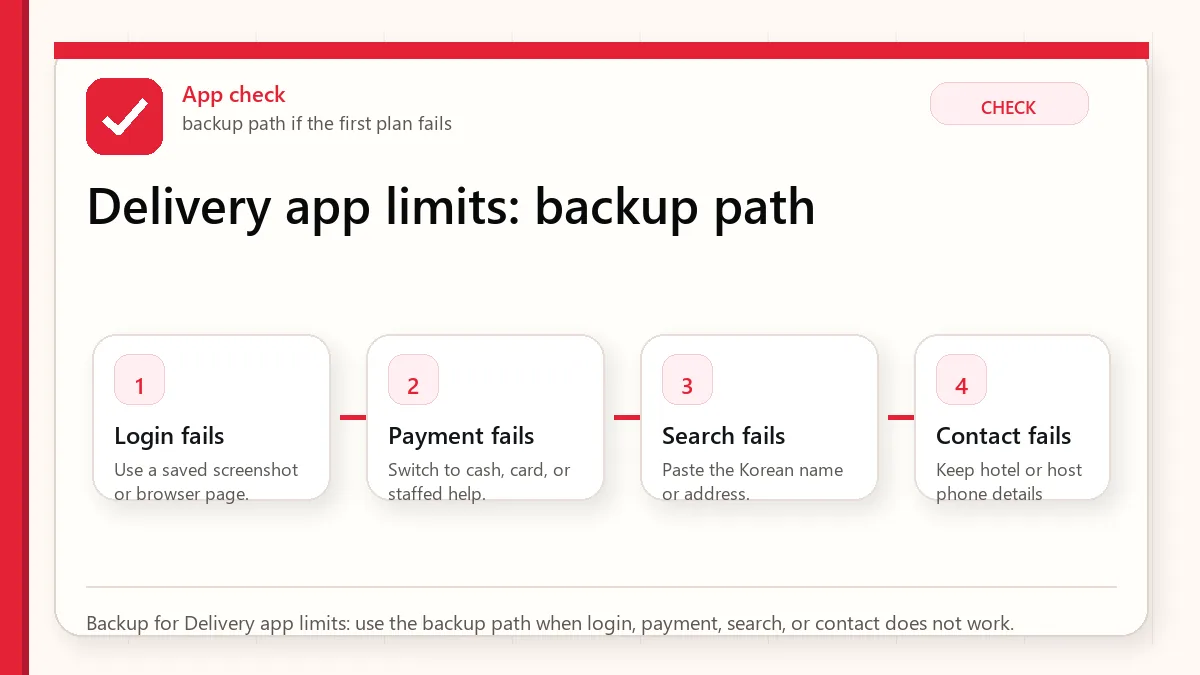
    Layered red check backup flow graphic for Delivery app limits.
    Backup for Delivery app limits: use the backup path when login, payment, search, or contact does not work.

    Short Korean pickup note

    You can prepare a simple message like this and adjust it with hotel staff if needed:

    저는 한국어를 잘 못합니다. 호텔 로비에서 받겠습니다. 전화가 어려우면 메시지로 알려주세요.

    Meaning: I do not speak Korean well. I will receive it in the hotel lobby. If calling is difficult, please message me.

    When delivery is not the best plan

    • You have allergies and cannot confirm ingredients clearly.
    • Your hotel has strict delivery or lobby rules.
    • It is late at night and you do not have a second food plan.
    • Your payment method has not been tested.
    • You cannot answer a Korean phone call from the rider.

    Related guides

    Official links to check

    Use these official links when the next step matters. This guide explains what to watch for, but app downloads, eligibility, prices, routes, policies, and service rules can change.

    Sources and official checks

    FAQ

    Can foreigners use Baemin or Coupang Eats?

    Some foreigners can use parts of the apps, but short-term visitors may be blocked by phone, identity, address, or payment steps.

    Do I need a Korean phone number?

    It can help with calls and SMS, but it does not guarantee every verification or payment flow.

    What should I do if delivery fails?

    Switch quickly to pickup, convenience store food, hotel desk help, or a nearby restaurant instead of fighting the app while hungry.

  • Korea eSIM with Phone Number: What Tourists Need

    Korea eSIM with Phone Number: What Tourists Need

    A Korea eSIM with a phone number sounds like the perfect travel upgrade, but it is not always necessary. For a short trip focused on sightseeing, messaging, maps, and translation, a data-only eSIM may be enough. The phone number becomes valuable when Korea’s local systems expect a reachable domestic contact: restaurant waitlists, taxi pickup calls, delivery riders, hotel callbacks, clinics, salons, and reservation desks.

    Last checked: June 1, 2026. Re-check the official app, service, or app-store page before acting, because routes, prices, labels, rules, app screens, eligibility, and store/service policies can change.

    Last updated: May 24, 2026.

    The important limitation: a phone number is not the same as Korean resident identity verification. Some apps may still block or limit foreigners even with a local number.

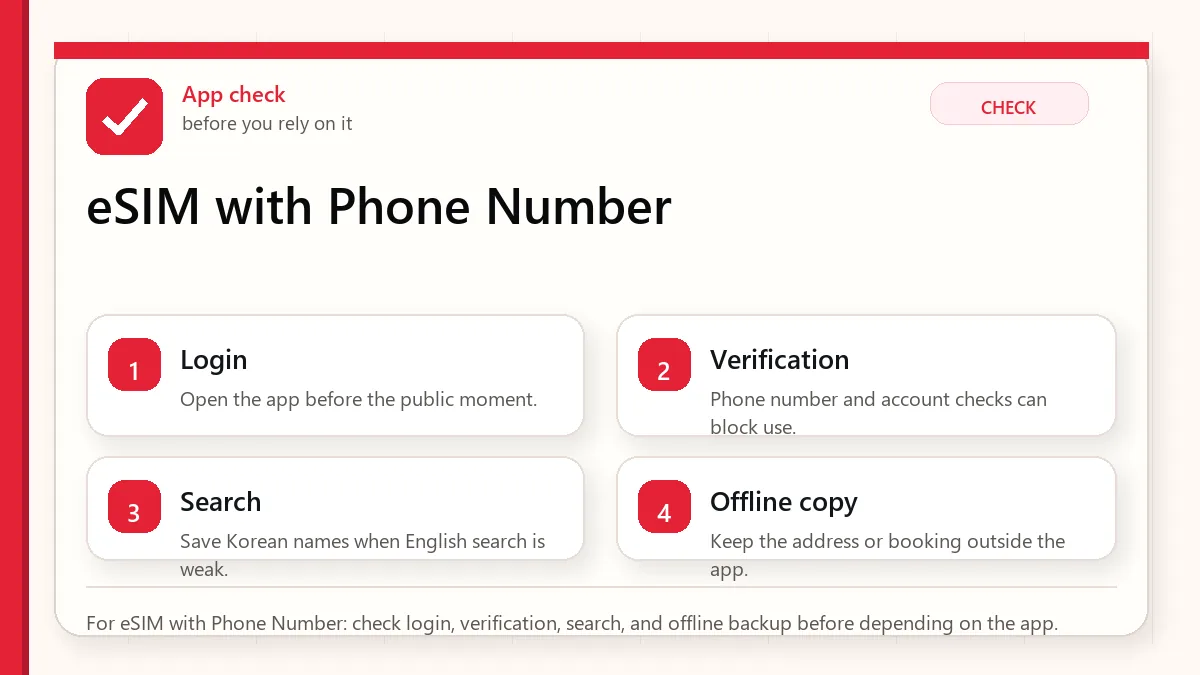
    Layered red check decision graphic for eSIM with Phone Number.
    For eSIM with Phone Number: check login, verification, search, and offline backup before depending on the app.

    Start with the account or access block

    Get a Korea eSIM or SIM with a phone number if you want smoother local contact and are willing to check the plan details carefully. Skip it if your itinerary is simple, you will use hotel help for reservations, and you are comfortable with messenger-based communication. Never buy a phone-number plan assuming it will unlock every Korean app.

    When the number actually helps

    • Restaurant waiting systems: Some venues use local phone numbers to call or text when your table is ready.
    • Taxis: A driver may call if the pickup point is unclear.
    • Delivery: Riders often call when an address, lobby, or hotel rule is confusing.
    • Clinics and salons: Appointment desks may prefer a reachable Korean number.
    • Hotel and tour contact: Local staff can call without using international dialing.

    What a tourist number may not solve

    Some Korean services require identity verification beyond a normal text message. This may involve resident registration, alien registration, real-name verification, domestic payment systems, or carrier-level identity checks. A tourist SIM can make you reachable, but it may not make you a verified Korean user.

    That distinction matters for apps such as food delivery, ride-hailing, payment, shopping, age-restricted services, and some booking systems. Always keep a backup path: hotel desk, concierge call, walk-in ordering, card payment at the counter, or a friend with a local account if appropriate.

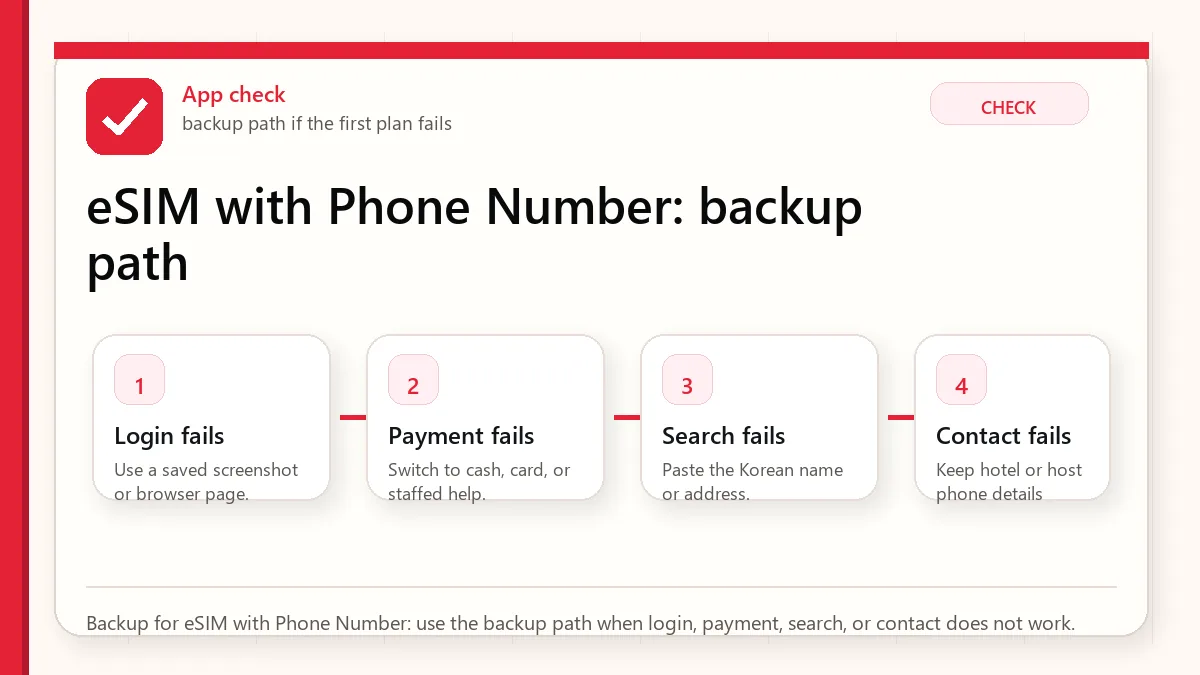
    Layered red check backup flow graphic for eSIM with Phone Number.
    Backup for eSIM with Phone Number: use the backup path when login, payment, search, or contact does not work.

    Questions to ask before buying

    • Is the plan data-only, or does it include voice and SMS?
    • Can it receive incoming calls from Korean numbers?
    • Can it receive SMS verification messages?
    • Does the provider explicitly mention identity verification limits?
    • Where do you get support if activation fails?
    • Does the plan start immediately, at QR scan, or at arrival pickup?

    Best practical setup

    For most visitors who choose a phone-number plan, the safest setup is to activate at or before arrival, test data, test receiving a text, and save the number in your own phone notes. Then update hotel forms, taxi apps, booking forms, and restaurant waitlists with that number only after confirming it works.

    If the plan does not receive SMS or calls as expected, do not spend the first day fighting every app. Switch to practical backups: ask hotel staff to call, use walk-in restaurants, use desk reservations, or choose services that accept foreign cards and messenger contact.

    Official links to check

    Use these official links when the next step matters. This guide explains what to watch for, but app downloads, eligibility, prices, routes, policies, and service rules can change.

    FAQ

    Do tourists need a 010 number in Korea?

    Not always. A reachable Korean number is helpful, but many tourists can complete a trip with data only. The need rises with restaurants, delivery, clinics, taxis, and local appointments.

    Can I receive KakaoTalk verification with a tourist number?

    It may work in some cases and fail in others. App verification policies and number types vary, so do not build your trip around that assumption.

    Should I choose eSIM or physical SIM for a number?

    Choose based on phone compatibility and support. If you are nervous about setup, a counter-supported physical SIM can be less stressful.

    The airport test

    Before leaving the airport or your first strong Wi-Fi area, test four things: mobile data, incoming SMS, incoming call, and one app that needs internet outside Wi-Fi. If the plan is supposed to include a Korean number but you cannot receive a text or call, solve it immediately while support is still reachable.

    Contact number vs verified identity

    Think of a tourist number as a contact address. It helps people reach you. Verified identity is a separate gate. Some Korean apps check whether the phone number is tied to a verified resident identity. That is why two visitors can buy similar-looking number plans and still have different app results depending on plan type, carrier rules, app policy, and verification path.

    Backup scripts for real situations

    If a taxi driver calls and you cannot answer in Korean, send the pickup point through the app if possible and stand somewhere obvious. If a restaurant asks for a phone number and your number fails, ask whether they can call your name instead. If delivery is too complicated, switch to takeout or ask hotel staff whether delivery to the lobby is allowed.

    When not to buy the number plan

    Skip the number plan if your trip is short, your itinerary is simple, your hotel can help with calls, and you are comfortable using walk-in restaurants and public transit. Spending mental energy on a plan you barely use can be worse than accepting a few low-tech workarounds.

    Related Before Korea guides

    Use these guides together rather than treating one article as the whole plan.

    Sources checked for this update

    Before Korea treats operational details as changeable. Check the official pages below before a trip or a large purchase.

  • Kakao T vs Uber in Korea: Taxi App Guide for Tourists

    Kakao T vs Uber in Korea: Taxi App Guide for Tourists

    If you are comparing Kakao T vs Uber in Korea, the best answer is practical: Kakao T or k.ride is usually the more local taxi path, Uber can still be a useful backup, and your real risk is not the app name. It is whether you can finish phone setup, payment, pickup, destination entry, and driver contact when you are tired or in a hurry.

    Last checked: June 2, 2026. Taxi app screens, payment flows, service areas, and visitor options can change. Test the current app before relying on it late at night or at the airport.

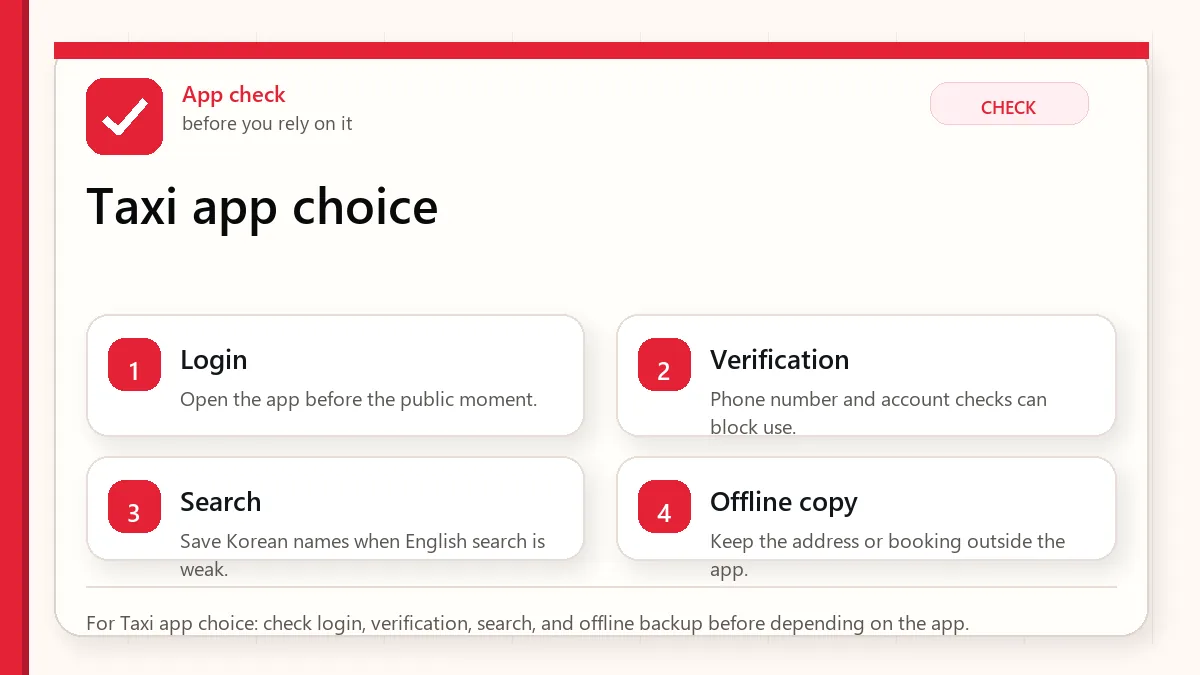
    Layered red check decision graphic for Taxi app choice.
    For Taxi app choice: check login, verification, search, and offline backup before depending on the app.

    What to use first

    Situation Start here Keep this backup
    Central Seoul in normal hours Kakao T, k.ride, or Uber if your account works Naver Map route, subway, or a main-road taxi stand
    Airport arrival with luggage Compare AREX, airport bus, official taxi stand, and app taxi Hotel address in Korean and a cash/card backup
    Late night after a concert or bar Check pickup availability before leaving the venue Walk to a larger road or official taxi area
    Foreign card fails Try another app/payment path only if time allows Pay-on-ride taxi, hotel call, or public transit

    The app is only one part of the ride

    Tourists often ask which taxi app is best. A better question is: can you complete all five steps? The app must accept your phone setup, understand the destination, place the pickup pin correctly, let the driver reach you, and finish payment. If one step fails, the app can still look fine while the ride fails.

    Save your hotel name, full Korean address, phone number, and nearest major road. English hotel names and automatic map pins are not enough in every neighborhood. If a driver calls, you may need a short Korean pickup note or hotel staff help.

    Kakao T, k.ride, and Uber are not the same problem

    Option Why it helps Where visitors still get stuck
    Kakao T Strong local taxi ecosystem and Korea-specific destination handling Account setup, payment choices, Korean pickup calls, and address details
    k.ride Visitor-focused Kakao Mobility option worth checking before arrival Availability and exact app flow should be tested on your phone
    Uber Familiar interface for many travelers Local availability, pickup accuracy, and feature differences in Korea
    Street taxi / hotel call Useful when apps fail You need a Korean destination card and clear fare/payment expectations

    A better taxi setup before arrival

    1. Install at least two taxi options before the trip, not after midnight.
    2. Save your hotel address in Korean and English.
    3. Save the destination name from Naver Map or Kakao Map, not only Google Maps.
    4. Test whether your phone number and payment method are accepted.
    5. Decide the non-app backup for airport arrival and late-night returns.

    When not to force the app

    Do not keep refreshing one app if your battery is low, the pickup pin is wrong, you cannot answer the driver, or the area is crowded after an event. In those moments, a taxi stand, hotel desk, subway route, night bus, or walking to a clearer pickup road can be more reliable than app loyalty.

    Foreign-card and cash reality

    Payment is where many visitors overestimate app convenience. A foreign card that works at Olive Young, a hotel, or a subway machine may still fail inside a mobility app because app payments, card verification, fraud checks, and local payment rails are different. If you are counting on app payment, test it with enough time to recover.

    Cash can still be useful as a taxi backup, but it is not a complete plan either. Some drivers may prefer card, some tourists may not understand the fare display, and large bills can be inconvenient late at night. Carry a small amount of cash, keep a card backup, and check the meter or app fare screen before relaxing.

    Airport, hotel, and event cases

    Case Better first move Why
    Incheon Airport arrival Compare AREX, airport bus, taxi stand, and app taxi before leaving the terminal Airport transport has official routes that can be easier than app pickup with luggage
    Hotel return at night Use the hotel Korean address and a main-road pickup point Drivers may not recognize the English hotel name or a back-alley pin
    Concert or stadium exit Walk away from the crowd before calling a taxi Crowded pickup zones cause cancellations and driver calls
    Rainy day with shopping bags Choose a pickup point under a clear building entrance or hotel canopy A vague sidewalk pin is harder for both driver and rider

    How to write a pickup note

    A pickup note should be short. Do not write a long translated paragraph. Use one clear landmark: hotel lobby, main entrance, station exit number, convenience store in front, or building name. If you cannot name the exact pickup spot, move to a place you can describe.

    For example: 'I am at the hotel main lobby' is better than 'I am near the building somewhere.' If you are using a translation app, translate only the pickup point and keep the message simple.

    How this page answers the search intent

    People searching 'kakao taxi vs uber', 'kakao t vs uber in korea', 'uber in seoul', or 'k ride vs uber' usually need a decision, not a brand history. The useful answer is: install more than one option, test the account before travel, save Korean addresses, and keep a route that does not depend on one app.

    Layered red check backup flow graphic for Taxi app choice.
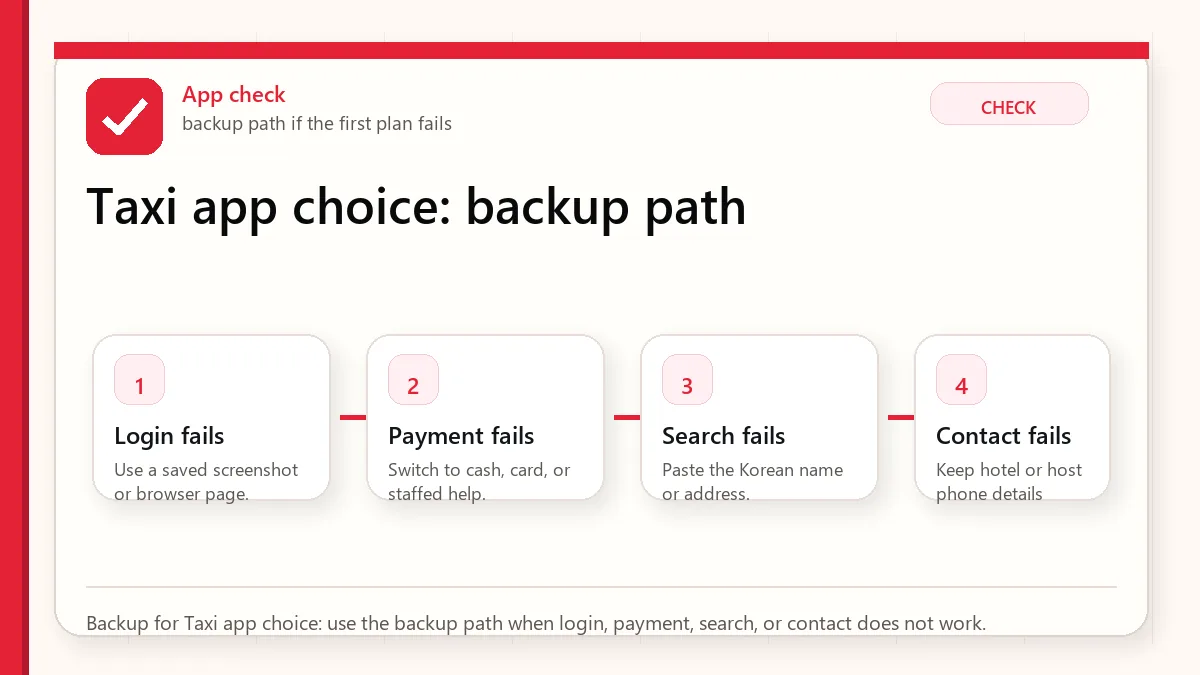
    Backup for Taxi app choice: use the backup path when login, payment, search, or contact does not work.

    Official links

    Related guides

    FAQ

    Is Kakao T better than Uber in Korea?

    For local taxi use, Kakao T or k.ride is often the stronger starting point. Uber is still useful as a familiar backup if your account, payment, and pickup flow work in Korea.

    Can I use Kakao T without a Korean phone number?

    You need to test the current app flow. Some features may be limited by phone number, account, payment, or local verification requirements.

    What should I do if the driver calls in Korean?

    Use a saved Korean pickup note, move to a clearer landmark, or ask hotel/store staff to help. If you cannot communicate the pickup point, canceling early may be safer than wasting time.

  • Korea Travel Mistakes to Fix Before Arrival

    Korea Travel Mistakes to Fix Before Arrival

    The biggest Korea travel mistakes first-time visitors make are rarely dramatic. They are small assumptions that stack up: one payment method, one map app, one airport route, one pair of untested shoes, one impossible day plan, and no backup for a kiosk or transit-card problem. Korea is very travel-friendly, but it has its own operating system.

    Last checked: June 1, 2026. Re-check the current Korean government or customs page before acting, because routes, prices, labels, rules, app screens, eligibility, and store/service policies can change.

    Last updated: May 24, 2026.

    Layered red check decision graphic for Travel Mistakes to Fix.
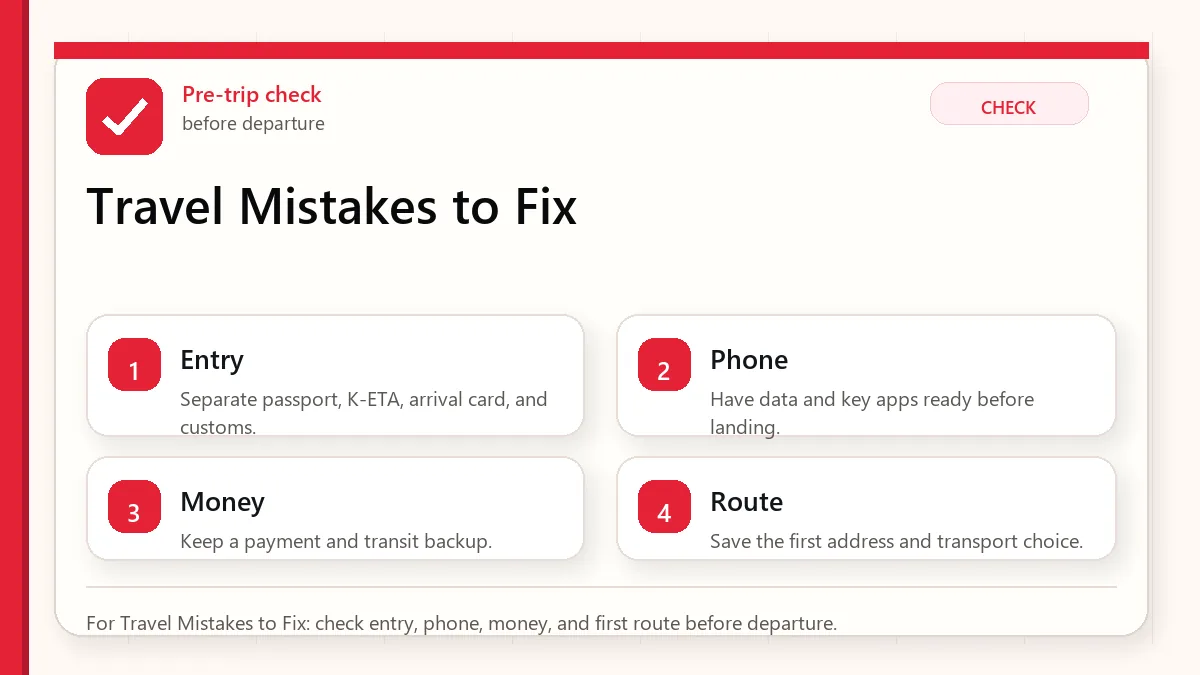
    For Travel Mistakes to Fix: check entry, phone, money, and first route before departure.

    Start with the situation, not a rule list

    Before you arrive, confirm entry requirements, save your hotel address in Korean and English, choose airport transport by hotel area and luggage, install Korean map and translation apps, prepare a T-money or transit plan, carry a small KRW cash buffer, and keep your first day simple. Do not use arrival day as the test day for every app, card, route, and reservation.

    The mistakes and fixes

    MistakeWhy it hurtsFix
    Ignoring entry paperwork until the airportSmall mismatches can become boarding stress.Check official requirements before departure.
    Choosing airport train by speed onlyTransfers with luggage can be tiring.Choose by hotel area, stairs, final walk, and arrival time.
    Using only one card or phone walletKiosks and transit top-ups can fail.Carry two cards and some KRW cash.
    Depending only on Google MapsLocal place search can be weaker.Install Naver Map or KakaoMap too.
    Overpacking the itinerarySeoul distances and station exits eat time.Plan by neighborhoods, not by wish list.

    Airport transport mistake

    AREX Express looks clean on paper because it is fast to Seoul Station. But if your hotel is in Myeongdong, Gangnam, Jamsil, or a hilly side street, the door-to-door route may involve stairs, transfers, and a tired final walk. Airport buses can be slower but easier with luggage. Taxis can be rational for groups, late arrivals, or heavy bags. Decide by final hotel area, not only by headline speed.

    T-money and cash mistake

    Many visitors arrive expecting every payment to work like a normal card city. Korea is card-friendly, but transit cards and some machines still create friction for foreigners. A small cash buffer is not old-fashioned; it is practical. Use it for transit top-ups, small shops, market food, or backup when a foreign card fails at a machine.

    Layered red check backup flow graphic for Travel Mistakes to Fix.
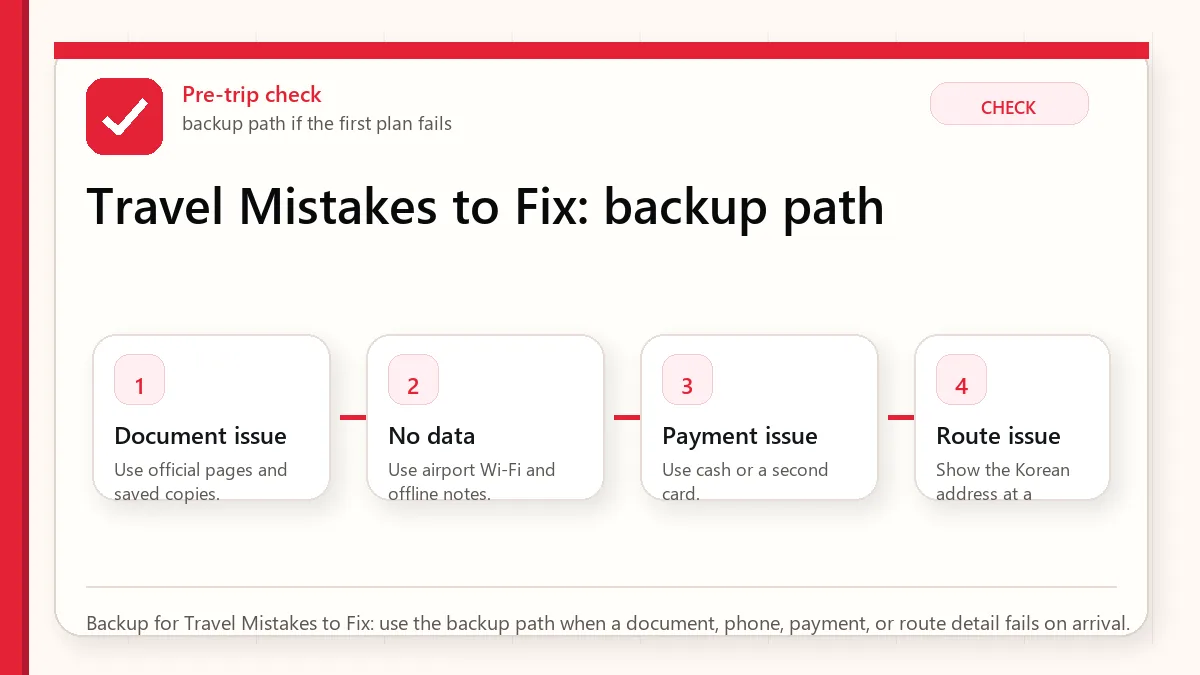
    Backup for Travel Mistakes to Fix: use the backup path when a document, phone, payment, or route detail fails on arrival.

    App and phone number mistake

    Some Korean apps are easy for tourists. Others become difficult because they expect Korean identity verification, local payment, or a Korean phone number. Install key apps before departure, but do not assume installation means full access. Keep alternatives: hotel front desk help, staff counters, browser translation, and saved Korean addresses.

    Itinerary mistake

    A Korea itinerary should be built around areas. Pair Gyeongbokgung with Insadong or Bukchon. Pair Hongdae with Yeonnam. Pair Seongsu with Seoul Forest. Pair Jamsil with Lotte World or Seokchon Lake. Avoid crossing the city several times in one day just because subway routes exist. The goal is not to prove you can move fast. The goal is to actually experience places.

    The first 24 hours deserve special protection

    Most first-time travel mistakes hurt most on arrival day because you are tired and carrying luggage. Do not schedule a complicated dinner, distant neighborhood, or prepaid activity immediately after landing. Keep the first evening close to your hotel, solve the transit card, test your payment backup, confirm your map app, and sleep. A boring first night often creates a better second day.

    Arrival day is also the wrong time to discover that your eSIM was not installed, your card needs overseas activation, or your hotel address is only saved in English. Test what you can before departure and screenshot what you cannot test.

    Build redundancy into the trip

    Redundancy is not pessimism. It is what makes a trip feel smooth. Use two payment methods, two map tools, a written hotel address, an offline copy of key documents, and one easy backup meal near the hotel. The more new systems a country has for you, the more valuable simple backups become.

    FAQ

    What should I prepare before flying to Korea?

    Entry checks, hotel address, airport route, eSIM or SIM plan, transit plan, map app, translation app, and payment backups.

    Is Korea easy for first-time travelers?

    Yes, especially if you prepare the local systems before arrival.

    How many Seoul neighborhoods should I visit per day?

    Usually one to two main areas per day is more enjoyable than chasing five across the city.

    Related Before Korea guides

    Source links to verify

  • Korea Travel Budget: Daily Costs and Cash

    Korea Travel Budget: Daily Costs and Cash

    Start with what can fail at payment

    A Korea budget is easier when you separate fixed costs from small daily leaks: cafes, transit, convenience stores, taxis, beauty shopping, tax-refund temptation, and late-night recovery choices. Plan one realistic daily range, then keep a small cash/card buffer for the moments when the cheaper plan becomes inconvenient.

    Last checked: June 1, 2026. Re-check the official provider, store, customs, or payment page before acting, because routes, prices, labels, rules, app screens, eligibility, and store/service policies can change.

    Last updated: May 23, 2026. Rules, app flows, prices, and eligibility can change, so re-check official sources close to your trip.

    Layered red check decision graphic for Travel Budget Daily Costs.
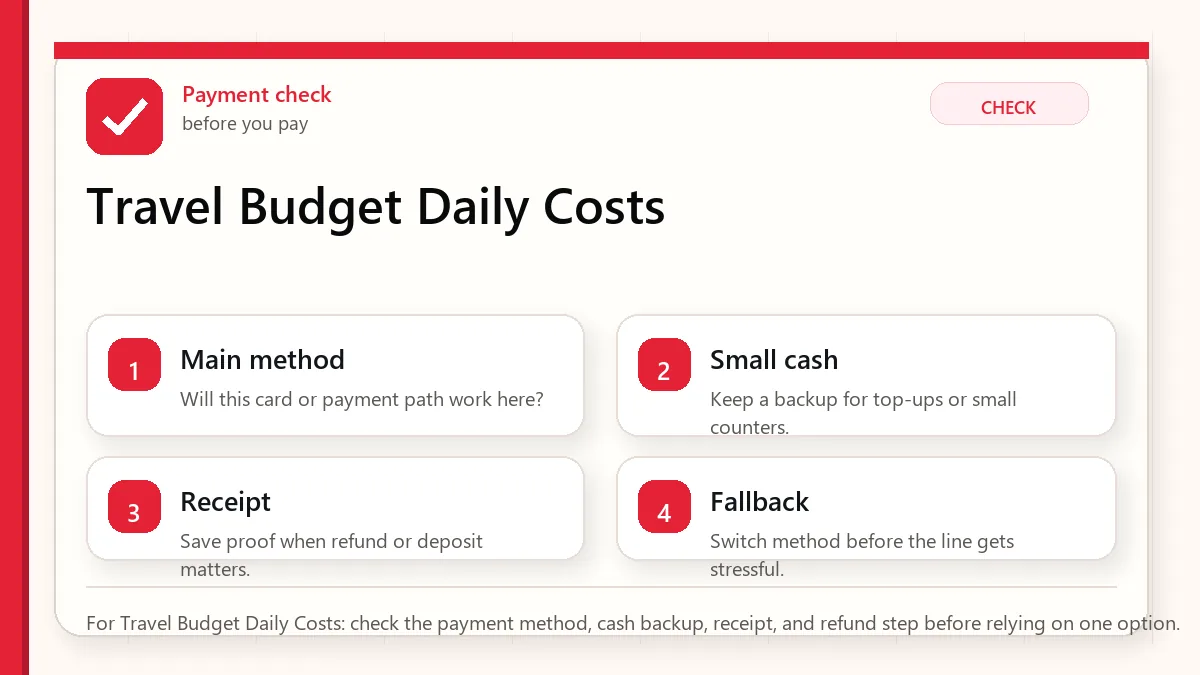
    For Travel Budget Daily Costs: check the payment method, cash backup, receipt, and refund step before relying on one option.

    Where weather plans usually become uncomfortable

    This matters when the forecast average hides the real problem: long walking days, sudden rain, humid subway transfers, indoor heating, wind, or luggage space. Pack for the condition that would make the day harder, not for the prettiest version of the season.

    What to verify before you go

    • Separate fixed costs from daily habits: airport transfer, transit, cafes, snacks, taxis, shopping, and late-night convenience meals.
    • Do not count tax refund as guaranteed savings; treat it as a possible partial return after paperwork.
    • Keep a cash/card buffer for payment failure rather than for heavy cash spending.
    • Plan one low-spend day after any shopping-heavy day.
    • Save the relevant page or screenshot before you need it in public.
    • Re-check volatile details near travel day because policies and app flows change.

    The budget leaks are usually small and repeated

    Cafes can quietly become a category

    Korea cafe culture is part of the trip for many visitors, but two drinks, dessert, and a long rest stop can turn into a daily budget line. That is fine if planned; it feels wasteful when it surprises you.

    Taxis are recovery tools

    A taxi can be a smart use of money after a late arrival, heavy shopping, rain, or a missed last train. The mistake is not taking a taxi; it is pretending taxis will never happen and then feeling budget guilt when one becomes practical.

    Shopping budgets need a stop rule

    Before a shopping day, decide what counts as a good buy and what makes you put an item back. Without a stop rule, promotions and limited-looking shelves do too much of the thinking.

    A weather plan that stays comfortable outside

    Decide which part of the day weather can ruin

    Decide which condition would make the day uncomfortable: rain, heat, cold, wind, long walking, or indoor temperature changes.

    Check a current forecast close to departure

    For weather-dependent choices, check a current forecast near departure instead of relying on seasonal averages.

    Carry one small item that fixes the likely discomfort

    The backup should be small enough to carry: umbrella, layer, comfortable shoes, medicine, or an indoor route option.

    Do not pack only from seasonal averages

    More clothes can become luggage weight. Pack the one layer or item that solves the likely problem.

    Layered red check backup flow graphic for Travel Budget Daily Costs.
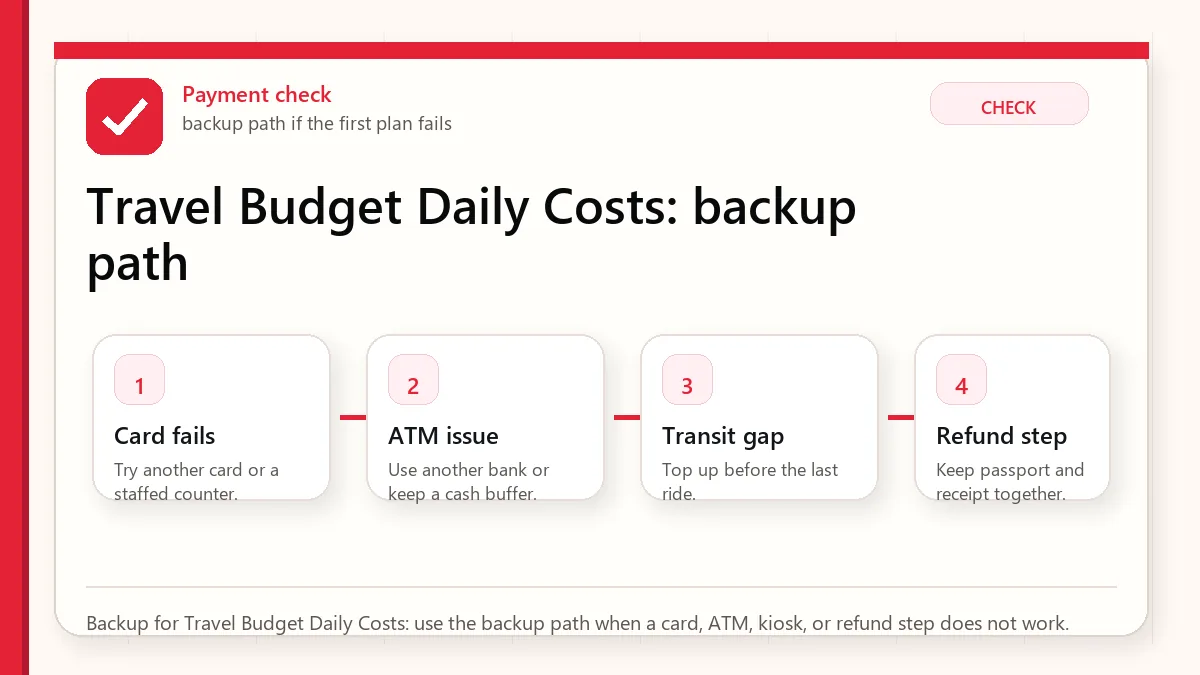
    Backup for Travel Budget Daily Costs: use the backup path when a card, ATM, kiosk, or refund step does not work.

    What to check before you rely on it

    The first plan depends on one fragile detail

    If one card, one app login, one translation scan, or one store policy controls the whole plan, add a backup before the trip.

    The information is technically correct but not practical

    A rule can be true and still be hard to use when you are tired, carrying luggage, or standing in a busy line. Plan for the human moment, not only the policy.

    A visitor copies advice from a different travel style

    A resident, Korean speaker, business traveler, or frequent visitor may solve problems differently from a first-time tourist. Use advice that matches your situation.

    The small check that changes the answer

    SituationSafer defaultWhy
    Short first tripChoose convenience and fewer moving partsRecovery time is limited
    Budget-conscious tripSeparate must-pay costs from nice-to-have extrasSmall purchases add up quickly
    Higher-risk situationUse official sources and conservative backupsHealth, entry, tax, and payment issues are not good places to gamble

    Sources to re-check

    Use these pages for facts that can change by date, operator, airport, app version, store, or traveler status.

    Where to go next

    Official links to check

    Use these official links when the next step matters. This guide explains what to watch for, but app downloads, eligibility, prices, routes, policies, and service rules can change.

    FAQ

    Can I rely on one answer for every visitor?

    No. Korea travel details can depend on nationality, app version, store, airport, phone setup, card issuer, and date.

    Should I solve this after arriving?

    Try not to. Anything involving entry, phone data, maps, payment, allergies, or airport transfer is easier to prepare before the first pressure moment.

    What is the safest habit?

    Keep the official source, the practical guide, and a simple backup together. That combination is more useful than memorizing many tips.
  • Where to Stay in Seoul: Best Areas for First-Timers

    Where to Stay in Seoul: Best Areas for First-Timers

    Where to stay in Seoul is not a question with one universal answer. Seoul is large, multi-centered, and strongly shaped by subway lines, nightlife zones, hills, river crossings, and airport access. The best neighborhood for a first-time visitor is the one that reduces daily friction for your specific trip.

    Last checked: June 1, 2026. Re-check the official or primary source page before acting, because routes, prices, labels, rules, app screens, eligibility, and store/service policies can change.

    Last updated: May 24, 2026.

    Layered red check decision graphic for Where to Stay in.
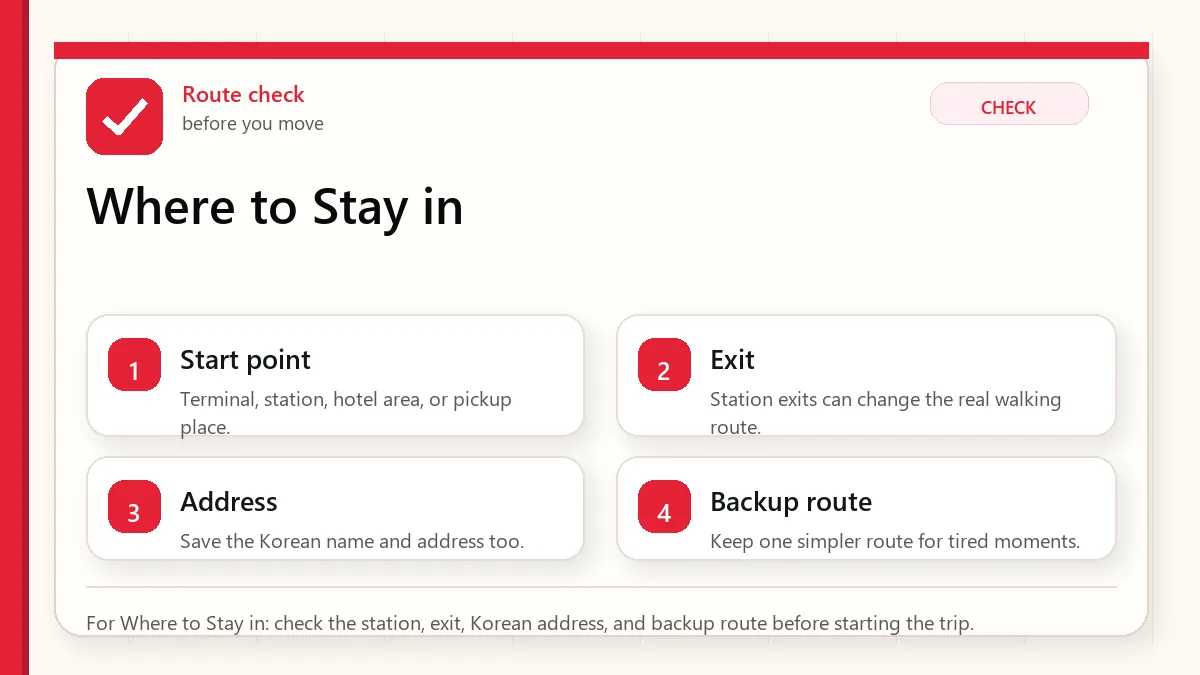
    For Where to Stay in: check the station, exit, Korean address, and backup route before starting the trip.

    Start with the route you will actually take

    Stay in Myeongdong if you want central sightseeing and easy tourist infrastructure. Stay in Hongdae or Yeonnam if you want airport rail access, nightlife, cafes, and younger energy. Stay in Insadong or Jongno if palaces, old streets, and traditional culture matter most. Stay in Gangnam if your trip is shopping, business, clinics, or southern Seoul. Stay in Jamsil for Lotte World, concerts, families, or southeast Seoul plans.

    Neighborhood comparison

    AreaBest forTradeoff
    MyeongdongFirst timers, shopping, central sightseeing.Touristy and crowded.
    HongdaeNightlife, youth culture, airport railroad.Noisy in the core.
    YeonnamCafes, quieter Hongdae access, solo travelers.Fewer big hotels.
    InsadongPalaces, tea houses, traditional atmosphere.Quieter evenings.
    JongnoMarkets, older Seoul, food alleys, transit.Can feel rougher or businesslike.
    GangnamShopping, clinics, business, polished streets.Farther from northern historic sights.
    ItaewonInternational dining and nightlife.Hills and weekend party energy.
    SeongsuDesign cafes, pop-ups, Seoul Forest.Accommodation options can be limited.
    JamsilFamilies, Lotte World, concerts, lake walks.Longer rides to palaces and older districts.

    Myeongdong vs Hongdae

    Myeongdong is convenient for first-time sightseeing because it sits near Namsan, palace routes, department stores, cosmetics shopping, and many tourist services. Hongdae is better if nightlife, youth culture, airport railroad convenience, and west-side energy matter. If you want Hongdae access without maximum noise, Yeonnam can be a softer base.

    Insadong, Jongno, and Bukchon

    Insadong is polished cultural Seoul: tea, crafts, galleries, and easy palace access. Jongno is broader, older, and more local, with markets and food alleys that can feel less curated. Bukchon and hanok areas are beautiful but hilly, quiet at night, and less convenient with heavy luggage. They can be wonderful for atmosphere, but not always the easiest base for a first trip.

    Layered red check backup flow graphic for Where to Stay in.
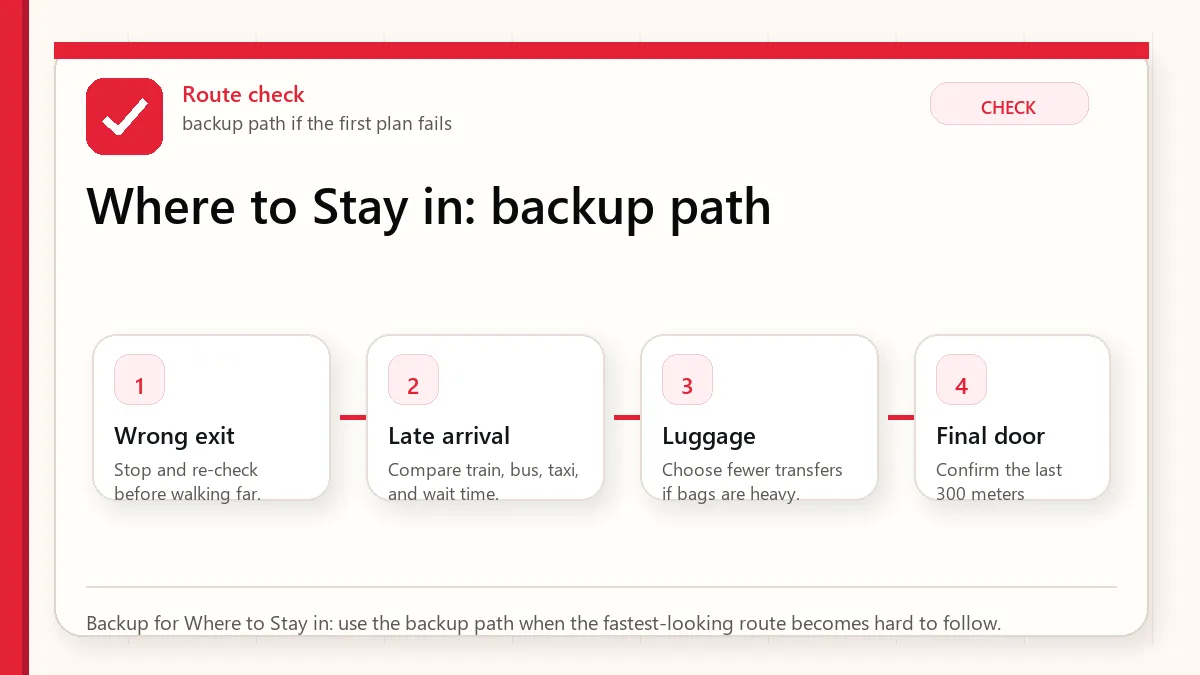
    Backup for Where to Stay in: use the backup path when the fastest-looking route becomes hard to follow.

    Gangnam, Seongsu, and Jamsil

    Gangnam is not the best base for every first-time tourist, but it is useful for southern Seoul, shopping, clinics, business, and polished dining. Seongsu is strong for trend-focused cafe and design travel, though big hotel choice may be thinner. Jamsil is excellent for Lotte World, families, sports, concerts, and mall convenience, but it is farther from the historic north.

    How to choose without regret

    List your top five fixed plans, then choose the area that reduces the most repeated travel. Check airport access, nearest subway line, walking distance from station exit, late-night food, and noise. Do not choose a neighborhood only because it appears often on social media. A famous area can still be the wrong base if it sends you across the city every day.

    Hotel location is a daily energy decision

    Choosing where to stay in Seoul is not only about attractions. It is about how tired you will feel at 10 p.m. after walking all day. A cheaper hotel that requires a long uphill walk from the station can feel expensive in energy. A famous neighborhood can be frustrating if your daily plans are on the other side of the city. The right hotel makes ordinary movement easier.

    Check the exact station exit, not just the neighborhood name. Some hotels say they are near a station but require a long underground walk or stairs. If you have luggage, children, older travelers, or winter weather, those details matter.

    Noise and late-night comfort

    Nightlife areas can be convenient and exciting, but not every traveler wants music, street noise, or crowds after midnight. If you choose Hongdae, Itaewon, or busy Myeongdong streets, check whether the hotel is on a quieter side street. If you choose a quieter hanok or residential area, check whether food and transit are still convenient after dark.

    FAQ

    Is Myeongdong the best place to stay in Seoul?

    It is one of the easiest first-time bases, especially for central sightseeing and shopping, but not the best for every traveler.

    Is Hongdae too noisy?

    The core can be noisy. Staying closer to Yeonnam or quieter streets can keep the convenience without full nightlife noise.

    Should families stay in Jamsil?

    Jamsil can be excellent for families visiting Lotte World or southeast Seoul, but it is farther from many palace and old-Seoul sights.

    Related Before Korea guides

    Source links to verify

  • Best Time to Visit Korea: Weather by Month

    Best Time to Visit Korea: Weather by Month

    The best time to visit Korea depends on what kind of trip you want. Spring and autumn are the easiest seasons for first-time visitors, but they are also popular and can be more expensive. Summer is lively but humid and rainy. Winter is cold, dry, and often clearer, with strong wind-chill in Seoul and milder conditions in southern areas such as Busan and Jeju.

    Last checked: June 1, 2026. Re-check the official provider, safety, weather, or service page before acting, because routes, prices, labels, rules, app screens, eligibility, and store/service policies can change.

    Last updated: May 24, 2026.

    Layered red check decision graphic for Best Time to Visit.
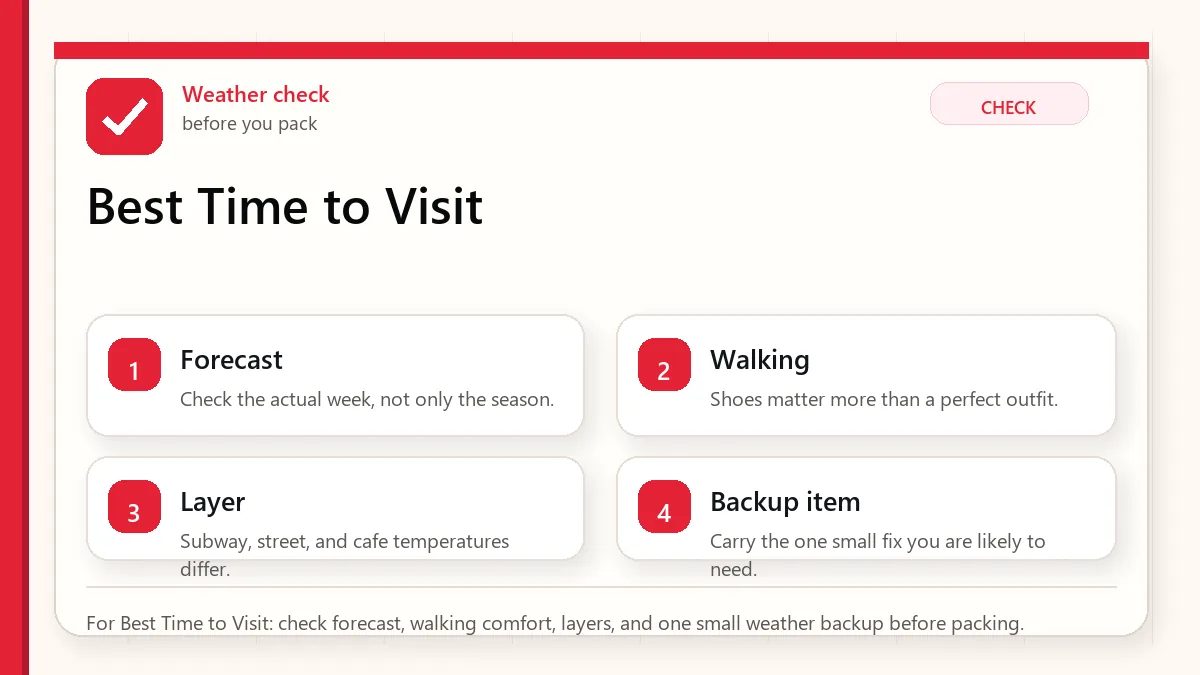
    For Best Time to Visit: check forecast, walking comfort, layers, and one small weather backup before packing.

    Start with the week you will actually be there

    For comfortable first-time travel, choose April to May or late September to early November. For cherry blossoms, expect a short and weather-dependent window around late March to early April in many major areas, varying by region and year. For autumn foliage, late October to early November is often attractive, but timing changes by mountain, city, and weather. Avoid assuming that one perfect week is guaranteed.

    Korea weather by month

    MonthTravel feelWatch out for
    January-FebruaryCold, dry, winter scenery.Wind chill, icy streets, short daylight.
    MarchTransition month, early spring.Temperature swings and dust.
    AprilPopular spring travel.Blossom crowds and higher prices.
    MayComfortable warm weather.Busy weekends and outdoor crowds.
    JuneWarmer, humid start.Rain increasing toward summer.
    July-AugustHot, humid, rainy or stormy periods.Heavy rain, heat fatigue, slippery transit.
    SeptemberLate-summer to early-autumn transition.Heat can linger early in the month.
    OctoberOne of the most comfortable months.Foliage demand and hotel pricing.
    NovemberCool, crisp, late foliage in places.Cold evenings and shorter days.
    DecemberWinter lights, shopping, cold weather.Dry air and wind.

    Spring: beautiful, crowded, fragile

    Spring is popular because temperatures become comfortable and blossoms make cities feel special. The catch is that bloom timing is short and weather-sensitive. Rain, wind, or a warm spell can shift the best days quickly. If blossoms matter, build flexibility into the itinerary and avoid making your entire trip depend on one park on one afternoon.

    Summer: not impossible, but humid

    Summer in Korea can be fun for festivals, nightlife, beaches, and long evenings, but first-time visitors should respect humidity. The rainy season can bring heavy downpours, and August can feel physically draining. Pack quick-dry clothes, shoes with grip, and a lighter schedule with indoor backups such as museums, malls, cafes, and food halls.

    Layered red check backup flow graphic for Best Time to Visit.
    Backup for Best Time to Visit: use the backup path when rain, heat, cold, or dust changes the day.

    Autumn: the easiest season for many visitors

    Autumn often gives Korea its best travel balance: cooler air, clearer skies, comfortable walking, and foliage in parks, palaces, and mountains. October can be excellent, but it is not secret. Book accommodation early for popular weeks, and remember that mountain foliage often peaks earlier than city trees.

    Winter: cold but manageable

    Winter can be a good choice if you like clear air, lower crowds in some tourist areas, ski trips, winter lights, shopping, and cafe culture. Seoul can feel much colder than the thermometer suggests because of wind. Pack thermal layers, gloves, warm socks, moisturizer, and shoes with grip. Jeju and Busan are milder, but coastal wind still matters.

    Do not chase one perfect date

    Many visitors plan Korea around cherry blossoms or autumn foliage, then feel stressed because nature does not follow flight bookings. A better strategy is to choose a strong general window and build several possible viewing points into the route. If blossoms peak early in Seoul, Busan, Jeju, or a later-blooming mountain area may still change the plan. If foliage is late, palace gardens and city parks can still provide color after mountain peaks have passed.

    Weather also affects mood more than photos suggest. A slightly less famous month with comfortable walking can create a better trip than a famous week packed with crowds, high prices, and rain risk.

    Regional differences matter

    Seoul is colder in winter and can feel harsher because of wind and urban walking. Busan is milder but still windy near the coast. Jeju is warmer than mainland Korea but weather can change quickly and wind can be strong. Do not pack only for the city where you land if your itinerary includes mountains, coast, or island travel.

    Official links to check

    Use these official links when the next step matters. This guide explains what to watch for, but app downloads, eligibility, prices, routes, policies, and service rules can change.

    FAQ

    What is the best month to visit Korea?

    April, May, October, and early November are strong choices for many first-time visitors.

    When is Korea rainy season?

    Rain risk usually rises in summer, especially around late June and July, but exact timing varies by year.

    Is winter a bad time to visit Korea?

    No. It is cold, but it can be clear, atmospheric, and manageable with proper layers.

    Related Before Korea guides

    Source links to verify