Author: user

  • Translation Apps in Korea

    Translation Apps in Korea

    Start with the account or access block

    Use translation apps as support, not authority. Install a camera/text translation app before the trip, save critical phrases, and keep one second app ready for cross-checking. The goal is not perfect Korean; it is making one clear request at a restaurant, taxi, clinic, shop, or station without guessing.

    Last checked: June 1, 2026. Re-check the official app, service, or app-store page before acting, because routes, prices, labels, rules, app screens, eligibility, and store/service policies can change.

    Translation helps most when the sentence is simple

    Translation apps are useful in Korea, but they work best as a bridge, not as a final authority. The reader's real task is to prepare short phrases, know when camera translation is enough, and recognize the situations where a bad translation could cost money, health, or time.
    Layered red check decision graphic for Translation Apps in.
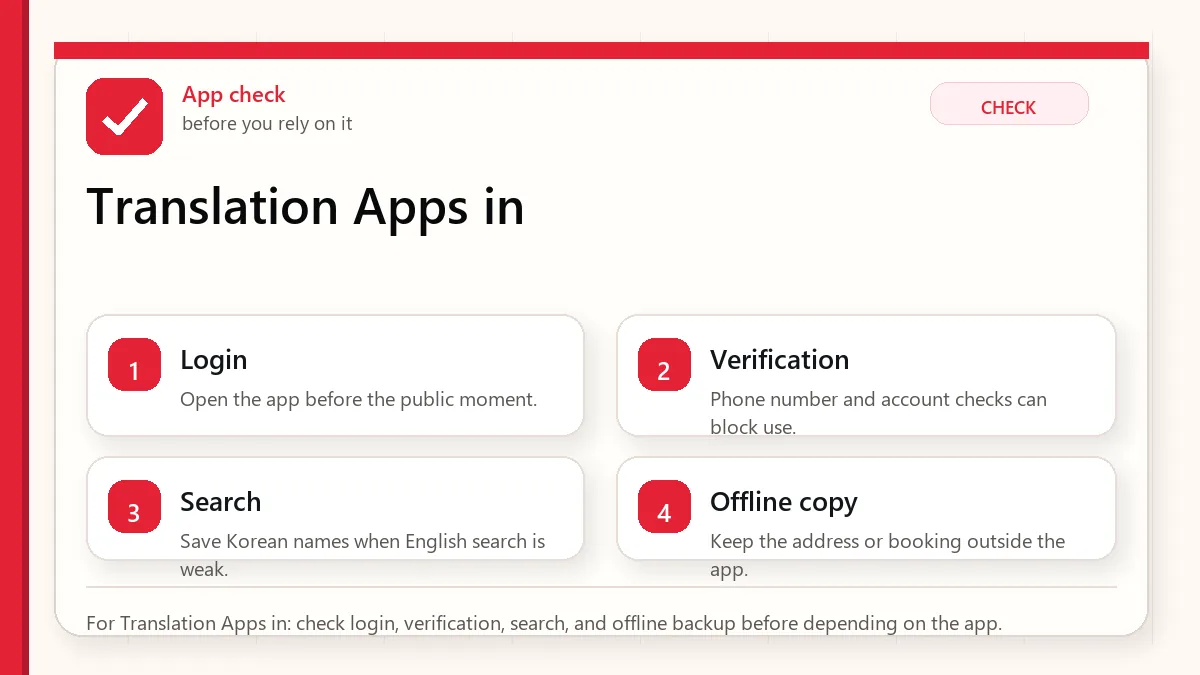
    For Translation Apps in: check login, verification, search, and offline backup before depending on the app.

    What translation apps are good and bad at

    UseHelpful forBe careful with
    Camera translationMenus, labels, signs, machines.Small fonts, stylized packaging, and ingredient nuance.
    Copied textKorean addresses, place names, app screens.Names with branches or abbreviations.
    Voice translationSimple questions in calm settings.Busy restaurants, background noise, and complex requests.
    Saved phrasesAllergies, spice, vegetarian, taxi destination.Do not rely on one phrase for serious medical risk.

    Checks before you need the phrase

    • Install at least one translation app before departure.
    • Download offline language support if available.
    • Save hotel address and emergency phrases.
    • Prepare allergy or dietary phrases carefully.
    • Keep screenshots of critical documents and addresses.

    Use translation in a way people can respond to

    • Use camera translation for first-pass understanding.
    • Copy Korean text into the app when accuracy matters.
    • Confirm key details with numbers, addresses, or official pages.
    • Use simple phrases instead of long paragraphs.
    • For serious allergies or medical issues, use professional or official help.
    • Keep a human backup: hotel desk, tourist information, or official helpline when needed.
    Layered red check backup flow graphic for Translation Apps in.
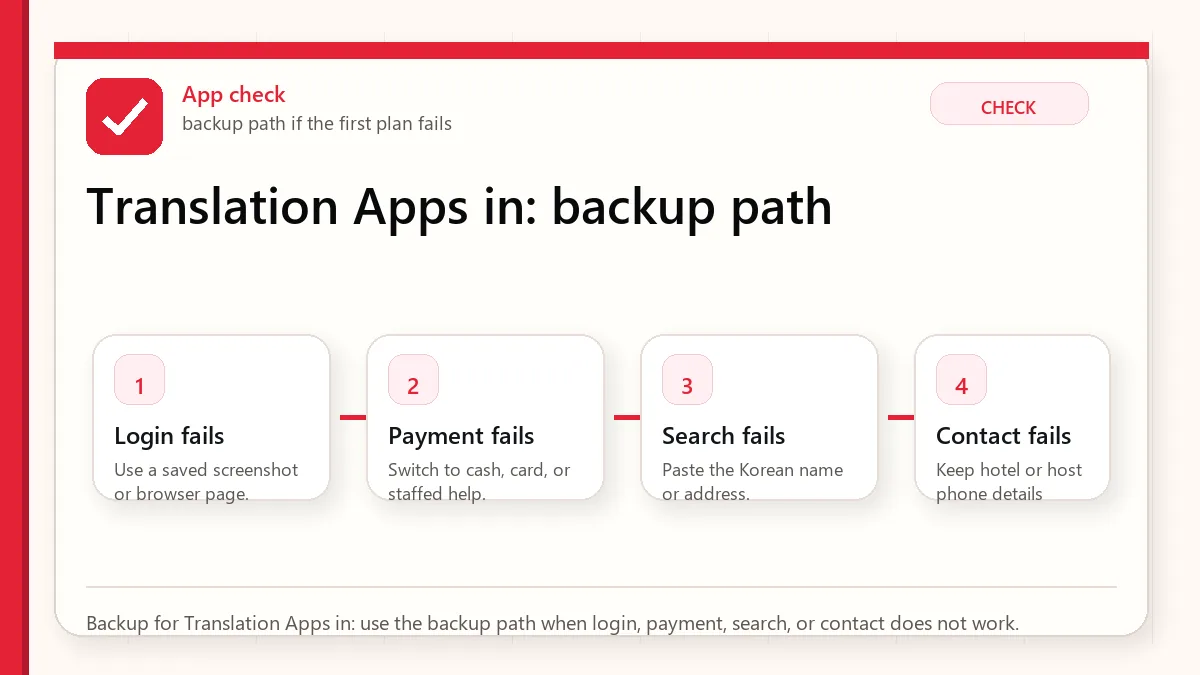
    Backup for Translation Apps in: use the backup path when login, payment, search, or contact does not work.

    Where translations usually become risky

    The app mistranslates a menu

    Check ingredients, photos, and staff confirmation. Avoid risky dishes if allergies matter.

    A taxi destination is misunderstood

    Show the Korean address and phone number, not a translated description.

    Camera translation is messy

    Take a clearer photo, crop the text, or type/copy the Korean text.

    You need official information

    Use official websites for immigration, customs, refunds, transport schedules, and safety.

    Use different translation habits for different stakes

    SituationBetter approachWhat to verify
    Restaurant orderingUse simple dietary phrases.Broth, sauce, and shared cooking.
    Taxi or mapShow Korean address.Branch and neighborhood.
    Shopping labelUse camera translation, then verify key ingredients.Allergens and expiry.
    EmergencyUse official emergency or helpline resources.Do not depend only on app translation.

    What not to assume from a translated result

    • Do not assume camera translation is accurate for small ingredient labels.
    • Do not assume polite nuance is preserved.
    • Do not assume a translated place name points to the correct branch.
    • Do not use machine translation as medical or legal advice.

    Small phrase habits that make communication gentler

    Prepare phrases before you need them

    Translation apps are much more useful when your key phrases are saved before the pressure moment. Save short Korean phrases for hotel address, allergies, no spicy food, no meat, receipt request, bathroom, help, and payment issue. A short clear phrase often works better than a long automatic translation, especially with busy staff or small restaurants.

    Use translation to confirm, not to argue

    Machine translation can make menus, signs, and labels understandable, but it can still miss context. Use it to narrow choices and ask better questions, not to insist that a staff member or label means exactly what the app says. For serious allergies, medicine, legal, customs, or safety situations, use official information or direct confirmation rather than relying only on a translated guess.

    Read next when translation connects to food, maps, or KakaoTalk

    This topic works best when it is not handled alone. Use the related guides below to connect the decision with maps, money, food, shopping, transit, and app backup planning.

    Related Before Korea guides

    Official links to check

    Use these official links when the next step matters. This guide explains what to watch for, but app downloads, eligibility, prices, routes, policies, and service rules can change.

    FAQ

    Which translation app should I use in Korea?

    Use one that supports Korean text, camera translation, and offline preparation. Test it before the trip.

    Can translation apps handle allergies?

    They can help, but serious allergies need extra caution and human confirmation.

    Should I translate English into Korean for every interaction?

    Use simple phrases and point to clear information. Long translated paragraphs can slow busy staff down.

    Source links to verify

    Last updated

    Last updated: 2026-05-23. Re-check official sources close to the day you travel, buy, eat, or use an app. Details involving prices, eligibility, transport, app features, opening hours, and refund rules can change.
  • Korea Subway and Bus Guide

    Korea Subway and Bus Guide

    Start with the route you will actually take

    For your first subway or bus ride in Korea, prepare a transportation card, use a local route app, check the station exit or bus stop direction, and leave extra time. The hardest part is usually not the train ride; it is choosing the right entrance, exit, platform, or bus direction.

    Last checked: June 1, 2026. Re-check the official operator, app, fare, or route page before acting, because routes, prices, labels, rules, app screens, eligibility, and store/service policies can change.

    The ride is simple when the direction and exit are clear

    Korea's public transport can be very visitor-friendly, but the small navigation details matter: the correct platform direction, bus stop side, transfer path, exit number, and card balance. This guide is for avoiding the mistakes that add twenty minutes to a five-minute ride.

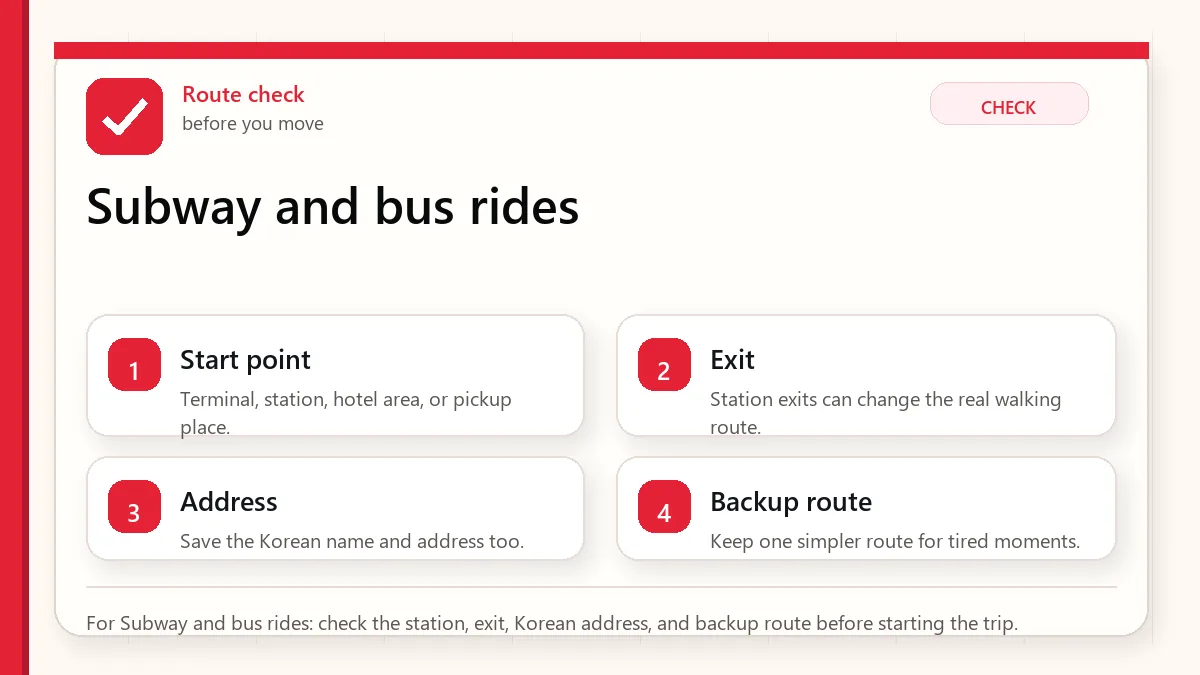
    Layered red check decision graphic for Subway and bus rides.
    For Subway and bus rides: check the station, exit, Korean address, and backup route before starting the trip.

    Subway vs bus for visitors

    ModeBest forMain challengePreparation
    SubwayPredictable city movement and station-based routes.Large stations, transfers, exits, and stairs.Route app, exit number, transit card.
    BusDirect neighborhood routes and places away from subway.Correct direction, stop names, and traffic.Map app, stop confirmation, tap habits.
    Taxi backupLate-night, luggage, or complex route situations.Address communication and fare expectation.Korean address and payment backup.

    Checks before the first tap

    • Prepare a transport card or verified payment method.
    • Save your destination in Korean and English.
    • Check route at the time you plan to travel.
    • Look for final station exit, not only station name.
    • Avoid first-time complex transfers when carrying heavy luggage.

    Move through transit one decision at a time

    • Use a local map app to choose route.
    • Check line color, direction, transfer station, and exit number.
    • Tap in and out as required.
    • Stand aside while checking your phone.
    • For buses, confirm the stop is on the correct side of the road.
    • After arrival, save the return route while still oriented.
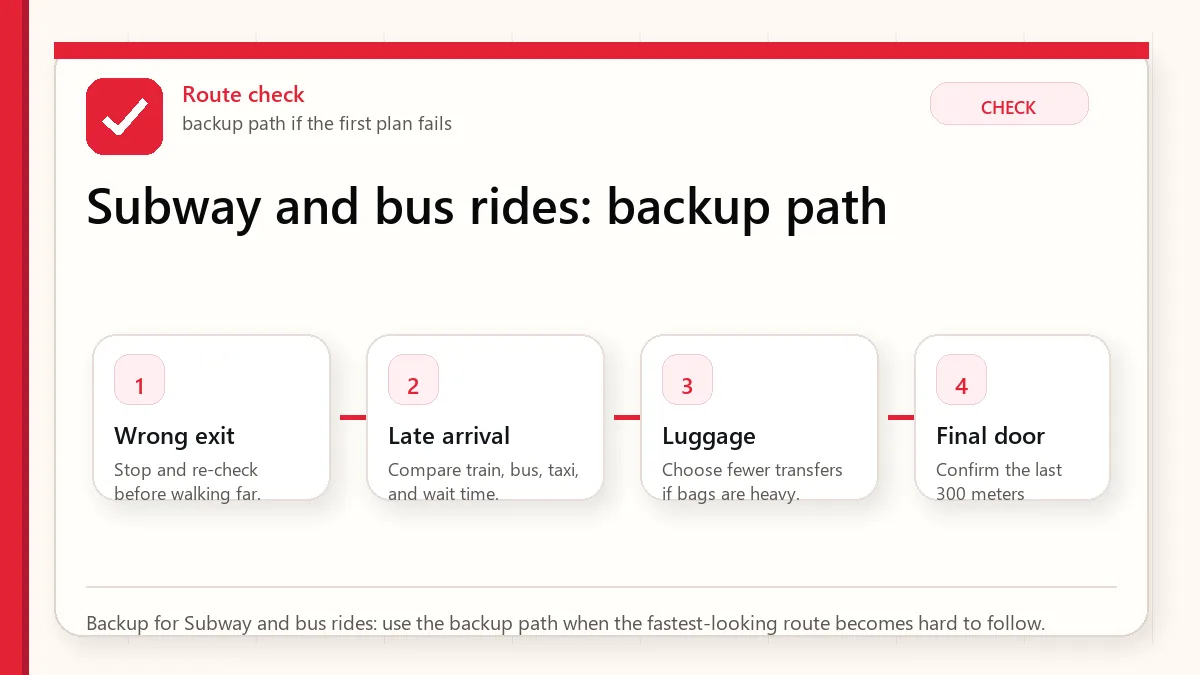
    Layered red check backup flow graphic for Subway and bus rides.
    Backup for Subway and bus rides: use the backup path when the fastest-looking route becomes hard to follow.

    Where first rides usually go wrong

    Wrong station exit

    Re-check the exit number before leaving the paid area if possible. A wrong exit can add a long walk.

    Wrong bus direction

    Check the next stops in the app and the road side before boarding.

    Transit card balance is low

    Top up before late-night travel or long routes.

    Transfer is too complex with luggage

    Use a simpler route, airport bus, or taxi when luggage makes public transport inefficient.

    Choose subway or bus based on recoverability

    SituationBetter approachWhat to verify
    First subway rideChoose a simple route with few transfers.Line direction and exit.
    Hotel with luggagePrefer fewer transfers over fastest time.Elevator availability and walking distance.
    Bus routeConfirm stop direction and destination.Traffic and correct side of road.
    Late nightCheck last service and taxi backup.Final train/bus time.

    What not to assume from a route result

    • Do not assume a station name is enough; exit number matters.
    • Do not assume the fastest route is best with luggage.
    • Do not assume every bus stop across the street serves the same direction.
    • Do not stand in gate or stair flow while checking directions.

    Transit details that make the city feel calmer

    The exit number matters more than visitors expect

    In large Korean stations, choosing the wrong exit can add a long walk, stairs, confusing underground passages, or an extra street crossing. When using a map app, do not stop at the station name. Check the suggested exit number and nearby landmark. This is especially useful when carrying luggage, meeting someone, or finding a small restaurant in a dense area.

    Bus routes need one extra check

    Buses can be efficient, but first-time visitors should confirm the direction, stop name, and whether the bus is local, trunk, express, or airport-related. The same road can have stops on opposite sides, and getting on in the wrong direction can waste more time than taking the subway. If you feel unsure, the subway is usually easier to recover from because stations are clearer and more forgiving.

    Read next when transit connects to maps, T-money, or cash

    This topic works best when it is not handled alone. Use the related guides below to connect the decision with maps, money, food, shopping, transit, and app backup planning.

    Related Before Korea guides

    Official links to check

    Use these official links when the next step matters. This guide explains what to watch for, but app downloads, eligibility, prices, routes, policies, and service rules can change.

    FAQ

    Do I need a transit card?

    It is highly practical for subway and bus travel. Prepare one or a verified alternative before relying on public transport.

    Are subway signs in English?

    VISITKOREA notes many public places including subway stations and bus stops have English signs, but apps and Korean names still help.

    Is bus harder than subway?

    Often yes for first-time visitors because direction, stop names, and traffic add uncertainty.

    Source links to verify

    Last updated

    Last updated: 2026-05-23. Re-check official sources close to the day you travel, buy, eat, or use an app. Details involving prices, eligibility, transport, app features, opening hours, and refund rules can change.
  • Korean Street Food Guide

    Korean Street Food Guide

    Start with the moment you order

    Try Korean street food in small portions first, bring small cash, watch how locals order, check spice and allergens, and choose stalls that look busy, clean, and organized. Street food is fun, but it is still food handling in a fast-moving environment.

    Last checked: June 1, 2026. Re-check the latest product label, restaurant information, and official/public database before acting, because routes, prices, labels, rules, app screens, eligibility, and store/service policies can change.

    Street food is best when you keep the first order small

    The pleasure of Korean street food is the quick, informal try. The risk is treating a crowded stall like a slow restaurant: too many questions, too much food, no cash, unclear spice, or allergy uncertainty. A small first order keeps the experience fun and reversible.

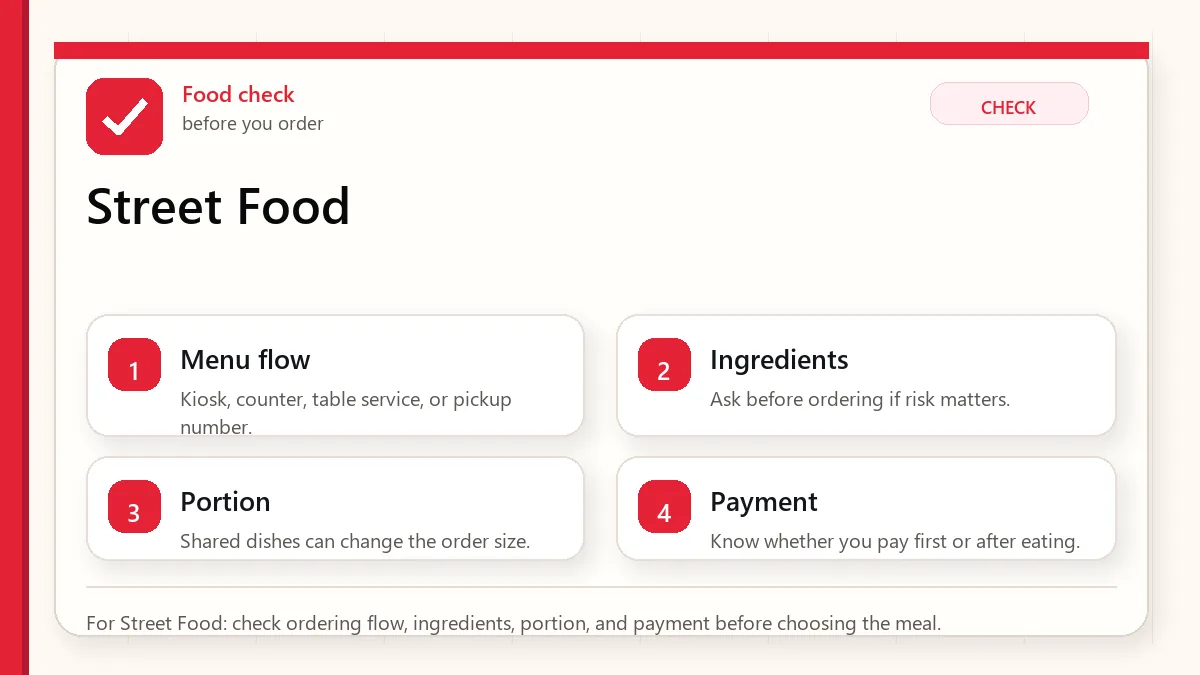
    Layered red check decision graphic for Street Food.
    For Street Food: check ordering flow, ingredients, portion, and payment before choosing the meal.

    Common street food and what to check

    FoodWhy visitors try itCheck first
    TteokbokkiIconic spicy rice cakes.Spice level and sauce intensity.
    Eomuk/fish cakeWarm, quick snack.Seafood base and broth.
    HotteokSweet filled pancake.Heat, nuts, and oil.
    GimbapPortable rice roll.Filling, freshness, and storage.
    Fried snacksEasy sharing food.Oil freshness and sauce.

    Checks before stepping up to the stall

    • Carry small cash in case card is not accepted.
    • Use translation for allergies and dietary limits.
    • Start with one or two items, not a full table of food.
    • Watch ordering flow before stepping forward.
    • Avoid stalls if food handling or storage makes you uncomfortable.

    Order without blocking the stall flow

    • Choose a stall with steady turnover and clean handling.
    • Point or order simply.
    • Confirm quantity before payment.
    • Eat hot foods carefully; fillings and broth can burn.
    • Dispose of skewers, cups, and trash where the stall or area provides.
    • Move aside after ordering so others can buy.
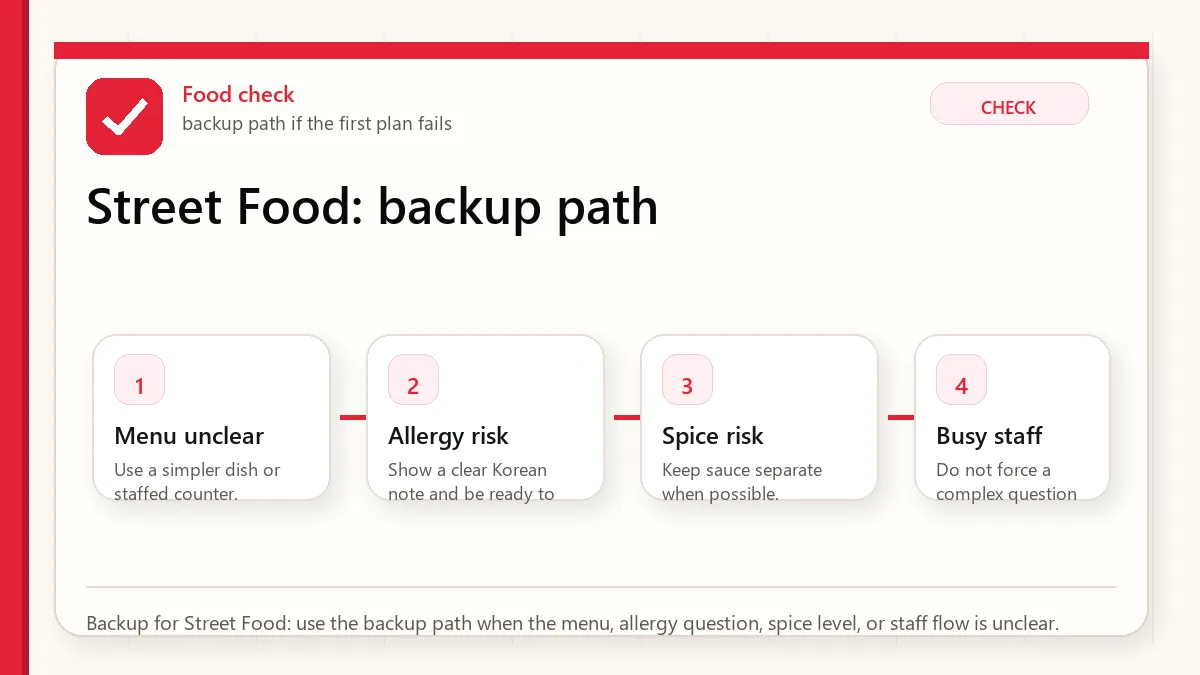
    Layered red check backup flow graphic for Street Food.
    Backup for Street Food: use the backup path when the menu, allergy question, spice level, or staff flow is unclear.

    Where street food plans usually go wrong

    You order too much

    Street food is best sampled. Share or buy in small rounds.

    It is spicier than expected

    Stop early, drink water, and choose a mild next item.

    You have a serious allergy

    If the stall cannot confirm ingredients, skip it. Shared oil and utensils can be a risk.

    No trash bin is visible

    Keep packaging until you find proper disposal rather than leaving it nearby.

    Choose the stall based on your risk level

    SituationBetter approachWhat to verify
    First-time visitorTry mild and popular items first.Spice and payment.
    Food market visitShare multiple small dishes.Crowds and hygiene.
    Winter tripWarm snacks and broth can be appealing.Heat and seafood ingredients.
    Dietary restrictionsUse dedicated restaurants when possible.Hidden broth and shared utensils.

    What not to assume from a busy line

    • Do not assume every street food stall accepts cards.
    • Do not assume seafood-free unless confirmed.
    • Do not assume mild-looking food is not spicy.
    • Do not assume trash disposal is obvious in every area.

    Small stall details that make street food easier to enjoy

    Street food is easiest when you keep the order simple

    Busy stalls are not the best place for a long custom order. Pointing, using the item name, asking price first, and stepping aside after paying usually works better than trying to redesign the dish. If you need allergy or dietary confirmation, a restaurant with staff time and clearer ingredients may be safer than a crowded stall.

    Use the crowd as one signal, not the only signal

    A line can suggest popularity, but visitors should still notice food handling, turnover, posted prices, and whether the stall looks set up for quick service. If the item is unfamiliar, start with a small portion and avoid buying multiple spicy or oily foods at once. Street food is best treated as a snack path, not as a full plan when you have strict food limits.

    Read next when street food connects to spice, cash, or ordering

    This topic works best when it is not handled alone. Use the related guides below to connect the decision with maps, money, food, shopping, transit, and app backup planning.

    Related Before Korea guides

    FAQ

    Is Korean street food safe?

    Many visitors enjoy it, but use basic judgment: turnover, cleanliness, heat, storage, and your own dietary risks.

    Do street food stalls take cards?

    Some may, but small cash is a safer backup.

    What should spice-sensitive visitors try first?

    Start with non-red, sweet, or grilled items and ask before ordering red-sauce dishes.

    Source links to verify

    Last updated

    Last updated: 2026-05-23. Re-check official sources close to the day you travel, buy, eat, or use an app. Details involving prices, eligibility, transport, app features, opening hours, and refund rules can change.
  • Korean Convenience Store Food Guide

    Korean Convenience Store Food Guide

    Start with the moment you order

    Korean convenience stores are useful for quick meals, snacks, drinks, transit top-ups, and late-night basics. For food, the key is reading labels, understanding heating or self-service steps, checking allergens, and not assuming every store has seating or English help.

    Last checked: June 1, 2026. Re-check the latest product label, restaurant information, and official/public database before acting, because routes, prices, labels, rules, app screens, eligibility, and store/service policies can change.

    The store is easy, but the small rules still matter

    Korean convenience stores are useful because they are fast, bright, and everywhere. The reader problem is not finding food. It is knowing how to heat it, where to eat it, how to read enough of the label, and how to avoid making a mess of the store flow.

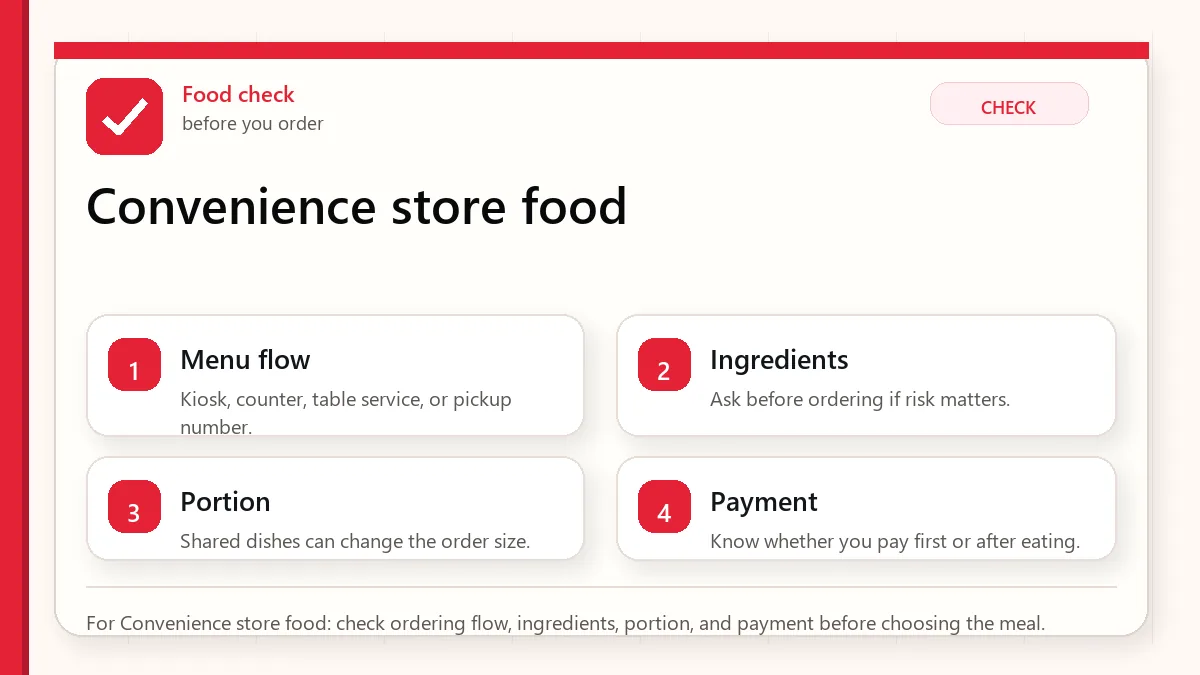
    Layered red check decision graphic for Convenience store food.
    For Convenience store food: check ordering flow, ingredients, portion, and payment before choosing the meal.

    Convenience store food types

    Food typeWhy it is usefulCheck
    Cup ramyeonEasy, cheap, and iconic.Spice level, hot water station, eating area.
    Dosirak lunch boxMore complete quick meal.Heating instructions and ingredients.
    Gimbap or triangle ricePortable meal or snack.Filling, expiry time, and refrigeration.
    Drinks and coffeeQuick caffeine and hydration.Sugar, dairy, and size.
    Desserts/snacksGood souvenirs and easy gifts.Allergens, fragility, and customs at home.

    Checks before heating or eating

    • Use translation for labels if you have allergies or dietary restrictions.
    • Check expiry date and whether the item needs heating.
    • Look for seating before opening hot food.
    • Carry a payment backup.
    • Avoid assuming every product is mild because the package looks cute.

    Use the store without disrupting the flow

    • Choose item and check whether it is refrigerated, frozen, or shelf-stable.
    • Read heating instructions or ask staff if unsure.
    • Use hot water and microwave areas carefully and cleanly.
    • Eat only where seating or store rules allow.
    • Dispose of packaging in the right bins if provided.
    • Save names of products you liked for later shopping.
    Layered red check backup flow graphic for Convenience store food.
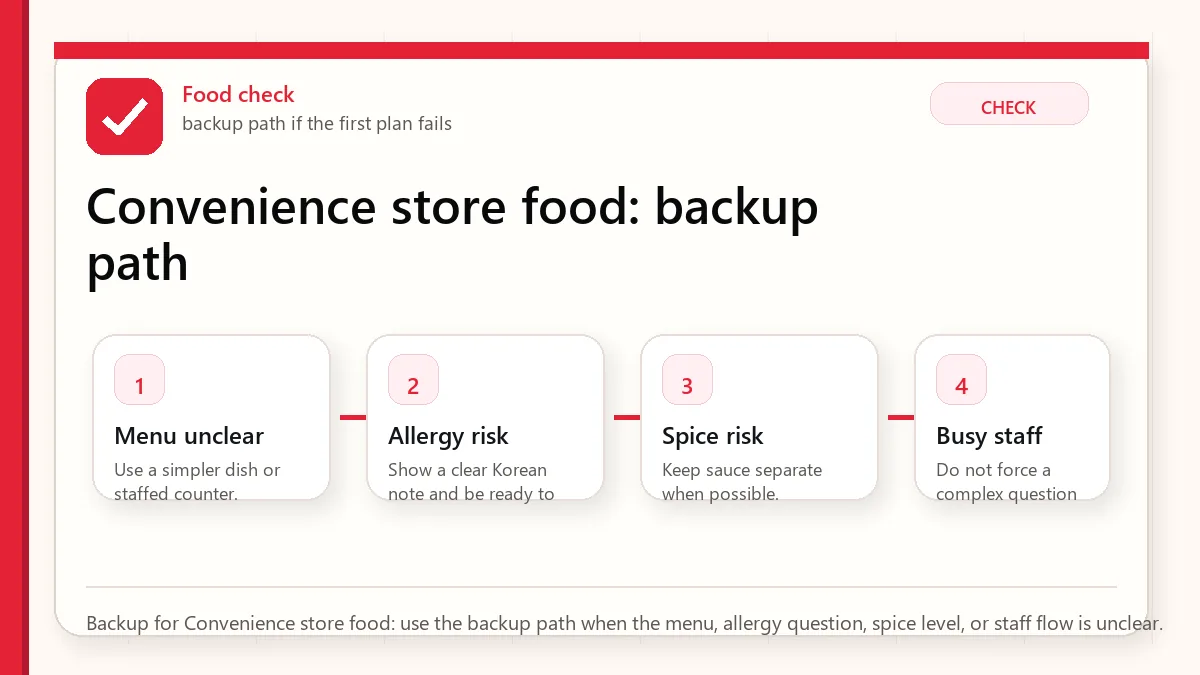
    Backup for Convenience store food: use the backup path when the menu, allergy question, spice level, or staff flow is unclear.

    Where convenience-store food gets confusing

    You bought the wrong spicy item

    Start with smaller portions and use translation for flavor names.

    You do not know how to heat it

    Look for microwave time icons or ask staff with the package in hand.

    No seating is available

    Do not open messy food until you know where you can eat it.

    Allergen risk is unclear

    Choose safer packaged items with readable labels or skip it.

    Choose food based on how much certainty you need

    SituationBetter approachWhat to verify
    Late-night arrivalUse convenience store for simple food and water.Payment and hotel eating rules.
    Budget mealChoose dosirak or gimbap with drink.Heating and expiry.
    Food souvenirChoose sealed snacks.Customs rules and fragility.
    Spice-sensitiveAvoid famous spicy products first.Flavor and chili warnings.

    What not to assume from packaging or photos

    • Do not assume every convenience store has seats.
    • Do not assume staff can explain ingredients in English.
    • Do not assume all ramyeon is equally spicy.
    • Do not assume public trash disposal is the same as your home country.

    Small store details that make the experience cleaner

    Convenience stores work best when you understand the self-service flow

    Many stores are designed for fast decisions. Choose the item, pay, use the microwave or hot-water area if available, eat only where seating is allowed, and clean up without leaving packaging behind. If you are not sure whether an item should be heated before or after paying, watch another customer or ask with a simple phrase.

    Labels are helpful but not complete for every visitor need

    Package labels can help with calories, allergens, expiry dates, and cooking instructions, but translated text can be incomplete or awkward. If you have a strict allergy, religious food rule, or medical restriction, convenience-store food should be approached carefully. Choose simpler packaged items where ingredients are easier to confirm, and use a translation app as a support tool rather than a guarantee.

    Read next when convenience food connects to translation or payment

    This topic works best when it is not handled alone. Use the related guides below to connect the decision with maps, money, food, shopping, transit, and app backup planning.

    Related Before Korea guides

    FAQ

    Can I eat inside Korean convenience stores?

    Some stores have seating, some do not. Check before opening food that needs a table.

    Are labels available in English?

    Not always. Use translation and avoid risky foods if allergies are serious.

    Can convenience stores top up transit cards?

    Many convenience stores can help with transport cards, but details vary by card and store.

    Source links to verify

    Last updated

    Last updated: 2026-05-23. Re-check official sources close to the day you travel, buy, eat, or use an app. Details involving prices, eligibility, transport, app features, opening hours, and refund rules can change.
  • Can Foreigners Use KakaoTalk in Korea? Setup, Verification, and Backups

    Can Foreigners Use KakaoTalk in Korea? Setup, Verification, and Backups

    Foreigners can use KakaoTalk, but the important travel question is not only whether the app opens. Before Korea, check whether you can verify your account, receive messages from hotels or clinics, manage storage and notifications, and avoid making KakaoTalk your only contact method.

    Last checked: June 2, 2026. KakaoTalk account, phone-number, privacy, and app-store flows can change. Check the official app page and your current app screen before relying on it for reservations.

    Layered red check decision graphic for KakaoTalk setup.
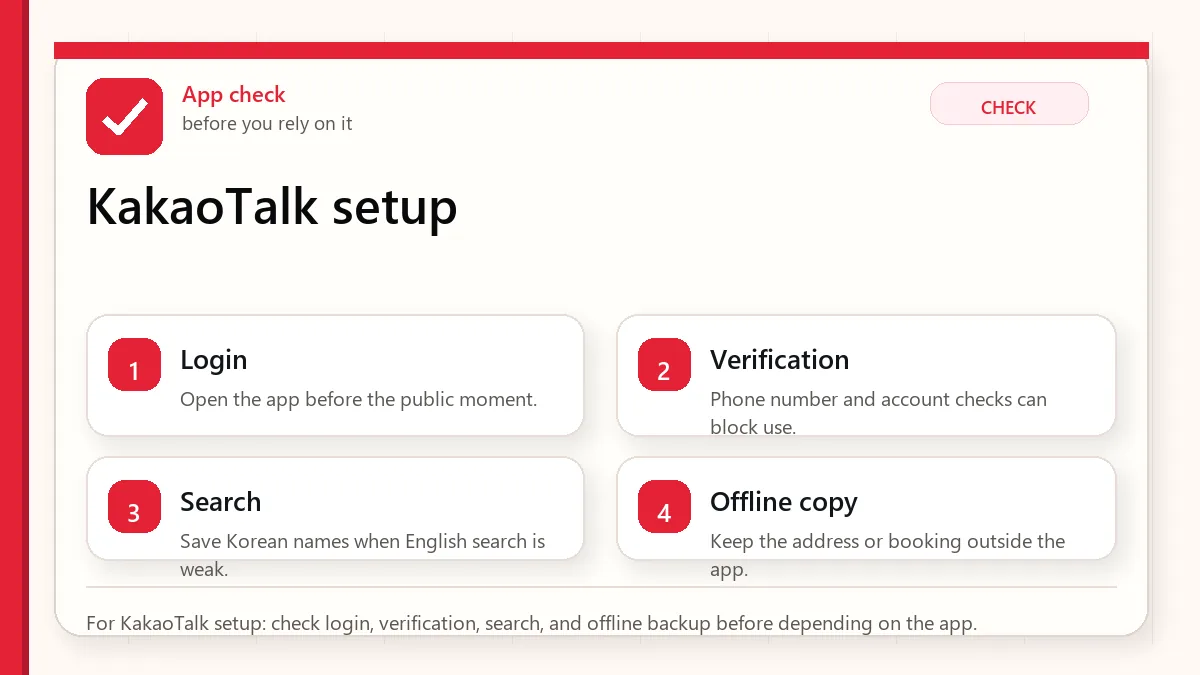
    For KakaoTalk setup: check login, verification, search, and offline backup before depending on the app.

    The practical answer for visitors

    Install KakaoTalk before arrival if you need to communicate with Korean contacts, clinics, salons, language exchanges, guesthouses, or local services. But keep email, phone, WhatsApp, Instagram DM, booking-app messages, or hotel front desk contact as a backup. A messenger app should not be the only way to reach a time-sensitive reservation.

    Where foreigners usually get stuck

    Problem What it means Before Korea check
    Phone verification You may need SMS or account confirmation Test signup before your first appointment
    Friend/contact flow People may search by phone, ID, QR, or link Ask the business which contact method they use
    Notifications Silent or blocked notifications can make you miss a message Enable alerts for important chats
    Storage Chat media can take phone space Keep storage free before a long trip
    Scams or wrong contacts Popular messengers attract impersonation risk Confirm official accounts and avoid sending payment details blindly

    KakaoTalk is useful, but it does not solve Korean verification

    Some visitors think KakaoTalk alone will unlock Korean apps. It will not. Korean services may separately require a Korean mobile number, real-name verification, carrier identity verification, a local payment method, or an ARC-linked account. KakaoTalk can help communication, but it is not a universal identity key.

    This matters for taxi apps, delivery apps, shopping, bookings, and hospital or beauty appointments. If a service asks for NICE, PASS, mobile identity verification, or a Korean carrier number, KakaoTalk itself may not be enough.

    A Korean phone number is not one product

    Visitors often buy an eSIM and assume they now have the same phone setup as a Korean resident. That is not always true. A data-only eSIM gives internet. A tourist SIM may give a temporary phone number. A prepaid voice/SMS plan may receive calls and texts. A resident carrier plan tied to local identity may pass checks that tourist products do not. These are different layers.

    For KakaoTalk messaging, internet and account access may be enough. For delivery, payment, age checks, coupons, or domestic login flows, the app may expect more than messaging. This is why a traveler can chat normally but still fail at Baemin, Coupang Eats, local shopping, or reservation verification.

    How to avoid losing access while changing SIMs

    The risky moment is usually not installation. It is changing phones, changing SIMs, reinstalling the app, or losing access to the number tied to the account. Do not experiment with KakaoTalk account settings right before a clinic appointment, fan event, private class, or host meetup.

    1. Confirm the account works before departure.
    2. Keep access to the registered phone number until the trip is stable.
    3. Write down your email, password recovery path, and backup contact method.
    4. Do not delete and reinstall the app during a time-sensitive problem unless official support tells you to.
    5. Save critical appointment details outside KakaoTalk.

    What to ask a Korean business

    Situation Ask this before the trip Why
    Clinic or salon appointment Can you confirm by email or phone if KakaoTalk fails? Appointments are time-sensitive and may require identity or deposit handling
    Guesthouse or local host Can I also reach you through booking-app messages? Travelers may change SIMs after arrival
    Private class or tour Can you send the exact meeting point outside KakaoTalk too? Map links and pickup points should not live in one app only
    Restaurant or event Do you use KakaoTalk Channel or a normal account? Search and contact methods differ

    Privacy and wrong-contact caution

    KakaoTalk is normal infrastructure in Korea, but you should still treat unknown accounts carefully. Verify official channels, avoid sending passport or card images unless you know why they are needed, and do not pay through an informal chat link without confirming the business.

    What to set up before a reservation

    1. Download KakaoTalk from the official store or Kakao page.
    2. Confirm you can log in and receive messages.
    3. Add a profile name that a Korean business can recognize.
    4. Save your hotel and appointment details outside KakaoTalk too.
    5. Prepare one fallback contact method for urgent changes.

    When KakaoTalk helps most

    KakaoTalk is most helpful when a Korean contact already expects to use it: a clinic follow-up, salon confirmation, private lesson, guesthouse message, or a friend in Korea. It is less helpful when the service requires Korean real-name verification or when you do not have a Korean phone/contact route.

    Layered red check backup flow graphic for KakaoTalk setup.
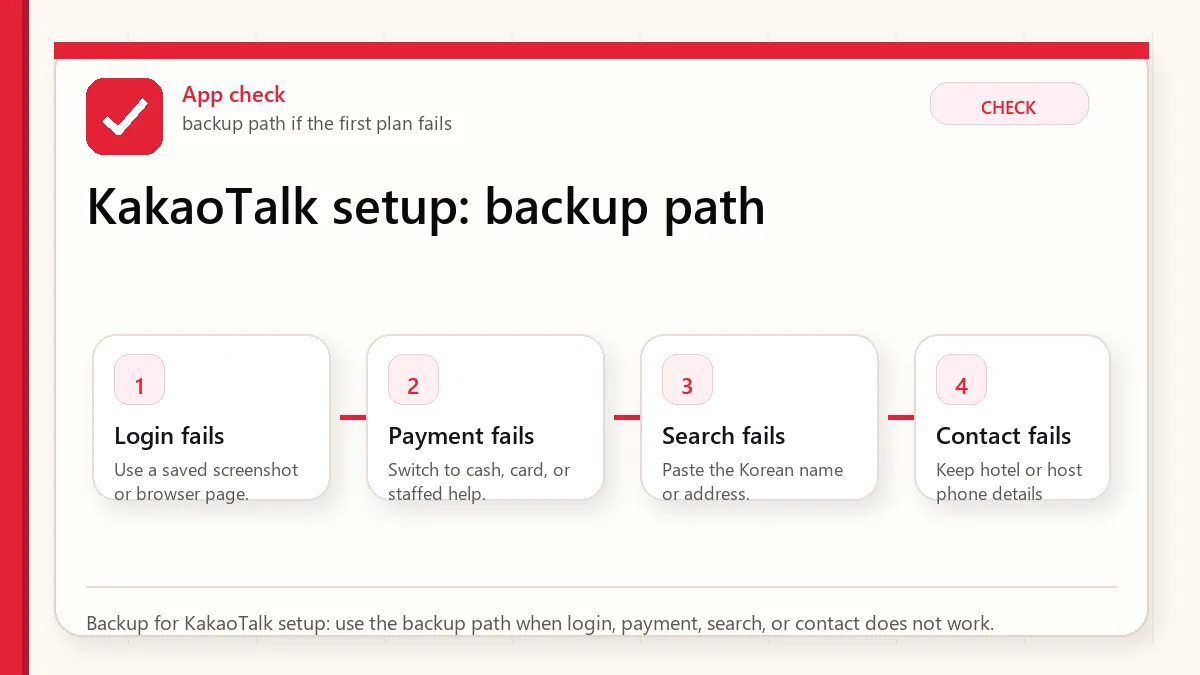
    Backup for KakaoTalk setup: use the backup path when login, payment, search, or contact does not work.

    Official links

    Related guides

    FAQ

    Can foreigners use KakaoTalk in Korea?

    Yes, many foreigners can use KakaoTalk. The practical risk is whether your account, phone number, notifications, and contact method work for the exact service you need.

    Do I need KakaoTalk before visiting Korea?

    Not always. It is useful for local communication, but you should also keep email, booking-app messages, and a phone/SMS backup.

    Does KakaoTalk replace Korean identity verification?

    No. KakaoTalk is a messenger. Korean apps may still require phone, carrier, NICE/PASS, ARC, or payment verification separately.

  • Korean Spicy Food Levels

    Korean Spicy Food Levels

    Start with the moment you order

    Korean spicy food is not one fixed level. Spice depends on dish, sauce, restaurant, broth, and whether chili paste, chili powder, or fresh peppers are used. If you are sensitive, choose known mild dishes, ask about spice before payment, and avoid assuming red color is the only clue.

    Last checked: June 1, 2026. Re-check the latest product label, restaurant information, and official/public database before acting, because routes, prices, labels, rules, app screens, eligibility, and store/service policies can change.

    The problem is not spice itself, but surprise spice

    Spicy Korean food can be part of the fun, but it is better when you choose the level instead of discovering it too late. This guide is for reading menu clues, controlling sauce, and keeping one mild option available so the meal stays enjoyable.

    Layered red check decision graphic for Spice level check.
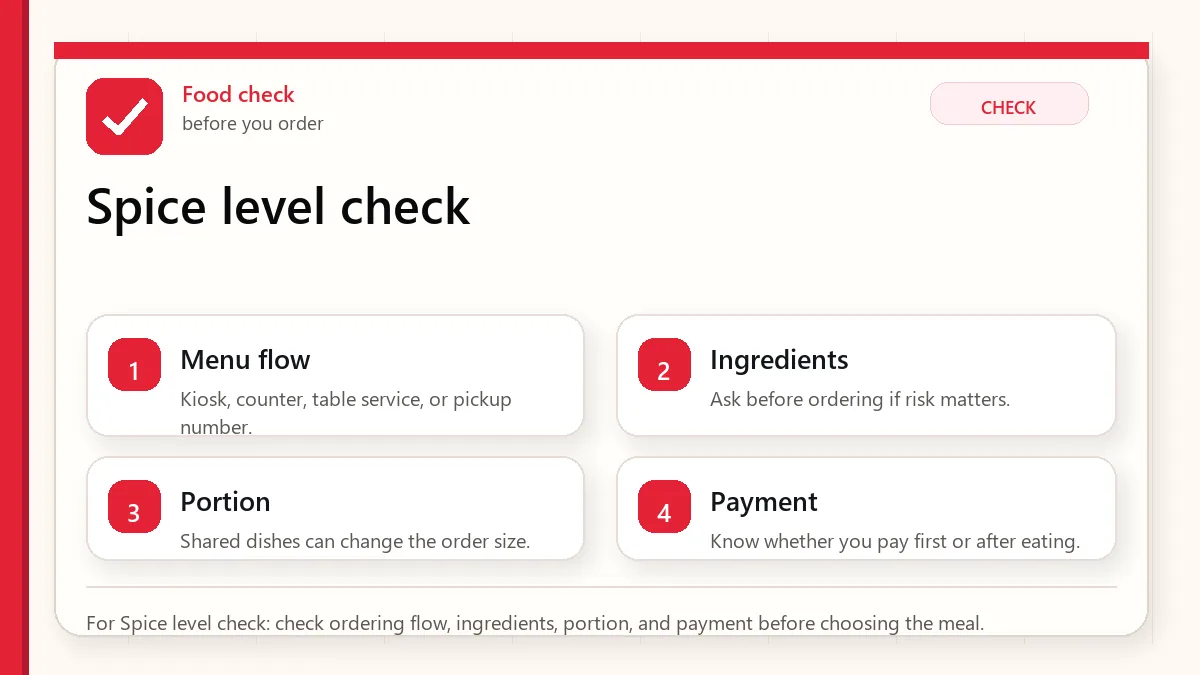
    For Spice level check: check ordering flow, ingredients, portion, and payment before choosing the meal.

    Spice risk by dish type

    Dish or categorySpice riskSafer move
    TteokbokkiOften spicy-sweet and sauce-heavy.Ask for mild if available or share a small portion.
    Kimchi dishesCan be mild to hot depending on stew, fried rice, or side dish.Ask whether the dish is spicy, not just whether it includes kimchi.
    Fried chicken saucesSauce can change the whole dish.Order sauce separate or choose plain/soy/garlic style.
    Soups and stewsBroth heat can build slowly.Choose clear or non-red broths when unsure.
    Convenience foodsPackage images and names may exaggerate or hide heat.Use translation and start with smaller servings.

    Checks before ordering something red or sauced

    • Know your own spice tolerance honestly.
    • Save a phrase for ‘not spicy’ or ‘mild’.
    • Check whether sauce can be served separately.
    • Keep rice, dairy drink, or mild side dish as backup if available.
    • Do not order the viral spicy item as your first meal after arrival.

    Explore spice without turning the meal into a test

    • Look for red sauces, chili icons, and words related to spicy heat.
    • Ask staff or use translation before ordering.
    • Start with shared portions when trying spicy street food.
    • Avoid stacking spicy soup, spicy side dishes, and spicy main dish in one meal.
    • If a dish is too hot, stop early rather than forcing it.
    • Record safe dishes you liked for later meals.
    Layered red check backup flow graphic for Spice level check.
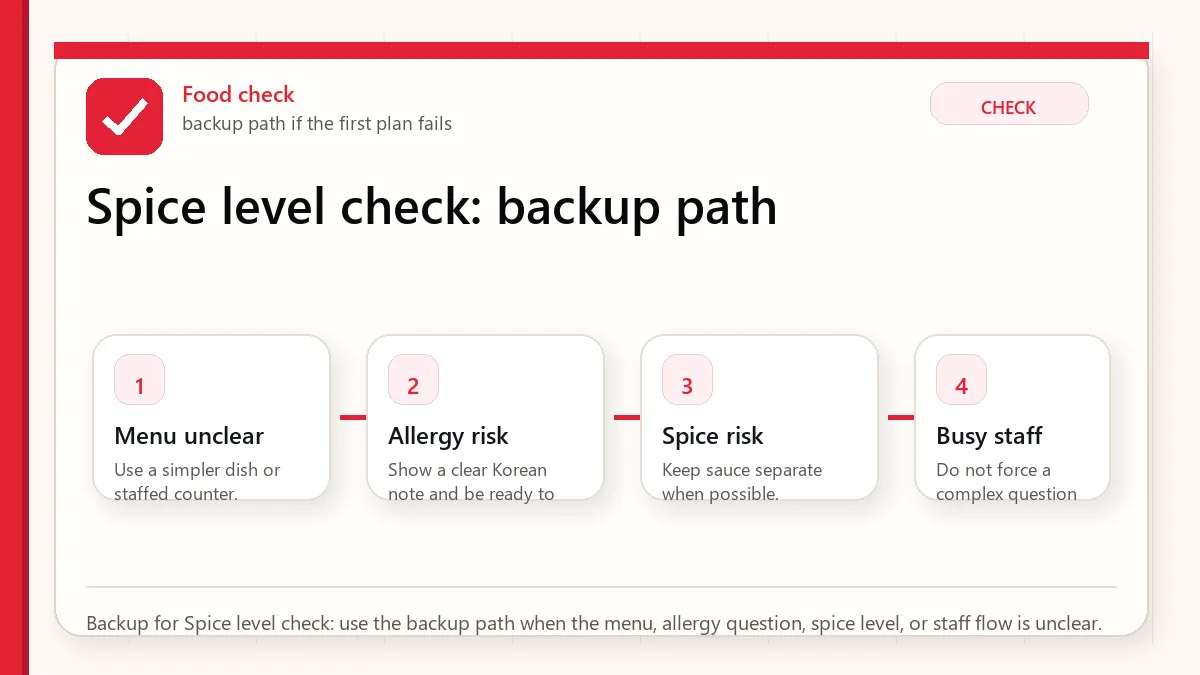
    Backup for Spice level check: use the backup path when the menu, allergy question, spice level, or staff flow is unclear.

    Where spice surprises visitors

    The first bite seems fine but heat builds

    Slow down. Soups and sauces can build over several minutes.

    You cannot explain spice tolerance

    Use simple words like mild or not spicy, plus translation. Avoid long explanations in a busy line.

    The dish cannot be made mild

    Choose another dish instead of asking for a version the restaurant does not make.

    You bought a very spicy convenience item

    Treat it as a tasting item, not a full meal, and have water or a mild snack ready.

    Choose the right caution for the dish

    SituationBetter approachWhat to verify
    Low spice toleranceStart with non-red dishes and sauce separate.Hidden chili in marinades or side dishes.
    Food adventurerTry spicy items in small portions first.Do not schedule intense food before long transit.
    Group mealOrder one spicy dish and other mild dishes.Shared tolerance differs.
    Sensitive stomachAvoid spice-heavy meals on arrival day.Travel fatigue and dehydration.

    What not to assume about color and heat

    • Do not assume all Korean food is spicy.
    • Do not assume every red dish is equally spicy.
    • Do not assume ‘mild’ means the same thing to every restaurant.
    • Do not assume you can return food because it is too spicy.

    Small choices that make spicy food easier to enjoy

    Color is only a rough clue

    A red dish can be mild, sharp, sweet, smoky, or extremely hot depending on sauce, chili paste, pepper powder, broth, and cooking style. The safest approach is to combine clues: menu wording, staff warning, dish category, sauce amount, and whether the food is served with broth. If you are sensitive to spice, do not gamble on a large shared dish as your first test.

    Build an escape route into the order

    A practical meal plan includes at least one less-spicy item, rice, soup, or side that gives you a break. Ask for sauce on the side where that makes sense, and avoid stacking spicy stew, spicy noodles, and spicy side dishes in the same meal. Visitors often enjoy Korean food more when spice is treated as a choice to explore gradually rather than a challenge to survive.

    Read next when spice connects to BBQ, ordering, or translation

    This topic works best when it is not handled alone. Use the related guides below to connect the decision with maps, money, food, shopping, transit, and app backup planning.

    Related Before Korea guides

    FAQ

    Is Korean food always spicy?

    No. Korea has many mild dishes, soups, noodles, rice dishes, grilled meats, and snacks.

    Can restaurants make spicy food mild?

    Sometimes, but not always. Some sauces and broths are prepared in advance.

    What should I order if I cannot eat spice?

    Look for grilled meats, plain rice dishes, non-red soups, some noodle dishes, or convenience foods with clear labels.

    Source links to verify

    Last updated

    Last updated: 2026-05-23. Re-check official sources close to the day you travel, buy, eat, or use an app. Details involving prices, eligibility, transport, app features, opening hours, and refund rules can change.
  • How to Order Food in Korea: Kiosks, BBQ, Payment

    How to Order Food in Korea: Kiosks, BBQ, Payment

    Ordering food in Korea is easier when you stop waiting for a restaurant to behave exactly like restaurants at home. Many Korean restaurants are efficient, active, and system-based. The menu might be on a wall, a kiosk, a tablet, a QR code, or a laminated sheet. Utensils may be inside a table drawer. Water may be self-service. Staff may expect you to press a call button when you need them. Payment may happen at the front counter after the meal.

    Last checked: June 1, 2026. Re-check the official provider, store, customs, or payment page before acting, because routes, prices, labels, rules, app screens, eligibility, and store/service policies can change.

    Last updated: May 24, 2026.

    Layered red check decision graphic for Ordering food.
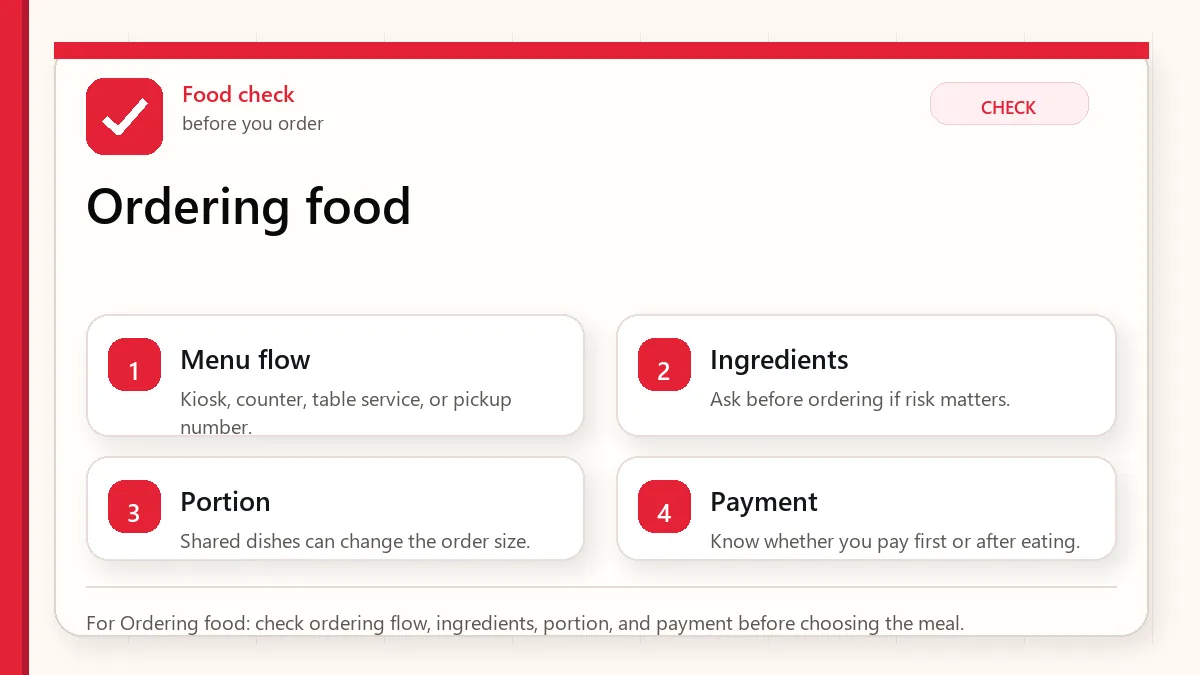
    For Ordering food: check ordering flow, ingredients, portion, and payment before choosing the meal.

    Start with what can fail at payment

    Choose the restaurant, check whether ordering is by staff, kiosk, or table tablet, look for utensil drawers and water stations, use jeogiyo or the call button when ready, order with pointing plus igeo juseyo, and pay at the counter when you leave unless a kiosk or table system already handled payment. Do not leave a tip on the table.

    The Korean restaurant flow

    StepWhat to look forTourist move
    Before sittingQueue machine, staff greeting, empty table, shoes-off area.Pause and follow the visible flow.
    At the tableCall button, utensil drawer, water pitcher, self-service sign.Set up the table before calling staff.
    OrderingMenu photos, English option, kiosk, QR, tablet.Point clearly or use translation.
    During mealBanchan, shared dishes, scissors, tongs, grill.Use serving tools and follow staff cues.
    PaymentCounter, kiosk receipt, table number card.Take the bill or table card to the counter.

    Table drawers, water, and banchan

    Many casual restaurants keep chopsticks, spoons, napkins, and wet tissues in a drawer under the table. If the table looks empty, check the side before assuming staff forgot. Water may be self-service, often marked with a Korean sign or placed at a visible station. Side dishes, called banchan, often arrive automatically, and some can be refilled, but do not waste them. Ask politely if you need more.

    How to call staff

    If the table has a button, press it once and wait. If there is no button, raise a hand and say jeogiyo. This is not rude in Korea when done calmly. Do not shout across the room aggressively, snap fingers, or wave money. The Korean restaurant service model gives customers more control over when staff come to the table.

    Layered red check backup flow graphic for Ordering food.
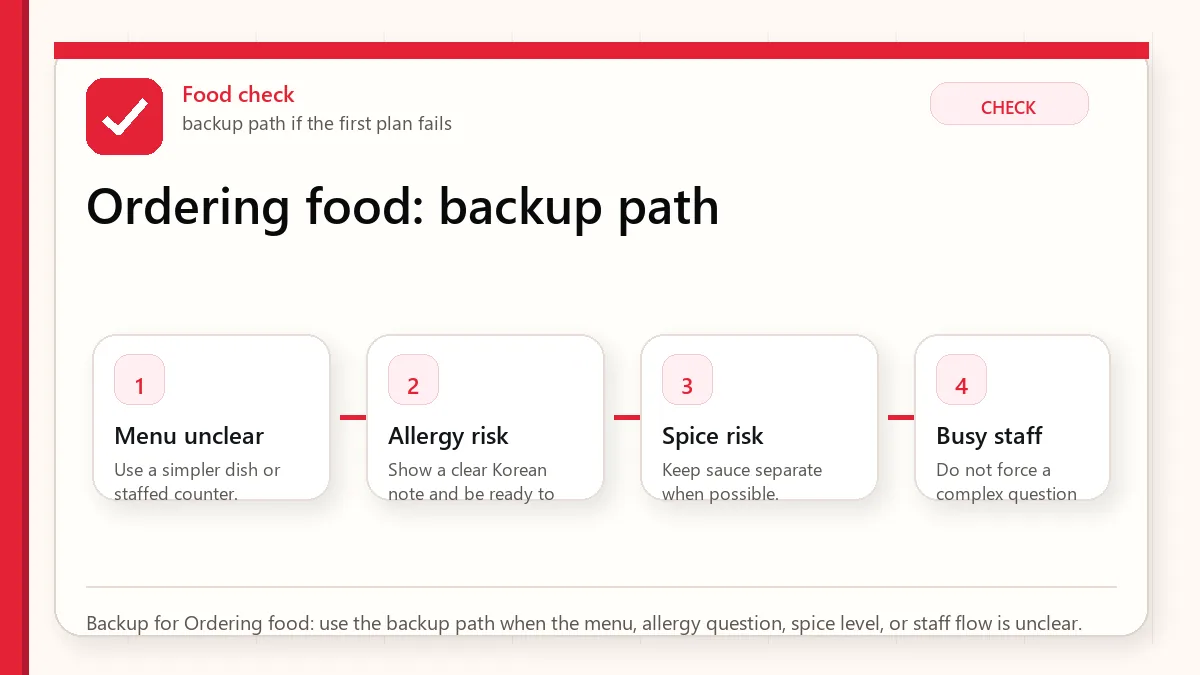
    Backup for Ordering food: use the backup path when the menu, allergy question, spice level, or staff flow is unclear.

    Kiosks and payment friction

    Self-order kiosks are common in fast-casual restaurants, food courts, bakeries, and some chains. They may have English, but not always. Foreign cards can sometimes fail, especially at unattended terminals. If the kiosk fails, look for a staffed counter, another payment option, or a simpler order. Keep cash or a second card as backup.

    Shared dishes and BBQ

    Korean dining often uses shared dishes. Use serving tongs or spoons where available. At BBQ restaurants, staff may grill the first round or control the timing, especially in specialist places. Let them lead unless they clearly leave the tools to you. Keep raw meat tools separate from eating utensils when possible. If you have allergies or dietary restrictions, ask before grilling begins because sauces, marinades, and shared surfaces matter.

    Useful phrases

    • Jeogiyo – excuse me, used to call staff.
    • Igeo juseyo – this one, please.
    • Mul jom juseyo – water, please.
    • Deol maepge hae juseyo – please make it less spicy.
    • Yeongsujeung juseyo – receipt, please.

    Dining confidence comes from reading the table

    Before looking at the menu, read the table. A call button means you control when staff come. A drawer means utensils are probably already there. A water station means you may be expected to self-serve. A small table number card or receipt may be needed for payment. These clues tell you how the restaurant works before language becomes an issue.

    This is why some visitors feel ignored when they are not being ignored at all. Staff may simply be waiting for you to press the button, call them, or come to the counter. Korean dining service often protects the table from constant interruption. Once you understand that, the experience feels less confusing and more efficient.

    Allergies and dietary limits need a different approach

    For spice preference, a simple phrase may help. For allergies, vegetarian limits, halal concerns, or gluten questions, spoken phrases are not enough. Show written Korean text and choose simpler dishes when staff cannot confirm ingredients. Shared broths, marinades, side dishes, grills, and sauces can all create hidden problems. A polite restaurant is not automatically a safe restaurant for a serious dietary restriction.

    FAQ

    Do Korean restaurants bring the bill to the table?

    Sometimes, but many expect you to pay at the front counter. Watch what other customers do.

    Is it rude to call staff with jeogiyo?

    No, when said calmly. It is a normal way to get attention in many restaurants.

    Should I tip after eating in Korea?

    No. Ordinary Korean restaurants do not expect tips.

    Delivery app reality check for visitors

    Food delivery can look like the easiest answer when you are tired, but it is not always the easiest tourist flow. Korean delivery apps may ask for a local phone number, identity verification, domestic payment, a precise Korean address, and rider communication. If Baemin becomes part of your food plan, read Can Foreigners Use Baemin in Korea? before relying on it for a late-night meal.

    For first meals after arrival, keep a lower-friction backup: a restaurant near the hotel, a food court, a convenience store meal, or a place where you can order face to face. Delivery is useful when it works, but it should not be the only way your group can eat.

    Related Before Korea guides

    Source links to verify

  • Korean BBQ Etiquette Guide

    Korean BBQ Etiquette Guide

    Start with the moment you order

    At Korean BBQ, treat the table as a shared cooking and eating space. Order enough for the group, follow the restaurant’s grill style, accept staff help when offered, use serving tools when provided, and do not treat side dishes or sauces as unlimited private plates.

    Last checked: June 1, 2026. Re-check the latest product label, restaurant information, and official/public database before acting, because routes, prices, labels, rules, app screens, eligibility, and store/service policies can change.

    The table rhythm that makes BBQ feel easier

    Korean BBQ is not difficult, but it is shared, fast-moving, and more structured than it may look at first. The useful preparation is knowing the minimum order, grill rhythm, staff help, side dishes, and payment flow before everyone at the table is already waiting.

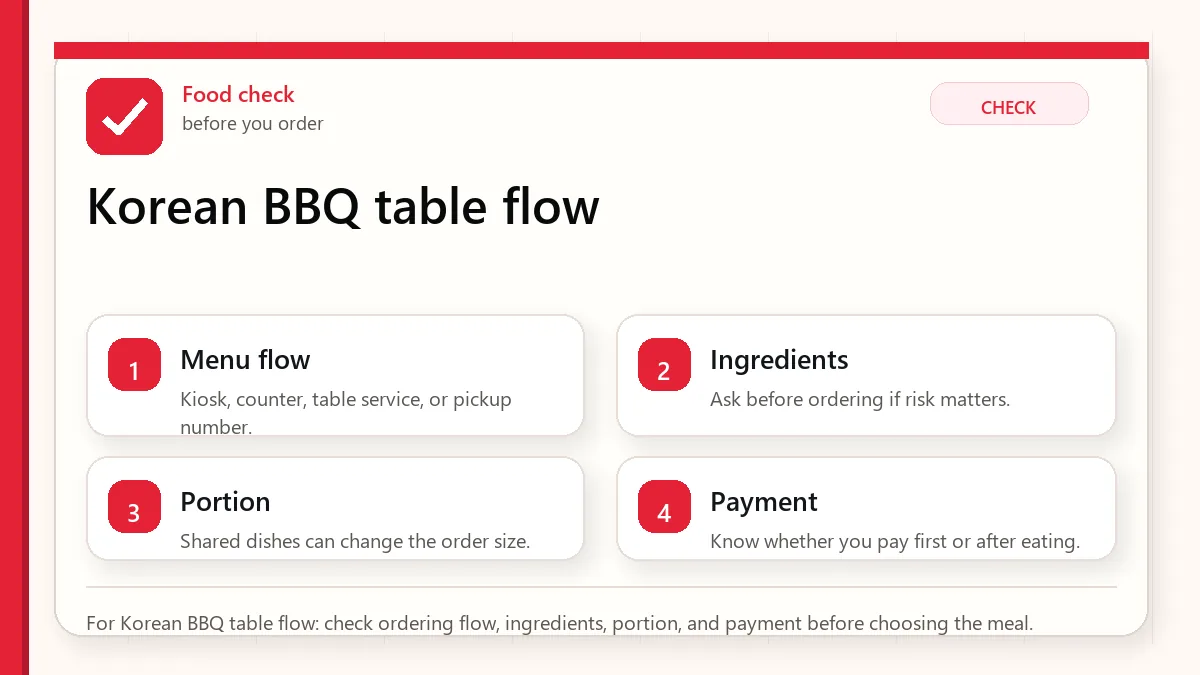
    Layered red check decision graphic for Korean BBQ table flow.
    For Korean BBQ table flow: check ordering flow, ingredients, portion, and payment before choosing the meal.

    Korean BBQ table basics

    MomentWhat to doWhy
    OrderingCheck minimum order and portion style.Many BBQ restaurants expect meat orders by portion or person.
    GrillingLet staff guide you if they manage the grill.Some restaurants prefer staff to cook or cut meat.
    SharingUse tongs/scissors/serving tools when available.The table is shared, so hygiene and flow matter.
    Side dishesAsk politely for refills if needed.Banchan is shared and should not be wasted.
    PaymentCheck whether payment happens at table or counter.Restaurant flow varies.

    Checks before the first order

    • Check whether the restaurant specializes in beef, pork, chicken, or another style.
    • Look for minimum order notes if eating alone.
    • Prepare allergy or dietary phrases if needed.
    • Do not assume every BBQ restaurant has the same grill rules.
    • Carry a backup payment method.

    Move through the meal without making it awkward

    • Order meat based on group size and appetite.
    • Wait for staff instructions before adjusting unfamiliar grill equipment.
    • Use separate tools for raw meat and cooked meat when provided.
    • Wrap cooked meat with lettuce, sauces, and side dishes if you like, but do not overfill shared plates.
    • Order additional items after seeing portion size.
    • Check final bill before leaving.
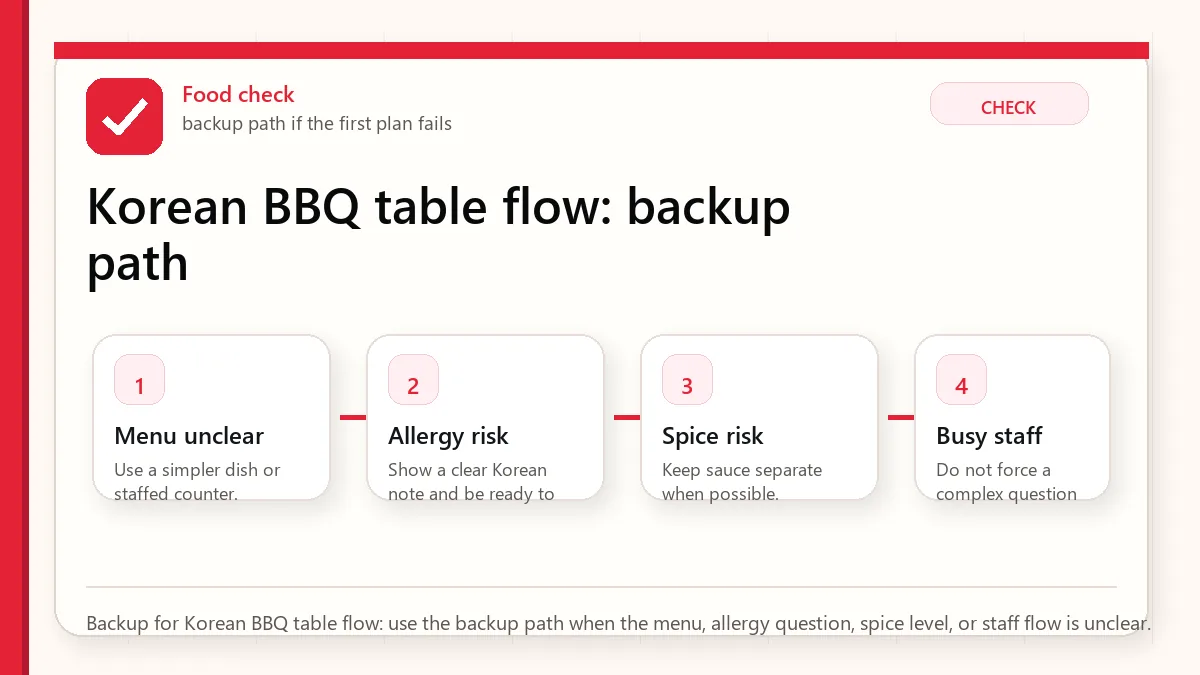
    Layered red check backup flow graphic for Korean BBQ table flow.
    Backup for Korean BBQ table flow: use the backup path when the menu, allergy question, spice level, or staff flow is unclear.

    Where first BBQ meals usually get uncomfortable

    You are not sure who cooks

    Pause and watch staff. If they start cooking, let them. If not, cook carefully and ask if unsure.

    You are dining alone

    Some BBQ restaurants have minimum orders or may be less solo-friendly. Check before entering.

    You have dietary restrictions

    Korean BBQ can involve shared grills, marinades, seafood sauces, or side dishes. Confirm ingredients rather than guessing.

    Smoke or smell bothers you

    Choose a restaurant with ventilation, avoid delicate clothing, and plan accordingly.

    Read the table before changing the flow

    SituationBetter approachWhat to verify
    First-time groupChoose a popular restaurant with staff-guided grilling.Minimum order and payment method.
    Solo travelerSearch for solo-friendly BBQ or non-grill alternatives.Minimum portion and seating policy.
    Pork restrictionConfirm meat type and shared grill risk.Marinades and side dishes.
    Budget travelerCheck menu price before sitting.Per-portion pricing and add-ons.

    What not to assume at a BBQ restaurant

    • Do not assume every side dish is vegetarian.
    • Do not assume staff will cook at every restaurant.
    • Do not assume one portion equals one full meal for every person.
    • Do not assume all sauces are mild or allergy-safe.

    Small table details that make the meal feel smoother

    The minimum order sets the meal

    Many Korean BBQ restaurants expect a minimum amount of meat, often based on portions or people. A visitor who orders too little can create confusion before the meal even starts. Check the menu structure first: meat type, portion size, minimum order, side dishes, stew, rice, and whether staff help with grilling. This makes the meal feel calmer and more respectful.

    Let the table flow guide you

    BBQ is social and shared, so the rhythm matters. Tongs, scissors, grill changes, side dishes, wrapping vegetables, and staff assistance all have a flow. If staff are managing the grill, let them. If your table is expected to cook, turn pieces carefully and avoid mixing raw and cooked utensils where separate tools are provided. When unsure, watching nearby tables usually helps.

    Read next when BBQ connects to ordering, spice, or etiquette

    This topic works best when it is not handled alone. Use the related guides below to connect the decision with maps, money, food, shopping, transit, and app backup planning.

    Related Before Korea guides

    FAQ

    Do staff cook Korean BBQ for you?

    Sometimes. It depends on the restaurant and meat style. Follow staff cues and ask politely if unsure.

    Can I eat Korean BBQ alone?

    Sometimes, but some places have minimum orders. Solo-friendly BBQ or non-grill meat restaurants may be easier.

    Are side dishes free?

    Many restaurants provide banchan and may refill some items, but do not waste food and ask politely.

    Source links to verify

    Last updated

    Last updated: 2026-05-23. Re-check official sources close to the day you travel, buy, eat, or use an app. Details involving prices, eligibility, transport, app features, opening hours, and refund rules can change.
  • K-Beauty in Korea

    K-Beauty in Korea

    Start with the label and skin risk

    Buy K-beauty in Korea by skin need, not by hype. Separate basics from active products, check functional claims and ingredients, avoid starting too many new products during travel, and keep tax refund and luggage rules in mind.

    Last checked: June 1, 2026. Re-check the latest product label, store policy, and official refund or safety page before acting, because routes, prices, labels, rules, app screens, eligibility, and store/service policies can change.

    The skin-care decision behind the trend

    K-beauty shopping is easiest when you begin with your own skin, not the shelf display. This guide is for slowing down enough to check ingredients, product role, expiry, claims, and whether the item will actually fit your routine after Korea.

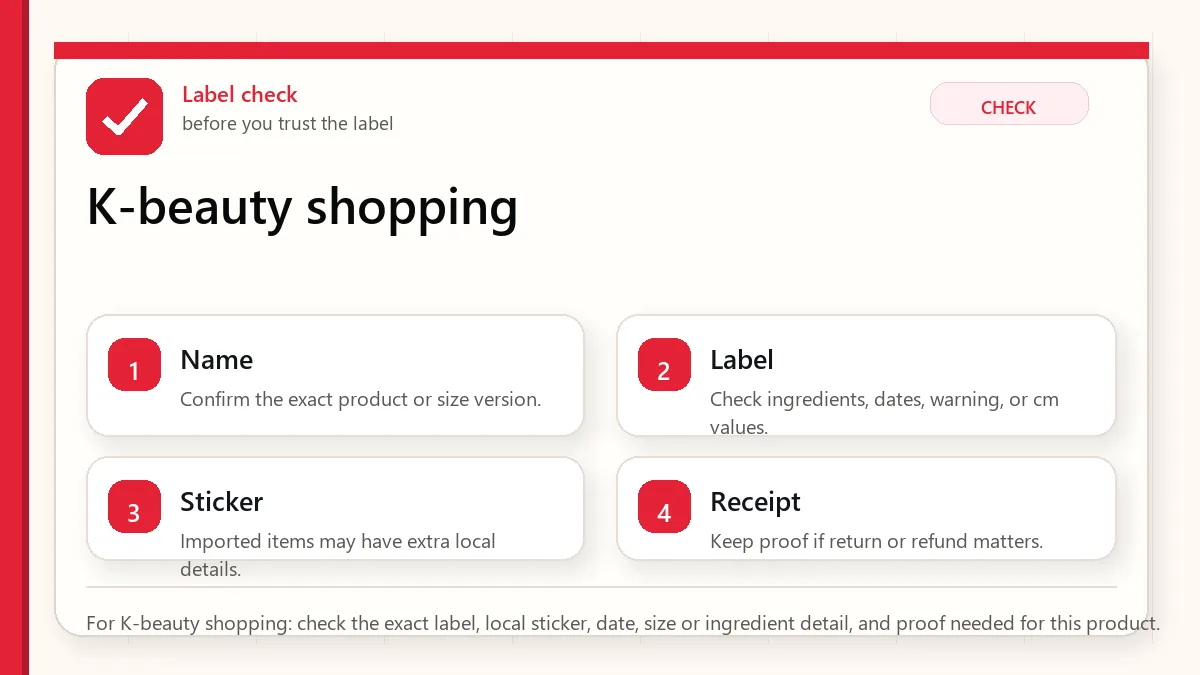
    Layered red check decision graphic for K-beauty shopping.
    For K-beauty shopping: check the exact label, local sticker, date, size or ingredient detail, and proof needed for this product.

    K-beauty buying framework

    Product typeGood reason to buyRisk to check
    CleanserEasy to compare and usually practical.Fragrance, dryness, and travel-size availability.
    MoisturizerUseful basic category for most routines.Texture, comedogenic concerns, and climate difference.
    SunscreenKorea has many cosmetic sunscreen options.Functional claim, SPF/PA label, sensitivity, and your country import rules.
    Brightening/wrinkle/acne careMay target specific concerns.Functional cosmetic claims, irritation risk, and unrealistic expectations.
    Masks and setsGood gifts and travel souvenirs.Bulk, expiry dates, and whether you will actually use them.

    Checks to make before buying skincare

    • Know your skin type and known irritants.
    • Choose one or two categories before entering a store.
    • Check expiry and packaging condition.
    • Understand that cosmetic claims are not medical guarantees.
    • Avoid testing many new active products at once while traveling.

    Build a basket around your routine, not the trend wall

    • Start with a simple routine gap: cleanser, moisturizer, sunscreen, or one targeted product.
    • Read the front claim and ingredient list before considering price.
    • Compare travel size versus full size.
    • Keep receipts and packaging if tax refund or return could matter.
    • Patch test cautiously after purchase.
    • Stop using a product if irritation appears and seek professional advice if needed.
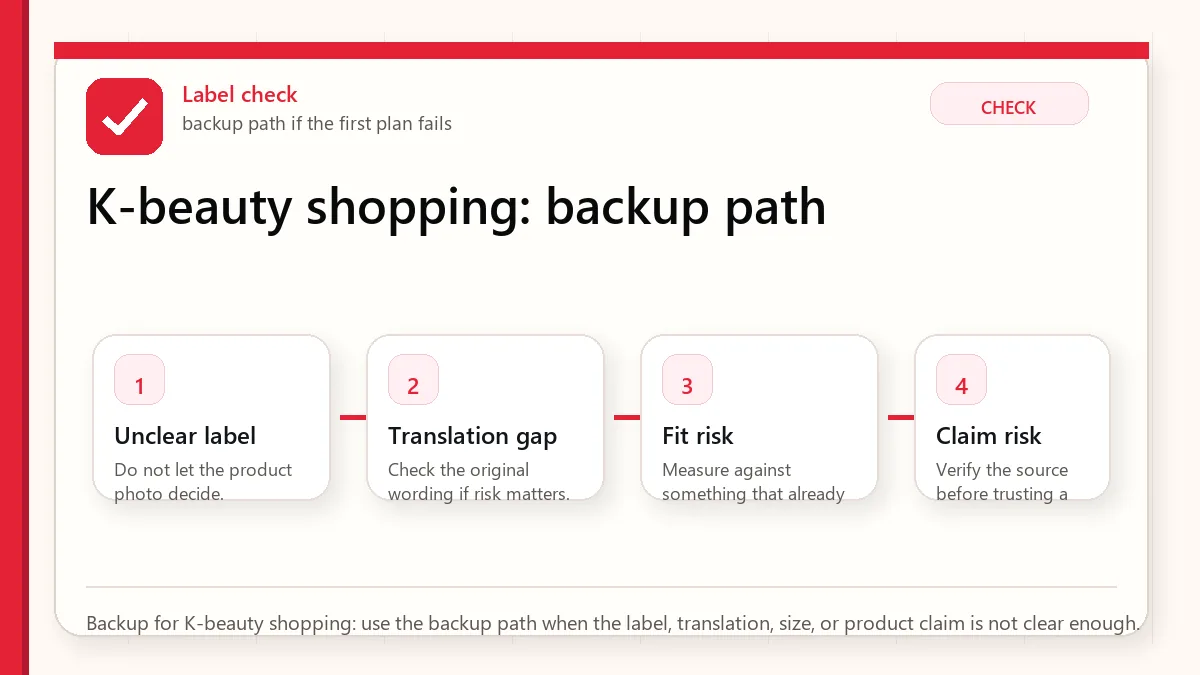
    Layered red check backup flow graphic for K-beauty shopping.
    Backup for K-beauty shopping: use the backup path when the label, translation, size, or product claim is not clear enough.

    Where K-beauty buying usually goes wrong

    You buy a strong active because it is popular

    Popularity does not tell you concentration, compatibility, or irritation risk. Introduce actives slowly.

    You confuse cosmetics with medicine

    Cosmetics can support appearance and routine, but medical claims and treatment decisions need professional advice.

    You buy gifts without checking skin concerns

    For gifts, choose gentle basics or sealed masks rather than aggressive actives.

    You ignore expiry dates

    Bulk buying can waste money if products expire before you use them.

    Different skin goals need different caution

    SituationBetter approachWhat to verify
    Sensitive skinChoose fragrance-light basics and avoid stacking actives.Known allergens and reaction history.
    Gift buyerBuy sealed, broad-use products.Expiry, skin sensitivity, and luggage.
    Trend hunterSave names and research later.Ingredient list and official product page.
    Tax-refund shopperPlan purchase amount and documents.Passport and store participation.

    What not to assume from claims or popularity

    • Do not assume K-beauty means gentle for everyone.
    • Do not assume whitening/brightening claims mean the same thing in every market.
    • Do not assume a staff recommendation is medical advice.
    • Do not assume a product popular in Korea is easy to repurchase at home.

    Beauty details that protect your skin and luggage

    Buy for your skin, not for the shelf

    K-beauty shopping is tempting because stores make discovery easy. The practical risk is buying too many similar products before knowing whether they fit your skin, climate, routine, or baggage limit. Start from your actual need: sunscreen, cleanser, moisturizer, barrier care, acne care, travel size, or gift. A focused list beats a basket full of trend items.

    Claims need context

    Words like brightening, calming, repair, pore, lifting, or sensitive can mean different things across brands and product categories. Visitors should check ingredient lists, usage directions, expiry dates, package size, and whether a product is cosmetic rather than medical. If your skin reacts easily, avoid testing several new active products during the same trip.

    Read next when skincare connects to Olive Young or tax refund

    This topic works best when it is not handled alone. Use the related guides below to connect the decision with maps, money, food, shopping, transit, and app backup planning.

    Related Before Korea guides

    Official links to check

    Use these official links when the next step matters. This guide explains what to watch for, but app downloads, eligibility, prices, routes, policies, and service rules can change.

    FAQ

    Are Korean skincare products regulated?

    MFDS provides cosmetics information and functional cosmetic processes. Still, shoppers should read labels and avoid treating cosmetics as medical treatment.

    What should a beginner buy first?

    A gentle cleanser, moisturizer, or sunscreen is usually more practical than several active products at once.

    Can I test many products during a short trip?

    It is better not to. Testing too many new products makes it hard to identify what caused irritation.

    Source links to verify

    Last updated

    Last updated: 2026-05-23. Re-check official sources close to the day you travel, buy, eat, or use an app. Details involving prices, eligibility, transport, app features, opening hours, and refund rules can change.
  • What to Buy in Korea

    What to Buy in Korea

    Start with the label and return risk

    The best things to buy in Korea are the items you can use, carry home legally and comfortably, verify for authenticity, and price-check after tax refund. K-beauty, snacks, stationery, fashion accessories, traditional crafts, and practical travel goods can all make sense, but not every viral item is worth suitcase space.

    Last checked: June 1, 2026. Re-check the latest product label, store policy, and official refund or safety page before acting, because routes, prices, labels, rules, app screens, eligibility, and store/service policies can change.

    The difference between a good buy and a suitcase problem

    A useful Korea purchase should still make sense after the trip. This guide is for deciding what deserves luggage space, what is easy to verify, what is better bought at home, and what is only tempting because the store atmosphere is doing its job.

    Layered red check decision graphic for Useful Korea purchases.
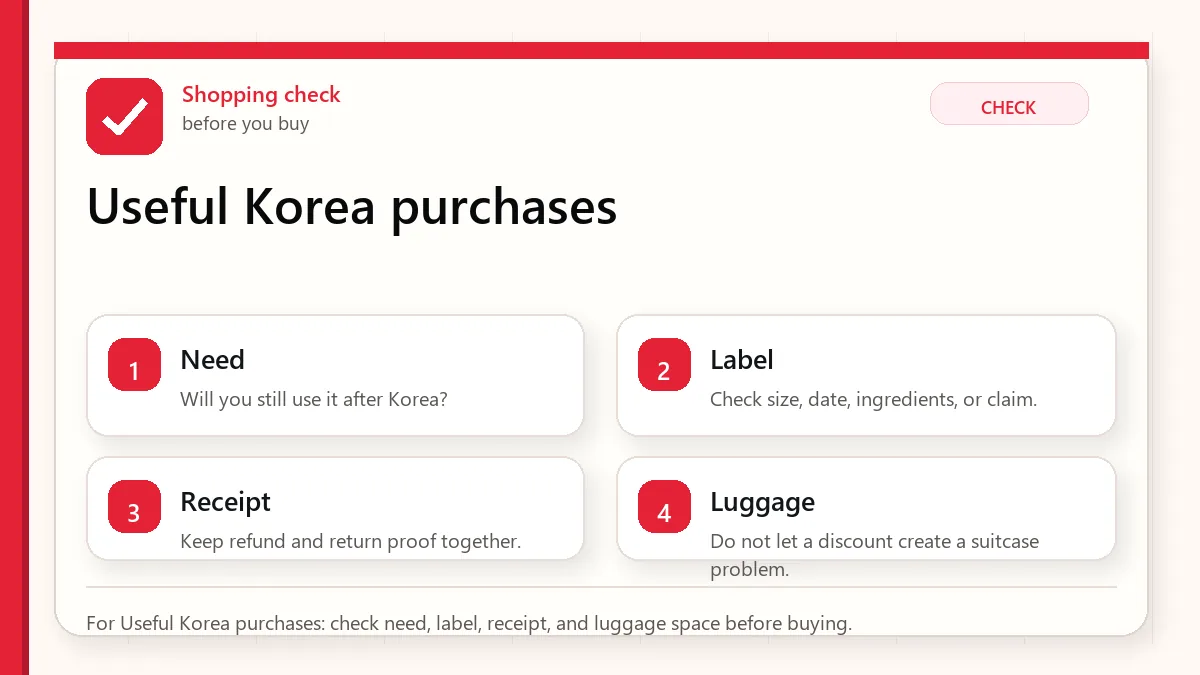
    For Useful Korea purchases: check need, label, receipt, and luggage space before buying.

    Good purchase categories and checks

    CategoryWhy people buy itCheck before buying
    K-beautyWide selection and Korea-specific launches.Skin fit, expiry date, ingredients, tax refund.
    Snacks and food giftsEasy gifts and Korea-specific flavors.Customs rules in your destination country and luggage crushing.
    Fashion and accessoriesTrendy styles and local brands.Sizing, return policy, material, baggage space.
    Stationery and lifestyle goodsLightweight, practical souvenirs.Fragility, duplicate items, and price comparison.
    Traditional craftsMore meaningful than generic souvenirs.Authenticity, packaging, and whether the item is easy to carry.

    Checks to make before spending luggage space

    • Write a maximum number of items before shopping-heavy areas.
    • Check your airline baggage allowance.
    • Know your home-country customs restrictions for food and cosmetics.
    • Bring passport if using tax refund.
    • Keep receipts for returns, refund, and proof of purchase.

    Choose purchases with the trip home in mind

    • Start with categories, not exact viral product names.
    • Compare store, online, duty-free, and tax-refund-adjusted prices when the item is expensive.
    • Buy heavy or fragile items later in the trip if possible.
    • Keep gifts sealed and labeled for easier packing.
    • Avoid buying skincare ingredients you would not normally tolerate.
    • Stop shopping when luggage space becomes the real cost.
    Layered red check backup flow graphic for Useful Korea purchases.
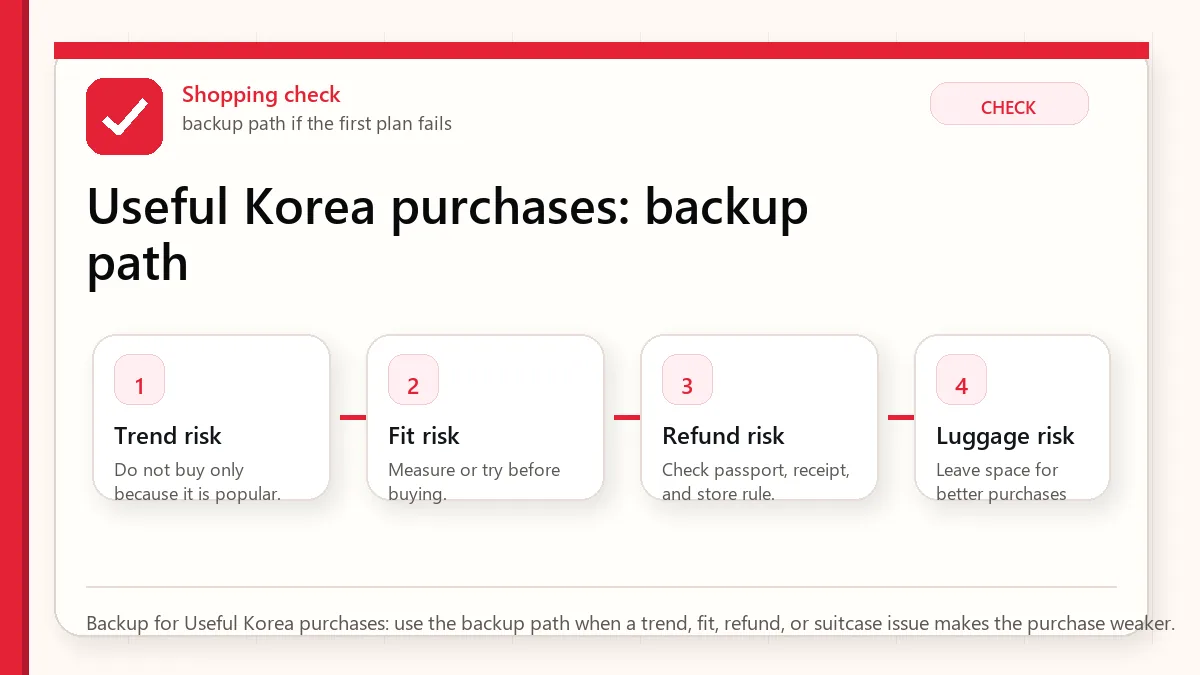
    Backup for Useful Korea purchases: use the backup path when a trend, fit, refund, or suitcase issue makes the purchase weaker.

    Where souvenir shopping usually disappoints

    You buy too much early

    Leave room for later discoveries and avoid carrying heavy bags across multiple hotels.

    The souvenir is hard to fly with

    Food, liquids, sharp objects, batteries, and fragile items need rules and packing checks.

    The product is not useful at home

    A product that only works because you are in Korea may not be a good purchase.

    Tax refund becomes airport stress

    Do not chase small refunds if the process risks your departure timing.

    Match the purchase to the person receiving it

    SituationBetter approachWhat to verify
    First tripBuy small, useful, easy-to-pack items.Baggage and customs rules.
    Gift-focused tripChoose sealed items with broad appeal.Expiry date and allergen/ingredient issues.
    Beauty-focused tripUse a planned product list.Skin type and functional claims.
    Minimal luggagePrefer lightweight stationery, masks, or flat gifts.Weight and liquid limits.

    What not to assume just because something is popular

    • Do not assume Korea is cheaper for every product.
    • Do not assume a viral item is authentic outside official or trusted retailers.
    • Do not assume you can return cosmetics or food easily.
    • Do not assume your destination country allows every food product.

    Buying details that still matter after the trip

    The best souvenir is not always the most famous one

    A practical purchase should survive the trip home and still make sense after the excitement fades. Think about luggage weight, liquid limits, customs rules, expiry dates, breakability, and whether the item is easy to buy online in your home country. Small useful goods often beat bulky trend purchases.

    Separate gifts from personal experiments

    Buying for yourself and buying gifts require different judgment. For gifts, prioritize items that are easy to understand, sealed, portable, and unlikely to trigger size, skin, allergy, or taste problems. For personal shopping, you can take more risk, but keep receipts and avoid buying too many similar items before you know what you actually like.

    Read next when shopping connects to beauty, sizing, or tax refund

    This topic works best when it is not handled alone. Use the related guides below to connect the decision with maps, money, food, shopping, transit, and app backup planning.

    Related Before Korea guides

    Official links to check

    Use these official links when the next step matters. This guide explains what to watch for, but app downloads, eligibility, prices, routes, policies, and service rules can change.

    FAQ

    What is the safest souvenir category?

    Small, sealed, lightweight, non-liquid items are usually easiest, but customs rules still depend on your destination country.

    Is K-beauty always cheaper in Korea?

    Not always. Compare price, tax refund, promotions, online availability, and baggage cost.

    Should I buy gifts at the airport?

    Airport shopping is convenient but may not have the same selection or prices. Use it for last-minute items, not the whole plan.

    Source links to verify

    Last updated

    Last updated: 2026-05-23. Re-check official sources close to the day you travel, buy, eat, or use an app. Details involving prices, eligibility, transport, app features, opening hours, and refund rules can change.