Author: user

  • Olive Young Korea Guide for Foreign Shoppers

    Olive Young Korea Guide for Foreign Shoppers

    Start with the label and return risk

    Use Olive Young as a convenient K-beauty discovery store, not as proof that every product suits your skin. Before buying, check skin type, ingredients, expiry date, tax refund eligibility, luggage limits, and whether the same product is easier to buy online later.

    Last checked: June 1, 2026. Re-check the latest product label, store policy, and official refund or safety page before acting, because routes, prices, labels, rules, app screens, eligibility, and store/service policies can change.

    How to keep Olive Young shopping useful

    Olive Young can be one of the easiest stores to overshop. A stronger plan starts with product role, skin needs, label checks, refund handling, and luggage space.

    AreaWhat to checkWhat to avoid
    Product roleKnow what the product adds to your routine.Trendy duplicates waste money and skin tolerance.
    LabelCheck ingredients, expiry, volume, and instructions.A product you cannot understand is harder to use safely.
    RefundAsk before checkout and keep receipts.Refund steps are not automatic for every situation.
    PackingPlan liquids, glass, gifts, and backups.A bargain can become luggage trouble.

    The checks that deserve your attention

    • Make a short product list before entering.
    • Avoid adding too many new actives.
    • Check expiration and sealed packaging.
    • Keep receipts and passport ready if refund matters.

    Failure cases to plan around

    • Basket fills with duplicates.
    • Ingredient sensitivity ignored.
    • Promotion drives the purchase.
    • Receipt lost before airport.

    Official and practical source checks

    Read next

    The moment the basket gets too easy to fill

    Olive Young is fun because discovery is easy. That is also the risk. The useful question is not only what is popular, but what fits your skin, luggage, receipt plan, budget, and ability to use the product after the trip.
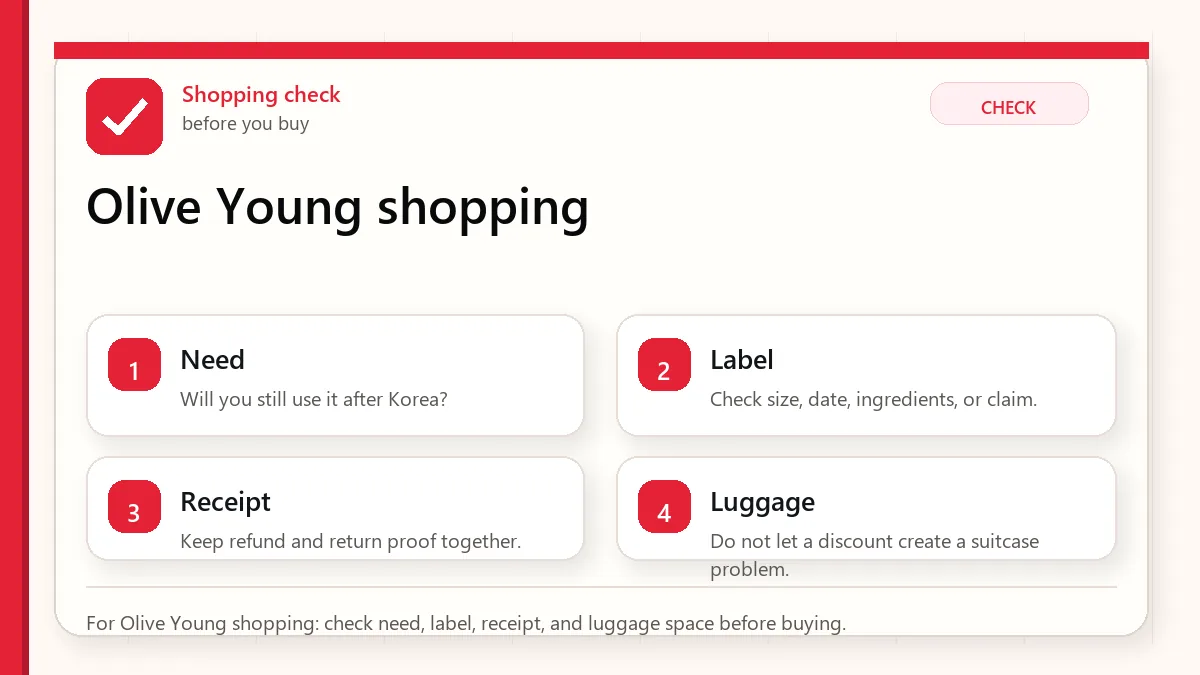
    Layered red check decision graphic for Olive Young shopping.
    For Olive Young shopping: check need, label, receipt, and luggage space before buying.

    What to check before putting a product in your basket

    CheckWhy it mattersHow to verify
    Skin needHydration, sunscreen, acne, brightening, and barrier products are not interchangeable.Read category and ingredient notes instead of only ranking stickers.
    Functional claimsSome cosmetic claims have regulatory meaning in Korea.MFDS cosmetics information
    Tax refundImmediate or standard refund can affect price.Tax refund guide
    Luggage and liquidsBottles, masks, and sets add bulk fast.Check airline liquid and baggage rules before bulk buying.

    Checks to make before putting it in the basket

    • List the product categories you actually need before entering.
    • Bring your passport if you plan to use tax refund.
    • Check whether the store supports immediate tax refund.
    • Avoid trying too many new actives at once while traveling.
    • Save product names for later comparison instead of panic-buying.

    Shop the store without letting the store decide for you

    • Start with basics: cleanser, sunscreen, moisturizer, or specific need.
    • Check expiry date and packaging condition.
    • Read ingredient warnings if you have sensitive skin or allergies.
    • Compare single item versus set price and whether the set includes useful sizes.
    • Ask about tax refund before payment, not after leaving.
    • Keep receipts and products organized if claiming refund later.
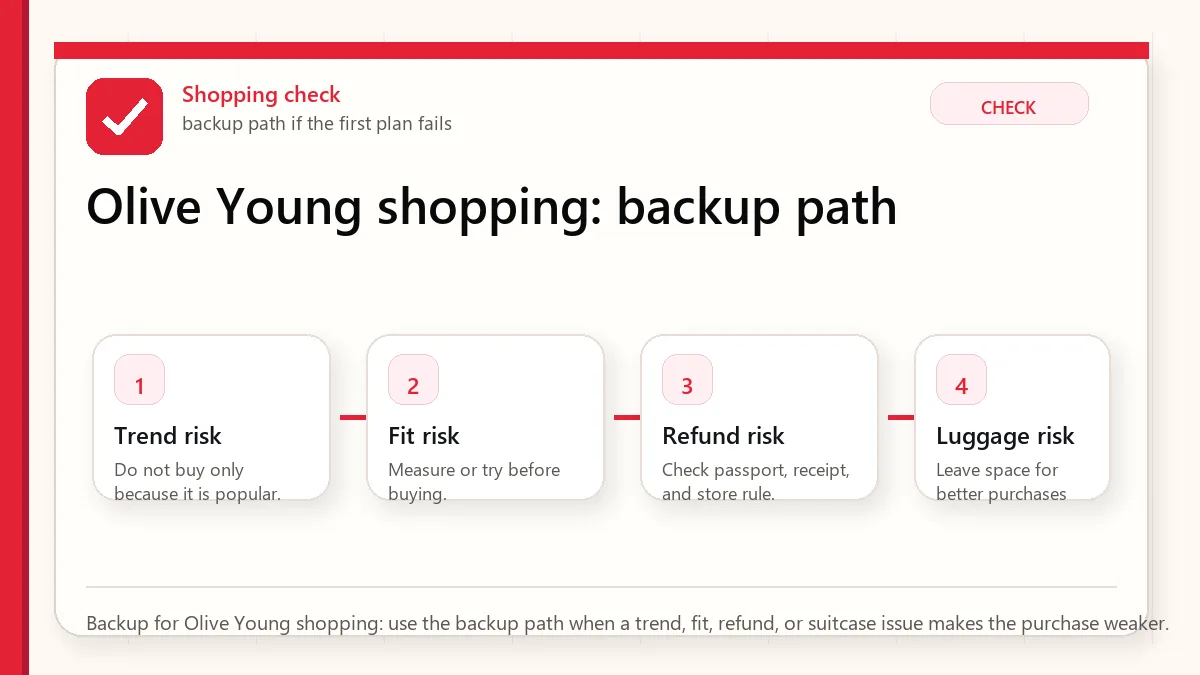
    Layered red check backup flow graphic for Olive Young shopping.
    Backup for Olive Young shopping: use the backup path when a trend, fit, refund, or suitcase issue makes the purchase weaker.

    Where Olive Young shopping usually goes wrong

    You buy because it is viral

    Viral demand does not equal skin compatibility. Treat social proof as a clue, not a diagnosis.

    You miss tax refund at checkout

    Immediate refund usually needs to be handled at payment. Ask before paying and keep your passport ready.

    You overbuy liquids

    Check airline liquid rules and luggage weight. Multi-step skincare sets can become baggage problems.

    Your skin reacts during travel

    Stop using the new product and avoid layering more new actives. This site cannot give medical advice.

    Different shopping goals need different caution

    SituationBetter approachWhat to verify
    Sensitive skinBuy fewer, simpler products.Fragrance, alcohol, acids, retinoids, and known allergens.
    Gift shoppingChoose sealed, easy-to-pack items.Expiry date, product language, and luggage limits.
    Tax-refund shoppingAsk before payment and keep documents.Store participation and passport requirement.
    Trend huntingSave names and compare official/global prices.Whether product is available in your country later.

    What not to assume from rankings or promotions

    • Do not assume staff recommendations replace dermatology advice.
    • Do not assume the busiest shelf has the best product for you.
    • Do not assume every promotion is cheaper than online or duty-free.
    • Do not assume opened products can be returned easily.

    Small shopping details that make the purchase feel considered

    Go in with categories, not a blank basket

    Olive Young is easier to navigate when you already know the categories you care about: sunscreen, masks, cleanser, toner pads, lip products, hair care, travel minis, or gifts. Without a category list, promotions and shelf rankings can pull you into buying duplicates. A short list keeps the store fun without turning it into random spending.

    Treat promotions as math, not pressure

    Multi-buy deals and store rankings can be useful, but only if the item fits your skin, luggage, expiry window, and home use. Check unit size and whether the discount requires buying more than you need. If you plan to use tax refund, keep passport and receipts organized before the checkout line becomes crowded.

    Read next when beauty shopping connects to refunds or luggage

    This topic works best when it is not handled alone. Use the related guides below to connect the decision with maps, money, food, shopping, transit, and app backup planning.

    Related Before Korea guides

    Official links to check

    Use these official links when the next step matters. This guide explains what to watch for, but app downloads, eligibility, prices, routes, policies, and service rules can change.

    FAQ

    Is Olive Young good for first-time K-beauty shopping?

    Yes, it is convenient and visitor-friendly, but product choice should still be based on your skin needs and ingredient tolerance.

    Do I need my passport at Olive Young?

    Bring it if you plan to use immediate tax refund or tourist benefits. Store rules and campaigns can change.

    Should I buy everything in Korea?

    No. Buy products that are genuinely useful, difficult to find at home, or clearly better priced after tax/refund and baggage cost.

    Source links to verify

    Last updated

    Last updated: 2026-05-23. Re-check official sources close to the day you travel, buy, eat, or use an app. Details involving prices, eligibility, transport, app features, opening hours, and refund rules can change.
  • Korea Tax Refund Guide for Tourists

    Korea Tax Refund Guide for Tourists

    Korea’s tourist tax refund is useful, but it is often misunderstood. It is not a blanket 10 percent discount, it is not guaranteed at every shop, and it can fail if the receipt, passport, purchase amount, or airport timing does not line up. The best way to use it is to treat the refund as a small shopping recovery system: helpful when the store is eligible, risky when you are rushing, and never worth buying things you do not actually need.

    Last updated: May 24, 2026.

    This guide is written for short-term foreign visitors who plan to shop in Korea and leave with the goods. It focuses on practical decisions: whether a purchase is worth the paperwork, how to estimate the refund, when immediate refund is easier, and what to do before packing your suitcase.

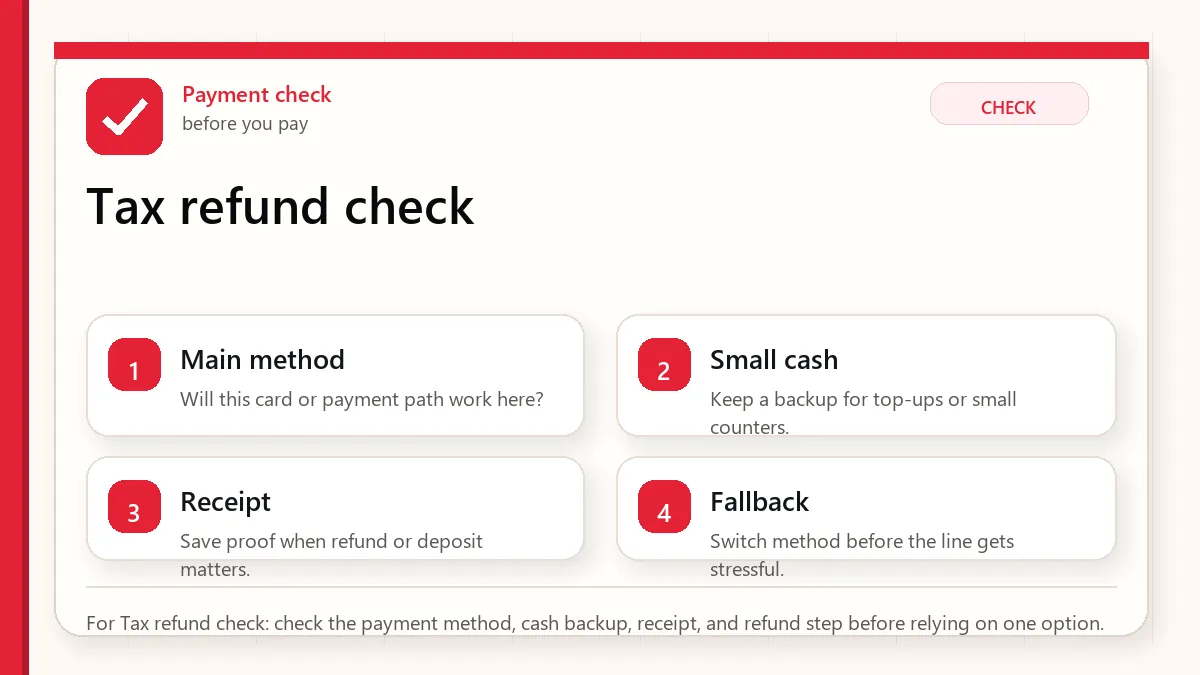
    Layered red check decision graphic for Tax refund check.
    For Tax refund check: check the payment method, cash backup, receipt, and refund step before relying on one option.

    Start with what can fail at payment

    Tourists can often receive a VAT refund on eligible goods bought from participating tax-free stores. The official Visit Korea guidance lists the basic purchase threshold at KRW 15,000 or more and says goods generally need to be taken out of Korea within a set export period. Immediate tax refund may be available at some shops, while other purchases require a refund slip and airport or downtown processing.

    The key word is eligible. A shop logo, a passport scan, and a receipt are not decoration; they are the evidence trail. If you buy from a store that does not participate, forget your passport, lose the receipt, pack the item deep in checked luggage before inspection, or misunderstand duty-free shopping as tax refund, the refund can disappear.

    Who should care about the tax refund?

    The tax refund matters most for travelers buying several medium-value items: skincare, cosmetics, fashion, electronics accessories, home goods, or gifts. It matters less for tiny snacks, very cheap souvenirs, or rushed purchases near departure. If your total eligible shopping is small, the time spent at a counter may be worth more than the refund.

    A useful rule is simple: if the purchase is intentional and the store clearly supports tax refund, keep the paperwork. If you are buying something just because a refund exists, stop. The refund should improve a good purchase, not justify a weak one.

    How to estimate the refund without fooling yourself

    Korea’s standard VAT is commonly discussed as 10 percent, but a tourist refund is not always equal to 10 percent of the sticker price. The sticker price usually includes VAT, refund agencies may apply processing rules, and some purchases are excluded or capped. A rough mental estimate is useful, but the final amount comes from the store, refund agency, and official system.

    Purchase situation What to expect Before Korea judgment
    Small purchase near KRW 15,000 May qualify only if the store participates and the receipt is valid. Do not queue long for this unless the process is instant.
    Multiple skincare items at one tax-free store Often the cleanest case if passport and receipt are handled at payment. Good candidate for immediate refund or simple airport processing.
    Mixed purchases across several small shops Receipts, refund forms, and eligibility can become fragmented. Keep documents grouped by store and date.
    Large luxury or electronics purchase Potential refund is meaningful, but goods may need to be shown. Leave time at the airport and do not pack blindly.

    Immediate refund vs airport refund

    Immediate refund is the easiest version when it works. At participating stores, the tax amount is deducted or processed at the point of sale after your passport is checked. This is common in tourist-heavy shopping environments, but it is not universal. Store staff may still issue a form, ask for passport information, or tell you to process later.

    Airport refund is the more traditional path. You pay the full price, receive tax refund documents, keep the goods and receipts, and process the refund before leaving Korea. Depending on airport flow and purchase value, you may need to use a kiosk, visit a customs confirmation area, or present goods if requested.

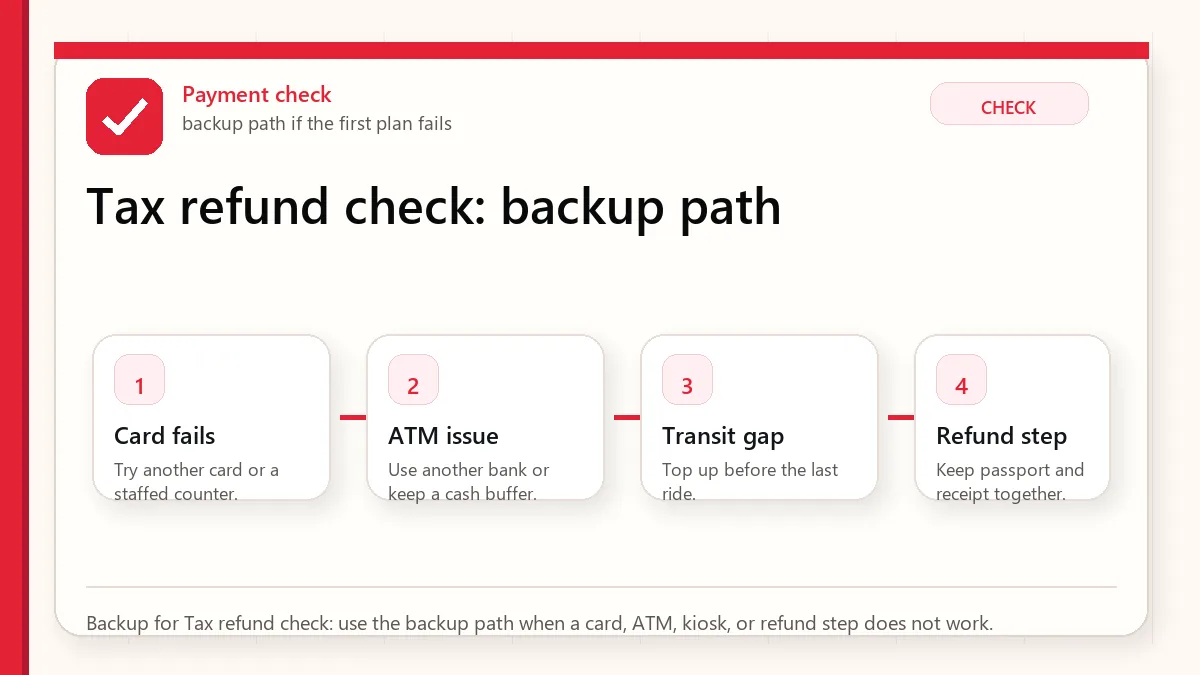
    Layered red check backup flow graphic for Tax refund check.
    Backup for Tax refund check: use the backup path when a card, ATM, kiosk, or refund step does not work.

    Before you pay at the store

    • Look for a tax-free or tax refund sign, but do not rely on the sign alone.
    • Ask, “Tax refund possible?” before paying, especially outside major tourist shopping areas.
    • Have your passport ready. A photo may not be accepted in all situations.
    • Keep the receipt and refund form together. Do not let one slip into a random shopping bag.
    • Check whether the refund was immediate or still needs airport processing.

    Airport timing: the part visitors underestimate

    Tax refund processing competes with check-in, security, immigration, baggage rules, and last-minute meals. If you are carrying refundable goods in checked luggage, think before checking the bag. Some goods may need to be available for inspection. If your flight is early, your group is large, or your purchases are expensive, arrive earlier than you normally would.

    The worst plan is to reach the airport late, check every bag, then search for a refund counter with no receipts in hand. The safer plan is to put receipts and forms in one pouch, keep refundable goods reachable until the process is complete, and accept that some small refunds are not worth missing boarding.

    Common mistakes

    • Expecting every store to participate. Many normal local shops do not handle tourist tax refund.
    • Confusing exchange, return, duty-free, and tax refund. These are different processes with different counters and documents.
    • Throwing away packaging or receipts too early. The item and purchase proof may matter.
    • Buying unsuitable products because of the refund. A refunded mistake is still a mistake.
    • Planning the refund after airport security. Some steps may happen before departure procedures.

    Official links to check

    Use these official links when the next step matters. This guide explains what to watch for, but app downloads, eligibility, prices, routes, policies, and service rules can change.

    FAQ

    Is the Korea tax refund exactly 10 percent?

    No. VAT is commonly discussed as 10 percent, but the actual refund can be lower because of included-tax math, agency processing, purchase rules, and exclusions. Treat calculators as estimates.

    Can I get a tax refund at Olive Young?

    Many tourist-facing branches support tax refund, but the process can differ by store, purchase value, and passport handling. Check at checkout and keep the receipt.

    Should I do the refund if the amount is small?

    Only if the process is easy. A tiny refund is not worth airport stress.

    Can I open or use the product in Korea?

    For tax-refund purchases, assume the goods should be exportable and available if checked. If the item is expensive, keep packaging and documents until departure.

    Before Korea field rule: decide before the receipt is printed

    The most reliable tax-refund moment is not the airport. It is the checkout counter. Before payment, you still have leverage: you can ask whether the store participates, whether immediate refund is available, whether your passport is required, and whether the receipt will be usable later. After payment, you are mostly following whatever process the store already issued.

    For shopping-heavy days, use a simple envelope method. Put tax-refund receipts in one pocket, normal receipts in another, and duty-free paperwork in a third. This sounds excessive until you are standing at the airport with five bags, three friends, a boarding time, and no idea which receipt belongs to which product.

    Product categories that need extra care

    Cosmetics and skincare are usually easier because tourist-facing shops understand the refund flow. Electronics and higher-value items need more care because the refund may be meaningful and goods may need to be shown. Fashion is mixed: department stores and major retailers are easier than small boutiques. Food, opened consumables, and tiny market purchases are less predictable.

    For hotel stays, medical services, and duty-free airport shopping, do not assume the normal retail refund article applies. Those categories can have separate rules or entirely different procedures. When the category is unusual, ask the provider directly and keep the official receipt language.

    What a strong receipt set looks like

    • The store name is clear and matches the place where you bought the goods.
    • The purchase date, amount, and item list are readable.
    • The refund form or barcode is attached if the store issued one.
    • Your passport information was handled at checkout if required.
    • The goods are still in your possession and can be connected to the receipt if asked.

    Related Before Korea guides

    Use these guides together rather than treating one article as the whole plan.

    Sources checked for this update

    Before Korea treats operational details as changeable. Check the official pages below before a trip or a large purchase.

  • Payment in Korea: Cards, Cash, ATMs

    Payment in Korea: Cards, Cash, ATMs

    Start with what can fail at payment

    Bring at least two ways to pay in Korea: an international card and a cash backup. Add a transportation card plan for subway and bus rides. Do not assume local mobile payment apps will work for every foreign visitor.

    A payment plan that survives the awkward counter moment

    Payment in Korea is usually easy until one card terminal, kiosk, transit machine, or app flow refuses to cooperate. The plan should assume a small failure will happen somewhere.

    Area What to check What to avoid
    Daily purchases Primary card plus backup card. Foreign card support can vary.
    Transit T-money/card top-up method and small cash. Transit is its own payment system.
    ATMs Know one global-friendly ATM option before you need it. ATM fees and acceptance vary.
    Shopping Passport/receipt plan for tax refund. Refund paperwork is harder to fix later.

    The checks that deserve your attention

    • Tell your bank about travel if needed.
    • Carry a second card separately.
    • Keep a small cash buffer.
    • Do not assume mobile wallet support everywhere.

    Failure cases to plan around

    • Card declined at kiosk.
    • Transit top-up requires cash.
    • ATM rejects a card.
    • Tax-refund receipt gets lost.

    Official and practical source checks

    Read next

    The payment moment visitors underestimate

    Payment usually feels simple until one machine, one card, or one app flow refuses to cooperate. This guide is for the moment at a kiosk, transit machine, small shop, restaurant counter, or ATM when a backup plan is more useful than another general tip.

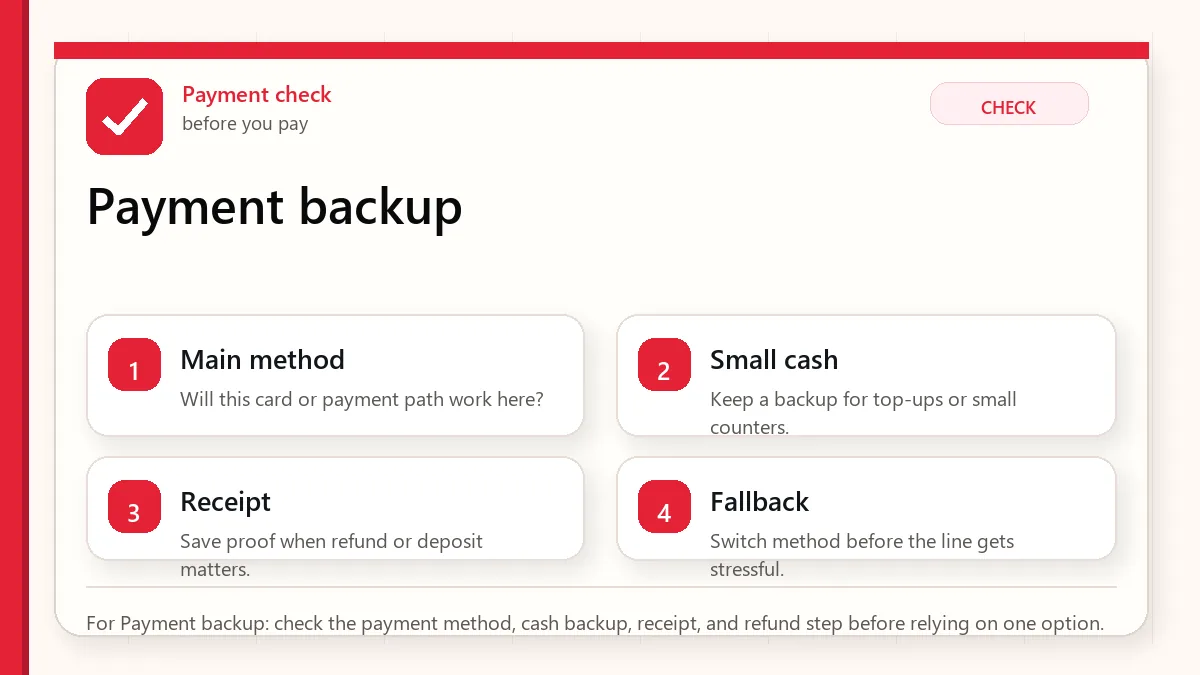
    Layered red check decision graphic for Payment backup.
    For Payment backup: check the payment method, cash backup, receipt, and refund step before relying on one option.

    Payment methods and where they fit

    Method Useful for Weak point Backup
    International credit/debit card Hotels, department stores, many shops and restaurants. Small stores or machines may reject some foreign cards. Second card and some cash.
    Korean won cash Transit card top-ups, small stores, street food, emergency fallback. Not ideal for large purchases or lost-wallet risk. Use modest amounts and keep separately.
    Transportation card Subway and bus rides. It is not a full payment strategy. T-money guide
    Mobile payment apps Some local services and convenience flows. Local verification, account, or card requirements. Card/cash plus web alternatives.

    Checks worth doing before you rely on one card

    • Notify your bank if needed and check international transaction settings.
    • Carry more than one card on separate networks if possible.
    • Prepare Korean won cash for the first day.
    • Know how you will pay for subway and bus rides.
    • Read tax refund rules before major shopping.

    Build a simple payment backup plan

    • Use a card for larger, documented purchases when accepted.
    • Use cash as a backup, not as your only plan.
    • Set up a transit card early if using public transport.
    • Keep receipts for purchases that may involve refunds, tax refund, or returns.
    • If a kiosk rejects your card, try a staffed counter before assuming the store cannot serve you.
    • Review foreign transaction fees after the first day so surprises do not accumulate.

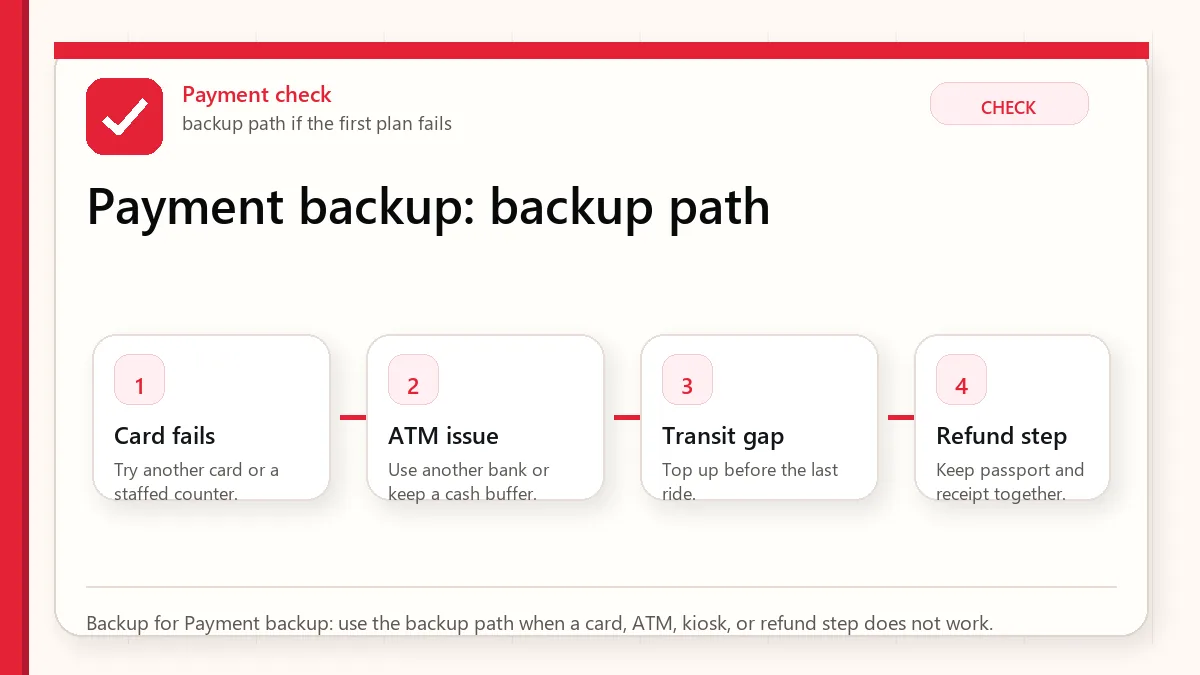
    Layered red check backup flow graphic for Payment backup.
    Backup for Payment backup: use the backup path when a card, ATM, kiosk, or refund step does not work.

    Where payment usually gets awkward

    A kiosk rejects your card

    Try another card, a staffed counter, or cash. Some machines behave differently from staffed payment terminals.

    You cannot top up transit with card

    Carry cash for transit card top-up backup, especially early in the trip.

    Mobile payment setup fails

    Use card or cash. Do not spend travel time forcing a local app that was not built for short-term visitors.

    ATM withdrawal fails

    Try a bank/airport ATM with international card support and check your bank’s overseas withdrawal settings.

    Use the right payment habit for the moment

    Situation Better approach What to verify
    Airport arrival Use card for major transport or cash exchange for immediate backup. Exchange counters and ATM locations/hours.
    Street food or market Carry small cash. Whether card is accepted before ordering.
    K-beauty shopping Use card but keep passport/receipt for tax refund. Store participation and refund path.
    Subway/bus day Use transportation card. Balance and top-up method.

    What not to assume about cards and cash

    • Do not assume every foreign card works at every kiosk.
    • Do not assume mobile wallets replace a transit card.
    • Do not assume cash is unnecessary because Korea is card-friendly.
    • Do not assume tax refund is automatic just because you paid by card.

    Payment details that keep small problems small

    Payment in Korea is convenient until the exception appears

    Many visitors can use cards smoothly in hotels, major shops, cafes, and restaurants. The weak point is the exception: a kiosk that rejects foreign cards, a transit top-up that needs cash, a bank security block, or a smaller place with limited payment options. A good plan assumes payment will usually work but prepares for the one moment it does not.

    Separate spending payment from movement payment

    Transit, taxis, restaurants, shopping, and online-style bookings may not behave the same way. A foreign credit card that works in one setting may not solve transit card top-up or a small-market purchase. Keep a simple structure: main card for larger payments, backup card in another bag, modest cash, and a transit card plan.

    Read next when payment connects to transit or shopping

    This topic works best when it is not handled alone. Use the related guides below to connect the decision with maps, money, food, shopping, transit, and app backup planning.

    Related Before Korea guides

    Official links to check

    Use these official links when the next step matters. This guide explains what to watch for, but app downloads, eligibility, prices, routes, policies, and service rules can change.

    FAQ

    Are credit cards widely accepted in Korea?

    VISITKOREA says major hotels, department stores, and general shops widely accept cards, but visitors should still check service availability before purchases.

    How much cash should I carry?

    Carry enough for small purchases, transit top-ups, and a first-day emergency, but avoid carrying unnecessary large amounts.

    Can I rely on mobile payments?

    Not as your only plan. Local mobile payments may require local verification, app setup, or supported cards.

    Source links to verify

    Last updated

    Last updated: 2026-05-23. Re-check official sources close to the day you travel, buy, eat, or use an app. Details involving prices, eligibility, transport, app features, opening hours, and refund rules can change.
  • Korea eSIM vs SIM Card: Phone Number and Data

    Korea eSIM vs SIM Card: Phone Number and Data

    For Korea, the eSIM vs SIM card decision is not only about data speed or price. The real question is whether you need only internet access or whether you need a Korean phone number that can receive calls or text messages. Many travelers can use a data-only eSIM and be perfectly fine. Others discover too late that taxi apps, restaurant waiting systems, delivery apps, clinic forms, or hotel callbacks are easier with a local number.

    Last updated: May 24, 2026.

    This guide separates the decision into practical visitor scenarios, because buying the cheapest data plan is not always the cheapest trip decision.

    Layered red check decision graphic for eSIM or SIM card.
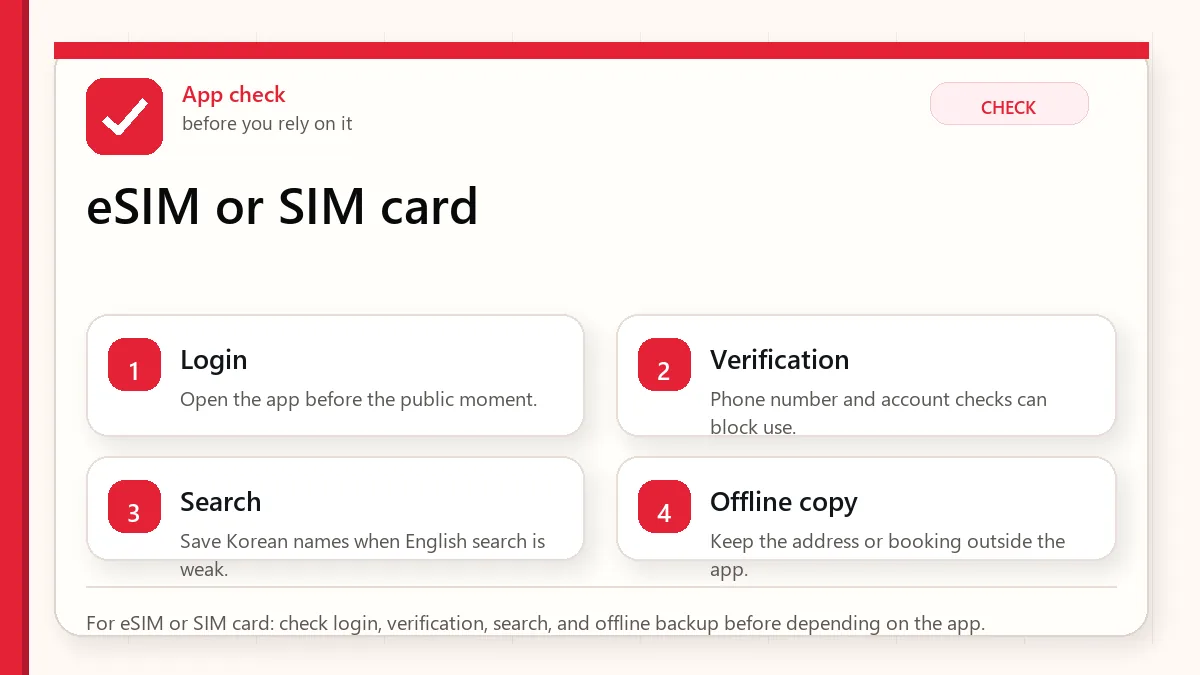
    For eSIM or SIM card: check login, verification, search, and offline backup before depending on the app.

    Start with what can fail at payment

    Choose a data-only eSIM if you mainly need maps, messaging, translation, browsing, and app-based travel. Choose a Korea eSIM or SIM with a phone number if you expect restaurant waitlists, local calls, delivery, clinic appointments, or app verification attempts. Choose a physical SIM if your phone does not support eSIM, you want a carrier counter to help, or you prefer a simple arrival setup.

    Decision table

    Option Best for Trade-off
    Data-only eSIM Short trips, maps, translation, messaging, light app use. No normal Korean call/SMS number; some local services are harder.
    eSIM with Korean number Visitors who need local contact, waiting lists, calls, or SMS-capable plans. Availability and verification rules vary by provider and plan.
    Physical prepaid SIM Phones without eSIM, travelers who want counter support, longer stays. You may need to swap SIMs and keep the small card safe.
    Pocket Wi-Fi Groups sharing data, older phones, heavy laptop use. One device becomes the group’s internet lifeline and needs charging.

    Phone number does not mean full Korean identity verification

    This is the part many visitors miss. A tourist SIM with a Korean number may help you receive calls or messages, but it does not automatically give you resident-level identity verification. Some Korean apps and services require local identity verification tied to resident registration or alien registration systems. A tourist number may not pass those gates.

    Before buying a plan, read whether it includes data only, voice, outgoing calls, incoming calls, SMS, and whether identity verification is supported. If the product page is vague, assume less, not more.

    Layered red check backup flow graphic for eSIM or SIM card.
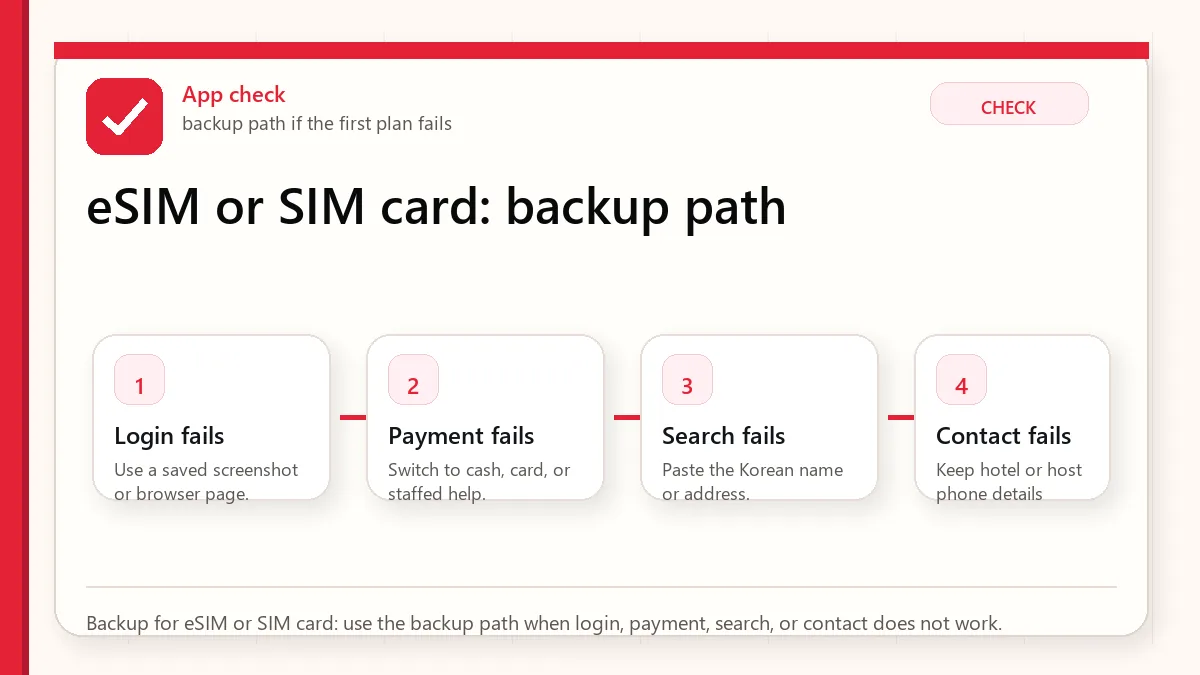
    Backup for eSIM or SIM card: use the backup path when login, payment, search, or contact does not work.

    When a local number is worth it

    • You plan to use restaurants with waiting systems that text or call.
    • You may need taxi drivers to call you at a pickup point.
    • You are booking clinics, salons, tours, or local services.
    • You want hotel staff, delivery riders, or reservation desks to reach you.
    • You are staying longer than a few days and want fewer workarounds.

    Arrival setup checklist

    • Check whether your phone is unlocked and supports the right eSIM or SIM format.
    • Save the QR code, voucher, pickup location, and passport requirement offline.
    • Activate and test data before leaving the airport if possible.
    • Open Naver Map, a messenger app, and a web page to confirm data actually works.
    • If you bought a number plan, test whether you can receive a local text or call.

    Official links to check

    Use these official links when the next step matters. This guide explains what to watch for, but app downloads, eligibility, prices, routes, policies, and service rules can change.

    FAQ

    Can I travel Korea with only a data eSIM?

    Yes, many visitors can. Maps, translation, messaging, and web search are the core needs. The problem appears when a local service requires a Korean contact number.

    Do I need to buy at Incheon Airport?

    Not always. Airport pickup is convenient because staff can help if setup fails. Online eSIM activation can be faster if your phone is compatible and you understand the instructions.

    Will a Korean tourist number verify KakaoTalk or every app?

    Do not assume that. App verification rules change and may depend on the service, number type, and identity verification requirement.

    Trip profiles: which plan fits?

    Three-day city trip: a data-only eSIM is usually enough if you use messaging apps and do not need delivery or clinic bookings. One-week food and shopping trip: consider a number plan if you expect restaurant queues, taxi calls, or beauty appointments. Longer stay or work trip: a physical SIM or carrier-supported plan may be worth the setup time because support and reliability matter more.

    Payment and app friction

    A SIM card does not solve payment by itself. Foreign cards, domestic app payment, age verification, and identity verification are separate problems. You can have perfect data and still be unable to order delivery if the app rejects your card or requires local identity verification. That is why Before Korea recommends pairing phone setup with payment planning.

    Data usage reality

    Maps, translation, messaging, and search do not require enormous data for most travelers. Video streaming, cloud photo backup, hotspot sharing, remote work, and social video uploads are the heavy users. If you are buying a large plan because you are nervous, check whether your accommodation has reliable Wi-Fi and whether your phone can restrict background data.

    Common setup mistakes

    • Buying an eSIM for a phone model that does not support eSIM in that region.
    • Deleting the eSIM profile before the trip ends.
    • Leaving the airport before testing data.
    • Assuming “phone number included” means full app verification.
    • Forgetting that a pocket Wi-Fi device needs charging and must stay with the group.

    Related Before Korea guides

    Use these guides together rather than treating one article as the whole plan.

    Sources checked for this update

    Before Korea treats operational details as changeable. Check the official pages below before a trip or a large purchase.

  • Incheon Airport to Seoul: Train, Bus, Taxi

    Incheon Airport to Seoul: Train, Bus, Taxi

    Start with the pickup and payment fallback

    The best Incheon Airport to Seoul transfer is the one that fits your terminal, arrival time, luggage, hotel location, and tolerance for transfers. AREX can be efficient for Seoul Station and rail connections; airport buses can be easier for hotel-area stops; taxis can help with luggage or late arrivals, but need address and payment preparation.

    Choose the airport route by recovery, not only speed

    The best Incheon-to-Seoul route changes when you add luggage, jet lag, children, rain, late arrival, hotel location, and the number of transfers you can tolerate.

    Area What to check What to avoid
    AREX/train Good when Seoul Station or rail transfer fits. A fast train can still require a difficult final transfer.
    Airport bus Good for direct hotel-area movement. Traffic and route timing vary.
    Taxi Good for late arrival or heavy luggage. Cost and pickup location need care.
    Subway Possible for some budgets/routes. Not always pleasant with bags after a long flight.

    The checks that deserve your attention

    • Check arrival time against last convenient service.
    • Save hotel address in Korean.
    • Know terminal and pickup point.
    • Choose a backup route before leaving the airport.

    Failure cases to plan around

    • Last train missed.
    • Bus stop not near hotel.
    • Taxi pickup confusion.
    • Too many subway stairs with luggage.

    Official and practical source checks

    Read next

    Start with the destination, not the transport type

    Many visitors ask whether train, bus, or taxi is best. The better question is: where exactly are you sleeping tonight, and how hard is the final 500 meters? A fast airport train is less useful if it leaves you with multiple subway transfers and heavy luggage. A bus can be slower on paper but easier if it stops near the hotel. A taxi can be practical, but not if you only have an English nickname for the destination.

    Layered red check decision graphic for Airport to Seoul.
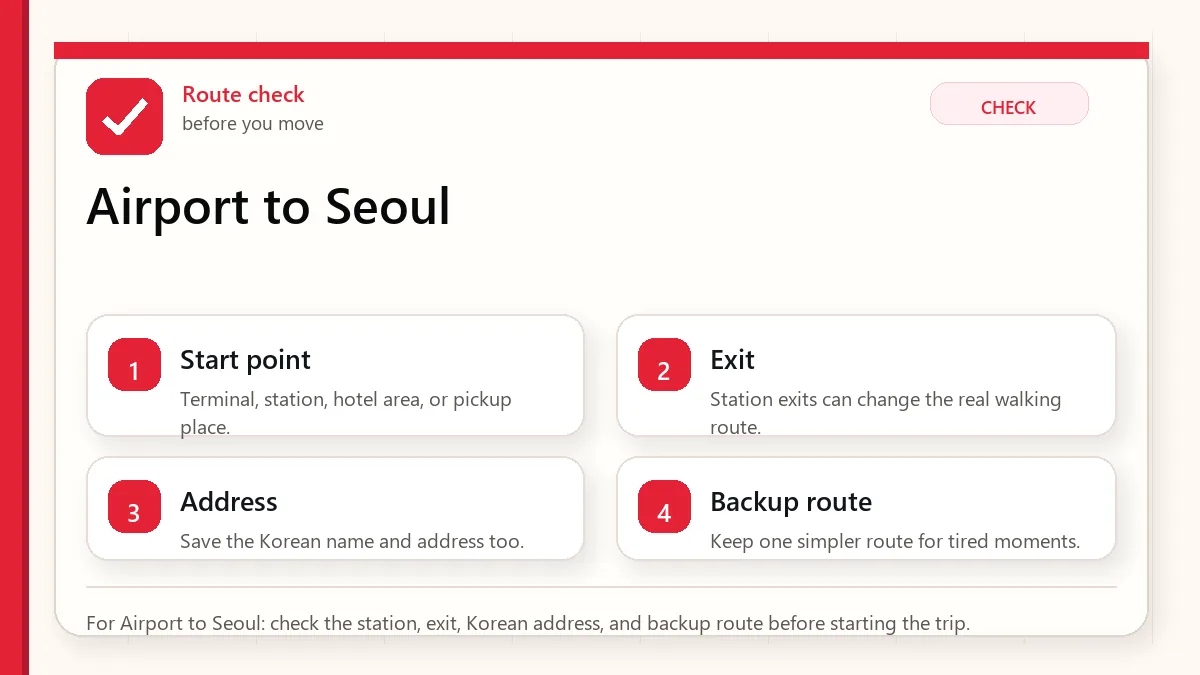
    For Airport to Seoul: check the station, exit, Korean address, and backup route before starting the trip.

    VISITKOREA lists airport transportation options to downtown Seoul including AREX, Seoul subway, airport limousine bus, and taxis. It also notes that AREX Express runs non-stop between Incheon International Airport and Seoul Station, and that taxis at Incheon include standard, deluxe, jumbo, and international taxis.

    Transfer decision table

    Your situation Usually consider first Why Risk to check
    Hotel near Seoul Station or rail connection AREX Express or all-stop train Rail can be direct and predictable for station-centered plans. Final subway transfer, walking distance, elevator access, and last train time.
    Hotel near a known airport bus stop Airport limousine bus Can reduce transfers and walking with luggage. Traffic, bus timetable, stop location, and whether your arrival time still has service.
    Late arrival or heavy luggage Taxi or pre-planned late-night route Door-to-door movement can reduce stress. Fare expectation, queue, address clarity, and payment method.
    Budget-focused traveler with light bags Rail/subway combination Often cost-efficient if you can manage transfers. Stairs, crowded trains, and navigation after the last station.
    Family or group Bus or taxi depending on hotel location Fewer transfers can matter more than speed. Car seats, luggage volume, and communication with driver.

    Before you land: collect these details

    • Arrival terminal: Terminal 1 and Terminal 2 are not the same starting point.
    • Expected exit time: landing time is not the same as leaving customs with bags.
    • Hotel name in Korean and English.
    • Full address and phone number from the booking confirmation.
    • Nearest subway station and exit, if using rail.
    • Nearest airport bus stop, if using bus.
    • Late-night backup if your first option is gone.

    Option 1: AREX and rail

    AREX is strongest when your destination works naturally with Seoul Station or another rail connection. It can be predictable and clear once you know whether you need Express or all-stop service. The hidden cost is the transfer after Seoul Station or another stop: stairs, elevators, crowds, and a final walk can change the experience.

    • Use rail if you have manageable luggage and a station-friendly hotel.
    • Check the route at your expected arrival time, not only during the day.
    • Look for the final exit number and walking route before leaving the station.
    • Keep your accommodation address offline in case data fails underground.

    Option 2: Airport limousine bus

    Airport buses can be excellent when a stop is close to your hotel. The advantage is fewer transfers and less dragging luggage through large stations. The tradeoff is traffic and timetable dependence. A route that is easy at 14:00 may not exist at your actual arrival time.

    • Confirm the correct terminal, bus number, ticketing area, stop name, and last service.
    • Check whether your hotel stop is before or after a long city loop.
    • Have the stop name in Korean if possible.
    • Do not assume a bus stop near the hotel means an easy walk with luggage.

    Option 3: Taxi

    Taxi is not automatically the lazy option. It can be the sensible option for late arrivals, groups, heavy luggage, or hotels far from rail/bus stops. VISITKOREA notes that standard and deluxe taxis are available at taxi platforms outside the waiting areas of Incheon Airport Terminals 1 and 2, and that international taxis require advance reservation.

    • Prepare the destination in Korean, plus phone number and building name.
    • Use official airport taxi stands and avoid unofficial approaches.
    • Keep a payment backup. VISITKOREA lists cash, credit cards, and transportation cards as accepted taxi payment methods, but real-world acceptance can still vary.
    • If language is a concern, consider official international taxi reservation routes or hotel pickup options.

    A simple route-quality test

    Question Good sign Warning sign
    How many transfers after the airport? Zero or one easy transfer. Two or more transfers with luggage.
    How far is the final walk? Short, clear, and above ground if possible. Long, uphill, stairs, or confusing underground exits.
    What happens if the flight is late? A known later route exists. The plan depends on the last train or last bus.
    Can you show the destination in Korean? Yes, saved offline. Only an English nickname or social media post.
    Can you pay if your first card fails? Cash/card backup ready. One payment method only.

    Common mistakes

    • Choosing Seoul Station because it is famous, then realizing the hotel is nowhere near it.
    • Ignoring the difference between landing time and the time you actually exit with luggage.
    • Following a route that is fine for a backpacker but bad for a family or suitcase.
    • Taking a taxi without a Korean address prepared.
    • Assuming daytime transport advice applies to late-night arrival.

    Arrival details that matter more when you are tired

    Choose by your first destination, not by the most famous option

    AREX, airport buses, subway transfers, and taxis each make sense for different destinations. A train can be fast to Seoul Station but less convenient if your hotel is far from the final stop. A bus can be easier with luggage if it stops near your hotel. A taxi can be useful late at night, but cost and traffic should be expected.

    Late arrival needs a separate plan

    A route that looks simple at noon can become risky after immigration, baggage claim, SIM pickup, exchange, or a delayed flight. If you land late, check last train and bus times before assuming public transport will work. Save the hotel address in Korean, keep enough payment backup, and know whether your accommodation has a late check-in rule.

    Read next before choosing data, cash, or your first route

    This topic works best when it is not handled alone. Use the related guides below to connect the decision with maps, money, food, shopping, transit, and app backup planning.

    Related Before Korea guides

    Official links to check

    Use these official links when the next step matters. This guide explains what to watch for, but app downloads, eligibility, prices, routes, policies, and service rules can change.

    FAQ

    Is AREX always the fastest way from Incheon Airport to Seoul?

    Not always for your actual destination. It may be fast to Seoul Station, but the total trip includes transfers and walking after that.

    Is airport bus better than train?

    It can be better when the bus stop is close to your hotel and the timetable fits your arrival. It can be worse if traffic, a long route loop, or limited late service works against you.

    Should I avoid taxis?

    No. Use official taxi stands or official reservation channels, prepare the Korean destination, and keep a payment backup. Taxis can be practical for late arrivals, groups, and luggage-heavy trips.

    Source links to verify

    Last updated

    Last updated: 2026-05-23. Korea travel, transport, app, shopping, and refund details can change. Re-check official sources close to the day you act, especially when money, eligibility, route timing, or account access is involved.

    This guide is written as practical preparation content. It does not claim personal hands-on testing, a personal visit, or official legal advice unless explicitly stated.

    Layered red check backup flow graphic for Airport to Seoul.
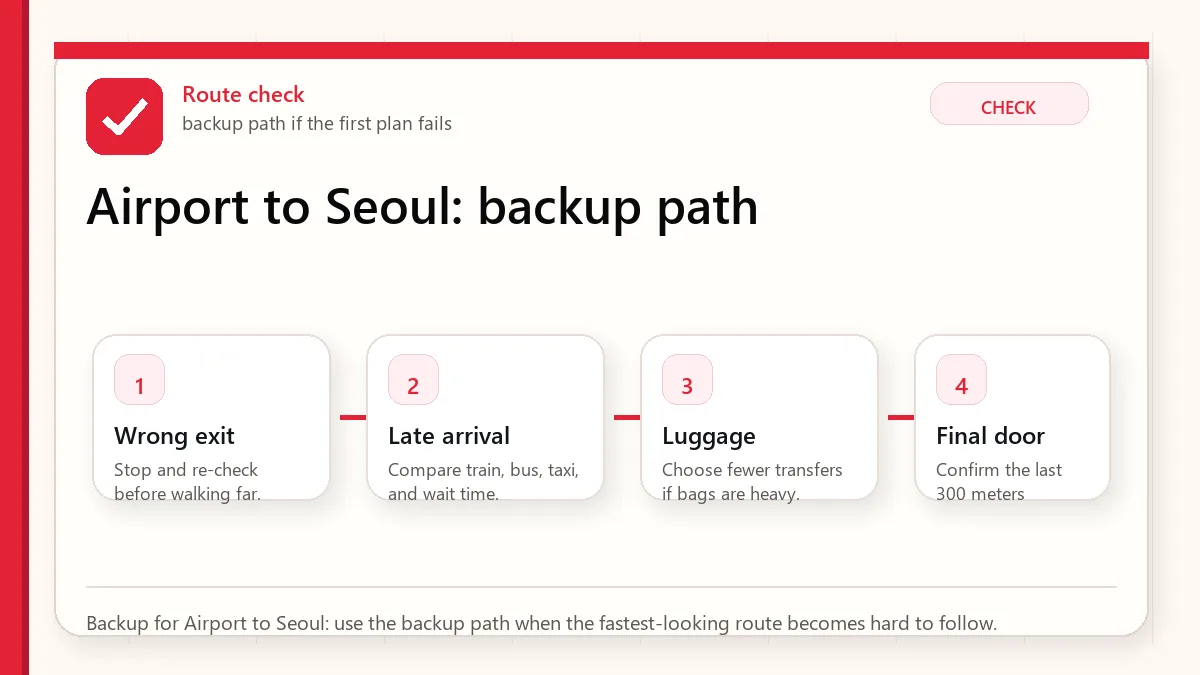
    Backup for Airport to Seoul: use the backup path when the fastest-looking route becomes hard to follow.

  • Naver Map in Korea: Setup Guide for Visitors

    Naver Map in Korea: Setup Guide for Visitors

    Naver Map is one of the most useful apps a foreign visitor can install for Korea, but it can feel unfamiliar at first. The app is not just a map; it is a local search system, route planner, restaurant finder, station-exit checker, bus-stop matcher, and address translator. Used well, it reduces the small frictions that make Korea harder than it needs to be.

    Last updated: May 24, 2026.

    The trick is not to expect Naver Map to behave exactly like Google Maps. Korea’s address system, underground stations, building floors, local business names, and route habits reward a slightly different workflow.

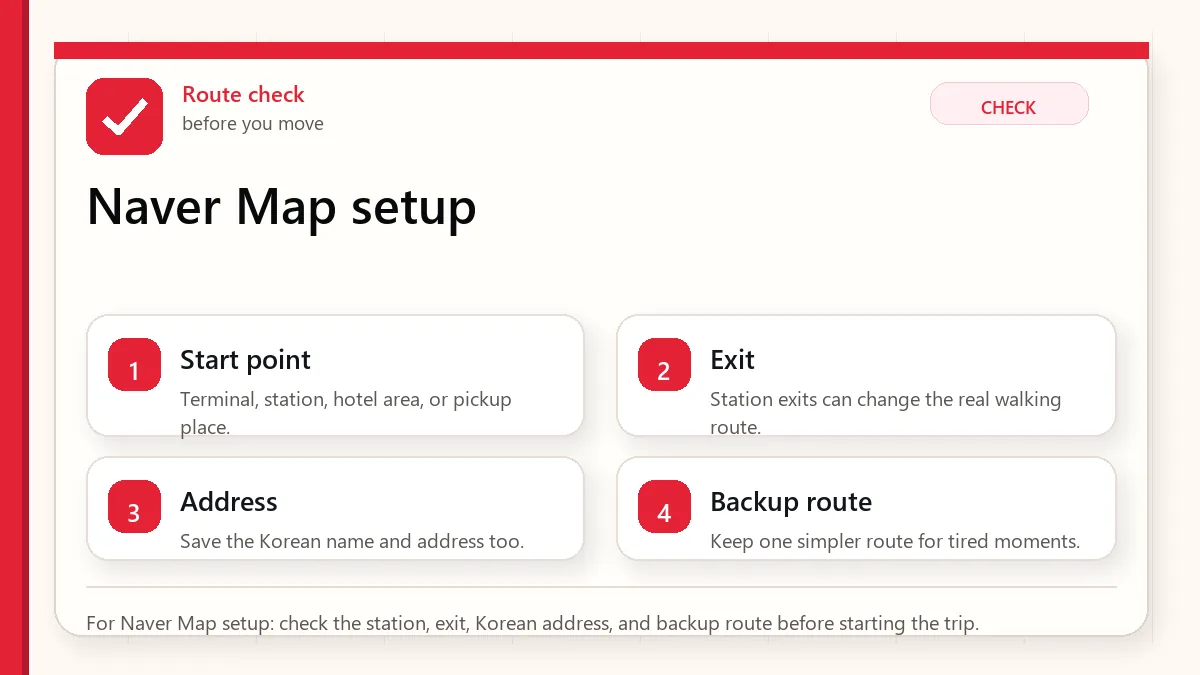
    Layered red check decision graphic for Naver Map setup.
    For Naver Map setup: check the station, exit, Korean address, and backup route before starting the trip.

    Start with the place name and exit

    Install Naver Map before departure, set the language to English if available, save your hotel, airport route, and first-day destinations, then learn to search by Korean name, station exit, and phone number. For important routes, compare Naver Map with Google Maps or another app rather than trusting the first result blindly.

    Set it up before you land

    Do not wait until you are tired at Incheon Airport. Install the app, open it once, confirm the language setting, and search for your hotel before your flight. If the hotel has an English name, also copy its Korean name and address from the hotel website or booking confirmation. Save both.

    If you are traveling with someone else, share screenshots of the hotel address, nearest subway station, and station exit. If one phone dies or loses data, the group still has the basic route.

    Search habits that work in Korea

    • Search the Korean name when the English name gives weak results.
    • Use the business phone number when several branches have similar names.
    • Check photos to confirm you found the right entrance or floor.
    • Use station exit numbers as real-world anchors.
    • For restaurants inside malls, check the floor and building wing.
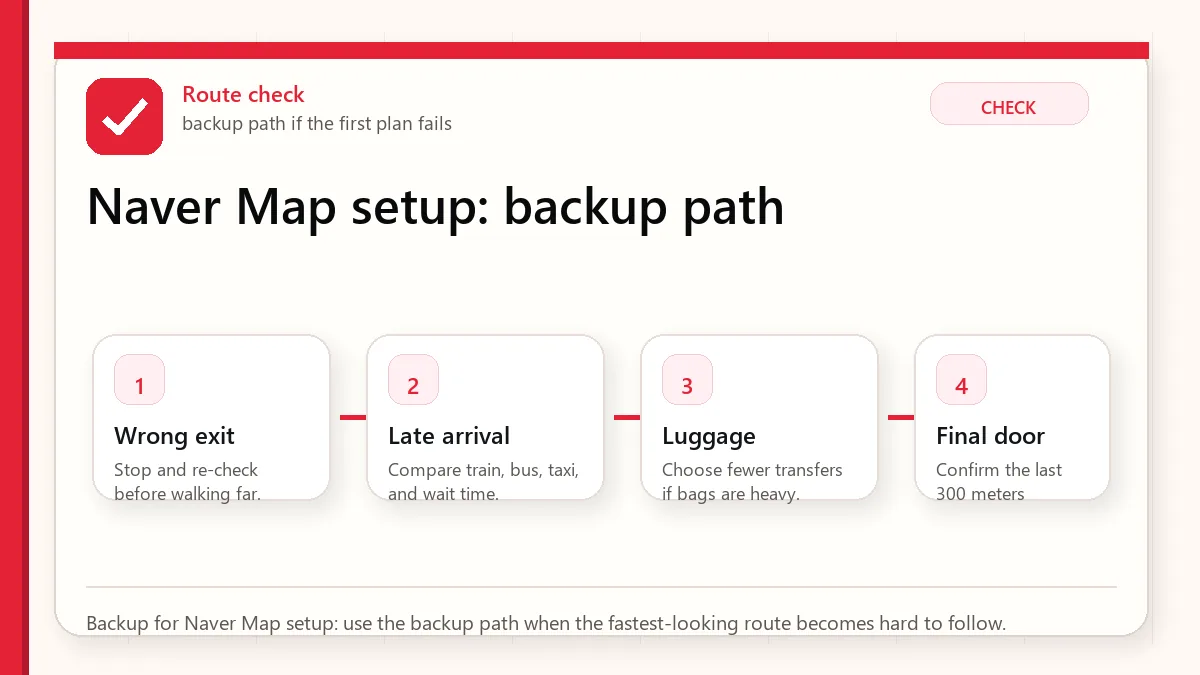
    Layered red check backup flow graphic for Naver Map setup.
    Backup for Naver Map setup: use the backup path when the fastest-looking route becomes hard to follow.

    Subway exits matter more than visitors expect

    A Seoul station can have many exits spread across a large intersection or underground mall. “Arrive at Hongdae” or “arrive at Gangnam Station” is not enough. The exit number can decide whether your walk is three minutes or fifteen minutes, whether you cross a huge road, and whether you pop up beside the correct building.

    Before leaving a train, check the recommended exit and keep it visible. If you are meeting someone, send the exit number, not only the station name.

    Bus routes and walking routes

    Buses can be excellent in Seoul, but first-time visitors often misread stop direction. Naver Map can help, but you should still check the stop name, bus number, platform direction, and arrival side of the street. A bus stop across the road may serve the opposite direction.

    For walking routes, remember that Korea has hills, underpasses, overpasses, apartment complexes, and roads that may not feel intuitive from above. If you have luggage, elderly companions, or small children, favor simpler routes over technically shorter ones.

    When Naver Map is not enough

    • If a restaurant has no English information, use Papago or Google Translate for menu photos and reviews.
    • If a business recently moved, compare its official website or Instagram.
    • If a route includes a late-night transfer, check last train or use taxi backup.
    • If you are going to a hospital, clinic, or official appointment, confirm the address directly with the provider.

    Official links to check

    Use these official links when the next step matters. This guide explains what to watch for, but app downloads, eligibility, prices, routes, policies, and service rules can change.

    FAQ

    Does Naver Map have English?

    Naver Map offers language settings and multilingual support, but some local content may still be easier in Korean. Think of English support as helpful, not complete.

    Should I use Naver Map or KakaoMap?

    Both can be useful. Naver Map is a strong default for visitors because of local search and broad use, while KakaoMap can be a good backup if a route looks strange.

    Can I rely on screenshots?

    Use screenshots as backup, not as live navigation. They are excellent for addresses, station exits, and hotel information when signal or translation fails.

    First-day Naver Map drill

    On your first day, practice with low-risk routes before using Naver Map under pressure. Search your hotel, the nearest convenience store, the nearest subway station, and one restaurant within walking distance. Check the difference between walking, transit, and taxi route tabs. Then look at the station exit number and compare it with signs in the station.

    This small drill teaches the app’s rhythm before you are late for a booking. It also reveals whether your language setting, data plan, and search habits are working.

    Branch and floor mistakes

    Korea has many chain restaurants, cafes, clinics, and stores with similar names. A visitor may find the right brand but the wrong branch. In malls and large buildings, the floor matters as much as the address. Always check branch name, district, floor, and photos. If a place is inside a department store, underground mall, or office building, the final five minutes can be harder than the subway ride.

    Hotel address card habit

    Create a small note with the hotel name in English, hotel name in Korean, address in Korean, phone number, nearest station, and nearest exit. Keep it in screenshots and notes. This helps with taxis, lost groups, delivery riders, clinic forms, and any moment when your phone signal is weak.

    When to use translation with Naver Map

    Use translation for reviews, menus, and notes, but do not over-read machine translation. A review phrase can sound harsher or stranger than intended. For practical travel, focus on objective clues: hours, closed days, entrance location, queue pattern, reservation requirement, and whether foreign cards are mentioned.

    Related Before Korea guides

    Use these guides together rather than treating one article as the whole plan.

    Sources checked for this update

    Before Korea treats operational details as changeable. Check the official pages below before a trip or a large purchase.

  • T-money Card in Korea: Tourist Guide

    T-money Card in Korea: Tourist Guide

    Start with what can fail at payment

    For most first-time visitors, a simple physical transportation card is still the safest public-transport backup in Korea. Tmoney is widely known, but the better question is how you will buy it, top it up, avoid overloading it, and handle refund or leftover balance before leaving.

    The transit-card details that keep rides simple

    T-money is not only a card to tap. For visitors, it is part of a small system involving purchase, top-up, transfer habits, refunds, and backup cash.

    Area What to check What to avoid
    Buying Get a transit card from a convenient channel. Design cards and tourist products can differ.
    Top-up Know whether your top-up point accepts your method. Cash can still matter.
    Riding Tap in and out where required. Transfer benefits can depend on correct tapping.
    Leaving Refund remaining balance when practical. Small balances may not be worth stress.

    The checks that deserve your attention

    • Buy before your first subway/bus ride.
    • Keep small cash for top-up.
    • Check balance before late-night rides.
    • Do not treat T-money as a full replacement for cards/cash.

    Failure cases to plan around

    • Insufficient balance at gate.
    • No cash for top-up.
    • Wrong card expectation outside Seoul.
    • Forgetting to tap out where needed.

    Official and practical source checks

    Read next

    What a transportation card solves

    VISITKOREA describes Korean transportation cards such as Tmoney, EZL, WOWPASS, and Climate Card as rechargeable prepaid cards that do not require an account. That matters for visitors because it separates transit access from more complicated local app, bank, or phone verification steps.

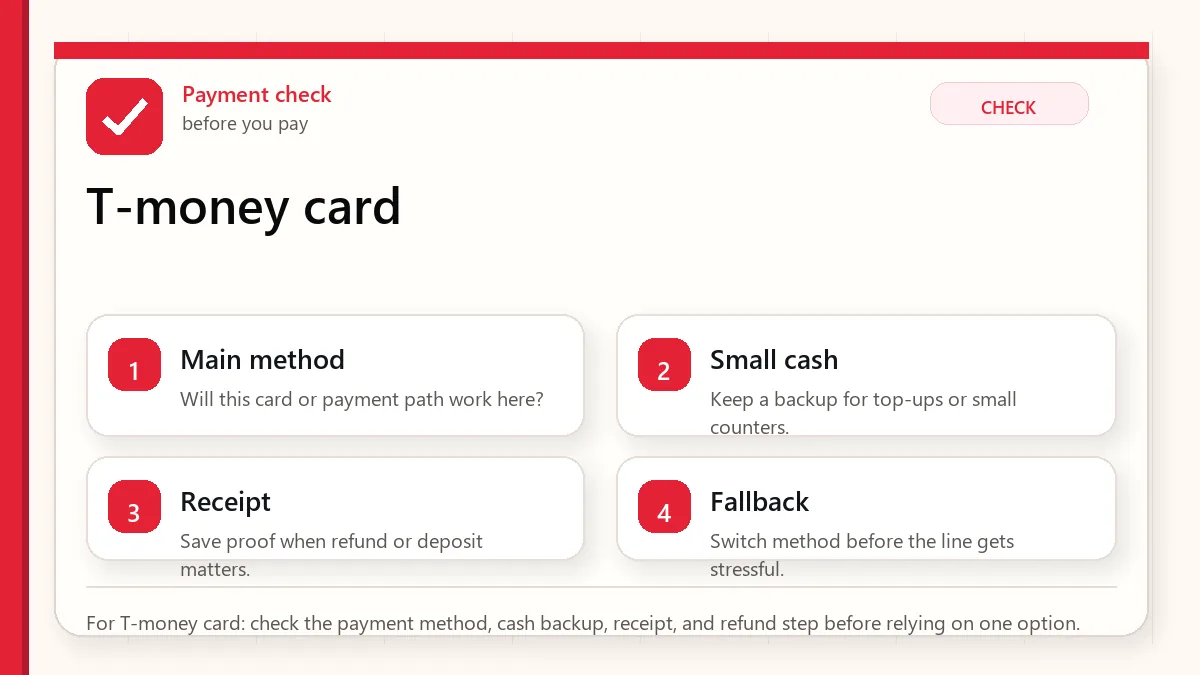
    Layered red check decision graphic for T-money card.
    For T-money card: check the payment method, cash backup, receipt, and refund step before relying on one option.

    A card does not solve every payment situation. It is mainly a practical way to reduce friction on subway and bus rides and, depending on card type and affiliated stores, some small payments. You still need a backup payment method.

    Which card type fits which traveler?

    Traveler situation Best starting point Why Watch out
    First-time visitor staying in several areas Standard Tmoney or similar transport card Simple, flexible, and familiar for subway/bus use. Top-up and refund rules can vary; keep cash backup.
    Visitor who wants currency/payment plus transport in one product WOWPASS or similar visitor card May combine prepaid payment, currency exchange, and transport functions. Check kiosk locations, activation, fees, and refund rules before relying on it.
    Seoul-heavy trip with many rides in a short period Climate Card if your routes fit the covered area Can be attractive for frequent Seoul transit use. Coverage, payment methods, and refund rules have restrictions. Check Seoul’s official page.
    Short intense Seoul transit itinerary Mpass only if the route and usage limit make sense VISITKOREA lists Mpass as a foreigner-exclusive time-limited option. Pass rules, purchase location, and included transport should be checked before buying.

    The visitor mistake: choosing by brand instead of use case

    A transport card is not a souvenir decision. It is an operations decision. Choose based on how many rides you will take, where you will travel, whether you need currency/payment features, and how easily you can get leftover balance back.

    • If you only ride a few times, keep the card simple and avoid overloading balance.
    • If you stay mostly in Seoul and ride many times, compare short-term unlimited options carefully.
    • If you shop heavily, separate transport convenience from card/payment and tax-refund planning.
    • If you travel beyond Seoul, check whether your chosen option covers your actual routes.

    Buying and topping up

    VISITKOREA says Tmoney and EZL cards can be purchased and charged at convenience stores nationwide, and Tmoney can also be reloaded through subway ticket vending machines. However, travelers should treat payment method, machine language, and top-up limits as practical details to verify locally.

    • Carry Korean won cash for top-up backup, especially on the first day.
    • Do not load a large amount just because you are nervous. Load enough for the next few rides, then adjust.
    • Keep the card easy to reach when entering and exiting gates.
    • If traveling with kids or teens, check discount registration rules before assuming reduced fares apply.

    Using it on subway and bus

    The basic habit is simple: tap when required, keep enough balance, and do not block gates while searching for the card. The deeper habit is to watch transfers. Transportation cards can provide transfer benefits, but transfer timing and conditions are rules, not guesses.

    • Tap with the same card consistently for a trip.
    • Keep a separate mental note of remaining balance if you are traveling late or away from major stations.
    • Do not assume airport express, intercity, taxi, or store acceptance is identical across every card and location.
    • For anything outside ordinary subway/bus use, verify the current card-specific rules.

    Refund and leftover balance strategy

    The best refund strategy is not needing a refund. VISITKOREA notes that refund of over KRW 50,000 for Tmoney is only possible at Tmoney Town near Seoul Station. For visitors, that means large leftover balances can become inconvenient.

    Balance habit Why it helps
    Top up in smaller amounts after the first day. You learn your real daily ride cost instead of guessing.
    Keep enough for the return route. Running out late at night is more annoying than carrying a small leftover.
    Spend down before the airport. Refund rules, counters, and time pressure can make last-minute recovery stressful.
    Check card-specific refund rules. Tmoney, EZL, WOWPASS, Climate Card, and passes do not all behave the same.

    When a transport card is not enough

    • Airport transfer may require a separate ticket, route check, or payment method depending on option.
    • Some taxis may accept cards, but destination communication and route trust still matter.
    • Shopping, restaurants, and attractions need a separate payment plan.
    • Mobile transit setup may depend on phone model, app region, payment source, or local verification.

    The card habits that make transit feel less stressful

    A transit card is a movement tool, not just a souvenir

    T-money is useful because it reduces repeated ticket buying and makes subway and bus transfers easier. The practical habit is to check balance before a long ride or airport movement, especially if you are traveling with luggage or late at night. A card with too little balance can turn a simple trip into a delay.

    Top-up planning prevents small stress

    Visitors often forget that transit convenience still needs preparation. Know where you can top up, whether cash is required, and how much you expect to ride that day. Keep small won notes available if you rely on machines or stores for top-up. At the end of the trip, think about whether to keep the card for another visit or spend down the balance.

    Read next when transit connects to money or airport arrival

    This topic works best when it is not handled alone. Use the related guides below to connect the decision with maps, money, food, shopping, transit, and app backup planning.

    Related Before Korea guides

    Official links to check

    Use these official links when the next step matters. This guide explains what to watch for, but app downloads, eligibility, prices, routes, policies, and service rules can change.

    FAQ

    Should I buy Tmoney before arriving in Korea?

    It can be convenient, but it is not always necessary. The important thing is knowing where you will get or top up a card after arrival and carrying a backup payment method.

    Can I use only my foreign credit card for transport?

    Do not assume that. Prepare a local transportation card or a verified visitor-friendly option unless you have confirmed your exact payment method works for the transport you plan to use.

    How much should I load?

    Start with a modest amount that covers the first day or two, then adjust. Avoid large leftover balances unless you understand refund rules and locations.

    Source links to verify

    Last updated

    Last updated: 2026-05-23. Korea travel, transport, app, shopping, and refund details can change. Re-check official sources close to the day you act, especially when money, eligibility, route timing, or account access is involved.

    This guide is written as practical preparation content. It does not claim personal hands-on testing, a personal visit, or official legal advice unless explicitly stated.

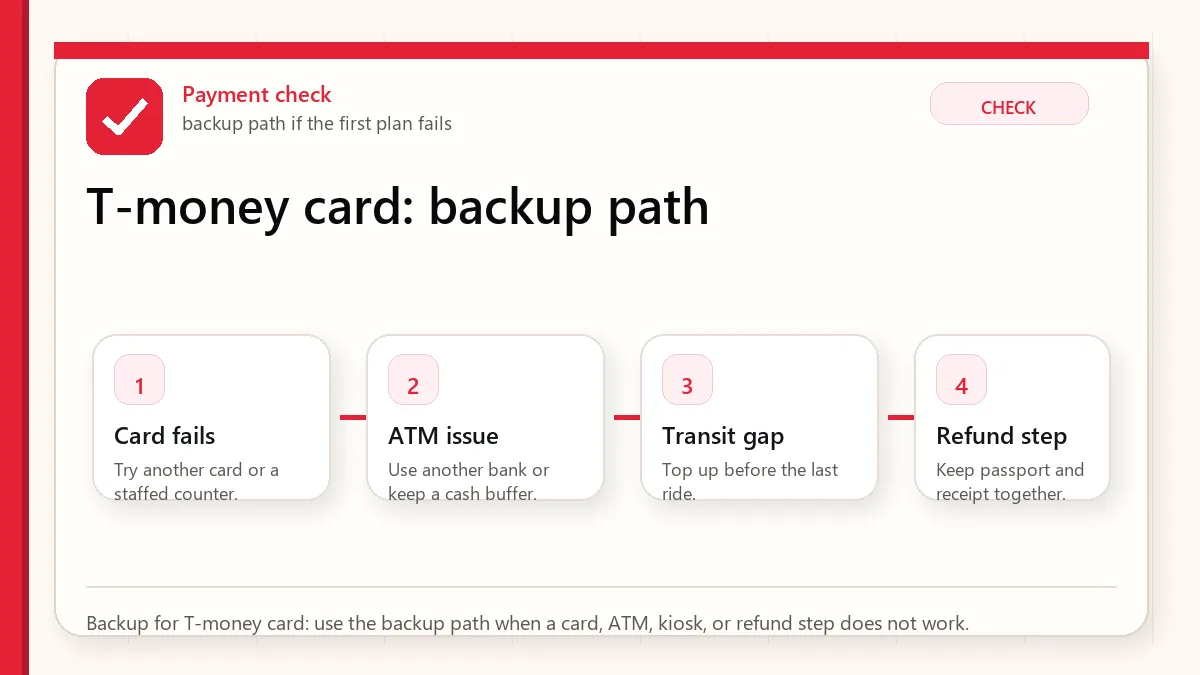
    Layered red check backup flow graphic for T-money card.
    Backup for T-money card: use the backup path when a card, ATM, kiosk, or refund step does not work.

  • Korea Travel Apps Guide

    Korea Travel Apps Guide

    Start with the account or access block

    Install fewer apps, but test them properly before departure. For most visitors, the useful setup is a local map app, translation app, weather source, messaging app if needed, transport/payment backup, and saved official pages for airport, transit, and entry details.

    The moment this usually matters

    This matters before you are standing outside the airport, trying to find a hotel, translate a sign, message a host, or pay for something with a tired brain and a low battery. The best Korea app setup is not a long list. It is a small set of tools you have already opened, tested, and backed up.

    Layered red check decision graphic for Travel app setup.
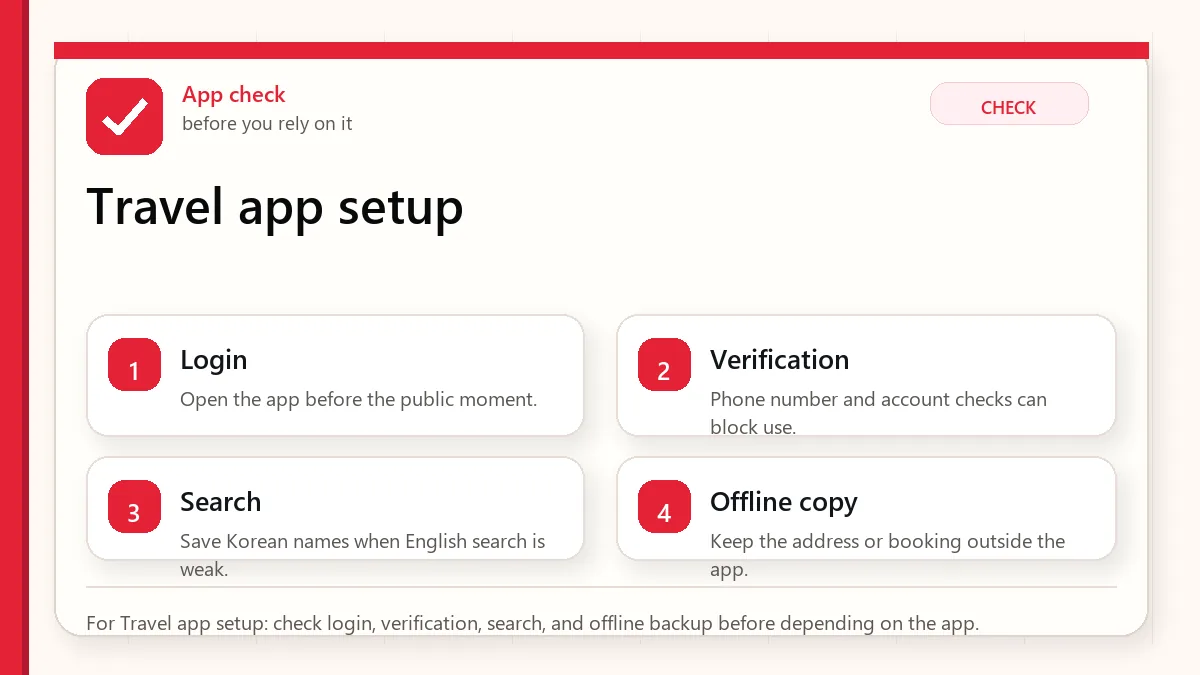
    For Travel app setup: check login, verification, search, and offline backup before depending on the app.

    Core app stack for Korea visitors

    Need App or source type Why it matters Backup
    Navigation Naver Map plus another map reference Local place names, transit, and station exits often matter more than a simple pin. Naver Map guide
    Translation Text and camera translation app Menus, ingredient labels, kiosks, and address screens may not be fully translated. Translation apps guide
    Connectivity Carrier app, eSIM app, or provider portal You need data before you can solve most app problems. eSIM vs SIM guide
    Transport Transit card info, airport route page, or subway app First-day route choices depend on arrival time and luggage. Subway and bus guide
    Messaging KakaoTalk only if your contacts, tour, or reservation uses it Installing it does not guarantee every local service will work for visitors. KakaoTalk guide

    Checks worth doing before the flight

    • Open each important app once before the flight and complete basic setup.
    • Save your hotel address in Korean and English.
    • Screenshot the first airport-to-hotel route.
    • Do not depend on airport Wi-Fi as your only setup plan.
    • Keep official pages bookmarked for entry, airport transport, and transport cards.

    Set up the app stack in a calm order

    • Choose your primary navigation app and save your first five places.
    • Install a translation app that can handle camera translation and copied Korean text.
    • Prepare data access through roaming, eSIM, SIM card, or portable Wi-Fi.
    • Save transport and airport pages outside app accounts.
    • Test whether logins, language settings, and push messages work before travel.
    • Delete apps that require local verification you cannot complete and prepare a web or offline backup.

    Layered red check backup flow graphic for Travel app setup.
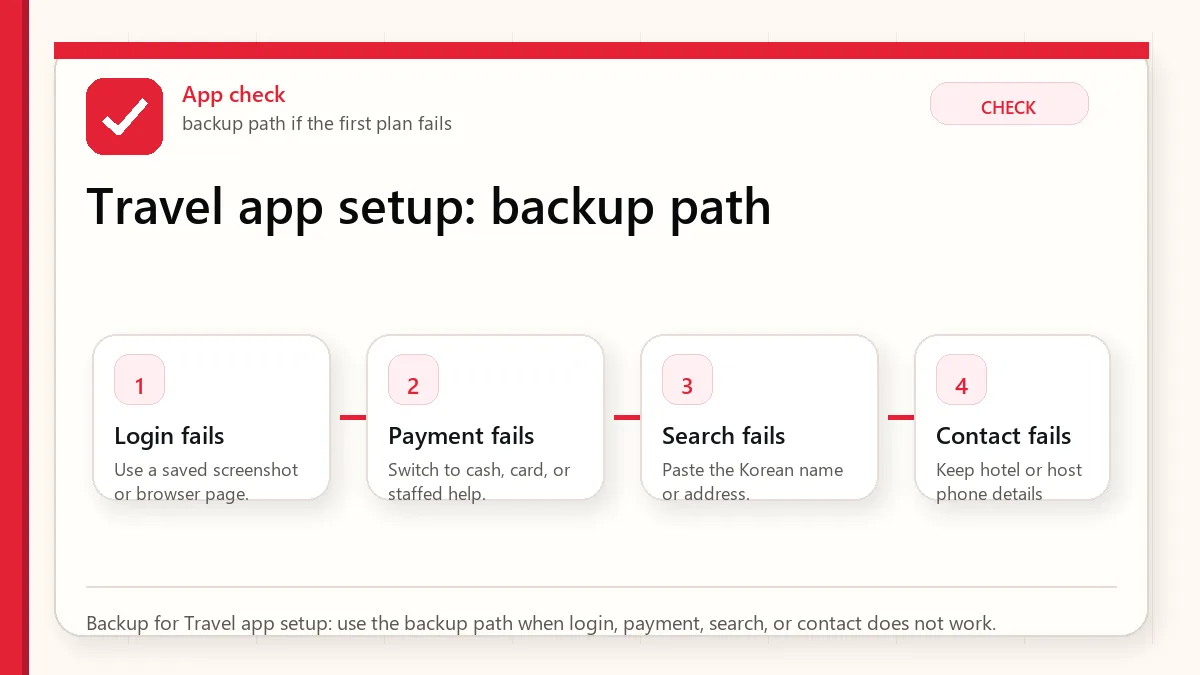
    Backup for Travel app setup: use the backup path when login, payment, search, or contact does not work.

    Where app plans usually break down

    The app requires local verification

    Do not force workarounds. Use a web booking option, hotel help, official counter, or another service that clearly supports foreign visitors.

    The English search result is poor

    Copy Korean names from official pages, booking confirmations, or Naver listings. English names can point to the wrong branch.

    Data does not work after landing

    Use airport Wi-Fi only long enough to activate your data plan or contact the provider, then confirm the airport-to-hotel route before leaving.

    Payment app setup fails

    Assume some local payment apps may not be visitor-friendly. Carry a card, cash backup, and transit card plan.

    Use different apps for different pressure moments

    Situation Better approach What to verify
    First-time solo traveler Use a small app stack and save offline screenshots. Hotel address, airport route, data activation, and map search.
    Shopping-focused traveler Add tax refund and store official pages to bookmarks. Passport requirement, receipt handling, refund limits, and store participation.
    Food-focused traveler Prioritize translation, allergy phrases, and map searches. Menu ingredients, spice level, restaurant hours, and payment method.
    Late arrival Prioritize airport route, taxi address, and data setup. Last train/bus time and Korean destination text.

    Things not to assume just because an app is installed

    • Do not assume every Korean app supports foreign cards, foreign phone numbers, or English.
    • Do not assume app store reviews prove a service works for tourists today.
    • Do not assume map opening hours are official.
    • Do not assume a messenger app is necessary unless a real contact or booking uses it.

    Small app details that make Korea feel easier

    Install is not the same as ready

    A travel app can be on your phone and still fail when you need it. Login, language setting, phone verification, map search, saved places, payment method, and offline access should be checked before departure. The airport is a bad place to discover that an app needs SMS, a Korean number, or a card setting you did not prepare.

    Use apps as a system

    One app rarely solves the whole trip. A good Korea setup combines map, translation, data, payment, transit, booking messages, and offline documents. If one layer fails, another should still help you move, ask, pay, or return to the hotel. That is the real reason to prepare apps before arrival.

    Read next when apps connect to maps, money, or data

    This topic works best when it is not handled alone. Use the related guides below to connect the decision with maps, money, food, shopping, transit, and app backup planning.

    Food delivery apps are not the same as map apps

    A map app only needs to help you find a place. A delivery app may need identity, payment, phone, address, and live rider communication to work. If your Korea app list includes Baemin, check the practical limits in Can Foreigners Use Baemin in Korea? before treating delivery as certain.

    Related Before Korea guides

    Official links to check

    Use these official links when the next step matters. This guide explains what to watch for, but app downloads, eligibility, prices, routes, policies, and service rules can change.

    FAQ

    Should I install every Korean app before arrival?

    No. Install the few apps tied to real decisions and test them. More apps can mean more login and verification problems.

    Can I use only Google Maps in Korea?

    It can help for orientation, but local map tools and Korean place names are often more practical for routes and branches.

    What is the most important app setup step?

    Confirm data access and save your hotel address in Korean. Without those, every other app becomes harder to use.

    Source links to verify

    Last updated

    Last updated: 2026-05-23. Re-check official sources close to the day you travel, buy, eat, or use an app. Details involving prices, eligibility, transport, app features, opening hours, and refund rules can change.
  • Korea Travel Checklist for First-Time Visitors

    Korea Travel Checklist for First-Time Visitors

    Start with the first thing that can block the day

    For a first Korea trip, the useful checklist is not a long packing list. It is a risk checklist. Before departure, settle five things: entry paperwork, phone data, map/navigation, money/transit, and your first route from the airport. If those five are ready, most first-day stress becomes manageable.

    What makes this checklist worth using

    The practical value of this checklist is not that it names every possible travel task. It helps you identify the few tasks that can block the first day if they are left unresolved.

    Area What to check What to avoid
    Entry Verify official entry requirements, e-Arrival/K-ETA status, passport validity, and customs basics. Do not rely on social media comments for nationality-specific rules.
    Phone Choose data setup and app login plan before departure. Data-only service may not solve phone-number verification.
    Maps Save Korean names, hotel address, station exits, and first route. English place search can be uneven.
    Money Prepare card plus cash plus transit plan. A single card is not a full payment strategy.

    The checks that deserve your attention

    • Confirm entry admin from official pages.
    • Open Naver Map and translation apps before flying.
    • Save hotel address in Korean.
    • Choose airport transfer by fatigue and luggage, not only speed.

    Failure cases to plan around

    • No working data after landing.
    • Hotel name does not search.
    • Card fails at a kiosk.
    • Airport bus/train timing no longer fits late arrival.

    Official and practical source checks

    Read next

    Who this guide is really for

    This is for first-time visitors who want to avoid the problems that usually appear after landing: no working data, a hotel address that does not search well, a card that fails at a kiosk, a late arrival with no planned transfer, or a tax/refund/app rule discovered too late.

    Layered red check decision graphic for First Korea trip checklist.
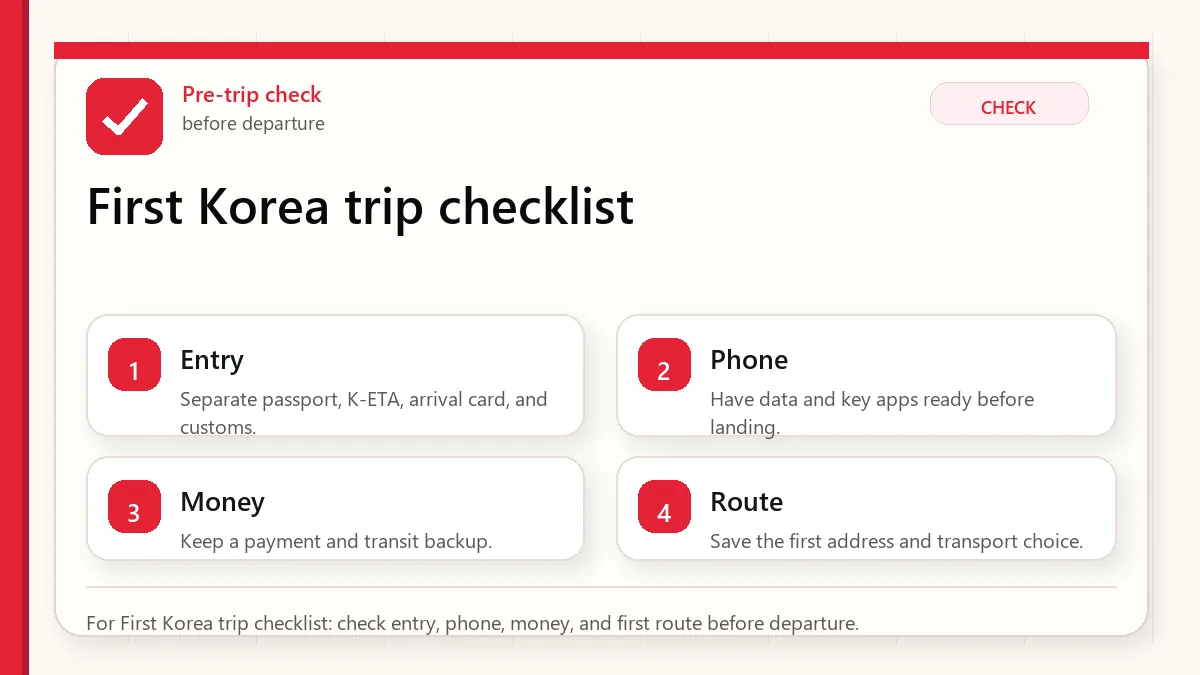
    For First Korea trip checklist: check entry, phone, money, and first route before departure.

    This guide is intentionally practical. It does not try to be a complete Korea travel guide. It tells you what to prepare before the trip so that your first day in Korea is not spent fixing preventable problems.

    The five decisions to make before departure

    Decision What to decide Why it matters Best verification source
    Entry admin Whether you need to submit the Korea e-Arrival card or other entry information before arrival. Immigration forms and timing are not the thing to solve while tired in the arrival hall. VISITKOREA e-Arrival notice
    Connectivity Roaming, eSIM, SIM card, or portable Wi-Fi, plus a fallback if setup fails. Maps, translation, airport transport, hotel contact, and payment troubleshooting all depend on working data. VISITKOREA travel basics
    Navigation Which map app you will use and whether your hotel/destinations are saved in Korean as well as English. Korean place names, station exits, and branch names can decide whether a route is actually usable. Naver Map guide
    Money and transit How you will pay for subway/bus rides, small purchases, and backup cash needs. Not every card or app flow works smoothly for every foreign visitor in every place. T-money guide
    First route Train, airport bus, taxi, or another transfer from the airport to your accommodation. The best route depends on terminal, arrival time, luggage, destination, and walking distance after the last stop. Incheon Airport to Seoul guide

    72-hour pre-departure checklist

    1. Entry and arrival information

    Check official entry requirements for your passport, stay purpose, and arrival date. Korea introduced an e-Arrival card system for inbound passengers starting February 24, 2025, according to VISITKOREA. Do not rely on old screenshots of paper forms; use the official e-Arrival or immigration source close to travel.

    • Save your accommodation address in English and Korean.
    • Keep your first-night accommodation contact details offline.
    • Check whether arrival forms, visa-free entry conditions, or airline document checks apply to your situation.
    • If anything is legal, immigration, medical, or visa-related, verify with the official authority rather than a travel blog.

    2. Phone data and backup access

    Your phone is your map, translation tool, booking reference, payment helper, and emergency contact device. Prepare data before you depend on airport Wi-Fi. If using eSIM, check phone compatibility and activation timing before departure. If using a physical SIM or portable Wi-Fi, check pickup location, opening hours, and what happens after a delayed flight.

    • Download app updates before the flight.
    • Save booking confirmations and hotel address offline.
    • Keep one low-tech backup: a printed or screenshot route from the airport to your hotel.
    • Do not assume a local phone number will be available unless the product clearly includes it.

    3. Maps and Korean names

    A global map app can still be useful for orientation, but Korea travel is easier when you prepare a local map app and Korean place names. Save the airport terminal, hotel, nearest station, and your first meal or destination before boarding.

    • Save place names in Korean when available from official pages or booking confirmations.
    • Check final walking distance, station exit, and whether the route uses stairs.
    • For time-sensitive plans, test the route at a similar day/time before travel.
    • Treat opening hours on map listings as a hint, not final proof.

    4. Money, cards, and transit

    For public transport, Korea uses transportation cards such as Tmoney, EZL, WOWPASS, and other options. VISITKOREA describes these as rechargeable prepaid cards that do not require an account and can be useful for public transportation. The practical question is not only which card exists, but how you will buy, charge, use, and refund it.

    • Carry some Korean won cash for top-ups or small fallback payments.
    • Bring more than one payment method if possible.
    • Avoid loading more transit balance than you can reasonably use before leaving.
    • For shopping-heavy trips, read the tax refund rules before the first large purchase, not at the airport.

    5. Airport transfer

    VISITKOREA lists airport-to-Seoul options including AREX, Seoul subway, airport limousine bus, and taxi. Your best option depends on the final destination, not only the airport departure point. A train to a major station may be fast, but a bus can be easier if it stops near your hotel. A taxi can be useful with luggage or late arrival, but you should prepare the address and payment backup.

    First 90 minutes after landing

    Moment Do this Why
    Before immigration Open your offline documents and confirm accommodation address. You may not want to depend on live data immediately.
    After baggage Confirm your data connection before leaving the terminal. A broken data plan is easier to solve at the airport than on a sidewalk.
    Before buying transport Compare the route you planned with current time and luggage reality. A delayed flight can make the original plan worse.
    Before taxi or bus Show the Korean destination name/address, not only an English hotel name. Similar names and branch names can cause route mistakes.
    At hotel Save the nearest station, convenience store, and return route. The second trip out is easier once your home base is set.

    Different travelers need different backups

    • Solo first-timer: prioritize offline address, map backup, and a transfer route that is easy to follow while tired.
    • Family or group: prioritize luggage, seating, walking distance, and one shared plan everyone can find if phones separate.
    • Shopping-focused traveler: understand tax refund eligibility, passport needs, receipt/voucher handling, and baggage space before buying.
    • Food-focused traveler: prepare translation for allergies, dietary limits, spice tolerance, and restaurant ordering basics without pretending apps can solve every situation.
    • Short layover or late arrival: build the plan around timing and backup transport, not sightseeing ambition.

    Common mistakes this checklist prevents

    • Arriving with an app installed but not opened or configured.
    • Saving only English place names for a destination that is easier to find in Korean.
    • Choosing an airport route that is fast to a station but awkward to the actual hotel.
    • Assuming foreign cards, mobile wallets, or app payments will work everywhere.
    • Buying tax-refund-eligible goods without keeping receipts, vouchers, passport details, or export requirements in mind.
    • Using old blog prices or app screenshots as if they were official current rules.

    The small preparations that make day one easier

    Build the trip around recoverable mistakes

    A first Korea trip does not need to be perfect. It needs to be recoverable. If a map search fails, you have a Korean address. If a card fails, you have cash and a second card. If mobile data fails, you have airport Wi-Fi and saved documents. If a route changes, you know the nearest station and hotel address. This mindset is more useful than trying to memorize every rule.

    Do one final check close to departure

    Some details are stable, but others change: weather, airport process, app verification, transport schedules, tax refund rules, opening hours, and travel notices. A checklist is strongest when it is reviewed once early for planning and once again shortly before departure for current details. Keep the final version offline so the first day does not depend on perfect mobile data.

    Read next for the parts of the trip that usually overlap

    This topic works best when it is not handled alone. Use the related guides below to connect the decision with maps, money, food, shopping, transit, and app backup planning.

    Related Before Korea guides

    Official links to check

    Use these official links when the next step matters. This guide explains what to watch for, but app downloads, eligibility, prices, routes, policies, and service rules can change.

    FAQ

    Do I need to plan every day before visiting Korea?

    No. Plan the arrival day and the systems you will use every day: map, data, money, transit, and official source checks. Sightseeing can stay flexible.

    Should I install every Korean app before I arrive?

    No. Install only the apps tied to real decisions: navigation, translation, transit, weather, messaging if needed, and specific bookings. Too many apps can create more account and verification problems than they solve.

    What should I verify again right before travel?

    Verify entry requirements, e-Arrival details, airport route timing, transit card information, weather, store or venue hours, tax refund rules, and any reservation or app account requirement that affects money or access.

    Source links to verify

    Last updated

    Last updated: 2026-05-23. Korea travel, transport, app, shopping, and refund details can change. Re-check official sources close to the day you act, especially when money, eligibility, route timing, or account access is involved.

    This guide is written as practical preparation content. It does not claim personal hands-on testing, a personal visit, or official legal advice unless explicitly stated.

    Layered red check backup flow graphic for First Korea trip checklist.
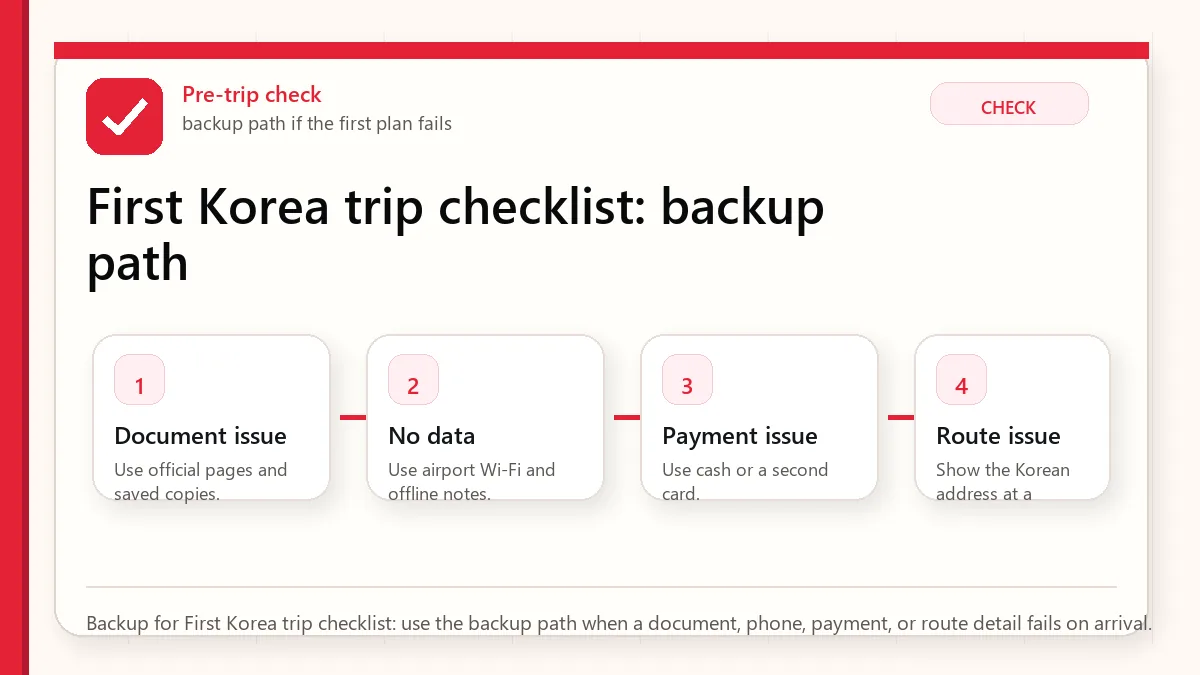
    Backup for First Korea trip checklist: use the backup path when a document, phone, payment, or route detail fails on arrival.