Author: user

  • Korea Entry Requirements: K-ETA and Customs

    Korea Entry Requirements: K-ETA and Customs

    Start with the official requirement for your trip

    Entry preparation should be boring by the time you fly. The important work is checking the official status for your nationality, travel purpose, K-ETA or visa requirement, e-Arrival Card, customs items, and health or safety notices. Do this before packing, because airport staff cannot fix every missing requirement at the counter.

    Last checked: June 1, 2026. Re-check the current Korean government or customs page before acting, because routes, prices, labels, rules, app screens, eligibility, and store/service policies can change.

    Last updated: May 23, 2026. Rules, app flows, prices, and eligibility can change, so re-check official sources close to your trip.
    Layered red check decision graphic for Entry Requirements K-ETA and.
    For Entry Requirements K-ETA and: check entry, phone, money, and first route before departure.

    Where pre-trip checks usually save the day

    This matters before the first pressure moment: airline counter, immigration form, airport train, SIM setup, hotel route, payment machine, or customs question. Finish the boring checks early so arrival day has fewer moving parts.

    What to check before you rely on it

    • Use the official e-Arrival Card site and K-ETA site directly; avoid lookalike pages that ask for unnecessary payment or confusing service fees.
    • Check your nationality close to travel day because K-ETA exemption and entry conditions can be date-sensitive.
    • Save the confirmation details where you can reach them offline, not only inside an email app.
    • Keep customs questions separate from immigration questions; one is about entering the country, the other is about what you bring with you.
    • Save the relevant page or screenshot before you need it in public.
    • Re-check volatile details near travel day because policies and app flows change.

    The entry check should feel boring before you fly

    Do not treat K-ETA as a universal yes/no answer

    Some travelers may be exempt during a specific period, some may still choose to apply for convenience, and some may need a different visa route entirely. The safer habit is to use the official K-ETA flow and your nearest Korean mission’s notices as verification, then avoid repeating the answer as if it applies to every passport.

    The e-Arrival Card is a timing task

    The official e-Arrival Card site says the form can be handled close to arrival, but it is still better to understand the flow before the travel day. You do not want the first encounter with passport, email, and trip-address fields to happen while boarding or after a long flight.

    Customs is where shopping plans can matter

    Visitors often think customs only matters when entering Korea, but it also matters when leaving with tax-refund goods. Keep the mental link between entry documents, shopping receipts, and departure paperwork; the trip is smoother when documents do not scatter.

    A preparation path that keeps arrival day calm

    Decide which first-day problem you are preventing

    Decide which first-day problem you are preventing: entry paperwork, phone setup, payment, transport, address, or customs.

    Use official sources for entry, customs, health, and transport details

    For entry, customs, health, and transport rules, use the official page close to the date you travel.

    Keep offline copies of the details you may need first

    The backup should be available offline: documents, address, phone number, payment method, and the first route.

    Do not leave official checks for the airport line

    More checklists can hide the real priority. Finish the few checks that would block arrival day.

    Layered red check backup flow graphic for Entry Requirements K-ETA and.
    Backup for Entry Requirements K-ETA and: use the backup path when a document, phone, payment, or route detail fails on arrival.

    The small check that changes the answer

    The first plan depends on one fragile detail

    If one card, one app login, one translation scan, or one store policy controls the whole plan, add a backup before the trip.

    The information is technically correct but not practical

    A rule can be true and still be hard to use when you are tired, carrying luggage, or standing in a busy line. Plan for the human moment, not only the policy.

    A visitor copies advice from a different travel style

    A resident, Korean speaker, business traveler, or frequent visitor may solve problems differently from a first-time tourist. Use advice that matches your situation.

    What this means in the real moment

    SituationSafer defaultWhy
    Short first tripChoose convenience and fewer moving partsRecovery time is limited
    Budget-conscious tripSeparate must-pay costs from nice-to-have extrasSmall purchases add up quickly
    Higher-risk situationUse official sources and conservative backupsHealth, entry, tax, and payment issues are not good places to gamble

    Sources to re-check

    Use these pages for facts that can change by date, operator, airport, app version, store, or traveler status.

    Where to go next

    Official links to check

    Use these official links when the next step matters. This guide explains what to watch for, but app downloads, eligibility, prices, routes, policies, and service rules can change.

    FAQ

    Can I rely on one answer for every visitor?

    No. Korea travel details can depend on nationality, app version, store, airport, phone setup, card issuer, and date.

    Should I solve this after arriving?

    Try not to. Anything involving entry, phone data, maps, payment, allergies, or airport transfer is easier to prepare before the first pressure moment.

    What is the safest habit?

    Keep the official source, the practical guide, and a simple backup together. That combination is more useful than memorizing many tips.
  • Before You Shop in Korea

    Before You Shop in Korea

    Start with the first thing that can block the day

    Shopping in Korea works better when you treat the checkout as part of the trip plan: payment method, tax refund, receipt handling, product authenticity, clothing size, luggage space, and what will still feel useful at home.

    Last checked: June 1, 2026. Re-check the official or primary source page before acting, because routes, prices, labels, rules, app screens, eligibility, and store/service policies can change.

    Last updated: May 23, 2026. Rules, app flows, prices, and eligibility can change, so re-check official sources close to your trip.

    Layered red check decision graphic for You Shop in.
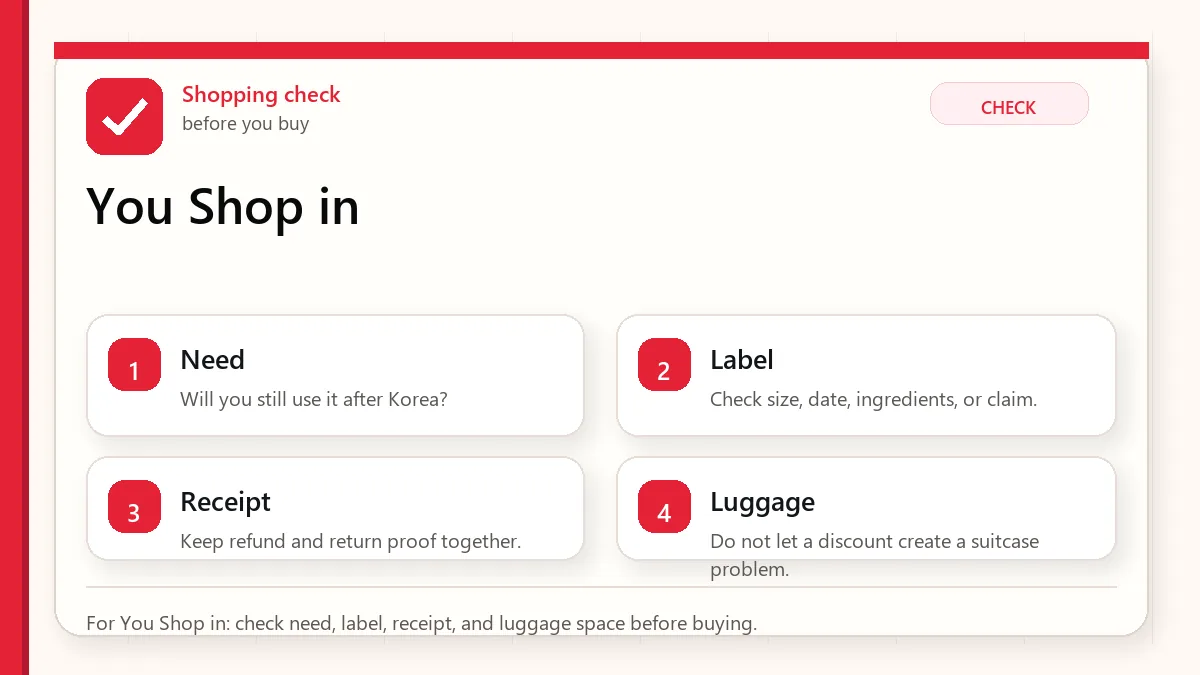
    For You Shop in: check need, label, receipt, and luggage space before buying.

    How to use this hub guide

    This hub is broader than K-beauty. It connects tax refund, payments, clothing sizes, what to buy, what not to buy, Olive Young, and Korean product shopping decisions.

    The goal is not to make every visitor spend more. It is to make each purchase easier to justify after the trip, when the store lighting and travel excitement are gone.

    The checks that decide whether it is worth buying

    If you are decidingCheck this firstWatch out for
    Tax refundKorea tax refund guide and receipt planAssuming every shop/item qualifies
    PaymentForeign card, cash buffer, and kiosk/card reader fallbackCard failure can turn a simple checkout into a delay
    SizingBody measurements, return policy, and free-size cautionLetter sizes may not translate cleanly
    SouvenirsUsefulness, portability, authenticity, and recipient fitPopular does not always mean worth carrying home

    The small check that changes the answer

    • Carry the passport if you plan tax-free shopping where required.
    • Check return/exchange policy before buying clothing or cosmetics.
    • Keep receipts together until after departure.
    • Do not buy liquids, glass, or bulky items without checking luggage space.
    • Compare price and availability at home before buying expensive goods.

    A shopping path that still makes sense after Korea

    Start with constraints

    Know luggage space, liquid limits, budget, skin needs, size measurements, and gift recipients before choosing stores.

    Pay attention at checkout

    Ask tax-refund questions before paying, keep receipts, and do not assume the cashier can fix refund issues later.

    Separate impulse from value

    A Korea-only product, useful gift, or verified local item can be worth buying. A bulky trend item with unclear use often is not.

    Pack with inspection in mind

    If a refund process may require goods or receipts, do not bury them in a way that makes airport handling impossible.

    Layered red check backup flow graphic for You Shop in.
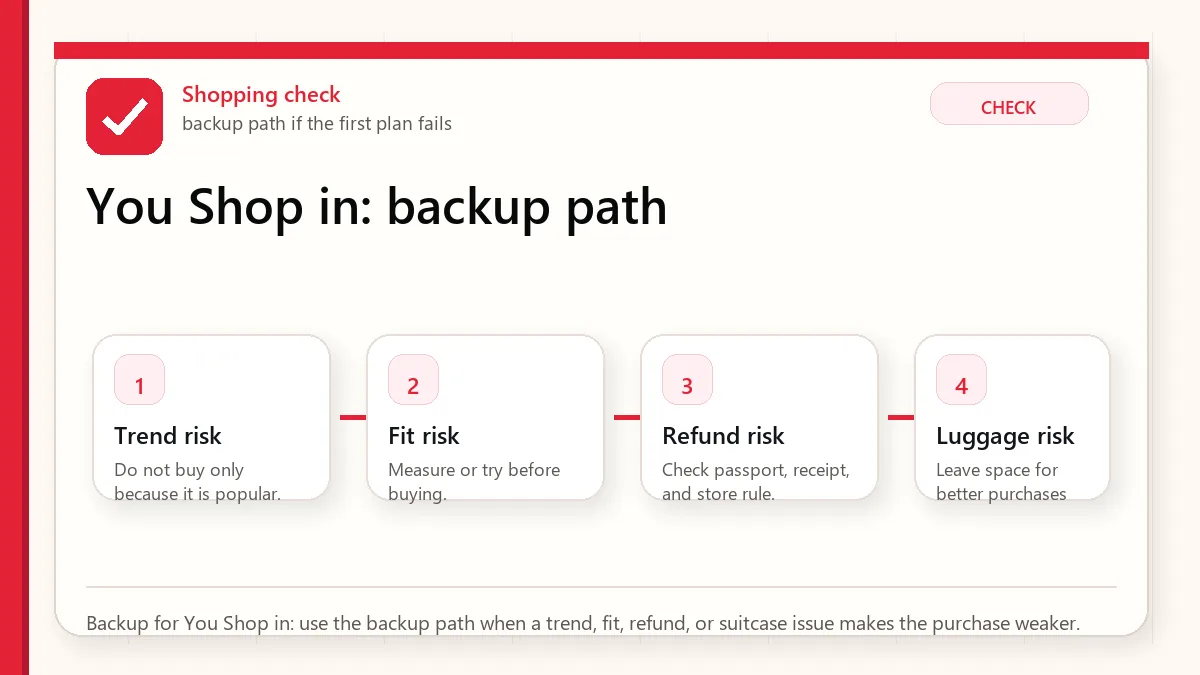
    Backup for You Shop in: use the backup path when a trend, fit, refund, or suitcase issue makes the purchase weaker.

    What this means in the real moment

    The card does not work

    Try another card, use cash if possible, or avoid blocking a line while troubleshooting. Keep payment backups realistic.

    The size is wrong

    Do not rely on S/M/L alone. Check measurements and avoid final-sale items if fit is uncertain.

    The refund is smaller than expected

    Remember that refund processing, item eligibility, and method can affect the amount. Treat the refund as a bonus, not the reason to buy.

    A safer way to make the decision

    SituationSafer defaultWhy
    Beauty shopperStart with K-beauty and Olive Young guidesProduct fit matters more than trend volume
    Fashion shopperUse measurements and return policy firstSize labels can mislead
    Gift shopperChoose light, sealed, easy-to-explain itemsThe best gift survives the flight and makes sense to the recipient

    Sources to re-check

    Use these pages for facts that can change by date, operator, airport, app version, store, or traveler status.

    Where to go next

    Official links to check

    Use these official links when the next step matters. This guide explains what to watch for, but app downloads, eligibility, prices, routes, policies, and service rules can change.

    FAQ

    Should I shop duty-free or in the city?

    It depends on item type, price, time, pickup preference, and refund process. Compare convenience, not only headline price.

    Is tax refund always worth the effort?

    Not always. Small refunds can be useful, but they should not create airport stress or encourage purchases you do not need.

    Are Korean sizes smaller?

    Sometimes, but the safer answer is to use measurements. Fit varies by brand, cut, and item category.

  • Before You Use Korean Apps

    Before You Use Korean Apps

    Start with the account or access block

    The best Korea app setup is small, tested, and backed up. Installing many apps is less useful than knowing which app handles maps, taxi, translation, payment, delivery, and emergency help. Open the important apps before arrival and check the phone-number or payment blocks while you still have time.

    Last checked: June 1, 2026. Re-check the official app, service, or app-store page before acting, because routes, prices, labels, rules, app screens, eligibility, and store/service policies can change.

    Last updated: May 23, 2026. Rules, app flows, prices, and eligibility can change, so re-check official sources close to your trip.

    Layered red check decision graphic for You Use Apps.
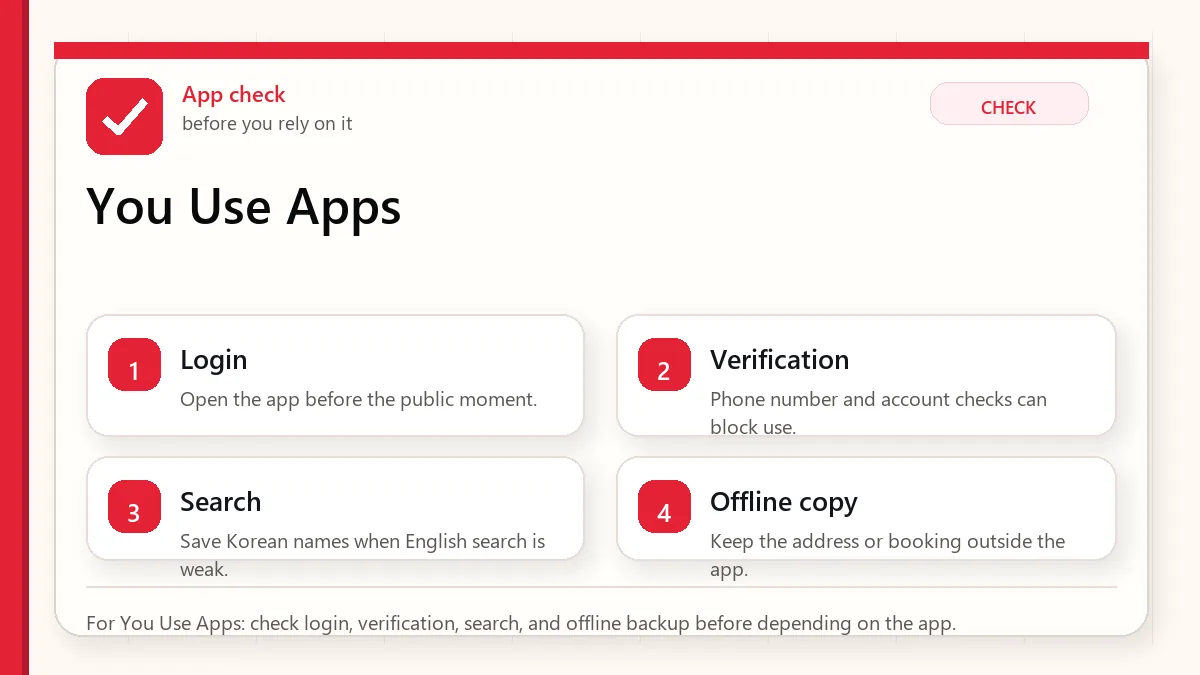
    For You Use Apps: check login, verification, search, and offline backup before depending on the app.

    How to use this hub guide

    This hub is for visitors who want apps to work before a real moment depends on them. It links Naver Map, translation, KakaoTalk, taxi, eSIM, emergency, and delivery-app guides.

    It does not promise every foreign visitor can use every app feature. Korea app flows can depend on phone numbers, identity checks, app versions, card support, language settings, and provider policy.

    The checks that decide whether the app is enough

    If you are decidingCheck this firstWatch out for
    NavigationNaver Map guide and Korean place namesEnglish search can be uneven
    TranslationPapago/Google Translate plus saved key phrasesCamera translation may miss context or allergens
    TaxisKakao T, k.ride, or street taxi fallbackForeign card or phone verification can be the bottleneck
    Delivery and local servicesEligibility, address format, phone number, and payment methodSome services are not visitor-friendly without local setup

    The small check that changes the answer

    • Open each essential app before departure and check language settings.
    • Save important destinations in Korean and English.
    • Do not rely on one translation app for allergies or medical needs.
    • Understand whether your eSIM includes data only or a local phone number.
    • Keep emergency numbers and hotel contact outside app-only storage.

    An app setup that does not depend on one fragile step

    Build the core stack

    Start with maps, translation, messaging/contact, payment/transit support, and emergency information. Add taxis or delivery only if your trip actually needs them.

    Test before the airport

    Search your hotel, save a route, translate a sample menu, and check whether login works. A failed login is much easier to solve at home.

    Prepare non-app backups

    Screenshots, written addresses, a hotel card, cash, and staff help still matter. Apps reduce friction, but they should not be your only plan.

    Review permissions calmly

    Some apps need location, notifications, or camera access. Give only what is needed and avoid rushing through permission prompts in public.

    Layered red check backup flow graphic for You Use Apps.
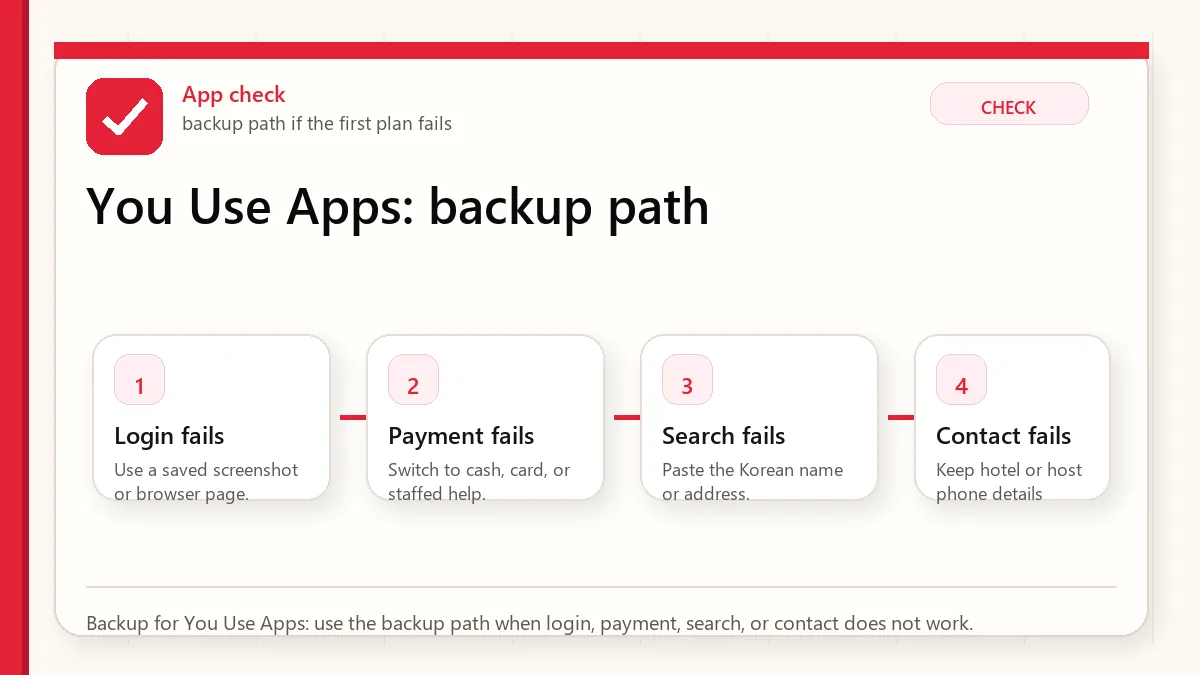
    Backup for You Use Apps: use the backup path when login, payment, search, or contact does not work.

    What this means in the real moment

    A place does not appear in English

    Search by Korean name, nearby landmark, or copied address. Ask hotel staff to write the exact name if needed.

    A taxi app will not accept your card

    Use pay-to-driver if available, try another app designed for visitors, or use an official taxi stand.

    A delivery app blocks signup

    Do not build meal plans around it. Use restaurants, convenience stores, hotel help, or visitor-friendly food courts.

    A safer way to make the decision

    SituationSafer defaultWhy
    First-time visitorNaver Map, translation, eSIM, T-money/payment guideThese affect the first day directly
    Solo travelerAdd emergency numbers and taxi backupRecovery options matter more when no one else can troubleshoot
    Longer stayCheck local phone-number needs more carefullyMore services become useful but also more verification-heavy

    Sources to re-check

    Use these pages for facts that can change by date, operator, airport, app version, store, or traveler status.

    Where to go next

    Official links to check

    Use these official links when the next step matters. This guide explains what to watch for, but app downloads, eligibility, prices, routes, policies, and service rules can change.

    FAQ

    Can I use only Google Maps in Korea?

    It may help for general place context, but many visitors need Korean map apps for more reliable routes, place names, transit details, and station exits.

    Do I need a Korean phone number?

    Not always. But taxis, delivery, reservations, and account recovery may be easier or only possible with local verification.

    Should I install apps after arrival?

    Install and test the essential ones before departure. Airport Wi-Fi, fatigue, and account verification make arrival a poor time to troubleshoot.

  • Before You Eat Korean Food

    Before You Eat Korean Food

    Start with the moment you order

    Eating in Korea is easier when you understand the systems around the food: ordering flow, shared dishes, self-service water, side dishes, payment timing, and allergy limits. Before you choose a restaurant, decide whether the risk is language, ingredients, spice level, queue pressure, or not knowing how the meal is served.

    Last checked: June 1, 2026. Re-check the latest product label, restaurant information, and official/public database before acting, because routes, prices, labels, rules, app screens, eligibility, and store/service policies can change.

    Last updated: May 23, 2026. Rules, app flows, prices, and eligibility can change, so re-check official sources close to your trip.

    Layered red check decision graphic for You Eat Food.
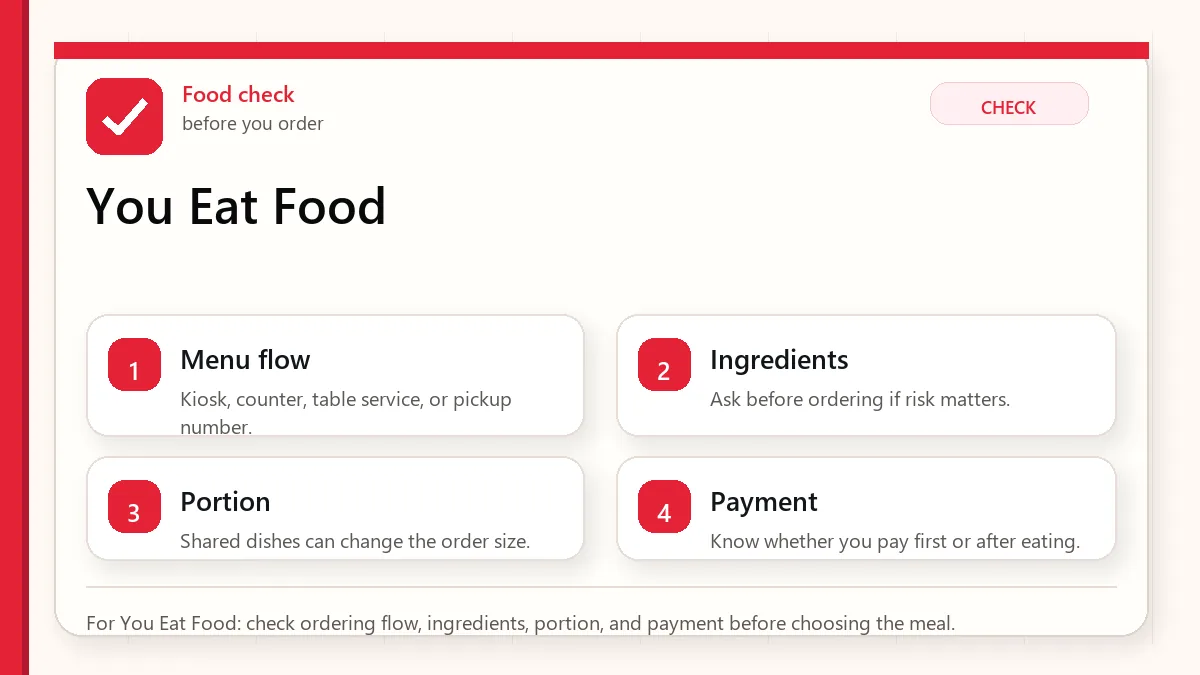
    For You Eat Food: check ordering flow, ingredients, portion, and payment before choosing the meal.

    How to use this hub guide

    This hub is for visitors who want to enjoy Korean food with fewer awkward moments and safer choices. It links the BBQ, ordering, allergy, kiosk, cafe, convenience store, and street-food guides.

    It does not rank restaurants or pretend to have visited specific places. The point is to help you recognize the pattern when you are standing in front of a menu, machine, grill, or busy counter.

    The checks that decide the safer food choice

    If you are decidingCheck this firstWatch out for
    First restaurant mealHow to Order Food in Korea and kiosk basicsAssuming every place has English service
    Korean BBQPortions, cuts, grill flow, side dishes, and staff helpOrdering too much or misunderstanding shared-table rhythm
    Food allergiesWritten Korean allergy notes, simpler dishes, and backup mealsCross-contact and hidden broths/sauces are real risks
    Late-night or budget mealConvenience-store meals, cafes, or simple restaurantsChoosing only by viral food lists

    The small check that changes the answer

    • Prepare allergy phrases in Korean if allergy risk is serious.
    • Learn whether you order at table, counter, kiosk, or QR code before sitting down.
    • Expect some side dishes to be shared and some water/utensils to be self-service.
    • Ask about spice before sauce is mixed in when possible.
    • Keep one low-risk backup meal idea for tired or sensitive days.

    An ordering path that keeps the meal manageable

    Read the ordering system first

    Look for kiosk, counter, table bell, QR code, or staff seating. The system matters more than memorizing perfect Korean phrases.

    Separate curiosity from safety

    Trying new food is part of travel, but allergies, spice tolerance, and dietary restrictions need a more cautious plan.

    Use photos and translation as support

    Menu photos, Papago/Google Translate, and saved dish names can help, but they do not guarantee allergen accuracy.

    Let the meal move at local pace

    Many casual restaurants expect efficient dining. If you want to linger, a cafe after the meal may feel more natural.

    Layered red check backup flow graphic for You Eat Food.
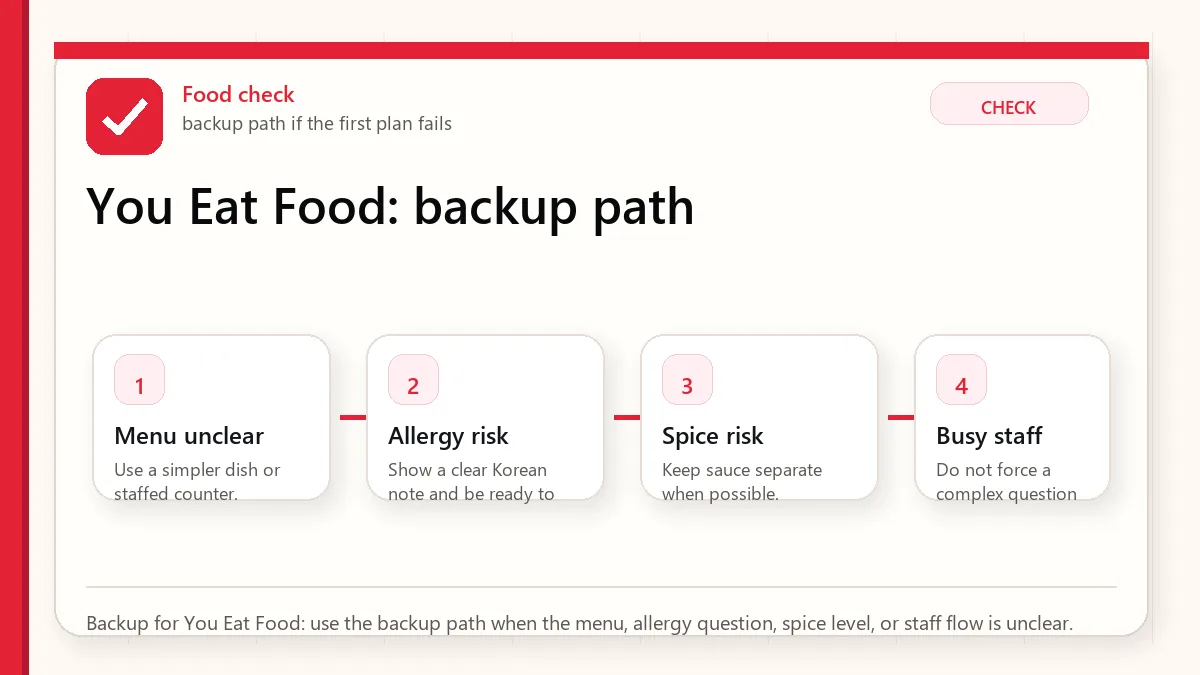
    Backup for You Eat Food: use the backup path when the menu, allergy question, spice level, or staff flow is unclear.

    What this means in the real moment

    The kiosk has no English

    Use camera translation, match dish photos, or choose a staffed counter if the order has dietary risk.

    The food is too spicy

    Stop adding sauce, ask for plain rice or water, and choose milder dishes next time rather than trying to prove tolerance.

    You are unsure about allergens

    Do not rely on guessing. Use a written allergy card and choose simpler food or a different restaurant if staff cannot confirm.

    A safer way to make the decision

    SituationSafer defaultWhy
    First-time touristStart with ordering flow and BBQ basicsThe mechanics are often more confusing than the dish names
    Sensitive eaterRead allergy and spice guides before restaurant listsHidden sauces and broths matter
    Budget travelerUse convenience stores and simple restaurants carefullyCheap meals can still be satisfying with the right expectations

    Sources to re-check

    Use these pages for facts that can change by date, operator, airport, app version, store, or traveler status.

    Where to go next

    FAQ

    Do Korean restaurants expect tipping?

    Tipping is generally not customary in Korea. Check the bill and local context rather than importing tipping habits from home.

    Are allergies easy to communicate?

    They can be difficult. Use Korean written notes, simple dishes, and avoid high-risk restaurants when the consequence would be serious.

    Is Korean BBQ hard for first timers?

    Not if you understand portions, shared side dishes, and whether staff or guests handle the grill.

  • Before You Buy K-Beauty in Korea

    Before You Buy K-Beauty in Korea

    Start with the label and skin risk

    Buying K-beauty in Korea is easiest when you begin with your skin and travel constraints, not with a ranking wall. The better question is what you can use safely, carry home, and still understand after the excitement of the store fades.

    Last checked: June 1, 2026. Re-check the latest product label, store policy, and official refund or safety page before acting, because routes, prices, labels, rules, app screens, eligibility, and store/service policies can change.

    Last updated: May 23, 2026. Rules, app flows, prices, and eligibility can change, so re-check official sources close to your trip.

    Layered red check decision graphic for You Buy K-Beauty in.
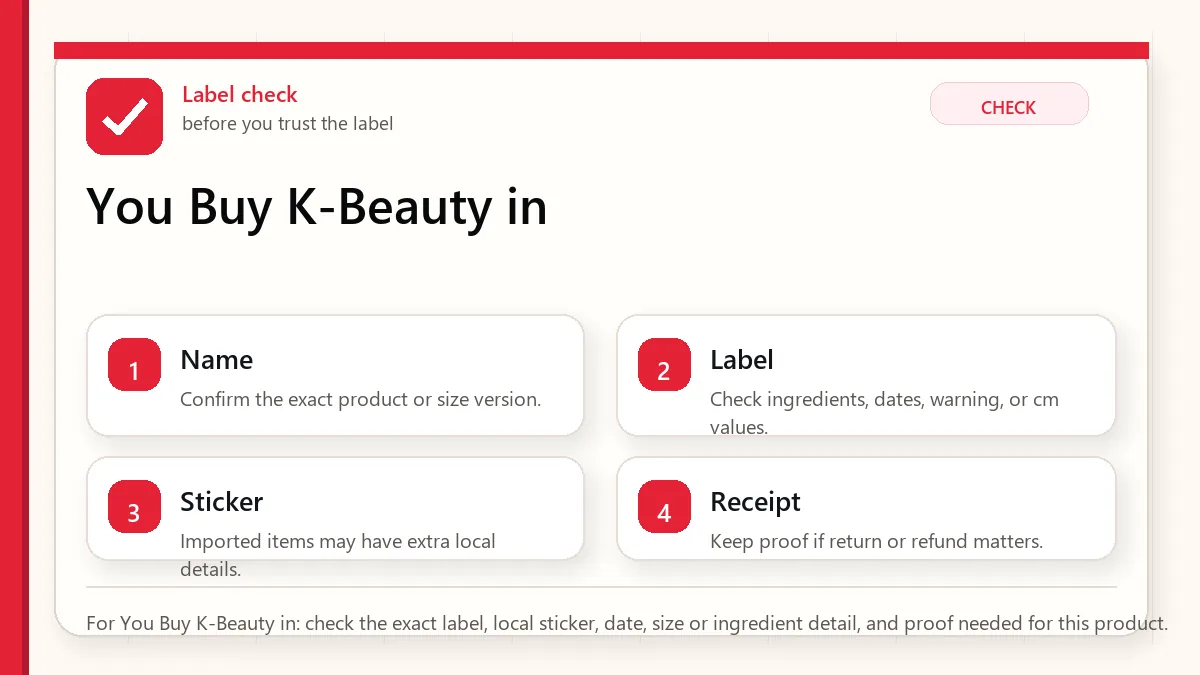
    For You Buy K-Beauty in: check the exact label, local sticker, date, size or ingredient detail, and proof needed for this product.

    How to use this hub guide

    This hub is for visitors who want K-beauty shopping to feel considered rather than chaotic. It links the product-choice guides, Olive Young guide, tax-refund guide, and shopping mistakes guide into one path.

    It does not pretend to test products personally. The focus is how to read claims, check ingredients, compare stores, protect receipts, and avoid buying more than you can actually use.

    The checks that decide whether to trust the label

    If you are decidingCheck this firstWatch out for
    Where to startOlive Young guide plus a skin-needs listBuying from rankings before checking your own routine
    How to judge a productIngredients, role in routine, expiry date, packaging, and claimsPopular products can still irritate or be redundant
    How to handle refundPassport, receipt, refund method, and airport timingTax-refund steps can be missed if receipts are scattered
    How much to buyUse rate, luggage, liquid limits, gifts, and storageA good deal becomes waste if you overbuy

    The backup that keeps the problem small

    • Write down your skin type, sensitivities, and products you already own.
    • Separate routine products from gifts so you do not buy duplicates.
    • Check expiry or period-after-opening marks before buying multiples.
    • Keep tax-refund receipts flat and together.
    • Avoid claiming a product is safe just because it is famous.

    A label check that prevents regret later

    Build a product role list

    Decide whether you need cleanser, sunscreen, moisturizer, serum, mask, or gift items. This keeps the store from making the decision for you.

    Use ingredients as a filter

    Look for actives and fragrance/sensitivity clues before price or packaging. If your skin is reactive, choose fewer new products rather than a full new routine.

    Treat promotions carefully

    Multi-buy deals are useful only if the item already makes sense. Do not let a discount create a product category you did not need.

    Finish with refund and luggage

    Before paying, ask whether tax-free/refund applies and check whether the size, liquid volume, or glass packaging will make packing harder.

    Layered red check backup flow graphic for You Buy K-Beauty in.
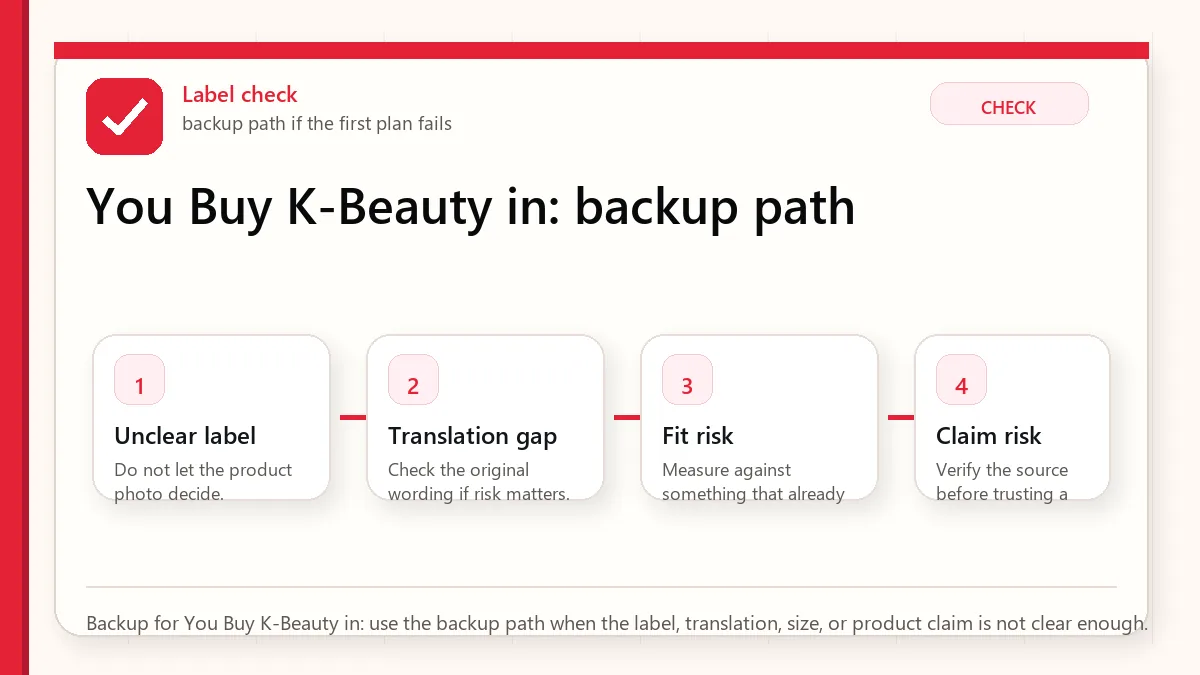
    Backup for You Buy K-Beauty in: use the backup path when the label, translation, size, or product claim is not clear enough.

    What to verify before you go

    The basket becomes too large

    Pause before checkout and remove anything without a clear role, recipient, or use date.

    A product claim sounds too strong

    Treat strong claims as marketing until you understand the ingredient, product category, and label language.

    Refund paperwork gets messy

    Keep passport and receipts together; do not pack refund goods where inspection would be impossible if requested.

    What to check before you rely on it

    SituationSafer defaultWhy
    Sensitive skinBuy fewer products and prioritize ingredient clarityA famous product can still be wrong for you
    Gift shoppingChoose sealed, easy-to-explain products with reasonable sizeThe recipient may not share your skin type
    Tax-refund focusBuy where the process is clearly supported and receipts are easy to manageRefund value is not worth airport stress if timing is tight

    Sources to re-check

    Use these pages for facts that can change by date, operator, airport, app version, store, or traveler status.

    Where to go next

    Official links to check

    Use these official links when the next step matters. This guide explains what to watch for, but app downloads, eligibility, prices, routes, policies, and service rules can change.

    FAQ

    Is Olive Young the only place to buy K-beauty?

    No. It is convenient, but department stores, duty-free shops, brand stores, pharmacies, and online channels can each make sense depending on your goal.

    Should I buy a full new routine in Korea?

    Usually, no. A few well-chosen products are easier to test and finish than a full routine bought under travel pressure.

    Can I rely on tax refund for every purchase?

    No. Eligibility depends on shop, amount, item, and current rules. Check at the store and keep documents.

  • Before You Visit Korea

    Before You Visit Korea

    Start with the first thing that can block the day

    A good first Korea plan is not a huge itinerary. It is a set of small decisions made before the pressure starts: entry paperwork, phone data, navigation, payment, transit, lodging area, and what you will do if one piece fails.

    Last checked: June 1, 2026. Re-check the official or primary source page before acting, because routes, prices, labels, rules, app screens, eligibility, and store/service policies can change.

    Last updated: May 23, 2026. Rules, app flows, prices, and eligibility can change, so re-check official sources close to your trip.

    Layered red check decision graphic for You Visit.
    For You Visit: check entry, phone, money, and first route before departure.

    How to use this hub guide

    Use this hub if you are building your first Korea trip from scratch or if your plan has scattered notes but no clear order. The goal is to make the first 24 hours easier, because that is when most preventable problems show up.

    This page links the most important Before Korea guides together. Read the broad checklist first, then move into airport transfer, T-money, eSIM, maps, money, and etiquette depending on the part of the trip that still feels uncertain.

    The checks that decide whether you are ready

    If you are decidingCheck this firstWatch out for
    Whether you are ready to enter Koreae-Arrival card and K-ETA statusThird-party lookalike sites and outdated visa notes
    How you will get onlineRoaming, eSIM, SIM, or Wi-Fi before airport exitA data-only plan may not solve phone-number verification
    How you will move on day oneAirport route, hotel address, transit card, and backup cashLate arrivals and heavy luggage change the best answer
    How you will payForeign card, ATM, small cash buffer, and T-money top-up methodOne failed card can slow down a kiosk, taxi, or station machine

    What to verify before you go

    • Save your hotel name, address, and nearest station in English and Korean.
    • Open every essential app once before departure rather than installing at the airport.
    • Prepare one offline copy of passport details, lodging address, and first route.
    • Check official sources for arrival forms and K-ETA because rules can shift by nationality and date.
    • Build a payment backup: one card, a second card, and a small amount of cash.

    A preparation path that keeps arrival day calm

    Start with the admin layer

    Confirm whether you need an e-Arrival card, K-ETA, visa, or other entry step. Do this from official Korean government pages, not from ads or unofficial application sites.

    Make the phone usable before landing

    Install maps, translation, messaging, and payment-support apps while you still have a calm connection. A Korea trip becomes harder when data setup is the first task after immigration.

    Plan the first route as a recovery plan

    Do not only choose the fastest airport route. Choose the route that still works if you are delayed, tired, carrying luggage, or arriving after the last convenient connection.

    Connect money to transit

    T-money, cards, cash, ATMs, and mobile payments overlap. Treat them as one system, because a transit problem often becomes a payment problem.

    Layered red check backup flow graphic for You Visit.
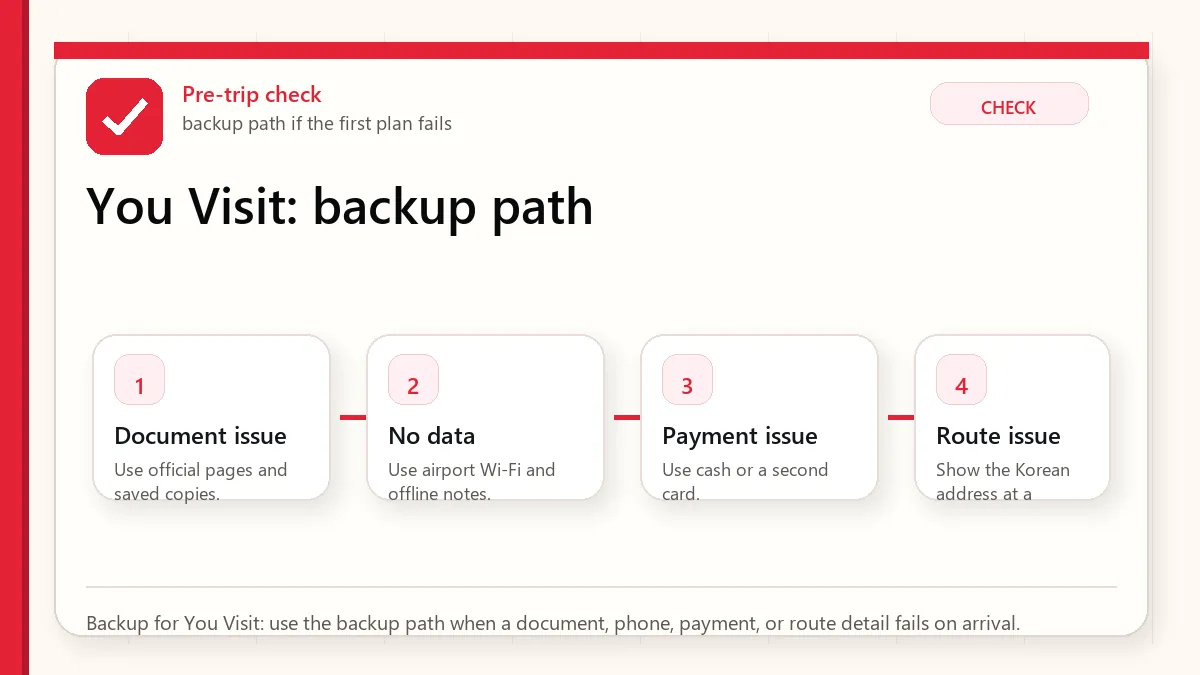
    Backup for You Visit: use the backup path when a document, phone, payment, or route detail fails on arrival.

    What to check before you rely on it

    The address does not search well

    Try the Korean name, nearby station, building name, and saved map pin. Keep a screenshot so you can show staff or a taxi driver without relying on pronunciation.

    The card fails at a kiosk

    Step out of the line, try another card if possible, and keep cash for transit-card top-ups or small purchases where card systems are awkward.

    The airport route no longer fits the arrival time

    Switch from ideal route to resilient route: airport bus for direct luggage movement, taxi for late-night recovery, or AREX plus short taxi if your hotel is near Seoul Station.

    The small check that changes the answer

    SituationSafer defaultWhy
    Short Seoul tripPrioritize airport transfer, Naver Map, T-money, and payment backupYou have less time to recover from small setup mistakes
    Shopping-heavy tripRead tax refund, Olive Young, sizing, and card/cash guides earlyReceipts, passport, luggage, and refund timing matter
    Food-focused tripPrepare translation, allergy phrases, ordering flow, and restaurant etiquetteMenus and kiosks can be harder than famous dish lists suggest

    Sources to re-check

    Use these pages for facts that can change by date, operator, airport, app version, store, or traveler status.

    Where to go next

    FAQ

    Do I need to read every guide before traveling?

    No. Read the checklist first, then focus on the parts that can block your first day: arrival, data, maps, payment, and transit.

    Is this a full itinerary?

    No. It is a preparation guide. It helps you make the practical decisions that support whatever itinerary you choose.

    Should I trust old Korea travel posts?

    Use older posts for general context only. For entry, airport, tax, app, and payment details, check official or current primary sources close to your trip.

  • Cash, Cards, and ATMs in Korea

    Cash, Cards, and ATMs in Korea

    Start with what can fail at payment

    Korea is card-friendly, but visitors should still carry some Korean won cash. Use cards for larger purchases when accepted, cash for backup and transit top-ups, and airport or authorized exchange services when you need money immediately after arrival.

    Last checked: June 1, 2026. Re-check the official provider, store, customs, or payment page before acting, because routes, prices, labels, rules, app screens, eligibility, and store/service policies can change.

    Money problems usually happen at the least convenient moment

    Korea is easy to pay in until the one exception appears: a foreign card block, an ATM that does not cooperate, a transit top-up that wants cash, or a small purchase where you did not prepare backup won. This guide is for keeping that exception small.

    Layered red check decision graphic for Cash Cards and ATMs.
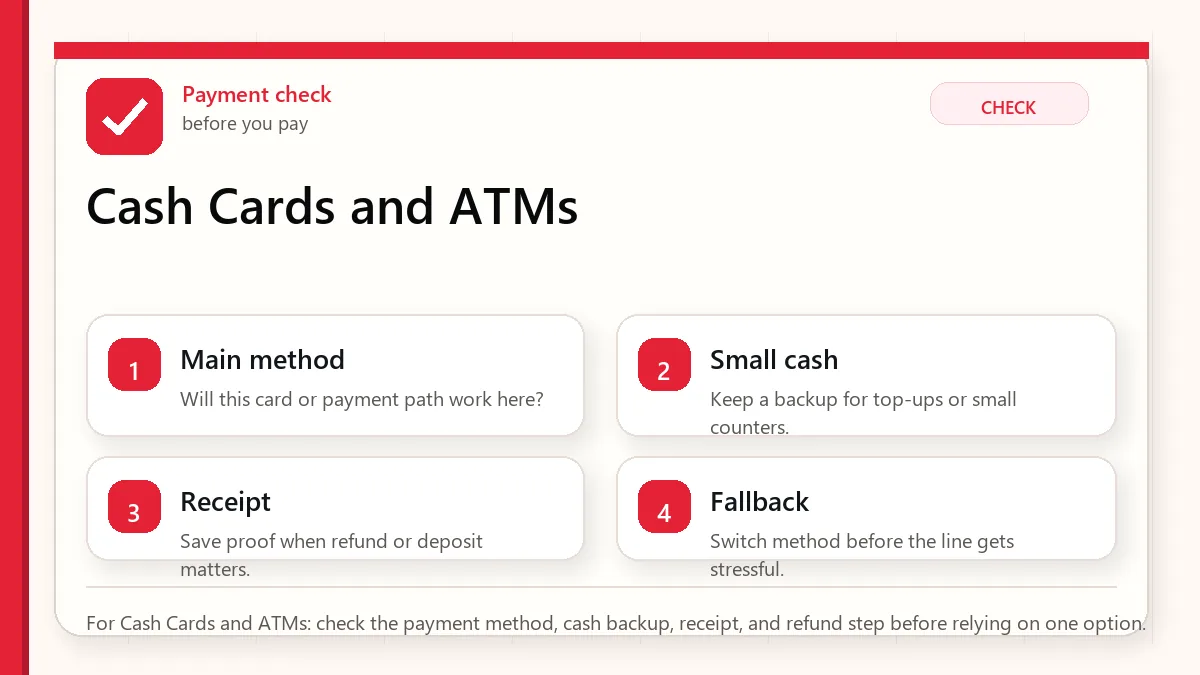
    For Cash Cards and ATMs: check the payment method, cash backup, receipt, and refund step before relying on one option.

    Money tools for Korea visitors

    ToolUse it forRiskBackup
    Credit/debit cardHotels, shops, restaurants, online-style purchases.Foreign card rejection or bank block.Second card and cash.
    Korean won cashSmall shops, markets, transit top-ups, emergencies.Loss and over-exchanging.Carry modest amount.
    Airport exchangeImmediate arrival cash.Rates and hours vary.Check official airport bank info.
    ATM withdrawalGetting cash during trip.Machine compatibility and bank fees.Use bank/airport ATMs and know your bank settings.

    Checks before relying on your main card

    • Check your bank’s overseas card and ATM settings.
    • Bring more than one card if possible.
    • Carry enough arrival cash or exchange at airport.
    • Know your daily ATM limit and fees.
    • Separate backup card/cash from your main wallet.

    Carry money in a way that gives you options

    • Use official exchange or bank counters when exchanging significant amounts.
    • Withdraw a modest amount rather than carrying all trip cash.
    • Keep small notes for street food, markets, or transit top-up.
    • Keep receipts for major purchases and tax refund.
    • Check statements for foreign transaction fees.
    • If an ATM fails, try another bank/airport ATM rather than repeated attempts at one machine.
    Layered red check backup flow graphic for Cash Cards and ATMs.
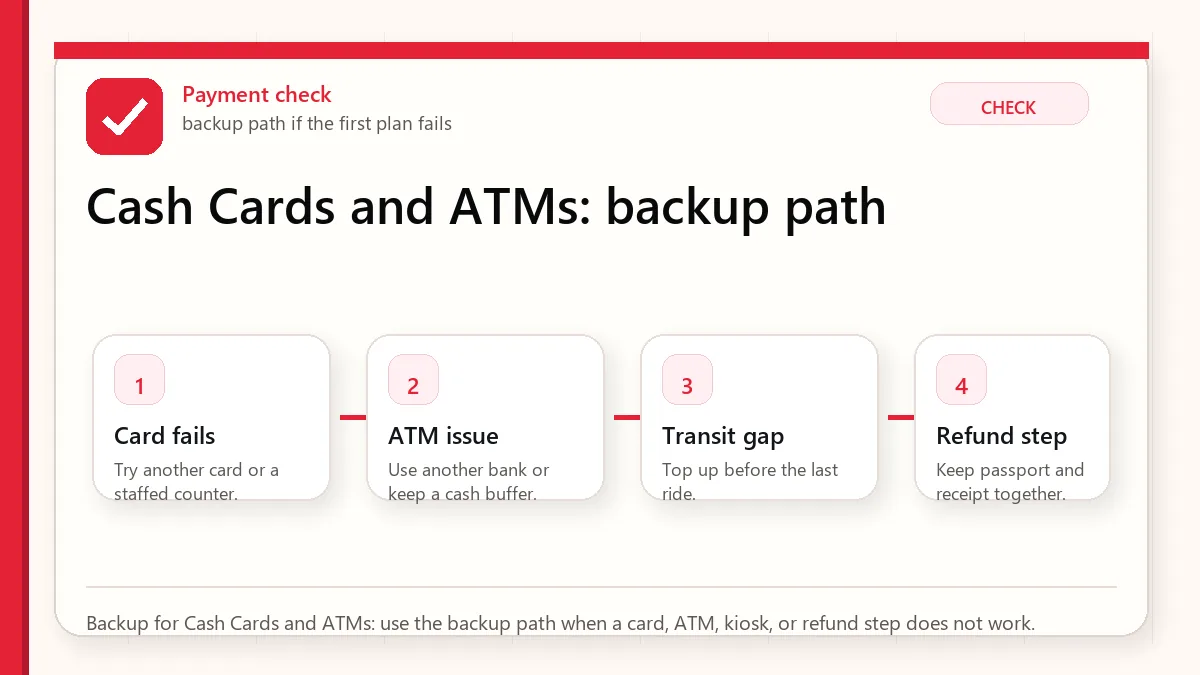
    Backup for Cash Cards and ATMs: use the backup path when a card, ATM, kiosk, or refund step does not work.

    Where cash and ATM plans usually fail

    ATM rejects your card

    Check network logo, overseas withdrawal settings, and try a different bank ATM.

    Card fails at a kiosk

    Try staffed counter, another card, or cash if accepted.

    You run out of small cash

    Exchange or withdraw before late-night travel and transit card top-ups.

    You over-exchange

    Spend down cash on transport and small purchases before departure, but keep enough for airport needs.

    Use different money habits for different parts of the day

    SituationBetter approachWhat to verify
    Arrival dayExchange or withdraw enough for first-day backup.Airport exchange hours and route needs.
    Transit-heavy tripKeep cash for card top-ups if needed.Top-up method and balance.
    Shopping dayUse card and keep passport/receipt for tax refund.Refund eligibility.
    Market or street foodUse small cash.Card acceptance.

    What not to assume about ATMs and cash

    • Do not assume every ATM accepts every foreign card.
    • Do not assume Korea being card-friendly means cash is useless.
    • Do not assume exchange counters have identical hours.
    • Do not assume your bank will allow overseas transactions by default.

    Small money habits that prevent avoidable stress

    Plan money by moment, not by trip average

    A visitor rarely needs the same payment setup all day. Airport arrival, subway top-up, convenience-store snacks, restaurant bills, shopping receipts, and late-night taxis each create different risks. A practical plan is to separate money into moments: arrival cash, daily spending card, transit top-up cash, emergency reserve, and one backup card stored away from the main wallet.

    Check the weak points before you leave

    The most common failure is not that Korea is impossible for foreign cards; it is that one card, one ATM, one kiosk, or one bank setting fails at the wrong moment. Before departure, confirm overseas use with your bank, know your withdrawal limit, and keep the card issuer phone number somewhere offline. That preparation is boring, but it prevents a payment problem from becoming a travel problem.

    Read next when cash connects to payment, transit, or tax refund

    This topic works best when it is not handled alone. Use the related guides below to connect the decision with maps, money, food, shopping, transit, and app backup planning.

    Related Before Korea guides

    Official links to check

    Use these official links when the next step matters. This guide explains what to watch for, but app downloads, eligibility, prices, routes, policies, and service rules can change.

    FAQ

    Do I need cash in Korea?

    Yes, as backup. Cards are widely used, but cash can still matter for top-ups, small purchases, and emergencies.

    Where should I exchange money?

    VISITKOREA recommends banks or authorized exchange service centers, and airport exchange is often easiest on arrival.

    Are foreign cards accepted?

    Many major businesses accept international cards, but check availability and keep a backup.

    Source links to verify

    Last updated

    Last updated: 2026-05-23. Re-check official sources close to the day you travel, buy, eat, or use an app. Details involving prices, eligibility, transport, app features, opening hours, and refund rules can change.

  • Google Maps vs Naver Map in Korea

    Google Maps vs Naver Map in Korea

    Use Google Maps in Korea for saved places, broad planning, and a familiar interface, but keep Naver Map or Kakao Map ready for local search, subway exits, bus stops, Korean place names, and the final walk to the door.

    Last checked: June 1, 2026. Re-check the official app, service, or app-store page before acting, because routes, prices, labels, rules, app screens, eligibility, and store/service policies can change.

    Last updated: May 27, 2026. Routes, fares, stops, station exits, app listings, and operating hours can change, so re-check before you move.

    Layered red check decision graphic for Map app choice.
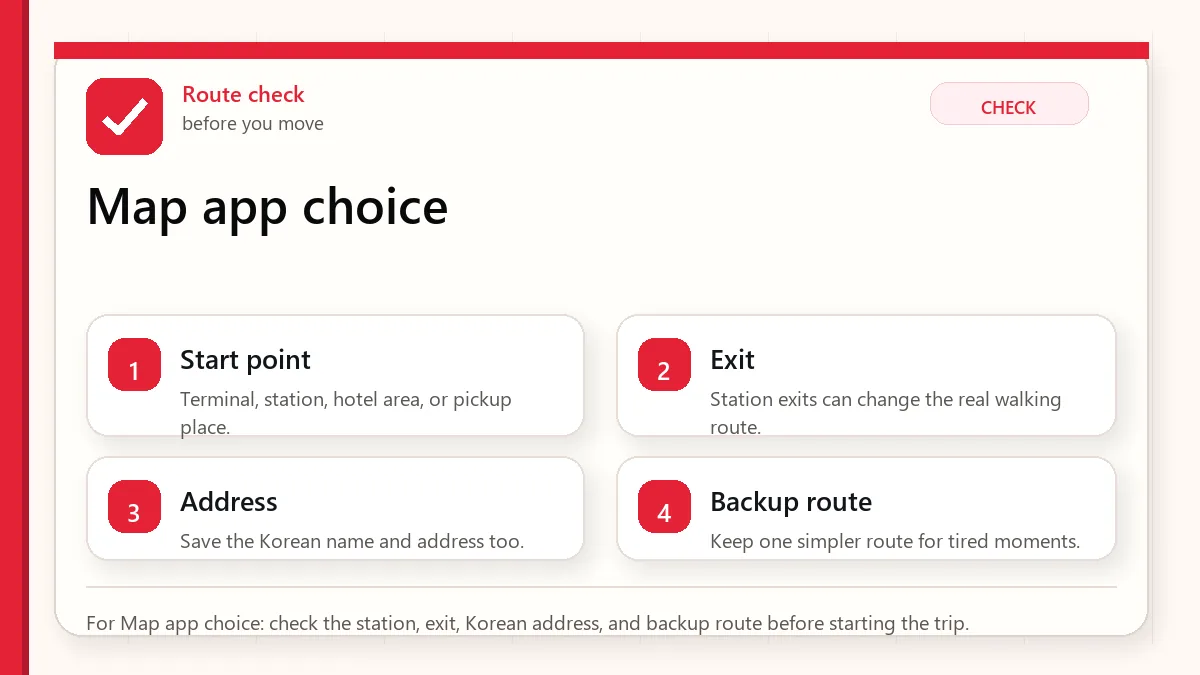
    For Map app choice: check the station, exit, Korean address, and backup route before starting the trip.

    Start with the place name and exit

    If you are visiting Korea in 2026, use Google Maps for planning, lists, broad orientation, and places you already saved. Use Naver Map for local search, public transit checks, station exit details, bus stops, walking approaches, and Korean-language place matching. If Google improves during your trip, great. If it does not, you are still ready.

    What changed in 2026?

    The big change is policy-level, not a guarantee that every travel route is immediately perfect. Korea’s conditional approval of Google map data export is important because it may allow Google to improve local navigation and mapping functions. But app behavior can roll out gradually, and visitors often travel during transition periods. A guide that says “Google Maps is useless” is outdated; a guide that says “Google Maps now solves everything” is careless.

    Before Korea’s operating advice is conservative: test your hotel-to-station route, your airport route, and one restaurant route after arrival. If Google and Naver disagree, check the Korean business name, station exit, and recent reviews before moving.

    Where Google Maps still helps

    • Saving hotels, restaurants, and attractions before the trip.
    • Sharing place lists with travel companions who already use Google.
    • Getting broad city orientation and walking sense before switching apps.
    • Checking international-style reviews or photos for tourist-heavy places.
    • Comparing approximate distance between neighborhoods.

    Where Naver Map is still stronger for visitors

    • Searching local businesses by Korean name, English name, or copied address.
    • Checking subway exits and bus stop names.
    • Finding restaurants, cafes, pharmacies, clinics, and small stores that locals actually use.
    • Seeing details that may be fresher in Korea’s local map ecosystem.
    • Matching a place from a Korean website, Instagram post, or reservation message.
    Layered red check backup flow graphic for Map app choice.
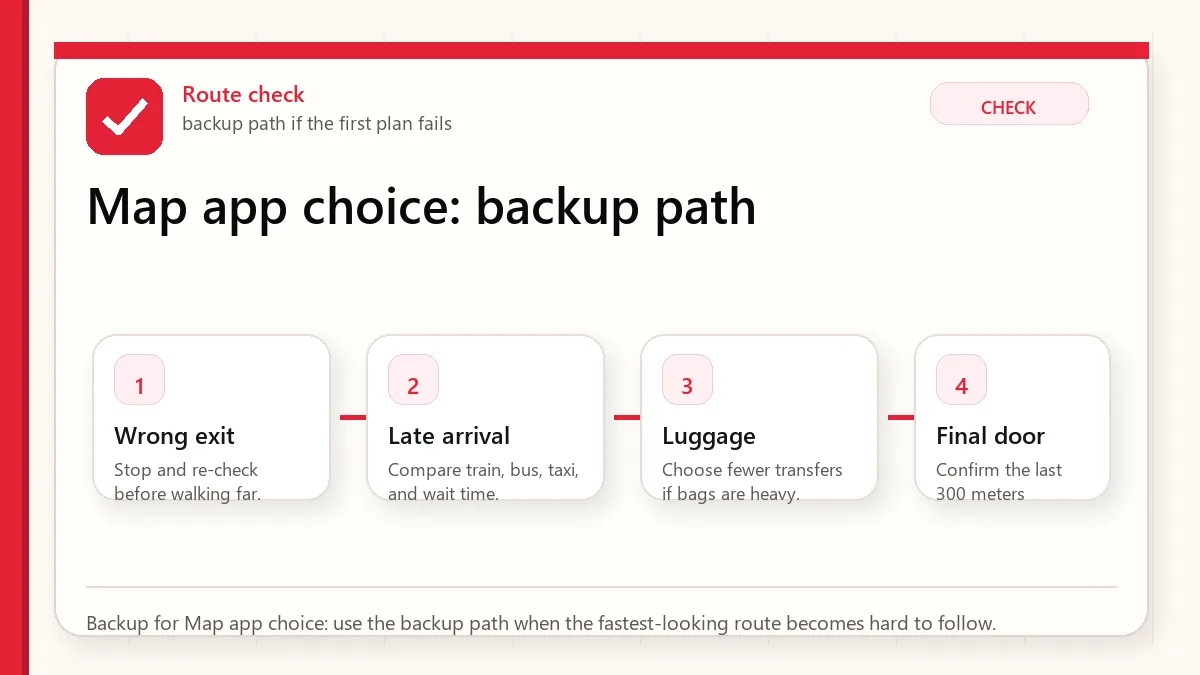
    Backup for Map app choice: use the backup path when the fastest-looking route becomes hard to follow.

    The two-map workflow that works best

    Start with the app you understand, but confirm with the app Korea understands. Save your hotel and major attractions in Google Maps if that is comfortable. Then search the same places in Naver Map, save them there, and check the nearest station exit. For restaurants, copy the Korean name from the restaurant’s website, Naver listing, or booking page. For taxis, use the destination’s Korean address if possible.

    This sounds like extra work, but it prevents the classic visitor mistake: arriving near the right block but on the wrong side of a large station, underground mall, or multi-building complex.

    How to reduce search errors

    • Save your hotel in both apps before leaving the airport.
    • Screenshot the Korean address and phone number of your hotel.
    • Use station exit numbers as landmarks, not just the station name.
    • For restaurants, match photos and floor numbers, not just the English name.
    • If a route looks odd, compare Naver Map, KakaoMap, and the subway app.

    Official links to check

    Use these official links when the next step matters. This guide explains what to watch for, but app downloads, eligibility, prices, routes, policies, and service rules can change.

    FAQ

    Can I use only Google Maps in Korea?

    You might be able to for simple trips, especially as Google updates continue. But for a first visit, relying on only one app is unnecessary risk. Install Naver Map as backup.

    Is Naver Map available in English?

    Naver provides language settings and multilingual support, but not every local review, menu, or business detail will feel fully translated. That is why copy-paste and translation apps still help.

    Which map should I use for taxis?

    Use the destination address from Naver Map or the business’s Korean listing when possible. Taxi drivers and ride-hailing apps usually handle Korean place data more reliably.

    Will Google Maps keep improving in Korea?

    It may, especially after the 2026 map-data approval, but visitors should verify current app behavior close to their trip date.

    Three route types to compare

    Hotel to landmark routes are usually forgiving. Even if one app is imperfect, the destination is famous and there are many signs. Hotel to small restaurant routes are less forgiving because branches, floor numbers, alleys, and Korean names matter. Late-night return routes need the most caution because transit frequency, taxi pickup points, and walking comfort change after dark.

    Before depending on one app, test all three route types. If Google Maps performs well for your hotel, your first restaurant, and a late-night route, you can use it more confidently. If it struggles with Korean place names, station exits, or buses, keep Naver Map as the primary tool.

    How to tell if a search result is probably safe

    • The English name, Korean name, and address point to the same place.
    • Recent photos match the storefront or building.
    • The business phone number matches the official website or booking page.
    • The station exit makes sense when checked on Naver Map.
    • Reviews mention the same branch, not a similarly named location elsewhere.

    What to save offline

    Save screenshots of your hotel address in Korean, nearest station exit, airport route, and one taxi-friendly destination card. If your data plan fails or a driver asks for the address, the screenshot is faster than explaining an English hotel name in a noisy street.

    Related guides

    Use these guides together rather than treating one article as the whole plan.

    Sources checked for this update

    Before Korea treats operational details as changeable. Check the official pages below before a trip or a large purchase.

  • Korean Clothing Size to US Guide

    Korean Clothing Size to US Guide

    Korean clothing sizes often run narrower or shorter than foreign shoppers expect, but one conversion chart is not enough. The safest way to buy clothes in Korea is to compare Korean size labels with centimeter measurements from clothes that already fit you.

    Last updated: May 27, 2026. Product labels, prices, tax refund handling, return rules, store policies, and stock can change, so re-check before buying.

    Layered red check decision graphic for Korean size labels.
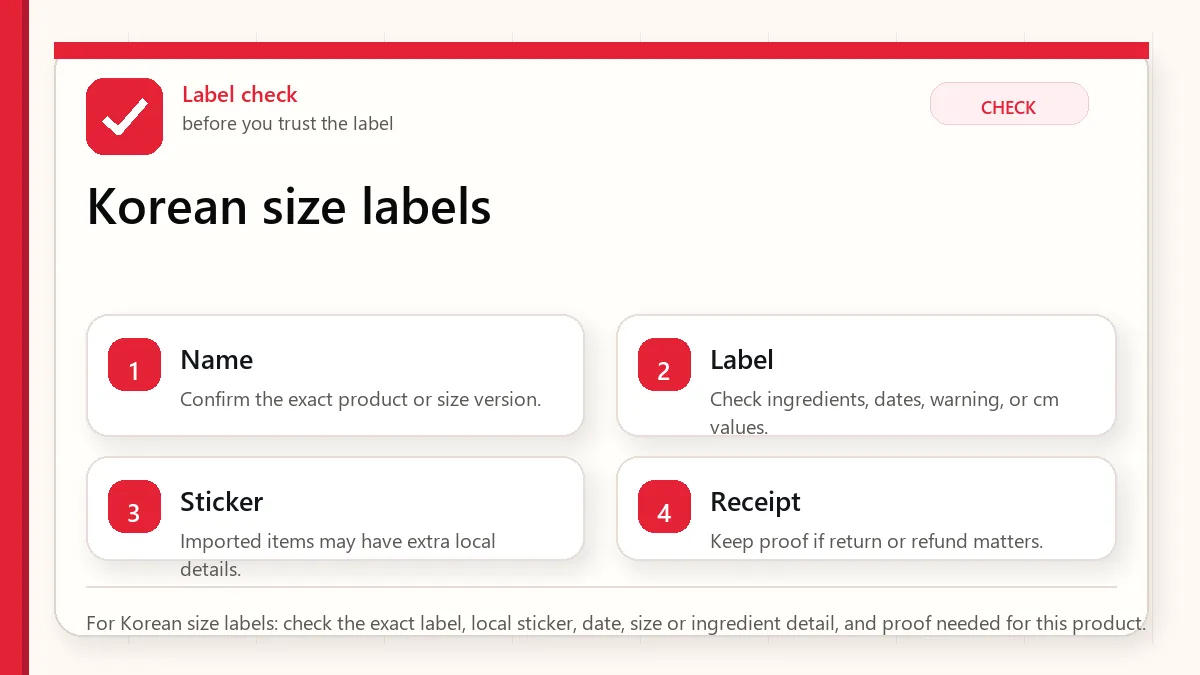
    For Korean size labels: check the exact label, local sticker, date, size or ingredient detail, and proof needed for this product.

    Korean shirt size to US: the safer way to compare

    A rough shirt conversion can help you start, but it should never be the final decision. Korean men’s tops often use numbers like 95, 100, 105, or 110. Women’s clothing may use 44, 55, 66, 77, 88, or letter sizes such as S, M, L. But brands cut differently, oversized styles are common, and some boutiques carry only one or two sizes.

    Korean label you may see Often feels like What to check
    Men’s 95 Small to slim medium in some brands. Chest width, shoulder width, sleeve length.
    Men’s 100 Medium in many local charts. Whether the fit is slim, regular, or oversized.
    Men’s 105 Large in many local charts. Chest, shoulder, and total length.
    Women’s 55 Small in many local charts. Bust, waist, shoulder, and fabric stretch.
    Women’s 66 Medium in many local charts. Actual garment width, not just label.
    Free size One limited size range, not universal. Flat measurements and model info.

    Use this table as a starting map, not a promise. A Korean size 100 in a relaxed sweatshirt can feel larger than a 100 in a slim dress shirt. A “free size” cardigan can fit many bodies, while a “free size” blouse with no stretch may be narrow at the shoulders or bust. The number is only a label; the garment measurements are the truth.

    The measurement method that prevents most mistakes

    Before shopping seriously, measure one item you already own and like. Lay it flat. Measure shoulder width, chest width from armpit to armpit, sleeve length, total length, waist, rise, thigh, hip, and inseam depending on the garment. Save those numbers in centimeters in your phone. Korean stores and online shops often list dimensions in centimeters, so this simple note becomes your personal size converter.

    • Shoulder width: important for shirts, jackets, blazers, coats, and dresses.
    • Chest width: double the flat width if comparing to body chest circumference.
    • Total length: determines whether a top is cropped, regular, or long on you.
    • Waist and hip: critical for skirts, pants, and fitted dresses.
    • Inseam: protects taller shoppers from ankle-length surprises.
    • Fabric stretch: can decide whether a small difference matters.
    Layered red check backup flow graphic for Korean size labels.
    Backup for Korean size labels: use the backup path when the label, translation, size, or product claim is not clear enough.

    What free size means in Korea

    “Free size” does not mean one size fits every visitor. It usually means the item is sold in one size and designed to fit a limited range. That range may be generous for loose knits, cardigans, sweatshirts, or elastic-waist skirts. It may be narrow for fitted shirts, blouses, coats, mini skirts, tailored pants, and non-stretch dresses.

    If a free-size item lists a model height and weight, use it as context, not as judgment. Look at shoulder seams, sleeve length, where the waist hits, and whether the model is wearing an intentionally oversized style. A free-size item that looks oversized on a petite model may fit a taller shopper as regular, cropped, or tight.

    Why Korean clothes may feel smaller

    Several factors combine. Many Korean fashion brands design around local fit preferences and model proportions. Street shops may buy from wholesalers that produce limited size runs. Boutiques may focus on visual style rather than inclusive sizing. Some clothes are meant to be worn slim, cropped, or neat. Other pieces are intentionally oversized, but oversized in Korea still follows a specific shoulder and length logic.

    This does not mean foreign shoppers cannot buy Korean clothes. It means the best shoppers stop asking “Am I a medium?” and start asking “What are the measurements?” Once you use centimeters, Korean shopping becomes much less mysterious.

    Online shopping: read the Korean size chart

    Online Korean fashion stores often provide a size table with terms such as shoulder, bust/chest, sleeve, armhole, hem, waist, hip, rise, thigh, and length. Translation apps can help, but check the diagram or product photos too. Some charts use flat garment measurements. Others may use body recommendations. If the chart says there can be a 1-3 cm difference due to measuring method, do not cut it too close.

    Korean chart clue Meaning for shoppers
    cm measurements Best signal. Compare to your own garment.
    Model size Useful context, but not enough by itself.
    Fabric content Stretch, thickness, and lining affect fit.
    Fit description Slim, regular, loose, oversized, cropped, long.
    Exchange and return policy Check before paying, especially for sale items.

    In-store shopping in Seoul

    In major shopping areas, some stores allow trying on clothes and some do not, especially for light tops, white garments, sale items, or small boutiques. Ask before assuming. If trying on is not possible, compare the garment to your body quietly: shoulder seam to shoulder, waistband around your waist, sleeve against your arm, and length against a similar item you are wearing. This is not perfect, but it is better than buying only by label.

    For shoppers who usually need extended sizes, Korean street boutiques can be hit or miss. Larger department stores, global brands, sportswear shops, select shops, men’s sections, oversized streetwear brands, and online global shipping options may be easier than small one-size boutiques. If clothing is a major trip goal, build time to browse rather than expecting every shop to fit.

    Shoes are easier because Korea uses millimeters

    Korean shoe sizing is often shown in millimeters, such as 230, 240, 250, 260, or 270. This can be clearer than clothing labels because it is tied to foot length. Still, width matters. If you have wide feet, high arches, or need orthopedic support, try shoes in person when possible. Some fashion shoes may run narrow even when the length is correct.

    Return and exchange caution

    Do not assume return rules are the same as your home country. Small shops, market stalls, discounted items, cosmetics, undergarments, accessories, and opened packaging can have strict rules. Ask before payment if size is uncertain. For online purchases, check whether exchanges are possible from your country, whether return shipping is realistic, and whether sale items are final.

    Before-you-buy checklist

    • Save your best-fitting garment measurements in centimeters.
    • Check shoulder, chest, and length for tops before caring about S/M/L.
    • For pants, check waist, hip, rise, thigh, and inseam.
    • Treat free size as limited size, not universal size.
    • Ask about fitting rooms and return rules before paying.
    • If between sizes, consider fabric stretch, silhouette, and whether you can exchange it.

    The foreign shopper’s size workflow

    Use this workflow every time you are unsure. First, ignore the label for a moment. Second, find the centimeter chart. Third, compare the chart to a garment you already own, not to your body in a rushed fitting room. Fourth, check the fabric and silhouette. Fifth, decide whether you can exchange or return it if the fit is wrong.

    Question Why it matters Safer action
    Is this slim, regular, or oversized? The same number can fit very differently. Look at shoulder drop, chest width, and model fit.
    Is the chart flat or body measurement? Flat chest width and body chest are not the same. Compare like with like and double flat widths when needed.
    Does the fabric stretch? One or two centimeters can matter in non-stretch fabric. Be stricter with cotton shirts, denim, coats, and blazers.
    Can I return or exchange? Tourist purchases can be final or inconvenient to return. Ask before paying, especially at boutiques and markets.

    Korean size words to recognize

    Even if you do not read Korean comfortably, recognizing a few chart words helps. 어깨 means shoulder, 가슴 means chest or bust, 총장 means total length, 소매 means sleeve, 허리 means waist, 엉덩이 means hip, 밑위 means rise, and 안감 means lining. Translation apps can read these, but knowing what they refer to keeps you from comparing the wrong numbers.

    If a shop only gives S/M/L with no centimeter chart, treat the purchase as higher risk. That does not mean never buy it. It means the price, return rule, fabric stretch, and how badly you want the item should all be part of the decision.

    If your question is specifically shirt size

    If you searched for “korea shirt size,” “korean size to us,” or “korean xxl size,” use the dedicated Korea shirt size guide for foreigners. This broader page covers clothing size habits across tops, shoes, free size, shopping, and return risk; the shirt guide goes deeper into 95, 100, 105, free size, XXL, and flat centimeter measurements.

    Official and internal checks to use with this guide

    There is no single official tourist conversion chart that can guarantee fit across Korean brands. That is exactly why this guide uses a measurement workflow instead of pretending one chart solves everything. For shopping planning, connect this with Before You Shop in Korea, What to buy in Korea, Korea tax refund for tourists, and What not to buy in Korea.

    FAQ

    What is a Korean shirt size 100 in US size?

    It often works as a medium starting point for men’s tops, but it depends on the brand and fit. Check chest width, shoulder width, sleeve length, and total length in centimeters.

    What does Korean free size mean?

    It means the garment is sold in one size. It may fit a limited range, but it is not a universal one-size-fits-all promise.

    Do Korean clothes run small?

    Some do, especially slim, boutique, and one-size items. Others are intentionally oversized. Measurements matter more than the general stereotype.

    Should I buy clothes in Korea if I cannot try them on?

    Only if the measurements, fabric, and return risk make sense. For expensive pieces, do not buy blind unless you can absorb the risk.

    Related guides

    Sources and verification notes

    Use these sources to re-check app, identity, labeling, or travel details close to the day you act. App flows and eligibility can change.

    Last checked: June 2, 2026. Re-check the latest product label, store policy, and official refund or safety page before buying because sizing, stock, labels, and return rules can change.

  • Public Etiquette in Korea

    Public Etiquette in Korea

    Start with the situation, not a rule list

    In Korea, good public etiquette usually means staying aware of shared space: keep noise moderate, queue calmly, do not block transit flow, handle trash responsibly, respect priority seats, and follow smoking or food rules in the place you are using.

    Last checked: June 1, 2026. Re-check the official or primary source page before acting, because routes, prices, labels, rules, app screens, eligibility, and store/service policies can change.

    Most etiquette is reading the room early

    Visitors do not need to memorize a long list of rules to be considerate in Korea. The better habit is to pause for a few seconds, notice the local flow, and avoid taking up more noise, space, or time than the situation expects.

    Layered red check decision graphic for Public Etiquette in.
    For Public Etiquette in: check context, space, timing, and tone before acting in shared places.

    Shared-space etiquette by location

    PlaceBetter habitWhy
    Subway/busKeep bags close, let people exit first, avoid blocking doors.Transit flow matters in crowded cities.
    CafesOrder before occupying space when expected and keep noise reasonable.Cafes can be busy work and study spaces.
    StreetStep aside before stopping for maps or photos.Sidewalks and station exits move fast.
    QueuesFollow the visible line and wait your turn.Line discipline reduces conflict.
    TrashCarry small trash until proper disposal is available.Public bins may be limited in some areas.

    Checks before entering a shared space

    • Observe how people move before stopping in a crowded place.
    • Keep a small bag for personal trash.
    • Use headphones for videos and calls.
    • Check smoking signs and designated areas.
    • Use translation or signs when a rule is unclear.

    Move with the local rhythm

    • Let passengers exit before boarding.
    • Stand to the side on escalators or follow local signage and flow.
    • Keep conversation volume lower in transit and quiet spaces.
    • Do not leave cups, food, or trash on random ledges.
    • At cafes, understand whether seating is for customers only.
    • If corrected, adjust calmly rather than arguing.
    Layered red check backup flow graphic for Public Etiquette in.
    Backup for Public Etiquette in: use the backup path when you are unsure of the local flow.

    Where visitors accidentally stand out

    You block a station exit while checking your phone

    Step to the wall or a wider area before navigating.

    You cannot find a trash bin

    Carry the trash until you find a proper bin, store, hotel, or station area that accepts it.

    You sit in a priority area

    Move if someone who needs it boards, and follow signage.

    You are unsure about smoking

    Use designated smoking areas only and check local signs.

    Use the setting to decide the behavior

    SituationBetter approachWhat to verify
    Crowded commuteKeep bag close and minimize phone-stopping.Doors, stairs, and escalators.
    Cafe work sessionBuy appropriately and keep noise low.Outlet and seat rules.
    Street photographyAvoid blocking storefronts or pedestrians.Privacy and flow.
    Nightlife areaStay aware of noise and trash.Local rules and safety.

    What not to assume about public space

    • Do not assume public trash bins are everywhere.
    • Do not assume loud calls are acceptable in quiet transit spaces.
    • Do not assume cafe seating rules are identical across stores.
    • Do not assume smoking is allowed just because you are outdoors.

    Small habits that make shared spaces feel easier

    Observe the rhythm before acting

    Many etiquette problems are not about complicated rules. They happen because a visitor moves faster than the local flow: boarding before others exit, standing in a doorway, speaking loudly in a quiet carriage, or blocking a shop counter while deciding. A few seconds of observation usually tells you where to stand, when to move, and whether a space is meant for quick use or lingering.

    Shared spaces are the real test

    Cafes, trains, elevators, convenience stores, and narrow streets are where small habits become noticeable. Keep bags close, leave priority seating available, avoid sudden stops in walking lanes, and handle trash carefully because public bins can be less available than expected. These habits are simple, but they make the trip smoother for both visitor and local people nearby.

    Read next when etiquette connects to transit, food, or stores

    This topic works best when it is not handled alone. Use the related guides below to connect the decision with maps, money, food, shopping, transit, and app backup planning.

    Related Before Korea guides

    FAQ

    Is Korea strict about public etiquette?

    Many rules are common-sense shared-space habits. Observing local flow prevents most problems.

    Can I eat on public transport?

    Avoid messy or strong-smelling food on transit. Follow signs and local norms.

    What if I make a mistake?

    Adjust politely and move on. Most etiquette issues are solved by paying attention quickly.

    Source links to verify

    Last updated

    Last updated: 2026-05-23. Re-check official sources close to the day you travel, buy, eat, or use an app. Details involving prices, eligibility, transport, app features, opening hours, and refund rules can change.