Author: user

  • Korea Airport Train Guide: AREX Express vs All-Stop Train from Incheon Airport

    Korea Airport Train Guide: AREX Express vs All-Stop Train from Incheon Airport

    The Korea airport train is one of the cleanest ways to leave Incheon Airport, but tourists often get confused by the difference between AREX Express and the all-stop airport railroad. Both are trains. They do not serve the same travel style.

    Last checked: June 1, 2026. Re-check the official operator, app, fare, or route page before acting, because routes, prices, labels, rules, app screens, eligibility, and store/service policies can change.

    Last updated: May 26, 2026.

    The right choice depends on your hotel area, luggage, budget, transfer tolerance, arrival time, and whether Seoul Station is actually convenient for you. This guide helps you decide before you follow the first sign you see.
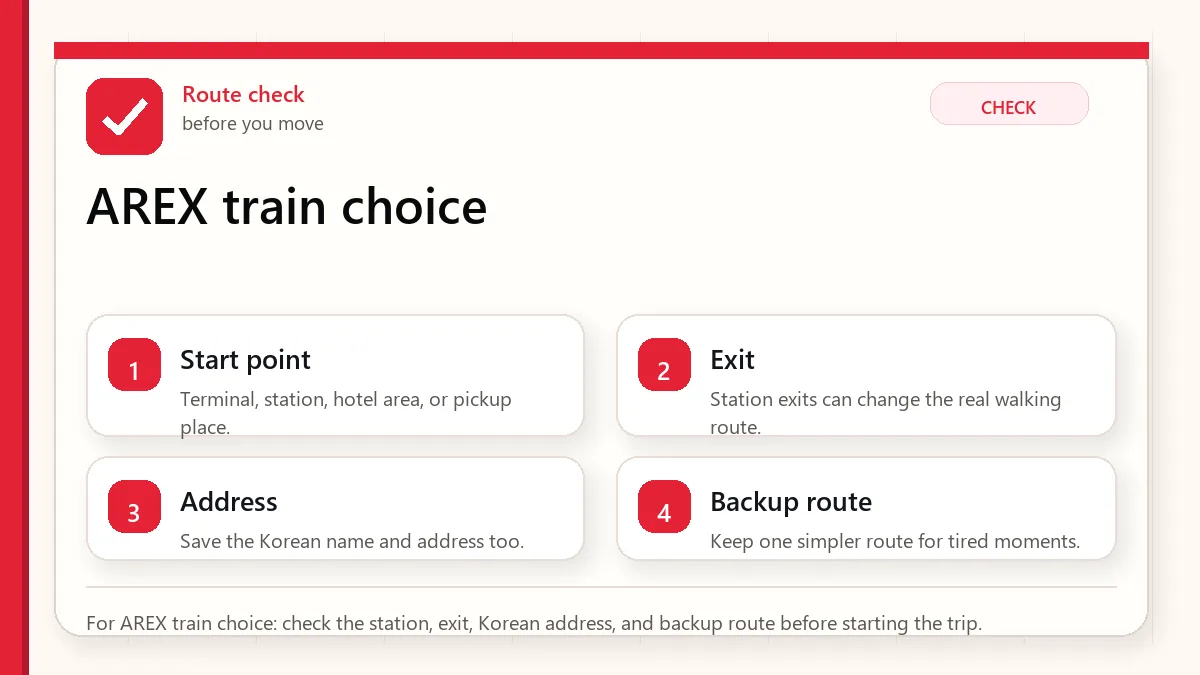
    Layered red check decision graphic for AREX train choice.
    For AREX train choice: check the station, exit, Korean address, and backup route before starting the trip.

    Start with the first transfer after landing

    Choose AREX Express when Seoul Station is your clear transfer point and you want a reserved, direct airport train. Choose the all-stop train when your destination connects better through stations along the airport railroad line.

    When this matters

    This matters when you are arriving at Incheon Airport and deciding between train, bus, taxi, and hotel-area transfer routes.

    Decision table

    SituationBest moveWhy it matters
    Staying near Seoul StationAREX Express can be convenientDirect service fits the destination.
    Staying near HongdaeAll-stop may fit betterHongik University is on the airport railroad line.
    Heavy luggageReduce transfersThe best route is the one you can carry.
    Late arrivalCheck final train and bus backupSchedules matter after immigration and baggage delay.

    How to make the decision

    Use the table as a filter, not as a rule to memorize. The right answer depends on your exact route, phone setup, luggage, arrival time, payment method, and how much uncertainty you can tolerate on that day. For this topic, the first question is: staying near seoul station. If that sounds like your situation, the safest starting point is to arex express can be convenient because direct service fits the destination..

    The second question is whether the choice still works when the trip becomes less ideal: late arrival, rain, low battery, no Korean phone call, a crowded station, a tired group, or a hotel address that is hard to explain. Those imperfect moments are where travelers usually lose time.

    Step-by-step setup

    • Before landing, identify your exact hotel area and nearest station.
    • Check whether Seoul Station is truly useful or just a famous transfer point.
    • Compare AREX Express, all-stop train, airport limousine bus, and taxi for your address.
    • Allow time for immigration, baggage claim, SIM pickup, restroom, and ticket purchase.
    • If you arrive late, check the last train before choosing a route.

    Before you rely on it

    Do one small test before the situation becomes urgent. Search the destination, open the app, check the route, confirm the address, read the current official page, or ask the hotel desk while you still have time. A five-minute test at the hotel is easier than troubleshooting in a taxi line, subway transfer, airport terminal, or restaurant doorway.

    Also separate what is convenient from what is required. A tool can be convenient without being essential. A card can be useful without replacing every payment method. A phone number can help without solving real-name verification. A train can be fast without being the easiest route with luggage. That distinction is the main habit that prevents bad decisions.

    Where travelers get stuck

    • Taking AREX Express only because it sounds faster, then making a hard transfer afterward.
    • Ignoring elevator access and walking distance with luggage.
    • Assuming Hongdae, Myeongdong, Gangnam, and Jamsil have the same airport-train convenience.
    • Forgetting that the best route changes at night.
    • Buying a ticket before checking terminal, train type, and hotel station.

    Realistic travel scenario

    If your hotel is in Hongdae, the all-stop train may avoid an unnecessary Seoul Station transfer. If your hotel is near Seoul Station, AREX Express can be very comfortable. If you stay in Gangnam, compare airport bus and taxi too because the train route may require transfers.

    Backup plan if the first choice fails

    Have one fallback that does not depend on the same weak point. If the app fails, use a saved Korean address, hotel desk, official counter, taxi stand, convenience store, or simpler route. If payment fails, switch to another card or cash. If translation fails, use shorter sentences and confirm with a person. If timing fails, choose the option that protects the flight, hotel check-in, medicine, or safety issue first.

    • Most likely failure: Taking AREX Express only because it sounds faster, then making a hard transfer afterward.
    • Fastest prevention step: Before landing, identify your exact hotel area and nearest station.
    • Most useful saved item: Hotel station and Korean address
    • Best mindset: solve the next practical step instead of trying to force the perfect plan.
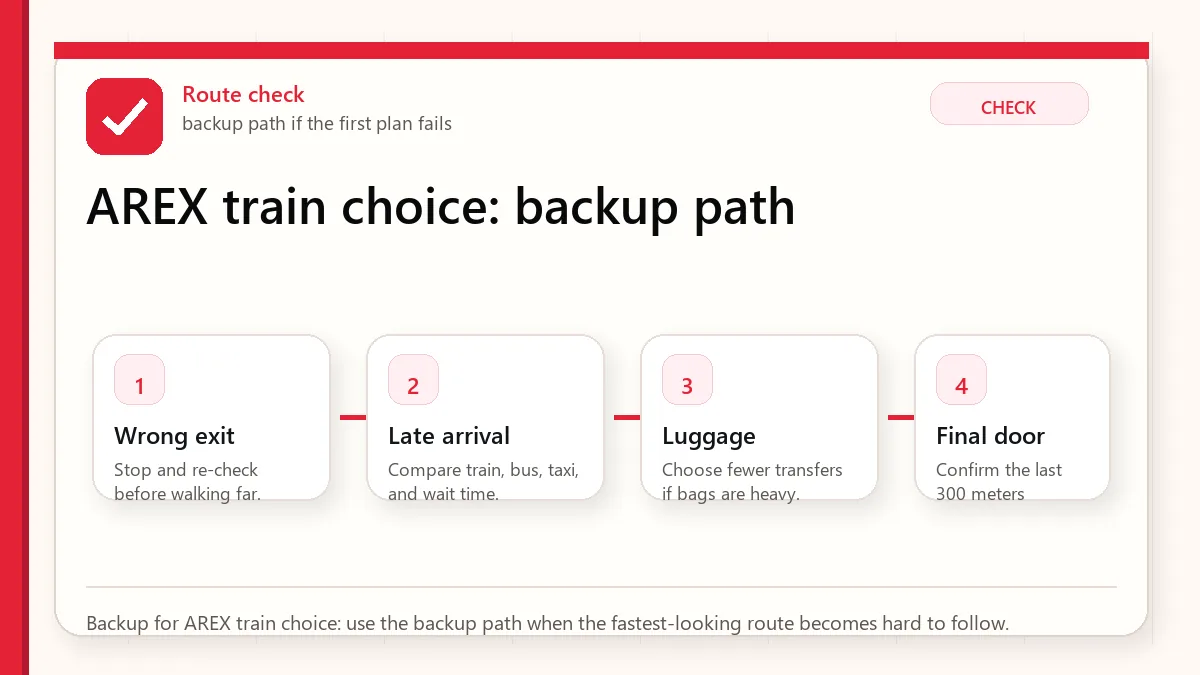
    Layered red check backup flow graphic for AREX train choice.
    Backup for AREX train choice: use the backup path when the fastest-looking route becomes hard to follow.

    What to save before you need it

    • Hotel station and Korean address
    • AREX or airport railroad route
    • Last train time
    • Airport bus backup
    • Taxi estimate for late arrival

    FAQ

    Is AREX Express always better?

    No. It is better when Seoul Station fits your route. The all-stop train can be better for destinations along the airport railroad line.

    Can I take the airport train with luggage?

    Yes, but transfer difficulty matters. Choose routes with fewer stairs and less walking if your bag is heavy.

    Should I buy a ticket in advance?

    It depends on your route and arrival confidence. First-time visitors should understand the train type before buying.

    Related guides

    Official links to check

    Use these official links when the next step matters. This guide explains what to watch for, but app downloads, eligibility, prices, routes, policies, and service rules can change.

    Sources and official checks

    App screens, entry rules, fares, and official procedures can change. Use the links below to re-check details before you rely on one route, app, card, or declaration step.
  • Korea Taxi Fare Guide for Tourists: Base Fare, Night Surcharge, Airport Trips, and App Taxis

    Korea Taxi Fare Guide for Tourists: Base Fare, Night Surcharge, Airport Trips, and App Taxis

    A Korea taxi fare search usually means one of two things: you are planning an airport ride, or you are standing outside wondering whether the taxi will be expensive. The answer depends on city, distance, time of day, taxi type, traffic, tolls, and whether a surcharge applies.

    Last checked: June 1, 2026. Re-check the official app, service, or app-store page before acting, because routes, prices, labels, rules, app screens, eligibility, and store/service policies can change.

    Last updated: May 26, 2026.

    This guide is not a fixed fare chart. Taxi fares can change and local details vary. It gives tourists a practical way to estimate risk, avoid surprises, and decide when a taxi is worth it compared with subway, bus, airport train, or ride-hailing apps.

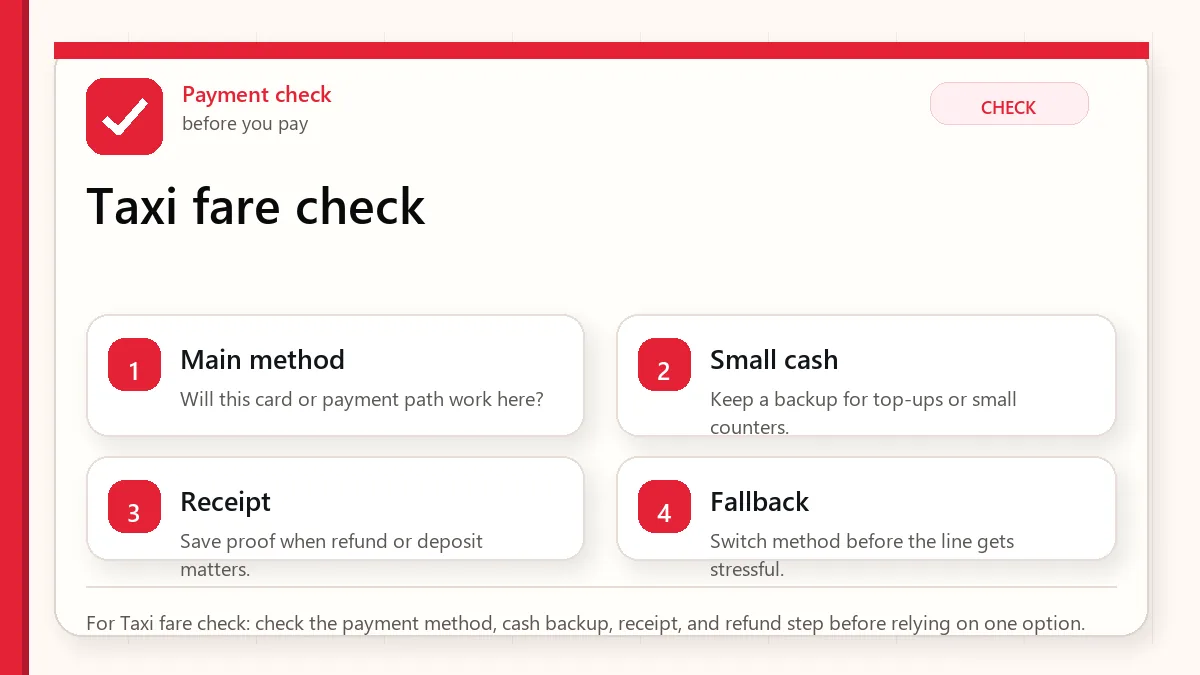
    Layered red check decision graphic for Taxi fare check.
    For Taxi fare check: check the payment method, cash backup, receipt, and refund step before relying on one option.

    Start with what can fail at payment

    Use the meter or official/app estimate, expect late-night and airport-related surcharges, and keep a payment backup because foreign cards may not work in every situation.

    When this matters

    This matters when you are comparing taxi, subway, airport train, bus, and app taxi options in Korea without wanting to memorize every fare rule.

    Decision table

    SituationBest moveWhy it matters
    Short city rideCheck traffic and meterA short ride can still feel slow in congestion.
    Late nightExpect surcharge riskNight rides can cost more and apps may be busy.
    Airport routeCompare taxi with AREX or busTaxi is convenient but not always efficient.
    Card uncertaintyCarry backup card or cashPayment failure is a practical stress point.

    How to make the decision

    Use the table as a filter, not as a rule to memorize. The right answer depends on your exact route, phone setup, luggage, arrival time, payment method, and how much uncertainty you can tolerate on that day. For this topic, the first question is: short city ride. If that sounds like your situation, the safest starting point is to check traffic and meter because a short ride can still feel slow in congestion..

    The second question is whether the choice still works when the trip becomes less ideal: late arrival, rain, low battery, no Korean phone call, a crowded station, a tired group, or a hotel address that is hard to explain. Those imperfect moments are where travelers usually lose time.

    Step-by-step setup

    • Before taking a taxi, save the destination in Korean and check the rough route distance.
    • If using an app, compare the estimate with subway or airport train time.
    • Ask hotel staff which taxi type makes sense if you have luggage or a very early flight.
    • Check whether tolls, late-night surcharge, or airport pickup conditions may apply.
    • Keep a card backup and small cash buffer for payment problems.

    Before you rely on it

    Do one small test before the situation becomes urgent. Search the destination, open the app, check the route, confirm the address, read the current official page, or ask the hotel desk while you still have time. A five-minute test at the hotel is easier than troubleshooting in a taxi line, subway transfer, airport terminal, or restaurant doorway.

    Also separate what is convenient from what is required. A tool can be convenient without being essential. A card can be useful without replacing every payment method. A phone number can help without solving real-name verification. A train can be fast without being the easiest route with luggage. That distinction is the main habit that prevents bad decisions.

    Where travelers get stuck

    • Comparing only fare and ignoring traffic time.
    • Assuming an airport taxi is always faster than the airport train.
    • Not saving the destination in Korean.
    • Taking a taxi for a route that has a direct subway or airport railroad option.
    • Forgetting late-night surcharge when returning after clubs, concerts, or shopping.

    Realistic travel scenario

    From central Seoul to Incheon Airport, a taxi may be comfortable with luggage, but the airport railroad or limousine bus can be more predictable depending on your hotel area. For a 5 a.m. flight, convenience may matter more. For rush hour, a train route may be calmer.

    Backup plan if the first choice fails

    Have one fallback that does not depend on the same weak point. If the app fails, use a saved Korean address, hotel desk, official counter, taxi stand, convenience store, or simpler route. If payment fails, switch to another card or cash. If translation fails, use shorter sentences and confirm with a person. If timing fails, choose the option that protects the flight, hotel check-in, medicine, or safety issue first.

    • Most likely failure: Comparing only fare and ignoring traffic time.
    • Fastest prevention step: Before taking a taxi, save the destination in Korean and check the rough route distance.
    • Most useful saved item: Destination in Korean
    • Best mindset: solve the next practical step instead of trying to force the perfect plan.
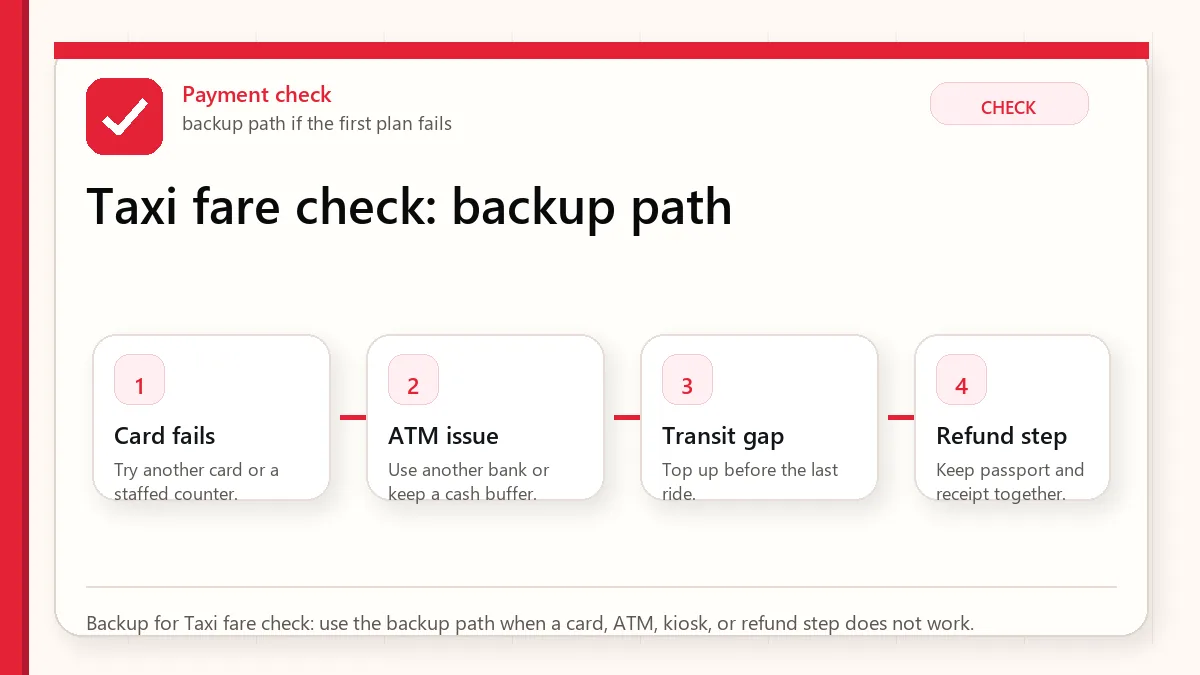
    Layered red check backup flow graphic for Taxi fare check.
    Backup for Taxi fare check: use the backup path when a card, ATM, kiosk, or refund step does not work.

    What to save before you need it

    • Destination in Korean
    • Map route estimate
    • Taxi app estimate if available
    • Airport terminal and airline
    • Backup transit route

    FAQ

    Are taxis expensive in Korea?

    They can be reasonable for short rides but become costly with distance, traffic, tolls, airport routes, and late-night surcharges.

    Can I pay by foreign credit card?

    Often yes, but not always smoothly. Keep another card and a small cash backup.

    Is Kakao T required for taxis?

    No, but it can help with destination entry and route confidence. Street taxis, hotel calls, and other services can still be useful.

    Related guides

    Sources and official checks

    App screens, entry rules, fares, and official procedures can change. Use the links below to re-check details before you rely on one route, app, card, or declaration step.
  • Korea Entry Form Guide for Travelers: e-Arrival Card, K-ETA, and Arrival Details

    Korea Entry Form Guide for Travelers: e-Arrival Card, K-ETA, and Arrival Details

    A Korea entry form can feel simple until you reach the fields that require exact travel details. Travelers often get stuck because they do not have the hotel address, phone number, flight information, passport details, or K-ETA status ready in one place.

    Last checked: June 1, 2026. Re-check the current Korean government or customs page before acting, because routes, prices, labels, rules, app screens, eligibility, and store/service policies can change.

    Last updated: May 26, 2026.

    This guide separates the entry-form problem from the bigger entry-requirements problem. The form is a data-entry step. K-ETA, visa status, passport validity, customs, and health-related requirements can be separate checks.

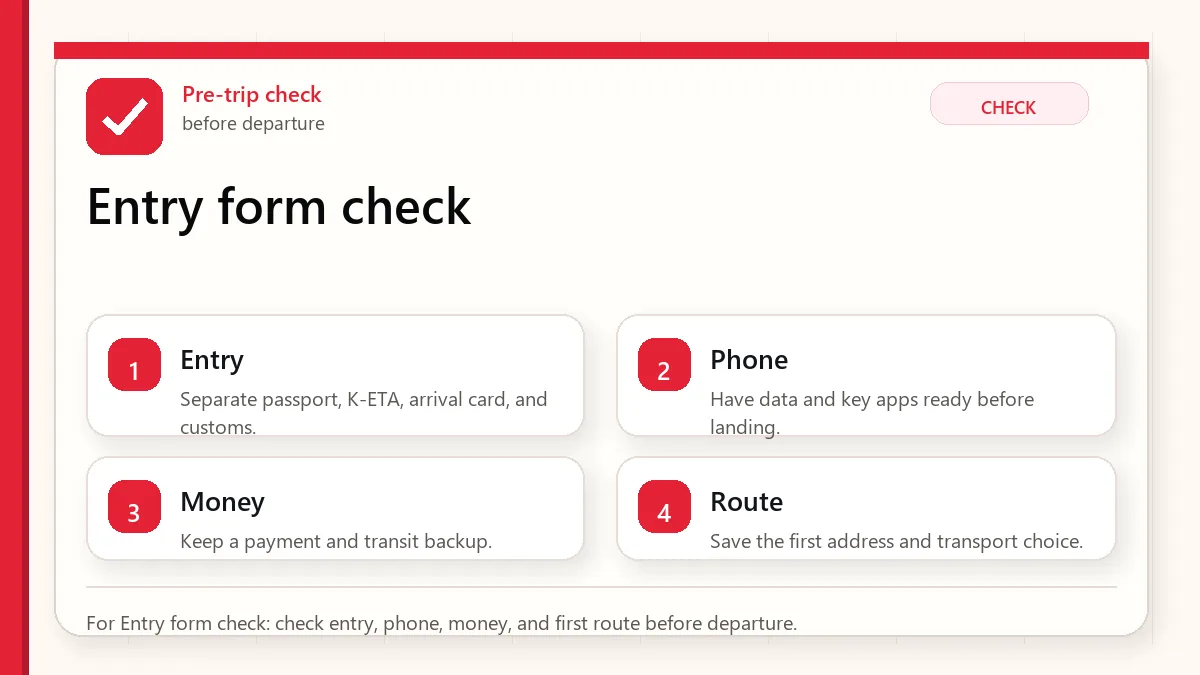
    Layered red check decision graphic for Entry form check.
    For Entry form check: check entry, phone, money, and first route before departure.

    Start with what can fail at payment

    Prepare passport information, flight details, accommodation address in Korea, contact information, and any required K-ETA or visa status before starting the entry form.

    When this matters

    This matters when you want a calm pre-flight checklist for Korea entry form details rather than rushing through official pages at the airport.

    Decision table

    SituationBest moveWhy it matters
    You are visa-free eligibleCheck K-ETA or exemption statusEntry form and entry permission are separate concerns.
    You changed hotelsUse the first real stay addressArrival details should match your actual plan.
    Your flight changesUpdate the details if requiredWrong arrival information can create confusion.
    You are unsure about statusUse official sites onlyRandom travel forums can be outdated.

    How to make the decision

    Use the table as a filter, not as a rule to memorize. The right answer depends on your exact route, phone setup, luggage, arrival time, payment method, and how much uncertainty you can tolerate on that day. For this topic, the first question is: you are visa-free eligible. If that sounds like your situation, the safest starting point is to check k-eta or exemption status because entry form and entry permission are separate concerns..

    The second question is whether the choice still works when the trip becomes less ideal: late arrival, rain, low battery, no Korean phone call, a crowded station, a tired group, or a hotel address that is hard to explain. Those imperfect moments are where travelers usually lose time.

    Step-by-step setup

    • Check whether your nationality and trip purpose require K-ETA, visa, or another permission route.
    • Save your passport page, flight number, arrival date, and first accommodation address.
    • Write your accommodation phone number and Korean address in a note before starting the form.
    • Use the official e-Arrival Card or K-ETA channels rather than look-alike pages.
    • Keep confirmation screenshots where you can access them without mobile data.

    Before you rely on it

    Do one small test before the situation becomes urgent. Search the destination, open the app, check the route, confirm the address, read the current official page, or ask the hotel desk while you still have time. A five-minute test at the hotel is easier than troubleshooting in a taxi line, subway transfer, airport terminal, or restaurant doorway.

    Also separate what is convenient from what is required. A tool can be convenient without being essential. A card can be useful without replacing every payment method. A phone number can help without solving real-name verification. A train can be fast without being the easiest route with luggage. That distinction is the main habit that prevents bad decisions.

    Where travelers get stuck

    • Confusing e-Arrival Card with K-ETA or visa permission.
    • Using a booking platform nickname instead of the real accommodation name and address.
    • Waiting until boarding time to gather passport, flight, and hotel details.
    • Ignoring nationality-specific differences.
    • Relying on old screenshots because entry procedures can change.

    Realistic travel scenario

    A traveler books the first night in Hongdae but plans to move later. The entry detail should focus on the first actual address in Korea. The traveler should save the hotel name, road-name address, phone number, booking confirmation, and map link before starting the form.

    Backup plan if the first choice fails

    Have one fallback that does not depend on the same weak point. If the app fails, use a saved Korean address, hotel desk, official counter, taxi stand, convenience store, or simpler route. If payment fails, switch to another card or cash. If translation fails, use shorter sentences and confirm with a person. If timing fails, choose the option that protects the flight, hotel check-in, medicine, or safety issue first.

    • Most likely failure: Confusing e-Arrival Card with K-ETA or visa permission.
    • Fastest prevention step: Check whether your nationality and trip purpose require K-ETA, visa, or another permission route.
    • Most useful saved item: Passport information page
    • Best mindset: solve the next practical step instead of trying to force the perfect plan.
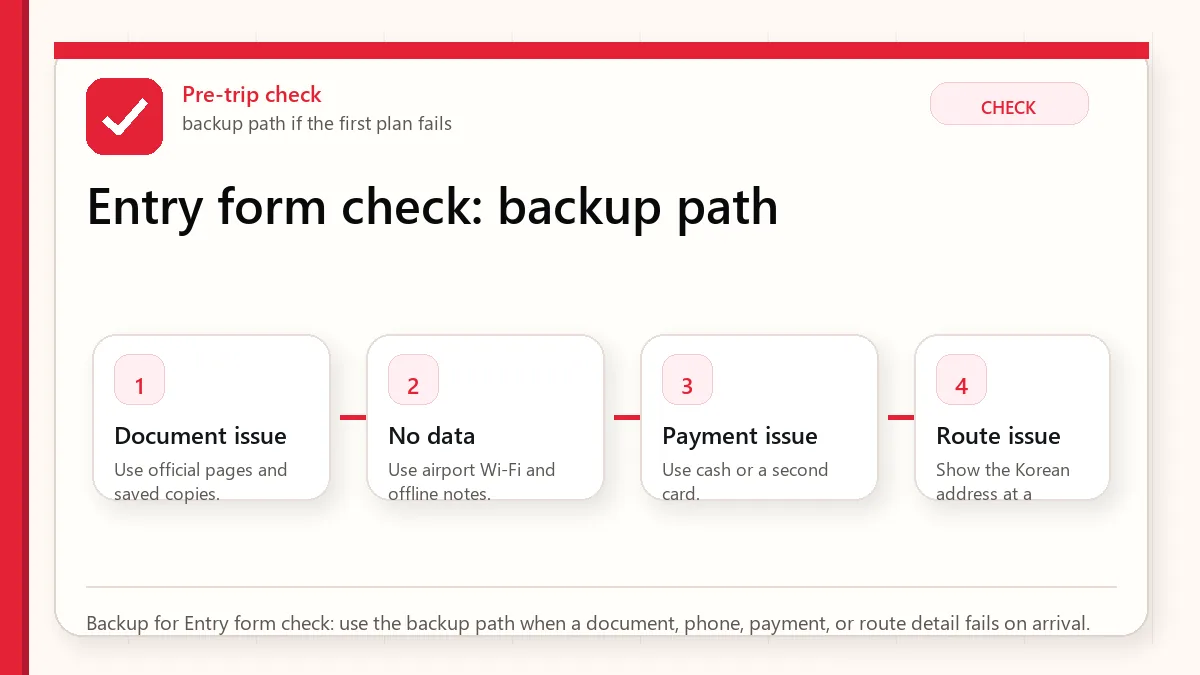
    Layered red check backup flow graphic for Entry form check.
    Backup for Entry form check: use the backup path when a document, phone, payment, or route detail fails on arrival.

    What to save before you need it

    • Passport information page
    • Flight number and arrival date
    • First Korea accommodation address
    • Accommodation phone number
    • Entry form or K-ETA confirmation

    FAQ

    Is the Korea entry form the same as K-ETA?

    No. Treat the entry form, K-ETA, visa status, and customs declaration as related but separate checks.

    When should I prepare the entry form details?

    Before departure, when you still have time to check your hotel address and official requirements calmly.

    Can I use an English hotel address?

    Keep both English and Korean versions if possible. Korean address text is useful for taxis, maps, and arrival questions.

    Related guides

    Official links to check

    Use these official links when the next step matters. This guide explains what to watch for, but app downloads, eligibility, prices, routes, policies, and service rules can change.

    Sources and official checks

    App screens, entry rules, fares, and official procedures can change. Use the links below to re-check details before you rely on one route, app, card, or declaration step.
  • Korea Customs Declaration Guide for Travelers: Food, Medicine, Cash, and Duty-Free Limits

    Korea Customs Declaration Guide for Travelers: Food, Medicine, Cash, and Duty-Free Limits

    A Korea customs declaration search usually happens right before departure or while standing near arrival. The problem is that travelers often think customs is only about expensive shopping, when it can also involve food, medicine, cash, alcohol, tobacco, commercial samples, and items for other people.

    Last checked: June 1, 2026. Re-check the current Korean government or customs page before acting, because routes, prices, labels, rules, app screens, eligibility, and store/service policies can change.

    Last updated: May 26, 2026.

    This guide gives a practical way to think about Korea customs declaration without guessing. It is not legal advice and it does not replace the current Korea Customs Service rules. It helps you know what to check before you pack and what to declare if you are unsure.

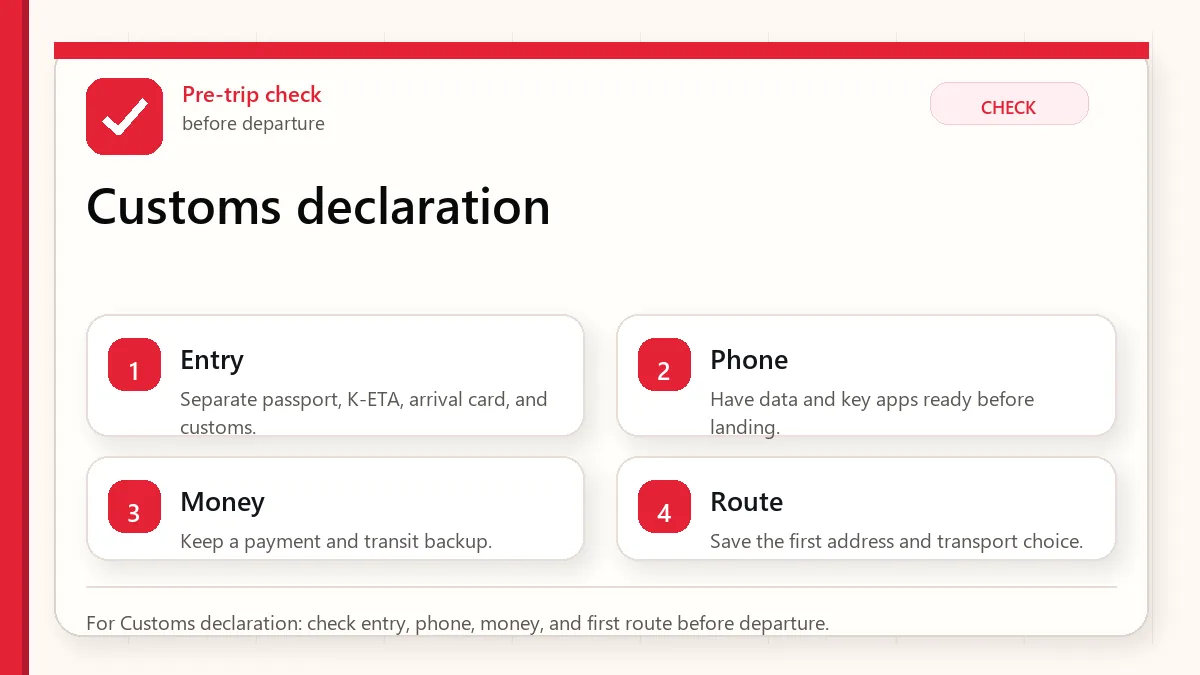
    Layered red check decision graphic for Customs declaration.
    For Customs declaration: check entry, phone, money, and first route before departure.

    Start with what can fail at payment

    Declare when the item, amount, value, purpose, or category may need official review. If you are unsure, choose the official declaration path instead of trying to hide the item.

    When this matters

    This matters when you are carrying food gifts, medicine, supplements, duty-free purchases, high-value goods, business items, or cash and wanting to avoid a bad arrival moment.

    Decision table

    SituationBest moveWhy it matters
    You carry medicineKeep prescription and packagingOfficials may need to understand the item and purpose.
    You carry foodCheck restrictions before packingSome animal, plant, and fresh products can be sensitive.
    You bought duty-free goodsKeep receipts and know limitsValue and quantity can matter.
    You carry large cashCheck declaration rulesCurrency rules can apply even when money is yours.

    How to make the decision

    Use the table as a filter, not as a rule to memorize. The right answer depends on your exact route, phone setup, luggage, arrival time, payment method, and how much uncertainty you can tolerate on that day. For this topic, the first question is: you carry medicine. If that sounds like your situation, the safest starting point is to keep prescription and packaging because officials may need to understand the item and purpose..

    The second question is whether the choice still works when the trip becomes less ideal: late arrival, rain, low battery, no Korean phone call, a crowded station, a tired group, or a hotel address that is hard to explain. Those imperfect moments are where travelers usually lose time.

    Step-by-step setup

    • Before packing, separate personal items from gifts, resale items, commercial samples, and goods for someone else.
    • Keep medicine in original packaging with a prescription or doctor note when appropriate.
    • Do not pack restricted food casually because it is common in your home country.
    • Keep purchase receipts for expensive items and duty-free products.
    • Use the official customs declaration process if the category or amount is unclear.

    Before you rely on it

    Do one small test before the situation becomes urgent. Search the destination, open the app, check the route, confirm the address, read the current official page, or ask the hotel desk while you still have time. A five-minute test at the hotel is easier than troubleshooting in a taxi line, subway transfer, airport terminal, or restaurant doorway.

    Also separate what is convenient from what is required. A tool can be convenient without being essential. A card can be useful without replacing every payment method. A phone number can help without solving real-name verification. A train can be fast without being the easiest route with luggage. That distinction is the main habit that prevents bad decisions.

    Where travelers get stuck

    • Thinking sealed food is always allowed.
    • Removing medicine from packaging to save space.
    • Carrying goods for other people without knowing value or contents.
    • Forgetting that cash and monetary instruments may need declaration above certain thresholds.
    • Treating customs as a trick to avoid instead of a checkpoint to handle honestly.

    Realistic travel scenario

    A traveler brings vitamins, skincare gifts, snacks, and a duty-free bottle. None of these automatically means trouble, but the traveler should know what each item is, keep receipts, keep labels visible, and declare if the rules or quantity are not clearly within the normal personal-use range.

    Backup plan if the first choice fails

    Have one fallback that does not depend on the same weak point. If the app fails, use a saved Korean address, hotel desk, official counter, taxi stand, convenience store, or simpler route. If payment fails, switch to another card or cash. If translation fails, use shorter sentences and confirm with a person. If timing fails, choose the option that protects the flight, hotel check-in, medicine, or safety issue first.

    • Most likely failure: Thinking sealed food is always allowed.
    • Fastest prevention step: Before packing, separate personal items from gifts, resale items, commercial samples, and goods for someone else.
    • Most useful saved item: Medicine prescription or doctor note
    • Best mindset: solve the next practical step instead of trying to force the perfect plan.
    Layered red check backup flow graphic for Customs declaration.
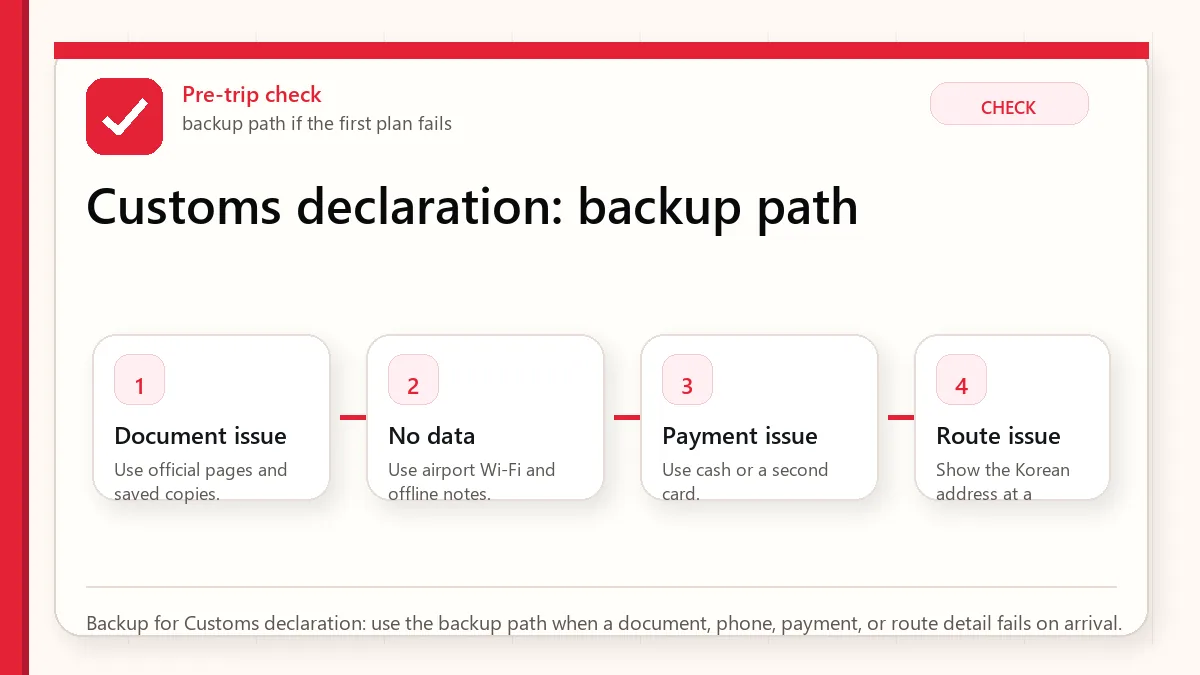
    Backup for Customs declaration: use the backup path when a document, phone, payment, or route detail fails on arrival.

    What to save before you need it

    • Medicine prescription or doctor note
    • Receipts for high-value goods
    • Customs declaration confirmation if submitted
    • Product labels for food or supplements
    • Official customs page saved offline

    FAQ

    Do all travelers need to fill a customs declaration?

    Follow the current official process. Some travelers may have nothing to declare, while others should use the official declaration channel.

    Can I bring Korean food gifts into Korea?

    It depends on the product type and current restrictions. Check official customs guidance before packing animal, plant, fresh, or unclear food items.

    Should I declare if I am unsure?

    Yes, if the item may fall into a controlled or value-sensitive category. A declaration is safer than hiding uncertainty.

    Related guides

    Official links to check

    Use these official links when the next step matters. This guide explains what to watch for, but app downloads, eligibility, prices, routes, policies, and service rules can change.

    Sources and official checks

    App screens, entry rules, fares, and official procedures can change. Use the links below to re-check details before you rely on one route, app, card, or declaration step.
  • Korea Delivery Apps for Foreigners: Baemin, Coupang Eats, Phone Numbers, and Hotel Addresses

    Korea Delivery Apps for Foreigners: Baemin, Coupang Eats, Phone Numbers, and Hotel Addresses

    A Korea delivery app looks simple until one small part fails: phone verification, real-name identity, address entry, card payment, rider calls, building access, or hotel policy. That is why many visitors can browse restaurants but still cannot complete the order.

    Last checked: June 1, 2026. Re-check the official app, service, or app-store page before acting, because routes, prices, labels, rules, app screens, eligibility, and store/service policies can change.

    Last updated: May 26, 2026.

    This guide does not promise that every foreign traveler can use every delivery app. It explains where the friction usually appears and what backup plan to prepare before hunger turns into a stressful phone call.

    Layered red check decision graphic for Delivery app setup.
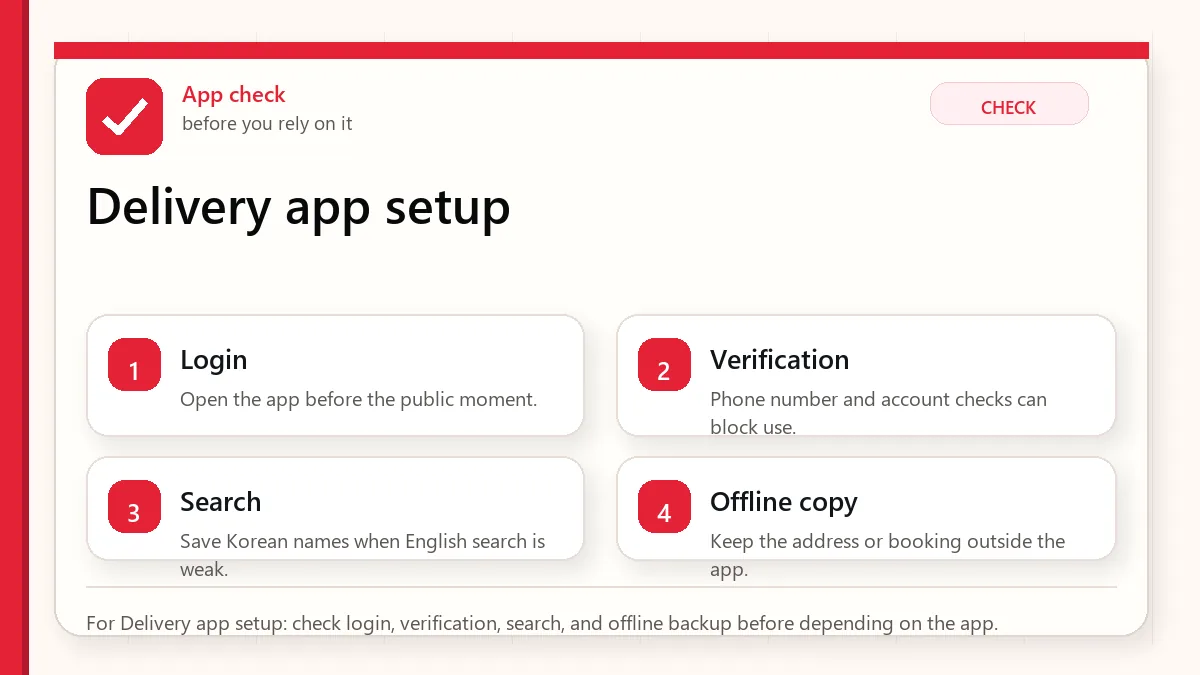
    For Delivery app setup: check login, verification, search, and offline backup before depending on the app.

    Start with the account or access block

    Foreigners may be able to use some delivery app functions, but the hard parts are phone number, identity verification, Korean address format, payment, and rider communication.

    When this matters

    This matters when you are trying to order food to a hotel, Airbnb, dorm, clinic stay, or short-term apartment without pretending that a delivery app is as easy as it looks in local screenshots.

    Decision table

    SituationBest moveWhy it matters
    You have only data eSIMExpect phone/SMS limitsA data-only plan may not receive calls or texts.
    You stay at a hotelAsk the front desk about delivery rulesSome hotels control lobby pickup or rider access.
    The app asks for identityRead it as a separate verification problemMessaging and payment are not the same as Korean real-name verification.
    Payment failsPrepare pickup, kiosk, or convenience-store foodBackup food plans matter late at night.

    How to make the decision

    Use the table as a filter, not as a rule to memorize. The right answer depends on your exact route, phone setup, luggage, arrival time, payment method, and how much uncertainty you can tolerate on that day. For this topic, the first question is: you have only data esim. If that sounds like your situation, the safest starting point is to expect phone/sms limits because a data-only plan may not receive calls or texts..

    The second question is whether the choice still works when the trip becomes less ideal: late arrival, rain, low battery, no Korean phone call, a crowded station, a tired group, or a hotel address that is hard to explain. Those imperfect moments are where travelers usually lose time.

    Step-by-step setup

    • Before using a Korea delivery app, save your accommodation address in Korean and English.
    • Check whether your phone plan can receive local calls or SMS if a rider needs to contact you.
    • Try adding the address before you are hungry, not at the moment of ordering.
    • Prepare a short Korean note for lobby pickup, room number policy, and unavailable phone calls.
    • Keep a second food plan: convenience store meal, hotel desk help, pickup restaurant, or international delivery option.

    Before you rely on it

    Do one small test before the situation becomes urgent. Search the destination, open the app, check the route, confirm the address, read the current official page, or ask the hotel desk while you still have time. A five-minute test at the hotel is easier than troubleshooting in a taxi line, subway transfer, airport terminal, or restaurant doorway.

    Also separate what is convenient from what is required. A tool can be convenient without being essential. A card can be useful without replacing every payment method. A phone number can help without solving real-name verification. A train can be fast without being the easiest route with luggage. That distinction is the main habit that prevents bad decisions.

    Where travelers get stuck

    • Assuming a Korean phone number included with a SIM automatically passes all verification flows.
    • Entering the hotel name without a detailed address, building, or lobby pickup instruction.
    • Choosing a restaurant far away because it appears in the app without checking delivery distance.
    • Ignoring rider calls because the number looks unfamiliar.
    • Depending on delivery for medication, allergies, or urgent meals without a backup.

    Realistic travel scenario

    A visitor staying near Myeongdong can browse menus but fails at payment. The calm response is not to reinstall five apps. Save the restaurant name, ask whether pickup is possible, use a nearby kiosk restaurant, or buy a convenience-store meal while you solve verification later.

    Backup plan if the first choice fails

    Have one fallback that does not depend on the same weak point. If the app fails, use a saved Korean address, hotel desk, official counter, taxi stand, convenience store, or simpler route. If payment fails, switch to another card or cash. If translation fails, use shorter sentences and confirm with a person. If timing fails, choose the option that protects the flight, hotel check-in, medicine, or safety issue first.

    • Most likely failure: Assuming a Korean phone number included with a SIM automatically passes all verification flows.
    • Fastest prevention step: Before using a Korea delivery app, save your accommodation address in Korean and English.
    • Most useful saved item: Accommodation address in Korean
    • Best mindset: solve the next practical step instead of trying to force the perfect plan.
    Layered red check backup flow graphic for Delivery app setup.
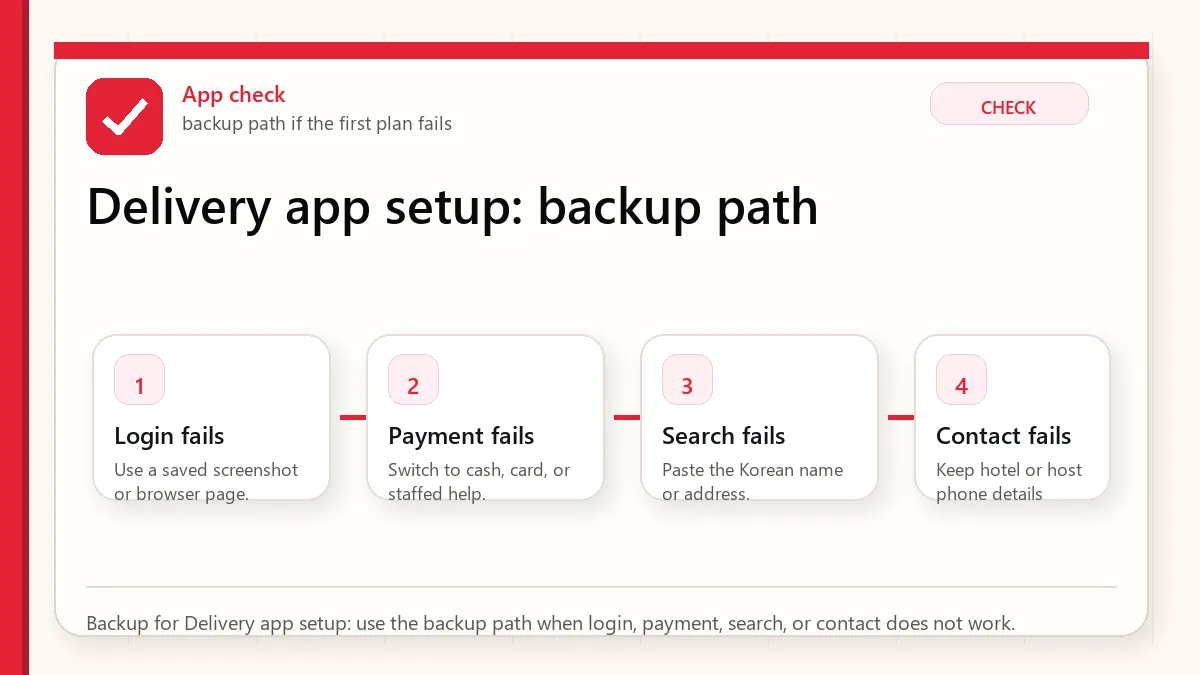
    Backup for Delivery app setup: use the backup path when login, payment, search, or contact does not work.

    What to save before you need it

    • Accommodation address in Korean
    • Hotel delivery instructions
    • A message saying you may not answer Korean calls
    • Restaurant name and order summary
    • Backup food places near the hotel

    FAQ

    Can tourists use Baemin in Korea?

    Some visitors can use parts of the service, but verification, phone number, address, and payment rules can still block a normal tourist setup.

    Do I need a Korean phone number for delivery apps?

    A Korean number can help, but it does not automatically solve every identity or payment requirement.

    What is the safest backup if delivery fails?

    Use a nearby restaurant, convenience store, hotel desk help, or pickup option instead of fighting the app while tired.

    Related guides

    Official links to check

    Use these official links when the next step matters. This guide explains what to watch for, but app downloads, eligibility, prices, routes, policies, and service rules can change.

    Sources and official checks

    App screens, entry rules, fares, and official procedures can change. Use the links below to re-check details before you rely on one route, app, card, or declaration step.
  • Best Korea Subway Apps for Tourists: Metro, Routes, Exits, and Transfers

    Best Korea Subway Apps for Tourists: Metro, Routes, Exits, and Transfers

    A Korea subway app search usually starts with a simple question: which app should I install before I land? The better question is what problem you need the app to solve. Some apps are good at subway line diagrams, some are better for walking from the station exit, and some are useful only when you already know the Korean place name.

    Last checked: June 1, 2026. Re-check the official app, service, or app-store page before acting, because routes, prices, labels, rules, app screens, eligibility, and store/service policies can change.

    Last updated: May 26, 2026.

    For tourists, the subway problem is not only finding Line 2 or Line 4. It is choosing the correct exit, knowing whether a route has stairs, avoiding a missed last train, and connecting the station to the actual door of your hotel, restaurant, clinic, or shop.

    Layered red check decision graphic for Subway app choice.
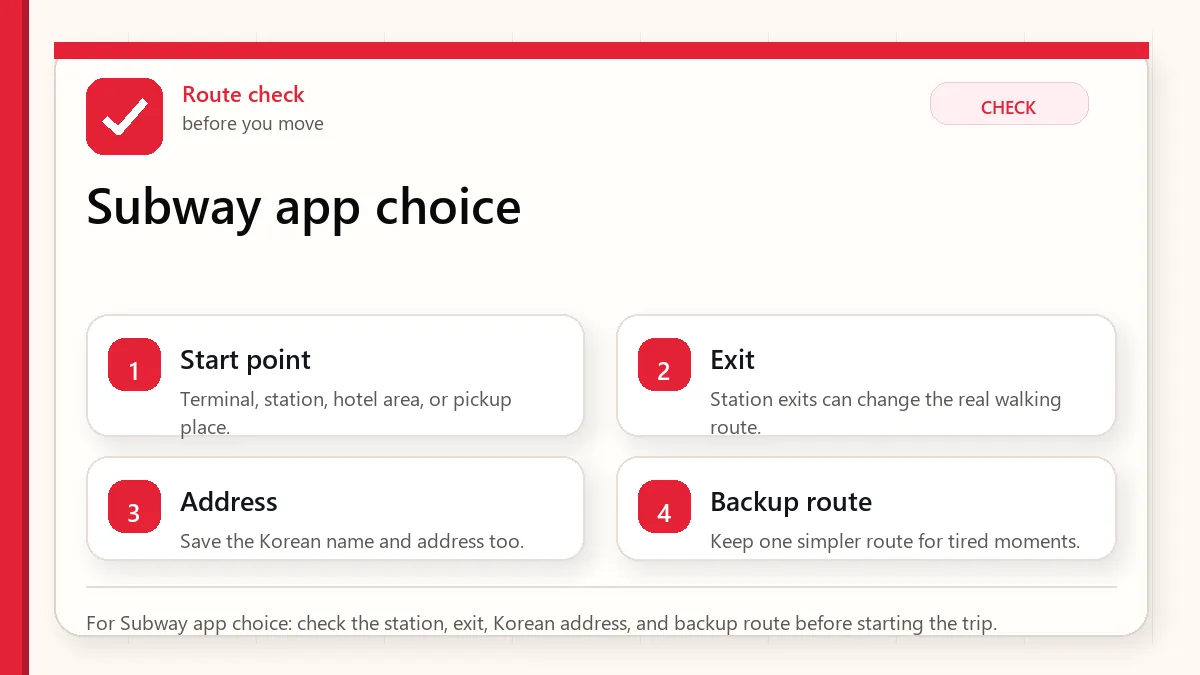
    For Subway app choice: check the station, exit, Korean address, and backup route before starting the trip.

    Start with the route you will actually take

    Install at least one subway-focused app plus one map app. Use the subway app for line clarity and transfers, then use Naver Map or Kakao Map for exits and the last walk.

    When this matters

    This matters when you need a Korea subway app or Korea metro app that works in real trip situations: airport arrival, hotel transfers, late-night returns, crowded stations, and routes with several exits.

    Decision table

    SituationBest moveWhy it matters
    You only need line and transfer infoUse a subway-focused appIt is faster for seeing route shape and station order.
    You need the correct exitUse Naver Map or Kakao Map tooExit choice can change the walk by several minutes.
    You are traveling lateCheck last train and backup taxi routeA route that works at 2 p.m. may fail at midnight.
    The destination is a small shopSave the Korean place nameEnglish search can miss local listings.

    How to make the decision

    Use the table as a filter, not as a rule to memorize. The right answer depends on your exact route, phone setup, luggage, arrival time, payment method, and how much uncertainty you can tolerate on that day. For this topic, the first question is: you only need line and transfer info. If that sounds like your situation, the safest starting point is to use a subway-focused app because it is faster for seeing route shape and station order..

    The second question is whether the choice still works when the trip becomes less ideal: late arrival, rain, low battery, no Korean phone call, a crowded station, a tired group, or a hotel address that is hard to explain. Those imperfect moments are where travelers usually lose time.

    Step-by-step setup

    • Install the subway app before departure and test a sample route from Incheon Airport or Seoul Station to your hotel area.
    • Save the station name in English and Korean if your hotel gives it to you.
    • Check the transfer count, not only total time. One easier transfer can beat two confusing ones with luggage.
    • Look at the exit number before you leave the train platform area.
    • Save a screenshot of the route in case mobile data becomes unstable underground.

    Before you rely on it

    Do one small test before the situation becomes urgent. Search the destination, open the app, check the route, confirm the address, read the current official page, or ask the hotel desk while you still have time. A five-minute test at the hotel is easier than troubleshooting in a taxi line, subway transfer, airport terminal, or restaurant doorway.

    Also separate what is convenient from what is required. A tool can be convenient without being essential. A card can be useful without replacing every payment method. A phone number can help without solving real-name verification. A train can be fast without being the easiest route with luggage. That distinction is the main habit that prevents bad decisions.

    Where travelers get stuck

    • Using a subway app for the station route but ignoring the final street walk.
    • Searching only in English when a Korean place name is more reliable.
    • Following the shortest route even when it has a difficult transfer with luggage.
    • Assuming every station exit has the same elevator or escalator access.
    • Not checking the last train before dinner, concerts, or late shopping.

    Realistic travel scenario

    Imagine you are staying near Hongdae but arriving at a guesthouse on a side street. The subway app may correctly bring you to Hongik University Station, but the useful question is which exit puts you on the right side of the road with luggage. That is where the subway app and map app need to work together.

    Backup plan if the first choice fails

    Have one fallback that does not depend on the same weak point. If the app fails, use a saved Korean address, hotel desk, official counter, taxi stand, convenience store, or simpler route. If payment fails, switch to another card or cash. If translation fails, use shorter sentences and confirm with a person. If timing fails, choose the option that protects the flight, hotel check-in, medicine, or safety issue first.

    • Most likely failure: Using a subway app for the station route but ignoring the final street walk.
    • Fastest prevention step: Install the subway app before departure and test a sample route from Incheon Airport or Seoul Station to your hotel area.
    • Most useful saved item: Hotel address in Korean
    • Best mindset: solve the next practical step instead of trying to force the perfect plan.
    Layered red check backup flow graphic for Subway app choice.
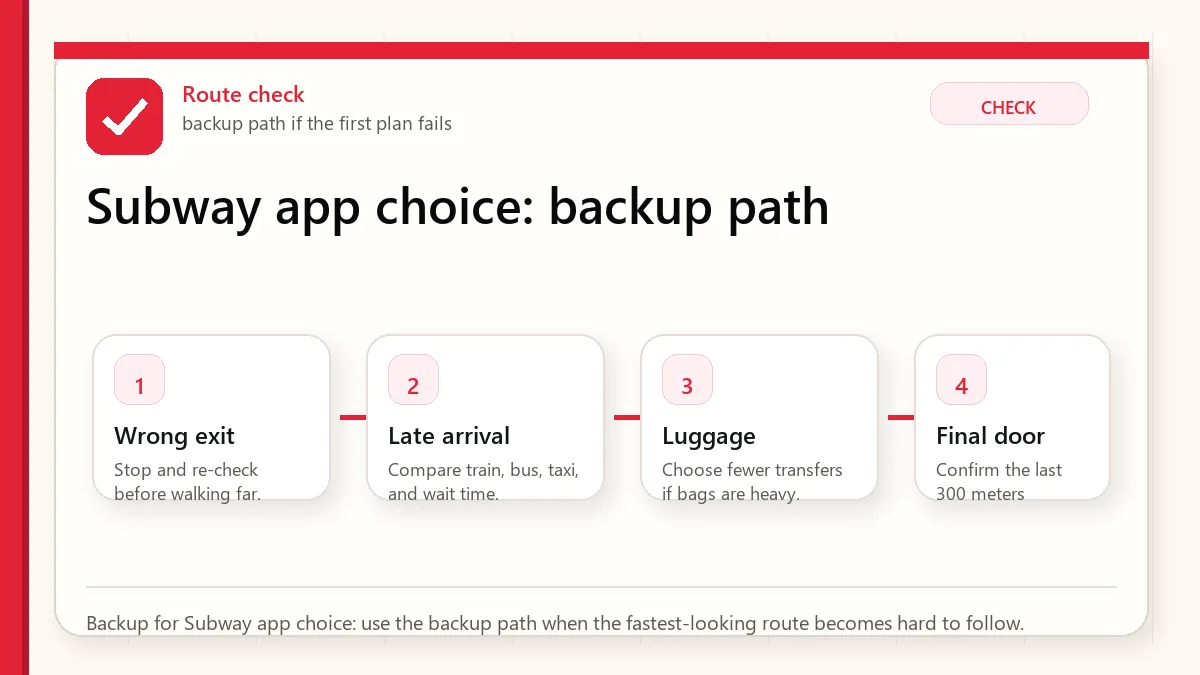
    Backup for Subway app choice: use the backup path when the fastest-looking route becomes hard to follow.

    What to save before you need it

    • Hotel address in Korean
    • Subway route and transfer station
    • Correct exit number
    • Last train result for the return route
    • A taxi backup route from the nearest large road

    FAQ

    Is there one best Korea subway app?

    Not for every visitor. A subway-focused app is best for line clarity, while map apps are better for exits and the final walk.

    Can I use Google Maps for subway routes in Korea?

    It can help in some ways, but many travelers still need Naver Map, Kakao Map, or a subway-specific app for better local detail.

    Should I install the app after arriving?

    Install before departure. It is easier to test language settings, route search, and saved places when you are not tired at the airport.

    Related guides

    Official links to check

    Use these official links when the next step matters. This guide explains what to watch for, but app downloads, eligibility, prices, routes, policies, and service rules can change.

    Sources and official checks

    App screens, entry rules, fares, and official procedures can change. Use the links below to re-check details before you rely on one route, app, card, or declaration step.
  • Korean Cosmetic Expiration Date Symbols: What Buyers Should Check

    Korean Cosmetic Expiration Date Symbols: What Buyers Should Check

    K-beauty shopping is exciting because Korea makes it easy to compare textures, ingredients, formats, and prices in one place. But for foreign shoppers, the practical question is not only “what should I buy?” It is also “is this product fresh enough, sealed properly, and realistic for me to use before it expires?” That is where Korean cosmetic expiration date symbols and label wording matter.

    Last checked: June 1, 2026. Re-check the latest product label, store policy, and official refund or safety page before acting, because routes, prices, labels, rules, app screens, eligibility, and store/service policies can change.

    Last updated: May 26, 2026.

    This guide is for buyers standing in Olive Young, a brand shop, duty-free, a department store, a pharmacy-style store, or an online product page trying to understand Korean date labels. It does not claim to replace official cosmetic safety guidance. It gives you a careful buying workflow so you do not overbuy near-expiry products, misunderstand opened-use symbols, or bring home skincare you will not use in time.

    Layered red check decision graphic for Cosmetic Expiration Date Symbols.
    For Cosmetic Expiration Date Symbols: check the exact label, local sticker, date, size or ingredient detail, and proof needed for this product.

    Start with the label and skin risk

    Check whether the product shows a manufacture date, an expiry/use-by date, or a period-after-opening symbol. Korean labels may include words such as 제조 or 제조일자 for manufacture date, 사용기한 for usable period or expiry, 까지 for “until,” and 개봉 후 for “after opening.” If a product is unsealed, damaged, unusually discounted, missing a box, or close to the printed date, do not buy it unless you fully understand the risk and will use it quickly.

    Useful Korean label words

    KoreanMeaningBuyer note
    제조ManufacturedOften appears near a manufacture date.
    제조일자Manufacture dateNot the same as expiry date.
    사용기한Use-by period or expiryUsually the more important date for tourists.
    까지UntilOften means the date is a limit, not a start date.
    개봉 후After openingConnects to opened-use period.

    Manufacture date vs expiry date

    A manufacture date tells you when the product was made. It does not automatically tell you when the product should be used by, because shelf life depends on product type, formula, packaging, storage, and official labeling. An expiry or use-by date is more direct for a buyer because it tells you the date you should not ignore.

    If you see only a manufacture date and cannot confidently understand the product’s shelf life, ask staff or choose a product with clearer labeling. Do not guess based on internet rules such as “all creams last three years.” Rules of thumb may be wrong for specific formulas, functional cosmetics, sunscreen, opened testers, or poorly stored items.

    Period after opening

    Some cosmetics use a period-after-opening idea, often shown with an open-jar style symbol or wording that tells you how long the product is recommended after opening. The common pattern is a number plus M, such as 6M or 12M, meaning months after opening. This is different from the unopened shelf date. If a product is unopened, the printed expiry date matters. Once opened, the after-opening period becomes important too.

    Travelers often forget this because they buy several serums at once. If you open five products after returning home, the after-opening clock starts on all of them. A better plan is to open one product at a time and write the opening month on the box or bottle if you are serious about using it carefully.

    Layered red check backup flow graphic for Cosmetic Expiration Date Symbols.
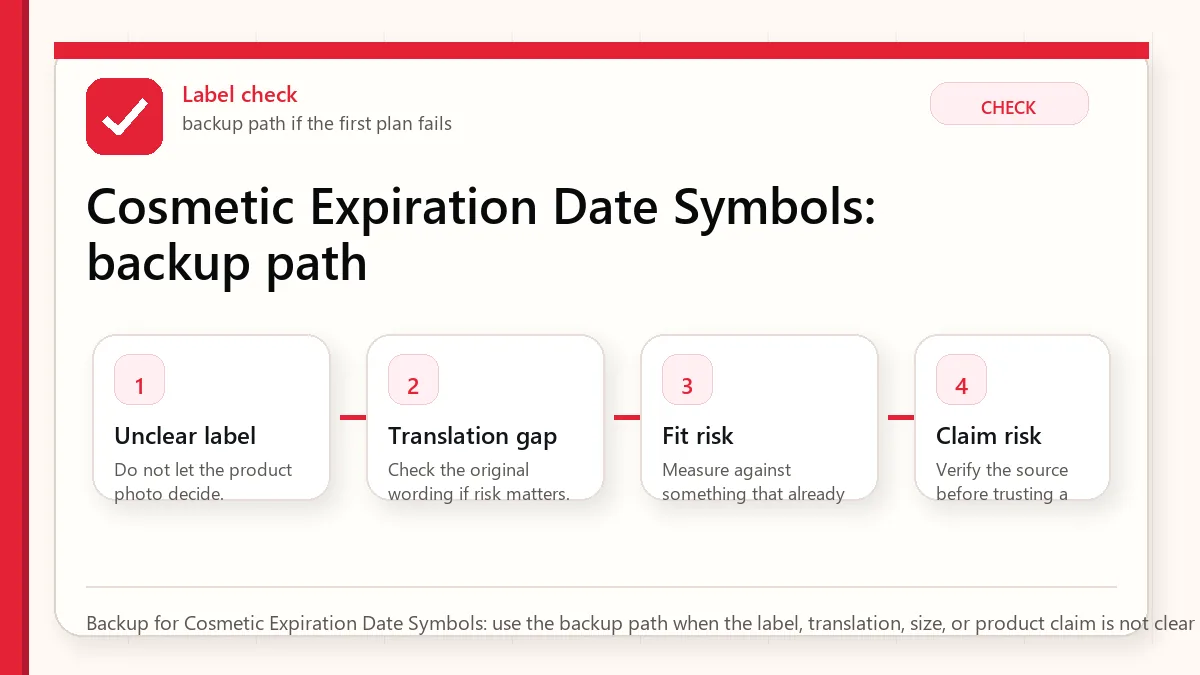
    Backup for Cosmetic Expiration Date Symbols: use the backup path when the label, translation, size, or product claim is not clear enough.

    Date format and reading risk

    Korean product dates may be written with year, month, and day, sometimes using Korean characters such as 년, 월, 일, or punctuation. Read the whole line rather than grabbing the first number you recognize. If you see “2026.08.15까지,” the “까지” means until that date. If you see a line connected to 제조, it may be a manufacture date instead.

    When in doubt, ask staff: “Is this the expiration date?” You can show a translation app sentence in Korean if needed. For skincare you will put on your face, guessing is not worth it.

    Store checks before buying

    • Seal: Avoid products with broken seals, damaged boxes, missing caps, or signs of leakage.
    • Date: Check the printed date before you pay, especially on discount shelves.
    • Tester confusion: Do not assume a tester represents the freshness of unopened stock.
    • Receipt: Keep the receipt until you inspect everything at the hotel.
    • Storage: Avoid leaving cosmetics in hot luggage, cars, or direct sunlight.

    Online and duty-free caution

    Online shopping can make date checking harder because you may not see the exact product label before purchase. Buy from official stores or trusted sellers, read return rules, and be careful with unusually cheap listings. For duty-free, check pickup timing, baggage rules, and whether you can inspect the product before leaving the airport area.

    Do not buy a product only because it is popular online. A product can be authentic and still be a poor buy for you if the date is close, the size is too large, the formula does not match your skin needs, or you already bought more than you can use.

    What to avoid

    Avoid open-box products unless the store clearly sells them that way with reliable handling. Avoid buying sunscreen, eye products, or active skincare close to expiry unless you will use them very soon. Avoid marketplace sellers with unclear origin, no date visibility, or prices that feel too good to explain. Avoid carrying large hauls in hot checked luggage for long periods.

    How this helps your K-beauty budget

    Expiration checks are not only about safety. They prevent waste. Many visitors buy more skincare than they can use because the store environment is exciting and the unit price feels better than home. A simple date check slows the decision down. If you already have unopened products at home, choose smaller sizes, travel kits, or one focused category instead of duplicating every step of a routine.

    FAQ

    What does 제조 mean on Korean cosmetics?

    It means manufactured or manufacture-related. It is not automatically the expiry date. Look for expiry wording or ask staff if you are unsure.

    What does 까지 mean?

    It means until. On a cosmetic date label, it often marks the date limit connected to the product wording around it.

    Is a manufacture date enough?

    Not always for a foreign shopper. If you cannot confirm shelf life or expiry, choose a clearer product or ask staff before buying.

    Should I buy near-expiry K-beauty if it is cheap?

    Only if you understand the date, the product is sealed, the seller is trustworthy, and you will use it quickly. For most tourists, near-expiry impulse buys are not worth the luggage space.

    Related Before Korea guides

    Official links to check

    Use these official links when the next step matters. This guide explains what to watch for, but app downloads, eligibility, prices, routes, policies, and service rules can change.

    Sources and official checks

    This guide was written for travel planning. App screens, fares, product labels, and service rules can change, so check the official pages below and the current app screen before paying or relying on one route.

  • How to Book Kakao T and Pay Cash as a Foreigner in Korea

    How to Book Kakao T and Pay Cash as a Foreigner in Korea

    Foreign visitors search for “Kakao T pay cash” because the taxi problem in Korea is rarely just “how do I call a taxi?” The real problem is a chain: Can I make an account? Can I search the destination? Can the driver find my pickup point? Can I pay if my foreign card will not register? What do I do if the app screen changes or the option I expected is not there?

    Last checked: June 1, 2026. Re-check the official app, service, or app-store page before acting, because routes, prices, labels, rules, app screens, eligibility, and store/service policies can change.

    Last updated: May 26, 2026.

    Kakao T is widely used in Korea, but foreign visitors should approach it with a backup mindset. Some travelers can use it smoothly. Others run into account, phone number, card registration, or language friction. Cash or pay-to-driver options may appear differently depending on app version, account state, taxi type, and current service rules. This guide explains how to think through the process without pretending one screen works for every traveler.

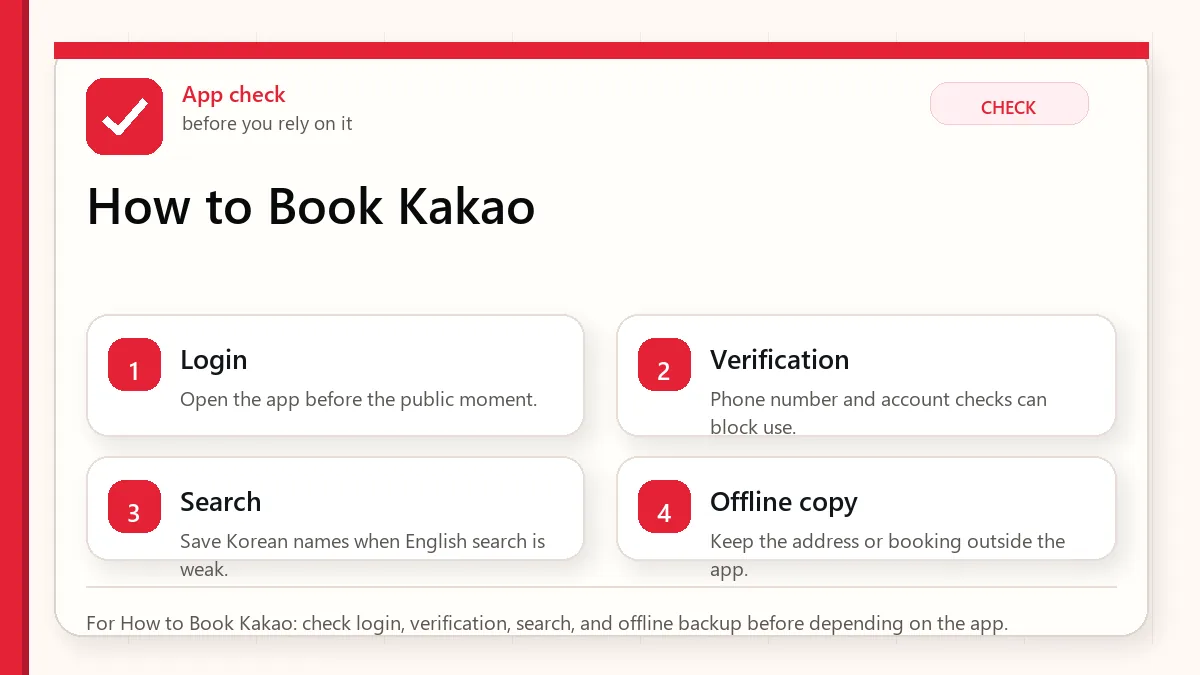
    Layered red check decision graphic for How to Book Kakao.
    For How to Book Kakao: check login, verification, search, and offline backup before depending on the app.

    Start with what can fail at payment

    If Kakao T shows a pay-to-driver or in-taxi payment option, you may be able to book a taxi and pay the driver by cash or accepted card after the ride. Check the payment option before confirming the call. If the app requires an in-app card you cannot register, use a backup such as k.ride, Uber where available, hotel front desk help, a taxi stand, or a normal street taxi. Always save your destination in Korean and carry enough cash for a fallback ride.

    What to check before you need a taxi

    CheckWhy it mattersBackup
    Account loginKakao ecosystem setup can be the first barrier.Try setup before arrival.
    Phone numberSome verification flows may not behave like a local Korean number.Use k.ride or hotel help.
    Payment optionIn-app foreign cards may not always work.Look for pay-to-driver, cash, or another app.
    Pickup pointDrivers need a clear roadside location.Use a landmark, hotel entrance, or taxi stand.
    Destination Korean addressEnglish names can confuse branch or building selection.Show Korean address screenshot.

    Step 1: test account setup before arrival

    Do not wait until midnight outside a station to discover whether your app login works. Install Kakao T before your trip if it is available to you, and test whether you can open the taxi flow, search places, and reach the payment selection screen. You do not need to book a ride during the test. You only need to know whether the app is usable on your phone and account.

    If Kakao T setup depends on your Kakao account, make sure your KakaoTalk login is stable too. If you are already having trouble with KakaoTalk verification, do not make Kakao T your only taxi plan.

    Step 2: search destination in Korean when possible

    For hotels and major landmarks, English may work. For restaurants, clinics, event venues, guesthouses, and small buildings, Korean is safer. Save the destination from Naver Map or your booking confirmation, including the Korean address and phone number if available. If the app shows several similar results, compare the neighborhood and distance before selecting one.

    A taxi driver can only drive to the point you requested. If you choose the wrong branch, the app did not fail. The search step failed. This is why a Korean address screenshot is one of the most useful travel tools in Korea.

    Step 3: choose a pickup point a driver can actually reach

    Ride-hailing apps can place a pin somewhere that is technically close but practically awkward. In Korea, a driver may not be able to stop safely on every road, near every bus lane, or in front of every crowded market street. If you are in a dense area, choose a hotel entrance, station exit, main road, taxi stand, or visible landmark instead of a tiny alley.

    When you are leaving a department store, underground mall, or subway station, go above ground first and choose the exit side carefully. “Gangnam Station” is not a pickup point. “Gangnam Station Exit 11 roadside” is much clearer.

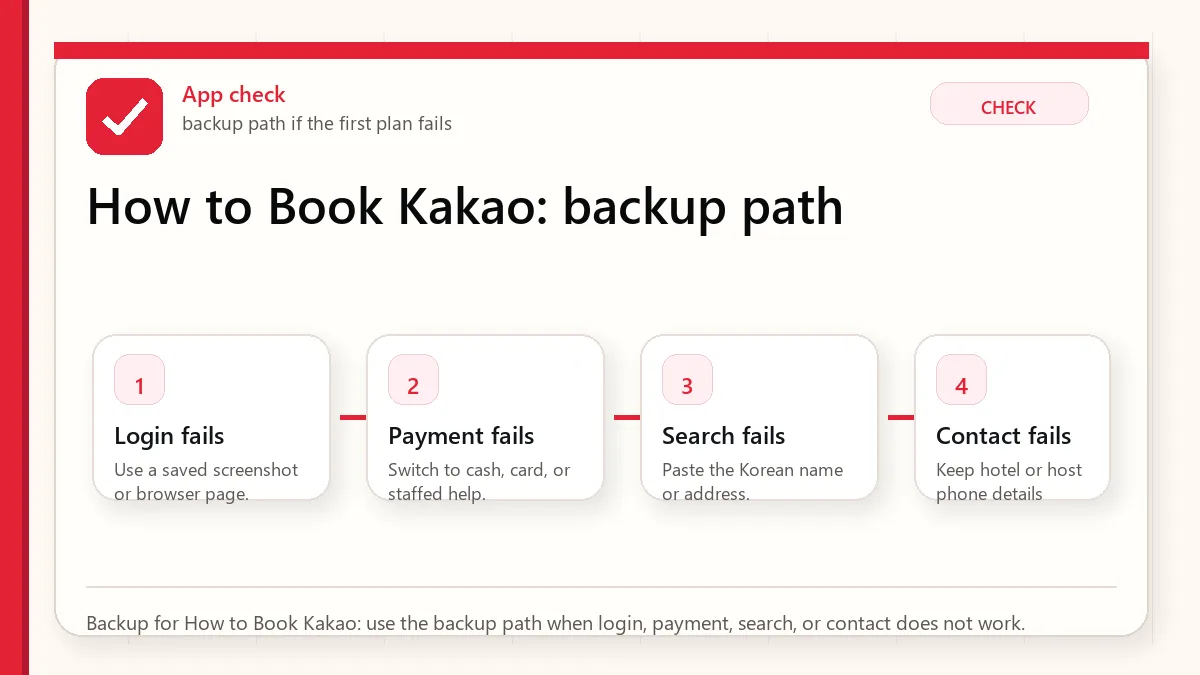
    Layered red check backup flow graphic for How to Book Kakao.
    Backup for How to Book Kakao: use the backup path when login, payment, search, or contact does not work.

    Step 4: check payment before confirming

    This is the step that matters for the keyword “pay cash.” Look carefully at the payment option before you call the taxi. If the app shows an in-app card only and your foreign card cannot register, do not assume you can fix it inside the taxi. If it shows a pay-to-driver option, confirm that this is the option selected before booking.

    Cash in Korean won is the cleanest fallback, but many taxis also accept cards in the vehicle. Still, do not build your whole plan around one payment method. Carry some cash, keep a physical card, and know your backup app or taxi stand.

    Step 5: communicate simply

    You do not need to explain your whole life to the driver. For normal rides, the destination is already in the app. If the driver calls or messages, translation can be difficult, especially while you are standing outside. Use simple pickup notes when the app allows them, such as a station exit, hotel entrance, or landmark. If you cannot communicate, canceling and rebooking from a clearer pickup point may be better than wandering around while the taxi waits somewhere else.

    When k.ride may be easier

    Kakao Mobility also operates k.ride, a foreigner-focused ride app. It may be easier for some visitors because it is designed around foreign traveler needs. The tradeoff is that service type, pricing, availability, and app rules may differ from standard Kakao T. Treat it as a valuable backup, especially if you cannot use Kakao T payment or account features reliably.

    Other backups

    • Hotel front desk: Useful for early morning airport rides or when you need a clear pickup.
    • Taxi stand: Good at stations, hotels, malls, and tourist areas.
    • Street taxi: Works best when you are on a road where taxis can stop safely.
    • Subway plus short taxi: Take transit closer, then taxi the final awkward segment.
    • Written Korean address: Useful across every backup.

    Common mistakes

    • Testing too late: App setup should be tested before you need the ride.
    • Choosing a vague pickup: Station name alone is not enough in busy districts.
    • Assuming cash always appears: Check the selected payment option before confirming.
    • Using English-only destinations: Korean addresses reduce branch and building confusion.
    • No second plan: Taxi apps are helpful, but not a substitute for cash, hotel help, or transit knowledge.

    FAQ

    Can foreigners use Kakao T in Korea?

    Some foreigners can use it, but setup and payment may vary by account, phone number, app version, and current service rules. Test before your trip and keep a backup.

    Can I pay cash after booking Kakao T?

    If your app flow offers a pay-to-driver or in-taxi payment option and you select it, cash may be possible. If the app requires in-app payment, do not assume cash will work.

    Is k.ride better for foreigners?

    It may be easier for some visitors because it is built for foreign travelers, but availability, service type, and pricing should be checked in the current app.

    What should I show a taxi driver?

    Show the Korean destination name, full Korean address, phone number if available, and a map screenshot. For hotels, save the hotel card or booking page too.

    Related Before Korea guides

    Official links to check

    Use these official links when the next step matters. This guide explains what to watch for, but app downloads, eligibility, prices, routes, policies, and service rules can change.

    Sources and official checks

    This guide was written for travel planning. App screens, fares, product labels, and service rules can change, so check the official pages below and the current app screen before paying or relying on one route.

  • T-money vs WOWPASS vs Climate Card: Which Korea Transit Card Fits?

    T-money vs WOWPASS vs Climate Card: Which Korea Transit Card Fits?

    Korea transit card advice can get noisy because travelers are comparing different kinds of tools as if they were the same product. T-money is a simple stored-value transportation card. WOWPASS is a tourist prepaid payment card that can also include transit functionality. The Climate Card is an unlimited-use pass with coverage rules that matter a lot. They overlap, but they do not solve the same problem.

    Last checked: June 1, 2026. Re-check the official operator, app, fare, or route page before acting, because routes, prices, labels, rules, app screens, eligibility, and store/service policies can change.

    Last updated: May 26, 2026.

    If you are choosing before your trip, start with your actual route. Are you mostly in Seoul? Are you leaving for Busan, Jeju, Gyeongju, or day trips? Will you ride transit many times per day, or only twice between hotel and sightseeing? Do you need a payment backup because your foreign card may fail? Those answers matter more than a simple “best card” ranking.

    Layered red check decision graphic for T-money vs WOWPASS vs.
    For T-money vs WOWPASS vs: check the payment method, cash backup, receipt, and refund step before relying on one option.

    Start with what can fail at payment

    For most first-time Korea visitors, T-money is the safest baseline because it is simple, widely understood, and works for normal subway and bus use. WOWPASS can be useful if you also want a prepaid shopping/payment card and a foreigner-friendly money tool. Climate Card can be good for Seoul-heavy travelers who will ride covered transit often enough, but it requires checking current coverage, pass duration, purchase rules, and route fit before buying.

    Comparison table

    OptionBest forMain caution
    T-moneyMost tourists who need simple subway and bus accessTop-up and refund rules still require attention, often with cash.
    WOWPASSVisitors who want a prepaid payment backup plus transit supportDo not confuse the payment balance with the transit balance.
    Climate CardSeoul-focused travelers taking many covered ridesCoverage, duration, purchase, and refund rules can make or break the value.

    T-money: the baseline choice

    T-money is the card most tourists should understand first. You load value, tap in, tap out where required, and use it for subway and bus travel. It is not glamorous, but that is part of the point. Convenience stores, subway stations, and staff are used to it. If something goes wrong, it is easier to explain “T-money” than a more specialized product.

    T-money is especially good if your trip includes several Korean cities or you do not want to calculate pass value every morning. You pay as you go. If you ride less, you spend less. If your plan changes, you are not trying to force an unlimited pass to feel worth it.

    WOWPASS: payment backup plus transit

    WOWPASS is attractive because it speaks to a real tourist fear: foreign cards sometimes fail in Korea, especially at kiosks, transit top-up machines, small shops, or systems that expect local card behavior. A prepaid tourist card can make shopping and daily spending feel less fragile.

    The key is understanding that a tourist payment card and a transportation balance are not the same mental bucket. Depending on the current WOWPASS product and app flow, the prepaid spending balance and the transit function may need separate handling. Before relying on it, read the current official guide in the app or on the WOWPASS site. If you buy it only because you think it magically replaces all cash, you may be disappointed.

    Climate Card: strong only when the route fits

    The Climate Card can be valuable for travelers who stay mostly inside its covered Seoul transit world and ride often. Unlimited-use passes are emotionally tempting because they remove the feeling of paying for every ride. But tourists need to check three things: whether your routes are covered, whether your pass duration matches your actual days, and whether you can buy and load it conveniently after arrival.

    Do not choose Climate Card just because you plan to ride the subway. Choose it if your itinerary is Seoul-heavy, transit-heavy, and compatible with the card rules. If you are taking airport transfers, private lines, out-of-city trips, taxis, or low-transit days, do the math calmly.

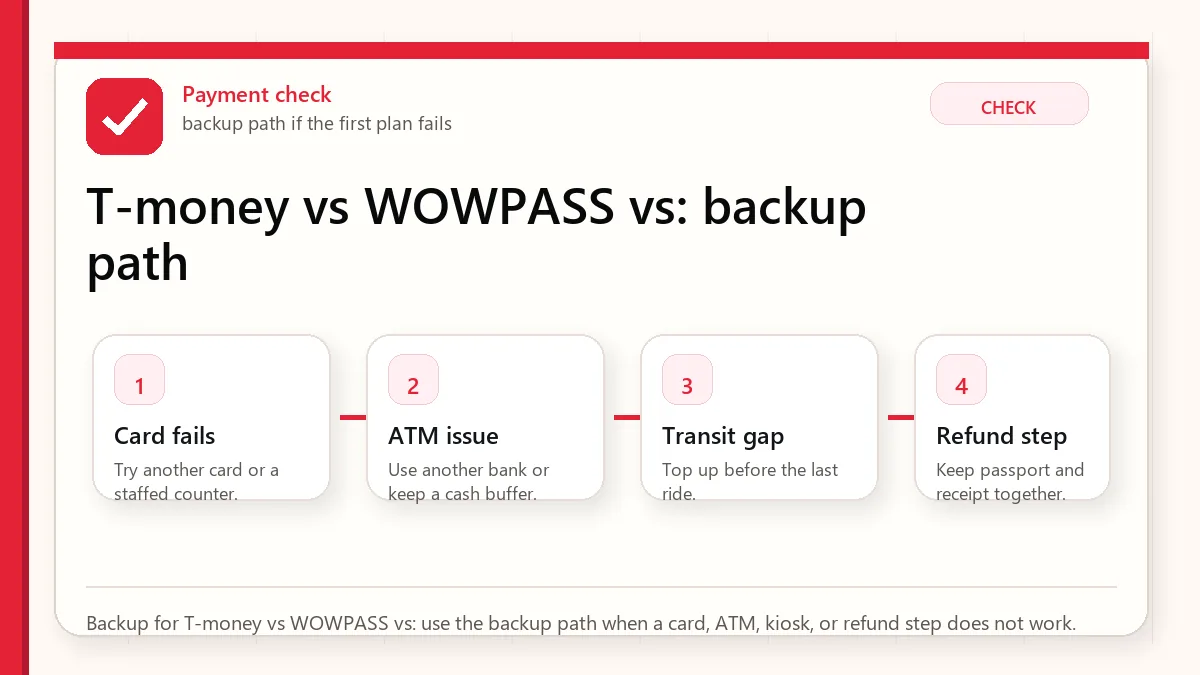
    Layered red check backup flow graphic for T-money vs WOWPASS vs.
    Backup for T-money vs WOWPASS vs: use the backup path when a card, ATM, kiosk, or refund step does not work.

    Decision guide by trip type

    First-time Seoul trip, four to six days

    Start with T-money unless you already know your daily routes are dense and covered by Climate Card. Add WOWPASS only if you want a prepaid spending backup.

    Shopping-heavy trip

    Consider WOWPASS as a payment tool, but still understand the transit balance separately. Keep a small cash buffer because some top-ups and small stores may still be easier with cash.

    Seoul-only, many subway rides per day

    Climate Card may be worth checking carefully. Look at the official coverage and pass rules, then compare your planned rides. The more spontaneous your route, the more you need to confirm coverage.

    Multi-city trip

    T-money is usually the cleaner baseline. A Seoul-specific pass can become less useful once you leave the covered area.

    Airport arrival strategy

    After a long flight, do not make your first hour in Korea depend on a complicated card decision. Have a simple path: a small amount of Korean won, a transit option from Incheon Airport, and one card choice you understand. If you plan to buy WOWPASS or another tourist card at the airport, know where the machine or pickup point is before you land. If you plan to use T-money, know whether you will buy it at a convenience store or station.

    If you arrive late at night, keep the plan even simpler. Airport buses, taxis, and hotel-area transport choices matter more than optimizing a card by a few rides.

    Top-up and refund habits

    Do not load a large amount on your first day unless you know how you will use it. Top up in smaller steps, especially if your trip is short. Before leaving Korea, check the current refund rules for your card type and remaining balance. Refund locations, fees, and limits can differ by product and change over time.

    For any card that combines multiple functions, confirm which balance you are refunding. A prepaid spending balance and a transportation balance may not be handled in the same place.

    Common tourist mistakes

    • Buying the most complicated card first: Start with the problem you need to solve, not the product name.
    • Ignoring coverage: Unlimited value disappears if your routes are outside the pass rules.
    • Confusing balances: Payment balance and transit balance can be separate.
    • Loading too much: Small top-ups reduce end-of-trip refund stress.
    • Forgetting cash: A little cash still helps with top-ups, markets, taxis, and backup moments.

    FAQ

    Do I need both T-money and WOWPASS?

    Not always. If your foreign card works well and you only need transit, T-money may be enough. WOWPASS is more useful when you want a prepaid payment backup too.

    Is Climate Card better than T-money?

    Only if your route and ride volume fit the official coverage and pass rules. T-money is simpler when your plans are mixed or uncertain.

    Can I tap my foreign credit card directly on Seoul subway gates?

    Do not assume that. Prepare a local transit card or pass, and read current official guidance before relying on direct card tapping.

    Should I buy a card before arriving?

    Pre-arrival purchase can save time for some travelers, but it can also add pickup rules. If you are unsure, choose the simplest arrival setup first.

    Related Before Korea guides

    Official links to check

    Use these official links when the next step matters. This guide explains what to watch for, but app downloads, eligibility, prices, routes, policies, and service rules can change.

    Sources and official checks

    This guide was written for travel planning. App screens, fares, product labels, and service rules can change, so check the official pages below and the current app screen before paying or relying on one route.

  • Kakao Map vs Naver Map: Which Is Better for Tourists?

    Kakao Map vs Naver Map: Which Is Better for Tourists?

    The question “Kakao Map vs Naver Map” sounds like a simple app comparison, but for a foreign visitor in Korea it is really a risk question. Which app will help you find the correct restaurant branch? Which one will show the subway exit before you walk above ground? Which one will still make sense when the place name is in Korean, the station is crowded, and your reservation is in 20 minutes?

    Last checked: June 1, 2026. Re-check the official app, service, or app-store page before acting, because routes, prices, labels, rules, app screens, eligibility, and store/service policies can change.

    Last updated: May 26, 2026.

    The short answer is that most tourists should start with Naver Map, then keep Kakao Map as a useful backup if they are comfortable testing both. Kakao Map is a serious local map product, but Naver Map is usually the smoother first install for visitors because its English experience, place search habits, and tourist learning curve tend to be easier for first-time Korea travel. Still, there are situations where Kakao Map is worth having.

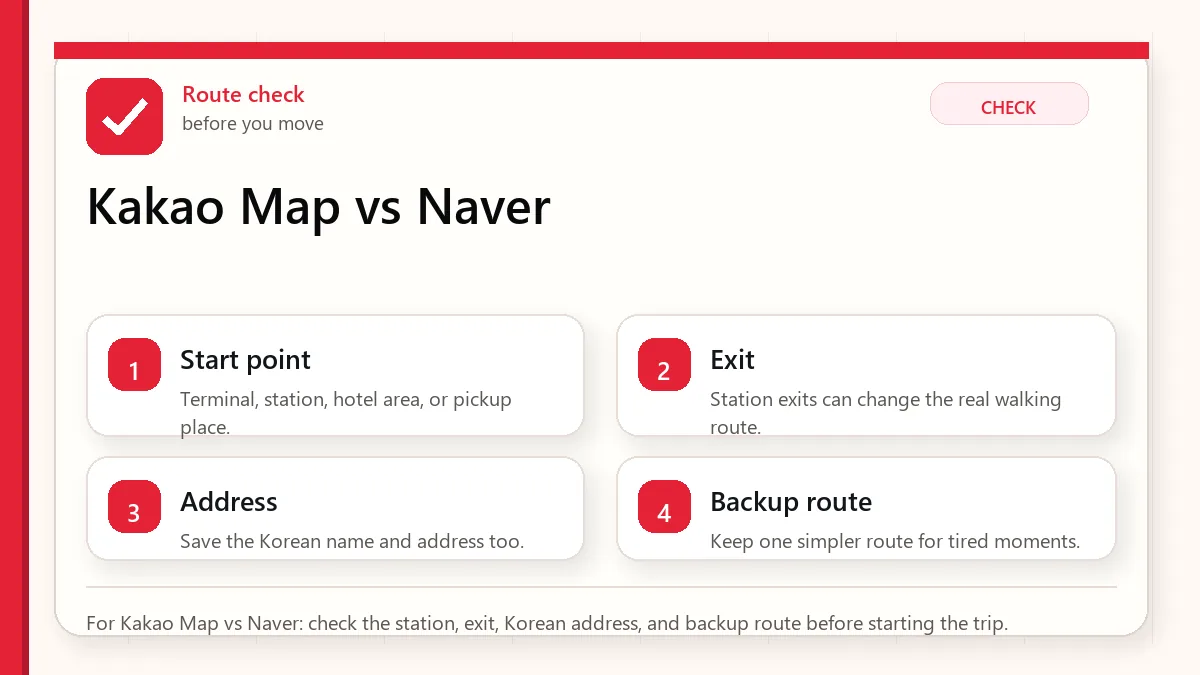
    Layered red check decision graphic for Kakao Map vs Naver.
    For Kakao Map vs Naver: check the station, exit, Korean address, and backup route before starting the trip.

    Start with the place name and exit

    Use Naver Map as your primary map app for a first trip to Korea. Add Kakao Map if you want a second local map for cross-checking routes, Korean place results, nearby food, and Kakao ecosystem links. Do not rely on either app blindly. For important destinations, save the Korean name, address, phone number, nearest station, subway exit, and a screenshot.

    Comparison table

    NeedNaver MapKakao MapTourist advice
    First installUsually easier for visitorsUseful but may feel more localStart with Naver Map.
    Subway exitsStrong for station and walking workflowAlso useful for routesCheck exit number before leaving station.
    English useMore common tourist recommendationEnglish support exists, but local data can still feel Korean-heavySave Korean names either way.
    Local discoveryStrong place search and reviewsStrong local discovery and route toolsCross-check when branch confusion matters.
    Backup valuePrimary appGood second opinionInstall both for appointment-heavy trips.

    Why Naver Map is the safer first choice

    Naver is deeply woven into Korean local search. For a tourist, that matters because many travel problems are not about map drawing. They are about names, branches, entrances, floor numbers, reviews, photos, and the relationship between transit and the final walking route. Naver Map tends to be the app foreigners hear about first because it solves enough of those problems in one place.

    Naver Map is especially useful when your destination is tied to a subway station. You can search the place, route by public transit, check which line and transfer to use, then identify the exit number before walking. If your trip involves Myeongdong shopping, Hongdae cafes, Gangnam clinics, university neighborhoods, or large underground stations, this workflow matters more than a pretty map screen.

    Where Kakao Map can help

    Kakao Map is not a weak app. It is a local Korean map with public transit, walking, driving, nearby discovery, and connection to the broader Kakao ecosystem. If you are already using KakaoTalk, Kakao T, or local Kakao links, Kakao Map can be useful as a second app to cross-check a place, route, or nearby result.

    The reason it is not my first recommendation for most short-term visitors is not because it cannot work. It is because the average foreign visitor needs the lowest-friction path. If you are comfortable reading mixed Korean-English screens, comparing branch names, and testing apps before you leave the hotel, Kakao Map can absolutely earn a place on your phone.

    The real issue: Korean place names

    Both apps become stronger when you stop relying only on English. Korean business names often have branch words, neighborhood words, floor details, and building names that do not translate neatly. A romanized name can also have several spellings. For example, the same Korean sound can appear in English in slightly different ways, while the Korean spelling stays exact.

    When the destination matters, save the Korean name. If a restaurant, hotel, clinic, or friend sends you a Korean address, do not replace it with your own English guess. Copy it into the map app, compare the result, and save it as a favorite or screenshot.

    Layered red check backup flow graphic for Kakao Map vs Naver.
    Backup for Kakao Map vs Naver: use the backup path when the fastest-looking route becomes hard to follow.

    Use both apps for high-stakes days

    You do not need two map apps for every cafe. You do want a backup for airport transfers, hotel changes, medical appointments, beauty clinics, ticketed events, late-night taxis, and restaurant reservations with cancellation fees. For those moments, search the destination in both Naver Map and Kakao Map. If both point to the same building and address, your confidence goes up. If they disagree, check the official website, booking message, or phone number before moving.

    Tourist scenarios

    First-time Seoul sightseeing

    Use Naver Map as your main app. Save major places and subway exits. Kakao Map is optional unless you enjoy comparing routes.

    Food-heavy trip

    Use Naver Map for reliable search and routing, but Kakao Map can help you cross-check nearby places and local discovery. Always check the branch.

    Clinics, salons, and appointments

    Use both. Save building name, floor, Korean address, phone number, and subway exit. Do not trust a single English pin if money or time is at stake.

    Late-night taxi or hotel return

    Keep the Korean hotel address outside your map app too. A screenshot is useful if your battery is low or a driver needs to see the address quickly.

    What about Google Maps?

    Google Maps can help with general orientation and saved international habits, but Korea-specific travel still benefits from local apps. The question should not be Google versus everything else. A safer setup is Google Maps for your familiar global layer, Naver Map for Korean transit and place work, and Kakao Map as a second local reference when needed.

    Before arrival setup

    1. Install Naver Map and set language preferences.
    2. Install Kakao Map if you want a local backup.
    3. Save your hotel in Korean and English.
    4. Save airport, first meal, first station, and emergency meetup point.
    5. Test one route from your hotel to a famous landmark before you fly.

    FAQ

    Is Kakao Map better than Naver Map?

    For many Korean users, Kakao Map is a normal and capable app. For most first-time foreign tourists, Naver Map is usually the easier primary choice. Kakao Map is best treated as a backup or second opinion unless you already prefer it.

    Should I install both?

    Yes if your itinerary includes appointments, restaurant reservations, rural transfers, or late-night movement. No if you want the simplest phone setup and will stay in central Seoul with flexible plans.

    Which app is better for subway exits?

    Naver Map is the safer first recommendation for tourists. Regardless of app, check the exit number before leaving the station.

    Can I use English only?

    You can use English for many major places, but save Korean names and addresses for anything important. That habit prevents more mistakes than switching apps.

    Related Before Korea guides

    Official links to check

    Use these official links when the next step matters. This guide explains what to watch for, but app downloads, eligibility, prices, routes, policies, and service rules can change.

    Sources and official checks

    This guide was written for travel planning. App screens, fares, product labels, and service rules can change, so check the official pages below and the current app screen before paying or relying on one route.