Author: user

  • How to Use Naver Map in English for Seoul Subway Exits

    How to Use Naver Map in English for Seoul Subway Exits

    Seoul subway stations are not just train platforms. Many of them are underground neighborhoods with several exits, long transfer corridors, department stores, food courts, office towers, and street crossings that do not always line up neatly above ground. That is why a tourist who chooses the right train but the wrong exit can still lose time, miss a reservation, or arrive sweaty before the day has properly started.

    Last checked: June 1, 2026. Re-check the official app, service, or app-store page before acting, because routes, prices, labels, rules, app screens, eligibility, and store/service policies can change.

    Last updated: May 26, 2026.

    The practical answer is not simply “download Naver Map.” The useful answer is to use Naver Map in a way that matches how Korea is organized: Korean place names, subway exit numbers, walking routes from the exit, and a backup screenshot when mobile data or translation becomes awkward. If you came to this page after searching for subway exits in Seoul, this guide is written for that exact moment.
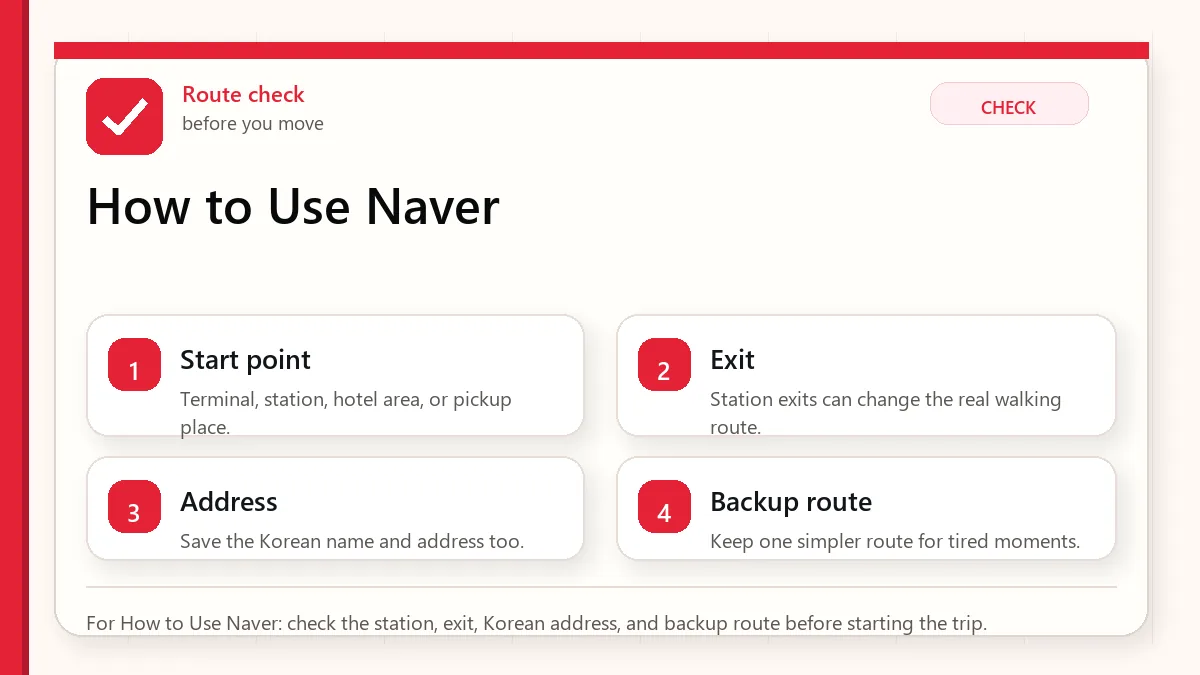
    Layered red check decision graphic for How to Use Naver.
    For How to Use Naver: check the station, exit, Korean address, and backup route before starting the trip.

    Start with the place name and exit

    Set Naver Map to English before you arrive, but keep the Korean name of your destination saved. Search the place, open the route, choose public transit, and look for the recommended subway exit number before you leave the train station. Once you exit, switch from transit mode to walking mode and confirm the final few minutes on the street. For hotels, clinics, restaurants, and meeting points, save a screenshot with the Korean address and exit number.

    Why subway exits matter in Seoul

    In many cities, a station name is enough. In Seoul, the station name only gets you close. A single station can have ten or more exits, and the wrong exit may put you across a wide road, behind a building, or at the opposite end of a shopping district. This matters most in areas such as Myeongdong, Hongdae, Gangnam, Seoul Station, Jamsil, Jongno, and Yeouido, where underground passages and street layouts can feel like separate systems.

    Exit numbers are also used as everyday landmarks. People may say “meet at Hongik Univ. Station Exit 9” or “the clinic is near Gangnam Station Exit 11.” If you only save the business name in English, you may still be missing the most useful part of the directions.

    Set Naver Map to English first

    Before your flight, install Naver Map and open the settings menu. If English is available in your version, switch the app language before you start saving places. This reduces pressure when you are tired after arrival. The exact menu labels can change, so use the official Naver help page if your screen looks different.

    Do not expect every piece of map content to become perfect English. App menus, route categories, and major station names are easier. Some building names, store names, reviews, and small address details may still appear in Korean or mixed text. That is normal. Your goal is not a fully translated Korea. Your goal is enough structure to move with confidence.

    Search with English, then save the Korean name

    For major tourist places, English search often works. “Gyeongbokgung,” “Myeongdong Cathedral,” “Seoul Station,” and many hotels can appear correctly. The problem starts with small restaurants, beauty clinics, guesthouses, branches inside department stores, or places with similar English names. In those cases, the Korean name is more reliable.

    If your hotel confirmation, clinic message, restaurant booking, or friend gives you a Korean place name, copy it into Naver Map and save that exact result. If you only have an English name, cross-check the address, phone number, neighborhood, and photos before trusting the first result. Korea has many branches with similar names. A coffee chain or skin clinic may have several locations within the same district.

    The subway exit workflow

    StepWhat to checkWhy it matters
    Search the destinationPlace name, address, neighborhood, phone, branchPrevents choosing the wrong branch.
    Tap directionsPublic transit route, line color, transfer stationShows the station path before you move.
    Read the exit numberRecommended exit and walking distanceStops you from crossing large roads later.
    Leave the stationConfirm walking route after GPS settlesUnderground GPS can be unreliable.
    Save a backupScreenshot with Korean address and exitUseful for staff, taxi drivers, or weak data.

    Use exit numbers before GPS starts behaving

    GPS can drift inside stations and under large buildings. If the app seems confused while you are underground, do not keep spinning in circles. Follow the station signs to the recommended exit number first. After you come above ground and walk a short distance, your phone usually has a better chance of placing you correctly.

    This is why exit numbers are more useful than a blue dot at the beginning. The station sign system is physical, visible, and consistent. Your GPS dot is helpful, but it may not know which underground level you are standing on.
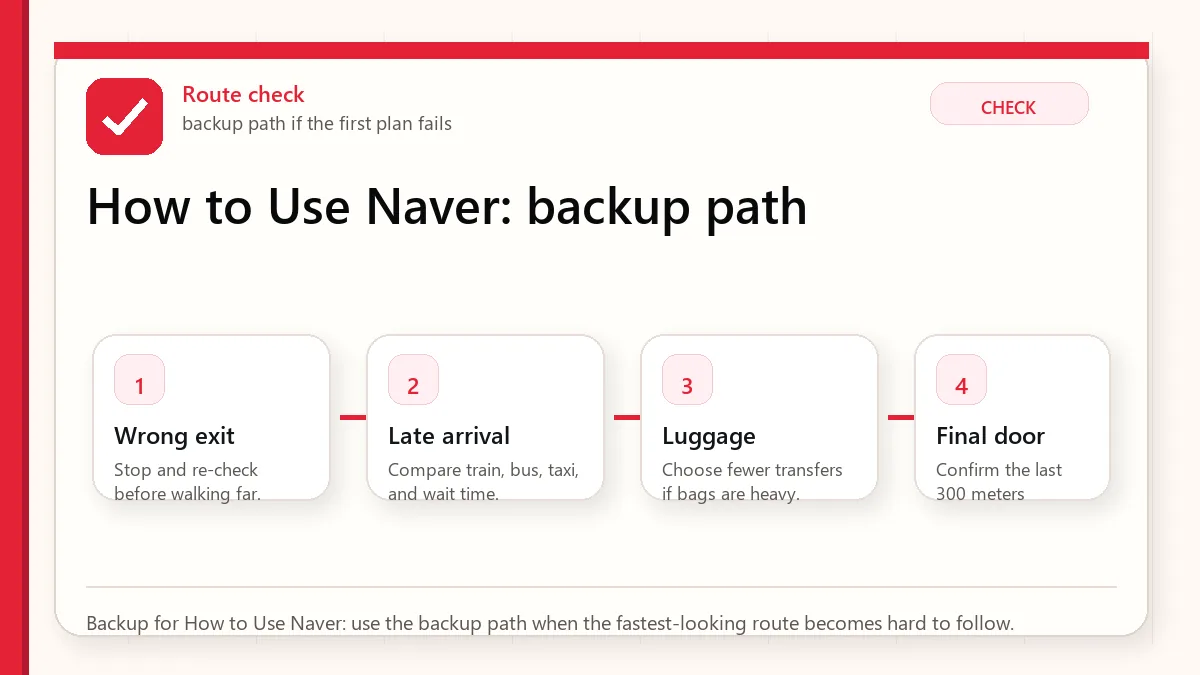
    Layered red check backup flow graphic for How to Use Naver.
    Backup for How to Use Naver: use the backup path when the fastest-looking route becomes hard to follow.

    When English search fails

    If English search fails, try three recovery paths. First, paste the Korean name. Second, search the road address in Korean if you have it. Third, search a nearby landmark such as the station, department store, university, or hotel and then look for the destination in the area. For restaurants and small shops, a Korean phone number can also help distinguish one branch from another.

    If you are using a booking app, compare the map pin with Naver Map rather than assuming every imported pin is precise. A small address mismatch matters more in dense Korean neighborhoods than it may at home.

    How to read the final walking route

    The last five minutes are where tourists make the most mistakes. Naver Map may show a walking line through a side street, underground passage, or building-connected route. Before following it blindly, check whether the route starts from the correct exit. Then look for the first turn, the side of the road, and any major landmark. If the route crosses a wide street immediately after exit, confirm whether there is a crossing, an underground passage, or a different exit that would avoid the crossing.

    For late-night arrivals, rainy days, strollers, or large luggage, the “shortest” route is not always the best route. A slightly longer route with fewer stairs can be more comfortable.

    Hotel, clinic, and reservation addresses

    For hotels, save the Korean address, English address, phone number, and nearest subway exit. For clinics, salons, restaurants, and appointments, also save the floor number and building name. Korea often uses multi-floor commercial buildings where several businesses share the same street entrance. The map can get you to the building, but the appointment message often gets you to the correct floor.

    If you will arrive by taxi after using the subway earlier in the day, keep the same Korean address screenshot. Taxi drivers may recognize a building or road name faster than an English brand name.

    Common mistakes

    • Trusting station name only: The station is not the destination. The exit is the first real checkpoint.
    • Saving only English names: English names are convenient, but Korean names are often more exact.
    • Ignoring branch names: Search results can show another branch in the same district.
    • Following GPS underground: Use station signs until you are above ground.
    • Not saving screenshots: A screenshot can rescue you when data, battery, or translation becomes unreliable.

    FAQ

    Is Naver Map fully in English?

    No. The app can be used in English, but some place names, reviews, building labels, and local details may still appear in Korean or mixed text. Save Korean names for important destinations.

    Can I use Google Maps instead?

    Google Maps can help with general orientation, but visitors should still keep Naver Map as a Korea-specific backup for place search, transit details, and station exits.

    What should I screenshot before leaving my hotel?

    Screenshot your destination name in Korean, the address, phone number if available, nearest station, recommended exit, and final walking route.

    Do subway exits have elevators?

    Some do, but not all exits are equally convenient for luggage or strollers. Check station signs and route details, and allow extra time if accessibility matters.

    Related Before Korea guides

    Official links to check

    Use these official links when the next step matters. This guide explains what to watch for, but app downloads, eligibility, prices, routes, policies, and service rules can change.

    Sources and official checks

    This guide was written for travel planning. App screens, fares, product labels, and service rules can change, so check the official pages below and the current app screen before paying or relying on one route.
  • Korea Packing List by Season: Shoes, Weather, Adapters, Medicine, and Shopping Space

    Korea Packing List by Season: Shoes, Weather, Adapters, Medicine, and Shopping Space

    A Korea packing list should start with the trip you will actually take, not the outfit you imagine for photos. First-time visitors often underestimate walking, subway transfers, stairs, rain, winter wind, and shopping volume. The best packing strategy is practical: comfortable shoes, season-appropriate layers, a correct adapter, medicine checks, clean socks, and enough empty luggage space for what you buy.

    Last checked: June 1, 2026. Re-check the latest product label, store policy, and official refund or safety page before acting, because routes, prices, labels, rules, app screens, eligibility, and store/service policies can change.

    Last updated: May 24, 2026.

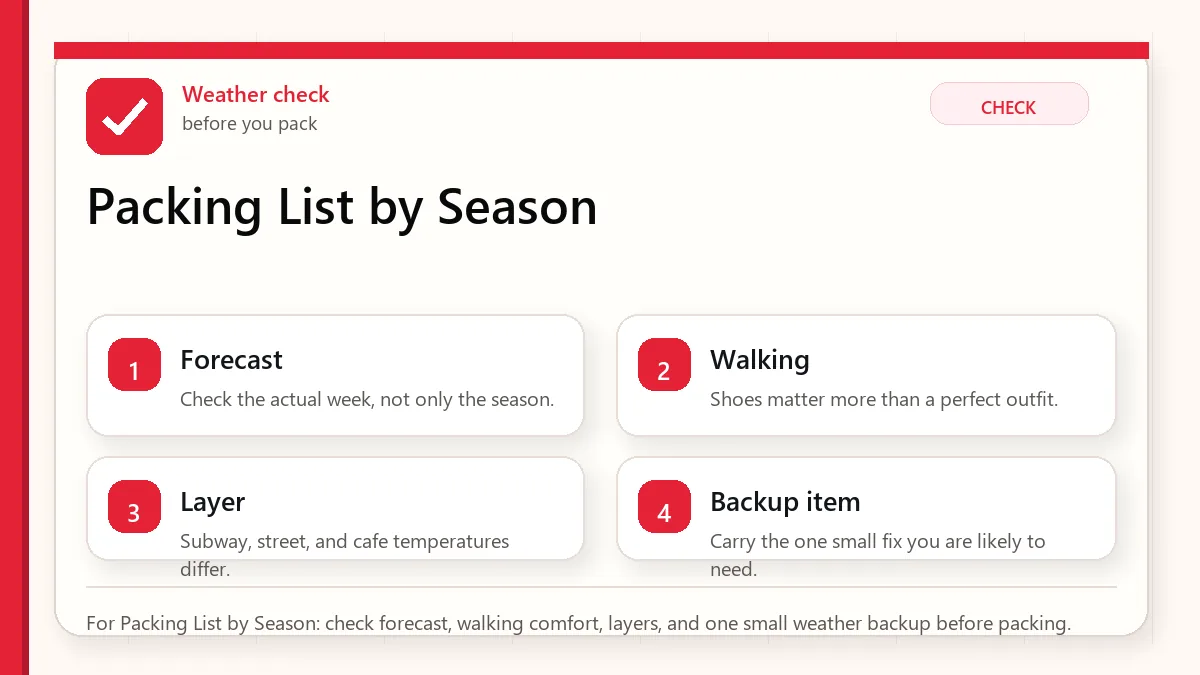
    Layered red check decision graphic for Packing List by Season.
    For Packing List by Season: check forecast, walking comfort, layers, and one small weather backup before packing.

    Start with the label and return risk

    Pack comfortable walking shoes, clean socks for shoes-off spaces, a Type C or Type F plug adapter for Korea’s 220V outlets, a small medicine kit after checking restrictions, a light rain layer for summer, warm windproof layers for winter, and extra luggage space if you plan to shop. Do not bring single-voltage high-heat appliances unless you know exactly what you are doing.

    Season packing table

    SeasonPackWatch out for
    SpringLight jacket, layers, comfortable shoes, allergy supplies.Temperature swings, crowded blossom weeks, dust days.
    SummerBreathable clothes, compact umbrella, quick-dry shoes, deodorant, sun protection.Humidity, heavy rain, slippery stairs.
    AutumnLight sweater, jacket, walking shoes, flexible layers.Warm afternoons and cool nights.
    WinterThermal layers, windproof coat, gloves, warm socks, grippy shoes.Dry cold, wind chill, icy hills.

    Shoes are the most important item

    Korea trips can become 15,000 to 25,000 step days quickly. Subway stations are deep, neighborhoods are hilly, palace grounds are wide, and shopping districts encourage long wandering. Bring shoes you have already tested. For general city travel, supportive sneakers are better than stiff boots or new fashion shoes. If you will visit traditional restaurants, temples, hanok stays, or guesthouses, shoes that slip on and off easily are more convenient.

    Power adapters and voltage

    Korea uses 220V electricity and round-pin Type C or Type F style outlets. Most modern phone, laptop, camera, and tablet chargers support 100-240V and only need a plug adapter. Many hair dryers, curling irons, and high-heat appliances from 110V countries are not safe unless they are dual voltage. Check the label before packing. A multi-port USB-C charger plus one good adapter is usually cleaner than carrying many small chargers.

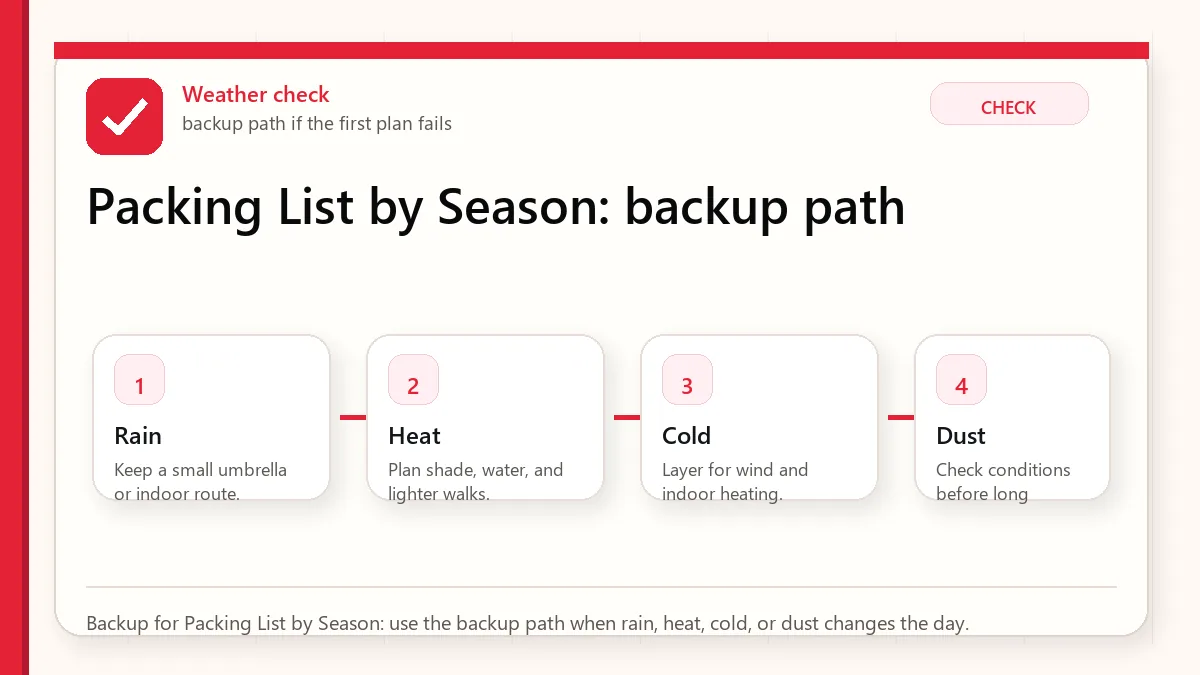
    Layered red check backup flow graphic for Packing List by Season.
    Backup for Packing List by Season: use the backup path when rain, heat, cold, or dust changes the day.

    Medicine and health packing

    Bring normal personal medicines in original packaging when possible, but do not assume every medication that is legal at home can enter Korea freely. Controlled medicines and some psychiatric, stimulant, opioid, or codeine-related medicines may require advance review or approval. Check official MFDS guidance before travel if your medicine is controlled, prescription-heavy, or unusual. Do not rely on social media comments for legal medicine rules.

    Rain, winter, and air quality

    Summer packing should account for humidity and sudden rain. A compact umbrella is easy to buy in Korea, but quick-dry clothing and shoes are harder to improvise mid-trip. Winter packing should focus on windproof warmth, not only a thick coat. Spring can bring dust or air-quality discomfort, so travelers with respiratory sensitivity may want masks and medication they already use.

    Leave shopping space

    K-beauty, snacks, stationery, and small design goods are easy to accumulate. If shopping is part of the trip, pack less at the start. Liquids and full-size skincare need checked-luggage planning. Power banks and spare batteries need cabin-handling rules. The best Korea packing list protects both your feet and your return luggage.

    Pack for surfaces, not just temperature

    Korea packing advice often focuses on weather, but surfaces matter just as much. You may walk across palace gravel, wet subway tiles, steep side streets, basement restaurants, polished mall floors, and long station corridors on the same day. Shoes that look fine in photos can become a trip problem after two days. Prioritize cushioning, grip, and a fit that survives swelling after long walks.

    Clean socks deserve their own place on the list. Shoes-off restaurants, hanok stays, temples, guesthouses, fitting rooms, and some clinics can all make socks visible. In summer, carrying a spare pair can make the day more comfortable. In winter, warm socks help more than many visitors expect because cold pavement and station platforms drain heat quickly.

    Pack one small repair layer

    A compact kit with blister pads, pain relief you are allowed to bring, a few bandages, tissues, and a small reusable bag can rescue long sightseeing days. This is not overpacking. It is insurance against the small discomforts that make travelers waste time searching for a pharmacy or convenience store when they are tired.

    Official links to check

    Use these official links when the next step matters. This guide explains what to watch for, but app downloads, eligibility, prices, routes, policies, and service rules can change.

    FAQ

    Can I buy forgotten items in Korea?

    Yes. Convenience stores, Daiso, pharmacies, malls, and electronics shops are easy to find in major cities.

    Do I need special shoes for Korea?

    You need comfortable, already-tested walking shoes. Slip-on convenience is helpful but support matters more.

    Should I bring a hair dryer to Korea?

    Usually no. Many hotels provide one. Single-voltage 110V heat appliances can be unsafe on Korea’s 220V system.

    Related Before Korea guides

    Source links to verify

  • Korean Phrases for Tourists: What to Say in Restaurants, Taxis, Shops, and Awkward Moments

    Korean Phrases for Tourists: What to Say in Restaurants, Taxis, Shops, and Awkward Moments

    You do not need fluent Korean for a good trip. You need a small set of phrases that reduce friction at exactly the right moments: greeting staff, ordering food, asking for help, paying, showing a taxi destination, explaining an allergy, and recovering when you bump into someone or make a small mistake.

    Last checked: June 1, 2026. Re-check the official operator, app, fare, or route page before acting, because routes, prices, labels, rules, app screens, eligibility, and store/service policies can change.

    Last updated: May 24, 2026.

    Layered red check decision graphic for Phrases for What to.
    For Phrases for What to: check ordering flow, ingredients, portion, and payment before choosing the meal.

    Start with the pickup and payment fallback

    Start with annyeonghaseyo for hello, gamsahamnida for thank you, joesonghamnida for sorry, and juseyo for please give me. These four tools cover a surprising amount of tourist life. Use them with a calm voice, a small nod, and your phone ready for anything complicated.

    Core phrases

    KoreanRomanizationUse
    안녕하세요annyeonghaseyoHello, general polite greeting.
    감사합니다gamsahamnidaThank you.
    죄송합니다joesonghamnidaSorry, excuse me after a mistake.
    실례합니다sillyehamnidaExcuse me, when passing or asking attention politely.
    괜찮아요gwaenchanayoIt is okay, no problem.

    Restaurant phrases

    KoreanRomanizationMeaning
    저기요jeogiyoExcuse me, used to call staff.
    이거 주세요igeo juseyoThis one, please.
    물 좀 주세요mul jom juseyoWater, please.
    덜 맵게 해주세요deol maepge hae juseyoPlease make it less spicy.
    포장해 주세요pojanghae juseyoPlease make it to go.

    The easiest restaurant pattern is noun plus juseyo. Pointing at a menu photo and saying igeo juseyo is normal. If allergies matter, do not rely only on spoken Korean. Use a prepared allergy card with Korean text and show it before ordering.

    Layered red check backup flow graphic for Phrases for What to.
    Backup for Phrases for What to: use the backup path when the menu, allergy question, spice level, or staff flow is unclear.

    Taxi, shopping, and payment phrases

    KoreanRomanizationUse
    여기로 가 주세요yeogiro ga juseyoPlease go here.
    카드 돼요?kadeu dwaeyo?Do you take card?
    영수증 주세요yeongsujeung juseyoReceipt, please.
    얼마예요?eolmayeyo?How much is it?
    괜찮습니다gwaenchanseumnidaNo thank you, or it is okay.

    Help and emergency phrases

    For real emergencies, call the relevant emergency number or ask nearby staff for help. For ordinary travel confusion, short phrases work better than long speeches. Dowajuseyo means please help me. Yeongeo haseyo? asks whether someone speaks English. If the situation is complicated, open your translation app and show a clear sentence.

    Pronunciation habits that help

    Do not worry about perfect pronunciation. Speak slowly, do not over-stretch vowels, and avoid shouting English words with Korean endings. Many Korean service workers understand context quickly if you point, show the address, or display a photo. The phrase is only one part of communication; the visual cue often does the rest.

    Use phrases as keys, not speeches

    Tourist Korean works best when it is short. A long translated paragraph can overwhelm a busy cashier or server, especially if the translation app makes the sentence too formal or strange. Use a phrase to open the interaction, then support it with pointing, a photo, a saved address, or a translated note. For example, in a taxi, yeogiro ga juseyo plus a Korean address is stronger than trying to explain the whole route out loud.

    For restaurants, learn patterns rather than isolated words. Igeo juseyo means this, please. Mul jom juseyo means water, please. Yeongsujeung juseyo means receipt, please. Once you understand that juseyo turns a thing into a polite request, you can use menus, photos, and gestures with more confidence.

    When not to rely on spoken phrases

    Do not rely only on pronunciation for allergies, medicine, legal issues, hotel addresses, or emergency details. Use written Korean for anything where accuracy matters. Save your hotel address in Hangul. Prepare allergy text before the meal. Keep your passport name and booking name consistent. Phrases are for everyday friction; written text is for precision.

    FAQ

    Is romanized Korean enough for tourists?

    Yes for basic phrases, but save important addresses and allergy text in Hangul too.

    Should I learn honorific grammar before visiting Korea?

    No. Use standard polite phrases and keep requests simple.

    What is the most useful Korean word for tourists?

    Juseyo is one of the most useful because it turns menu items, objects, and requests into polite tourist language.

    Related Before Korea guides

    Source links to verify

  • Korea Shirt Size Guide for Foreigners: Korean to US, Free Size, and XXL

    Korea Shirt Size Guide for Foreigners: Korean to US, Free Size, and XXL

    If you are searching for Korea shirt size, do not start with S, M, L, or one Korean-to-US conversion chart. Start with centimeters: shoulder width, chest width, total length, and sleeve length. Korean shirt labels such as 95, 100, 105, free size, or XXL are useful only after you compare the actual garment measurements with a shirt you already own.

    Last checked: June 2, 2026. Brand size charts, product labels, return rules, and stock can change. Re-check the product page or store label before buying.

    Checklist graphic for korea shirt size in Korea.
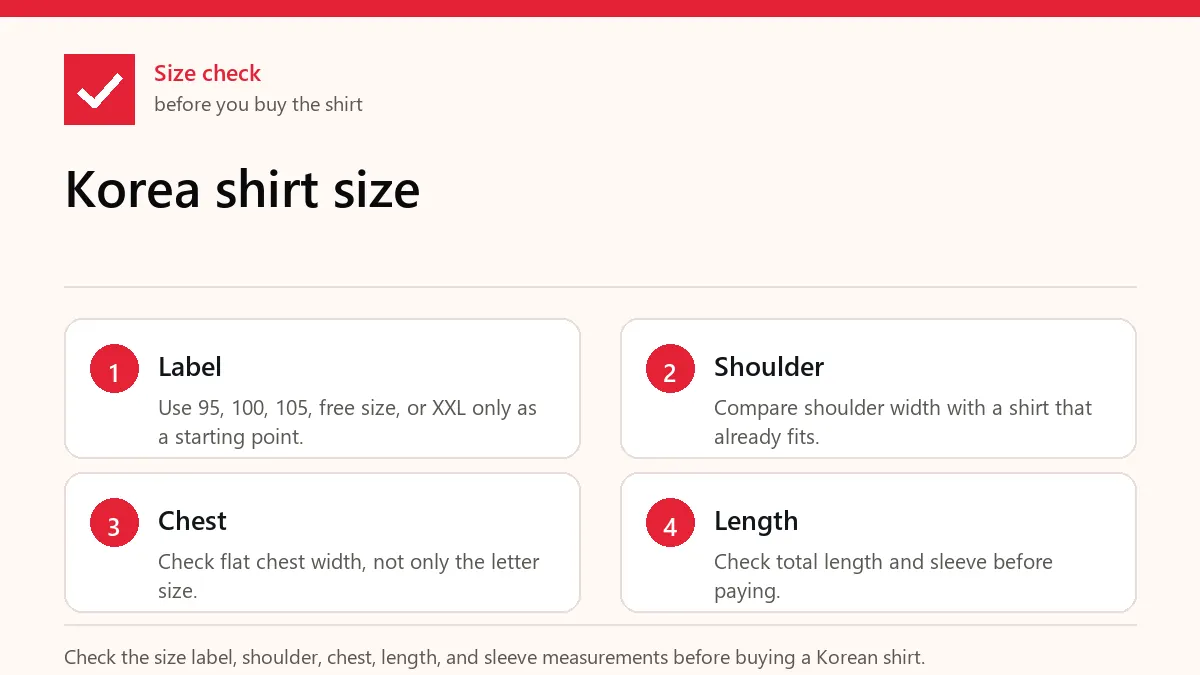
    Check the size label, shoulder, chest, length, and sleeve measurements before buying a Korean shirt.

    The short answer

    A Korean shirt size 100 is often treated as a men’s medium starting point, and 105 is often treated as a large starting point, but this is not a guarantee. Slim shirts, oversized streetwear, women’s free-size tops, and boutique items can all break the simple conversion. The safe question is not “What is my Korean size?” It is “Does this shirt’s centimeter chart match a shirt that already fits me?”

    What the search usually means

    Search phrase What the visitor probably needs Best answer
    korea shirt size A quick way to understand 95, 100, 105, free size, and XXL. Use the label as a starting point, then check shoulder, chest, length, and sleeve in cm.
    korean size to us A conversion before buying online or in Seoul. Compare against your own shirt measurements, not only your US letter size.
    korean xxl size Whether Korean XXL equals overseas XXL. Do not assume it does. Check the actual chest and shoulder measurements first.
    korean clothing size A broader clothing-size guide. Use this shirt guide for tops, then read the broader clothing-size guide for pants, shoes, and free size.

    How Korean men’s shirt numbers usually work

    Men’s tops in Korea often show numbers such as 95, 100, 105, 110, or 115. Many shoppers read these like a rough chest-size scale, but stores do not cut every shirt the same way. A slim dress shirt in 100 can feel tighter than a relaxed sweatshirt in 100. A streetwear shirt can be intentionally wide while still using a familiar number.

    Korean label Rough starting point Do not buy until you check
    95 Often around small to slim medium. Shoulder width and chest width. This is where tight shoulders surprise visitors.
    100 Often around medium. Whether the fit is slim, regular, or oversized.
    105 Often around large. Total length and sleeve length, especially if you are tall.
    110 Often around XL in many local charts. Chest width, shoulder width, and whether the store actually stocks it.
    115 or above May be harder to find in small boutiques. Stock, return policy, and whether it is true plus sizing or just a loose style.

    Free size is not one size fits all

    “Free size” is one of the easiest Korean shopping terms to misunderstand. It usually means the item is sold in one size, not that it fits every body. A free-size T-shirt may be roomy. A free-size blouse with no stretch may be narrow at the bust or shoulder. A free-size cardigan may depend almost entirely on sleeve length and how you want it to drape.

    If the store gives model information, read it carefully. Model height, weight, and the way the shirt is styled can help, but it is still not enough. The actual flat measurements are more useful than a model photo.

    The measurement method that actually works

    Before you shop, measure one shirt you already like. Lay it flat. Do not stretch it. Measure the same parts Korean shopping pages usually list.

    Measurement Korean word often used Why it matters
    Shoulder width 어깨 This decides whether the shirt feels tight even if the chest looks fine.
    Chest or bust width 가슴 This is usually measured flat across the front, not around the body.
    Total length 총장 Tall visitors often notice shirts are shorter than expected.
    Sleeve length 소매 Long-sleeve shirts and jackets can fail here even when the body fits.
    Hem width 밑단 Important for cropped tops, boxy shirts, and layered outfits.

    Important detail: many Korean product pages list flat measurements. If the chest width says 54 cm, that usually means the garment is 54 cm across when laid flat, not a 54 cm body chest. Compare flat-to-flat with your own shirt.

    How to use a Korean size chart without guessing

    Use this simple order when a product page has a size chart:

    1. Find the exact size chart for that product, not a general brand chart.
    2. Check whether the measurements are flat garment measurements.
    3. Compare shoulder width first if you often have fit problems there.
    4. Compare chest or bust width next.
    5. Check total length and sleeve length if you are tall, broad, or between sizes.
    6. Read the fabric information. Stretchy knit, woven cotton, and structured jacket fabric fit differently.
    7. Check the return rule before paying, especially for sale items, markets, boutiques, and overseas shipping.

    XXL and larger sizes in Korea

    If you usually buy XL, XXL, tall, big, or plus sizes outside Korea, be more careful with Korean shirt shopping. Some Korean brands now sell wider oversized fits, but that does not always mean the item is graded like international plus sizing. Oversized fashion can be wide in the body and still short in length or narrow in the shoulder.

    For visitors, the safest plan is to search for actual centimeters and store return rules before you fall in love with the design. If a shop does not show measurements and you cannot try it on, treat the purchase as higher risk.

    In-store shopping: what to check before paying

    When you shop in Seoul, Busan, or another Korean city, the fastest safe move is to ask whether trying on tops is allowed. Some stores allow fitting for shirts, some limit fitting for delicate items, and some market shops may have stricter return policies. Do not assume you can return a shirt just because it does not fit.

    • Check the label inside the shirt, not only the hanger tag.
    • Ask about exchange or refund before payment if fit is uncertain.
    • Keep the receipt and tag attached until you are sure.
    • For white, delicate, or sale items, confirm the rule before trying or buying.
    • If the store is crowded, take a photo of the size label and decide outside the line.

    Online shopping: what can go wrong

    Online shopping is where Korea shirt size mistakes happen most often. The photo may show a loose fit because the model is slim, short, or wearing a larger size. The title may say oversized, but the shoulder or length may still not work for your body. A translation app may turn size-chart words into strange English, so check the Korean terms and numbers yourself.

    Risk What it looks like Better move
    Model-photo trap The shirt looks loose in photos, but the model is much smaller than you. Use measurements, not the photo mood.
    Free-size trap Only one size is sold and no flat measurements are shown. Avoid expensive blind purchases unless returns are clear.
    Oversized trap Wide chest, but short sleeves or short total length. Check length and sleeve, not only width.
    Return trap Sale, personal-import, tag-removed, or hygiene-related limits. Read return conditions before ordering.

    A simple buying rule

    If the shirt is cheap, easy to try on, and not important, a rough label may be enough. If the shirt is expensive, hard to return, bought online, or meant to fit precisely, do not buy from the Korean label alone. Use centimeter measurements and a return plan.

    Backup path graphic for korea shirt size in Korea.
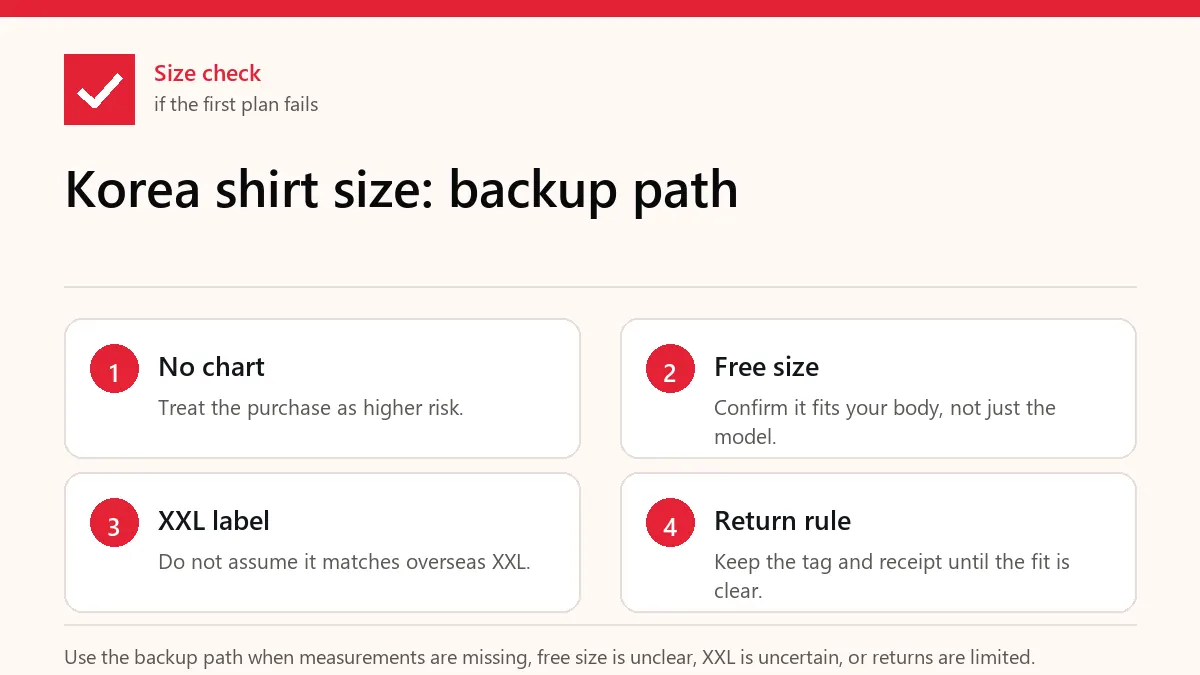
    Use the backup path when measurements are missing, free size is unclear, XXL is uncertain, or returns are limited.

    FAQ

    What is Korean shirt size 100 in US size?

    It is often a medium starting point for men’s shirts, but it is not a guaranteed US medium. Check the actual shoulder, chest, length, and sleeve measurements.

    Is Korean XXL smaller than US XXL?

    It can be. Some Korean XXL items may feel smaller than overseas XXL, while oversized fashion pieces may feel wide but short. The measurement chart matters more than the label.

    What does free size mean in Korean clothing?

    It means the item is sold in one size. It does not mean it fits every body. Always check flat measurements, fabric stretch, and model information.

    Do Korean shirts run small?

    Some slim and boutique shirts do. Some streetwear and casual shirts are intentionally oversized. The better rule is to check the fit type and measurements instead of relying on the stereotype.

    What Korean words should I know on a shirt size chart?

    Look for 어깨 (shoulder), 가슴 (chest or bust), 총장 (total length), 소매 (sleeve), and 밑단 (hem). Compare these with a shirt you own.

    Related Before Korea guides

    Sources and verification notes

    There is no single official conversion chart that can guarantee the fit of every Korean shirt brand. Use official body-measurement resources as background, then rely on the product’s own centimeter chart before buying.

    Last checked: June 2, 2026. Re-check the product page, store label, and return policy before buying because brand sizing and store rules can change.

  • Tipping in Korea: What Tourists Should Actually Do in Restaurants, Taxis, Hotels, and Tours

    Tipping in Korea: What Tourists Should Actually Do in Restaurants, Taxis, Hotels, and Tours

    Tipping in Korea is one of the easiest rules for tourists to misunderstand. In many countries, tipping is a kindness or a social duty. In Korea, the normal rule is different: pay the listed price and say thank you. Leaving extra cash can confuse staff, make them think you forgot change, or create an awkward moment that neither side wanted.

    Last checked: June 1, 2026. Re-check the official operator, app, fare, or route page before acting, because routes, prices, labels, rules, app screens, eligibility, and store/service policies can change.

    Last updated: May 24, 2026.

    Layered red check decision graphic for Tipping in What Should.
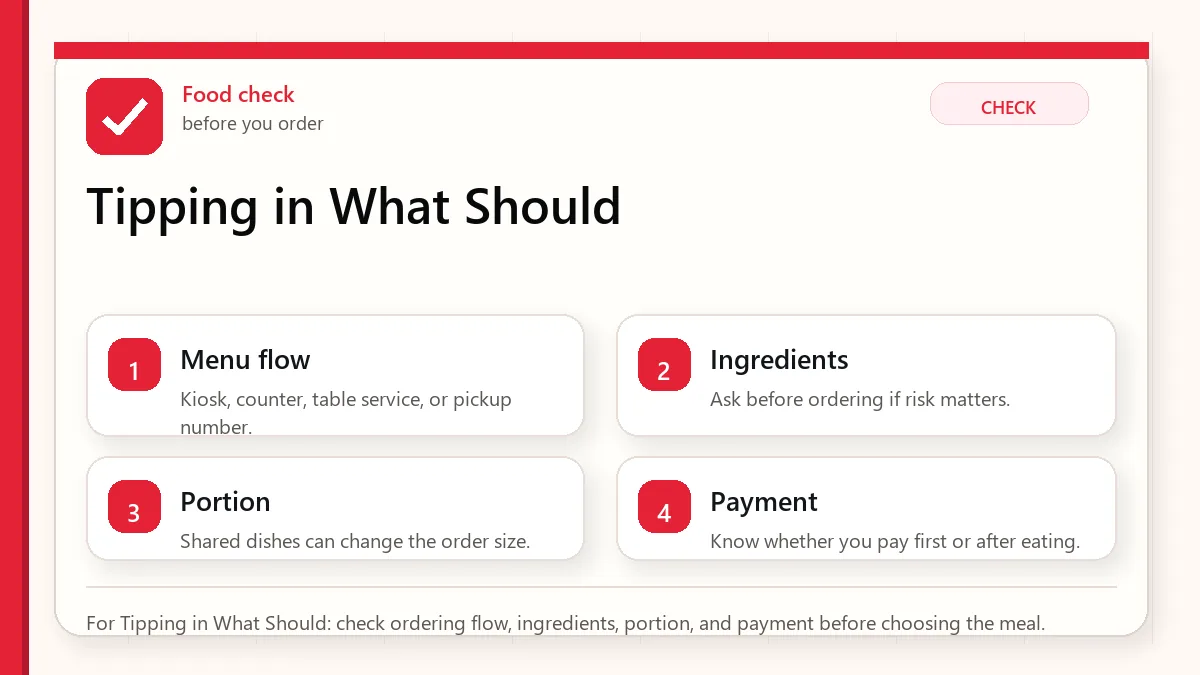
    For Tipping in What Should: check ordering flow, ingredients, portion, and payment before choosing the meal.

    Start with the pickup and payment fallback

    You generally do not tip in Korea. Do not tip at ordinary restaurants, cafes, taxis, salons, convenience stores, delivery situations, or casual services. For private tour guides, private drivers, high-end hotel luggage help, or a dedicated private-room server, a small discreet thank-you may be optional, but it should never feel required. If someone refuses, accept the refusal gracefully.

    Tipping by situation

    ServiceShould tourists tip?What to do instead
    Standard restaurantNo.Pay at the counter or kiosk and say thank you.
    CafeNo.Order clearly, return tray if required.
    TaxiNo.Pay the fare. Rounding small cash change is optional but not expected.
    HotelUsually no.Say thank you. Luxury luggage help can be a rare exception.
    Private guide or driverOptional in tourist-facing service.Use an envelope or discreet handover at the end.
    Salon or spaNo by default.Pay the listed price.

    Why no tipping feels normal in Korea

    Korean service culture is built around clear prices and professional roles. Good service is not treated as a separate add-on that customers must calculate at the end. That does not mean service workers are not appreciated. It means appreciation is usually expressed through polite words, smooth payment, and not creating extra confusion for staff during a busy shift.

    What can go wrong if you tip casually

    If you leave cash on a restaurant table, staff may chase after you to return it. If you hand loose money to someone who does not expect it, the gesture can feel uncomfortable rather than generous. If a tip jar appears in a tourist-heavy shop, you still should not assume tipping is expected everywhere. The safest visitor rule is simple: no tip unless the setting is clearly a private tourist service where gratuity is explicitly optional.

    Layered red check backup flow graphic for Tipping in What Should.
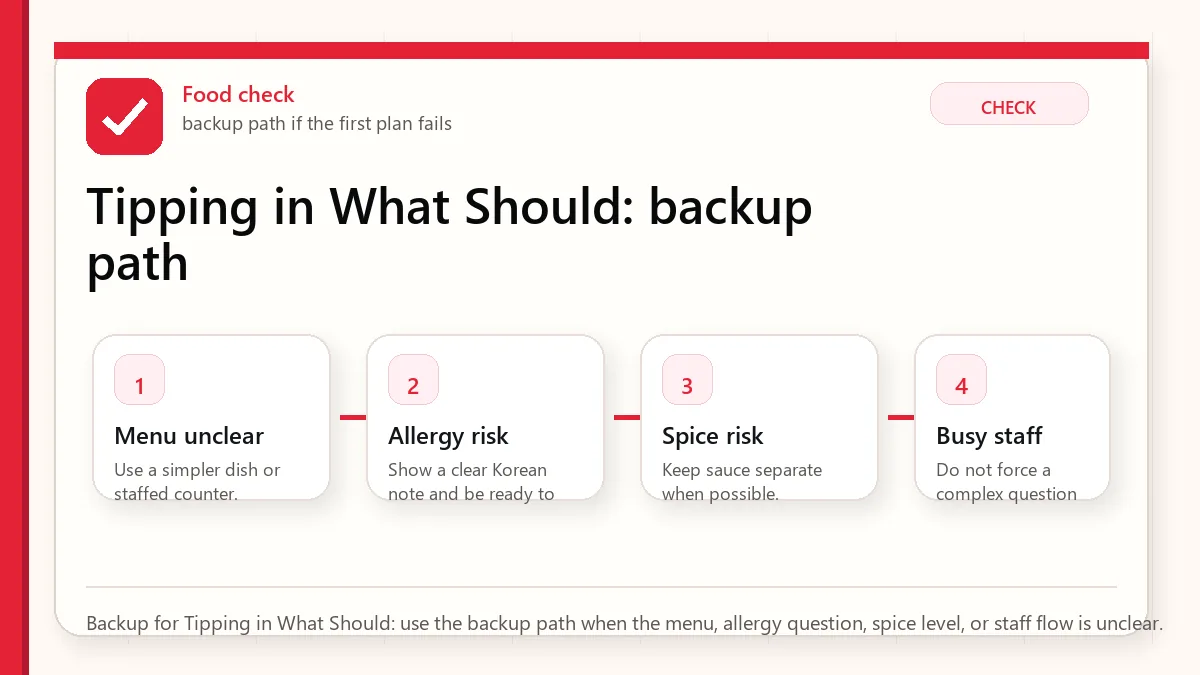
    Backup for Tipping in What Should: use the backup path when the menu, allergy question, spice level, or staff flow is unclear.

    How to show appreciation instead

    Use a clear thank you: gamsahamnida. Hand cards, cash, passports, receipts, or small items with two hands when it feels natural. Do not snap fingers, shout aggressively, or wave money. If staff helped you solve a hard problem, a sincere thank you and calm behavior usually mean more than trying to import a tipping ritual.

    If you choose to tip a private guide

    For a private guide, private driver, or highly personalized tourist-facing service, a small tip can be understood. Present it quietly at the end. A clean envelope is more graceful than loose bills. Use both hands. If the person hesitates or refuses, do not insist. Smile, say thank you, and stop. Pressuring someone to accept a tip makes the gesture about you, not them.

    Why tourists feel uncertain

    Tipping confusion often comes from mixed travel environments. A hotel may feel international, a tour guide may work mostly with foreigners, a restaurant may look upscale, and a taxi driver may help with luggage. Visitors then wonder whether Korean rules or international tourist rules apply. The safest answer is to start from the Korean baseline: no tip. Then only consider an exception if the service is private, personalized, and clearly outside an ordinary transaction.

    This is especially important in restaurants. A nice meal, attentive staff, or extra banchan does not create a tipping obligation. The listed price is the expected price. In fact, trying to force a tip can create more work for staff because they may need to return it or explain that it is not needed.

    Private service exceptions

    Private guides and drivers are the main gray area because they often operate inside international tourism norms. Even there, tipping should stay optional and discreet. Do not tip at the beginning as if buying better behavior. If you choose to offer something, do it at the end, privately, with a short thank you. A written review, punctuality, and clear communication can be just as valuable.

    FAQ

    Do you tip in Korean restaurants?

    No. Pay the listed price and do not leave cash on the table.

    Do taxi drivers in Korea expect tips?

    No. Pay the metered or app fare. Small cash rounding can happen, but it is not expected.

    What if a Korean worker refuses my tip?

    Accept it immediately. Say thank you and do not try to persuade them.

    Related Before Korea guides

    Source links to verify

  • Korea Subway Etiquette for Tourists: Priority Seats, Luggage, Lines, and Bus Transfers

    Korea Subway Etiquette for Tourists: Priority Seats, Luggage, Lines, and Bus Transfers

    Korea subway etiquette is not complicated, but it is easy to feel clumsy on your first ride. Stations are large, cars can be crowded, transfers may involve long walks, and everyone around you seems to know exactly where to stand. The tourist version is simple: keep the flow moving, keep sound low, manage your bag, and treat priority areas seriously.

    Last checked: June 1, 2026. Re-check the official operator, app, fare, or route page before acting, because routes, prices, labels, rules, app screens, eligibility, and store/service policies can change.

    Last updated: May 24, 2026.

    Layered red check decision graphic for Subway Etiquette for Priority.
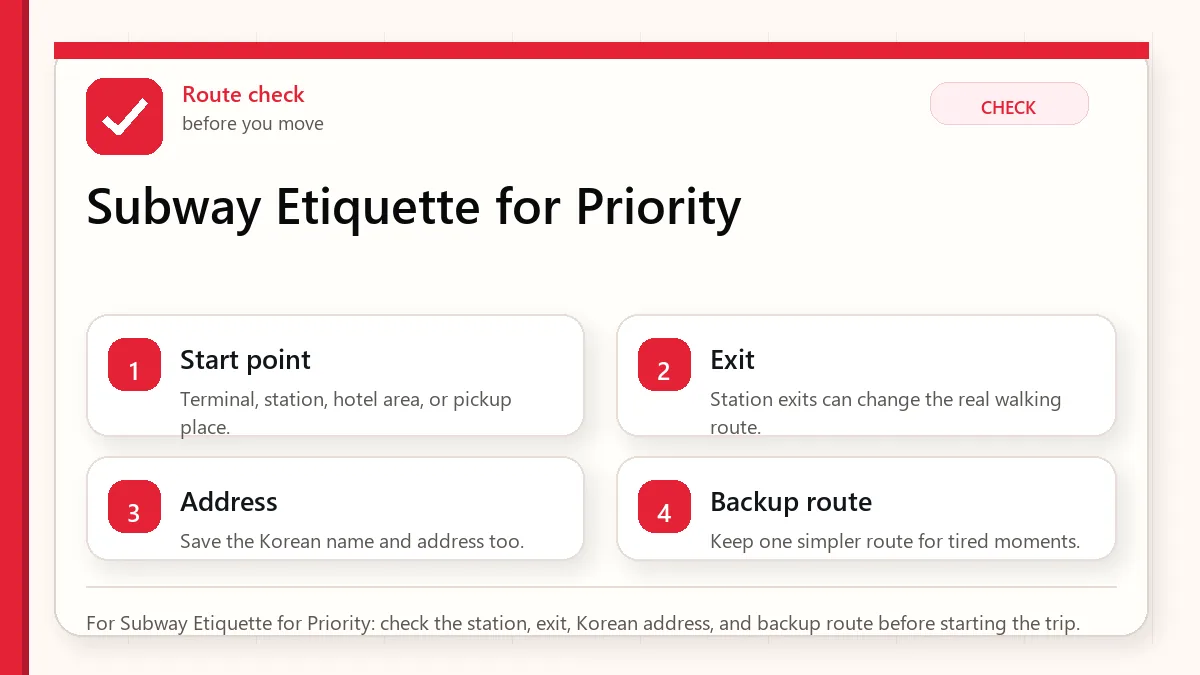
    For Subway Etiquette for Priority: check the station, exit, Korean address, and backup route before starting the trip.

    Start with the route you will actually take

    Stand to the side of the train doors, let people exit first, line up where platform markings indicate, avoid long phone calls, keep backpacks in front or low when crowded, and do not sit in priority seats unless you genuinely need them. On buses, tap your transportation card when boarding and again when getting off if you want transfer discounts to work properly.

    Subway behavior visitors should know

    SituationWhat to doWhat to avoid
    Platform doorsWait beside the door path.Standing directly in front of exiting passengers.
    Inside the trainMove inward when space opens.Stopping at the doorway with luggage.
    Phone useText, map, or use quiet audio.Long speakerphone calls or loud video sound.
    Priority seatsLeave them for elderly, pregnant, injured, or disabled riders.Using them as empty tourist seats.
    LuggageHold it close, use elevators when needed.Dragging bags across feet or blocking stairs.

    Priority seats and pregnant women seats

    Korean subway cars usually have priority seating areas for elderly, disabled, pregnant, injured, or otherwise mobility-limited passengers. Some cars also have marked pregnant women seats. Tourists should be conservative here. Even if the train is not full, do not treat these seats as normal open seating unless you personally need them. If you accidentally sit there, stand up calmly when you notice.

    Luggage etiquette

    Luggage is not rude by itself. It becomes a problem when it blocks doors, stairs, escalator landings, or narrow transfer paths. If you arrive with large suitcases, avoid rush hours when possible and consider airport buses, taxis, luggage delivery, or a route with fewer transfers. Inside a train, keep bags close to your body and do not let them roll into other passengers.

    Layered red check backup flow graphic for Subway Etiquette for Priority.
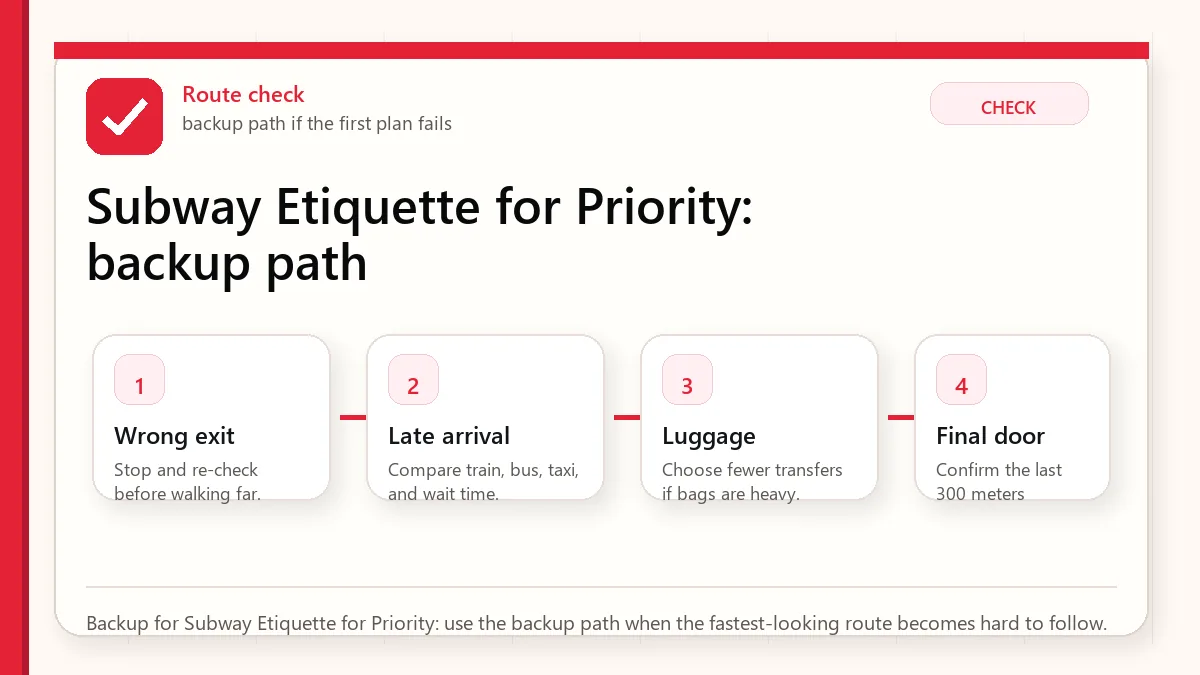
    Backup for Subway Etiquette for Priority: use the backup path when the fastest-looking route becomes hard to follow.

    Bus etiquette and tapping out

    On many Seoul buses, you board near the front and exit near the rear. Tap your transit card when boarding. Tap again when getting off, especially if you are transferring. This matters for fare calculation and transfer recognition. Press the stop bell before your stop, prepare to move toward the exit, and avoid standing in the stairwell or doorway until you need to leave.

    Food, drinks, and smell

    The subway is not the place for a full meal. A sealed water bottle is usually fine, but open food, strong smells, and spill-risk drinks are inconsiderate in crowded transit. Seoul has also published rules about items that can be refused on city buses, especially uncovered takeout drinks or foods that may spill or smell. When in doubt, finish it before boarding.

    Escalators, stairs, and station flow

    Station movement can be fast. Do not stop at the top or bottom of escalators to check your map. Step aside first. If you need an elevator, follow signs early rather than trying to force a suitcase through stairs at the last moment. Some escalator walking norms are changing for safety, so the safest tourist habit is to stand carefully, hold the handrail, and avoid rushing around people.

    Rush hour changes the rules

    During quiet hours, tourists have more room to look around, check signs, and learn the system. During rush hour, the social expectation changes: move with the flow and reduce friction. Avoid standing in the middle of transfer corridors, do not stop immediately after gates, and keep bags tight against your body. If you have a large suitcase, a route that is fine at 2 p.m. can be miserable at 8:30 a.m.

    Families and groups should agree on a station exit before boarding. If someone gets separated, do not block the train door trying to regroup. Get off at the next station or meet at a clear exit. Seoul stations can have many exits, and the wrong exit can add steep stairs or a long walk.

    How to use transit without looking lost

    Save your destination, exit number, and transfer station before entering the busiest part of the station. Hold your card or phone ready before the gate. If a gate rejects your card, step out of the line and solve it at a machine or counter. This keeps everyone behind you moving and gives you room to think.

    Official links to check

    Use these official links when the next step matters. This guide explains what to watch for, but app downloads, eligibility, prices, routes, policies, and service rules can change.

    FAQ

    Can tourists sit in Korea subway priority seats?

    If you genuinely need the seat, yes. If you do not, avoid it even when it is empty.

    Do I need to tap out on Korean buses?

    Yes, make it a habit. Tapping out helps transfer discounts and proper fare handling.

    Is luggage allowed on the Seoul subway?

    Yes, but plan routes carefully and avoid peak commute hours if you have large bags.

    Related Before Korea guides

    Source links to verify

  • What Not to Do in Korea as a Tourist: Mistakes That Actually Matter

    What Not to Do in Korea as a Tourist: Mistakes That Actually Matter

    “What not to do in Korea” can sound dramatic, but most mistakes are ordinary travel mistakes: choosing the wrong airport route, blocking a subway door, relying on one payment method, assuming Google Maps will answer every question, or treating a shoes-off space like a regular room. Korea is not hard to visit, but it rewards visitors who prepare for local systems before arrival.

    Last checked: June 1, 2026. Re-check the official or primary source page before acting, because routes, prices, labels, rules, app screens, eligibility, and store/service policies can change.

    Last updated: May 24, 2026.

    Layered red check decision graphic for What Not to Do.
    For What Not to Do: check context, space, timing, and tone before acting in shared places.

    Start with the situation, not a rule list

    Do not treat Korea as a country where every familiar travel habit will work automatically. Do not rely on one card, one map app, one airport route, one pair of fashion shoes, or one translation method. Do not be loud on transit, do not sit in priority seats casually, do not step into clean indoor spaces with outdoor shoes, do not leave tips on restaurant tables, and do not photograph strangers without care.

    Mistakes by type

    Mistake typeExampleBetter move
    LogisticsChoosing AREX Express only because it is fastest on paper.Choose by hotel area, transfers, luggage, and arrival time.
    PaymentArriving with only one phone wallet.Carry two cards and a small KRW cash buffer.
    Transit etiquetteStanding in the doorway while checking a route.Step aside first, then check your phone.
    Restaurant flowWaiting forever for staff to bring the bill.Look for counter payment or use the table call button.
    Cultural spaceWalking into a temple hall with shoes or a loud voice.Pause, observe, and follow posted rules.

    Do not confuse inconvenience with disrespect

    Some problems are not cultural mistakes at all. A foreign card failing at a kiosk, a delivery app asking for a Korean phone number, or a subway transfer feeling difficult with luggage are system-friction problems. Treat them practically. Move to a staffed counter, use a backup payment method, save Korean addresses, and build extra time into arrival day.

    Do not overpack your schedule

    First-time Korea itineraries often look reasonable on a map and exhausting in real life. Subway exits can be far apart. Cafes may have waits. Popular streets can be crowded. Palace, market, shopping, dinner, and nightlife in one day may leave you tired before the best part begins. The better approach is one anchor area in the morning, one flexible neighborhood in the afternoon, and a simple dinner plan near your route.

    Layered red check backup flow graphic for What Not to Do.
    Backup for What Not to Do: use the backup path when you are unsure of the local flow.

    Do not rely on one app

    Install more than one tool before arrival. Naver Map or KakaoMap can be stronger for local places and transit. Papago is useful for menus and signs. Your hotel booking app holds the address. A taxi or ride app can help late at night. Google Maps is still useful for orientation, but it should not be your only Korea navigation plan.

    Do not make tipping awkward

    Korea is generally a no-tipping country. Leaving cash on a restaurant table can make staff think you forgot your money. For ordinary restaurants, taxis, cafes, salons, and delivery, pay the listed price and say thank you. Private tours or luxury services can be different, but they are exceptions, not the rule.

    Do not photograph people as background props

    Korea is extremely photogenic, especially around markets, cafes, palaces, and shopping streets. That does not mean every staff member, child, older resident, or stranger in hanbok is part of your content. Shoot wider scenes, wait for a clear moment, or ask permission when a person is the subject. Be extra careful inside small shops, restaurants, and religious spaces.

    What is serious versus simply awkward

    Not every mistake has the same weight. Sitting briefly in the wrong seat, using the wrong restaurant door, or mispronouncing a phrase is usually just awkward. Smoking in prohibited areas, ignoring safety barriers, filming people closely without permission, or bringing restricted medicine without checking rules can be much more serious. Separate social discomfort from legal or safety risk so you do not worry about the wrong things.

    For most first-time visitors, the highest-impact mistakes are practical rather than cultural. A failed card can stop dinner. A bad airport route can ruin arrival night. A wrong hotel area can add an hour of travel every day. A medicine rule you did not check can become an airport problem. Handle those first, then refine your etiquette.

    The traveler’s recovery script

    If something goes wrong, use a simple sequence: stop doing the thing, step aside, apologize briefly, and follow the corrected flow. You rarely need a long explanation. In a restaurant, show the menu item. In a subway station, move away from the gate. In a shop, use the payment method staff points to. Calm recovery is part of good etiquette.

    FAQ

    What is the biggest first-time Korea mistake?

    Trying to solve every trip problem after landing. Payment, maps, hotel area, airport route, and phone setup should be prepared before departure.

    Are Koreans offended easily by tourists?

    No. Most small mistakes are fine if you notice, apologize, and adjust. Loud, careless, or repeated behavior is the real issue.

    Should I avoid Korea if I do not speak Korean?

    No. Learn a few phrases, install translation tools, and keep addresses saved in Korean where possible.

    Related Before Korea guides

    Source links to verify

  • Korea Etiquette for Tourists Before Visiting: What Actually Matters

    Korea Etiquette for Tourists Before Visiting: What Actually Matters

    Korea etiquette for tourists is not about memorizing a long list of cultural rules. Most visitors only need to understand a few everyday patterns: public spaces are shared quietly, shoes come off in certain clean indoor spaces, restaurants often expect customers to be more active, tipping is not the default, and small mistakes are usually recoverable if you stay calm and polite.

    Last checked: June 1, 2026. Re-check the official or primary source page before acting, because routes, prices, labels, rules, app screens, eligibility, and store/service policies can change.

    Last updated: May 24, 2026.

    Layered red check decision graphic for Etiquette for Visiting What.
    For Etiquette for Visiting What: check context, space, timing, and tone before acting in shared places.

    Start with the situation, not a rule list

    If you are visiting Korea for the first time, focus on five habits: keep your voice low on transit, let people exit before boarding, remove shoes when the floor or doorway clearly signals it, pay at the front counter when the restaurant flow points that way, and use simple polite phrases such as annyeonghaseyo, gamsahamnida, and joesonghamnida. These habits matter more than trying to perform every formal custom perfectly.

    The etiquette that matters most

    SituationGood tourist habitWhy it matters
    Subway and busQuiet voice, organized bag, clear boarding line.Transit is a dense shared space.
    Shoes-off spacesPause at the entrance and copy the local flow.Clean floor culture is still practical in homes, hanok stays, temples, and some restaurants.
    RestaurantsUse the call button, self-serve water when indicated, pay at the counter.Korean service is efficient and less table-interruptive.
    CafesOne drink per seated person, no outside food, return tray if required.Many cafes are small, high-turnover businesses.
    PhotosAvoid photographing strangers, staff, children, and private interiors without permission.Privacy matters even in photogenic spaces.

    Shoes-off etiquette

    The simplest rule is visual: if you see a lower entry area, shoe shelves, slippers, or other people removing shoes, stop and remove yours. Do not step onto the raised clean floor with outdoor shoes. Keep socks trip-ready, especially in summer, because bare feet can feel awkward in semi-public traditional spaces. If bathroom slippers are provided in a guesthouse or traditional stay, use them only inside the bathroom and do not walk back into the room wearing them.

    Public space etiquette

    Korean public life can be fast and crowded, but the expected sound level is often lower than visitors expect. On the subway, avoid long phone calls and loud group conversations. In cafes, restaurants, and hotel lobbies, match the room rather than your travel excitement. On sidewalks and station corridors, step aside before checking your phone or map. The mistake is not being foreign. The mistake is blocking a flow that everyone else is trying to use.

    Layered red check backup flow graphic for Etiquette for Visiting What.
    Backup for Etiquette for Visiting What: use the backup path when you are unsure of the local flow.

    Restaurant and cafe etiquette

    Many restaurants do not use the same service rhythm as Western restaurants. Staff may not check on you repeatedly. Look for a call button on the table, a utensil drawer, a water station, and a front counter for payment. If there is no button, raise a hand and say jeogiyo or yeogiyo. In cafes, the one-drink-per-person expectation is common when you sit down. Return trays and sort waste when the cafe has a visible return station.

    Temples, palaces, and traditional areas

    At temples, lower your voice, avoid running, follow photo restrictions, and remove shoes before entering halls when required. Palaces are more open and visitor-friendly, but they are still cultural spaces. Do not climb on walls, block narrow photo spots for a long time, or treat hanbok rental as permission to ignore staff directions. A small amount of restraint makes these places better for everyone.

    How to recover from a mistake

    Tourists make mistakes. The best recovery is short and plain: stop, step back, say sorry, and adjust. A small bow and joesonghamnida work better than a long explanation. Do not turn an etiquette correction into a debate. Most awkward moments disappear quickly when you respond lightly and move on.

    The difference between etiquette and performance

    A useful Korea etiquette guide should not make visitors feel they need to act like locals. Tourists are not expected to understand every age-based or social nuance. What people notice more is whether you are paying attention. Do you lower your voice when the train is quiet? Do you move out of the doorway before checking your phone? Do you notice shoes at the entrance before stepping inside? These small signals matter because they show that you are reading the space rather than treating every place as a tourist stage.

    Do not overperform etiquette either. Deep bows, exaggerated Korean phrases, or nervous apologies after every small interaction can feel unnatural. A calm greeting, a clear request, and a simple thank you are enough in most shops, cafes, hotels, and restaurants. The best visitor behavior is relaxed but observant.

    How to judge a new situation

    When you are unsure, pause for three seconds and watch the local flow. Where do people queue? Are they returning trays? Are they removing shoes? Are they paying first or after eating? Are they taking photos freely or keeping phones away? This “watch first” habit solves more problems than memorizing a long etiquette list. It also keeps your trip from feeling tense.

    FAQ

    Do tourists need to bow in Korea?

    A small nod or slight bow is enough for most tourist situations. You do not need formal deep bows.

    Is Korea strict about etiquette?

    Daily life is more flexible than etiquette lists suggest. Shared-space behavior matters more than perfect cultural performance.

    Can I speak English in Korea?

    Yes, but do not assume every staff member is comfortable in English. Use simple phrases, translation apps, and patience.

    Related Before Korea guides

    Source links to verify

  • What to Buy in Korea Without Wasting Luggage Space: Beauty, Snacks, Fashion, Daiso, Tax Refund, and Authenticity

    What to Buy in Korea Without Wasting Luggage Space: Beauty, Snacks, Fashion, Daiso, Tax Refund, and Authenticity

    The best things to buy in Korea are not “everything Korean.” The best buys are light, useful, sealed, easy to authenticate, and realistically packable: mainstream K-beauty from trusted channels, tea and snack gifts, local fashion accessories, stationery, Daiso organizers, and selected official electronics accessories. The worst buys are bulky, fragile, fake, overhyped, liquid-heavy, or cheaper only because you stopped comparing.

    Last checked: June 1, 2026. Re-check the official provider, store, customs, or payment page before acting, because routes, prices, labels, rules, app screens, eligibility, and store/service policies can change.

    Last updated: May 24, 2026.

    Layered red check decision graphic for What to Buy in.
    For What to Buy in: check the payment method, cash backup, receipt, and refund step before relying on one option.

    Start with the package in your hand

    Buy K-beauty from Olive Young or official brand channels, sealed snacks and tea from reputable stores, Korean stationery from known shops, practical Daiso travel goods, and local fashion only from official stores or reputable retailers. Compare duty-free with local sale prices, keep tax-refund goods new and documented, and do not buy anything you cannot pack, authenticate, or legally bring home.

    Best buys by category

    CategoryGood buyWhere to buyRisk
    K-beautySkincare basics, sunscreen, lip tints, masks.Olive Young, department stores, official brand stores.Overbuying or buying unsuitable products.
    Snacks and teaSealed tea sets, almonds, shelf-stable sweets.Brand stores, department food halls, supermarkets.Liquids, expiry, customs rules at home.
    FashionLocal bags, basics, accessories from official channels.Brand stores, department stores, major platforms.Counterfeits and poor return options.
    StationeryPens, notebooks, planners, design goods.Monami, Hottracks, Artbox, museum shops.Low risk, but easy to buy too much.
    DaisoTravel pouches, organizers, socks, laundry items.Daiso stores.Utility items only; avoid mission-critical electronics.
    Electronics accessoriesOfficial cases, earbuds, certified chargers.Samsung, Apple-authorized, department or official retail.Unsafe or uncertified accessories.
    Layered red check backup flow graphic for What to Buy in.
    Backup for What to Buy in: use the backup path when a card, ATM, kiosk, or refund step does not work.

    Duty-free is not always cheaper

    Duty-free shopping is convenient for selected prestige beauty or international brands, but it is not automatically the cheapest channel. Some Korean local brands may be cheaper on the domestic official site or in store, especially during promotions. Duty-free also changes the pickup flow: you may need passport, flight details, and airport pickup time. Compare before assuming.

    Tax refund should not drive bad buying

    Tax refund is useful when you already planned to buy eligible goods from a participating store. It should not make you buy bulky cookware, unsuitable skincare, or duplicate souvenirs. Keep receipts, passport information, and goods new if you want the refund. Remember that duty-free goods are already tax-exempt and do not get a separate local VAT refund.

    Luggage rules change the shopping list

    Carry-on travelers should be very careful with full-size skincare, liquid food gifts, perfumes, and duty-free liquids. Power banks and spare batteries need cabin handling and airline rules. Heavy cookware, ceramics, and fragile homeware only make sense if you have checked-bag space and a plan to protect them.

    Counterfeit and authenticity rules

    Traditional markets are excellent for browsing, food, crafts, accessories, and practical goods. They are not where you should trust “luxury” claims. For brand-name fashion, premium headphones, cosmetics, skincare, and electronics, use official stores, department stores, authorized retailers, or clearly reputable channels. If a price looks impossible, treat that as information.

    Use the exit test

    Before buying, ask four questions: will I still use this after the trip, can I pack it safely, can I authenticate it, and is Korea actually a better place to buy it? If the answer is weak, the item is probably a travel mood purchase rather than a good buy. There is nothing wrong with a small emotional souvenir, but a shopping guide should protect your luggage and money, not encourage random hauling.

    This is especially important for beauty products. Korea is excellent for skincare discovery, but new products are not automatically good for your skin. Buy one or two items from categories you already understand, and avoid building an entire routine from products you have never tested. For gifts, sealed masks, lip products, hand creams, tea, snacks, stationery, and small design goods are usually safer than bulky or skin-sensitive items.

    Tax refund, duty-free, and home price are different comparisons

    Tourists often compare only the Korean shelf price. A better comparison includes promotion price, tax refund eligibility, duty-free price, baggage restrictions, currency conversion, credit-card foreign transaction fees, and the price at home. Duty-free can be excellent for some items, but city stores may win during promotions. Tax refund helps, but only after the product is already worth buying.

    Keep receipts organized by store and do not pack refund-related goods in a way that makes inspection impossible if you are asked to show them. Also separate Korean tax refund from your destination country’s import rules. Buying in Korea does not remove your responsibility when you return home.

    What to skip without regret

    Skip fake luxury, suspiciously cheap electronics, skincare with unclear ingredients, fragile ceramics without packing space, heavy sauces if you have no checked luggage, large duplicate snack boxes, and anything you are buying only because a short-form video made it look mandatory. The best Korea haul is not the largest one. It is the one you can explain, carry, use, and recommend without embarrassment.

    Official links to check

    Use these official links when the next step matters. This guide explains what to watch for, but app downloads, eligibility, prices, routes, policies, and service rules can change.

    FAQ

    What should I not buy in Korea?

    Avoid fake luxury, unknown chargers, bulky goods without checked luggage, skincare that does not fit your skin, and liquids you cannot carry.

    Is Olive Young always the best place for K-beauty?

    It is one of the easiest and most reliable mass-market channels, but compare official brand stores and department counters for premium products.

    Should I shop duty-free or in the city?

    Compare item by item. Duty-free can win, but local sale pricing and tax refund can sometimes be better for Korean brands.

    Related Before Korea guides

    Source links to verify

  • Korean BBQ Costs, Portions, Cuts, and Allergy Questions for First-Time Visitors

    Korean BBQ Costs, Portions, Cuts, and Allergy Questions for First-Time Visitors

    Korean BBQ is not just “grilled meat at the table.” For a first-time visitor, it is a system: meat ordered by serving weight, shared side dishes, wraps, dips, stews, noodles, rice, staff or self-grilling patterns, and a bill that can change quickly if you order premium beef or alcohol without noticing portion size.

    Last checked: June 1, 2026. Re-check the latest product label, restaurant information, and official/public database before acting, because routes, prices, labels, rules, app screens, eligibility, and store/service policies can change.

    Last updated: May 24, 2026.

    Layered red check decision graphic for BBQ Costs Portions Cuts.
    For BBQ Costs Portions Cuts: check the exact label, local sticker, date, size or ingredient detail, and proof needed for this product.

    Start with the risk you need staff to understand

    For pork BBQ, start with about one serving per adult, then add more after you see the actual tray. For premium beef or Hanwoo, start more cautiously because servings can be smaller and much more expensive. If you need gluten or allergy caution, favor plain unseasoned meat, salt, and clear staff confirmation; marinades, soy sauce, ssamjang, broths, and shared grills can create risk.

    Price bands to expect

    BBQ typeTypical feelingBudget warning
    All-you-can-eat pork or mixed meatBest for appetite and simple value.Quality and time rules vary by chain.
    Standard pork a la carteMost first-time friendly.Order one round first, then add.
    Jeju black porkMore destination-style and often pricier.Do not compare it directly to budget samgyeopsal.
    Premium Hanwoo or beefSmaller portions, richer cuts, higher bill.Check price per serving or per 100g before ordering.
    Layered red check backup flow graphic for BBQ Costs Portions Cuts.
    Backup for BBQ Costs Portions Cuts: use the backup path when the label, translation, size, or product claim is not clear enough.

    Portion strategy

    Many pork restaurants use serving units around the size of a single adult starting order. Premium beef often uses smaller serving weights, so the same number of plates may not feed the same number of people. Do not order the whole table at once. Start with the house recommendation, watch how filling it feels, then add another cut or finishing dish.

    Cuts visitors see often

    • Samgyeopsal: pork belly, fatty and classic.
    • Moksal: pork neck or shoulder, more balanced.
    • Hangjeongsal: rich pork special cut with a chewy-fatty texture.
    • Chadolbagi: thin beef brisket, quick-cooking.
    • Galbi or galbisal: rib or boneless rib, often pricier and sometimes marinated.
    • Hanwoo beef: premium Korean beef category where price rises fast.

    Staff grilling vs self-grilling

    If staff start cutting and turning the meat, let them handle the first round. Premium or curated restaurants often care about timing. If staff leave the tools to you, self-grill calmly, turn meat before it burns, and keep raw-meat tongs separate from eating utensils when possible.

    Gluten and allergy questions

    Korean BBQ can look simple, but hidden ingredients matter. Soy sauce often contains wheat. Ssamjang may contain soybean paste, chili paste, wheat, or other ingredients. Marinades are often soy-based. Shared grills and tongs can create cross-contact. If you need a lower-risk order, ask for plain unseasoned meat and use salt or plain sesame oil with salt only if ingredients are safe for you.

    Read the menu before choosing a table rhythm

    Korean BBQ feels casual, but the menu has structure. Look for the cut, the serving weight, whether there is a minimum order, whether the item is pork or beef, whether it is marinated, and whether side dishes, stew, rice, or noodles are included or separate. A table that orders too much at the beginning may feel pressured to finish, while a table that orders too little may keep interrupting the meal to call staff back.

    The safest first round is often one familiar cut and one house-recommended cut, then rice, stew, or noodles later if the group is still hungry. Premium beef should be treated more carefully because the price can climb quickly and the serving size may be smaller than visitors expect. Pork BBQ is usually the easier first Korean BBQ experience because the value and portion logic are more forgiving.

    A first-order template

    For two adults, start with the restaurant’s basic pork set or two servings of a classic cut, then add after seeing the portion. For a mixed group, avoid ordering the spiciest or most heavily marinated item first. If the restaurant specializes in one cut, follow the specialty unless someone has a dietary restriction. If staff grill, watch their timing and do not move pieces constantly unless they indicate you should take over.

    Finishing dishes matter. Naengmyeon, fried rice, doenjang jjigae, or rice can make the meal feel complete without adding another expensive meat round. Alcohol can also shift the bill. If budget matters, separate the meat plan from the drink plan before ordering.

    Allergy and cross-contact reality

    Plain grilled meat may look safe, but the table environment is shared. Marinades, soybean paste, chili paste, sesame oil blends, side dishes, tongs, scissors, grill surfaces, and soups can create cross-contact. If an allergy is serious, choose a simpler restaurant, avoid marinades, use written allergy language, and be prepared to leave if staff cannot clearly confirm.

    FAQ

    Can I eat Korean BBQ alone?

    Sometimes. Some restaurants allow solo diners or lunch sets; others expect two or more servings. Check before sitting.

    Is Korean BBQ all-you-can-eat?

    Some restaurants are AYCE, many are not. Check whether you are ordering a fixed buffet or individual servings.

    Do I tip at Korean BBQ?

    Tipping is generally not expected in Korea. Pay the bill as presented unless the restaurant has a special service rule.

    Related Before Korea guides

    Source links to verify